Background: Road traffic accidents are a major cause of unhappiness, disability and death globally, with an inordinate number occurring in developing countries. Aims: To assess the frequency, characteristics of studied samples with RTA and to identify the outcomes of admission to emergency units during the period of this study. Method: A retrospective cross-sectional study was carried out in all the hospitals which are containing the Emergency department. All the road traffic injuries registering from 1st January 2015 to end of December 2019 were taken irrespective of the place of accident. Total patients registered were approximately 988226 in this time period. Semi-structured questionnaire was used to study socio-demographic variables, site of injury and various risk factors related to RTAs. Results: Our finding found that the majority of cases 61.2% were in the age groups 26-35 years old followed by 27.3% in the 36 to 45 years and the least frequency 1.8% in the ages less than 15 years old. The male cases 59.2% were more than female cases 40.8%. The majority of them had no job. The highest frequency 38.4 %of them had head injury followed by 37.2% had chest and abdomen injury. Conclusion: We concluded that the majority of RTA patients were in the age 26-35 years old. The higher percentage of RTA patients occurs during 2019. The rate of RTA injuries was higher during 2015 and 2019. Majority of them are alive and most of them had permanent disability. There is a significant association has been found between the site of injury and year at the p. value less than 0.05. Recommendation: We need further research on this field to decrease the mortality and morbidity among people with RTA injuries in emergency department.
Traffic accidents are one of the most important causes of death for young people and most of these accidents happen due to human neglect of traffic rules by drivers or pedestrians and their causes include excessive speeding or exceeding the speed limit or using the phone to talk or exchange messages and browse social media by the driver or Pedestrians and the failure of the driver and pedestrians to follow traffic lights contributes to a significant increase in traffic accidents [1-3]. Also, most drivers drive their cars despite feeling sleepy or tired or drive cars while under the influence of medication that causes drowsiness, lack of focus or hallucinations and despite medical and security warnings, most drivers ignore this, exposing their lives and the lives of others to certain danger [4,5]. Every year, approximately 1.25 million people are killed as a result of traffic accidents. Between 20 million and 50 million more people are not fatal and many are disabled as a result [6]. Low and middle-income countries witness 90% of road traffic deaths in the world, although they only have about 45% of the vehicles in the world [7]. Road traffic injuries cause significant economic losses to individuals, their families and to entire countries [8]. These losses arise from the cost of treatment and lost productivity for people who die or become disabled due to their injuries and for family members who have to miss work or school to care for the injured [9,10]. From this point, the aimed of this study to assess the frequency, characteristics of studied samples with RTA and to identify the outcomes of admission to emergency units during the period of this study.
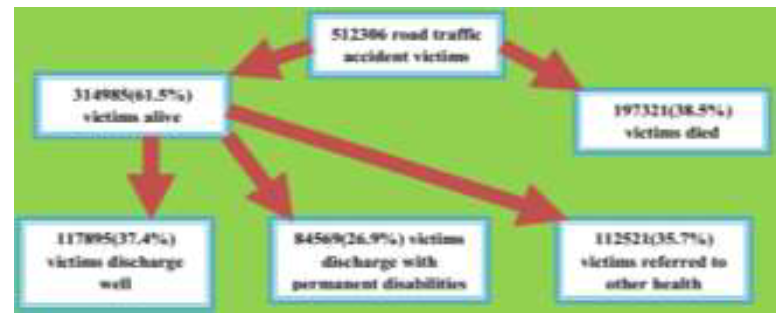
A retrospective cross-sectional study was carried out in all the hospitals which are containing the Emergency department from eighteen governorates in Iraq. All the road traffic injuries registering from 1st January 2015 to end of December 2019 were taken irrespective of the place of accident. Total patients registered were approximately 988226 in this time period. Out of which number of total road traffic injuries were 512306, among them 117895 RTA patients discharged well from hospitals; 112521 RTA patients were referred to other health departments and 84569 RTA patients were discharge with permanent disability. Cases not documented in records and containing the blank fields were excluded from this study. For the purpose of the study, case definition of RTA was, an event that occurs on a way or street open to public traffic; resulting in one or more persons being injured or killed, where at least one moving vehicle is involved.
Semi-structured questionnaire was used to study socio-demographic variables, site of injury and various risk factors related to RTAs. The data was entered in excel sheet and results were expressed as frequency and percentages, chi-square and p. value by using the STATA version 16 to analysis this data.
Out of 512306 cases of RTA, the majority of cases 61.2% were in the age groups 26-35 years old, followed by 27.3% in the 36 to 45 years and the least frequency 1.8% in the ages less than 15 years old. The male cases 59.2% were more than female cases 40.8%. The majority of them had no job see (Table 1).
Table 1: Characteristics of patients with RTA admitted to emergency department
Variables | Frequency | Percent |
Age groups | ||
<15 year | 9443 | 1.8 |
16-25 | 29537 | 5.8 |
26-35 | 313469 | 61.2 |
36-45 | 139970 | 27.3 |
>45 | 19887 | 3.9 |
Gender | ||
Male | 303110 | 59.2 |
Female | 209196 | 40.8 |
Occupation | ||
Employed | 112106 | 21.9 |
Unemployed | 388806 | 75.8 |
Student | 9610 | 1.9 |
Others | 1784 | 0.4 |
The highest frequency of cases 21.3, 20.6, 20.1 occur during 2019, 2018 and 2017, respectively (Table 2).
Table 2: Distribution of studied samples by year
Years | Frequency | Percent |
2015 | 101991 | 19.9 |
2016 | 92551 | 18.1 |
2017 | 102728 | 20.1 |
2018 | 105655 | 20.6 |
2019 | 109381 | 21.3 |
Total | 512306 | 100 |
The highest frequency 38.4 %of them had head injury followed by 37.2% had chest and abdomen injury. Also, 3.8 % of them had spine injury and 3% had pelvic injury (Table 3).
Table 3: Distribution of studied sample according to site of injury by year
| Year | Site of injury | Total | ||||
Musculoskeletal | Head | Chest and abdomen | Pelvic | spine | ||
F. % | F. % | F. % | F. % | F. % | F. % | |
2015 | 17752 17.4 | 46016 45.1 | 31421 30.8 | 2872 2.8 | 3930 3.9 | 101991 100 |
2016 | 16231 17.5 | 33027 35.7 | 37310 40.3 | 1821 2.0 | 4162 4.5 | 92551 100 |
2017 | 14998 14.6 | 40317 39.2 | 42167 41.1 | 3215 3.1 | 2031 2.0 | 102728 100 |
2018 | 19102 18.1 | 39298 37.2 | 38002 36.0 | 4251 4.0 | 5002 4.7 | 105655 100 |
2019 | 22121 20.2 | 38271 35.0 | 41862 38.3 | 3001 2.7 | 4126 3.8 | 109381 100 |
Total | 90204 17.6 | 196929 38.4 | 190762 37.2 | 15160 3.0 | 19251 3.8 | 512306 100 |
The p-value is<0.00001. The result is significant at p<0.05.
There is a significant association has been found between the site of injury and year at the p value less than 0.05.
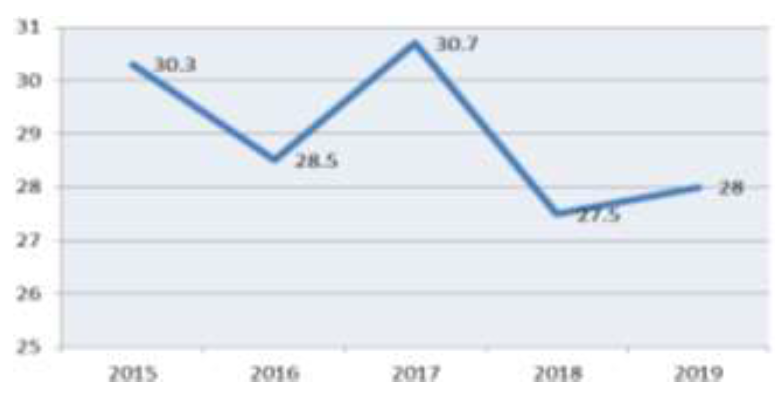
The rate of RTA injury was higher 30.7, 30.3 during 2017 and 2015(Figure 1).

Figure 1: Rate of RTA injuries among patients in emergency department during 2015 to 2019
61.5% of them were a live and 38.5% were died (Figure 2).

Figure 2: Flow chart showing the clinical outcome of RTA victims who visited emergency department during 2015-2019
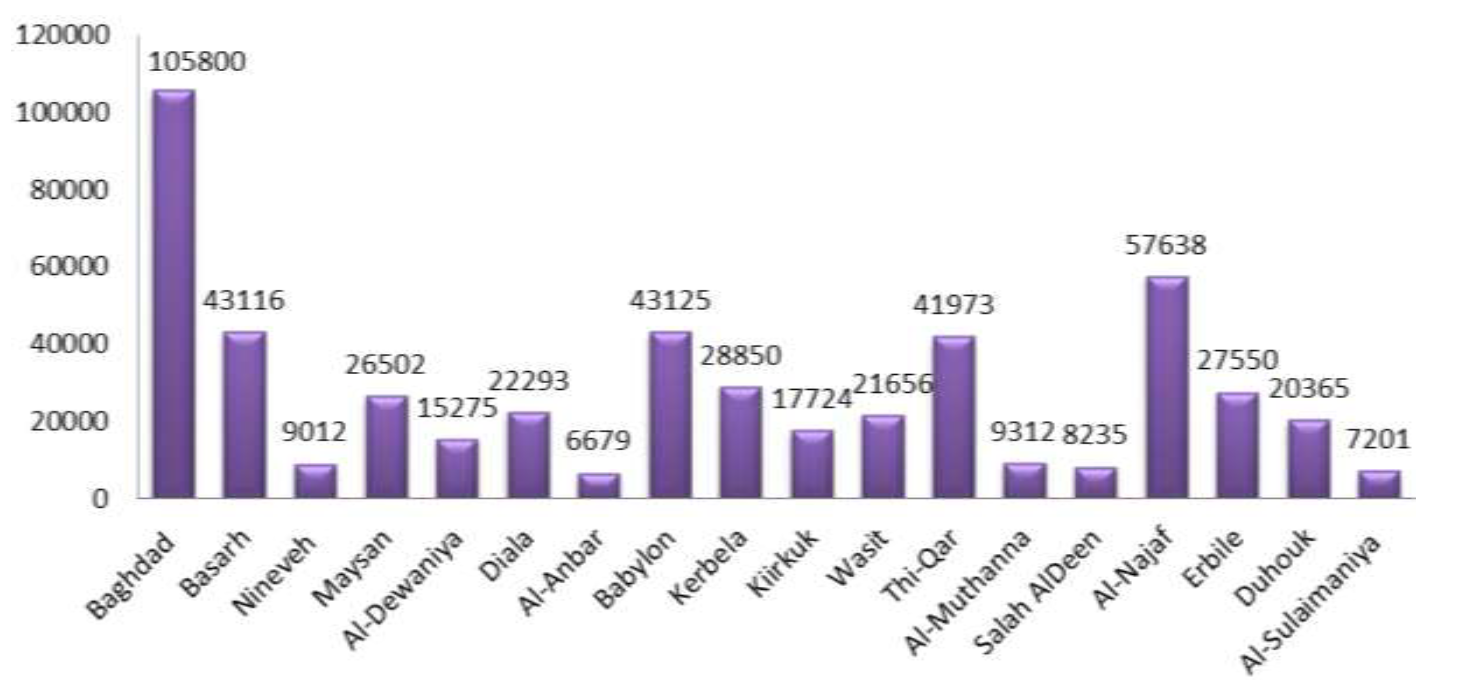
In Figure 3, we show that the frequency of RTA injuries 106025 were higher in Baghdad, followed by 57638 in Al-Najaf and 43125, 43116 in Babylon and Basarh, respectively.

Figure 3: Distribution of RTA injuries among patients in Emergency unit according to Health Directorates during 2015 to 2019
Our study aimed to assess the frequency, characteristics of studied samples with RTA and to identify the outcomes of admission to emergency units during the period of this study. According to literature, the driver's age and gender are critical risk factors for RTAs and the severity of the RTA outcome [11,12]. In this study, we found the majority 61.2% of RTA patients were in the age groups 26-35 years old, followed by 27.3% in the 36 to 45 years and the least frequency of them 1.8% occur in the ages less than 15 years old. Compared with other studied in India, the authors reported the most cases occur in the age 25 to 35 years old [3,5,10]. Another study done it in Saudi Arabia, the investigators mentioned the RTA injuries occur in the age groups 15 to 25 years old [13]. This refers to the majority of countries are suffering from the same problems in spite of the religion and cultural.
The most common injury mechanisms in the male group were car and motorcycle accidents whereas females were mostly victims of falls and pedestrian accidents [14,15]. As age increased, a shift from transportation-related to unintentionally caused injuries occurred. Overall, young men had their most severe injuries on head, whereas elderly women suffered more severe extremity injuries. Injury severity was similar between men and women [16]. In our study, we found the male cases 59.2% were more than female cases 40.8%. Compared with other studied done it in Tanzania [17,18] and in Kenya [19], they reported the RTA injuries among male was higher more than female cases. In fact, that, the men were used the motorcycles more compared to women and also that personal protective equipment is not used by them.
In our study, we found that the majority of RTA patients 75.8% had no job and compared with a similar study in Ethiopia [20,21], the majority of them had own job. This is due to the deterioration of the economic situation and the lack of job opportunities in the government sector, which led to the search for work in the private sector or to self-employment in which motorcycles are used as one of the means to deliver the goods. In addition, in this study we found that the highest frequency of RTA inpatients 109381,105655,102728 occur during 2019, 2018 and 2017, respectively. Another studied done it in Saudi [11] and in Ethiopia [21].
The RTA cases were higher rate during 2019 and 2020. This means that the problem is still present and the high rate of road accidents requires intense efforts to educate citizens about the dangers of using motorcycles, the risks of injury and their complications after an injury that leads to death or disability. In this study, we found the head/neck injuries were also more common and accounts for 38.4 % of RTA followed by 37.2% had chest and abdomen injuries. Compared with other study in India [15], the authors reported that the extremities (53.54%) and the maxillofacial injuries (19.31%) were the most common body region injured. Head/neck was also more common and accounts for (18.78%) cases. This difference is due to the type of motorcycle used, the severity of the collision and the speed used by the driver.
In our study, we found that the rate of RTA injuries was higher 30.7, 30.3 during 2017 and 2015. Other studied in Nigeria [22] and in Tanzania [23], the rate of RTA injuries among patients were higher during 2013 and 2012. Therefore, in this study we found 61.5% of RTA injuries among patients were a live and 38.5% of them were died. A studied I Bahrain [24] and in Turkey [25], the authors reported the majority of them had disability after injury. This is due to the same consequences of accidents and the extension of their impact on people's lives.
We concluded that the majority of RTA patients were in the age 26-35 years old. The male cases were more than female cases. Most of them were unemployed. The higher percentage of RTA patients occurs during 2019. The head, chest and abdomen are the most sites of injuries. The rate of RTA injuries was higher during 2015 and 2019. Majority of them are alive and most of them had permanent disability. The frequency of RTA patients was higher in Baghdad.
Recommendations
So let us all exert our double efforts to reduce traffic accidents, there is no need for speed and traffic violations, for your life and the lives of others are much more important than your time and comfort and always remember that your late arrival is better for you than never arriving or from paying the price of others for your arrival. Your life and health, preserve the life and health of your children, preserve the life and health of your loved ones, please do not break the rules and do not hurry, please do not be the reason for ending the lives of others.
Peden, M. et al. World Report on Road Traffic Injury Prevention. World Health Organization, 2004.
Gopalakrishnan, S. “A public health perspective of road traffic accidents.” Journal of Family Medicine and Primary Care, vol. 1, no. 2, 2012, pp. 144-150.
Jha, N. et al. “Epidemiological study of road traffic accident cases: a study from South India.” Indian Journal of Community Medicine, vol. 29, no. 1, 2004, pp. 20-24.
World Health Organization. Road Traffic Injuries: Key Facts. World Health Organization, 2015.
Kanchan, T. et al. “Age and gender variations in trend of road traffic fatalities in Manipal, India.” Medicine, Science and the Law, vol. 50, no. 4, 2010, pp. 192-196.
Hyder, A.A. et al. “Estimating the burden of road traffic injuries among children and adolescents in urban South Asia.” Health Policy, vol. 77, no. 2, 2006, pp. 129-139.
United Nations. Economic and Social Commission for Asia and the Pacific: Status Paper on Road Safety in India. 2010.
Mandal, B.K. et al. “Study of pattern of injuries in victims of fatal road traffic accidents in Nepal.” Indian Journal of Forensic Medicine & Toxicology, vol. 6, no. 2, 2012, pp. 29-33.
Razzak, J.A. et al. “Injuries among children in Karachi, Pakistan—what, where and how.” Public Health, vol. 118, no. 2, 2004, pp. 114-120.
Mohan, D. “Road accidents in India.” IATSS Research, vol. 33, no. 1, 2009, pp. 75-79.
Gorge, J. et al. “The age and gender distribution of patients admitted following nonfatal road traffic accidents in Riyadh: a cross-sectional study.” International Journal of Critical Illness and Injury Science, vol. 10, no. 2, 2020, pp. 76-80. https://doi.org/10.4103/IJCIIS.IJCIIS_16_19.
Al-Aamri, A.K. et al. “Disentangling age-gender interactions associated with risks of fatal and non-fatal road traffic injuries in the Sultanate of Oman.” BMJ Global Health, vol. 2, no. 3, 2017.
Ahmed, S. et al. “Frequency and nature of road traffic injuries: data of more than 10,000 patients from Ha’il, Saudi Arabia.” Cureus, vol. 11, no. 1, January 2019, e3830.
Fernando, D.M. et al. “Characteristics of road traffic accident casualties admitted to a tertiary care hospital in Sri Lanka.” Forensic Science, Medicine and Pathology, vol. 13, no. 1, 2017, pp. 44-51.
Singh, R. et al. “Pattern, severity and circumstances of injuries sustained in road traffic accidents: a tertiary care hospital-based study.” Indian Journal of Community Medicine, vol. 39, no. 1, 2014, pp. 30-34.
Ghaffar, A. et al. “The burden of road traffic injuries in developing countries: the 1st national injury survey of Pakistan.” Public Health, vol. 118, no. 3, 2004, pp. 211-217.
Museru, L.M. et al. “Road traffic accidents in Tanzania: a ten year epidemiological appraisal.” East and Central African Journal of Surgery, vol. 7, no. 1, 2002, pp. 23-26.
Boniface, R. et al. “Factors associated with road traffic injuries in Tanzania.” Pan African Medical Journal, vol. 23, 2016, pp. 46.
Sisimwo, P.K. et al. “Crash characteristics and injury patterns among commercial motorcycle users attending Kitale Level IV District Hospital, Kenya.” Pan African Medical Journal, vol. 19, 2014, pp. 296.
Seid, M. et al. “Injury characteristics and outcome of road traffic accident among victims at Adult Emergency Department of Tikur Anbessa Specialized Hospital, Addis Ababa, Ethiopia.” BMC Emergency Medicine, vol. 15, no. 1, 2015, pp. 10.
Baru, A. et al. “Injury severity levels and associated factors among road traffic collision victims referred to emergency departments of selected public hospitals in Addis Ababa, Ethiopia: the study based on the Haddon matrix.” BMC Emergency Medicine, vol. 19, no. 1, 2019, pp. 2.
Dongo, A.E. et al. “Motorcycle related injuries among rural dwellers in Irrua, Nigeria: characteristics and correlates.” Emergency Medicine International, 2013.
Chalya, P.L. et al. “Injury characteristics and outcome of road traffic crash victims at Bugando Medical Centre in Northwestern Tanzania.” Journal of Trauma Management & Outcomes, vol. 6, no. 1, 2012, pp. 1.
Hamza, A.Y. et al. “Road traffic accidents in Bahrain.” Bahrain Medical Bulletin, vol. 25, no. 3, 2003, pp. 105-110.
Durak, D. et al. “Road traffic collisions in Bursa, Turkey, during 2003, 2004 and 2005.” Injury, vol. 39, no. 5, 2008, pp. 547-553.