The research was conducted to analyze the role of E-commerce and digital marketing on the productivity of MSMEs in Pontianak City, West Kalimantan. The method used in this research is quantitative with regression analysis. The object of this research is MSME actors in Pontianak City with a total of 40 MSME actors as samples. The results of this research show that the E-commerce variable has a positive and significant effect on the productivity of MSMEs. The digital marketing variable has a positive and significant effect on MSME productivity.
Keywords
E-commerce
Digital Marketing
Productivity of MSMEs
INTRODUCTION
A country will never be separated from economic activities, including Indonesia. The country's economy is formed due to trading activities (buying and selling). This buying and selling transaction aims to fulfill all the needs of daily life, where goods produced by producers are then distributed by distributors until they finally reach the hands of consumers. One of the stakeholders most often involved in this activity is Micro, Small and Medium Enterprises (MSMEs). MSMEs are a form of business (enterprise) run by one or more individuals. MSMEs refer to a form of home or factory business on a relatively small scale [1].
In West Kalimantan, especially in Pontianak City itself, there are many MSME players. This is because Pontianak City is the center of government in West Kalimantan, so there are many business opportunities available and these businesses can easily grow and develop. This certainly has a positive impact on the economy in Pontianak City because the economic turnaround is so fast and good. The government's role is needed to increase the effectiveness of MSME actors. So that the number of existing MSMEs can continue to increase and be able to develop well so that the economy in Pontianak City can also increase and grow and there will be economic equality.
Current world conditions have entered the era of Industrial Revolution 4.0 where all forms of production activities that were initially carried out conventionally must switch to digital. There are many benefits to be gained from the Industrial Revolution 4.0, such as wide market reach, increased productivity, more organized cash flow and so on. For this reason, this can provide opportunities for MSME players to develop their businesses by utilizing digital platforms, especially related to marketing and buying and selling activities. The implication is that MSMEs have a fairly wide market reach nationally and even internationally.
Trulline [2] explained that most MSME players have used social media and e-commerce to market their products. MSME players feel an increase in daily sales after utilizing social media and e-commerce. This can happen because the reach that e-commerce and social media can achieve is so wide so that the number of consumers increases or becomes large. MSME players also use Instagram as social media and e-commerce platforms such as GoFood and GrabFood.
With the rapid development of technology, people are following the development of existing technology, because this technology makes it easy for its users. One of the technological advances in the business sector is E-commerce and Digital Marketing. Good use of technology by business actors will provide benefits to the business they run, one of which is increasing business productivity. So MSME players must also be able to utilize this technology in running their business.
Several studies have been explained to show that digitalization in MSMEs has a positive impact on business productivity through increased turnover that occurs due to the existence of online buying and selling platforms. This shows that technology has a positive impact on the growth and development of a business that has been run. There is a need to maximize the use of technology so that the benefits of the business being run can be maximized for the business being run. Therefore, this research aims to find out how much impact digital marketing and e-commerce have on business productivity.
LITERATURE REVIEW
Concept and Role of MSMEs
MSME is a term that refers to a business that is founded by a private person (individual) with net assets of a maximum of IDR 200 million (excluding land and buildings) (Nayla in Putri et al. [3]). Other definitions are clearly explained by Law Number 20 of 2008 as in Table 1.
MSMEs have a significant role in national economic development efforts. Apart from MSMEs playing an active role in economic growth, MSMEs also play an active role in distribution activities or distributing the results of development. MSMEs are expected to be able to make maximum use of all available resources, including the use of human resources (labor), which must be in the interests or needs of the people so that maximum economic growth can be achieved.
E-commerce
Electronic Commerce(E-commerce) is the activity of buying and selling goods and services, between a company, individual (private person), household, government community or other private organizations, where these activities are carried out via computers on internet network media [4]. With E-commerce, it is hoped that it can provide benefits to the business world which is full of competition [5]. Utilization of e-commerce is from implementation development technology and progress operational to promote products in all locations and segments which There is, Good physique digital, from level national to international [6].
There are several benefits provided by E-commerce, such as product marketing which will certainly be easier, consumers or buyers can buy the desired products through the E-commerce site which can be done anywhere and anytime, expanding market reach, the level of customer trust will be further increased and Returning defective products will be easy because all sales and purchase transaction data will be stored in the customer's purchase history [7].
Digital Marketing
American Marketing Association (AMA) in Sulaksono and Zakaria [8] explains that digital marketing is activities and processes supported by existing digital technology to present, discuss and communicate value to consumers and other stakeholders. Digital marketing can increase business productivity in ways that conventional marketing cannot. With digital marketing, customers get added value which will increase business revenue [9].
Digital Marketing Strategy includes:
Publish photos and videos about products on social media as often as possible
Making social media marketing product videos must be in real-time
Involving the role of consumers in product selection, providing knowledge and introduction about the quality of products on social media accounts
MSME players must remain open to current technology so that they continue to develop
MSME players need to improve product quality to increase customer trust and be able to communicate product quality effectively to customers
MSME players also need to improve the quality of services provided by adding services, such as home delivery orders, online shopping and so on
Customer Relationship Marketing. MSMEs must also maintain product quality and look after existing consumers, as well as build consumer satisfaction to retain them
Productivity
Productivity is a comparison of the value between the output value and the input value used. Nasution in
Table 1: Definition of Business According to Law Number 20 of 2008
Type of business
Definition
Micro business
Productive businesses are owned by individuals and/or individual business entities that meet the criteria for micro-businesses as regulated in this law.
Small business
Independent productive economic businesses carried out by people or business entities that are not subsidiaries or branches of businesses owned, controlled or directly or indirectly by regulated business entities, whether medium or large businesses that meet the criteria for small businesses in the law
Medium Business
Independent productive economic enterprises, carried out by individuals or business entities that are not subsidiaries or affiliates of companies owned, controlled directly or indirectly by the company, as well as small or large businesses that have a regulated total net worth or annual sales proceeds in law.
Big business
Productive economic businesses carried out by business entities with net assets or annual sales results greater than medium-sized businesses, which include state-owned or private national businesses, joint ventures and foreign businesses carrying out economic activities in Indonesia.
Source: BPS (Luthfi, 2023)
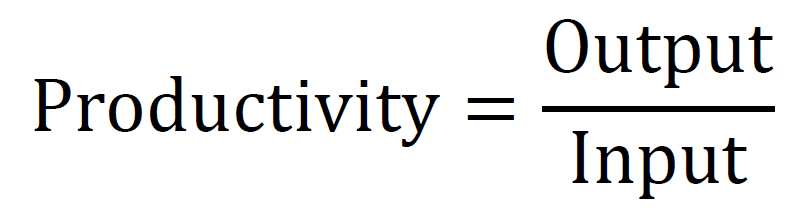
Turyandi [10] explains that productivity is a comparison of the value between output (results of activities) and all costs (sacrifice) incurred to achieve inputs (results). If productivity increases, it will increase employee income which will indirectly also increase people's purchasing power. The formula for productivity is as follows:
Output is the result desired by the customer, originating from input processing, in the quantity, type and time required. Output is calculated in various units, such as working hours, materials in kilograms, volume, money in currency units, machines in operating hours and methods outlined in work rules or Standard Operating Procedures (SOP). Before output is produced, input is processed using various methods and pathways that are implemented effectively and efficiently involving all parties in the organization to create value. Productivity can be increased by improving the quality of inputs or improving all processes to reduce waste [11].
Previous Research
Study Harto et al. [12] concluded that based on the results of a series of efforts to improve and implement changes to the business model by using digital marketing facilities and applications. Sanfresh MSMEs which have used-based applications have proven to make it easier for consumers to find Sanfresh in all online buying and selling applications. This has increased in the number of customers so Sanfresh has experienced rapid development in providing fresh and varied products with excellent and maintained quality.
Study Wijoyo and Widiyanti [13] shows that the Covid-19 pandemic is a big challenge for MSMEs to survive. Sales fell due to the widespread implementation of Community Activity Restrictions (PPKM). Digitalization of MSMEs is a solution when this policy is implemented. Digitalization changes the buying and selling model which was originally carried out directly (conventionally) to become digital. The presence of digitalization has made MSMEs able to survive during the pandemic because MSMEs achieved significant sales after digitalization.
Research conducted by Siagian [14] shows that E-commerce is the right solution to improving the economy of the Indonesian people so that economic equality can be implemented. This is because Indonesia is a potential country for developing e-commerce. E-commerce development can be applied to all MSME players spread throughout Indonesia. From this research, the results showed that the marketing effect of MSME respondents stated that they had received a good influence from the use of e-commerce and there was also a positive influence on the performance of MSMEs. E-commerce provides benefits to MSMEs by increasing sales compared to before the use of e-commerce. Many MSMEs are interested in applying e-commerce to their business. With this, it is hoped that Indonesia can develop e-commerce for the development and improvement of the country's economy.
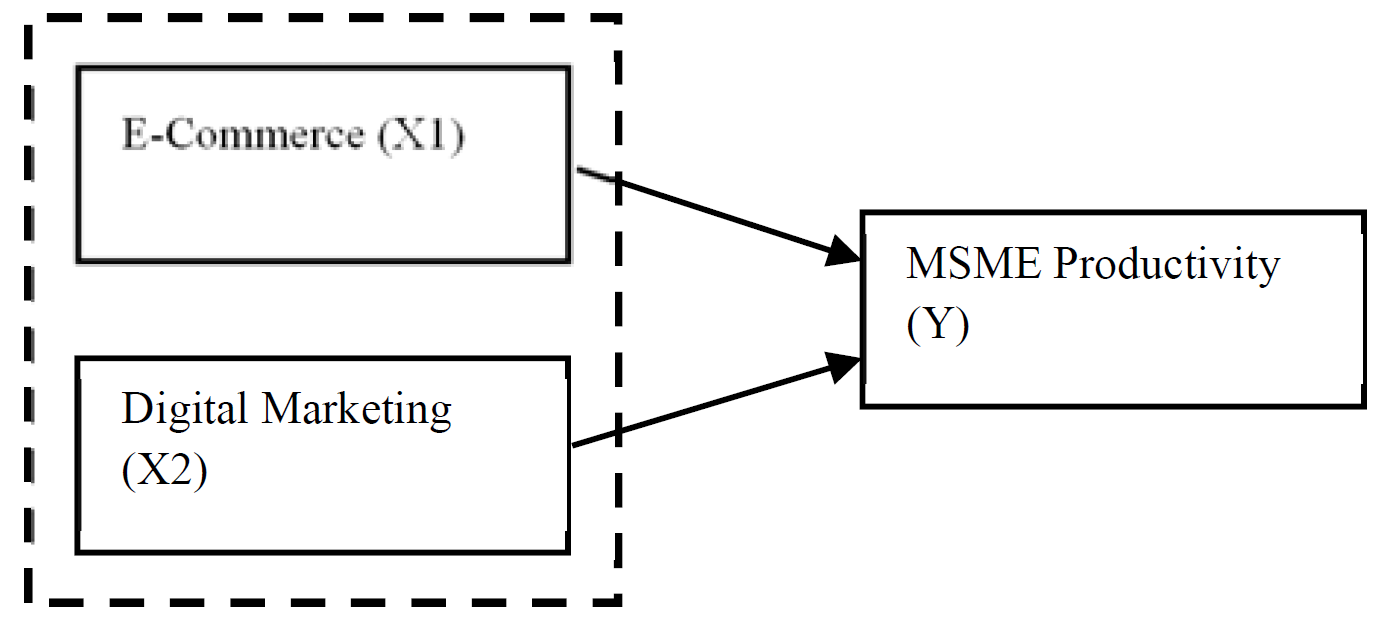
Figure 1: Conceptual framework
Research conducted by Widodo and Handayani [15] shows that there are benefits felt by MSME players from the technology that is developing in the business world. This developing technology has had a significant positive impact on business development. MSME players who use online buying and selling platforms experience benefits such as expanding the market, increasing their network of business partners and feeling more effective and efficient in running their business.
Study Solihat and Sandika [7] has the aim of knowing the development of E-commerce in the Industry 4.0 era. The results of this research show that an entrepreneur who can use and utilize e-commerce well will be able to compete in the business world. To use e-commerce, MSME players must understand and know in depth the key factors for business success so that business goals (targets) can be achieved (Figure 1).
Research Hypothesis
First Hypothesis: E-commerce influences the productivity of MSMEs
Second Hypothesis: Digital Marketing influences the productivity of MSMEs
Third Hypothesis: Digital marketing and E-commerce together influence the productivity of MSMEs
METHOD
This research uses a quantitative approach and is carried out in Pontianak City, West Kalimantan, where many residents work as traders and Pontianak City is also the government center of West Kalimantan Province. The time for this research is March 2023.
This research uses primary data from halal MSMEs in Pontianak City, West Kalimantan. The sampling technique was purposive sampling and produced a sample of 40 MSME actors.
Research Variables and Operational Definitions
According to Sugiyono, research variables are the characteristics or values of people, objects or activities that have certain variations that are determined by the researcher to be studied and then draw conclusions. The independent variables in this research are Digital Marketing and E-commerce. Meanwhile, the dependent variable is MSME Productivity.
Method of Collecting Data
Data Analysis Method
Regression Analysis: This research uses cross-section data regression analysis. Cross-section data is a type of data that consists of variables collected on several individuals or categories at a certain point in time. The following is the Equation Model used:
Information:
Y = Sales Turnover
C(1) = Y coefficient
C(2) = DM coefficient
C(3) = EC coefficient
DM = Digital Marketing
EC = Ecommerce
Classic Assumption Test
The classic assumption test is used before linear regression analysis. This test aims to ensure that the regression coefficients are unbiased and consistent and that there is accuracy in the estimates.
Normality test
The normality test, according to Ghozali, is used to determine whether a regression model has independent variables and dependent variables that have a normal or abnormal distribution. If a variable does not have a normal distribution, the statistical test results will decrease. The data normality test can be carried out using the Kolmogrov-Smirnov one-sample test, where the significance value must be greater than 5% or 0, to show that the data is normally distributed.
Multicollinearity Test
Multicollinearity testing, according to Ghozali, aims to determine whether there is a correlation between the independent variables or independent variables in the regression model. This multicollinearity leads to a highly variable sample. This indicates a large standard error and because the coefficient is tested, the calculated t-value will be smaller than the t-table value. This shows that there is no linear relationship between the independent variable and the dependent variable.
Heteroscedasticity Test
The purpose of the heteroscedasticity test is to find out whether the variance variance in the regression model occurs between the residuals in one observation and other observations. Heteroscedasticity occurs when there are differences in variance. The Glejser test was used to determine whether there was heteroscedasticity in this study. The results show that there is no heteroscedasticity, with F-count and chi-square probability <0.05.
Hypothesis Testing
Partial Significance Test (T-Test): The t-test is useful to see whether there is an influence of the independent variable on the dependent variable individually (partially). T-test hypothesis:
H0: β = 0; there is no influence of the independent variable on the dependent variable
Ha: β ≠ 0; there is an influence of the independent variable on the dependent variable
Conditions for knowing the influence of independent variables partially: If t value > t-table means H0 is rejected and Ha is accepted while if t-value <t-table means H0 is accepted and Ha is rejected.
Simultaneous Significance Test (F Test)
The F test is useful for seeing whether there is an influence of the independent variable on the dependent variable simultaneously or together. F test hypothesis:
H0: β = 0; Simultaneously there is no influence of the independent variable on the dependent variable
Ha: β ≠ 0; simultaneously there is an influence of the independent variable on the dependent variable
Conditions for knowing the influence of independence variables Simultaneously: If t-value>t-table means H0 is rejected and Ha is accepted while if t-value <t-table means H0 is accepted and Ha is rejected
Coefficient of Determination Test (R2)
This test shows the capacity of the independent variable to explain variations in the dependent variable. The R² value ranges between 0 and 1. The lower the R2 value, the less ability the independent variable has to explain the dependent variation. F test
The f test, which aims to measure the accuracy of the method used, is carried out simultaneously with two or more objects as comparisons. The criteria for decision-making are as follows:
If F count > F table or sig. ≤ alpha, then accept Ha
If F count < F table or sig. ≥ alpha, then accept H0
RESULTS AND DISCUSSION
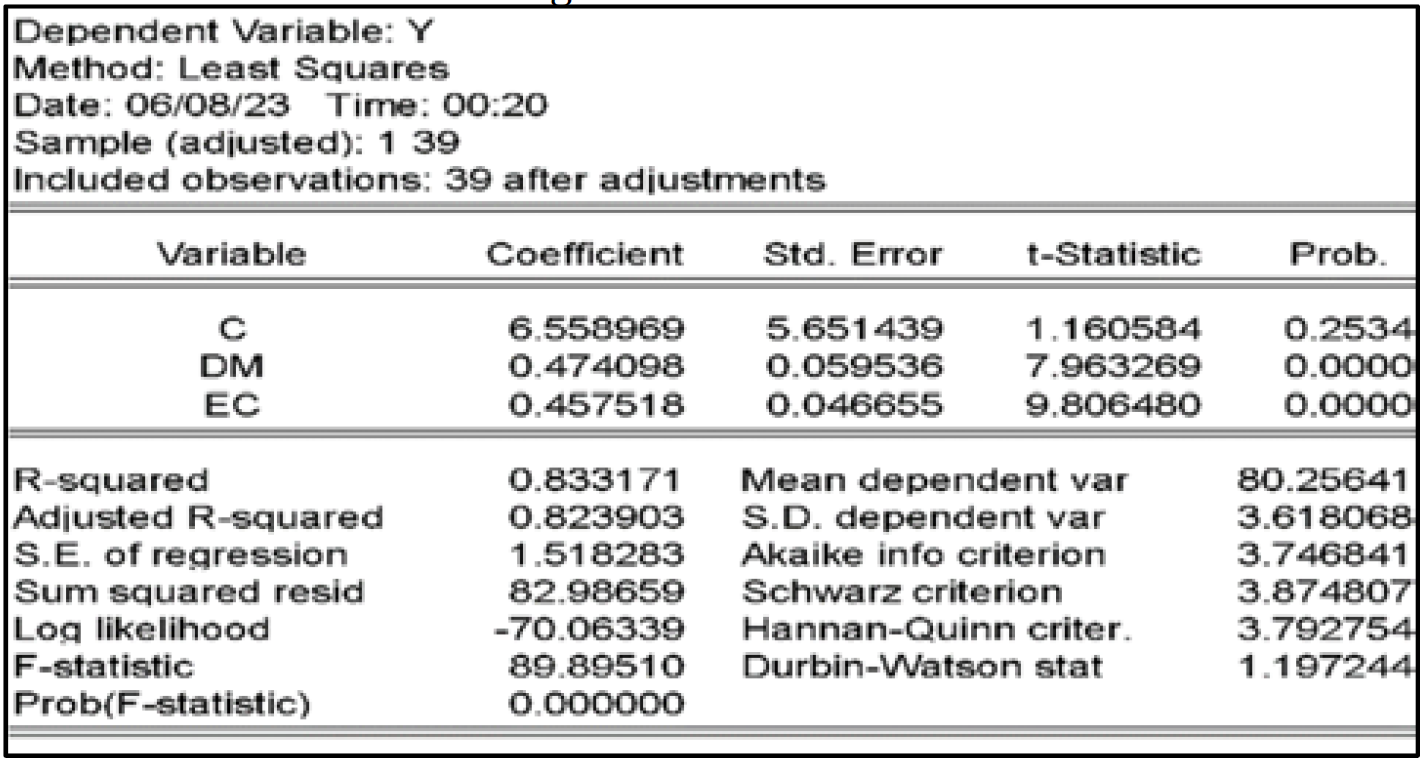
The results of the regression analysis of the data in the research can be explained as in Table 2.
In Table 2, the constant value in the coefficient column is 6.558969, the coefficient value for the digital marketing (DM) variable is 0.474098 and the e-commerce (EC) variable is 0.464260. The equation of the cross-section data regression model This research is:
Y = 6.558969 + 0.474098*DM + 0.457518*EC
Information:
Y = Business Productivity
DM = Digital Marketing
EC =Ecommerce
The explanation is as follows:
The constant coefficient value is 6.558969 or 65.58%, this means that without the digital marketing (DM) variable and the E-commerce (EC) variable, the business productivity variable (Y) will increase by 65.58%
Table 2: Research Model Regression Results
Source: Output (processed, 2023)
The beta coefficient value of the digital marketing (DM) variable is 0.474098 or 4.74%. If the values of other variables are constant and the DM variable experiences an increase of 1%, then the business productivity variable will increase by 4.74%
The e-commerce (EC) variable has a beta coefficient value of 0.457518 or 4.57%, if the other variable values are constant and the EC variable has an increase of 1%, then there will be an increase of 4.57% in the business productivity variable (Y)
Partial Significance Results (t-test)
The calculated t-value of the digital marketing (DM) variable is 7.963269> the t table value is 2.02 and the prob value. namely 0.0000≤0.05, then Ha is accepted and H0 is rejected, which means that business productivity is significantly affected by the digital marketing (DM) variable
The calculated t value of the E-commerce (EC) variable is 9.806480>the t table value is 2.02 and the prob value. namely 0.0000≤0.05, then H0 is rejected and Ha is accepted, meaning that the E-commerce (EC) variable has a significant effect on Business Productivity
Simulative Results (F-Test)
Based on Table 2, it is known that the calculated F value is 89.89510>the table F value is 4.10 and the sig value. namely 0.000000≤0.05, then Ha is accepted and H0 is rejected, which means productivity is influenced by digital marketing and e-commerce.
Coefficient of Determination Test Results (R2)
This test shows the capacity of the independent variable to describe variations in the dependent variable. The value of the R2 quantity ranges from 0 to 1. The smaller the value of the R2 quantity, the less capable the independent variable is in explaining the dependent variation.
In the Table 2, the Adj R square value is 0.823903 or 82.39%. The determinant coefficient value shows that the digital marketing (DM) and e-commerce (EC) variables can explain the business productivity variable (Y) by 82.39%, while the remaining 17.61% is explained by other variables.
Digital Marketing Provides Positive and Significant Impact on Business Productivity
From the results of the t-statistical test that has been obtained, it can be concluded that the digital marketing (DM) variable has a t-statistical probability level that is higher than the significance level. The digital marketing (DM) variable has a regression coefficient with a positive value in the regression equation model, this shows that the digital marketing (DM) variable has a unidirectional relationship (positive direction) to Business Productivity (Y). which means the digital marketing (DM) variable has a positive and significant influence on business productivity (Y). The digital marketing (DM) variable has a beta coefficient value of 0.474098 or 4.74%, this indicates that every 1% increase in digital marketing (DM) will increase business productivity (Y) by 4.74%.
The large DM value is part of the factor in increasing the productivity of MSME businesses in Pontianak City. The good use of digital marketing has a positive impact on MSMEs in terms of increasing business productivity. Digital marketing makes promotions or dissemination of information about the products being sold have a wide reach. So that wherever and whenever people can easily find out about the products being offered, whether between villages, sub-districts, cities, districts, provinces and between countries, so that distance and time are no longer obstacles in getting information about the products being offered. The more people who receive information about the products being offered, the higher the chance that people (potential customers) will decide to buy the products being offered, so of course, this will have an impact on increasing sales turnover from the businesses run by the MSMEs themselves.
The results of this research are in line with the statement of Hadi and Zakiah [16] that the right solution for MSMEs to keep their business running is by using digital marketing. To increase sales, digital marketing can also be the right strategy for MSME players. Likewise, research conducted by Hidayah [17] that digital marketing helps generate high sales, saves costs and is quick and efficient in marketing products. In line with research Gumilang [18] that digital marketing through social media increased the number of sales obtained from cross-sectional interviews, measuring the increase in the number of sales based on a comparison of sales before and after using social media.
Ecommerce Positive and Significant Influence on Business Productivity
From the results of the t-statistical test that has been obtained, it can be concluded that the e-commerce (EC) variable has a t-statistical probability level that is higher than the significance level. The e-commerce (EC) variable has a regression coefficient with a positive value in the regression equation model, this shows that the e-commerce (EC) variable has a unidirectional relationship (positive direction) to Business Productivity (Y). which means the e-commerce variable (EC) has a positive and significant influence on business productivity (Y). The e-commerce (EC) variable has a beta coefficient value of 0.457518 or 4.57%, this indicates that every 1% increase in e-commerce (EC) will increase business productivity (Y) by 4.57%.
The large EC value ratio shows that MSME players have made maximum use of e-commerce applications or platforms. The positive impact of this is increasing sales turnover through digital. Because consumers do not need to come directly to the place or shop to buy the desired product. This is because buying and selling transactions have shifted and occur digitally on e-commerce platforms. Consumers choose to carry out buying and selling transactions online via e-commerce for various reasons, ranging from not having much time to come directly to the shop, being hampered by the lack of transportation, being sick and requiring you to stay at home and various other reasons. This is what encourages MSMEs to register their businesses on e-commerce platforms. Because of this, sales turnover will increase.
The results of this research are in line with the statement of Irawati and Prasetyo [19] that MSMEs who join the e-commerce platform experience an average increase in sales of around IDR 50,000 to IDR 100,000 per day. Study Dwijayanti et al. [20] proves that MSMEs experience an increase in sales, expansion of market reach and also an increase in the number of consumers after utilizing e-commerce in their business. In research Wulandari et al. [21] prove that there is an increase in sales and ease of interacting with consumers for MSMEs after participating in and using the e-commerce program.
CONCLUSION
Based on the results of the research and discussion, it can be concluded as follows:
Digital marketing has a positive and significant impact on the productivity of MSME businesses in Pontianak City in 2023. This is because the use of digital marketing by MSME players causes the information and product promotions offered to have a wider reach. This information is easily obtained by potential consumers because digital marketing is easily accessed by anyone, anytime and anywhere. The media used by MSMEs in digital marketing are Instagram, WhatsApp, Facebook and TikTok
E-commerce has a positive and significant effect on the productivity of MSMEs in Pontianak City in 2023. This is because the use of e-commerce by MSME players in the businesses they run has implications for increasing business turnover. With e-commerce, it makes it easier for MSMEs and consumers to carry out buying and selling activities, where buying and selling transactions can be carried out digitally via the e-commerce platform. The buying and selling or e-commerce platforms used by MSME players include GoFood, Grab Food, Shoppe Food and Maxim
REFERENCE
Rudito, B. “The Improvement of Community Economy as Impact of Corporate Social Responsibility Program: A Case Study in Pengalengan, Bandung, West Java, Indonesia.” Procedia - Social and Behavioral Sciences, vol. 164, 2014, pp. 471-476. https://doi.org/10.1016/j.sbspro.2014.11. 104.
Trulline, P. “Marketing of MSME Products Through Social Media and E-commerce.” Journal of Communication Management, vol. 5, no. 2, 2021, p. 259. https://doi.org/ 10.24198/jmk.v5i2.32746.
Putri, I.S. et al. “Development of Fintech-Based Sharia Banking in Indonesia.” Bhirawa: Journal of Marketing and Commerce, vol. 6, no. 1, 2021, pp. 47-52.
Hendricks, S. and S.D. Mwapwele. “A Systematic Literature Review on the Factors Influencing E-commerce Adoption in Developing Countries.” Data and Information Management, 2023, p. 100045. https://doi.org/10.1016/ j.dim.2023.100045.
Zeng, S. et al. “Logistics Density, E-commerce and High-Quality Economic Development: An Empirical Analysis Based on Provincial Panel Data in China.” Journal of Cleaner Production, vol. 426, 2023, p. 138871. https://doi.org/10. 1016/j.jclepro.2023.138871.
Maryama, S. “Application of E-commerce in Increasing Business Competitiveness.” Journal of Business Management, vol. 17, no. 3, 2020, p. 317. https://doi.org/ 10.38043/jmb.v17i3.2486.
Solihat, M. and D. Sandika. “E-commerce in Industry 4.0.” Asian Business and Economic Scientific Journal, 2022. https://doi.org/10.32812/jibeka.v16i2.967.
Sulaksono, J. and N. Zakaria. “The Role of Digital Marketing for Micro, Small and Medium Enterprises (MSMEs) in Tales Village, Kediri Regency.” Generation Journal, vol. 4, no. 1, 2020, pp. 41-47.
Toukola, S. et al. “Renaissance of Project Marketing: Avenues for the Utilization of Digital Tools.” Project Leadership and Society, vol. 4, 2023. https://doi.org/10. 1016/j.plas.2023.100091.
Turyandi, I. “Optimizing Work Productivity Through Increasing Employee Training and Development.” KarismaPro (Professional Management Studies & Research), vol. 12, no. 2, 2016, pp. 1-23.
Jeske, T. et al. “Development of Digitalization in Production Industry - Impact on Productivity, Management and Human Work.” Procedia Computer Science, vol. 180, 2021, pp. 371-380. https://doi.org/10.1016/j.procs.2021. 01.358.
Harto, B. et al. “Sanfresh MSME Business Transformation Through Post-Covid 19 Business Digitalization.” IKRA-ITH ABDIMAS, vol. 6, no. 2, 2023, pp. 9-15.
Wijoyo, H. and Widiyanti. “Digitalization of Micro, Small and Medium Enterprises.” Proceedings of the Kahuripan I National Seminar 2020, 2020, pp. 9-13.
Siagian, A.O. “E-commerce Marketing Strategy for Indonesian MSMEs to Improve the Indonesian Economy.” Champion Familiar Journal, vol. 6, no. 1, 2021, pp. 1-15.
Widodo, P.H. and T. Handayani. “Journal of Economics and Business.” Journal of Economics and Business, vol. 9, no. 2, 2022, pp. 337-346. https://doi.org/10.51792/jeb.Vol9. Jeb2.246.
Hadi, D.F. and K. Zakiah. “Digital Marketing Strategy for MSMEs (Micro, Small and Medium Enterprises) to Compete in the Pandemic Era.” Competitive, vol. 16, no. 1, 2021, pp. 32-41.
Hidayah, N. Analysis of Digital Marketing Strategy to Help Sales. Thesis, Islamic University of Indonesia, 2018.
Gumilang, R.R. “Implementation of Digital Marketing to Increase Sales of Home Industry Products.” Coopetition: Management Scientific Journal, vol. 10, no. 1, 2019, pp. 9-14. https://doi.org/10.32670/coopetition.v10i1.25.
Irawati, R. and I.B. Prasetyo. “Utilization of E-commerce Platforms Through Marketplaces as an Effort to Increase Sales and Maintain Business During the Pandemic (Study of Food and Beverage MSMEs in Malang).” Journal of Applied Management Research (PENATARAN), vol. 6, no. 2, 2022, pp. 114-133.
Dwijayanti, A. et al. “Utilization of Digital Marketing Strategy Using E-commerce in Maintaining the Pempek4Beradek MSME Business During the Covid-19 Pandemic.” IKRA-ITH ABDIMAS, vol. 4, no. 2, 2021, pp. 68-73.
Wulandari, O.A.D. et al. “Deep Marketplace Utilization Analysis.” Journal of Management Economics, vol. 6, no. 2, 2020, pp. 96-101.
Recommended Articles
Research Article
The Effect of Employer Attractiveness and Compensation on Job Persuit Intention to Fmcg Companies in Indonesia: Coporate Reputation as an Intervening Variable
Download PDF
Research Article
Country of Origin and Foreign Branding on Perceived Quality of Local Products in Indonesia: The Moderating Role of Consumer Ethnocentrism
Download PDF
Research Article
The Effect of Self-Efficacy and Working Environment on Work Achievement with Organizational Commitment as Mediation
Sri Wahyuni,
...
Veithzal Rivai Zainal
Download PDF
Research Article
The Effect of Beauty Vlogger on Purchase Decision for Local Skincare Products in Indonesia: Brand Image as a Mediating Variable
Download PDF
PO Box 101, Nakuru
Kenya.
Email: office@iarconsortium.org
Editorial Office:
J.L Bhavan, Near Radison Blu Hotel,
Jalukbari, Guwahati-India
None, H., Luthfi, F., A., A. S., Laksamana, R. & None, W. (2023). The Role Of E-Commerce And Digital Marketing On The Productivity Of Msmes In Pontianak City. Scientific Research Journal of Economics and Business Management, 3(2), 1-8.
MLA
None, Hendrawan, et al. "The Role Of E-Commerce And Digital Marketing On The Productivity Of Msmes In Pontianak City." Scientific Research Journal of Economics and Business Management 3.2 (2023): 1-8.
Chicago
None, Hendrawan, Faishol Luthfi, Aya S. A., Rio Laksamana and Wahyudi . "The Role Of E-Commerce And Digital Marketing On The Productivity Of Msmes In Pontianak City." Scientific Research Journal of Economics and Business Management 3, no. 2 (2023): 1-8.
Harvard
None, H., Luthfi, F., A., A. S., Laksamana, R. and None, W. (2023) 'The Role Of E-Commerce And Digital Marketing On The Productivity Of Msmes In Pontianak City' Scientific Research Journal of Economics and Business Management 3(2), pp. 1-8.
Vancouver
Hendrawan H, Luthfi F, A. AS, Laksamana R, Wahyudi W. The Role Of E-Commerce And Digital Marketing On The Productivity Of Msmes In Pontianak City. Scientific Research Journal of Economics and Business Management. 2023 Jul;3(2):1-8.


 Download PDF
 Download XML