Contents
Download PDF
pdf Download XML
103 Views
40 Downloads
Share this article
Research Article | Volume 5 Issue 1 (January-June, 2025) | Pages 1 - 4
Role of Total Quality Management Dimensions and Their Direct and Effective Impact on the Dimensions of Electronic Circuits: A Structural and Analytical Study of Organizational Structures to Address Difficulties
1
Ministry of Education, Al-Diwaniyah Commercial Preparatory Department, Iraq
Under a Creative Commons license
Open Access
Received
Jan. 3, 2025
Revised
Jan. 9, 2025
Accepted
Jan. 19, 2025
Published
Jan. 27, 2025
Abstract

Real monitoring at all times and without interruption of dimensions of Total Quality Management (TQM) (Focus (FO), Planning (PL)) and within specified and certain basics in making a major change that serves organizations on Electronic Circuit EC (Devices (DE), Software (SO)). Quality is indispensable and cannot be ignored in helping companies reach safety and stability. The researcher's work involves analyzing basic data to develop more effective strategic approaches. He began by working with 120 employees at the Ishtar Hotel in Baghdad. The data collected in response numbered 114 of which 6 were incomplete. SPSS was the primary tool used in compiling the results for the researcher. Hypotheses 4 support the study and are considered successful in relying on them.

Keywords
INTRODUCTION

Any research in the field of administration cannot ignore (TQM) and distinctive features contained within its records [1]. It also has many multifaceted dimensions, but we will focus on only two: (FO and PL) to fulfill the requirements for success in this research [2]. We will examine in detail the impact on the energy of the (EC) through administrative input and interaction with its components (DE and SO) [3]. The effort exerted in determining the success of the hypotheses 4 is great and evident to all those close to the subject to be researched, in order to seize the time allotted to it and devote absolute time to the research prepared for study [4]. (TQM) emphasizes the paramount importance of providing technology to (EC) as a tool for all research phases aimed at expanding and diversifying the administrative field. Importance of TQM, with its inspiring development that benefits employees and all institutions, is widely recognized [5]. The responses of the selected employees in the sample to the questionnaire allow for necessary processing, as some may not be accurate or cautious in their answers [6]. It is crucial to avoid rushing to answer the questions without careful consideration, as this is essential in determining the outcome of the research [6]. Investment relies heavily on (TQM) standards and incorporates all beneficial elements. Success stems from a number of supporting factors [7]. We have given investment paramount importance, considering it essential and realistic for the development of (EC) [8]. Furthermore, the needs of employees are addressed in this study because their primary concerns are their lives, housing and living requirements [9]. This is their right, enabling them to work with complete confidence and ease, without complacency. Collaboration among employees is essential for delivering strong results [10]. Without it, the desired outcome will be diminished [11].


One of the requirements that must be instilled in employees is a love of sharing work, ideas and innovation to generate modern, collaborative scientific approaches among individuals, within the same context [12]. Previous studies identified a negative research gap, which we needed to address and resolve permanently. Research invariably leaves gaps in some sections, so we had to continuously search for and address these gaps effectively [13]. Our research also aimed to ensure that no other researchers could identify any existing gaps [14].


Theoretical Research

Total Quality Management

Focuses: It is an administrative performance for most administrative matters and the employees implement any proposal they are ordered to make by the higher-ranking official [15]. Waves of change occurring and their impact on producing valuable products necessitate a focus on the methods employed within the institutional framework and a dedication to highly focused performance [16]. Without precision, we cannot achieve our desired, supported production goals [17]. Some companies may resort to rushing to launch their products in the market, but these risks reducing their market share, losing customers and falling behind other goods and services [18]. The process of focusing is fundamental in determining the supply and demand for services offered and their widespread acceptance by customers [19]. A lack of focus can sometimes hinder recruitment. Here, we rely on correct analysis of each simple paragraph to prevent any gaps that may occur in our research [20]. Research gaps that hinder the development of institutions must be closed [21]. It gives institutions a distinctive and prominent role and emphasizes determining the performance capacity in achieving the desired technology [22].


Planning

Administrative work focuses on defining the future of organizations and developing performance evaluation tools for activities [23]. It also involves a comprehensive analysis of the environment to set well-defined goals and avoid difficulties and challenges. A comprehensive planning process was undertaken to research and validate this type of TQM (Total Quality Management) dimension [24]. This planning is not haphazard but rather the work of highly skilled experts, programmers and technicians, ensuring rigorous and sophisticated ideas that are more advanced and dedicated than those of other companies [25]. We focused on planning and how to prevent organizational pitfalls. According [26]. Believes Kadhim and Ahmad. Responsibility should be given to the employee who possesses qualities and qualifications that the rest of the staff lack. [27]. Because continuing to implement the plan requires a capable employee who can manage the company [28]. According [29] planning in administrative work is key to success and this type of planning greatly clarifies organizational structure [30]. Development requires more effort than is portrayed [31]. While [32]. While Asad et al. [33] initiative we have undertaken in this research, which we present to you, addresses the weaknesses that afflict companies [34],  Yusuf, [35].


Electronic Circuit

Devices: According [36], Rapid progress is accompanied by the accuracy and flexibility of the equipment and we must contribute to our work in a stable manner [37,38] This research aims to provide a precise and comprehensive design that simplifies information for students, despite the abundance of modern devices and demonstrates how to use them effectively over time [39]. Electronics have become essential within organizations due to technological advancements and their widespread applications [40]. This includes various engineering and scientific fields, necessitating workshops for the operation and installation of electrical equipment [41]. Devices with more advanced operating systems or versions implement more sophisticated and modern modes [42]. Furthermore, technology is essential in companies and may rely on a number of registration methods [43].


Software

These systems, or technologies, focus on training and automating data and daily tasks within organizations, while achieving their strategic goals. They include software for electronic circuit. Software plays a vital role in advancing and developing program management skills through lectures, workshops and seminars [44]. This training course aims to equip you with the skills necessary for successful leadership in electronic circuit, revealing the essential elements for achieving excellence and performance leadership [45]. The electronic circuit program aims to improve your performance and develop your skills [46]. Using an electronic circuit system means many simple, basic steps. It's already part of the infrastructure in many countries and its adoption is expanding rapidly [47]. This type of software provides electronic circuit with the information they need. The electronic circuit system streamlines data flow and improves efficiency, connecting to both electronic and daily management processes [48]. The electronic management system works on a permanent and institutional basis to monitor employees and financial management, in addition to duties, in organizations and performance [49].


Hypothesis Research


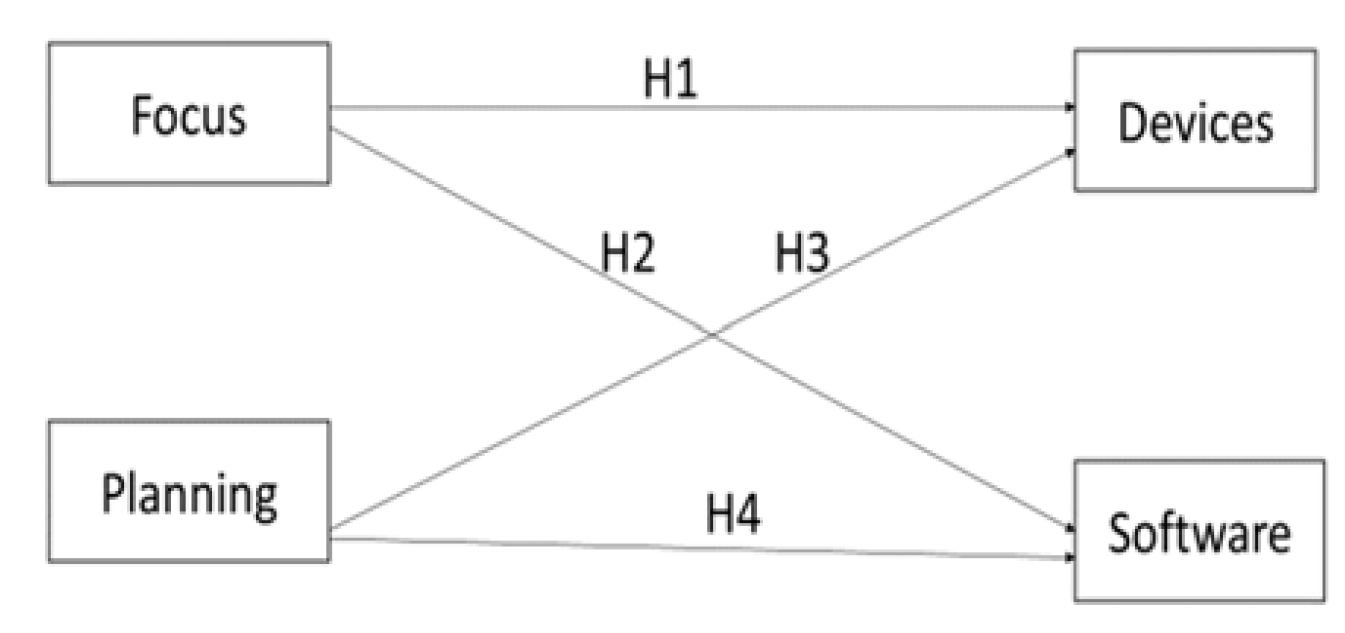
  • H1: Focus (FO) effect on Devices (DE)

  • H2: Focus (FO) effect on Software (SO)

  • H3: Planning (PL) effect on Devices (DE)

  • H4: Planning (PL) effect on Software (SO) (Figure 1)


Figure 1: Conceptual Model

MATERIALS AND METHODS

The Iraqi government agreed to cooperate with me by interviewing its employees and providing all necessary administrative support to complete this study. The analysis relied on quantitative methods and data from the Ishtar Hotel in Baghdad. I also drew upon previous studies to develop a comprehensive research paper [3].

RESULTS

SPSS was used to analyze the data, which numbered 114 and it fulfilled our intended purpose. We will now discuss the results (Table 1) [8].


Table 1: Reliability Validity

ItemsCronbach's alphaComposite reliability

Average variance

extracted (AVE)

FO0.8640.8610.511
PL0.8320.8550.531
DE0.8610.8320.531
SO0.8290.4380.612


Its positive results show us that there are clear differences between the terms and each dimension has a higher result that is stronger than the lower one (Table 2).


Table 2: Discriminant Validity

 FOPLDESO
FO----
PL0.945---
DE0.3290.934--
SO0.3000.2430.863-


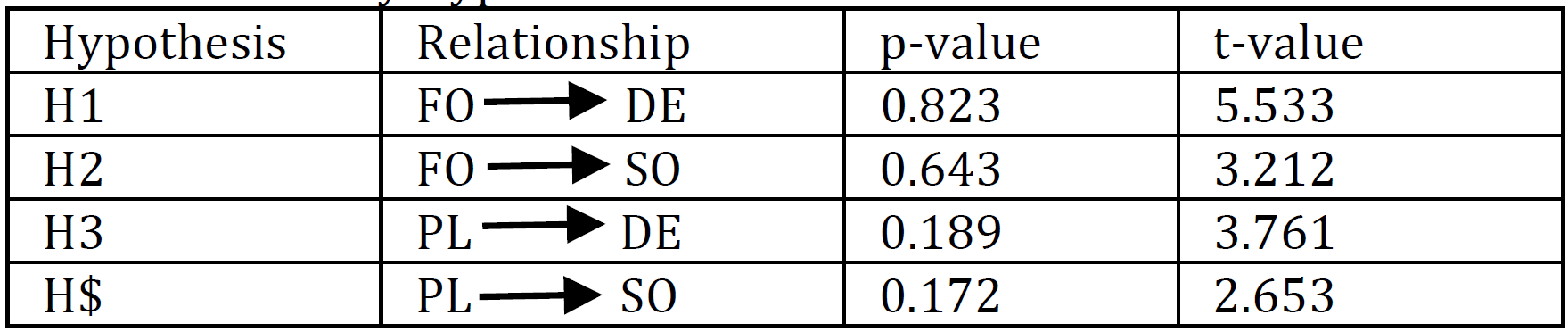
Hypotheses 4 consider a direct relationship between the variables (Table 3).


Table 3: Summary Hypothesis

CONCLUSION

TQM model is used to expand business operations due to its advanced production methods. Therefore, we encourage organizations to utilize this study because it contains up-to-date information not found in another research. This in-depth research addressed all the challenges and identified optimal solutions, surpassing previous studies. Anyone who adopts the methods of this research will contribute to enhancing the performance of their company.


Recommendations


  • Clarifying the dimensions of (TQM) and understanding its objectives and effectiveness in delivering work at the highest levels of progress and excellence

  • The adaptability of (TQM) dimensions was distinguished on the dimensions of electronic circuit.

  • The data and information, through its results, all showed that it was good

  • The need to adopt advanced and sophisticated technology in the performance of electronic circuit

  • Emphasis is placed on maintaining progress in the world and achieving the highest level of productive efficiency that provides the necessary energy

REFERENCES
  1. Al-Okaily, A. et al. “An Empirical investigation of enterprise system user satisfaction antecedents in jordanian commercial banks.” Cogent Business & Management, vol. 8, no. 1, 2021.

  2. Almonawer, F.H. “Applying the dimensions of the total quality management as an approach for improving the performance of the public administration – from the perspective of the employees at the ministry of social affairs in Kuwait.” 2024.

  3. Alshourah, S. “Management science letters.” Management Science Letters, vol. 11, 2021, pp. 67–76. https://doi.org/10.5267/j.msl.2020.8.029

  4. Albadry, H.F. et al. “The impact of branding on the marketing advantage and the role of sustainable competitiveness as mediator.” International Journal of Advanced Science and Technology, vol. 29, no. 11s, 2020.

  5. Awad, I.K. and S.A. Kadhim. “Total Quality management: Do they improves institutions performance and performance efficiency.” International Journal of Studies in Business Management, Economics and Strategies, vol. 4, no. 9, September 2025.

  6. Ahmad, F. et al. “A study of barriers and challenges of industry 4.0 in Malaysia manufacturing companies.” International Journal of Supply Chain Management, vol. 9, no. 5, 2020.

  7. Amer, F. et al. “A systematic review: The dimensions to evaluate health care performance and an implication during the pandemic.” BMC Health Services Research, 2022, pp. 1–22.

  8. Asad, M. et al. “Open innovation: the missing nexus between entrepreneurial orientation, total quality management and performance of SMEs.” Journal of Innovation and Entrepreneurship, vol. 12, no. 1, 2023. https://doi.org/10.1186/s13731-023-00335-7

  9. Banks, I.N.C. “Conceptual basis of improvement of bank audit.” 2023, pp. 118–124.

  10. Buer, S. et al. “The complementary effect of lean manufacturing and digitalisation on operational performance.” 2021.

  11. Dhir, S. et al. “Critical Success factors determining performance of cross-border acquisition: evidence from the African telecom market.” 2021, pp. 43–61. https://doi.org/10.1002/tie.22156

  12. Do, T.D. et al. “The Impact of digital transformation on performance: Evidence from vietnamese commercial banks.” 2022.

  13. Dulal, M. et al. “Green banking: The case of commercial banking sector in Oman.” 2020.

  14. Elit, P. and M. Partnering. “Montenegrin journal of economics.” Montenegrin Journal of Economics, vol. 19, no. 2, 2023.

  15. Fatorachian, H. and H. Kazemi. “Impact of industry 4.0 on supply chain performance.” Production Planning & Control, vol. 32, no. 1, 2021, pp. 63–81. https://doi.org/10.1080/09537287.2020.1712487

  16. Ghosh, R. “Resilience of commercial banks of bangladesh to the shocks caused by COVID-19 pandemic: An application of MCDM-based approaches.” vol. 6, no. 3, 2026, pp. 281–295. https://doi.org/10.1108/AJAR-10-2020-0102

  17. Harianto, P. and Z. Zainol. “The effect of organizational culture’s dimension, total quality management and entrepreneurial orientation towards the performance of herbal enterprises in Indonesia.” vol. 12, no. 2, 2022, pp. 41–51.

  18. Hani, I.R. et al. “Implementation total quality management on dimensions’ investment portfolio by stakeholders as a mediator: General company for textile industries / babylon.” Library Progress International, vol. 45, no. 2, July–December 2025, pp. 313–330.

  19. Kadhim, S.A. and F. Ahmad. “Proposed framework for total quality management and its impact in high schools.” International Journal of Supply Chain Management, vol. 8, no. 3, 2019.

  20. Kadhim, S.A. and F. Ahmad. “The role of tqm in education: an empirical investigation of preparatory schools of Iraq.” International Journal of Services and Operations Management, vol. 39, no. 1, 2021.

  21. Kadhim, S.A. and F. Ahmad. “The impact of total quality management by mediator’s compliance and information technology on education performance in secondary schools Iraq.” International Journal of Services and Operations Management, vol. 41, no. 1–2, 2022, pp. 82–100.

  22. Kadhim, S.A. and R.I. Hani. “Total quality management and its role in developing banking institutions through compliance as a mediating factor.” Journal of Theoretical and Applied Information Technology, vol. 102, no. 2, 2024.

  23. Kadhim, S.A. and B.A.K. Jassmy. “Effectiveness of total quality management on strategic planning and the importance of stakeholders as a mediator.” American Journal of Economics and Business Management, vol. 7, no. 2, 2024.

  24. Kadhim, S.A. and L.M. Habeeb. “Role of Comprehensive total quality management in enhancing the importance of the insurance company.” International Journal of Studies in Business Management, Economics and Strategies, vol. 3, no. 2, 2024.

  25. Kadhim, S.A. and L.A. Atiyah. “Green human resources practices and impact on possibility of applying total quality management.” International Journal on Economics, Finance and Sustainable Development, vol. 6, no. 2, 2024.

  26. Kadhim, S.A. and S.F. Mahmoud. “Constraints that affect the implementation of total quality management on executive management and effectiveness of planning.” World Economics & Finance Bulletin, vol. 32, 2024.

  27. Kadhim, S.A. “Impact of applying total quality management on supply chain management by stakeholders as a mediator.” Tikrit Journal of Administrative and Economic Sciences, vol. 21, Special Issue, part 1, 2025, pp. 1075–1097.

  28. Karageorgos, C. et al. “Planning and implementing total quality management in education: The case of cyprus.” International Journal of Educational Management and Innovation, vol. 2, no. 1, 2021. https://doi.org/10.12928/ijemi.v2i1.2627

  29. Khrais, L.T. et al. “Exploring the dimensions using exploratory factor analysis of european foundation for quality management’s enablers and competitive advantages.” n.d.

  30. Kristanti, D. et al. “The role of commitment, work ethos and competence on employee performance in sharia commercial bank.” vol. 9, no. 2, 2023, pp. 523–529.

  31. Luning, P.A. et al. Food Quality Management. 2020.

  32. Management, Q. “Critical Success factors of total quality management practices using pareto analysis.” vol. 36, no. 3, 2022.

  33. Miah, S. et al. “Soft dimension of TQM: A validation by confirmatory factor analysis.” vol. 15, no. 10, 2021, pp. 907–917.

  34. Moh, H. et al. “Enhancing Project performance through quality dimensions: An empirical study in jordan’s construction industry.” 2024, pp. 26–36.

  35. Mouzaek, E. et al. “An Empirical investigation of the impact of service quality dimensions on guest’s satisfaction: A case study of Dubai hotels.” vol. 27, no. 3, 2021.

  36. Nguyen, T.A.V. et al. “Total quality management & business excellence indicators for TQM 4.0 Model.” 2023.

  37. Preference, P. “Impact of Service quality on in-patients’ satisfaction, perceived value and customer loyalty.” 2021. https://doi.org/10.2147/PPA.S333586

  38. Qasaimeh, G.M. “The Impact of artificial intelligence on the effective applying of cyber governance in Jordanian Commercial Banks.” vol. 2, no. 1, 2022, pp. 68–86.

  39. Radulović, A.H. et al. “Work from home and musculoskeletal pain in telecommunications workers during covid-19 pandemic.” vol. 3559, no. 5, 2021, pp. 232–239. https://doi.org/10.2478/aiht-2021-72-3559

  40. Ribeiro, M.M. “The Different dimensions of quality care management.” Nursing & Primary Care, 2022, pp. 1–7.

  41. Siddique, A. “The Effect of credit risk management and bank-specific factors on the financial performance of the south Asian commercial banks.” February 2026. https://doi.org/10.1108/AJAR-08-2020-0071

  42. Siddique, M. et al. “Effect of total quality management on students’ performance in chemistry at secondary level in Pakistan.” vol. 7, no. 11, 2021, pp. 592–602.

  43. Singh, S.K. et al. “The effect of non-performing loan on profitability: empirical evidence from nepalese commercial banks.” vol. 8, no. 4, 2021, pp. 709–716. https://doi.org/10.13106/jafeb.2021.vol8.no4.0709

  44. Sk, K.B. “Credit investigation and comprehensive risk management system based big data analytics in commercial banking.” 2023, pp. 2387–2391. https://doi.org/10.1109/ICACCS57279.2023.10113084

  45. Taleb, I. et al. “Big data quality framework: A holistic approach to continuous quality management.” Journal of Big Data, 2021. https://doi.org/10.1186/s40537-021-00468-0

  46. Thi, N. et al. “ICT application in commercial banks in the post-covid-19 economy in Vietnam.” 2022, pp. 408–413.
Recommended Articles
Research Article
The impact of waste management strategies on achieving sustainability through waste treatment –Applied Study in a Sample of (Environmental Protection and Improvement Department in the Southern Region, Zubair Municipality Directorate, and Basra Municipality Directorate)
Published: 19/09/2023
Download PDF
Research Article
Organizational Creativity: The Information Security Paradigm
Published: 10/04/2022
Download PDF
Research Article
Designing and Examining a Digital Business Transformation Model and its Role in Developing Green Intellectual Capital: An Empirical Study in the Oil Sector
...
Published: 12/04/2025
Download PDF
Research Article
Measuring manufacturing performance under the application of value engineering using the balanced scorecard: An applied study in the Kufa Cement Factory
Published: 25/08/2023
Download PDF
Chat on WhatsApp
Flowbite Logo
PO Box 101, Nakuru
Kenya.
Email: office@iarconsortium.org

Editorial Office:
J.L Bhavan, Near Radison Blu Hotel,
Jalukbari, Guwahati-India
Useful Links
Order Hard Copy
Privacy policy
Terms and Conditions
Refund Policy
Shipping Policy
Others
About Us
Team Members
Contact Us
Online Payments
Join as Editor
Join as Reviewer
Subscribe to our Newsletter
+91 60029-93949
Follow us
MOST SEARCHED KEYWORDS
Copyright © iARCON International LLP . All Rights Reserved.