Contents
Download PDF
pdf Download XML
731 Views
467 Downloads
Share this article
Research Article | Volume 3 Issue 1 (Jan-June, 2022) | Pages 1 - 6
Optimization of Biosurfactant Production from Pseudomonas Aeruginosa VB MCC 4751 Isolated from Sea Water Near Uran Beach
 ,
 ,
1
Department of Microbiology, Fergusson College, India
2
Department of Microbiolgy, Yogeshwari Mahavidyalaya, Ambajogai, India
3
Department of Physics, Savitribai Phule Pune University, India
Under a Creative Commons license
Open Access
Received
Jan. 3, 2022
Revised
Feb. 9, 2022
Accepted
March 19, 2022
Published
April 10, 2022
Abstract

Optimization of media components and maintaining suitable growth conditions are the most important steps for the improved production of biosurfactants. In the present study, Pseudomonas aeruginosa VB MCC 4751 isolated from sea water near Uran beach, near ONGC plant, Navi Mumbai, was studied for improved biosurfactant production. Effects of different carbon and nitrogen sources, sodium chloride, pH and temperature on biosurfactant production by Pseudomonas aeruginosa VB MCC 4751 were studied. 1% sodium chloride was found to be suitable for the growth and biosurfactant production was observed within 24 hours of incubation in the shake flask condition at 280C. Using glucose as a carbon source, maximum surface tension reduction up to 44.3 mN/m (69.74 mN/m to 25.39 mN/m) and 60% of emulsification index was observed. Sodium nitrate was found to be the most suitable for biosurfactant production with surface tension reduction of 43.5 mN/m (70.50 mN/m to 27.08 mN/m) and 63.33% of emulsification index. pH 7 and temperature of 30 0 C was found to be optimum (surface tension reduction readings of 27.32 mN/m and 27.8 mN/m respectively) for biosurfactant production though the given isolate was found to produce biosurfactant over a wide range of pH and temperature. Marine bacteria are adapted to adverse environmental conditions and hence suitable for the production of bioactive compounds on commercial scale.

Keywords
INTRODUCTION

The demand for production of surfactants has increased in recent years. Biosurfactants are amphiphilic compounds produced by variety of microorganisms either on cell surfaces or extracellularly using variety of substrates such as sugars, hydrocarbons, oils, glycerol and agricultural waste. Due to ready degradability, stability in extreme environment and low toxicity biosurfactants are preferred over chemical surfactants. Owing to their antimicrobial property and ability to form stable emulsion in variety of environmental conditions, biosurfactants possess potential applications in variety of industries such as food, paper, petrochemicals, pharmaceuticals and agriculture industry in near future [1,2]. Large amount of oil discharges in the ocean due to oil pipeline leaks, oil tanker crashes cause adverse effect on marine ecosystem and decrease the self-purification ability of the ocean. Ability of large number of marine bacteria to produce biosurfactants during their growth on hydrocarbons play a major role in bioremediation of oil spills [3,4].


Low yield along with the high production cost are the major limiting factors for the commercial scale production of biosurfactant. optimization of fermentation parameters is one of the important strategies to improve the biosurfactant production [5,6]. Main objective of the present study is to optimize the fermentation parameters such as carbon, nitrogen, pH and temperature for improved biosurfactant production from Pseudomonas aeruginosa VB MCC 4751 isolated from sea water near Uran beach close to ONGC plant, Navi Mumbai.

MATERIALS AND METHODS

Pseudomonas aeruginosa VB MCC 4751 was isolated from sea water near Uran beach and tested for biosurfactant production using variety of screening methods such as drop collapse [7-9], emulsification index [10,11], oil displacement test [12], hydrocarbon overlay agar method and blue agar method [13]. Ability to reduce surface tension was determined by surface tension measurement studies using Optical Contact Angle Goniometer (OCA 15+, Data Physics Instruments GmbH, Germany) by pendant drop technique and found to be potent biosurfactant producer. Formation of blue-colored halos around the growth in blue agar plate containing Cetyltrime Thyl-Ammonium Bromide (CTAB) indicate glycolipid/anionic nature of the biosurfactant. Selected isolate was identified using 16s r RNA gene sequencing method (partial) using Sophisticated Analytical Instrumentation Facility at Agharkar research institute, Pune [8,9,14].


Mineral salt medium containing glucose was used for the production of biosurfactant. Viscous yellowish brown coloured crude biosurfactant was obtained by acid precipitation and solvent extraction of cell free supernatant. Solvent system Ethyl acetate and methanol (4:1) was used for extraction of biosurfactant. To improve the production of biosurfactant from Pseudomonas aeruginosa VB MCC 4751, effects of various fermentation parameters were studied [8,15,16].


Optimization of Biosurfactant Production

Mineral Salt Medium supplemented with trace element solution (MSM) was used as a basal medium for checking effects of various fermentation parameters on biosurfactant production from Pseudomonas aeruginosa VB MCC 4751 [1]. Effect of various carbon and nitrogen sources, different pH and temperature on biosurfactant production were tested. 6% v/v 24 hours old culture suspension of Pseudomonas aeruginosa VB MCC 4751 grown in MSM at 28°C in shaker incubator at 150 rpm was used for inoculating the medium. Biosurfactant production was tested by drop collapse test, emulsification index percentage and surface tension reduction.


Initially effect of various concentration of sodium chloride was tested by adding 1%, 2%, 3%, 4%, 5% and 6% w/v concentration in the fermentation medium.1% NaCl was found to be most suitable for growth and biosurfactant production. Using this concentration, maximum turbidity was observed within 24 hours along with the positive drop collapse test and therefore used the same concentration in the medium for parameter optimization.


Effect of Different Carbon Sources on Biosurfactant Production

MSM adjusted to pH 7 inoculated with the test culture suspension were supplemented with 2% of different carbon sources such as glucose, sucrose, lactose, mannitol, xylose, starch, cellulose, coconut oil and liquid paraffin. Culture media were incubated at 28°C for 5 days in shaker incubator at 150 rpm. After incubation culture broths were centrifuged at 10,000 rpm for 15 minutes at 4°C. Cell free supernatant was tested for biosurfactant production.
 

Effect of Different Nitrogen Sources on Biosurfactant Production

MSM adjusted to pH 7 inoculated with the test culture suspension was supplemented with 0.2% of different nitrogen sources such as ammonium citrate, sodium nitrate, ammonium sulphate, meat extract, ammonium oxalate, potassium nitrate, yeast extract. Culture media were incubated at 28°C for 5 days in shaker incubator at 150 rpm. After incubation culture broths were centrifuged at 10,000 rpm for 15 minutes at 4°C. Cell free supernatant was tested for biosurfactant production. 


As glucose and sodium nitrate were found to be most suitable carbon and nitrogen sources, these were used in the MSM for testing effect of pH and temperature on biosurfactant production.


Effect of pH on Biosurfactant Production

MSM adjusted to different pH such as 4.5, 5.0, 5.5, 6.0, 6.5, 7.0, 7.5, 8.0, 8.5, 9.0, 9.5, 10.0, 10.5, 11.0 were inoculated with the test culture suspension and incubated at 28°C for 5days in shaker incubator at 150 rpm. After incubation culture broths were centrifuged at 10,000 rpm for 15 minutes at 4°C. Cell free supernatant was tested for biosurfactant production. 

 

As pH 7.0 was found to be suitable for biosurfactant production it was further used for checking the effect of temperature on biosurfactant production.


Effect of Temperature on Biosurfactant Production

MSM adjusted to pH 7.0 was inoculated with the test culture suspension and incubated at various temperatures such as 25°C, 30°C, 35°C, 40°C, 45°C, 50°C, 55°C, 60°C for 5 days in shaker incubator at 150 rpm. After incubation culture broths were centrifuged at 10,000 rpm for 15 minutes at 4°C. Cell free supernatant was tested for biosurfactant production.

RESULTS AND DISCUSSION

Initially, the effect of various concentration of sodium chloride on growth and biosurfactant production was checked. out of 6 different concentrations of sodium chloride,1% w/v sodium chloride was found to be the most suitable for growth of Pseudomonas aeruginosa VB MCC 4751. Within 24 hours of incubation maximum growth was observed along with the positive drop collapse test (Table 1). This indicates that higher concentration of sodium chloride is not suitable for the given isolate [17].


Effect of Different Carbon Sources on Biosurfactant Production

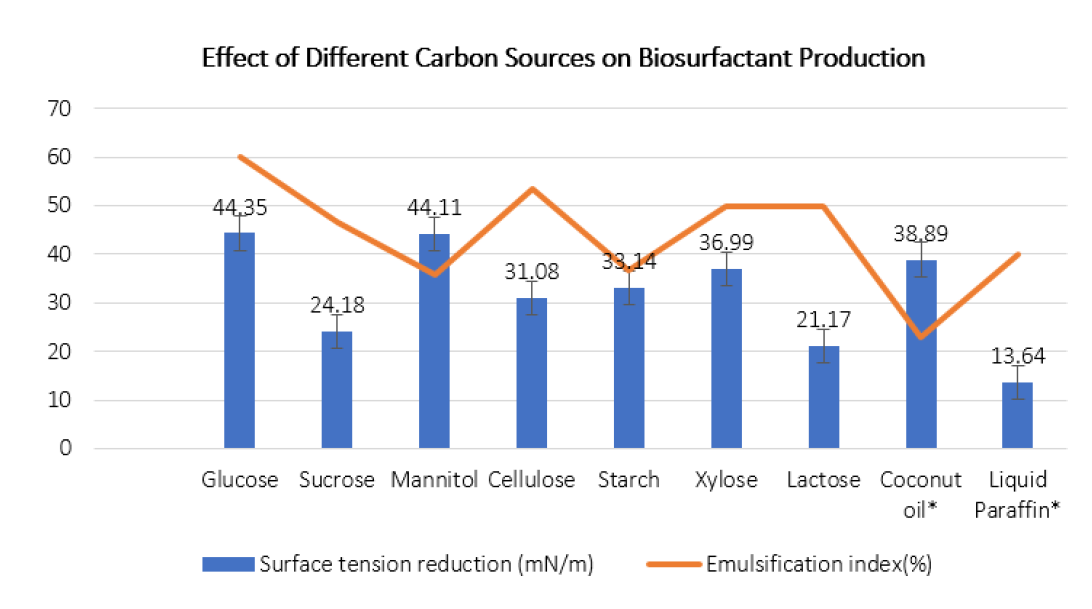
Out of 9 different carbon sources tested, glucose was found to be the most suitable for Pseudomonas aeruginosa VB MCC 4751 for biosurfactant production. Surface tension reduction in the presence of glucose was 44.3 mN/m (69.74 mN/m to 25.39 mN/m) and emulsification index was 60%. Mannitol was also found to be suitable for biosurfactant production. Similar results were observed for Pseudomonas aeruginosa [17].


Table 1: Results of Effect of NaCl Concentration on Growth and Biosurfactant Production after 5 Days Of Incubation at 280C

NaCl concentration in % w/vGrowth after 24 hoursDrop collapse test after 24 hours
1+++++
2++
3+-
4--
5--
6--

For Growth, + Indicates Slight Growth, +++ Indicates Good Growth, For Drop Collapse Test, + Indicates Weak Positive Test, +++ Indicates Positive Test and Drop Collapse Immediately with Increase in Drop Diameter from 4 mm to 7 mm on Parafilm M


Low surface reduction activity was observed in the presence of liquid paraffin and lactose. Greenish pigmentation was observed in mannitol containing medium. and yellow colored pigmentation observed in glucose containing medium. Milky white colored emulsification was observed in coconut oil containing tube (Figure 1 and Table 2).


Figure 1: Effect of Different Carbon Sources on Biosurfactant Production


Table 2: Results of Effect of Different Carbon Sources on Surface Tension Reduction and Emulsification Index

Carbon source 2% w/vSurface tension readings (mN/m) Control (Without culture)Surface tension readings (mN/m) Test sampleSurface tension reduction (mN/m)Emulsification index (%)
Glucose69.7425.3944.3560
Sucrose6237.8224.1846.66
Mannitol72.5428.4344.1135.71
Cellulose68.1837.7231.0853.33
Starch66.9333.7933.1436.66
Xylose69.993336.9950
Lactose60.138.9321.1750
Coconut oil*69.6331.0438.8923.07
Liquid Paraffin*48.4031.7613.6440

*-samples were centrifuged and cell free supernatant was filtered through Whatmann filter paper and then used for surface tension measurement studies. Green colored pigmentation was observed in Mannitol containing tube and yellow colored pigmentation was observed in glucose containing medium. Milky white colored emulsification was observed in coconut oil containing tube


Effect of Different Nitrogen Sources on Biosurfactant Production

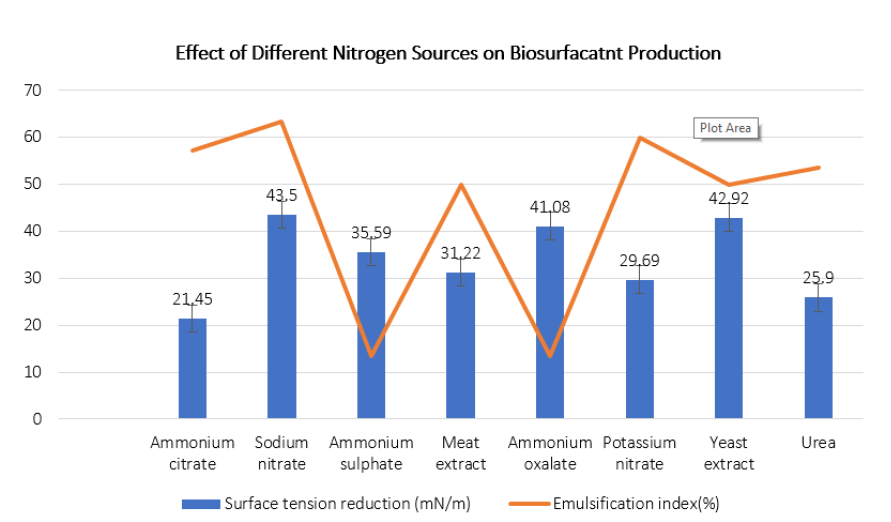
Out of 8 different nitrogen sources tested sodium nitrate was found to be most suitable for Pseudomonas aeruginosa VB MCC 4751 for biosurfactant production. Using sodium nitrate 43.5 mN/m of surface tension reduction (70.50 mN/m to 27.08 mN/m) and 63.33% emulsification index was observed. Similar results were observed for other strains of Pseudomonas aeruginosa [18,19]. Significant decrease in surface tension reduction was observed in the medium containing ammonium oxalate and yeast extract. Low value of emulsification index was observed in ammonium sulphate and ammonium oxalate (Table 3 and Figure 2).


Figure 2: Effect of Different Nitrogen Sources on Biosurfactant Production


Table 3: Results of Effect of Different Nitrogen Sources on Surface Tension Reduction and Emulsification Index

Nitrogen source 0.2% w/vSurface tension readings (mN/m) Control (Without culture)Surface tension readings (mN/m) Test sampleSurface tension reduction (mN/m)Emulsification index (%)
Ammonium citrate59.3837.9321.4557.14
Sodium nitrate70.5027.0843.563.33
Ammonium sulphate68.9033.3135.5913.33
Meat extract59.3828.1631.2250
Ammonium oxalate68.9427.8641.0813.33
Potassium nitrate69.5539.8629.6960
Yeast extract70.1127.1942.9250
Urea5832.1025.953.57


Effect of pH on Biosurfactant Production

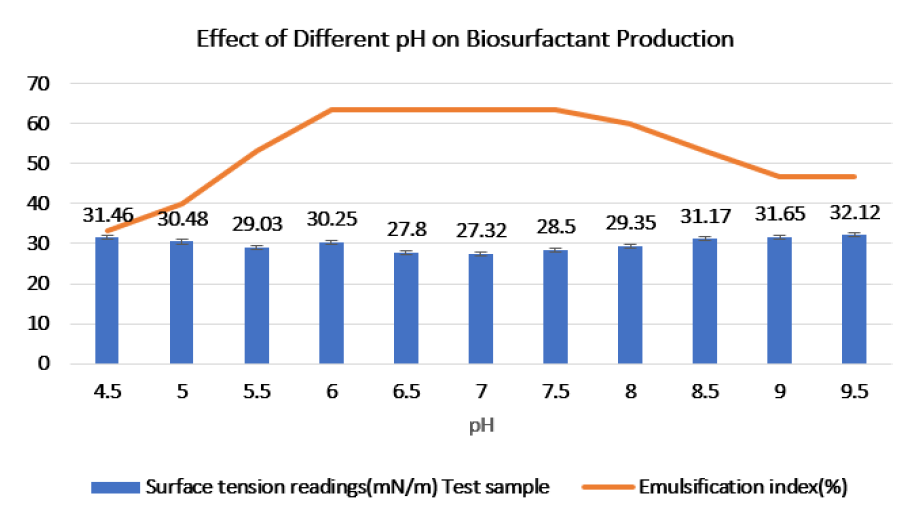
When grown in the different pH containing media, Pseudomonas aeruginosa VB MCC 4751 showed maximum reduction in surface tension to 27.32 mN/m and emulsification index of 63.33%. The given isolate showed the ability of reducing surface tension over a wide range of pH (Table 4 and Figure 3). Similar results were observed for other strains of Pseudomonas aeruginosa [17].


Calibration of instrument Optical Contact Angle Goniometer was carried out by checking surface tension of distilled water. Distilled water reading -72.52(mN/m).


Figure 3: Effect of pH on Biosurfactant Production


Table 4: Results of Effect of Different pH on Biosurfactant Production

pHSurface tension readings (mN/m) Test sampleEmulsification index (%)
4.531.4633.33
530.4840
5.529.0353.33
630.2563.33
6.527.8063.33
727.3263.33
7.528.5063.33
829.3560
8.531.1753.33
931.6546.66
9.532.1246.66


Effect of Different Temperature on Biosurfactant Production

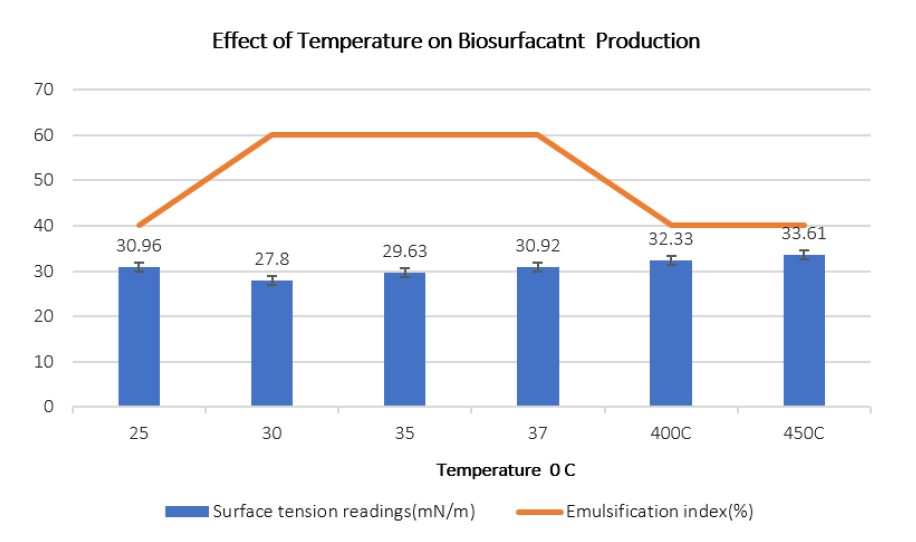
When grown at different temperatures, significant reduction in surface tension up to 27.8 mN/m was observed at 30 0C for Pseudomonas aeruginosa VB MCC 4751. The given isolate was showing reduction in surface tension at temperatures ranging from 250C to 45 0C and high emulsification index up to 60% over a temperature range of 30 0C to 37 0C (Table 5 and Figure 4). Similar results were observed for other strains of Pseudomonas aeruginosa [18].


Calibration of instrument Optical Contact Angle Goniometer was carried out by checking surface tension of distilled water. Distilled water reading-72.52 (mN/m, Medium control without bacterial culture 71.46(mN/m).


Table 5: Effect of Different Temperature on Biosurfactant Production

Temperature in 0CSurface tension readings (mN/m) Test sampleEmulsification index (%)
2530.9640
3027.860
3529.6360
3730.9260
4032.3340
4533.6140


Figure 4: Effect of Different Temperature on Biosurfactant Production

CONCLUSION

Optimization of parameter for improved production of biosurfactant is an important step due to low yield and high production cost as compared to chemical surfactants. By maintaining optimum conditions such as pH, temperature, salinity, carbon and nitrogen source, significant increase in biosurfactant production in terms of surface tension reduction was observed for Pseudomonas aeruginosa VB MCC 4751. Growth and biosurfactant production over a wide range of pH and temperature indicates significance of using marine bacteria for producing bioactive compounds on commercial scale due to their better adaptability to adverse environmental conditions. Use of cheaper nutrient sources for the production of biosurfactants in future will further decrease the production cost.


Acknowledgment

First author would like to thank the Department of Physics, SPPU, for providing facility for surface tension measurement studies.

REFERENCES
  1. Nurfarahin, A.H. et al. “Development of palm fatty acid distillate-containing medium for biosurfactant production by Pseudomonas sp. LM19.” Molecules, vol. 24, no. 14, 2019, article 2613, https://doi.org/10.3390/molecules24142613.

  2. Kalaimurugan, D. et al. “Production and characterization of a novel biosurfactant molecule from bacillus safensis yks2 and assessment of its efficiencies in wastewater treatment by a directed metagenomic approach.” Sustainability, vol. 14, no. 4, 2022, article 2142, https://doi.org/10.3390/su14042142.

  3. Maneerat, S. “Biosurfactants from marine microorganisms.” Songklanakarin Journal of Science and Technology, vol. 27, no. 6, 2005, pp. 1263–1272.

  4. Guo, P. et al. “Isolation and characterization of a biosurfactant producing strain planococcus sp. xw-1 from the cold marine environment.” International Journal of Environmental Research and Public Health, vol. 19, no. 2, 2022, article 782, https://doi.org/10.3390/ijerph19020782.

  5. Sharma, R. et al. “Optimization of rhamnolipid production from Pseudomonas aeruginosa PBS towards Application for microbial enhanced oil recovery.” 3 Biotech, vol. 8, no. 1, 2018, article 20, https://doi.org/10.1007/s13205-017-1022-0.

  6. Eslami, P. et al. “Recent advancements in the production of rhamnolipid biosurfactants by Pseudomonas aeruginosa.” RSC Advances, vol. 10, 2020, pp. 34014–34032.

  7. Thavasi, R. et al. “Evaluation of screening methods for the isolation of biosurfactant producing marine bacteria.” Journal of Petroleum and Environmental Biotechnology, 2011, article S1:001, https://doi.org/10.4172/2157-7463.S1-001.

  8. Chopra, A. et al. “Pseudomonas aeruginosa RTE4: A tea rhizobacterium with potential for plant growth promotion and biosurfactant production.” Frontiers in Bioengineering and Biotechnology, vol. 8, 2020, article 861, https://doi.org/10.3389/fbioe.2020.00861.

  9. Bindu, V. et al. “Isolation of biosurfactant producing Pseudomonas aeruginosa VB MCC 4751 from sea water near uran beach.” PARIPEX – Indian Journal of Research, March 2022.

  10. Maneerat, S. and K. Phetrong. “Isolation of biosurfactant-producing marine bacteria and characteristics of selected biosurfactant.” Songklanakarin Journal of Science and Technology, vol. 29, no. 3, 2007, pp. 781–791.

  11. Santos, D. et al. “Biosurfactants: Multifunctional biomolecules of the 21st century.” International Journal of Molecular Sciences, vol. 17, 2016, article 401, https://doi.org/10.3390/ijms17030401.

  12. Vanavil, B. “Biosurfactant production from novel air isolate NITT6l: Screening, characterization and optimization of media.” Journal of Microbiology and Biotechnology, 2013, https://doi.org/10.4014/jmb.1212.12031.

  13. Satpute, S.K. et al. “Assessment of different screening methods for selecting biosurfactant producing marine bacteria.” Indian Journal of Marine Sciences, vol. 37, 2008, pp. 8–13.

  14. Zhang, X. et al. “Isolation and identification of biosurfactant producing and crude oil degrading pseudomonas aeruginosa strains.” Chemical Engineering Journal, vol. 209, 2012, pp. 138–146, https://doi.org/10.1016/j.cej.2012.07.110.

  15. Patowary, K. et al. “Characterization of biosurfactant produced during degradation of hydrocarbons using crude oil as sole source of carbon.” Frontiers in Microbiology, vol. 8, 2017, article 279, https://doi.org/10.3389/fmicb.2017.00279.

  16. Ceresa, C. et al. “Inhibitory effects of lipopeptides and glycolipids on Candida albicans–Staphylococcus spp. Dual-Species Biofilms.” Frontiers in Microbiology, vol. 11, 2021, article 545654, https://doi.org/10.3389/fmicb.2020.545654.

  17. Saikia, R.R. et al. “Isolation of biosurfactant-producing Pseudomonas aeruginosa RS29 from oil-contaminated soil and evaluation of different nitrogen sources in biosurfactant production.” Annals of Microbiology, vol. 62, 2012, pp. 753–763, https://doi.org/10.1007/s13213-011-0315-5.

  18. Joice, P.A. and R. Parthasarathi. “Optimization of biosurfactant production from Pseudomonas aeruginosa PBSC1.” International Journal of Current Microbiology and Applied Sciences, vol. 3, no. 9, 2014, pp. 140–151.

  19. Moussa, T. et al. “Production and characterization of Di-rhamnolipid produced by Pseudomonas aeruginosa TMN.” Brazilian Journal of Chemical Engineering, vol. 31, 2014, pp. 867–880, https://doi.org/10.1590/0104-6632.20140314s00002473.

Recommended Articles
Research Article
Amit Jain’s System of Practice: From Modern to Super Modern Diabetic Foot Surgery
Published: 11/12/2020
Download PDF
Research Article
Awareness Regarding Danger Sign and Symptoms During Pregnancy among Antenatal Mothers Attending Outpatient Department of Rural Hospital in Himachal Pradesh
Published: 26/05/2023
Download PDF
Research Article
Curcumin: A Possible Treatment for Coronavirus Infection
Published: 10/10/2021
Download PDF
Review Article
Role of Nanotechnology in Pharmaceutical Science: A Review
...
Published: 10/09/2021
Download PDF
Chat on WhatsApp
Flowbite Logo
PO Box 101, Nakuru
Kenya.
Email: office@iarconsortium.org

Editorial Office:
J.L Bhavan, Near Radison Blu Hotel,
Jalukbari, Guwahati-India
Useful Links
Order Hard Copy
Privacy policy
Terms and Conditions
Refund Policy
Shipping Policy
Others
About Us
Team Members
Contact Us
Online Payments
Join as Editor
Join as Reviewer
Subscribe to our Newsletter
+91 60029-93949
Follow us
MOST SEARCHED KEYWORDS
Copyright © iARCON International LLP . All Rights Reserved.