Fifty children patient with Coronavirus 19 were collected from Karbala Health Directorate, Karbala, Iraq, where all demographic variables were recorded for children. The symptom can be confusing. However, it is almost impossible to distinguish one disease from another, and sometimes children are admitted to the hospital in the later stages of the illness, on average on the seventh day, if of moderate severity," noting that most of them were diagnosed with pneumonia based on CT scans. Children are not the main victims of this epidemic. But they are taking risks to be one of those who suffered the most Anyway, they are, fortunately, largely spared from direct the health impact of COVID-19 infection - at least Today at least - but the crisis seriously affects their well-being.
The COVID-19 pandemic is the biggest test the world has faced to understand its consequences for children worldwide and severe accidental act that is more common in the elderly - at least for the time being [1].
Many hospitalizations and child deaths from people living with HIV are exceptions and are likely related to pre-existing medical conditions.
All too often, children, due to coronavirus infection with COVID-19, tragically lose a parent, family member or guardian [2].
The psychological and social consequences of this loss on children should not be overlooked. The second area is the social and economic consequences of the virus and appropriate measures to prevent and control its transmission [3,4]. Pandemic because health services are overwhelmed with care for a large number of infected patients in need of treatment, children and pregnant women have less access to standard health care for the children of those at the forefront of the struggle, it has also had to adapt to alternative care options Children [5,6].
Children living in areas of armed conflict which already face significant difficulties in accessing health care can further deprive them of attention and access to health systems, Measures to ensure physical distancing and isolation, movement restrictions and border closures, and supervision mechanisms - all of these affect children in myriad ways [7,8].
So far, the direct impact of COVID-19 infection on children has been milder than on other age groups. Preliminary data on observed cases indicate that asymptomatic children's hospitalization rates are 10 and 20 times less than the middle-aged and 25-100 times less than the elderly 12.
Among the hospitalized patients, children are the least in need of intensive care [9-12]. It is estimated that 1 in 25,000 children who died from symptoms of the virus was 30 times less than middle-aged patients and 3,000 times less than older people than the general population. However, conclusions based on this data should be extreme.
The caution gave the limited coverage of current data sets and the different circumstances in which COVID-19 currently generally occurs. The epidemiological impact of the virus is expected to change over time and over time, and the broader impact of the pandemic on children's health, as opposed to the direct effects of COVID-19 infection being significant [13-15].
Children may not recover quickly from "Covid-19 and Children who do not show symptoms incubate the virus for a long time. A recent study confirmed that children may be infected with the “emerging coronavirus,” which causes the “Covid-19” pandemic, for several weeks without showing any symptoms of the disease [16,17].
The study, published in JAMA Pediatrics and conducted by Roberta, chief of pediatrics at Children's National Hospital in Washington, and Megan Delaney, chief of pathology and laboratory medicine at the hospital, provided many insights into the role of children in transferring Covid-19 disease [18].
"The study focused on 91 pediatric patients who were followed up in 22 hospitals across South Korea," DIBIASE says, according to the press release accompanying the study. Contrary to the American health system, the South Korean authorities detain in the hospital all those who test positive for the disease, even if they do not show symptoms, until their recovery [19].
Patients were divided into 22% who did not show any symptoms, 20% developed symptoms after a while, and 58% developed symptoms when the initial test was performed. During the study, the children were tested every three days, on average; To visualize how their bodies would get rid of the virus over time.
The study concluded several important points related to “Covid-19” in children, including that a large segment of sick children did not show symptoms of “Covid-19” disease (22% of the study sample) and that the belief that children develop a slight degree of infection. Illness, and that they quickly recover from it is a mistaken belief; About 50% of those who showed symptoms suffered from the disease for about three weeks, and the study also revealed that children who did not show symptoms incubate the virus for a long time, which makes them major potential carriers of the disease [5,12,18].
The two researchers explained, in statements to "Al-Salam," that the PCR test, which detects the genetic material of the COVID 19 virus using a laboratory technique called a polymerase chain reaction, only determines the presence of the virus or not, regardless of its quantity, which means that the positive analysis may mean the presence of a quantity Too little or too much virus. It detects the presence of remnants of a non-living, non-infectious virus just as it detects the presence of infectious viruses. Thus, a positive test result does not necessarily mean that the detected virus can transmit to humans and make them sick [10,11]. A positive result in a PCR test cannot distinguish whether a patient is still a potential source of infection for others. The only way to know is to determine whether the virus can be cultured, but this is not widely available and is limited to research laboratories. Preliminary research is currently being conducted to determine whether a certain amount of virus (a quantitative test) is associated with a greater likelihood of infection or not, and these findings and additional questions may affect efforts.
Currently, children are concerned about the negative impact of the pandemic on their lives and communities.
As well as uncertainties about the future for how long today's emergencies will last and how the pandemic will eventually be overcome, acute stress in severely deprived children can impair their cognitive development and cause long-term mental health problems [18,19].
Fifty pediatric patients with COVID-19 were collected, and demographic variables and all required characteristics were collected from Karbala Health Directorate, Karbala, Iraq.
Minors may have a runny nose and cough. In addition, older adults may have a headache while younger people may have irritation. For this reason, it is sufficient to present any of these symptoms to be evaluated by a doctor and less frequent symptoms such as abdominal pain, diarrhea and later, palpitations Breathing problems. There is a large proportion of children with symptoms. It was confirmed that recent information indicates that up to 40% of children who have been in contact with people with COVID-19 who have been infected have never developed symptoms.
According to the CDC, after infection, the incubation period for SARS-CoV-2 appears to be about the same for children as for adults, from 2 to 14 days with an average of 6 days.
It should be noted that in some cases, children with COVID-19 with or without symptoms may develop a rare and serious complication called pediatric multisystem inflammatory syndrome (SMIP).
Statistical Analysis
Medical statistics collected is a complete service that includes all demographic information on sick children, including age and gender. Medical statistics are presented by compiling multi-part reports, but this is an oversimplified look to correctly interpret the data obtained, as the program relied on SPSS 22 SOFT. It also included age analysis by relying on a real value and logistic regression and analysis by knowing the type and effect of the disease in terms of the type of relationship, whether direct or inverse.
The conditions for obtaining complete, accurate and reliable statistical information are based on the “E” principle: a unified system of prior medical records and procedures for their preservation; unified software for accounting and data collection; unified methodology for calculating indicators; Standardized, systematic approaches to reporting by all healthcare organizations; A unified system of concepts and terminology in which the "veracity" of information is achieved through the analysis of several indicators And if an error crept into the statistical report, then it can be detected when analyzing the indicators of different sections of the report when the information received does not correspond to each other.
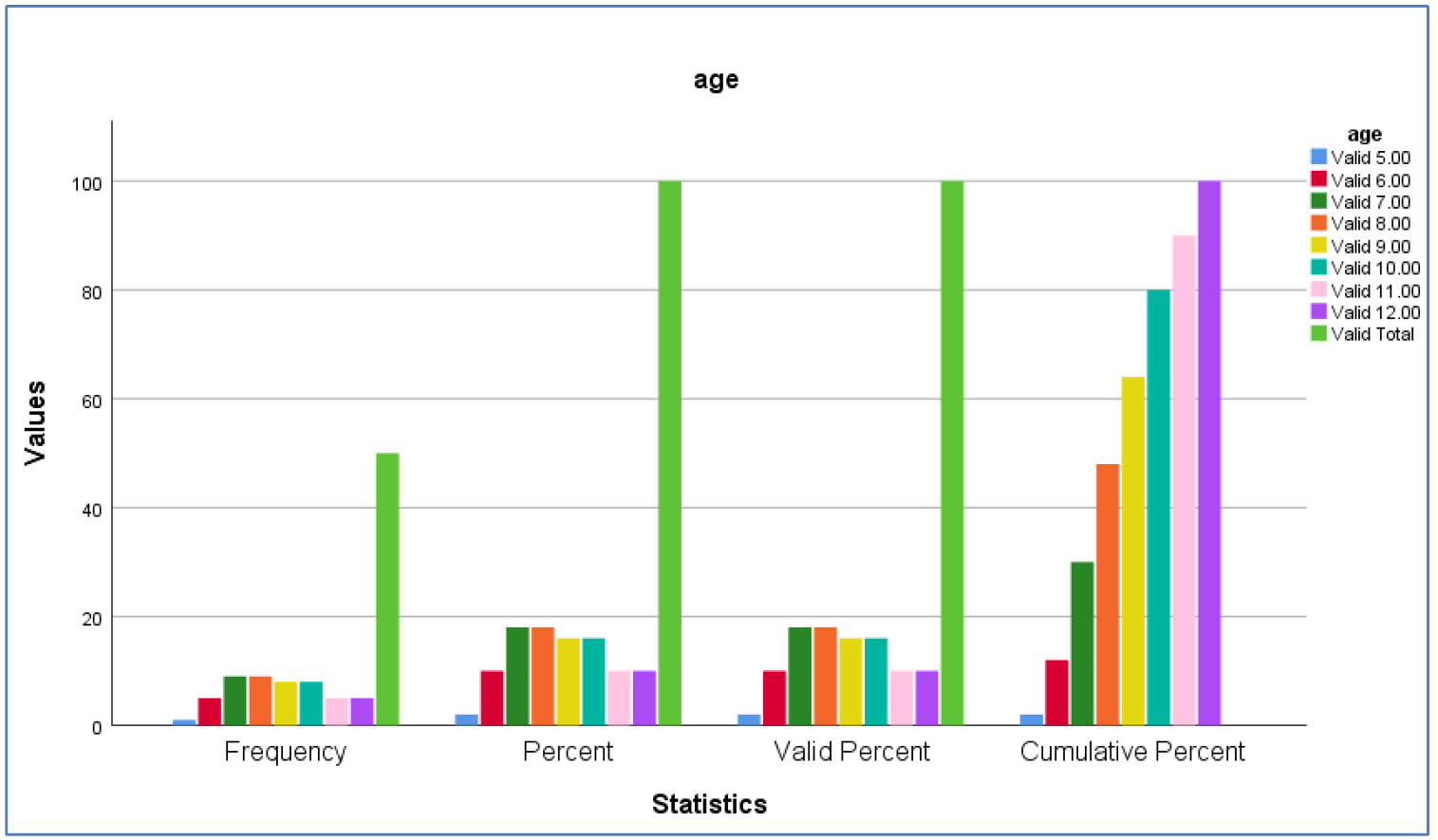
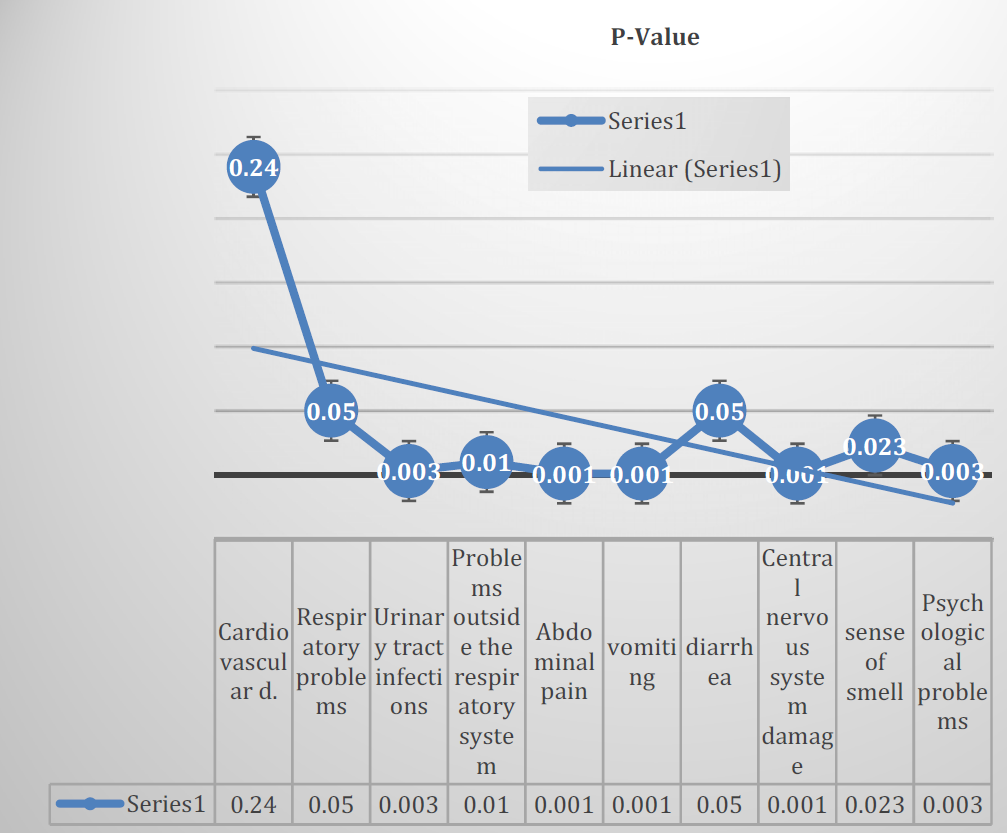
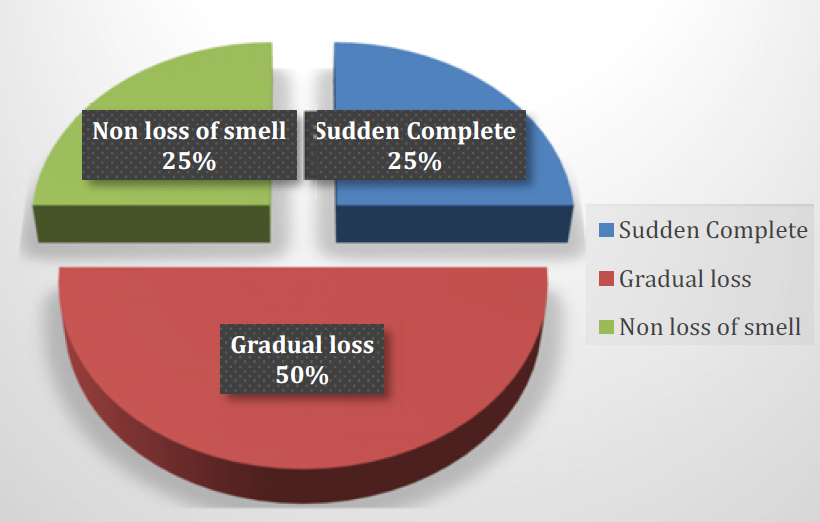
Following Table 1,2 and 3 shows the different results. Figure 1,2 and 3 shows the results graphically.
Table 1: Analysis of the Ages of Patient Children
| Age | |||||
| Parameters | F | P Percentage | VP | CP Percentage | |
| Valid | 5.00 | 1 | 2.0 | 2.0 | 2.0 |
| 6.00 | 5 | 10.0 | 10.0 | 12.0 | |
| 7.00 | 9 | 18.0 | 18.0 | 30.0 | |
| 8.00 | 9 | 18.0 | 18.0 | 48.0 | |
| 9.00 | 8 | 16.0 | 16.0 | 64.0 | |
| 10.00 | 8 | 16.0 | 16.0 | 80.0 | |
| 11.00 | 5 | 10.0 | 10.0 | 90.0 | |
| 12.00 | 5 | 10.0 | 10.0 | 100.0 | |
| Total | 50 | 100.0 | 100.0 | - | |
Table 2: Distribution of the Number of Patients According to Age
| Ages | N |
| Cardiovascular d. | 1 |
| Respiratory problems | 5 |
| Urinary tract infections | 4 |
| Problems outside the respiratory system | 9 |
| Abdominal pain | 16 |
| Vomiting | 8 |
| Diarrhea | 11 |
| Central nervous system damage | 2 |
| Sense of smell | 50 |
| Psychological problems | 19 |
Table 3: Olfactory Dysfunction
| Age | |||||
| Parameters | Frequency | Percent | Valid Percent | Cumulative Percent | |
| Valid | Sudden Complete | 1 | 2.0 | 2.0 | 2.0 |
| Sudden Complete | 5 | 10.0 | 10.0 | 12.0 | |
| Sudden Complete | 9 | 18.0 | 18.0 | 30.0 | |
| Sudden incomplete | 9 | 18.0 | 18.0 | 48.0 | |
| Gradual loss | 8 | 16.0 | 16.0 | 64.0 | |
| Gradual loss | 8 | 16.0 | 16.0 | 80.0 | |
| Non loss of smell | 5 | 10.0 | 10.0 | 90.0 | |
| Non loss of smell | 5 | 10.0 | 10.0 | 100.0 | |
| Total | 50 | 100.0 | 100.0 | ||

Figure 1: Explain the Validity of the Patient

Figure 2: P Value

Figure 3: P-Value Olfactory Dysfunction
Fifty pediatric patients were collected from Karbala Health Directorate, Karbala, Iraq; the ages were confined between 5 to 12 years. The true value with the arithmetic means to the children most patients with coronavirus was 8±1.5.
Child patients with a mild course of coronavirus complain more often of a loss of smell and taste than those with severe disease, and doctors who work with patients daily confirm this pattern. They explained that these symptoms primarily indicate damage to the nervous system, while the lungs suffer more in severe patients.
“Covid affects different organs in terms of complications, and decreased sense of smell and lack of taste are more related to damage to the central nervous system. Patients who have experienced complications also report apathy and depression - those with the most obvious complications of the virus suffer the most. Sometimes from damage to the pulmonary system, this is just a development of pneumonia, which most “acute” patients suffer in addition to skin and intestinal syndromes.”
Even in some studies, it is not denied that there are no serious symptoms of the Coronavirus -19 on children. On the contrary, some serious problems cannot be denied, and children with Covid-19 have milder symptoms than adults.
All HCoVs are known to cause respiratory infections, and the SARS virus is considered the most aggressive, although the disease appears to be less severe in children than in adults. In patients <12 years of age, the clinical course of SARS was generally milder and shorter than in those >12 years: no deaths were reported, only 5% of infected children were admitted to the intensive care unit.
The proportion of children who developed severe or critical illness with ARF (acute respiratory hurt course) and shock is much lower (6 6) than grown-ups (19 19)- especially the elderly generation with confirmed cardiovascular or lung complications.
According to the February report of the World Health Organization business, only 2.4 % of those infected are 13 epochs old or immature, in2.5; the complication has turned into a serious form.
And represent in 0.2 % - as critical condition and a small chance of children, despite the infection they had no symptoms at all and “One possible reason is that this toxin needs a protein on the cell face to get out and start its destructive conditioning. Putatively, the coronavirus uses the ACE-2 receptor as a gateway. Children may have lesser of it in the lower respiratory tract. Only the upper respiratory tract is affected.
This may explain why symptoms in children infected with the coronavirus are similar to the common cold. Coronaviruses are attracted to the ACE-2 receptor.
It seems that in children, the body reacts more intensively than in adults to a viral infection, for example, a high temperature, which is not very common in adults - it is very likely that the child's immune system will be able to control better the virus, Its localization in the upper respiratory tract, preventing it from causing further damage and eliminating it and that the reason for the lack of necessary effects is that children are helped through fewer cardiovascular and lung diseases than adults. Very few children develop the dangerous infectious disease Covid-19, and this means there is something fundamentally different about how their bodies handle the virus."
Corsetti, R. et al. “The immune system of children: The key to understanding SARS-CoV-2 susceptibility?” The Lancet Child & Adolescent Health, 2020, pp. 414–416.
Shock, N. et al. “Pathophysiology of COVID-19: Why do children fare better than adults?” 2020, https://doi.org/10.1007/s12098-020-03322-y.
Schuez-Havupalo, L. et al. “Daycare attendance and respiratory tract infections: A prospective birth cohort study.” BMJ Open, vol. 7, 2017.
Parri, N. et al. “Children with COVID-19 in pediatric emergency departments in Italy.” New England Journal of Medicine, vol. 383, 2020, pp. 187–190. https://doi.org/10.1056/NEJMc2007617.
Lu, X. et al. “SARS-CoV-2 infection in children.” New England Journal of Medicine, vol. 382, 2020, pp. 1663–1665. https://doi.org/10.1056/NEJMc2005073.
Götzinger, F. et al. “COVID-19 in children and adolescents in Europe: A multinational, multicentre cohort study.” 2020, pp. 1–9.
Fouchier, R.A. et al. “A previously undescribed coronavirus is associated with respiratory disease in humans.” Proceedings of the National Academy of Sciences, vol. 101, no. 16, 2004, pp. 6212–6216.
Esper, F. et al. “Evidence of a novel human coronavirus that is associated with respiratory tract disease in infants and young children.” The Journal of Infectious Diseases, vol. 191, no. 4, 2005, pp. 492–498.
Suzuki, A. et al. “Detection of human coronavirus-NL63 in children in Japan.” The Pediatric Infectious Disease Journal, vol. 24, no. 7, 2005, pp. 645–646.
Chiu, S.S. et al. “Human coronavirus NL63 infection and other coronavirus infections in children hospitalized with acute respiratory disease in Hong Kong, China.” Clinical Infectious Diseases, vol. 40, no. 12, 2005, pp. 1721–1729.
Arden, K.E. et al. “New human coronavirus, HCoV-NL63, associated with severe lower respiratory tract disease in Australia.” Journal of Medical Virology, vol. 75, no. 3, 2005, pp. 455–462.
Ebihara, T. et al. “Detection of human coronavirus NL63 in young children with bronchiolitis.” Journal of Medical Virology, vol. 75, no. 3, 2005, pp. 463–465.
Kaiser, L. et al. “Human coronavirus NL63 associated with lower respiratory tract symptoms in early life.” The Pediatric Infectious Disease Journal, vol. 24, no. 11, 2005, pp. 1015–1017.
Bastien, N. et al. “Human coronavirus NL-63 infections in children: A 1-year study.” Journal of Clinical Microbiology, vol. 43, no. 9, 2005, pp. 4567–4573.
Vabret, A. et al. “Human coronavirus NL63, france.” Emerging Infectious Diseases, vol. 11, no. 8, 2005, p. 1225.
Boivin, G. et al. “Infections by human coronavirus-NL in hospitalized children.” The Pediatric Infectious Disease Journal, vol. 24, no. 12, 2005, pp. 1045–1048.
Esposito, S. et al. “Impact of human coronavirus infections in otherwise healthy children who attended an emergency department.” Journal of Medical Virology, vol. 78, no. 12, 2006, pp. 1609–1615.
Choi, E.H. et al. “The association of newly identified respiratory viruses with lower respiratory tract infections in Korean children, 2000–2005.” Clinical Infectious Diseases, vol. 43, no. 5, 2006, pp. 585–592.
Guan, Y. et al. “Isolation and characterization of viruses related to the SARS coronavirus from Animals in Southern China.” Science, vol. 302, no. 5643, 2003, pp. 276–278.