Background: GIT is one of the main causes of human morbidity and mortality especially in developing countries. Aim: To identify the characteristics of patients with gastrointestinal tract infection in emergency unit during the study period. Methods: A retrospective cross-sectional study was conducted in all hospitals which contain the emergency department in eighteen governorates in Iraq. All the cases admitted from the first of January 2018 to the end of December 2019 was enrolled in this study. Semi-structured questionnaire was used to collect the information from the records. The sample size was 3085345 cases. Data was described by using the descriptive statistics such as frequency, percentage, Chi-square and P. value. STATA version 14 statistical package was used to analyze the data. Results: Our finding presented that the higher percentage 52% of them were occur during 2019 and 25.3% of them were occur in the age groups 20 to 44 years old, followed by 25% in the age more than 45 years old; half of them 51.3% were male cases. The frequencies of cases 52% were higher during 2019 more than 48% in 2018. Conclusion: We concluded that the GIT infection had occurred in the age groups 1- 19, 20- more than 45 years old, respectively. The higher rate of disease was higher during 2019 more than in 2018. There are a highly significant association has been found between the age groups, gender by years at the p. value less than 0.05. Recommendation: We need further research on this field to decrease the mortality and morbidity among people in emergency department.
Globally, GIT is one of the main causes of human morbidity and mortality especially in developing countries in which public health standards are not as high as in developed countries [1]. GIT is associated with climate conditions, poor sanitation and economic variables, lack of access to potable water, improper food and cultural habits [2].
The rate of GIT infection was 1.8 per 10000 of population during 2019 while in 2018, the rate was 1.7 [3,4]. The rate of GIT infection in US was 22% per 100000 of population, 19% in Brazil, 12% in Russia and 9% in Japan, respectively [5].
Gastrointestinal infection is one of the most common diseases in young children and it’s due to the norovirus, rotavirus, salmonella and campylobacter bacteria, indicating that the risk of infection increases in children under five years of age compared to other older children [6].
Emergency unit is a vital line for each hospital and it’s the main gate to receive all with different reasons [7]. In Iraq and during the seventeen years, the deterioration in health system as a result of war and Daesh and, the lack of facilities and equipment’ and which is lead to increase the mortality and morbidity among cases in emergency units [8]. All the patients are examined immediately after admission by the appropriate specialized doctors according to the patient's condition [9].
Although we do not see the microorganisms surrounding us, they play a vital role in all areas of our life; in a way that makes them appear to manage the world we live in on planet Earth and even manage our lives as humans [10]. Millions of billions of microorganisms (mostly bacteria) live in our gut, cover the membranes lining the intestine and create a tiny ecosystem called the micro biome. Day after day, this system proves to play a very important role in maintaining human health, in addition to affecting one's mood [11].
A cross-sectional study conducted in Nigeria that the 8.2% of patients were admitted to emergency unit had GIT infection [12]. Other cross-sectional study conducted in Iran, the authors reported the male cases had a higher rate of GIT infections more than female cases [13].
In addition, worldwide, previous studies have shown that there are several risk factors associated to the high prevalence and incidence of GIT including untreated water supply, age, poor sanitation, low family income, low level of education, low level of parental education, eating unpeeled/unwashed vegetables and fruits, contact with livestock or pets and poor personal hygiene [14-18].
This study aimed to identify the characteristics of patients with gastrointestinal tract infection in emergency unit during the study period.
A retrospective cross-sectional study was conducted in all hospitals which contain the emergency department in eighteen governorates in Iraq. All the cases admitted from the first of January 2018 to the end of December 2019 was enrolled in this study. All cases suffering from digestive disorders were admitted to the emergency ward which included constipation, irritable bowel syndrome, hemorrhoids, anal fissures, perianal abscesses, anal fistulas, perianal infections, diverticular diseases, colitis, colon polyps and cancer were enrolled in this study. Other causes of admission to emergency unit were excluded from this study. Semi-structured questionnaire was used to collect the information from the records. The sample size was 3085345 cases. Data was described by using the descriptive statistics such as frequency, percentage, Chi-square and P. value. STATA version 14 statistical package was used to analyze the data. Ethical clearance was obtained from the Ministry of Health/ Iraq. Oral and written informed consent was obtained from participants before enrolled to this study.
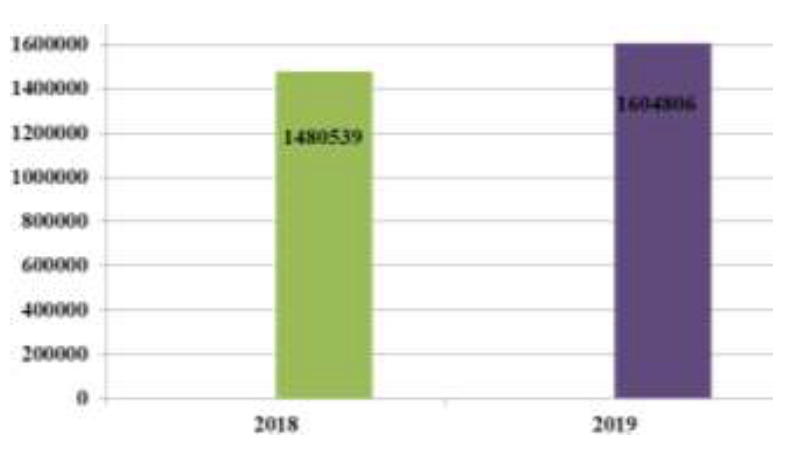
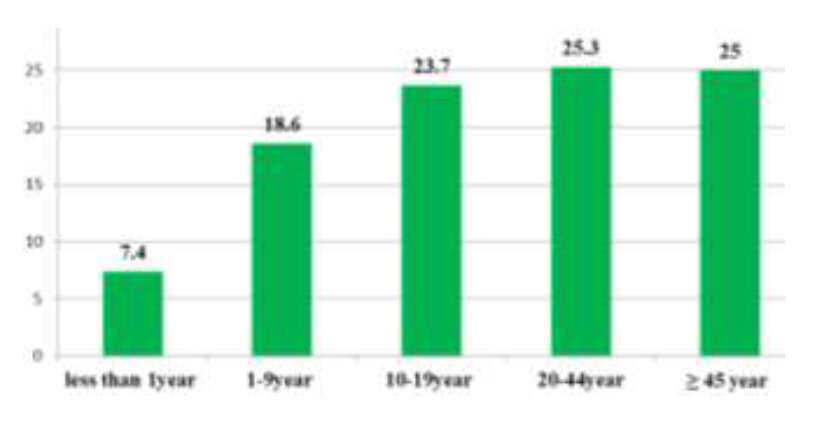
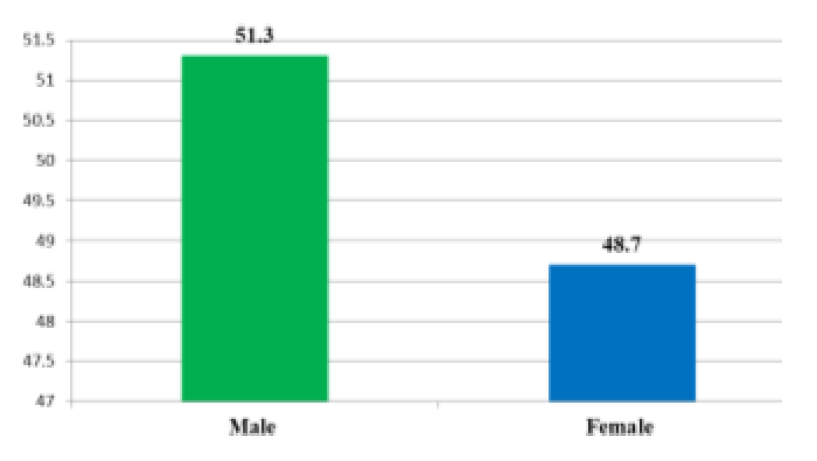
Out of 3085345 cases, the higher percentage 52% (1604806 /3085345) of them were occur during 2019 more than 48% (1480539/3085345) in 2018 (Table 1). Also, in Table 1 and Figure 2, we show that the higher percentage 25.3% (780107/3085345) of cases were occur in the age groups 20 to 44 years old, followed by 25% (772314/3085345) in the age more than 45 years old and the less percentage of them 7.4% (228711/3085345) were occurred in age less than one year old. There is a highly significant association has been found between the age groups and years at the P. values less than 0.05 (Table 1). In Table 2 and Figure 3, we show that the higher percentages 51.3% (1582321/3085345) of them were male cases and 48.7% (1503024/3085345) were female cases. There is a highly significant association has been found between the gender and years at the P. values less than 0.05. In Figure 1, the frequencies of cases 52% (1604806 / 3085345) were higher during 2019 more than 48% (1480539/ 3085345) in 2018.
Table 1: Distribution of studied samples according to age groups by years
| Age groups (years) | Years | Total | ||||
2018 | 2019 | |||||
F | % | F | % | F | % | |
Less than 1 | 104571 | 7.1 | 124140 | 7.7 | 228711 | 7.4 |
1-9 | 270175 | 18.3 | 304014 | 18.9 | 574189 | 18.6 |
10-19 | 360148 | 24.3 | 369876 | 23.1 | 730024 | 23.7 |
20-44 | 389751 | 26.3 | 390356 | 24.3 | 780107 | 25.3 |
≥45 | 355894 | 24.0 | 416420 | 26.0 | 772314 | 25.0 |
Total | 1480539 | 100 | 1604806 | 100 | 3085345 | 100 |
The p value is <0.00001
Table 2: Distribution of studied samples according to gender by years
| Gender | Years | Total | ||||
2018 | 2019 | |||||
F | % | F | % | F | % | |
Male | 763349 | 51.6 | 818972 | 51.0 | 1582321 | 51.3 |
Female | 717190 | 48.4 | 785834 | 49.0 | 1503024 | 48.7 |
Total | 1480539 | 100 | 1604806 | 100 | 3085345 | 100 |
The p value is <0.00001

Figure 1: Distribution of studied samples during 2018-2019

Figure 2: Distribution of studied samples according to age groups during 2018-2019

Figure 3: Distribution of studied sample according to gender during 2018 to 2019
This study aimed to identify the characteristics of patients with gastrointestinal tract infection in emergency unit during the study period. Gastrointestinal infections are viral, bacterial or parasitic infections that cause gastroenteritis, an inflammation of the gastrointestinal tract involving both the stomach and the small intestine. Symptoms include diarrhea, vomiting and abdominal pain [19]. In our study, we found that age has a positive relationship with gastrointestinal diseases, especially between the younger and elderly ages.
The higher percentage 50.3% of them had occur in the age groups 20 to more than 45 years, as well as 42.3% in the ages one year to 19 years. Compared with other studied in Canada [20], US [21], the authors reported the infection was high among children and elder people. This is due to the fact that the majority of them eat food outside the home, which lacks the level of hygiene or they practice wrong hygiene habits. In this study, we found that the higher percentages 52% of them were occur during 2019 more than 48% in 2018. Another study conducted in Uganda [22], the disease was higher during 2015.
This difference is due to the deterioration of the health situation. Also, the lack level of health awareness and methods of personal protection among individuals. Our finding presented that the higher percentages 51.3% of them were male cases and 48.7% were female cases. Compared with similar studied done it in Nigeria [23], Africa [10] and in Iran [13], this refers the same habits and behaviors between countries. There is a highly significant association has been found between the gender and years at the P. values less than 0.05. In fact, that the majority of men prefer to eat outside the home and in different places with lack of hygiene, in addition to the fact that most of them suffer from some diseases that increase their incidence of gastrointestinal diseases.
We concluded that the majority of cases were male, the GIT infection had occurred in the age groups 1- 19, 20- more than 45 years old, respectively. The higher rate of disease was higher during 2019 more than in 2018. There are a highly significant association has been found between the age groups, gender by years at the p. value less than 0.05. We need further research on this field to decrease the mortality and morbidity among people in emergency department.
Greenwood, Z. et al. “Gastrointestinal infection among international travelers globally.” Journal of Travel Medicine, vol. 15, no. 4, 2008, pp. 221-228.
Roy, S.L. et al. “The rate of acute gastrointestinal illness in developed countries.” Journal of Water and Health, vol. 4, suppl. 2, 2006, pp. 31-69.
Iraqi Ministry of Health. The Annual National Health Statistics Report. Baghdad, 2018.
Iraqi Ministry of Health. The Annual National Health Statistics Report. Baghdad, 2019.
Elflein, J. “Prevalence of diagnosed gastrointestinal conditions in selected countries.” 2019.
Boga, J.A. et al. “Etiology of sporadic cases of pediatric acute gastroenteritis in Asturias, Spain and genotyping and characterization of norovirus strains involved.” Journal of Clinical Microbiology, vol. 42, no. 6, 2004, pp. 2668-2674.
Bech, C.N. et al. “Risk factors associated with short-term mortality changes over time, after arrival to the emergency department.” Scandinavian Journal of Trauma, Resuscitation and Emergency Medicine, vol. 26, no. 1, 2018, pp. 29.
Lafta, R.K. and M.A. Al-Nuaimi. “National perspective on in-hospital emergency units in Iraq.” Qatar Medical Journal, vol. 2013, no. 1, 2013, pp. 19-27.
Carter, A.J. and A.H. Chochinov. “A systematic review of the impact of nurse practitioners on cost, quality of care, satisfaction and wait times in the emergency department.” Canadian Journal of Emergency Medicine, vol. 9, no. 4, 2007, pp. 286-295.
Fletcher, S.M. et al. “Prevalence of gastrointestinal pathogens in Sub-Saharan Africa: systematic review and meta-analysis.” Journal of Public Health in Africa, vol. 2, no. 2, 2011, pp. 127-137.
Fletcher, S. et al. “Gastrointestinal pathogen distribution in symptomatic children in Sydney, Australia.” Journal of Epidemiology and Global Health, vol. 3, no. 1, 2013, pp. 11-21.
Uchendu, J.O. et al. “Gastrointestinal lesions in a Nigerian tertiary care centre: a histopathological study.” West African Journal of Medicine, vol. 37, no. 4, 2020, pp. 362-367.
Kiani, H. et al. “Prevalence, risk factors and symptoms associated to intestinal parasite infections among patients with gastrointestinal disorders in Nahavand, Western Iran.” Revista do Instituto de Medicina Tropical de São Paulo, vol. 58, 2016. https://doi.org/10.1590/s1678-9946201658042.
Choy, S.H. et al. “Prevalence and associated risk factors of Giardia infection among indigenous communities in rural Malaysia.” Scientific Reports, vol. 4, 2014, pp. 6909.
Muñoz-Antoli, C. et al. “Prevalence and risk factors related to intestinal parasites among children in Department of Rio San Juan, Nicaragua.” Transactions of the Royal Society of Tropical Medicine and Hygiene, vol. 108, no. 12, 2014, pp. 774-782.
Arani, A.S. et al. “Prevalence of intestinal parasites in a population in south of Tehran, Iran.” Revista do Instituto de Medicina Tropical de São Paulo, vol. 50, no. 3, 2008, pp. 145-149.
Wördemann, M. et al. “Prevalence and risk factors of intestinal parasites in Cuban children.” Tropical Medicine and International Health, vol. 11, no. 12, 2006, pp. 1813-1820.
Daryani, A. et al. “Epidemiological survey of the prevalence of intestinal parasites among schoolchildren in Sari, northern Iran.” Transactions of the Royal Society of Tropical Medicine and Hygiene, vol. 106, no. 8, 2012, pp. 455-459.
Fletcher, S.M. et al. “Prevalence of gastrointestinal pathogens in developed and developing countries: systematic review and meta-analysis.” Journal of Public Health Research, vol. 2, no. 1, 2013, pp. 42-53.
Pardhan-Ali, A. et al. “A descriptive analysis of notifiable gastrointestinal illness in the Northwest Territories, Canada, 1991-2008.” BMJ Open, vol. 2, no. 4, 2012.
Mullaney, S.B. et al. “Magnitude, distribution, risk factors and care-seeking behaviour of acute, self-reported gastrointestinal illness among US Army soldiers: 2015.” Epidemiology and Infection, vol. 147, 2019, e151.
Clark, S. et al. “The burden and determinants of self-reported acute gastrointestinal illness in an Indigenous Batwa Pygmy population in southwestern Uganda.” Epidemiology and Infection, vol. 143, no. 11, 2015, pp. 2287-2298.
Awi-Waadu, G.D. “The prevalence of gastro-intestinal tract parasites in the inhabitants of Bori Military Cantonment in Port Harcourt Local Government Area of Rivers State, Nigeria.” African Journal of Applied Zoology and Environmental Biology, vol. 7, 2005, pp. 56-60.