Background: Previous studies revealed that Neutrophil-to-Lymphocyte Ratio (NLR) is associated with cirrhotic adults’ mortality rate in the liver transplantation waiting list, independent of the cirrhosis stage or the (MELD) score Model for End-Stage Liver Disease. However, there is not enough information available about the usefulness of this ratio among children. Objective: We aimed to evaluate the prognostic value of NLR on the survival of cirrhotic children, candidates for liver transplantation, on the waiting list. Materials and Methods: In the present historical cohort study, cirrhotic children, younger than 18 years of age, listed for first elective single organ liver transplant, were recruited. Results: A total of 103 patients were studied. The median of the patients’ age was 4.5 years and the male to female ratio was 0.94:1. Sixteen patients died during follow-up (mean duration of 9.34±3.98 weeks). The clinic-demographic and laboratory parameters between surviving and non-surviving patients were similar to each other’s except for variceal bleeding, total bilirubin, PELD/MELD score and NLR that was higher among the non-survivor patients. After adjusting for confounding factors in the multiple logistic models, the adjusted odds ratio (OR) for NLR for those who survived was 1.39 (95% CI, 1.04-1.87; P=0.026). The NLR has more specificity but less sensitivity than MELD/PELD score (81% vs. 70%) and (50% vs. 68%) respectively. Conclusion: We observed that a higher NLR was correlated with higher risk of mortality among the children who suffered from liver cirrhosis, on the liver transplantation waiting list.
Keywords
Liver Cirrhosis
Liver Transplantation
Child
Survival
Neutrophil to Lymphocyte
INTRODUCTION
There are some scoring systems available to predict the survival of patients with liver cirrhosis on the waiting list for liver transplantation. Child-Turcotte-Pugh (CTP), Model for End-Stage Liver Disease (MELD) or the Pediatric End-Stage Liver Disease (PELD) scores for patients who are younger than 12 years old are commonly applied for such patients [1]. The CTP score has some disadvantages, including using subjective items (ascites and hepatic encephalopathy) and a narrow range (7 to 15) for the severity of the liver cirrhosis [2]. Despite the more usefulness of the MELD/PELD score in assessing the prognosis/ survival of patients, identified as liver transplant candidates who are kept on the waiting list, this tool still has some limitations [3-5]. The MELD/PELD scores does not consider the significant complications of liver cirrhosis that are independently correlated with lower survival rate (including hyponatremia- which is true for the PELD score only because the new MELD-Na has serum sodium value as a criteria-, hepatic encephalopathy, hepatorenal syndrome, esophageal varices bleeding and spontaneous bacterial peritonitis) [6]. Furthermore, the MELD score accuracy decreases among patients with lower scores (MELD score ≤20) [7]. One of the complimentary parameters that have recently been found to be useful in predicting the survival of cirrhotic patients is the neutrophil-to-lymphocyte ratio (NLR) [8,9]. The NLR is not only used prognostic in liver cirrhosis, it is also useful for assessing outcome of cardiovascular diseases [10] and malignancies [11-13]. It is also associated with mortality in the general population [14]. Previous studies revealed that elevated NLR is associated with a higher mortality rate independent of MELD score and cirrhosis stage [8,15]. However, they were performed among adult patients and to our best knowledge; there is not enough information available about the usefulness of this ratio among children. Thus, in the present study, we evaluated the prognostic value of NLR as survival indicator in cirrhotic children, listed for liver transplantation.
Objectives
The objective of the study is aimed to evaluate the prognostic value of NLR for the survival of cirrhotic children, listed for liver transplantation.
MATERIALS AND METHODS
This is a historical cohort study performed at Organ Transplant Center affiliated with Shiraz University of Medical Sciences between January 2015 and January 2019. A total of 103 patients were studied. All children, less than 18 years of age, with clinical, histological or radiographic evidence of liver cirrhosis who were listed for the first elective single organ liver transplant; were recruited. Initially, 130 patients fulfilling the inclusion criteria were identified. Twenty-seven of these patients were excluded from the study. Of these, 10 had active infection, seven had renal failure and ten were unreachable after discharge. The study protocol was approved by the local committee (Protocol approval number: IR.SUMS.MED.REC.1399.383). Written informed consent from patients was not required. The exclusion criteria were: incomplete information, ongoing infection, recent antibiotic therapy, and/or concomitant renal failure. The following baseline characteristics were recorded for liver transplantation listing: age, sex, weight, liver cirrhosis etiology (including six major disease categories that are relevant in children: biliary atresia, metabolic disorders such as Wilson disease, Tyrosinemia and Galactosemia; autoimmune diseases; acute liver failure; cancer and miscellaneous: such as PFIC, neonatal hepatitis and other chronic diagnoses). The liver cirrhosis complications during the liver transplantation waiting period (such as encephalopathy, variceal bleeding, ascites, spontaneous bacterial peritonitis, cyanosis, hepatopulmonary syndrome, previous history of infections, etc.) were recorded. Some laboratory values, including complete blood count (CBC), albumin, international normalized ratio (INR), creatinine, sodium and neutrophil and lymphocyte counts were obtained from their medical records. The survival predictors of the cirrhotic patients (including PELD/MELD and CTP scores) were calculated using their clinical and laboratory findings according to the formula provided by United Network for Organ Sharing (UNOS) [16]. The MELD score is applied for patients older or equal to 12 years of age. We considered 1, 2 and 3 points for A, B and C CTP scores, respectively. Moreover, the NLR was calculated by dividing the neutrophil count by lymphocyte count. CBC of all patients was measured using a hematology analyzer (Sysmex KX-21N, Japan).
Statistical Analysis
In the present study, the quantitative data was expressed as the mean±SD or as the median (inter-quartile range) and the qualitative data was described as the frequency and percentage. In order to compare the two underling groups, Student’s t-test and Mann - Whitney U test were used for the quantitative data. And qualitative data was analyzed using Chi-squared or Fisher’s exact test. Spearman correlation test was also applied to evaluate the relationship between NLR and other variables. Multiple logistic regression analysis was performed to assess the potential predictors of liver-related death, as the variables that were significant in univariate analysis (p-value<0.1) were entered into the model. Receiver-Operating Characteristic (ROC) curves were then generated to assess the accuracy of variables in predicting death by 3 months. Data were analyzed using the SPSS 16 package (SPSS Inc, Chicago, IL, USA) and MedCalc 14 software (MedCalc, Belgium). P-value of less than 0.05 was regarded as statistically significant
RESULTS
The baseline demographic and laboratory characteristics of the patients at the time of listing for liver transplantation are shown in Table 1.
Table 1: Baseline clinic-demographic and laboratory parameters of the children with liver cirrhosis in liver transplantation waiting list
Parameters
n =103
Age (years, median (IQR))
4.5 (1, 10)
Weight (kg, median (IQR))
12 (7.3, 25)
Sex (male, %)
50 (48.5%)
Underlying disease
Biliary Atresia (yes, %)
31 (30.1%)
Metabolic Disorders (yes, %)
34 (33%)
Autoimmune Diseases (yes, %)
9 (8.7%)
Acute Liver Failure (yes, %)
2 (1.9%)
Cancer (yes, %)
1 (1%)
Miscellaneous (yes, %)
25 (24.3%)
Complications on Waiting
Encephalopathy (yes, %)
27 (26.2%)
GI Bleeding (yes, %)
31 (30.1%)
Ascites (yes, %)
75 (72.8%)
SBP (yes, %)
5 (4.9%)
Cyanosis (yes, %)
1 (1%)
Hepatorenal Syndrome (yes, %)
2 (1.9%)
Hepatopulmonary Syndrome (yes, %)
1 (1%)
Infections (yes, %)
22 (21.4%)
Other (1) (yes, %)
6 (5.9%)
Laboratory Data
Total Bilirubin (mg/dL)
13.5 (4.5, 22.1)
Creatinine (mg/dL)
0.1 (0.1, 0.31)
Albumin (g/dL)
3.01±0.7
INR (Unit)
2.73±1.71
Sodium (mEq/L)
136.59±5.54
Endpoints
CTP score
9.79±2.3
PELD/MELD scores
25.34±12.36
Neutrophil Count
59.92±17.13
Lymphocyte Count
32.85±16.58
NLR
2.1 (1.14, 3.75)
Non-surviving (yes, %)
16 (15.5%)
Survival after discharge (month, median (IQR))
9.34±3.98
Values expressed as Mean±Standard Deviation, Median (inter-quartile range) and Number (percent) where appropriate.
The median age was 4.5 (1, 10) years and the male to female ratio were 0.94:1. The mean CTP score was 9.79±2.3 and the mean listing PELD/MELD scores was 25.34±12.36. The median NLR of the entire study cohort was 2.1 (1.14, 3.75). The mean duration of follow-up was 9.34±3.98 weeks. Sixteen of 103 patients (15.5 %) died during the follow-up period. Table 2 presents the comparison of clinic-demographic and laboratory parameters between Surviving and non-surviving patients using an independent T-test and Chi-square test.
Table 2: Comparison of clinic-demographic and laboratory parameters of surviving and non-surviving children with liver cirrhosis in liver transplantation waiting list
Parameters
Surviving
(n = 87)
Non-surviving
(n = 16)
p-value
Age (years)
5 (1, 10)
2.75 (1.1, 7.7)
0.63a
Weight (kg)
12.5 (7.3, 25)
10.5 (8, 24.2)
0.89a
Sex (male, %)
45 (51.7%)
8 (50%)
0.89
Underlying disease
Biliary Atresia (yes, %)
26 (29.9%)
5 (31.3%)
0.91b
Metabolic Disorders (yes, %)
32 (36.8%)
2 (12.5%)
0.06
Autoimmune Diseases (yes, %)
8 (9.2%)
1 (6.3%)
0.7 b
Miscellaneous (yes, %)
17 (19.5%)
8 (50%)
0.02b
Complications on Waiting
Encephalopathy (yes, %)
22 (25.3%)
5 (31.3%)
0.75 b
GI Bleeding (yes, %)
19 (21.8%)
12 (75%)
<0.001b
Ascites (yes, %)
61 (70.1%)
14 (87.5%)
0.22 b
SBP (yes, %)
4 (4.6%)
1 (6.3%)
0.57 b
Hepatorenal Syndrome (yes, %)
1 (1.1%)
1 (6.3%)
0.28 b
Infections (yes, %)
16 (18.4%)
6 (37.5%)
0.1 b
Other (1) (yes, %)
5 (5.7%)
0 (0%)
1 b
Laboratory Data
Total Bilirubin (mg/dL)
11.9 (4.1, 22)
20.5 (12.8, 31.77)
0.04a
Creatinine (mg/dL)
0.1 (0.1, 0.4)
0.15 (0.1, 0.3)
0.85 a
Albumin (g/dL)
3.02±0.67
2.91±0.86
0.57
INR (Unit)
2.6±1.6
3.41±2.14
0.08
Sodium (mEq/L)
136.85±4.68
135.18±8.98
0.48
Endpoints
CTP score
9.62±2.37
10.75±1.61
0.07
PELD/MELD scores
24.1±12.38
32.04±10.19
0.01
Neutrophil Count
58.79±16.03
66.06±21.81
0.11
Lymphocyte Count
33.74±15.83
28±20.07
0.2
NLR
1.97 (1.13, 3.31)
3.52 (1.47, 4.92)
0.07 a
a: Mann – Whitney U test, b: Fisher exact test, NLR: neutrophil-to-lymphocyte ratio, MELD score: Model for End-Stage Liver Disease, PELD score: Pediatric End-Stage Liver Disease, CTP score: Child–Turcotte–Pugh score, CI: Confidence Interval
As shown in the table, there was no significant difference between the two groups in terms of age, weight and sex. Also, all rates of underlying diseases except miscellaneous were not significant. Our results indicated that non-surviving patients had higher rates of variceal bleeding in comparison with the surviving patients. The median of total bilirubin and the mean of PELD/MELD score were significantly higher in non-surviving patients (11.9 vs. 20.5) and (24 vs. 32) respectively. The median of NLR was relatively higher in non-surviving patients (1.97 vs. 3.52), but it was not significant. Multiple logistic regression was performed to assess the influential parameters, where P-value was lower than 0.1 (Table3).
Table 3: Correlations of mortality among the children with liver cirrhosis in liver transplantation waiting list according to multiple logistic regressions
So, metabolic disorders, miscellaneous, variceal bleeding, infections, total bilirubin, INR, CTP score, PELD/MELD scores and NLR entered into the model. The result showed that variceal bleeding, infections and NLR were the influential variables (P-value < 0.05); however variceal bleeding and infections both have unreliableOR; and a 95% CI for OR; due to the small sample size in the crosstab cells.
After controlling other parameters in the multiple logistic models, the adjusted odds ratio (OR) for NLR for those who survived was 1.39 (95% CI, 1.04-1.87; P=0.026). Diagnostic performance of NLR, PELD/MELD score and CTP score to predict mortality is shown in (Table 4).
Table 4: Diagnostic performance of NLR, PELD/MELD score and CTP score to predict mortality
Parameters
Cut-off
AUC (95% Cl)
Sensitivity
Specificity
+PV
-PV
+LR
-LR
P-value
NLR
3.78
0.64 (0.54, 0.73)
50
81.6
33.3
89.9
2.72
0.61
0.07
PELD/MELD Scores
28
0.7 (0.6, 0.78)
68.7
70.1
29.7
92.4
2.3
0.45
0.01
CTP Score
8
0.64 (0.54, 0.73)
93.7
31
20
96.4
1.36
0.2
0.06
NLR: neutrophil-to-lymphocyte ratio, MELD Score: Model for End-Stage Liver Disease, PELD Score: Pediatric End-Stage Liver Disease, CTP Score: Child–Turcotte–Pugh score, CI: Confidence Interval, PV: predictive value, LR: likelihood Ratio
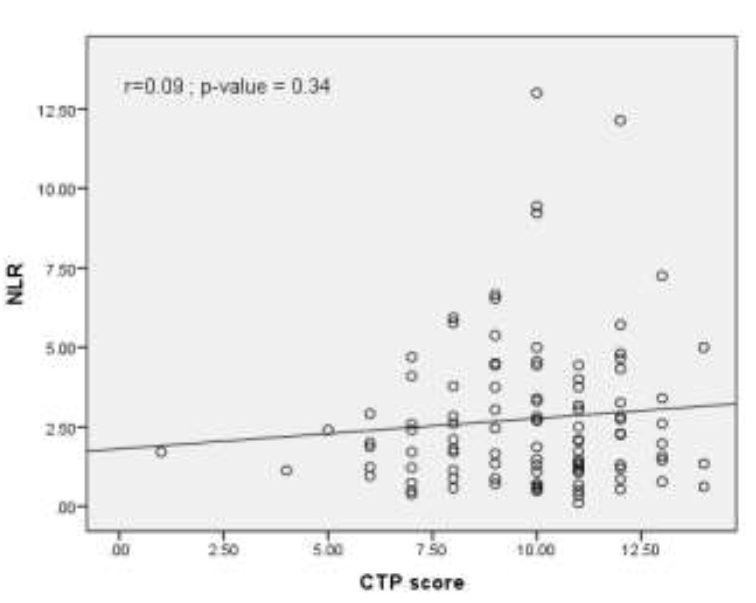
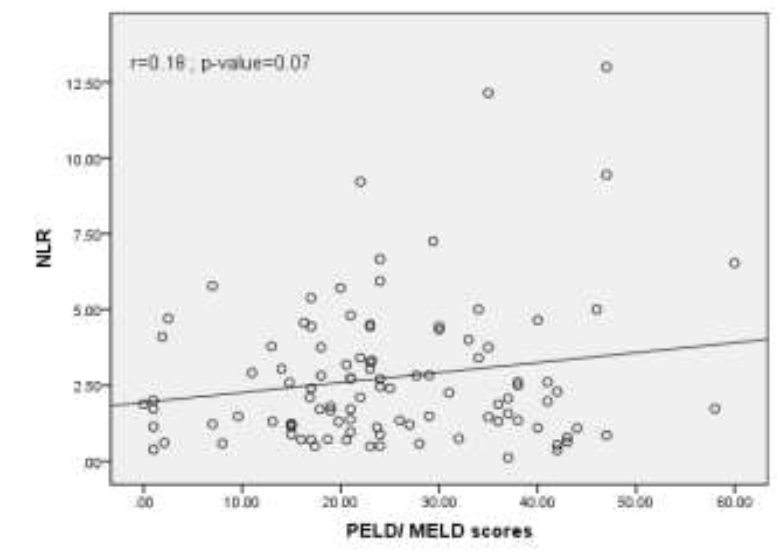
It means an increase in NLR has a 39% increase in odds ratio of death. The NLR has more specificity but less sensitivity than MELD/PELD score (81% vs. 70%) and (50% vs. 68%) respectively. We also evaluated the correlation between CTP and PELD/MELD scores with NLR in figures 1 and 2.
Figure 1: Correlation between neutrophil-to-lymphocyte ratio (NLR) and Child–Turcotte–Pugh (CTP) score
Figure 2: Correlation between neutrophil-to-lymphocyte ratio (NLR) and Model for (Pediatric) End-Stage Liver Disease (PELD/MELD) score
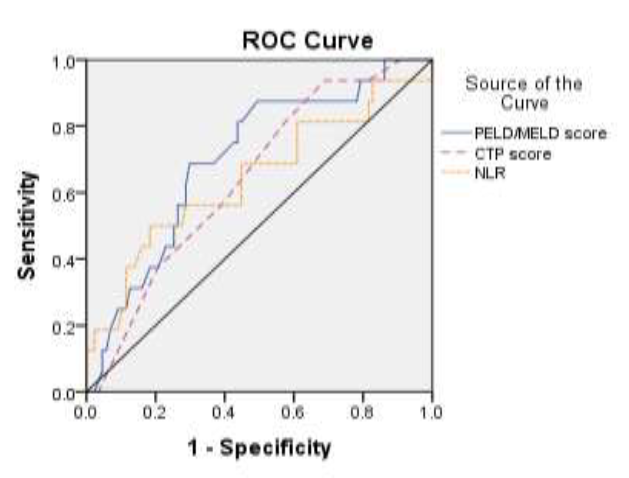
NLR had a relatively positive correlation with PELD/MELD scores, but it was not significant (P-value = 0.07). The utility of NLR, PELD/MELD scores and CTP score, as the diagnostic tests, were assessed using ROC methods. The area under the ROC curve of PELD/MELD scores was 0.7, which was more reliable than others and it was significant. However, the value of sensitivity and specificity were not high enough Figure 3.
Figure 3: Receiver operating characteristic curve of neutrophil-to-lymphocyte ratio (NLR), Model for (pediatric) End-Stage Liver Disease (PELD/MELD) scores and Child–Turcotte–Pugh (CTP) score was plotted to diagnose the best test for predicting mortality
DISCUSSION
The present study aimed to evaluate the prognostic value of NLR for the survival of cirrhotic children, listed for liver transplantation. The results revealed that a higher NLR was correlated with higher risk of mortality among the mentioned population. Also, variceal bleeding and infection increase the risk of mortality independently from other parameters. Multiple regression models shows that NLR increases the odds of mortality among the patients patients and it is independent from other risk factors. This finding is similar to results from other investigations among adult patients. Elevated NLR is correlated with poor prognosis in various conditions such as cardiovascular disease [10] and malignancies [11-13]. Some studies suggest that NLR is representative of the pathophysiological pathways in chronic liver failure [17]. Elevated NLR is a nonspecific laboratory finding that occurs in systematic inflammatory conditions.
One of the reasons for the chronic systemic inflammatory process among the patients with liver cirrhosis is bacterial translocation which is a frequent complication among these patients. Bacterial translocation is defined as migration of bacteria or its products such as lipopolysaccharide, peptidoglycan and lipopeptides from intestine into circulation [18]. Bacterial translocation induces a mild endotoxemia condition rather than acute symptoms of infection. Endotoxemia triggers the inflammatory process via various pathways. It is shown that early phases of infection are associated with inhibition of neutrophil apoptosis [19] and inducing lymphocyte apoptosis in the spleen [20]. During inflammatory process neutrophils produces arginase, nitric oxide and reactive oxygen species that consequently suppress the immune response of lymphocytes. So, subtle endotoxemia in chronic liver diseases increases the neutrophil and decreases the lymphocyte in complete blood count via the systemic inflammatory process [15]. Some studies emphasis on the role of the bacteremia and infection on NLR elevation [15]; however other factors may be influential in this issue. As we observed in our study that prognostic value of NLR for mortality was independent from the infection in adjusted model. Another complication in liver cirrhosis is malnutrition that is associated with higher rates of hepatic decompensation. Malnutrition can induce lymphocytopenia and consequently elevate NLR. Our results show that NLR is positively correlated with weight. This finding is against the findings of other previous studies among the patients with malignancies. This could be due to more fluid retention in extracellular space in form of limb edema or ascites in decompensated liver failure. Positive correlation of NLR with autoimmunity as the cause of liver cirrhosis was consistent with previous investigations, that NLR is elevated in autoimmune diseases, such as multiple sclerosis,
Hashimoto, Behҫet disease and autoimmune encephalitis. The NLR and age were correlated with each other in our study similar to the result of a study among the general population. Today, the MELD/PELD score is the main prognostic criteria for liver transplant candidates. However, it has some limitations such not including some major complications of liver cirrhosis that influence the survival of the patients, including hyponatremia, hepatic encephalopathy, hepatorenal syndrome, esophageal varices bleeding and spontaneous bacterial peritonitis [6]. Also, the accuracy of the MELD/PELD decreases in lower scores [7]. Previous investigations on cirrhotic adults on the waiting list for liver transplantation showed that NLR was a sensitive and specific prognostic test. In the present study, with cut-off value of 3.78, the sensitivity of NLR for predicting mortality was low (50%) while its specificity was higher than MELD/PELD score (70.1 vs. 81.6%). Kwon et al. [19] found that NLR was an accurate biomarker that is elevated in infection. Also, they found that the NLR predicts one-month survival of hospitalized cirrhotic patients. Biyik et al. [20] studied the predicting value of NLR for long-term survival of patients who suffer from stable liver cirrhosis. Moreover, they found that NLR is a mortality predictor independent of MELD and CTP scores. Kalra et al. [8] found that NLR is associated with mortality of cirrhotic patients with lower MELD scores (less than 20). Also, is shown that NLR is correlated with the stage of liver fibrosis among nonalcoholic fatty liver disease [9]. Despite some studies among adult cirrhotic patients, this is the first investigation that carried out among cirrhotic children. We tried to include the majority of confounding factors that influence the mortality of cirrhotic patients.
Limitations
One of the limitations of the present study is its retrospective nature. Another limitation was the short follow-up period (averagely 9.5 weeks) that does not include the long-term outcome of the patients. Also, it didn’t take into consideration the physiologic change in neutrophil and lymphocyte count with children’s age. Moreover, the size of the studied population was small. One on the strengths of this study is that it is the first one in pediatric age.
CONCLUSION
Our results show that NLR is correlated with mortality among the children with liver cirrhosis. Thus, it can be considered as a complementary parameter besides other prognostic scoring systems such as MELD and PELD.
REFERENCE
Acharya, G. et al. “Child-Turcotte-Pugh Score, MELD Score and MELD-Na Score as Predictors of Short-Term Mortality among Patients with End-Stage Liver Disease in Northern India.” Inflammatory Intestinal Diseases, vol. 5, no. 1, 2020, pp. 1-10.
Kok, B. and J.G. Abraldes. “Child-Pugh Classification: Time to Abandon?” Seminars in Liver Disease, vol. 39, no. 01, February 2019, pp. 96-103.
Jasseron, C. et al. “Impact of the New MELD-Based Allocation System on Waiting List and Post-Transplant Survival—A Cohort Analysis Using the French National CRISTAL Database.” Transplant International, vol. 32, no. 10, 2019, pp. 1061-1073.
Sacleux, S.C. and D. Samuel. “A Critical Review of MELD as a Reliable Tool for Transplant Prioritization.” Seminars in Liver Disease, vol. 39, no. 04, November 2019, pp. 403-413.
Díaz, L.A. et al. “Prioritization for Liver Transplantation Using the MELD Scores in Chile: Inequities Generated by MELD Exceptions.” Annals of Hepatology, vol. 18, no. 2, 2019, pp. 325-330.
Ritschl, P.V. et al. “The Effects of MELD-Based Liver Allocation on Patient Survival and Waiting List Mortality in a Country with a Low Donation Rate.” Journal of Clinical Medicine, vol. 9, no. 6, 2020, p. 1929.
Emek, E. et al. “Analysis of the Liver Transplant Waiting List in Our Center.” Transplantation Proceedings, vol. 51, no. 7, September 2019, pp. 2413-2415.
Kalra, A. et al. “Neutrophil-to-Lymphocyte Ratio Correlates with Proinflammatory Neutrophils and Predicts Death in Low Model for End-Stage Liver Disease Patients with Cirrhosis.” Liver Transplantation, vol. 23, no. 2, 2017, pp. 155-165.
Peng, Y. et al. “The Role of Neutrophil to Lymphocyte Ratio for the Assessment of Liver Fibrosis and Cirrhosis: A Systematic Review.” Expert Review of Gastroenterology and Hepatology, vol. 12, no. 5, 2018, pp. 503-513.
Angkananard, T. et al. “Mediation Effect of Neutrophil Lymphocyte Ratio on Cardiometabolic Risk Factors and Cardiovascular Events.” Scientific Reports, vol. 9, no. 1, 2019, pp. 1-11.
Choi, N. et al. “A Meta-Analysis of the Impact of Neutrophil-to-Lymphocyte Ratio on Treatment Outcomes after Radiotherapy for Solid Tumors.” Medicine, vol. 98, no. 18, 2019.
Su, S. et al. “Prognostic Role of Pretreatment Derived Neutrophil to Lymphocyte Ratio in Urological Cancers: A Systematic Review and Meta-Analysis.” International Journal of Surgery, vol. 72, 2019, pp. 146-153.
Pirozzolo, G. et al. “Neutrophil-to-Lymphocyte Ratio as Prognostic Marker in Esophageal Cancer: A Systematic Review and Meta-Analysis.” Journal of Thoracic Disease, vol. 11, no. 7, 2019, p. 3136.
Fest, J. et al. “The Neutrophil-to-Lymphocyte Ratio Is Associated with Mortality in the General Population: The Rotterdam Study.” European Journal of Epidemiology, vol. 34, no. 5, 2019, pp. 463-470.
Leithead, J.A. and N. Rajoriya. “Neutrophil-to-Lymphocyte Ratio Predicts Mortality in Patients Listed for Liver Transplantation.” Liver International, vol. 35, no. 2, 2015, pp. 502-509.
Freeman Jr., R.B. et al. “The New Liver Allocation System: Moving toward Evidence-Based Transplantation Policy.” Liver Transplantation, vol. 8, no. 9, 2002, pp. 851-858.
Alkhouri, N. et al. “Neutrophil to Lymphocyte Ratio: A New Marker for Predicting Steatohepatitis and Fibrosis in Patients with Nonalcoholic Fatty Liver Disease.” Liver International, vol. 32, no. 2, 2012, pp. 297-302.
Kaya, T. et al. “Association between Neutrophil-to-Lymphocyte Ratio and Nutritional Status in Geriatric Patients.” Journal of Clinical Laboratory Analysis, vol. 33, no. 1, 2019.
Kwon, J.H. et al. “The Usefulness of C-Reactive Protein and Neutrophil-to-Lymphocyte Ratio for Predicting the Outcome in Hospitalized Patients with Liver Cirrhosis.” BMC Gastroenterology, vol. 15, no. 1, 2015, pp. 1-7.
Biyik, M. et al. “Blood Neutrophil-to-Lymphocyte Ratio Independently Predicts Survival in Patients with Liver Cirrhosis.” European Journal of Gastroenterology and Hepatology, vol. 25, no. 4, 2013, pp. 435-441
Recommended Articles
Research Article
Leigh Syndrome Should Not Be Diagnosed Exclusively Upon Cerebral MRI
Finsterer J
Published: 15/07/2020
Download PDF
Research Article
Vision for a Brighter Kangra: Unmasking the Truth about Pink Eye – A Comprehensive Study on Types, Symptoms, and Proactive Prevention in Himachal Pradesh’s Kangra District
Deepti ,
...
Garima
Published: 11/11/2023
Download PDF
Research Article
It Remains Unproven That the Variant M.8231C>A Causes Coronary Atherosclerosis
Finsterer J
Published: 15/07/2020
Download PDF
Research Article
Bioactive ingredients screening and antibacterial activity of Citrus aurantifolia leaf extract against some enteric isolates
Abdallah M.S,
Kabiru Sama’ila
Published: 10/08/2020
Download PDF
PO Box 101, Nakuru
Kenya.
Email: office@iarconsortium.org
Editorial Office:
J.L Bhavan, Near Radison Blu Hotel,
Jalukbari, Guwahati-India
Ghandour, F., Ataollahi, M., Haghighat, M., Honar, N., Dana, R., Merhi, B. A., Ghandour, Z. & Darban, B. (2021). Prognostic Value of Neutrophil-to-Lymphocyte Ratio for Survival of Cirrhotic Children, Listed for Liver Transplantation. IAR Journal of Medical Sciences, 2(1), 1-5.
MLA
Ghandour, Fatima, et al. "Prognostic Value of Neutrophil-to-Lymphocyte Ratio for Survival of Cirrhotic Children, Listed for Liver Transplantation." IAR Journal of Medical Sciences 2.1 (2021): 1-5.
Chicago
Ghandour, Fatima, Mariam Ataollahi, Mahmood Haghighat, Naser Honar, Rouwayda Dana, Bassem A. Merhi, Zahraa Ghandour and Behnaz Darban. "Prognostic Value of Neutrophil-to-Lymphocyte Ratio for Survival of Cirrhotic Children, Listed for Liver Transplantation." IAR Journal of Medical Sciences 2, no. 1 (2021): 1-5.
Harvard
Ghandour, F., Ataollahi, M., Haghighat, M., Honar, N., Dana, R., Merhi, B. A., Ghandour, Z. and Darban, B. (2021) 'Prognostic Value of Neutrophil-to-Lymphocyte Ratio for Survival of Cirrhotic Children, Listed for Liver Transplantation' IAR Journal of Medical Sciences 2(1), pp. 1-5.
Vancouver
Ghandour F, Ataollahi M, Haghighat M, Honar N, Dana R, Merhi BA, Ghandour Z, Darban B. Prognostic Value of Neutrophil-to-Lymphocyte Ratio for Survival of Cirrhotic Children, Listed for Liver Transplantation. IAR Journal of Medical Sciences. 2021 Jan;2(1):1-5.


 Download PDF
 Download XML