Background: Heart failure is one of the major causes of mortality & morbidity in Bangladeshi cardiac patients. Combination of heart failure (HF) and depression may worsen the symptoms. There may be bad prognosis. However, there are limited data on the psychological correlation with heart failure in Bangladeshi patients. Materials andMethods: This was an observational & cross-sectional study. The study enrolled 90 patients with heart failure admitted in university cardiac center of Bangabandhu Sheikh Mujib Medical University; Shahbag, Dhaka, Bangladesh from March, 2019 to February, 2020. History taking and complete medical records were reviewed carefully. The structured questionnaire used in this study gathered information on respondent demographic and disease characteristics and information obtained from the Depression Questionnaire. Results: The prevalence of depression among heart failure patients was 41.11%. Those who had sleep disturbances, followed no regular exercise regimen, had family disharmony were higher risk of depression. Conclusion: Prevalence of depression in HF patients should be kept in mind of healthcare providers. Early identification of HF patients with depression, healthcare providers may prevent worse prognosis and ensure the provision of appropriate rehabilitation to this population.
Keywords
Depression
Heart Failure
Prevalence
INTRODUCTION
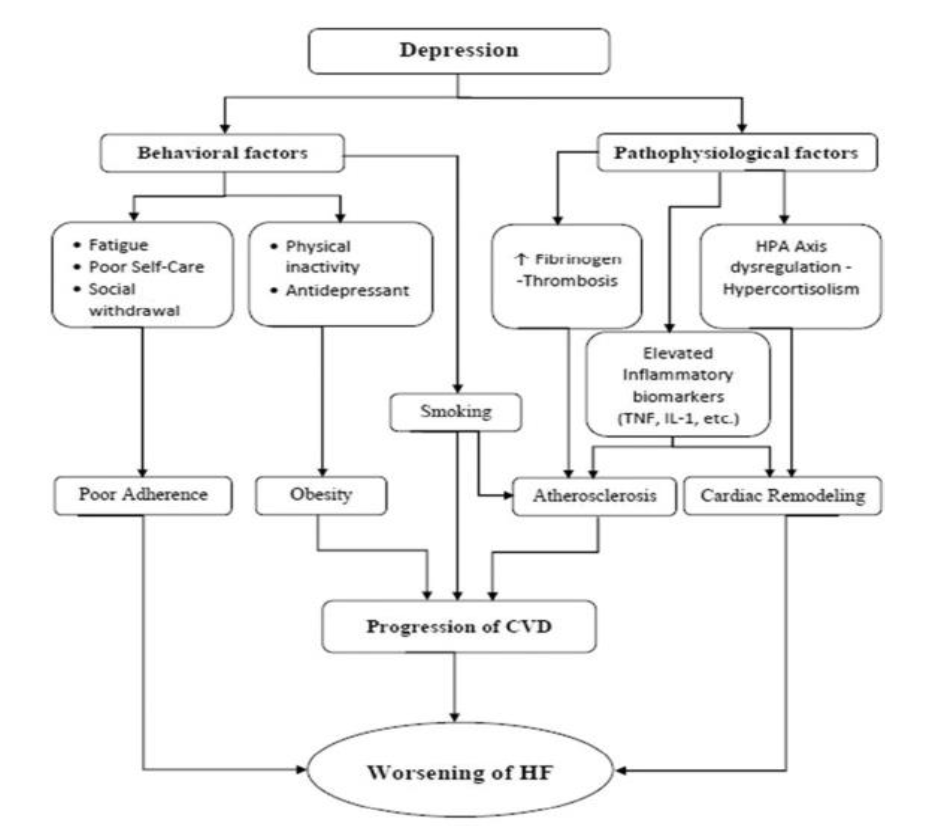
In Bangladeshi cardiac patients, heart failure is one of the major causes of mortality and morbidity [1]. Combination of heart failure and depression may worsen the symptoms. There may be a vicious cycle of bad prognosis (Figure 1) [2]. However, there are limited data on the psychological correlation with heart failure in Bangladeshi patients. This study was performed to see the prevalence of depression in heart failure patients among Bangladeshi population.
MATERIALS AND METHODS
This was an observational and cross-sectional study. The study enrolled 90 patients with heart failure admitted in university cardiac center of Bangabandhu Sheikh Mujib Medical University; Shahbag, Dhaka, Bangladesh from March, 2019 to February, 2020. History taking and complete medical records were reviewed carefully. The structured questionnaire used in this study gathered information on respondent demographic and disease characteristics and information obtained from the Depression Questionnaire.
Working definition of depression:
A deep understanding of the relation between these diseases across all the stages of heart failure is essential as depression and heart failure share a common genetic and pathophysiologic basis [3]. Depression is a common psychiatric disorder, in which there are loss of interests in anything and several other features that are present almost daily for at least two weeks. A person with depression reflects a pathological change in the mental sphere in relation to a previously healthy mental state.
According to the Diagnostic and Statistical Manual of Mental Disorders, the diagnosis of a depressive syndrome involves the following: a) insomnia or hypersomnia b) diminished concentration c) diminished interest or pleasure from activities d) loss of energy or fatigue e) excessive or inappropriate guilt f) decrease or increase in appetite and resulting weight loss or gain g) psychomotor retardation/agitation h) recurrent thoughts of death, suicidal ideation or suicide attempt [3].
Figure 1: Depression in Heart Failure [2]
RESULTS
The prevalence of depression was 41.11%. Those who had sleep disturbances, followed no regular exercise regimen, had family disharmony were higher risk of depression (Tables 1-3).
Table 1: Socio-demographic parameters of the study patients (n=90)
Parameters
Distribution
Frequency
Percentage
Age (Mean ± SD) Years
66±14
Gender
Male
Female
67
23
74.4
25.5
Marital status
Married
Single
84
06
93.3
6.6
Area of residence
Village
Upazilla
District
City
32
20
4
34
35.5
22.2
4.4
37.7
Educational status
No education
Primary
High school
Graduation
18
31
22
19
20.0
34.4
24.4
21.1
DISCUSSION
Although there are recent improvements in heart failure treatment, about 50% having an average life expectancy of less than five years and those with advanced forms of heart failure, nearly 90% die within one year [4].
Table 2: Depression in the study patients’ (n=90):
Parameters
Heart Failure with Depression
Heart Failure without Depression
Frequency
n=37
n=53
Percentage
41.1%
58.8%
In a progressive & debilitating disease like chronic heart failure, the quality of life of the patients gradually declines and socio-economic burdens increase day by day [5].
Depression and anxiety are often observed in patients with Chronic Heart Failure (CHF) [6]. These psychiatric diseases complicate the therapeutic option and increase hospitalizations and mortality rate [7,8]. Approximately one-fifth of patients with CHF affected by depression and as a result, worsening the functional class. Depression affects two- to three-times more in HF patients than the general population [7].
In our study we also found that, patients in heart failure with depression were more (64.8%) in NYHA functional class III-IV in comparison to heart failure without depression (37.7%).
Polikandrioti et al. [9] demonstrated that HF patients who are elderly (over 60 years old) feel more depressed due to the fact that they experience functional and cognitive impairment and this condition is making their daily life more difficult.
Table 3: Medical advice adherence parameters of the study population (n=90)
Parameters
Distribution
Heart Failure with Depression
Frequency, n=37
Heart Failure without Depression Frequency, n=53
Adherence to diet
No
Yes
Partial
12 (32.4%)
11 (29.7%)
14 (37.8%)
10 (18.8%)
24 (45.2%)
19 (35.8%)
Adherence to lifestyle
No
Yes
Partial
20 (54.0%)
7 (18.9%)
10 (27.0%)
12 (22.6%)
28 (52.8%)
13 (24.5%)
NYHA functional class
I-II
II-III
III-IV
2 (5.40%)
11 (29.7%)
24 (64.8%)
11 (20.7%)
22 (41.5%)
20 (37.7%)
Adherence to heart failure medicines
No
Yes
Partial
13 (35.1%)
8 (21.6%)
16 (43.2%)
5 (9.4%)
30 (56.6%)
18 (33.9%)
Repeated admission in last 6 months
No
Yes
8 (21.6%)
29 (78.3%)
31(58.4%)
22 (41.5%)
In a study, 70 years older heart failure patients with depression readmit more (67%) than the heart failure patients without depression (44%) [10].
Our heart failure patients who were in depression readmitted (78.3%) more in hospital than patients without depression (58.4%).
Usually, heart failure patients do not easily accept the disease condition; they show non-compliance to drug therapy for low socio-economic and educational status. These factors influence depression. As a result, these patients are unwilling to report their depressive symptoms and financial problems. Our heart failure patients with depression also had fewer adherences to diet, lifestyle, medicines and worsening functional class.
They seek for medical advice only when the disease process has reached in advanced level. HF severity is related to depression. Because physical or cognitive impairment imposes limitations on every dimension of personal, family and occupational lives; thus, depression is affecting the mental sphere of these vulnerable heart failure patients [9,11,12].
Care should be taken for heart failure patients in a holistic model to be emphasized in biological, psychological and social aspects of the individual. With conventional cardiac treatment, assessment of coronary disease patients, systematic screening of depression, counseling of the patients and psychological interventions including support groups at hospitals should be included in the holistic model [13].
Heart failure (HF) and depression are debilitating diseases with significantly reduce functional status and deteriorate quality of life. Despite many advanced therapies for HF; mortality remains still high. Heart failure and depression often coexist. Patients with depression develop more symptoms of HF, have worse compliance with medications, are slower to return to work and social activities and thus they lead a poorer quality of life [14].
CONCLUSION
Prevalence of depression in HF patients should be kept in mind of healthcare providers. Early identification of HF patients with depression, healthcare providers may prevent worse prognosis and ensure the provision of appropriate rehabilitation to this population.
REFERENCE
Ministry of Health and Family Welfare (MoHFW). Strategic Plan for Surveillance and Prevention of Non-Communicable Disease in Bangladesh 2007-2010. Government of People’s Republic of Bangladesh, 2007.
Ghosh, R.K. et al. “Depression in heart failure: intricate relationship, pathophysiology and most updated evidence of interventions from recent clinical studies.” International Journal of Cardiology, vol. 224, 2016, pp. 170-177.
Dimos, A.K. et al. “Depression and heart failure.” Hellenic Journal of Cardiology, vol. 50, no. 5, 2009, pp. 410-417.
Warner, J. “Heart failure patients too optimistic.” WebMD Health News, June 2008.
Ramani, G.V. et al. “Chronic heart failure: contemporary diagnosis and management.” Mayo Clinic Proceedings, vol. 85, no. 2, February 2010, pp. 180-195.
Janssen, D.J. et al. “Symptoms, comorbidities and health care in advanced chronic obstructive pulmonary disease or chronic heart failure.” Journal of Palliative Medicine, vol. 14, no. 6, 2011, pp. 735-743.
DeJongh, B. et al. “Managing comorbidities in patients with chronic heart failure: first, do no harm.” American Journal of Cardiovascular Drugs, vol. 15, no. 3, 2015, pp. 171-184.
Vongmany, J. et al. “Anxiety in chronic heart failure and the risk of increased hospitalisations and mortality: a systematic review.” European Journal of Cardiovascular Nursing, vol. 15, no. 7, 2016, pp. 478-485.
Polikandrioti, M. et al. “Evaluation of depression in patients with congestive failure.” Health Science Journal, vol. 4, no. 1, 2010, pp. 37-47.
Rozzini, R. et al. “Depression and major outcomes in older patients with heart failure.” Archives of Internal Medicine, vol. 162, no. 3, 2002, pp. 362-363.
DiMatteo, M.R. et al. “Depression is a risk factor for noncompliance with medical treatment: meta-analysis of the effects of anxiety and depression on patient adherence.” Archives of Internal Medicine, vol. 160, no. 14, 2000, pp. 2101-2107.
Cline, C.M.J. et al. “Non-compliance and knowledge of prescribed medication in elderly patients with heart failure.” European Journal of Heart Failure, vol. 1, no. 2, 1999, pp. 145-149.
Polikandrioti, M. et al. “The effects of anxiety and depression on the needs of patients hospitalized with coronary disease.” Archives of Hellenic Medicine, vol. 29, no. 1, 2012, pp. 33-43.
Nair, N. et al. “Commonality between depression and heart failure.” The American Journal of Cardiology, vol. 109, no. 5, 2012, pp. 768-772.
Recommended Articles
Research Article
It Remains Unproven That the Variant M.8231C>A Causes Coronary Atherosclerosis
Finsterer J
Published: 15/07/2020
Download PDF
Research Article
Leigh Syndrome Should Not Be Diagnosed Exclusively Upon Cerebral MRI
Finsterer J
Published: 15/07/2020
Download PDF
Research Article
Vision for a Brighter Kangra: Unmasking the Truth about Pink Eye – A Comprehensive Study on Types, Symptoms, and Proactive Prevention in Himachal Pradesh’s Kangra District
Deepti ,
...
Garima
Published: 11/11/2023
Download PDF
Research Article
Bioactive ingredients screening and antibacterial activity of Citrus aurantifolia leaf extract against some enteric isolates
Abdallah M.S,
Kabiru Sama’ila
Published: 10/08/2020
Download PDF
PO Box 101, Nakuru
Kenya.
Email: office@iarconsortium.org
Editorial Office:
J.L Bhavan, Near Radison Blu Hotel,
Jalukbari, Guwahati-India
Arzu, J., Hoque, H., Sheikh, N., Sweety, S. A., Fatema, N., Bajracharya, P. & Meshkat Ahmed, C. (2021). Prevalence of Depression in Heart Failure patients Among Bangladeshi population. IAR Journal of Medical Sciences, 2(1), 1-3.
MLA
Arzu, Jahanara, et al. "Prevalence of Depression in Heart Failure patients Among Bangladeshi population." IAR Journal of Medical Sciences 2.1 (2021): 1-3.
Chicago
Arzu, Jahanara, Harisul Hoque, Naveen Sheikh, Sohely Ahmed Sweety, Nilufar Fatema, Prashant Bajracharya and Chaudhury Meshkat Ahmed. "Prevalence of Depression in Heart Failure patients Among Bangladeshi population." IAR Journal of Medical Sciences 2, no. 1 (2021): 1-3.
Harvard
Arzu, J., Hoque, H., Sheikh, N., Sweety, S. A., Fatema, N., Bajracharya, P. and Meshkat Ahmed, C. (2021) 'Prevalence of Depression in Heart Failure patients Among Bangladeshi population' IAR Journal of Medical Sciences 2(1), pp. 1-3.
Vancouver
Arzu J, Hoque H, Sheikh N, Sweety SA, Fatema N, Bajracharya P, Meshkat Ahmed C. Prevalence of Depression in Heart Failure patients Among Bangladeshi population. IAR Journal of Medical Sciences. 2021 Jan;2(1):1-3.



 Download PDF
 Download XML