Relationship between Serum Procalcitonin Levels in Chronic Obstructive Pulmonary Disease and In Acute Exacerbations of Chronic Obstructive Pulmonary Disease in Coimbatore Population - An Observational Study
Lakshmi C
1
,
S. Manimekalai
2
,
A.Veena Juliette
3
1
Post Graduate, Department of Biochemistry, Coimbatore Medical College and Hospital, Coimbatore, India
2
Professor (r), Department of Biochemistry, Coimbatore Medical College and Hospital, Coimbatore, India
3
Associate Professor and Head Incharge, Department of Biochemistry, Coimbatore Medical College and Hospital, Coimbatore, India
Background: Chronic obstructive pulmonary disease (COPD) is a major global health problem and is expected to be the third leading cause of death worldwide by 2020 and about 20% suffer from acute exacerbations. The bacterial infection is one of the causes of exacerbation of COPD patients. Identification of a biomarker that could help in differentiating bacterial respiratory infections in AECOPD patients from stable COPD patients could possibly help to reduce overuse of antibiotics. Objective: To evaluate procalcitonin (PCT) as a biomarker to possibly differentiate AECOPD patients requiring antibiotic treatment from stable COPD patients. Methods: Serum PCT levels of stable COPD patients (n=43) and AECOPD patients (n=43) will be measured using ELISA kit. Results: There was a statistically significant difference (P value <0.001) between AECOPD patients (47.25 ± 2.03 mg/ml) and stable COPD patients (1.10 ± 0.18 mg/ml). At cut point of 5.872 ng/mL, PCT had 100% sensitivity and 100% specificity for predicting AECOPD patients with infections. Conclusions: This study suggests a role for PCT in predicting the bacterial exacerbations in COPD patients. Such study will help in the decision making in antibiotic treatment strategy in AECOPD.
Keywords
Serum Procalcitonin
COPD
PCT
INTRODUCTION
Chronic obstructive pulmonary disease (COPD) is a major global health problem and is expected to be the third leading cause of death worldwide by 2020 [1]. While COPD is a mainly chronic disease, about 20% of COPD patients suffer from exacerbations. Acute exacerbations of COPD (AECOPD) are an acute event characterized by worsening of the patient’s respiratory symptoms that is beyond normal day-to-day variations and leads to a change in medication. AECOPD have considerable impact on disease morbidity, mortality, healthcare utilization and associated costs. Three types of exacerbations are common – those driven by bacteria, viruses or by enhanced eosinophilic inflammation. Due to challenges in pathogen identification, AECOPD is said to be one of the major drivers of antibiotic overuse which is a potential risk for developing antibiotic-resistant organisms [2]. Therefore, identification of a biomarker that could help in differentiating bacterial respiratory infections in AECOPD patients from stable COPD patients and which could possibly be used to aid decision making in antibiotic treatment strategy in AECOPD is very useful.
Procalcitonin (PCT) is the prohormone of the hormone Calcitonin secreted by the thyroid C cells. PCT is an acute phase inflammatory protein that is known to be associated with bacterial infections and does not increase in viral infections, bacterial colonization and other inflammatory pulmonary conditions. PCT is liberated into circulation of patients in response to severe systemic inflammation, in particular by bacterial infection and the levels increase rapidly during infection and are correlated with the severity of illness [3]. This makes PCT an ideal candidate to be assessed as biomarker to possibly differentiate AECOPD patients requiring antibiotic treatment from stable COPD patients.
The present study aims to assess the relationship between serum PCT levels and stable COPD/AECOPD patients of Tamil Nadu population.
MATERIALS AND METHODS
Study Design and Patients
It was a single-center study of COPD patients aged 40 – 80 years with and without exacerbations. The study was approved by the ethics committee at the Coimbatore Medical College and Hospital.
Data Collection
After obtaining the baseline characteristics of the patients, the blood samples were collected from the stable COPD patients and AECOPD patients and a quantitative assessment of serum PCT levels was performed using ELISA.
Statistical Analysis
After assessing the normal distribution of the data, the values were presented as mean ± standard deviation and analyzed using independent t-test. The receiver operating characteristic (ROC) curve, the area under the curve (AUC) and the cut-point value was determined by the Youden index. p<0.05 was considered to indicate a statistically significant difference. All the statistical analysis was performed using the software Graph Pad Prism 5.01.
RESULTS
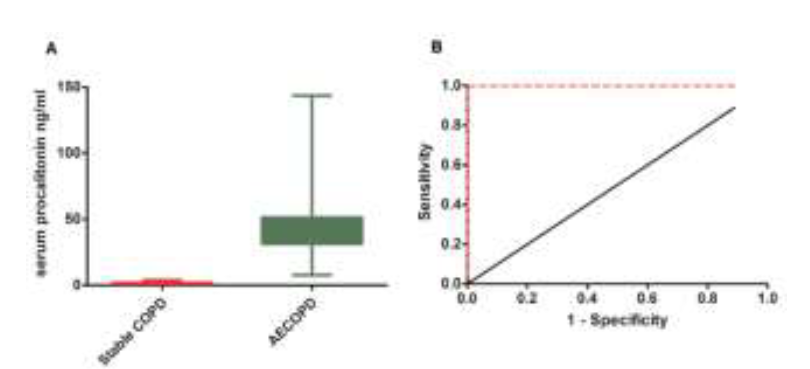
In the present study, 43 stable COPD patients and 43 AECOPD patients from Tamil Nadu population were recruited. Mean age of stable COPD and AECOPD patients were 60.18 ± 9.02 and 56.68 ± 9.09 years respectively and did not differ significantly. Serum PCT level in the COPD group was 1.10 ± 0.18 ng/ml, while it was 44.39 ± 3.16 ng/ml in the AECOPD group and their difference was statistically significant with p value <0.001. Based on the ROC curve analysis results, the cut point determining the difference between the stable COPD and AECOPD groups with a sensitivity of 100% and a specificity of 100% was 5.872 (Area under the curve = 1, p value <0.001).
DISCUSSION
In this single-center study of COPD patients of Coimbatore population, serum PCT levels in AECOPD patients were significantly higher than stable COPD patients with no significant difference in age. The mean serum PCT level in AECOPD patients with respiratory attack and diagnosed with sepsis and infections was 44.39±3.16 ng/ml, which is 40-fold more than that of the stable COPD group (1.13± 0.13) in the study population. A similar study in North Indian population also showed a significantly higher PCT levels in AECOPD (1.3±0.77 ng/ml) compared to stable COPD patients (0.1±0.09 ng/ml) [4]. In study of an Iranian population group, the PCT level in the exacerbation group was 0.272±0.586 ng/ml, which was significantly higher than the non-exacerbation group (0.066±0.027 ng/ml) [5]. In the present study, ROC curve analysis showed that such high levels of PCT observed in AECOPD group compared to stable COPD group of the population under study has given rise to a ROC curve with AUC = 1, with a cut point of 5.872 ng/ml with 100% sensitivity and 100% specificity. Another study in an Egyptian population showed that at cut off 1.495 ng/mL, PCT had 83.7% sensitivity and 78.3% specificity for predicting AECOPD patient that need ventilator support [6]. Procalcitonin biomarker-based algorithm was used to reduce antibiotic prescriptions, duration of therapy and costs in COPD [7]. A PCT-guided antibiotic strategy was associated with fewer antibiotic prescriptions in AECOPD patients [8]. Serum PCT levels was also an effective biomarker for infections and sepsis in cardiovascular disorders [9], cancer [10], type-2 diabetes mellitus [11].
Table 1: Characteristics of Stable COPD and AECOPD patients
Parameters
Stable COPD (n=43)
AECOPD (n=43)
p value
Age (years ± SD)
60.18 ± 9.02
56.68 ± 9.09
0.58
Procalcitonin (ng/ml ± SD)
1.13 ± 0.13
47.25 ± 2.03
<0.001
Figure 1: A. Serum procalcitonin levels in Stable COPD and AECOPD patients, B. ROC curve to evaluate procalcitonin as a biomarker to predict bacterial infection in AECOPD patients
CONCLUSION
The findings of this study indicate that PCT levels shows a superior diagnostic accuracy for sepsis in AECOPD patients and differentiating them from patients with stable COPD conditions in the Coimbatore population under study. Such study could be used to help in the decision making in antibiotic treatment strategy and the need for ventilator support in AECOPD patients. Further research is required to determine the optimal cutoff value for PCT and to conduct comparisons between PCT-guided antibiotic therapy and standard antibiotic therapy. Also, the PCT levels of patients with other conditions leading to infections and sepsis have to be compared. Also, the efficiency of PCT as biomarker as compared to other prospective biomarkers such as decorin, α2-macroglobulin, WBC count, C-reactive protein and copeptin should be studied to validate the study. It is also necessary to consider whether our findings can be generalized to other populations.
REFERENCE
Halbert, R.J. et al. “Global burden of COPD: systematic review and meta-analysis.” European Respiratory Journal, vol. 28, no. 3, 2006, pp. 523–532.
Viniol, C. and C.F. Vogelmeier. “Exacerbations of COPD.” European Respiratory Review, vol. 27, no. 147, 2018, p. 170103.
Covington, E.W. et al. “Procalcitonin monitoring as a guide for antimicrobial therapy: a review of current literature.” Pharmacotherapy: The Journal of Human Pharmacology and Drug Therapy, vol. 38, no. 5, 2018, pp. 569–581.
Pandey, S. et al. “Serum procalcitonin levels in chronic obstructive pulmonary disease patients in North Indian population.” Annals of African Medicine, vol. 18, no. 2, 2019, p. 103.
Borsi, H. et al. “Relationship between serum procalcitonin level and chronic obstructive pulmonary disease.” Journal of Family Medicine and Primary Care, vol. 8, no. 2, 2019, p. 738.
Halim, A.A. and M. Sayed. “The value of serum procalcitonin among exacerbated COPD patients.” Egyptian Journal of Chest Diseases and Tuberculosis, vol. 64, 2015, pp. 821–827.
van der Maas, M.E. et al. “Procalcitonin biomarker algorithm reduces antibiotic prescriptions, duration of therapy and costs in chronic obstructive pulmonary disease: a comparison in the Netherlands, Germany and the United Kingdom.” OMICS: A Journal of Integrative Biology, vol. 21, no. 4, 2017, pp. 232–243.
Li, Z. et al. “Procalcitonin-guided antibiotic therapy in acute exacerbation of chronic obstructive pulmonary disease: an updated meta-analysis.” Medicine, vol. 98, no. 32, 2019.
Schuetz, P. et al. “Procalcitonin: a new biomarker for the cardiologist.” International Journal of Cardiology, vol. 223, 2016, pp. 390–397.
El Haddad, H. et al. “Biomarkers of sepsis and bloodstream infections: the role of procalcitonin and proadrenomedullin with emphasis in patients with cancer.” Clinical Infectious Diseases, vol. 67, no. 6, 2018, pp. 971–977.
Wang, X. et al. “Predictive value of procalcitonin for infection of patients with type 2 diabetes mellitus.” Experimental and Therapeutic Medicine, vol. 18, no. 1, 2019, pp. 722–728.
Recommended Articles
Research Article
Leigh Syndrome Should Not Be Diagnosed Exclusively Upon Cerebral MRI
Finsterer J
Published: 15/07/2020
Download PDF
Research Article
Vision for a Brighter Kangra: Unmasking the Truth about Pink Eye – A Comprehensive Study on Types, Symptoms, and Proactive Prevention in Himachal Pradesh’s Kangra District
Deepti ,
...
Garima
Published: 11/11/2023
Download PDF
Research Article
It Remains Unproven That the Variant M.8231C>A Causes Coronary Atherosclerosis
Finsterer J
Published: 15/07/2020
Download PDF
Research Article
Bioactive ingredients screening and antibacterial activity of Citrus aurantifolia leaf extract against some enteric isolates
Abdallah M.S,
Kabiru Sama’ila
Published: 10/08/2020
Download PDF
PO Box 101, Nakuru
Kenya.
Email: office@iarconsortium.org
Editorial Office:
J.L Bhavan, Near Radison Blu Hotel,
Jalukbari, Guwahati-India
C, L., Manimekalai, S. & Juliette, A. (2020). Relationship between Serum Procalcitonin Levels in Chronic Obstructive Pulmonary Disease and In Acute Exacerbations of Chronic Obstructive Pulmonary Disease in Coimbatore Population - An Observational Study. IAR Journal of Medical Sciences, 1(2), 1-3.
MLA
C, Lakshmi, S. Manimekalai and A.Veena Juliette. "Relationship between Serum Procalcitonin Levels in Chronic Obstructive Pulmonary Disease and In Acute Exacerbations of Chronic Obstructive Pulmonary Disease in Coimbatore Population - An Observational Study." IAR Journal of Medical Sciences 1.2 (2020): 1-3.
Chicago
C, Lakshmi, S. Manimekalai and A.Veena Juliette. "Relationship between Serum Procalcitonin Levels in Chronic Obstructive Pulmonary Disease and In Acute Exacerbations of Chronic Obstructive Pulmonary Disease in Coimbatore Population - An Observational Study." IAR Journal of Medical Sciences 1, no. 2 (2020): 1-3.
Harvard
C, L., Manimekalai, S. and Juliette, A. (2020) 'Relationship between Serum Procalcitonin Levels in Chronic Obstructive Pulmonary Disease and In Acute Exacerbations of Chronic Obstructive Pulmonary Disease in Coimbatore Population - An Observational Study' IAR Journal of Medical Sciences 1(2), pp. 1-3.
Vancouver
C L, Manimekalai S, Juliette A. Relationship between Serum Procalcitonin Levels in Chronic Obstructive Pulmonary Disease and In Acute Exacerbations of Chronic Obstructive Pulmonary Disease in Coimbatore Population - An Observational Study. IAR Journal of Medical Sciences. 2020 Jul;1(2):1-3.


 Download PDF
 Download XML