Contents
Download PDF
pdf Download XML
93 Views
25 Downloads
Share this article
Research Article | Volume 1 Issue 1 (Jan-June, 2020) | Pages 1 - 4
Prevalence of Ultrasound-Diagnosed Non-Alcoholic Fatty Liver Disease (NAFLD) in Surgical Patients Undergoing Sonographic Examination of the Abdomen
 ,
 ,
 ,
 ,
1
Clinical Research Centre, Hospital Pakar Sultanah Fatimah Muar, Jalan Salleh, 84000 Muar, Johor, Malaysia
2
Department of Surgery, Hospital Pakar Sultanah Fatimah Muar, Jalan Salleh, 84000 Muar, Johor, Malaysia
Under a Creative Commons license
Open Access
Received
May 3, 2020
Revised
June 9, 2020
Accepted
July 19, 2020
Published
Aug. 10, 2020
Abstract

Introduction: NAFLD is defined as fatty liver i.e. an accumulation of lipids inside the hepatocytes exceeding 5% of the weight of the liver, without hepatitis B or hepatitis C infection and in the absence of ‘excessive’ alcohol intake. The prevalence in the Asian society is 16-25%. This may be under-estimated as patients are usually asymptomatic. The interest in this disease is currently heightened as more evidence is showing that a significant proportion of patient with NAFLD can progress to liver cirrhosis, liver failure and hepatoma. Objectives: 1. To determine the prevalence of NAFLD in the adult patients undergoing ultrasound examination for other causes in our outpatient setting. 2. To determine the prevalence of risk factors. Methods: Prospective study from 1 March–31 December 2019. Ultrasound abdomen for patients attending surgical outpatient clinic were screened for the word ‘fatty liver’. Patients fulfilling study criteria were included. Once consented, full history and body measurements were taken, followed by fasting blood test (FSL, FBS, LFT). Data analysis was done using IBM® SPSS® Statistics Version 24. Results: During the study period, 359 patients underwent ultrasound abdomen, 132 had fatty liver and 79 were included in the study. Mean age was 49.01±11.67 years, BMI 26.67±3.61 kg/m2, ALT 40.82±83.40 μ/L, FBS 5.79±1.51 mmol/L, total cholesterol 5.24±0.85 mmol/l and TG 1.47±0.80 mmol/L. Patients with risk factors are male (46.8%), type 2 DM (24.1%), obesity (67.1%), hypertension (49.4%) and hypercholesterolaemia (51.9%). Discussions: The prevalence of NAFLD in our centre is 22%, which is compatible with other western and Asian studies. The prevalence of male risk factor is similar to other Malaysian studies (45-50%). The prevalence of other risk factors is also high. Conclusions: In conclusion, the prevalence of NAFLD is high among our population and the associated factors are mostly obesity and hypercholesterolaemia. These patients are asymptomatic and they are at risk of getting chronic liver disease in the long term.

Keywords
INTRODUCTION

Non- Alcoholic Fatty Liver Disease (NAFLD) was previously a largely ignored disease. However, it is now becoming the most common liver disease worldwide. NAFLD is defined as fatty liver i.e. an accumulation of lipids inside the hepatocytes exceeding 5% of the weight of the liver, without hepatitis B virus or hepatitis C virus infection and in the absence of ‘excessive’ alcohol intake (conventionally defined as an intake of ethanol 20 g/day or 140g/week for male and 10g/day or 70g/ week for female) [1,2]. The prevalence in the western society is about 20-30% and in the Asian society about 16-25% [3]. The prevalence may be underestimated as patients are usually asymptomatic and liver enzymes are not surrogate markers of NAFLD in the general population. The interest in this disease is currently heightened as more and more evidence is showing that a significant proportion of patient with NAFLD can progress to liver cirrhosis, liver failure and hepatocellular carcinoma. However, the incidence and the natural history of this condition are still not well defined. Day in 2006 suggested that the long-term prognosis of the disease depends critically on the histological stage of the disease at presentation [4].  Patient initially starts with steatosis. Then they progress into non-alcoholic steatohepatitis (NASH), fibrosis, cirrhosis and then either liver death or hepatocellular carcinoma. Up to this moment there are no definitive treatment recommendations for NAFLD. Several risk factors have been associated with the development of NAFLD. It is more common in male patients and the risk increases with age. NAFLD is taught to represent the hepatic manifestation of the metabolic syndrome; which is a constellation of interconnected physiological, biochemical, clinical and metabolic factors that directly increases the risk of cardiovascular disease, type 2 diabetes mellitus and all-cause mortality. To diagnose metabolic syndrome, the US National Cholesterol Education Program Adult Treatment Panel III requires at least three of the following:        


  • Central Obesity: Waist circumference ≥102 cm or 40 inches (male), ≥88 cm or 35 inches (female)

  • Dyslipidaemia: TG ≥1.7 mmol/L (150 mg/dL)

  • Dyslipidaemia: HDL-C <40 mg/dL or 2.22 mmmol/l (male), <50 mg/dL or 2.78 mmol/l (female)

  • Blood pressure ≥130/85 mmHg (or treated for hypertension)

  • Fasting plasma glucose ≥6.1 mmol/L (110 mg/dL)


Diagnosis of NAFLD is usually done by ultrasonogaphy examination. Ultrasonography examination has sensitivity and specificity of 84.8% and 93.6%, respectively in detection of moderate to severe fatty liver [5]. Staging the disease however requires liver biopsy. 


There is limited data on the prevalence of NAFLD from Malaysia. A study done by Goh et al. in 2013 found the prevalence to be 22.7% with majority in the Chinese populations (78.3%) [6]. They found that NAFLD was strongly associated with diabetes mellitus, glucose intolerance, body mass index ≥23, low high-density lipoprotein cholesterol, hypertriglyceridaemia and hypertension [6]. A study among rural indigenous community of Sarawak revealed the prevalence of ultrasound diagnosed NAFLD was 44.2% (n = 34) [7]. This current study was done to determine the prevalence of NAFLD in the adult patients undergoing ultrasound examinations for other causes in our outpatient setting and to determine the prevalence of risk factors in our patients with NAFLD.


In this study, obesity is defined as BMI ≥25 kg/m2. This is lower than the World Health Organization criteria (≥30 kg/m2) as people of Asia pacific region tend to develop morbidities at a lower BMI range [8,9]. Hypercholesterolaemia is defined as total cholesterol ≥5.11 mmol/L (200 mg/dL), hypertriglyceridaemia as triglyceride ≥1.7 mmol/L (150 mg/dL) and hyperglycaemia as fasting blood sugar as ≥6.1 mmol/L (110 mg/dL).


Objective


  • To determine the prevalence of NAFLD in the adult patients undergoing ultrasound examination for other causes in our outpatient setting

  • To determine the prevalence of risk factors

MATERIALS AND METHODS

This is a prospective, cross sectional study where all our outpatients who went for ultrasound abdomen for various reasons from 1 March until 31 December 2019 were screened for the word ‘fatty liver’ in the results. The ultrasonography examinations were done by medical officers who have been privileged to do and were counter checked by radiologists, as per our hospital’s protocol. Patients with known liver disease, those with excessive alcohol intake (≥140g/week for male and ≥70g/week for female) and those who are taking medications that can impair their liver functions were excluded from the study. Once consented, full history and body measurements were taken, followed by fasting blood test (serum lipid, blood sugar and liver function test). If the results are abnormal, the patients were called, referred and managed appropriately. Data were then gathered into the standard data collection forms. Data analysis was done using IBM® SPSS® Statistics Version 24. Descriptive statistics were given as frequencies, median, mean, minimum and maximum for continuous variables and as percentages for categorical variables.


Ethics

Permission to carry out this study was obtained from the National Medical Research Register Malaysia (NMRR ID: 18-3105-44801 (IIR)).

RESULTS

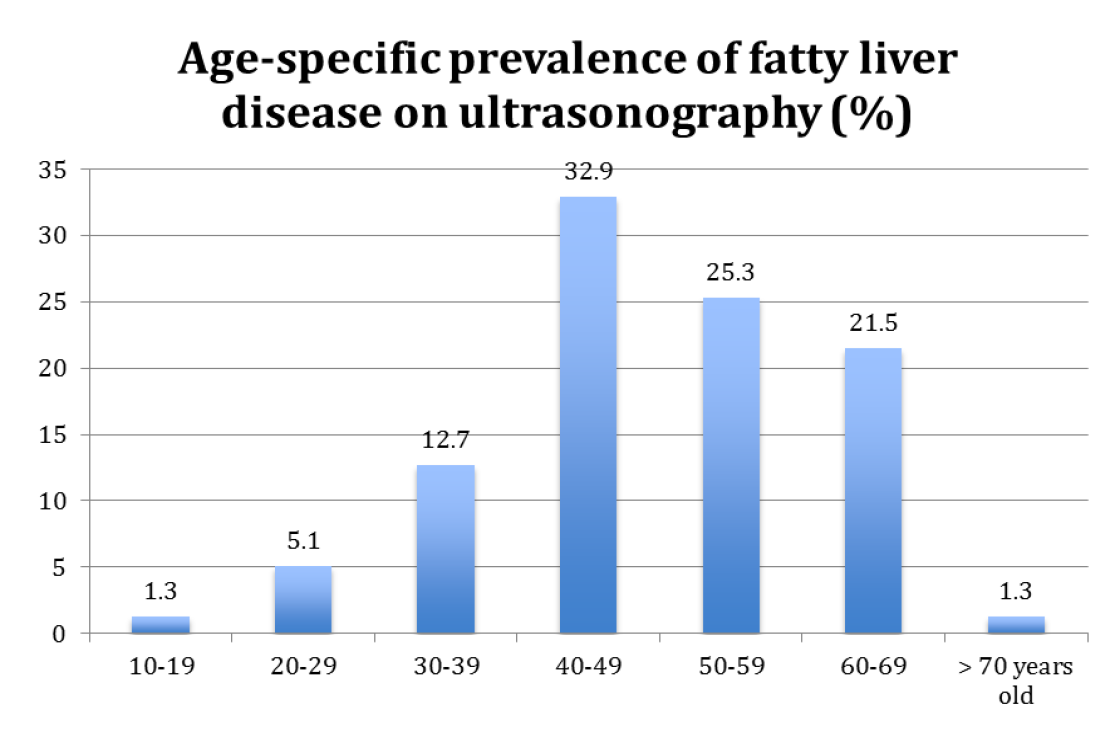
From 1 March–31 December 2019, 359 patients underwent ultrasound abdomen, 152 had fatty liver and 79 were included in the study. Their demographic data is as in the Table 1,2, Figure 1.


Table 1: Characteristics of Study Population (means±S.D. or %)

Parameters  Value
Age (in years)49.01±11.67
Race (%)
Malay49.4%
Chinese38.0%
Indian12.7%
Gender (% male)46.8%
Mean BMI (kg/m2)26.67±3.61
ALT (u/l) (5-40)40.82±83.40
Fasting glucose (mmol/l)5.79±1.51
Total cholesterol (mmol/l)5.24±0.85
HDL-C (mmol/l)1.22±0.35
LDL-C (mmol/l)3.43±0.82
TG (mmol/l)1.47±0.80


Table 2: Percentage of NAFLD Patients with Risk Factors (%)

Risk Factors of NAFLDPrevalence
Male46.8
Type 2 Diabetes Mellitus24.1
Obesity67.1
Hypertension49.4
Hypercholesterolaemia51.9
Cardiovascular Disease (CVA/IHD/PVD)10.1


Figure 1: Age-Specific Prevalence of Fatty Liver Disease

DISCUSSION

The result from this study is alarming as the prevalence of fatty liver is high among our patients undergoing ultrasonography examination of the abdomen for other reasons (42%). After excluding patients according to our exclusion criteria, the prevalence of NAFLD in our population is 22%, with majority in the Malay populations (49.4%). The prevalence is compatible with other western and Asian studies [4]. These patients are asymptomatic and yet they are carrying the early signs of a potentially serious disease. 


Elevated aminotransferase is considered a primary signs for NAFLD [10]. In our study, the mean ALT is 40.82±83.40 u/l (normal 5-40). However, in terms of percentage it is only found in 29% of the study population. This result is almost similar to another Malaysian study done by Magosso et al. who found 20% of his NAFLD positive subjects to have elevated ALT [11]. Targher et al. also found that 86% of their patients with NAFLD had normal ALT levels [12]. This is an important finding because it showed that even though their liver function tests values were within the normal range, these patients have already shown that they have fatty liver from ultrasonography examination. Perhaps if we could create awareness at this stage, some life style modification changes could have been done to prevent the disease from progressing further. 


Age specific prevalence of fatty liver (Figure 1) is found to be highest in the 40-49 years’ age group. This is similar to a study done in the Indian population by Amarapurkar in 2007 [3]. A trend that we are seeing is NAFLD is becoming more frequent in the younger age group. One report has quoted the prevalence to be as high as 80% in obese childen [14]. Sedentary life style and unhealthy eating could be the contributing factors to this worrying trend. 


Other risk factors found to be associated with NAFLD is male sex [3,8,9], most probably due to central obesity. However, in our study population we found that it is slightly more prevalent in our female patients (53.2%). 


Similar to previous studies, obesity, especially central obesity, is also associated with NAFLD in our study population (67.1%). However, not all obese patient developed NAFLD. Therefore, NAFLD is taught to be the hepatic manifestation of metabolic syndrome for which obesity is a part of it. Theoratically, hepatic histology in NAFLD patients can be improved by achieving weight loss. So, one part of management of this condition is weight reduction that could be achieved by either dieting, exercise regime or surgery.


More than half of our patients have hypercholesterolaemia (51.9%, mean 5.24±0.85 mmol/L) and 24.1% have hypertriglyceridaemia (mean 1.47±0.80 mmol/L) and raised fasting blood sugar (mean 5.79±1.51 mmol/L), each. Compared with non-diabetic patients, diabetic patients have higher risk of developing NAFLD. Targher et al found 69.5% of their Type 2 diabetic patients have NAFLD [12]. Insulin resistance and lipid peroxidation are accepted as ‘two-hit’ hypothesis of NAFLD [13]. Hyperlipidaemia impairs insulin receptor activation and glycogen synthesis whilst insulin resistance increases flux of substrates that promote lipogenesis and gluconeogenesis [15]. Controlling diabetes is vital in the management of NAFLD.


Following the findings from this observational study, we would like to propose that middle age patients with obesity and hypercholesterolaemia to go for ‘fatty liver’ screening by ultrasound. This non-invasive test has low predictive value. However, it is cheap, easy and painless. The patients with the positive findings should then be subjected to a multidisciplinary referral to control or eliminate their risk factors. In the long term this could save the health care provider a lot of money from having to treat chronic liver disease caused by NAFLD and save the patients from a lot of morbidity caused by the disease.
CONCLUSION

In conclusion, NAFLD is high among our population and the associated factors are mostly obesity and hypercholesterolaemia. These patients are asymptomatic and they are at risk of getting chronic liver disease in the long term.


Acknowledgment

The authors would like to thank the Director General of Health Malaysia for permission to publish this paper.

REFERENCES
  1. Angulo, P. and K.D. Lindor. “Non-Alcoholic Fatty Liver Disease.” Journal of Gastroenterology and Hepatology, vol. 17, suppl., 2002, pp. S186–S189.

  2. Neuschwander-Tetri, B.A. and S.H. Caldwell. “Nonalcoholic Steatohepatitis: Summary of an AASLD single topic conference.” Hepatology, vol. 37, no. 5, 2003, pp. 1202–1219.

  3. Amarapurkar, D. et al. “Prevalence of non-alcoholic fatty liver disease: population-based study.” Annals of Hepatology, vol. 6, no. 3, 2007, pp. 161–163.

  4. Day, C.P. “Non-alcoholic fatty liver disease: Current concepts and management strategies.” Clinical Medicine, vol. 6, no. 1, 2006, pp. 19–25.

  5. Hernaez, R. et al. “Diagnostic Accuracy and Reliability of Ultrasonography for the Detection of Fatty Liver: A Meta-Analysis.” Hepatology, vol. 54, no. 3, 2011, pp. 1082–1090.

  6. Goh, S.C. et al. “Prevalence and risk factors of non-alcoholic fatty liver disease in a multiracial suburban Asian population in Malaysia.” Hepatology International, vol. 7, no. 2, 2013, pp. 548–554.

  7. Cheah, W.L. et al. “Prevalence of ultrasound diagnosed nonalcoholic fatty liver disease among rural indigenous community of sarawak and its association with biochemical and anthropometric measures.” Southeast Asian Journal of Tropical Medicine and Public Health, vol. 44, no. 2, 2013, pp. 309–317.

  8. Ko, G.T. et al. “Prediction of hypertension, diabetes, dyslipidaemia or albuminuria using simple anthropometric indexes in Hong Kong Chinese.” International Journal of Obesity, vol. 23, no. 11, 1999, pp. 1136–1142.

  9. Deurenberg-Yap, M. et al. “Manifestation of cardiovascular risk factors at low levels of body mass index and waist-to-hip ratio in Singaporean Chinese.” Asia Pacific Journal of Clinical Nutrition, vol. 8, no. 3, 1999, pp. 177–183.

  10. Cave, M. et al. “Nonalcoholic fatty liver disease: predisposing factors and the role of nutrition.” Journal of Nutritional Biochemistry, vol. 18, no. 3, 2007, pp. 184–195.

  11. Magosso, E. et al. “Prevalence of non-alcoholic fatty liver in a hypercholesterolemic population of northwestern peninsular Malaysia.” Southeast Asian Journal of Tropical Medicine and Public Health, vol. 41, no. 4, 2010, pp. 936–942.

  12. Targher, G. et al. “Prevalence of nonalcoholic fatty liver disease and its association with cardiovascular disease among type 2 diabetic patients.” Diabetes Care, vol. 30, no. 5, 2007, pp. 1212–1218.

  13. Day, C.P. and O.P. James. “Steatohepatitis: A tale of two ‘hits’?” Gastroenterology, vol. 114, 1998, pp. 842–845.

  14. Della Corte, C. et al. “Epidemiology and Natural History of NAFLD.” Journal of Medical Biochemistry, vol. 33, 2014, pp. 1–5.

  15. Samuel, V.T. and G.I. Shulman. “The pathogenesis of insulin resistance: integrating signaling pathways and substrate flux.” Journal of Clinical Investigation, vol. 126, 2016, pp. 12–22.

Recommended Articles
Research Article
Regional Anesthesia in Covid 19-Do’s and Don’ts
Published: 12/08/2020
Download PDF
Chat on WhatsApp
Flowbite Logo
PO Box 101, Nakuru
Kenya.
Email: office@iarconsortium.org

Editorial Office:
J.L Bhavan, Near Radison Blu Hotel,
Jalukbari, Guwahati-India
Useful Links
Order Hard Copy
Privacy policy
Terms and Conditions
Refund Policy
Shipping Policy
Others
About Us
Team Members
Contact Us
Online Payments
Join as Editor
Join as Reviewer
Subscribe to our Newsletter
+91 60029-93949
Follow us
MOST SEARCHED KEYWORDS
Copyright © iARCON International LLP . All Rights Reserved.