Background: Scrub typhus, caused by Orientia tsutsugamushi and transmitted through infected mite bites, poses a significant health threat in various parts of Asia, including India. Shimla, Himachal Pradesh, renowned for its natural beauty and outdoor attractions, attracts a diverse population of tourists and outdoor enthusiasts. However, the region's scenic landscapes also harbor the risk of scrub typhus infection, necessitating an assessment of awareness and knowledge levels among the local and visiting population. Materials and Methods: A cross-sectional survey was conducted in Shimla from April to July 2023, involving 400 adults residing in both urban (69.75%) and rural (30.25%) areas. Participants were assessed using a structured questionnaire covering scrub typhus awareness, transmission, symptoms, and preventive measures. Responses were categorized into four knowledge levels: very good (>80%), good (60-79%), fair (41-59%), and poor (<40%). Data were analyzed using Epi Info V7 software. Results: Participants exhibited varying levels of knowledge regarding scrub typhus. Notably, 74.5% correctly identified scrub typhus, and 66.25% recognized its transmission through mite bites. A majority (58.5%) correctly identified geographic regions where scrub typhus is prevalent and common risk factors (60.5%). However, misconceptions persisted, with 32.25% believing scrub typhus to be person-to-person transmissible. While 67.25% identified typical clinical symptoms, only 30.25% were aware of diagnosis methods. Although 45.5% emphasized the importance of early treatment, 33.75% were informed about potential complications. Preventive measures were well-understood, with 61.75% aware of protective strategies. Additionally, 65.75% recognized specific precautions for endemic areas and 65.25% identified habitats of mite vectors. Participants were aware (47.5%) of the lack of scrub typhus vaccines. Public health initiatives (66.25%), the role of individuals in awareness promotion (68.25%), and misconceptions (59.25%) were also recognized. Conclusion: This study provides valuable insights into scrub typhus awareness among the general public in Shimla. While there is notable awareness regarding transmission and preventive measures, knowledge gaps exist, particularly in diagnosis and complications. Addressing these gaps through targeted public health campaigns and educational initiatives is essential to ensure safer outdoor activities, early detection, and effective prevention of scrub typhus in this picturesque region, benefiting both residents and visitors.
Scrub typhus, caused by the bacterium Orientia tsutsugamushi and transmitted through the bite of infected larval mites, is a potentially life-threatening vector-borne disease prevalent in various parts of Asia, including India. As a picturesque region known for its natural beauty and outdoor attractions, Shimla, Himachal Pradesh, draws tourists and outdoor enthusiasts from far and wide. However, this idyllic landscape also harbors the risk of scrub typhus infection, making it crucial to assess the awareness and knowledge levels regarding this disease among the local and visiting population [1-3].
Scrub typhus often presents with non-specific symptoms, including fever, headache, and muscle pain, making it challenging to diagnose without specific medical tests. Delayed diagnosis and treatment can lead to severe complications and even fatalities. Therefore, it is imperative to ensure that individuals engaging in outdoor activities in Shimla are well-informed about scrub typhus, its transmission, symptoms, and preventive measures [4,5].
This study aims to bridge the gap in understanding scrub typhus by assessing the awareness and knowledge levels among the general public in Shimla. By doing so, we intend to contribute to the development of targeted public health campaigns and educational initiatives that will promote safer outdoor activities, early detection, and effective prevention of scrub typhus in this scenic region.
Objectives of the Study
Our objective is to assess the level of awareness and knowledge about scrub typhus, its mode of transmission, symptoms, and preventive measures among the residents of Shimla.
Research Approach
This study employs a descriptive research approach to assess the level of knowledge regarding scrub typhus, its mode of transmission, symptoms, and preventive measures among the general public of Shimla. A descriptive approach is chosen as it allows for the systematic collection and analysis of data to describe and understand the current awareness and knowledge of the study participants on the specific topic of interest.
Research Design
A cross-sectional survey design is utilized for this study, enabling data collection at a single point in time from a diverse sample of individuals. This design ensures that information about the awareness of scrub typhus, its mode of transmission, symptoms, and preventive measures can be obtained from a representative sample of the target population, thereby providing a snapshot of the prevailing knowledge at the time of the study.
Study Area and Duration
The research is conducted in Shimla, renowned for its diverse population and urban lifestyle. The study duration spans from April 2023 to July 2023, during which data collection and analysis are performed.
Study Population and Sample Size
The study's target population comprises all adults above 18 years of age who have resided in Shimla for a minimum of 12 months. A sample size of 400 adults is determined, considering a 50% estimated knowledge level about scrub typhus, its mode of transmission, symptoms, and preventive measures, a 5% absolute error, a 95% confidence level, and a 5% non-response rate. This sample size ensures adequate representation and generalizability of findings to the larger population.
Data Collection Tool
To gather information on awareness regarding scrub typhus, its mode of transmission, symptoms, and preventive measures, a well-structured and validated Google Form questionnaire is developed. The questionnaire consists of two sections: the first section captures socio-demographic data, including age, gender, marital status, religion, employment, and education, while the second section comprises 20 carefully crafted questions related to knowledge about about scrub typhus.
Description of the Questionnaire
The questionnaire is designed to evaluate participants' knowledge on scrub typhus, its mode of transmission, symptoms, and preventive measures, with each correct response receiving one mark and incorrect answers receiving zero marks. Based on their scores, participants' knowledge levels are categorized into four groups: very good (>80%), good (60-79%), fair (41-59%), and poor (<40%). This scoring system allows for a clear understanding of the overall awareness levels among respondents.
Data Collection and Analysis
Data collection is conducted under the supervision of experienced supervisors, and the Google Form questionnaire is disseminated through various online platforms, such as email, WhatsApp groups, Facebook, Instagram, and LinkedIn, to reach both rural and urban areas of Shimla. Collected data is then meticulously entered into a Microsoft Excel spreadsheet and thoroughly checked for accuracy and completeness. Epi Info V7 software is employed for data analysis, and appropriate statistical tests, such as frequencies and percentages, are used to present the findings in a clear and concise manner.
Ethical Considerations
Throughout the study, utmost care is taken to adhere to ethical guidelines to ensure the privacy and confidentiality of participants. Informed consent is obtained from all respondents before their inclusion in the study, and their personal information is kept confidential. The research team ensures that all data is anonymized, safeguarding the participants' identities at all times

The primary objective of this study was to evaluate the understanding of scrub typhus, including its mode of transmission, symptoms, and preventive measures, among the general public of Shimla. This assessment was conducted through a non-experimental descriptive survey involving a total of 400 respondents. Among these participants, 279 (69.75%) were from urban areas, while 121 (30.25%) hailed from rural regions (Table 1).
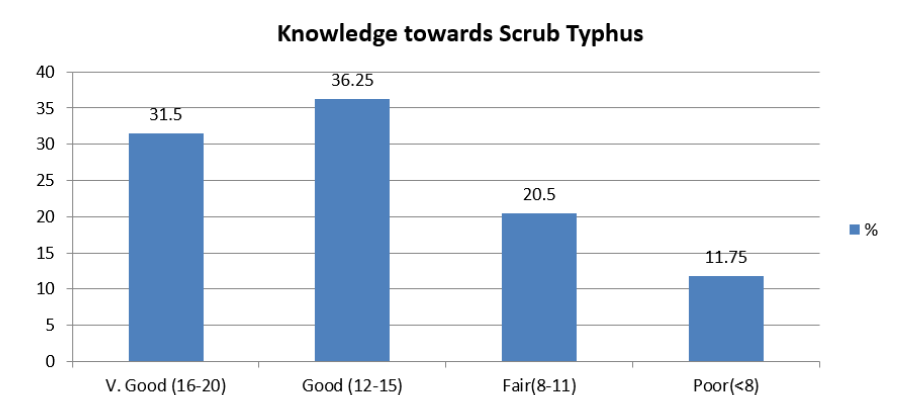
In the present study 31.5% (126) participants had very good knowledge (16-20 marks) towards scrub typhus, including its mode of transmission, symptoms, and preventive measures, 36.25% (145) had good knowledge (12-15 marks), 20.5% (82) had fair knowledge (8-11 marks) and 11.75% (47) having poor knowledge (<8 marks) (Figure 1).
Scrub typhus, caused by Orientia tsutsugamushi and transmitted by infected larval mites, is a significant vector-borne disease in several parts of Asia, including India. This study aimed to assess the awareness and knowledge levels regarding scrub typhus, including its mode of transmission, symptoms, and preventive measures, among the general public of Shimla, Himachal Pradesh. The findings reveal valuable insights into the current understanding of scrub typhus in this region [6].
Table 1: Knowledge Regarding Scrub Typhus Among Study Participants
Statements | Frequency of Correct Responses | % |
What is scrub typhus, and what causes it? | 298 | 74.5 |
How is scrub typhus transmitted to humans? | 265 | 66.25 |
Where is scrub typhus commonly found geographically? | 234 | 58.5 |
What are some common risk factors for contracting scrub typhus? | 242 | 60.5 |
Can scrub typhus be spread from person to person? | 129 | 32.25 |
What are the typical clinical features or symptoms of scrub typhus? | 269 | 67.25 |
How is scrub typhus diagnosed by healthcare professionals? | 121 | 30.25 |
Why is early diagnosis and treatment crucial for scrub typhus? | 182 | 45.5 |
What are some complications that can arise from untreated scrub typhus? | 135 | 33.75 |
How can individuals protect themselves from scrub typhus infection? | 247 | 61.75 |
Are there specific preventive measures for people living in endemic areas? | 263 | 65.75 |
Can you name some common habitats or locations where the scrub mite vectors are found? | 261 | 65.25 |
Are there any vaccines available for scrub typhus prevention? | 190 | 47.5 |
What should someone do if they suspect they have scrub typhus? | 232 | 58 |
Can you explain the importance of using insect repellents and wearing protective clothing in endemic areas? | 234 | 58.5 |
How do healthcare professionals typically treat scrub typhus? | 240 | 60 |
Are there any antibiotic resistance concerns related to scrub typhus treatment? | 118 | 29.5 |
Can you describe any public health initiatives in your region to control scrub typhus? | 265 | 66.25 |
What can individuals and communities do to raise awareness about scrub typhus? | 273 | 68.25 |
Are there any misconceptions or myths about scrub typhus that you are aware of? | 237 | 59.25 |

Figure 1: Knowledge Scores Towards Scrub Typhus Among Study Participants
The study assessed the knowledge levels of 400 respondents in Shimla, with 69.75% residing in urban areas and 30.25% in rural areas. The results demonstrate a range of knowledge among participants regarding scrub typhus [7].
Approximately 74.5% of respondents correctly identified scrub typhus and its causative agent, Orientia tsutsugamushi. This foundational knowledge is vital for recognizing the disease and its associated risks. A significant proportion 66.25% of participants understood how scrub typhus is transmitted, emphasizing the role of mite bites in disease transmission. 58.5% of respondents correctly identified the common geographical regions where scrub typhus is found. This knowledge can guide travelers and residents in taking preventive measures [8].
About 60.5% of participants recognized common risk factors associated with scrub typhus. This awareness can help individuals take precautions when engaging in outdoor activities. While 32.25% knew that scrub typhus is not spread from person to person, it's noteworthy that a substantial portion still held misconceptions about its transmission. This highlights the need for education on the disease's non-contagious nature.
An encouraging 67.25% of respondents correctly identified the typical clinical features or symptoms of scrub typhus, which can facilitate early recognition and medical attention. Only 30.25% of participants were aware of how healthcare professionals diagnose scrub typhus. Increased awareness in this aspect could aid in early diagnosis. Approximately 45.5% recognized the criticality of early diagnosis and treatment, which is essential to prevent complications [9].
While 33.75% knew about potential complications arising from untreated scrub typhus, there is room for improvement in understanding the disease's severity. 61.75% of respondents correctly identified measures to protect themselves from scrub typhus infection, indicating a significant level of awareness regarding preventive actions. 65.75% recognized the existence of specific preventive measures for individuals residing in endemic areas, contributing to the safety of local residents [10].
An impressive 65.25% could name common habitats or locations where the scrub mite vectors are found. This knowledge is crucial for avoiding high-risk areas. While 47.5% were aware of the absence of vaccines for scrub typhus prevention, the understanding of vaccine unavailability is important to avoid misconceptions. 58% of participants correctly identified what individuals should do if they suspect they have scrub typhus, reinforcing the importance of seeking medical attention promptly. 58.5% recognized the significance of using insect repellents and wearing protective clothing in endemic areas, demonstrating an understanding of preventive measures. 60% of respondents had knowledge of how healthcare professionals typically treat scrub typhus, which is essential for informed healthcare decisions.
Approximately 29.5% were aware of potential antibiotic resistance concerns related to scrub typhus treatment, highlighting the importance of responsible antibiotic use. An impressive 66.25% identified the presence of public health initiatives in their region to control scrub typhus, indicating community awareness of disease control efforts. 68.25% recognized the role of individuals and communities in raising awareness about scrub typhus, reflecting a willingness to engage in educational initiatives. Around 59.25% were aware of the existence of misconceptions or myths about scrub typhus, indicating a level of critical thinking about the disease.
Comparing these findings with other studies conducted in various regions, Shimla's residents exhibit relatively moderate to good levels of awareness and knowledge regarding scrub typhus. While some aspects align with findings from other studies, such as the recognition of transmission modes and clinical symptoms, there are notable knowledge gaps in areas like diagnosis methods and complications awareness. This underscores the need for targeted education and awareness campaigns in Shimla to enhance understanding further.
Assessing the knowledge levels regarding scrub typhus among the general public of Shimla has revealed valuable insights into the awareness of this vector-borne disease.6-10 While there is a commendable understanding of key aspects like transmission and preventive measures, there are opportunities for improvement in areas such as diagnosis, complications, and misconceptions. Addressing these knowledge gaps through tailored public health campaigns and educational initiatives is essential to promote safer outdoor activities, early detection, and effective prevention of scrub typhus in Shimla. These efforts will contribute to the well-being of both residents and visitors in this picturesque region.
Blacksell, S.D. et al. "Scrub typhus serologic testing with the indirect immunofluorescence method as a diagnostic gold standard: A lack of consensus leads to a lot of confusion." Clinical Infectious Diseases, vol. 44, no. 3, 2007, pp. 391–401.
Sharma, A. et al. "Investigation of an outbreak of scrub typhus in the himalayan region of India." Japanese Journal of Infectious Diseases, vol. 58, no. 4, 2005, pp. 208–210.
World Health Organization. Scrub Typhus: Report of a WHO Consultation on Scrub Typhus Epidemiology and Management. World Health Organization, 2016.
World Health Organization. "Scrub typhus: A disease of growing concern in Asia." World Health Organization, 2018, https://www.who.int/campaigns/world-antibiotic-awareness-week/waw-2018/scrub-typhus/en/. Accessed 30 Aug. 2023.
Mittal, G. et al. "A new face of an old pathogen: an alarming increase in scrub typhus cases." Medical Journal of Armed Forces India, vol. 71, Suppl. 1, 2015, pp. S85–S88.
Taylor, A.J. et al. "A systematic review of mortality from untreated scrub typhus (Orientia tsutsugamushi)." PLoS Neglected Tropical Diseases, vol. 9, no. 8, 2015, p. e0003971. PLoS Neglected Tropical Diseases, https://doi.org/10.1371/journal.pntd.0003971.
Watt, G., and P. Parola. "Scrub typhus and tropical rickettsioses." Current Opinion in Infectious Diseases, vol. 16, no. 5, 2003, pp. 429–436.
Mahajan, S.K. et al. "Scrub typhus involving central nervous system, India, 2004–2006." Emerging Infectious Diseases, vol. 16, no. 10, 2010, pp. 1641–1643.
Varghese, G.M. et al. "Clinical profile and improving mortality trend of scrub typhus in south India." International Journal of Infectious Diseases, vol. 23, 2014, pp. 39–43.
Kim, D.M. et al. "Clinical and laboratory findings associated with severe Scrub Typhus." BMC Infectious Diseases, vol. 10, 2010, p. 108. BMC Infectious Diseases, https://doi.org/10.1186/1471-2334-10-108.