Purpose: This paper discusses the correspondence between the nature of visual design style and audiences’ demands in different eras, and also discusses the evolution process. Method: This paper is based on Maslow’s Hierarchy of Needs, discussing the evolution of visual design style nature from the perspective of consumers’ demands. This paper discovers that the visual design style nature presents changes corresponding to the consumers’ hierarchical development change in different ears. Conclusion: With the consumers’ demand level changing from psychological needs, safety needs, social needs, esteem needs until self-actualization needs, the design style is also developing from function, amicability, interest, personality and pleasure, and also the design element shows the hierarchical development change from rational and precise, casual and free to perceptual aesthetics. It is hoped that this research could provide references towards the history construction of visual design style.
Keywords
Visual Design
Style Evolution
Maslow’s Hierarchy of Needs
INTRODUCTION
In recent years, there have been more and more researches focusing on design history. It has developed into an independent scientific field from the early research branch depending on art history. At present, there also begins to show diversified perspectives on research subjects and methods, developed from the early single perspective. Reyner Banham, the British architecture critic, pointed out that mass culture was the subject of design research. He also believed that the products of mass production and the various products in modern popular culture were the main research objects. While Nikolaus Pevsner, the German art historian, mentioned in his masterpiece Pioneers of Modern Design: From William Morris to Walter Gropius that design research was a regional dividing activity. He also believed that the main objects of design research should be the Western regions such as Western Europe and the Britain. However, Victor Margolin, the American design historian, pointed that because design was a continuously developing, spreading and changing activity, its research subjects were diversified and mobile, so if the research subjects were limited and described using single method, the research might be biased. Therefore, the research subjects have been changing gradually towards cross-domain and dynamic research category, with the research subjects ranging from the work to writing techniques, and from elitism to democratism, while the research orientation involved from formalism to pragmatism, and from sociocultural orientation to semiotics orientation, among which style discussion was considered one of the mainstreams in design history [1]. Style is of great significance in design, which is not only the external form of design, but also the first visual element between differences of design. Heinrich Wolfflin, the Swiss aesthetician, stated in his book The Anonymous Art History published in 1915 that style was the research object of art history. Giorgio Vasari, the Italian art theorist, believed that style has its own specific life cycles, which would experience the process of newborn, growth, senescence and death. Until the 19th century, under the influence of Darwinian Revolution Theory, the phrase of “style evolution” appeared [2]. Inevitably, style evolution is of timeliness. Through the evolution of time and distinguished by generations, the evolution of design style and differences in design elements of different generation background could be roughly understood [3]. Clearly knowing the process of style evolution in all historical periods, is not only part of the research on design style changing, inheritance and innovation motivation, but also part of the deep research from the perspectives of generations, society, visual and aesthetics reflected by visual reflection, visual symbol and visual language. Therefore, as design style as the research purpose, this paper aims at discussing the development path of design style in the past context.
On the other hand, “people”, as the target objective of design production, play an important role in writing code and audience decoding in design transmission chain [4], wherein there is inseparable relationship between design production style and perception and demands of “people”. Abraham. H. Maslow, the famous American social psychologist, put forward people’s Hierarchy of Needs in A Theory of Human Motivation Psychological Review in 1943, which started the related discussion on people’s need in various aspects. Based on the close relevance between design demands and perception reception, this paper aims to conduct research on the evolution process of visual design style and discuss the evolution of design nature in design style evolution, with the theoretical basis of Maslow’s Hierarchy of Needs and consumers’ cognitive need. By sorting out the evolution of design style nature, the paper hopes to provide references towards current design activities, and provides estimation of future design style. Lin Rongtai, the Taiwan scholar, pointed out that the culture reflects the past, creativity the present, and design reflects the future (). People can only see the farther future by standing on the shoulder of history, so as to reach the height of “representing the elegance” by “studying the culture in the past”.
Overlapping and Progress: Maslow’s Hierarchy of Needs
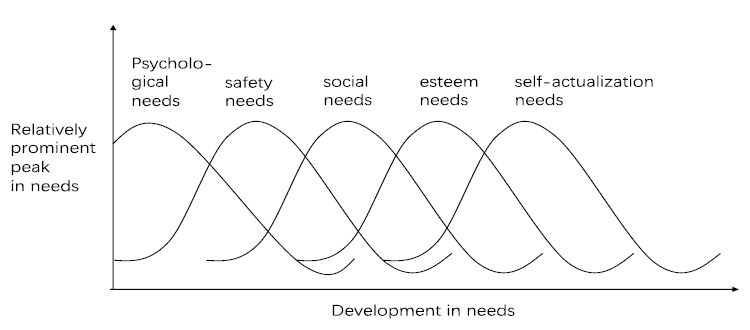
According to Maslow’s Hierarchy of Needs, people’s needs are divided into continuous, overlapping and waving evolution process. As shown in Fig. 1, there are five stages including psychological needs, safety needs, social needs, esteem needs until self-actualization needs [5]. These five stages are not interrupted or stepped jumping process. The development law mainly includes three aspects: the low level demands are the basis of high level demands; people’s demands level are developing in wave-like manners; the development of demands in different levels relates to individual’s gender, age and education degree, and also relates to social, political, economic and environmental aspects [3]. Although this theory has not been tested by arguments, it is still widely accepted in the academic world [6]. For example, Norwood stated that Maslow’s Hierarchy of Needs could be used in describing consultation types of different developing stages of individuals; Jordan took Maslow’s Hierarchy of Needs as a starting point, put forward consumers’ demand level from the perspective of people, including functionality level, usability level and pleasure level, and combined Tiger’s theory to further extend the pleasure level into physio-pleasure level, psycho-pleasure level, socio-pleasure level and ideo-pleasure level. Based on that, Daniels stated that “self-actualization needs” in Maslow’s Hierarchy of Needs is the highest level in the theory.
According to Maslow’s Hierarchy of Needs, it can be seen that the evolution of consumers’ demands shows a process of overlapping and progress. What kind of development will this evolution process bring to the visual design field? Design is a kind of commercial activity, with consumers’ demands as the direct purpose. The development of design style form will inevitably change corresponding to the evolution of consumers’ demands. The psychological needs and safety needs in the early stage correspond to the functionality in design demands; the social needs and esteem needs in the middle stage correspond to the usability of design demands; the self-actualization needs in the later stage correspond to the pleasure. What kind of corresponding development will there be in design style? Design style is the external form of design culture, and the audiences’ demands is one of the important elements construction of design culture, so as to conduct discussion on the development route of design element through research on evolution of audiences’ demands, which has important and practical significance. Upgrading and Innovation: Design Style of the Times
The word style was originated from the Latin word Stilus, originally meaning writings on the board, and later referring to writing style or literary form, close to “format”. In China, The Literary Mind and the Carving Dragons discussed theory of literature and art from the perspectives of writing and design style in an early stage. In the book, Liu Xie the author discussed the complementary relationship between characteristics and styles, and further summarized the main cause of the formation of work style [7], wherein when talking about aesthetic view on matters, the book put forward the perceptual effect of “focusing on the vivid description when writing about an object, and focusing on the impressive description when writing about perceptions”, which emphasized on the mutual effect between external formation and internal emotions of the design’s connotation [8]. Chan conducted discussion on style evolution from the perspective of history, which believed that style is a of its specific type in reflecting social and cultural condition and aspects. H. Wolfflin, the Swiss art historian, put forward in his master piece Principles of Art History that there were three elements in forming the style: generation, national character and individual personality. E.H. Gombrich, the famous British art historian said that “all the art and sports activities in 20th centuries had influenced the design”, In short, style has obvious features of generations and regions, and design style is the reflection of regional and culture connotation and social background. Therefore, sorting the development route of design style in generations helps to better understand the relevance between times and style.
The early 20th century is an important stage of rapid development in modern design, during which many schools of design appeared, including Deutschland Craft Union, De Stijl, and Bauhaus. The purism, which made art for art’s sake in modern artistic view, was questioned, and the radical schools of art proposed the attempt to differentiate the artistic autonomy which is emphasized by the purism [9]. The application of geometric aesthetics and new materials made the design style to show the functionality tendency of “less is more”, which was corresponding to the psychological needs in Maslow’s Hierarchy of Needs. Under the dominance of functionalism, the highest guiding principle of this period became “form decided by functionality”; until the 1950s, the design concepts of current style, streamlined style, and organic design were developed. In this period, the pro-human design concept has become the mainstream, which was corresponding to the safety needs in Maslow’s Hierarchy of Needs, emphasizing not only the function level, but also the friendly design in line with human nature [10]; until the 1970s, popular art tried to overturn abstract art, and focused on the detailed mass culture themes such as symbols and trademarks. From the perspective of visual perception, popular art combined “optical art” launched by scientific and technology revolution. In this period, the designs focused on individuals and won by features [11]. The work style put emphasis on the presentation of enjoyment, which was corresponding to the social needs in Maslow’s Hierarchy of Needs, fighting against authority culture and easel art by mass culture; until the 1990s, ideological trends sprung up, including postmodernism, California New Wave, and deconstructivism, which had the characteristics of loose, intuition, high color saturation and non-modern in design presentation, composing the work in broken collage method. It was corresponding to the esteem needs in Maslow’s Hierarchy of Needs, emphasizing individualized proposition; until the 21st century, with the technology development, design style is showing the tendency of diversified development. During this period, the design ideology based on “human nature” is emphasized, which is the perceptual form of design, aiming at aesthetic experience, namely the design of pleasure, which is corresponding to the self-actualization needs Maslow’s Hierarchy of Needs (Table 1).
In conclusion, the design style is developing along with the times, and changing with the change in audiences’ decoding demands. Maslow’s Hierarchy of Needs is related to the change of time, while the design style is also developing correspondingly. Due to the spiral development of different design styles in alternating among multiple aspects, although the style has certain “periodicity”, it still presents different visual design nature corresponding to the change in consumers’ Hierarchy of Needs during the upgrading and innovation.
Table 1: Relevance between Consumers’ Demands and Design Style (made by this research)
Period
Maslow’s Hierarchy of Needs
Design Demands
Style Features
Design Natures
The 1920s – 1930s
Psychological Needs
“Functionality” Design
Style feature of preciseness and rationality
the format construction of geometrical shape, straight line and solid color block, and “cellular base”
The 1950s
Safety Needs
“Pro-human” Design
Style feature of conciseness and high degree of identification
the geometrical constitution of Sans-serif font, straight line and big block
The 1970s
Social Needs
“Enjoyment” Design
Style feature of casualness and diversification
colorful and diversified font form and shape constitution
The 1990s
Esteem Needs
“Personalized” Design
Style feature of intuition and three-dimensional collage
high color saturation and application of three dimensions in two dimensions
The 21st Century
Self-actualization needs
“Pleasure” Design
Style feature of perceptual aesthetics
regional characterized design form
Figure 1: The Evolution of Maslow’s Hierarchy of Needs
CONCLUSION
In the field of design, style is endowed with extremely important connotation and meaning. As the external components of design, it is not only the first element of visual differentiation, but also the formal representation of culture connotation and social politics and economy. The discussion on style is actually the discussion on similarity and differentiation of works. Based on Maslow’s Hierarchy of Needs, this research discusses the evolution process in different generations from the perspective of consumers’ demands. The research results are as follows:
When consumers’ demands is in the psychological needs level, the design should focus on functionality formality. In terms of design element nature, it emphasizes the style feature of preciseness and rationality constructed by the combination of straight line and geometrical shapes
When the consumers’ demands is in the safety needs stage, the design should focus on pro-human formality. In terms of design element nature, it emphasizes the style feature of high degree of identification and “affinity” constructed by the geometrical constitution of sans-serif font, straight lines and big blocks
When the consumers’ demands is in social needs stage, the design should focus on enjoyment formality, so as to break the style feature of preciseness and rationality via diversified font form and shape constitution, showing the design style of postmodernism
When the consumers’ demands is in esteem stage, the design should focus on personalized tendency, in pursuit of high color saturation and application of three dimensions in two dimensions with the style feature of intuition and three-dimensional collage
When the consumers’ demands is in self-actualization stage, the design should focus on pleasure tendency. The visual design in this stage emphasizes the combination with regional culture, realizing reappearance and reconstruction of culture via artistic, perceptual and aesthetic visual formality, while the design elements present a diversified culture feature
Based on Maslow’s Hierarchy of Needs, this research discusses the development route and element nature of style, with relevance between design demands and style. The research of development history of design style in past context is the process of inspecting the existing structure changes as time goes by, and discussing the reason of past success or failure, as well as estimating the future. “History” is a piece of mirror, while its construction meaning is not in exploring the past, but in looking forward to the future. It is hoped that this research could provide references towards the history construction of visual design style.
REFERENCES
Wang, H.S. “Rethinking design history: A hypothesis of design history discourse in Taiwan.” Journal of Design, vol. 2, no. 1, 1997, pp. 65-78.
Ackerman, J.S. and Carpenter, R. “Style.” Art and Archaeology. Prentice-Hall, 1963, pp. 164-186.
Chien, C.W. et al. “The study of period style in products.” Journal of National Taiwan College of Arts, no. 99, 2016, pp. 1-27.
Jakobson, R. Language in Literature. The Belknap Press of Harvard University Press, 1987.
Maslow, A.H. Motivation and Personality. HarperCollins, 1954.
Soper, B. et al. “Belief when evidence does not support theory.” Psychology & Marketing, vol. 12, no. 5, 1995, pp. 415-422.
Wang, G.S. “A new probe into Liu Xie’s Wen-xin-diao-long.” Journal of National Taiwan Normal University, vol. 36, 1991, pp. 139-157.
Tao, L.T. “Visional integration: The constructivism of appreciation of aesthetic as well as mind-matters of Wen-xin-diao-long.” Bulletin of the Department of Chinese Literature National Chengchi University, no. 4, 2005, pp. 3-28.
Zhou, X. “Baohaus as another side of modernism.” Academic Research, no. 6, 2018, pp. 141-147.
Catanese, L. “Thomas Lamb, Marc Harrison, Richard Hollerith and the origins of universal design.” Journal of Design History, vol. 25, no. 2, 2012, pp. 206-217.
Smock, W. Bauhaus Ideal: Then and Now. Academy Chicago Publishers, 2004.
Recommended Articles
Research Article
Effect of Laser Bio stimulation and Bone Graft in Treatment of a Large Periapical Lesion – A CBCT Analysis
Ruchika Gupta Dewan,
Unnavi Chauhan
Published: 22/11/2020
Download PDF
Research Article
Classifying Problems of Diabetic Foot
Amit Kumar C Jain
Published: 23/11/2020
Download PDF
Research Article
Rare Presentation Heterogeneous Pregnancies
Imad Abedzaid Mohan Aljanabi,
...
Marwa Habeeb Nazal
Published: 20/03/2021
Download PDF
Research Article
Emerging Role of Nutraceuticals in Covid 19
Naaz Huda,
...
Kaur Charanjeet
Published: 22/11/2020
Download PDF
PO Box 101, Nakuru
Kenya.
Email: office@iarconsortium.org
Editorial Office:
J.L Bhavan, Near Radison Blu Hotel,
Jalukbari, Guwahati-India
Huang, J., Lin, C., Gao, Y. & Lin, R. (2021). Research on the Evolution Process of Visual Design Style Since the 20th Century-- Based on Maslow’s Theory of ‘Hierarchy of Needs’. IAR Journal of Humanities and Cultural Studies, 2(1), 1-4.
MLA
Huang, Jiangping, et al. "Research on the Evolution Process of Visual Design Style Since the 20th Century-- Based on Maslow’s Theory of ‘Hierarchy of Needs’." IAR Journal of Humanities and Cultural Studies 2.1 (2021): 1-4.
Chicago
Huang, Jiangping, Chinlon Lin, Yang Gao and Rungtai Lin. "Research on the Evolution Process of Visual Design Style Since the 20th Century-- Based on Maslow’s Theory of ‘Hierarchy of Needs’." IAR Journal of Humanities and Cultural Studies 2, no. 1 (2021): 1-4.
Harvard
Huang, J., Lin, C., Gao, Y. and Lin, R. (2021) 'Research on the Evolution Process of Visual Design Style Since the 20th Century-- Based on Maslow’s Theory of ‘Hierarchy of Needs’' IAR Journal of Humanities and Cultural Studies 2(1), pp. 1-4.
Vancouver
Huang J, Lin C, Gao Y, Lin R. Research on the Evolution Process of Visual Design Style Since the 20th Century-- Based on Maslow’s Theory of ‘Hierarchy of Needs’. IAR Journal of Humanities and Cultural Studies. 2021 Jan;2(1):1-4.


 Download PDF
 Download XML