Micro Electric Discharge Machining (Micro-EDM) is an established machining process for making very small parts/components with accuracy and superior surface finish. The present work, investigates the abrasive assisted Micro-EDM of Inconel alloy with Tungsten electrode using Response Surface Methodology (RSM). The experiments were carried out based on RSM design of experiments, especially face center cubic design with and without magnetic field assistance on Micro-EDM processes. The machining parameters for experimental design are voltage; Pulse on time and feed rate each varying at three levels. Material Removal Rate (MRR) is the response parameter. Mathematical model was developed for prediction of MRR based on RSM methods. Analysis of variance was used to check the significance of model of MRR for both machining processes. The experimental observation shows that voltage, pulse on time and its interactions are significant on the MRR. The MRR of abrasive assisted Micro-EDM is 22% more than the MRR of non- abrasive assisted Micro-EDM.
Keywords
Micro EDM
ANOVA
RSM
Inconel Alloy
Surface Morphology
INTRODUCTION
Micro-EDM is an established machining process to make micro features, micro holes on difficult to cut materials, electrically conductive metal and alloys; especially nickel based alloys, titanium alloys and other heat-resistant metal alloys [1]. Even though Micro-EDM machining process can be used for machining of conductive materials, still it has many problems to be explored such as accuracy and reliability. To overcome these problems, the magnetic field assisted Micro-EDM is an ideal technique. Magnetic field introduced Micro-EDM is advancement in modern nontraditional machining process to enhance the machining performances such as material removal rate, tool wear rate, accuracy and fine surface finish.
Inconel alloy 718 is used in automotive, aerospace and defense industries due to its high strength and corrosion-resistance. It is very difficult to cut by conventional machining process because of its high toughness and work hardening characteristics [2]. On the contrary to traditional machining, unconventional method like EDM is comparatively more advantageous to machine this alloy. Alternatively, low thermal conductivity limits the machining performances of Inconel-718 with EDM process. Therefore magnetic field assisted Micro machining is the ideal choice for machining performance improvements.
Singh [3] investigated the effect of abrasive in EDM process on Al-SiC composites using Taguchi method. The presence of magnetic field in EDM process resulted in improvement of material removal rate and surface roughness. MRR increases with the assistance of magnetic field in Electro chemical spark machining process when compared to non-magnetic field assisted ECDM process [4]. Magnetic suspension assisted spindle system in EDM produces higher material removal rate and quality while machining of Inconel alloy than conventional EDM [5]. There are many studies performed with the assistance of magnetic field in nontraditional machining process especially macro EDM processes. Lin and Lee [6] investigated the effect of magnetic field in EDM process and the test result shows that the machining stability and efficiency has improved considerably at high discharge energy regime. The machining stability was improved by magnetic field due to efficient removal of debris between the tool and work pieces. In addition to that magnetic field introduced EDM has more influences on MRR and crater characteristics.
Khan [7] experimented with powder mixed EDM as well as magnetic field assisted EDM on steel grade 760. Permanent cylindrical magnet was used for conducting the experiments.
Magnetic field assisted EDM contributed to higher machining performance in terms of MRR and surface roughness. Wang et al. [8] studied the effect of magnetic abrasive flow finishing process for getting fine surface finish with metals, ceramics and composite materials. Electromagnetic field assisted EDM has improved the MRR drastically over EDM process on titanium alloy [9-10]. Hardik Beravala investigated the effect of magnetic field in EDM process using liquid-air mixed di-electric medium. The result shows that magnetic field assisted EDM process have 21-41% better material removal rate compared to conventional EDM, experimental results reveal that micro hardness, surface finish and layer thickness of machined surface was improved significantly [12]. Rouniyar [13] studied the effect of powder mixed and magnetic field introduced hybrid machining in EDM on aluminium alloy. The magnetic field significantly improved the MRR whereas the TWR was decreased. The MRR increases and tool wear rate decreases up to the certain value and follow the reverse trend with an increase in powder concentration. The energy efficiency, material erosion efficiency and MRR increases by 15.2, 22.6 and 21.9%, respectively while magnetic field assisted machining [14]. The application of external magnetic field in EDM process which increasing plasma flushing efficiency and decreasing recast layer thickness [15].
From the review of literature, it is necessary to explore the magnetic field assisted Micro-EDM process on inconel alloy. The present study focused on investigating the machining performance of Micro-EDM with and without magnetic field. The effects of voltage, capacitance and feed rate on MRR were statistically analyzed by ANOVA for Micro-EDM and magnetic field assisted Micro-EDM. Mathematical model was applied for predicting MRR.
MATERIALS AND METHODS
Work piece and tool materials
Work piece material is an Inconel alloy metal circular bar of diameter 20 mm. EDM 3 oil was used as dielectric fluid. Tungsten electrode of 0.5mm diameter cylindrical rod was used as tool electrode. Abrasive particle (graphite and Silicon) with equal proportion is used in dielectric fluids while machining (Figure 1).
Figure 1: Work Piece Material
Response Surface Methodology (RSM)
RSM is one of the statistical techniques used for conducting the experiments, investigating the effects of parameters on responses and optimizing process parameters. RSM is used to study the relationship between the input factors and the responses which is represented by a 2D or 3D hyper surface. The RSM based face centered cubic design was applied to conduct the experimental run and also for modeling of Micro-EDM as well as abrasive assisted Micro-EDM. The developed mathematical model can be used for predicting the MRR for both the machining process.
Experimentation
DT-110 Multi process integrated micro machining system was used for conducting the experimental work with Micro-EDM setup using RC circuit shown in Figure 2. It has a positional accuracy of 0.1 μm. The Micro-EDM input parameters and their levels are presented in Table 1. Twenty different experimental combinations were conducted based on face centered cubic design using RSM. MRR is calculated using Equation 1. The experimental results of machining performance (MRR) of both the Micro-EDM, with and without abrasive are presented in Table 2.
(1)
Table 1: Input Factors and their Levels
Variable
Symbol
Levels
-1
0
1
Pulse on Time (μs)
A
10
20
30
Voltage (V)
B
100
110
120
Feed Rate (μm/sec)
C
1
2
3
Table 2: Experimental Results of MRR
Run
A
B
C
Micro- EDM
Abrasive assisted Micro- EDM
Pulse on Time (μs)
Voltage (V)
Feed Rate (μm/sec)
Material Removal Rate (mm3/min)
Material Removal Rate (mm3/min)
1.
20
110
2
0.00354
0.00502
2.
20
110
3
0.00418
0.00547
3.
20
110
2
0.00347
0.00462
4.
30
100
1
0.00064
0.00074
5.
10
120
3
0.00359
0.00427
6.
10
100
1
0.00087
0.00106
7.
30
100
3
0.0008
0.00092
8.
20
110
2
0.00355
0.0049
9.
10
110
2
0.00442
0.00521
10.
20
100
2
0.000615
0.00094
11.
30
110
2
0.00426
0.00506
12.
20
110
2
0.00346
0.00482
13.
30
120
3
0.0053
0.00548
14.
20
110
2
0.00377
0.00507
15.
30
120
1
0.00435
0.00487
16.
20
120
2
0.00331
0.00511
17.
20
110
1
0.00367
0.00538
18.
10
120
1
0.00351
0.00461
19.
20
110
2
0.00348
0.00496
20.
10
100
3
0.00069
0.00086
Figure 2(a-b): (a) Photo of EDM System and (b) The Machining Zone
RESULTS AND DISCUSSION
Model adequacy can be validated by following graphical analysis. Figure 3 shows residual plot for MRR. From Figure 3 inferred that all the errors are normally distributed, all the data points are almost lying in a straight line and there is no outliers in the plot. From Figure 4 it can be inferred that the errors are randomly scattered indicating that they are independent.From Figure 5, there is no unusual structure, which indicates that the model is correct.
Figure 3: Normal Probability Plot (MRR)
Figure 4: Residual Versus Order of Experimentation (MRR)
Figure 5: Residuals Versus Predicted Values (MRR)
This shows that the model is in good fit with experimental values. From ANOVA, p-values lower than 0.05 indicates that models of MRR for with and without magnetic field assisted Micro-EDM process is significant. Co-efficient of determination (R2) values of MRR for both models is 0.9662 and 0.9907, respectively. In-significant factors are eliminated by backward elimination process. The quadratic reduced model of MRR without magnetic field and with magnetic field introduced Micro-EDM processes are presented in ANOVA Table 3 and 4, respectively.
Table 3: ANOVA for MRR Without Abrasive
Source
Sum of Square x10-7
Degree of freedom
Mean Squarex10-7
F value
p-value Prob>F
Model
395.9
5
79.18
80.12
<0.0001
Significant
A-Voltage
5.153
1
5.153
5.21
0.0385
B-Capacitance
270.5
1
270.5
273.65
<0.0001
AB
8.911
1
8.911
9.02
0.0095
A2
11.65
1
11.65
11.78
0.0040
B2
100.8
1
100.8
101.95
<0.0001
Residual
13.84
14
0.9883
Lack of Fit
13.16
9
1.462
10. 79
0.00 87
Pure Error
0.6775
5
0.1355
Cor Total
490.8
19
Table 4: ANOVA for MRR With Abrasive
Source
Sum of Square x10-7
Degree of freedom
Mean Squarex10-7
F value
p-value Prob> F
Model
635.8
6
106
230.63
< 0.0001
Significant
A-Voltage
1.124
1
1.124
2.45
0.1419
B-Capacitance
392.8
1
392.8
855.33
< 0.0001
AB
0.1936
1
0.1936
0.42
0.5275
AC
3.741
1
3.741
8.14
0.0136
B2
2.211
1
2.211
512.94
< 0.0001
Residual
235.7
13
0.4594
Lack of Fit
5.973
8
1.462
5.21
0.04 27
Pure Error
0.6395
5
0.1279
Cor Total
614.7
19
The quadratics equations are used to express the MRR (YMRR) of both Micro-EDM processes shown in Equation 2 and 3. These developed model equations are used for predicting the MRR with a coded unit as follows:
The main, interaction and quadratic effects of various input process parameters on MRR with and without abrasive Micro-EDM processes are presented in ANOVA Table 3 and 4. From ANOVA Table 3, it has found that pulse on time has more effects on MRR when compared to voltage and feed rate. The voltage, pulse on time, interaction of voltage and pulse on time, quadratic effects of voltage and pulse on time have significant effects on MRR. Table 4 shows that, voltage, pulse on time, federate, interaction of voltage, pulse on time, and interaction of voltage, feed rate and pure quadratic effects of pulse on time have significant effects on MRR in abrasive assisted Micro-EDM process.
From Figure 6 and 7 it is inferred that there is considerable improvement in MRR while increasing pulse on time and voltage. Similar observations were found in abrasive assisted Micro-EDM, shown in Figure 6 and 7.
Figure 6: 3D-Surface Response of MRR Without Abrasive
Figure 7: 3D-Surface Response of MRR With Abrasive
From Figure 8, it is observed that the application of abrasive with Micro-EDM significantly improves MRR. In all the twenty experiments conducted, MRR of abrasive assisted Micro-EDM process is greater than the Micro-EDM process. This is due to the discharge process; additional force is acting on the melt pool. In Micro-EDM, force develops when a current carrying element is subjected to an externally applied abrasive. Molten material’s droplets produced by plasma interacting with an electrode are removed with half of a self-induced force.
Figure 8: Comparison of MRR With Abrasive and Without Abrasive
The addition of abrasive introduces an external force in Micro-EDM leads to efficient removal of molten droplet in the form of debris while machining thus improving the MRR [9]. Similar observations has been found in magnetic suspension spindle system has considerable improvements in MRR in machining of Inconel alloy due to improvements in discharge frequency and reducing the arc [6]. Effect of abrasive, a resultant force act as efficient removal of debris particles between the tool and electrode promotes the improvements in MRR [10]. The experimental results show that abrasive assisted Micro-EDM produces higher MRR than non-abrasive assisted Micro-EDM. The higher MRR could be achieved at Voltage of 120 V, pulse on time of 30 μs and Feed rate of 1μm/sec. The experimental results were validated by confirmation test based on optimal machining conditions. The optimal machining combination for both process are Voltage 120 V, pulse on time 30 μs and Feed rate 1 μm/sec presented in Table 5 and 6, respectively. The experimental data are in good agreement with predicted value with 95% confidence intervals presented in Table 5 and 6.
Table 5: Optimum Machining Conditions for Micro-EDM
Response
Goal
Desirability
Optimum combination
Predicted value
Actual value
A
B
C
MRR
Maximum
0.971
120
0.01
1
0.00504
0.00486
Table 6: Optimum Machining Conditions for abrasive assisted Micro-EDM
Response
Goal
Desirability
Optimum combination
Predicted value
Actual value
A
B
C
MRR
Maximum
0.971
120
0.01
1
0.00574
0.00565
Surface Morphology
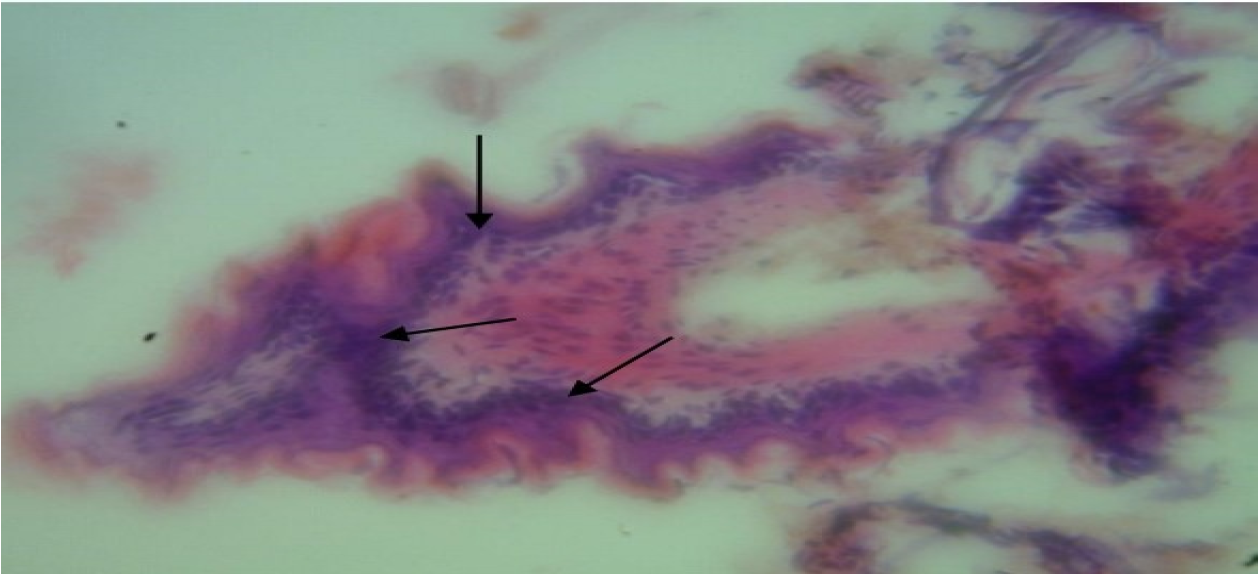
In order to reduce the over-cut effect, the hole should be machined as quickly as possible. When the tool was fed to a depth of four times of the thickness of the work piece, the difference in diameter was reduced by 12.5 μm. With further increase in tool feed depth, there was no reduction in the difference of diameter. The introduction of abrasive particles improved the flushing condition and reduced the machining time (Figure 9).
Figure 9: SEM After Machining With Abrasive Particles
CONCLUSION
Micro-EDM performance especially MRR was presented with and without abrasive assistance during machining of Inconel alloy. The statistical analysis highlighted that main factors such as Pulse on time, voltage and its quadratic effect (B2), (A2), interaction of voltage and pulse on time (AB) have significant influence on Material removal rate compared to feed rate in Micro EDM process with abrasive particles. Pulse on time and its quadratic effect (B2), interaction of voltage and pulse on time (AB) have more influence on MRR in abrasive assisted Micro-EDM process. For both cases the feed rate has less impact on machining performances. From the experimental results, it was found that the addition of an external abrasive produced higher MRR [0.00565 mm3/ min] using optimal machining conditions at Voltage of 120 V, pulse on time 30 μs and Feed rate 1 μm/sec.
The effect of abrasive in Micro-EDM has significant improvements in MRR of Inconel alloy. About 22% improvements in MRR (in average) is observed in abrasive assisted Micro- EDM process.
REFERENCE
Sivaprakasam, P. and P. Hariharan. “Optimization of Process Parameters of Micro-WEDM Process on Inconel Super Alloy through Response Surface Methodology.” Journal of Mechanical and Production Engineering Research and Development, vol. 8, no. 6, 2018, pp. 1001-1011.
Kuppan, P. et al. “Influence of EDM Process Parameters in Deep Hole Drilling of Inconel 718.” International Journal of Advanced Manufacturing Technology, vol. 38, 2008, pp. 74-84.
Singh, B.P. et al. “Investigation of Magnetic Field-Assisted EDM of Composites.” Materials and Manufacturing Processes, vol. 33, no. 6, 2018, pp. 670-675.
Rattan, Nav and Rahul S. Mulik. “Improvement in Material Removal Rate (MRR) Using Magnetic Field in TW-ECSM Process.” Materials and Manufacturing Processes, vol. 32, no. 1, 2017, pp. 101-107.
Feng, Yerui et al. “Micro-Holes EDM of Super Alloy Inconel 718 Based on a Magnetic Suspension Spindle System.” International Journal of Advanced Manufacturing Technology, vol. 101, 2019, pp. 2015-2026.
Lin, Y.C. and H.S. Lee. “Machining Characteristics of Magnetic Force-Assisted EDM.” International Journal of Machine Tools and Manufacture, vol. 48, 2008, pp. 1179-1186.
Khan, A.A. et al. “Improvement of Material Removal Rate and Surface Roughness for Steel Grade 760 Using Magnetic Field Assisted Al₂O₃ Powder-Mixed EDM.” Journal of Applied and Environmental Biological Sciences, vol. 7, no. 11, 2017, pp. 30-37.
Wang, Y. and D. Hu. “Study on the Inner Surface Finishing of Tubing by Magnetic Abrasive Finishing.” International Journal of Machine Tools and Manufacture, vol. 45, 2005, pp. 43-49.
Yadav, Pawan Kumar et al. “Experimental Study of EDM and Electromagnetic Field Assisted EDM for Ni Alloy: A Comparative Study.” Proceedings of the 10th International Conference on Precision, Meso, Micro and Nano Engineering (COPEN 10), 2017, pp. 391-395.
Jafferson, J.M. et al. “Effects of Ultrasonic Vibration and Magnetic Field in Micro-EDM Milling of Nonmagnetic Material.” Materials and Manufacturing Processes, vol. 29, no. 3, 2014, pp. 357-363.
Beravala, Hardik and Pulak M. Pandey. “Experimental Investigations to Evaluate the Effect of Magnetic Field on the Performance of Air and Argon Gas Assisted EDM Processes.” Journal of Manufacturing Processes, vol. 34, 2018, pp. 356-373.
Bains, P.S. et al. “Magnetic Field Influence on Surface Modifications in Powder Mixed EDM.” Silicon, vol. 11, no. 1, 2019, pp. 415-423.
Rouniyar, Arun Kumar and Pragya Shandilya. “Proceedings of the Institution of Mechanical Engineers, Part B: Journal of Engineering Manufacture.” Proceedings of the Institution of Mechanical Engineers, Part B: Journal of Engineering Manufacture, vol. 233, no. 12, 2019, pp. 2283-2291.
Ming, Wuyi et al. “Comparative Study of Energy Efficiency and Environmental Impact in Magnetic Field Assisted and Conventional Electrical Discharge Machining.” Journal of Cleaner Production, vol. 214, 2019, pp. 12-28.
Shabgard, M.R. et al. “Investigating the Effects of External Magnetic Field on Machining Characteristics of Electrical Discharge Machining Process, Numerically and Experimentally.” International Journal of Advanced Manufacturing Technology, vol. 102, nos. 1-4, 2019, pp. 55-65.
Recommended Articles
Research Article
OBSERVATIONS ON THE HOMOGENEOUS TERNARY QUADRATIC DIOPHANTINE EQUATION x2 + 4xy + 9y2 = 21z2
Download PDF
Research Article
Computer Driven Library Management and Service Rendering System: Mobile Library Landscape
Yekini N. A,
...
Ojo O
Published: 10/06/2020
Download PDF
Research Article
Influence of Optimum Percentage of Waste Ceramic Powder as a Fine Aggregate Replacement on Hardened Properties of Concrete
Mohammad Ali Asaad,
...
Mohammed Muhsin
Published: 11/06/2020
Download PDF
Research Article
The Possibility of Treating Corrosion in Iron Valves of Flow Regulators, Pumping Station Components, and Suspended Solids Filtration Networks in Rivers and Streams in Al-Qadisiyah Governorate
Qasim M. Turki,
...
Ahmed Hakem Jabor
Published: 02/03/2026
Download PDF
PO Box 101, Nakuru
Kenya.
Email: office@iarconsortium.org
Editorial Office:
J.L Bhavan, Near Radison Blu Hotel,
Jalukbari, Guwahati-India
Pandey, A. K., Tripathi, R. M., Satyendra, T. A., Chaudhary, S. P. & Mishra, A. K. (2022). Abrasive Assisted Micro Electric Discharge Machining on ‘Inconel 718’: An Experimental Exploration. IAR Journal of Engineering and Technology, 3(1), 1-7.
MLA
Pandey, Ashutosh K., et al. "Abrasive Assisted Micro Electric Discharge Machining on ‘Inconel 718’: An Experimental Exploration." IAR Journal of Engineering and Technology 3.1 (2022): 1-7.
Chicago
Pandey, Ashutosh K., Rajeev M. Tripathi, Tripathi A. Satyendra, Satya P. Chaudhary and Akshay K. Mishra. "Abrasive Assisted Micro Electric Discharge Machining on ‘Inconel 718’: An Experimental Exploration." IAR Journal of Engineering and Technology 3, no. 1 (2022): 1-7.
Harvard
Pandey, A. K., Tripathi, R. M., Satyendra, T. A., Chaudhary, S. P. and Mishra, A. K. (2022) 'Abrasive Assisted Micro Electric Discharge Machining on ‘Inconel 718’: An Experimental Exploration' IAR Journal of Engineering and Technology 3(1), pp. 1-7.
Vancouver
Pandey AK, Tripathi RM, Satyendra TA, Chaudhary SP, Mishra AK. Abrasive Assisted Micro Electric Discharge Machining on ‘Inconel 718’: An Experimental Exploration. IAR Journal of Engineering and Technology. 2022 Jan;3(1):1-7.


 Download PDF
 Download XML