In this paper is developed a strategy to cooperate in the line “revaluation of the teacher” which is part of the political public lines of the program “Nueva Escuela Mexicana” in Mexico. Therefore, the objective is reducing administrative work of teachers through the generation of official grading formats automatically. In that sense teachers use a web app to track attendance, homework delivery and final notes of students. That information is shared with students, principals and parents in real time. The web app is programmed with Php, Html, JavaScript and with APIs like Bootstrap, PhpSlim and PhpSpreadsheets. The system is implemented in the Colegio Agustín de Hipona in Coatzintla, Veracruz, Mexico. Middle and high school teachers use the project and they concluded that the system reduces administrative work compared to the previous strategy.
Keywords
Academic Performance
System Information
Web Development
Automatic Reports Generation
Administrative Process Automatization
Data Analysis
INTRODUCTION
During the last years it has implemented the “Nueva Escuela Mexicana” program in Mexico. The purpose of the program is that students apply their knowledge to change social and material context, coexist in solidarity, respect looking for welfare for everyone [1]. The program has six political public lines to operate: education with quality and equity, content and activities to learn, dignification and revaluation of the teacher, governance of the education system, educational infrastructure and financing and resources [2]. In that sense, this paper focuses on contributing in the line “revaluation of the teacher”, mainly to achieve the reducing administrative work objective.
The first endeavour was using online spreadsheets to record attendances, home work delivery and final grades with Google Spreadsheets Service [3]. The advantage of that platform is that the spreadsheet is structured according to the official grading format, hence, teachers generate automatically official reports and students check their progress in a different and unique document in real time. Nevertheless, the principal problems with that implementation are charging time, user interface adaptation, data protection, etc. Therefore, web technologies are used to mimic the online spreadsheets platform with a web app. It is proposed as a Distributed Computer System that uses a client-server architecture [4].
These kinds of platforms are integrated in schools to improve the management process, for example in Nagar et al. [5] is implementing a Management Information System to improve the administrative process in elementary schools. The results demonstrate that the system reduces the waiting time to obtain reports and foster less prints. Moreover some computer systems were designed to measure literacy in high school students [6]. With the systems educational authorities can show different views of index and score ranking from the dimensions of county, school, grade, class and gender.
In the same sense in Turky and Sathiyanarayanan [7], it is proposed a system to deliver educational resources with information technologies, especially with Mobily Learning. With that project teachers will improve the education quality and reduce time to deliver activities to students. Another insight is mixed school information and Geographic Information Systems. In consequence schools will match academic performance with geographic regions to identify patterns, characteristics and enhance the decision-making process.
There are some commercial technologies to track attendance, homework delivery and final grades of students. The main framework that these technologies use is Moddle. That framework provides web adaptable modules to build an online classroom. Students can see homeworks, send files, take exams, etc. Also, teachers will visualice academic results and communicate through a chat [8]. SchoolControl is a commercial platform orientated to private schools and has the characteristic of facilitating the communication between teachers and parents, generating performance statistics and register grades [9].
Though there exists some platforms to record academic performance in real time, teachers need to deliver official grades with the official format of the Secretary of Public Education. Therefore they need to invest more time to fill out that documentation. In that sense, in this paper we include a module to generate that format automatically as a spreadsheet file.
MATERIALS AND METHODS
The system considers four actors: administrador, principals, teachers and students. The administrator registers users in the systems, assign roles, enable or unable access, etc. It is important to say that one user can have one or more roles. Principals create subjects, groups, evaluation moments and visualize statistics about academic performance. Teachers record attendances, homework delivery, final grades and download the official grading format of the Secretary of Public Education. Students check their academic performance, teacher and subject information and compare their results during courses.
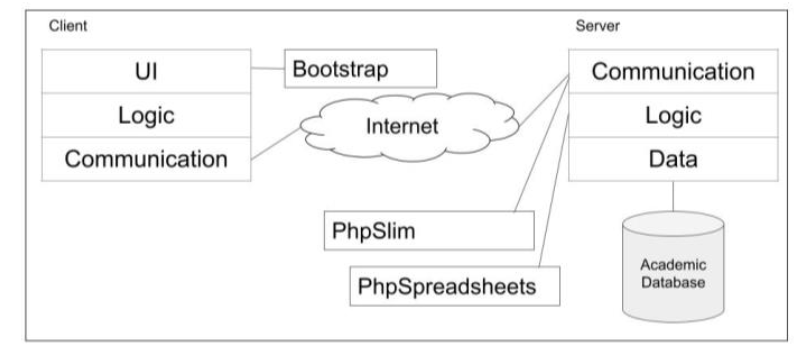
The system architecture has a three tiers orientation [10]. Users interact with a User Interface tier (UI) that implements Bootstrap API to be responsive and intuitive. UI communicates with a logic tier to solicit information and that tier calls communication tier to request data from the server. The communication between client and server is with REST protocol, json encapsulation and SHA 256 encryption. Server implements three tiers too. The first one is a communication tier which uses PhpSlim API to implement REST services. The second one is logic which interprete client solicitudes and calls data tier to get information. Also, that tier uses PhpSpreadsheets API to fill out the official grading report and deliver it to the user as a Spreadsheet file. Finally the data tier communicates with the database to retrieve information. Database is implemented with a relational paradigm and encapsulates data manipulations as procedures (Figure 1).
The technologies which are used to implementate the system are described on Table 1. It is important to say that cliente is implemented as a web app, therefore, users will use the system in whatever operating system and device. Moreover, Bootstrap API is easier to implement user interface artifacts, hence, the system is implemented as a hybrid mobile application too. In that sense Android Studio is used to develop an app with a webview which runs the client Php page. Also, the app integrates a JavaScript interface with Kotlin to run some native functions like open browser, dialer applications, etc.
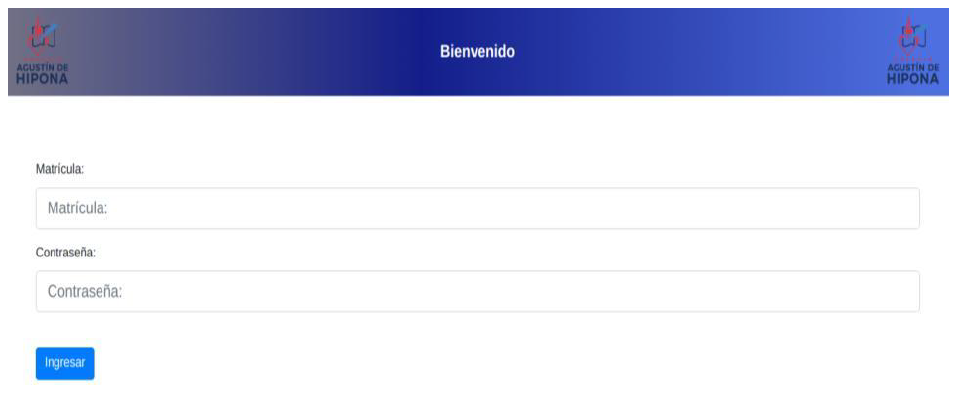
The client artifact is implemented in a web host with a SSH certification, we can see the login module in the Figure 2. That module detects the user’s roles and enables a menu with all privileges. In case that users enter a page of another role, they will redirect automatically to the index page to visualize the principal menu again.
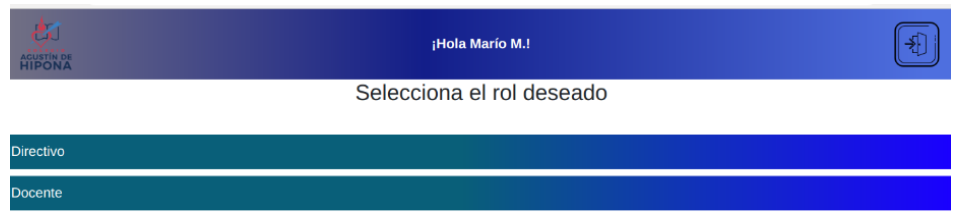
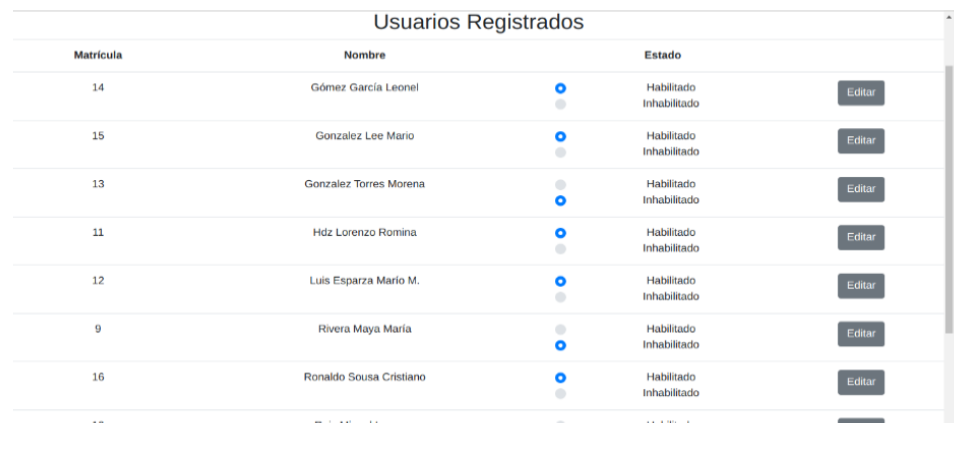
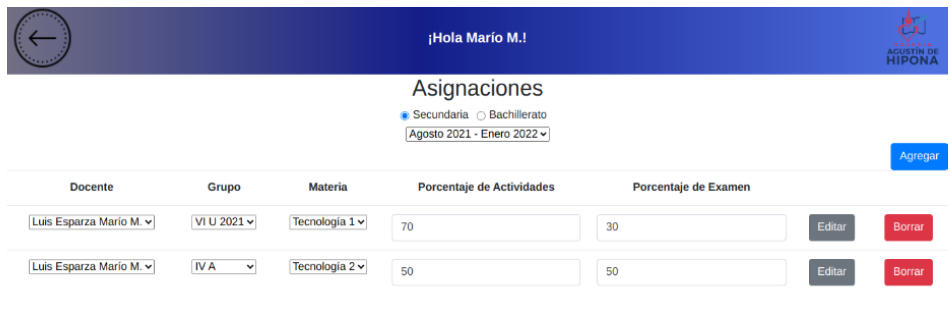
About user roles in Figure 3 it is an administrator screen where they register, update users and enable or disable access. It is important because some principals or teachers will finish their contracts and with this module with only one click the administrator closes their access. Moreover, administrators will temporarily be unable to access students in case they do not pay tuition. About principals, they manage subjects, teachers and students groups (Figure 4). The screen of the user interface about matching all these information to create the academic environment per year is in the Figure 5. They assign subjects to teachers and students depending on periods.
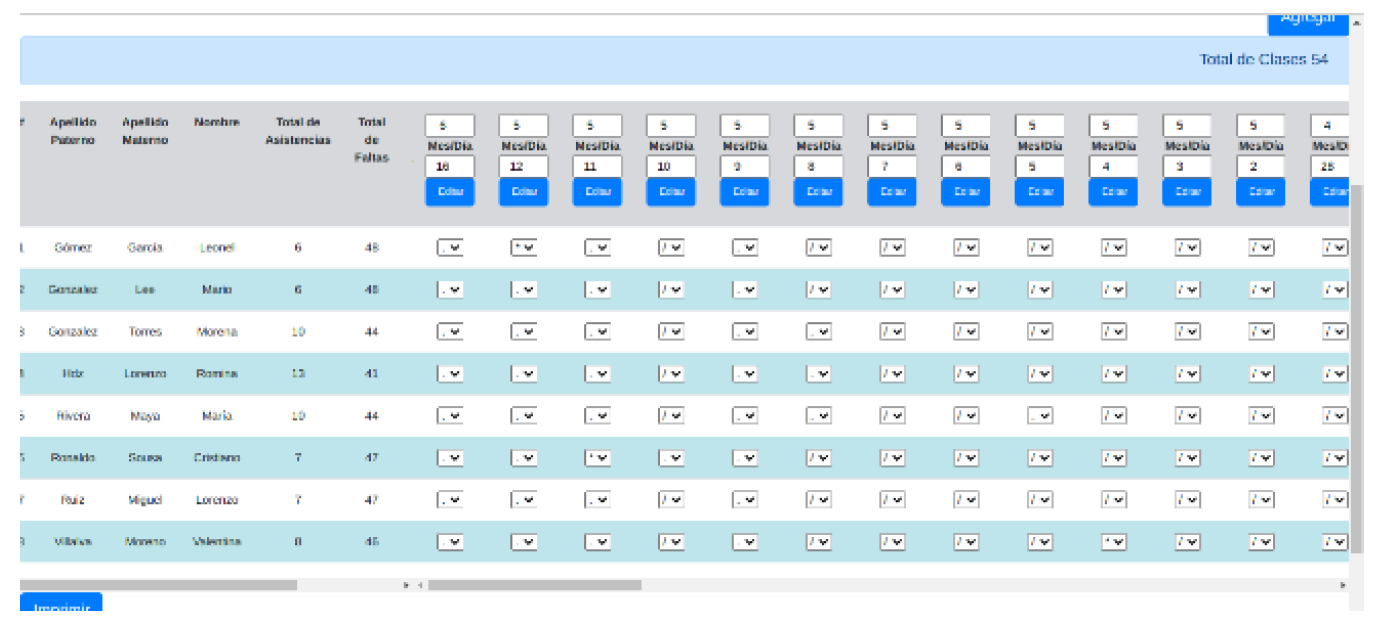
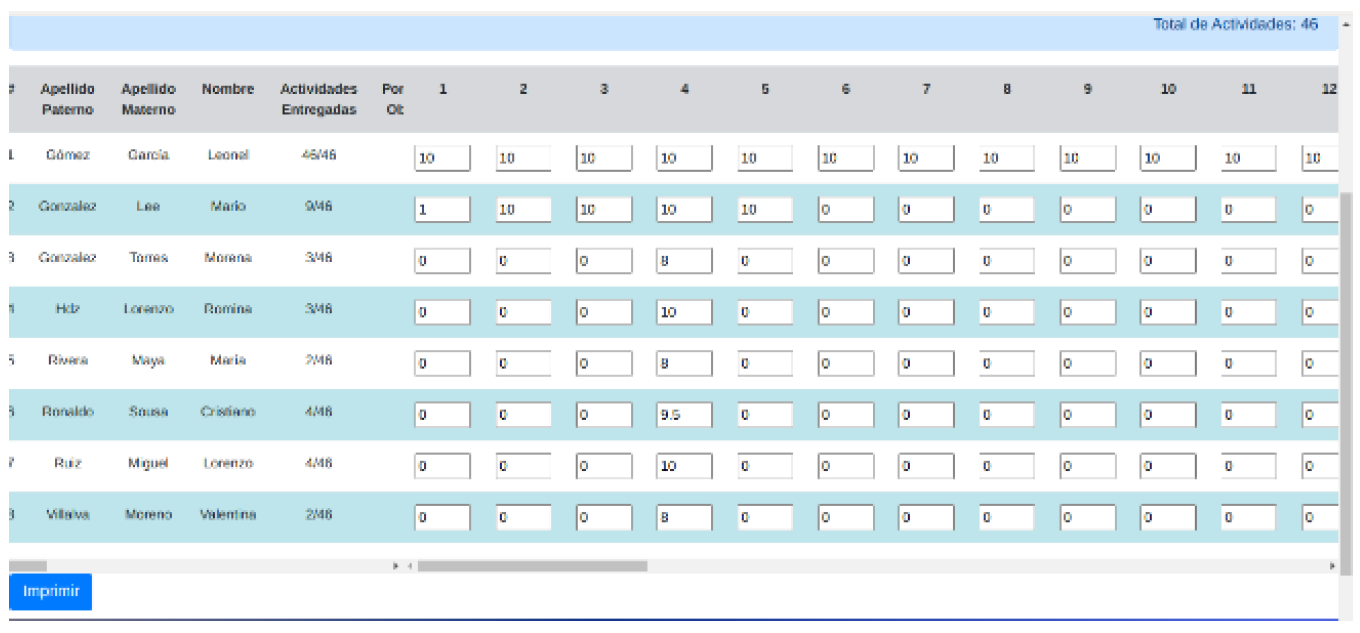
Considering that the first version of the system was with online spreadsheets, the interface of the teachers module is with responsive bootstrap tables. The interface to track assistance and homework delivery are on Figure 6 and 7.
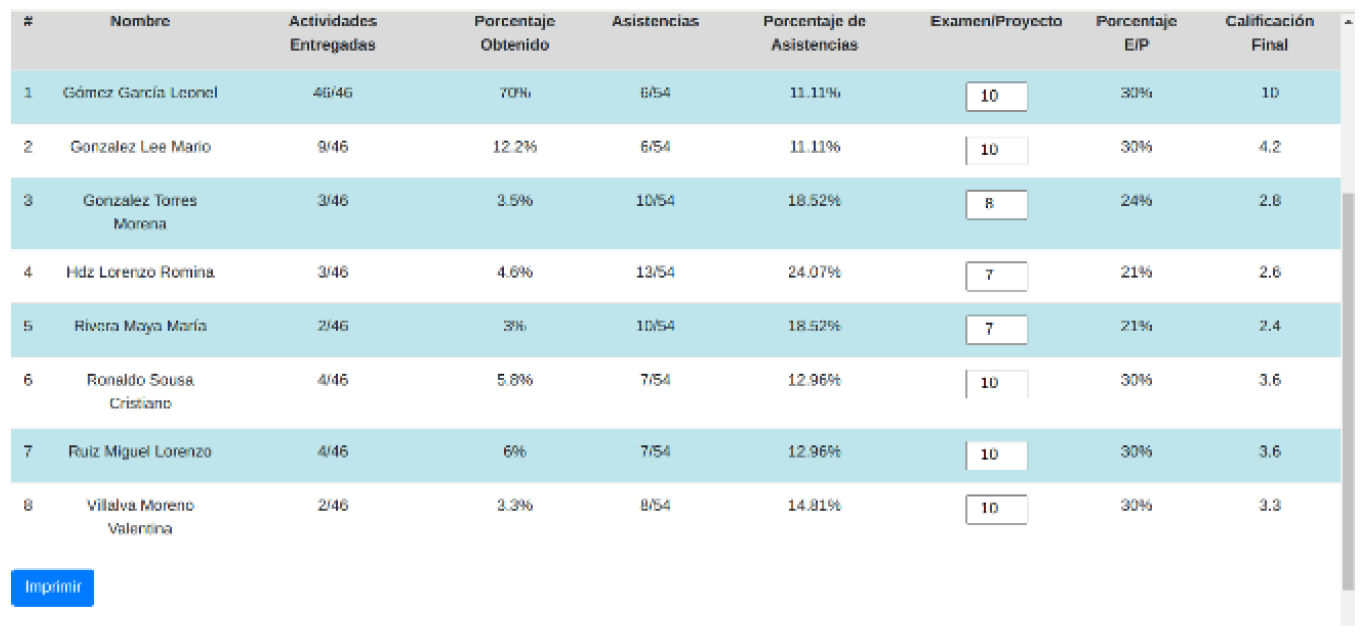
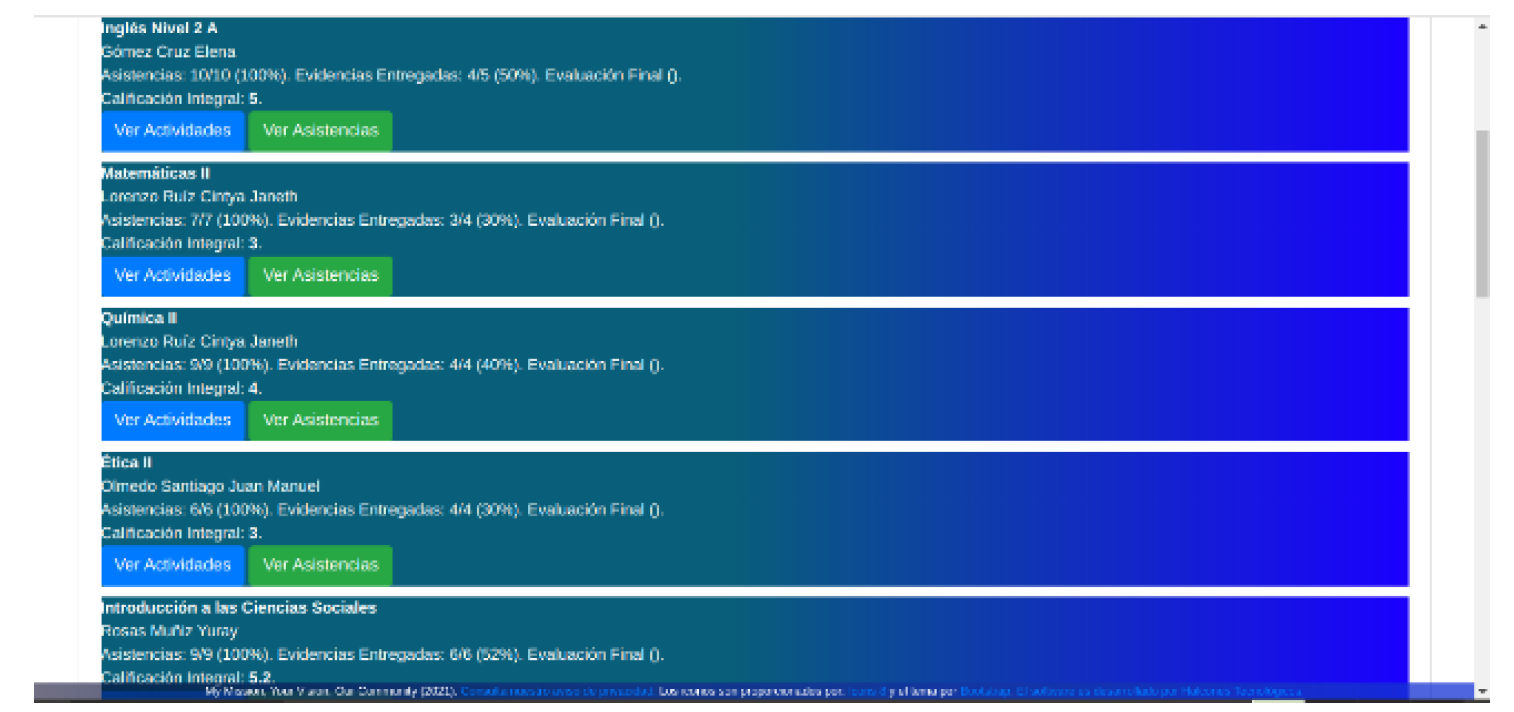
To generate the official grading format teachers assign the exams notes (Figure 8). In all the teachers modulces it is integrated with a print bottom that becomes the table information into a spreadsheet file that is downloaded automatically in the client device. About students, their check attendance, homework delivery and final grades with a list that sum up all data (Figure 9).
Table 1: System Implementation
Parameters
Client
Server
Back - End
JavaScript, Php and Kotlin
Php
Front - End
HTML, CSS, Bootstrap
-
Data Encapsulation
JSON
APIs
Bootstrap, Curl
PhpSlim, PhpSpreadsheets
Data Storage
Web Cookies
MySQL
Publication platform
Hostinger and Google Play
Hostinger
Figure 1: System Architecture
Figure 2: LogIn Module
Figure 3: User Roles
Figure 4: User Management
Figure 5: School Administration
RESULTS AND DISCUSSION
The system is implemented in the Colegio Agustín de Hipona in Coatzintla, Veracruz, Mexico. It is one of the most important privita institutes of the north of Veracruz state. Middle school and High School teachers use the system to register the academic performance of students. A questionnaire was applied to the fifteen teachers of the middle and high school sections of the school. This questionnaire is based on the Likert scale proposing statements whose possible answers are the following: totally disagree, disagree, neither agree nor disagree, agree and totally agree. To measure whether the use of the system reduces the administrative work of teachers, the process is divided into
Figure 6: Attendance Registration
Figure 7: Homework Delivery Registration
Figure 8: Final Grade Registration
Figure 9: Student Interface
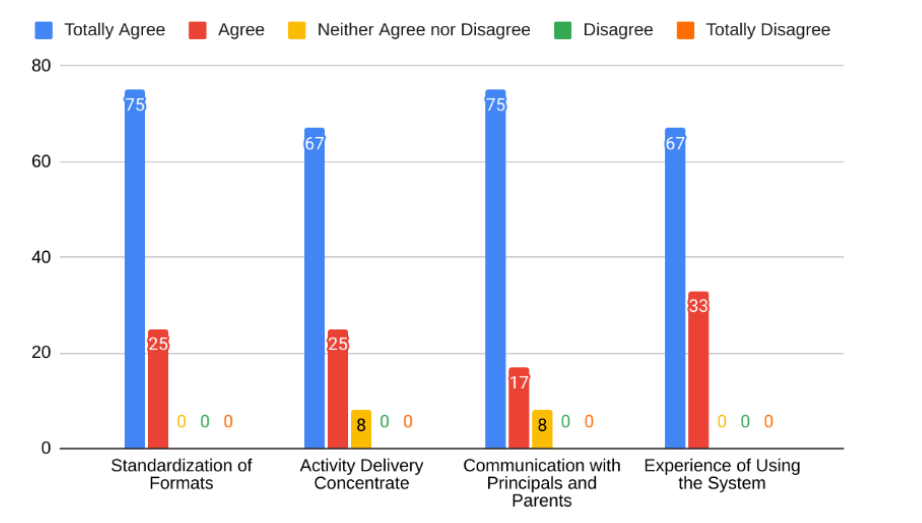
Figure 10: Survey Results
four variables. For each variable, at least one statement is included in the questionnaire. The description is as follows:
Standardization of formats: refers to the fact that a single format is proposed for the registration of the activities delivered and the grade obtained by the students
Activity Delivery Concentrate: considers teachers' perception when comparing time spent using the system and manual strategy in computing assessment activities and calculating grades
Communication with principals and parents: analyzes the teachers' perception when comparing the times invested using the system and its manual strategy in generating reports on the number of activities delivered and the grade obtained for principals and parents
Experience of using the system: it refers to measuring the opinion of teachers about the graphical interface of the platform, as well as the devices in which they can access the system
The results of the survey application are grouped by their respective variables and are found in Figure 10. In this sense, 75% of the teaching staff fully agree that the platform uses standardized formats for the concentration of activities delivered and the same way to calculate the final grade for middle school and high school students.
In addition, 92% of teachers agree at least that the platform reduces the time they invest in concentrating activities and in calculating the final grade of students who are enrolled in their subject compared to the strategy they used previously. Regarding communication with managers and parents.
About 92% of respondents agree at least that the platform reduces the time to share the reports of activities delivered and the final grade with principals and parents compared to the strategy they used previously. Also, 100% of the teaching staff agrees at least that it does not take more than one day to know the operation of the platform and that they access it using electronic devices that they already know.
CONCLUSION
Based on the results of the applied survey, more than 50% of the teachers agree at least that the use of the platform provides standardized formats for evaluation, reducing the time invested in generating delivery concentrates.
Activities and also to share evaluation reports with parents and administrators. In addition, it offers a user experience that meets your expectations. For the above, it is concluded that the administrative work of teachers is reduced in secondary and high school teachers in the Colegio Agustín de Hipona.
It is important to mention that the platform can be used in other sectors, for example, in the industrial sector. A company can use the system to assign activities to a group of employees and evaluate them based on their performance. Regarding the class attendance control module, it can be adapted to register in the system the number of people who attend company meetings or events. In this way, the data can be consulted by the human resources department to help them in making decisions about the hiring and rehiring of staff.
As future work, it will be sought to develop an artificial intelligence module with which data analysis algorithms are implemented to predict the school performance of students in the short, medium and long term. In this sense, strategies can be proposed to prevent school dropout or poor academic performance in the student population identified as at risk.
Another aspect that can be considered is the inclusion of a reward system, in such a way that the student can receive some kind of benefit in his school if he maintains a good academic performance. Likewise, it is feasible to implement other types of technologies such as augmented reality together with gamification techniques to encourage the delivery of activities.
Finally, with the development of this project, scientific and technological vocations are disseminated in the academic community. In addition, the foundations are built to include the Industry 4.0 paradigms in the institution's processes and the development of Mexican software is promoted.
REFERENCE
Secretaría de Educación Pública. “Hacia una Nueva Escuela Mexicana.” Perfiles Educativos, vol. 41, no. 166, 2020, pp. 182-190. http://www.scielo.org.mx/scielo.php?script=sci _arttext&pid=S0185-26982019000400182&lng=es&nrm =iso.
Arroyo Ortiz, J.P.Líneas de Política Pública para la Educación Media Superior. SEP, 2018. http://sems.gob.mx/ work/models/sems/Resource/13005/1/images/L%C3%83%C2%ADneas%20de%20pol%C3%83%C2%ADtica%20p%C3%83%C2%BAblica_Diseno.pdf.
Cuenca Lerma, J.M. “SmartHipona: Distributed Computer System to Record Academic Performance in Real Time.” IKSP Journal of Computer Science and Engineering, vol. 1, no. 1, 2021. https://iksp.org/journals/index.php/ijcse/ article/view/75.
Xu, B. “The Universal Design Solution for Ajax-Based Three-Tier Architecture.” 2015 6th IEEE International Conference on Software Engineering and Service Science, 2015, pp. 890-893.
Nagar, M. et al. “Education Management Information Systems in the Primary Schools of Sindh: A Case Study of Hyderabad Division.” 2018 IEEE 5th International Conference on Engineering Technologies and Applied Sciences, 2018, pp. 1-5. doi:10.1109/ICETAS.2018.862 9249.
Chen, M. et al. “Design and Implementation of the Information Literacy Evaluation System for High School Students.” 2017 International Conference of Educational Innovation through Technology, 2017, pp. 182-186. doi:10. 1109/EITT.2017.52.
Turky, A. and M. Sathiyanarayanan. “Importance of Mobile Learning in Improving the Quality of Educational-Information Systems in the Saudi Arabian High Schools.” 2018 21st Saudi Computer Society National Computer Conference, 2018, pp. 1-5. doi:10.1109/NCG.2018.8592 938.
De la Iglesia Villasol, M. “Huellas de los Estudiantes en las Plataformas Virtuales: Aplicación para Evaluar una Metodología de Aprendizaje Activo.” Revista Electrónica Interuniversitaria de Formación del Profesorado, vol. 22, no. 3, 2019, pp. 173-191. doi:10.6018/reifop.22.3.371341.
Agocs, A. and J. Goff. “A Web Service Based on RESTful API and JSON Schema/JSON Meta Schema to Construct Knowledge Graphs.” 2018 International Conference on Computer, Information and Telecommunication Systems, 2018, pp. 1-5.
Recommended Articles
Research Article
OBSERVATIONS ON THE HOMOGENEOUS TERNARY QUADRATIC DIOPHANTINE EQUATION x2 + 4xy + 9y2 = 21z2
Download PDF
Research Article
Machine Learning-Based Intrusion Detection for Detecting DDoS Attacks in Software-Defined Networks
Zainab Abbas Fadhil
Published: 30/06/2026
Download PDF
Research Article
Computer Driven Library Management and Service Rendering System: Mobile Library Landscape
Yekini N. A,
...
Ojo O
Published: 10/06/2020
Download PDF
Research Article
A Deep Representation Learning Framework Based on PCA-Compressed EfficientNetB0 Embeddings and Neural Spline-Based Classification for Iraqi Banknote Authentication
Saba Hussein Rashid
Published: 30/06/2026
Download PDF
PO Box 101, Nakuru
Kenya.
Email: office@iarconsortium.org
Editorial Office:
J.L Bhavan, Near Radison Blu Hotel,
Jalukbari, Guwahati-India



 Download PDF
 Download XML