Accumulated over time, the use of indigenous technical knowledge by the Maasai in protecting livestock against poor nutrition, improper breeding, pests or parasites, diseases as well as injuries emanating from accidental incidences caused by predation, lightning, raids and vehicles is on the decline. Knowledge on biodiversity used to conserve forests that ensure regular supply of water, availability of pastures and herbal plants for livestock treatment is unrecorded. The co-existence of the Maasai with wildlife albeit the danger they pose on livestock lives and the environmentally friendly techniques used to sustain the environment for future generations are diminishing. Oral channels used to transmit the Maasai indigenous technical knowledge by way of stories, riddles and proverbs from one generation to the other are also rare. Information on conservation agriculture practice, manure as well as stinging nettle uses by the Maasai is scarce as the extension service providers are largely absent. The purpose of the study was to determine the knowledge pathways being used to transmit and preserve ITK in livestock protection in Loita Ward of Narok County. The study employed a survey research design and was carried out in Loita Ward of Narok County, Kenya. The target population was the 30,130 pastoral Maasai households in Narok South Sub-county while the accessible population was 2,437 households in Loita Ward who applied indigenous livestock protection techniques. A sample of 120 respondents was selected through proportionate random sampling method. Qualitative data generated from Interview Schedule, Focus Group Discussions and Key Informants were studied and analyzed using Thematic Content Analysis in order to establish inherent facts and information about the extent of use of ITK in livestock protection. Statistical Package for Social Sciences was used for quantitative data analysis. The study revealed that most custodians of ITK knowledge are the community members themselves, cultural elders, herbalists, moran institution, seers and healers who have a lot of information for every subject ranging from weather, herbal medicine and treatment, vegetation, spiritual besides others. The knowledge practices are orally passed from person to person through personal communication channels like stories, songs, proverbs, myths, cultural values and cultural ceremonies. Whoever has this knowledge holds it on behalf the community. This study recommends that the National Government and the County Government of Narok should safeguard the documented ITK of the pastoralists as it is a vital resource and knowledge from total loss and its exploitation by other people at the expense of the owners, the Maasai. The many stories, songs, folklore, proverbs and questions and answers sessions among the Maasai pastoralists were effective oral channels communicated from one person to the other. These pathways are fast, efficient and effective ways of sharing information and have served the Maasai well. The enhancement of the traditional communication methods with Information and Communication Technologies (ICTs) such as computers, internet and libraries will improve accessibility of the integrated ITK. Mainstreaming of this oral channels communication in the new Kenyan Competencies Base Curriculum (CBC) could help improve children oral communication thereby improving their art of listening and comprehending information as they share this through the use of phones, internet and electronics.
Keywords
Extent
Use
Indigenous Technical Knowledge
Livestock
Protection
Maasai
Loita Ward
Narok County
Kenya
INTRODUCTION
Four to seven hundred million indigenous peoples directly depend on pastoralism that over the years has evolved for the last ten thousand years since the domestication of animals [1]. The long association of pastoralists with livestock have enabled them to acquire enormous range of Indigenous Technical Knowledge (ITK) that is critical for responding to Livestock Protection (LP) related risks at the pastoralists’ level [1-3]. The ITK forms the basic component of any country’s knowledge system applied for maintaining or improving people’s livelihoods [4]. [The indigenous knowledge systems constitute the world largest reservoir of knowledge that utilizes indigenous livestock practices and techniques.
The modern knowledge has something that it could also learn from the pastoralist friendly coexistence with their environment. This makes the involvement of pastoralists by Extension Service Providers (ESPs) in research and other technologies very important as this would only serve to up-scale such useful knowledge. Unfortunately, the development of ITK had to be slowed down by the changes that were taking place in the world history. The scramble for land by world powers subordinated the ITK systems to those of colonizing powers [5]. The colonialists made the locals to believe that ITK was primitive, irrelevant and out of tune in the society [6]. This colonial perception created a great difference between modern knowledge and the ITK systems [7]. The dominance of the modern knowledge system largely led to a prevailing situation in which ITK is ignored and neglected [8]. The continued weakening and erosion of ITK has made it hard for young people to acquire, use and blend it with modern knowledge thereby aggravating the problem further [9]. The Extension Service Providers (ESPs) on their part only disseminated information recommended by the researchers to pastoralists but not ITK [10]. This situation affected the development and flow of ITK in livestock protection prompting many studies to begin.
In the 1990s, world scholarly studies were begun in an attempt to salvage ITK. One such study was Rajasekaran and Warren [11]. Another study was Rajasekaran and Warren [12] on a framework for incorporating indigenous knowledge systems into agricultural extension organizations for sustainable agricultural development. Several studies then followed in Kenya like the one on ethnoveterinary diagnostic skills that concluded that the pastoralists’ diagnostic skills appeared to be superior to those of agro-pastoralists but with the advent of modern veterinary medicine, the Maasai ethnoveterinary practice appeared to be on the decline [13].
Value for livestock as an important asset, a wealth reserve and a sacrificial gift by the Maasai people is known. Indigenous Technical Knowledge (ITK) is applied to protect them though its flow and access through oral channels like stories, riddles and songs is on the decline. Consequently, incidences of pests, diseases, plant poisoning, poor nutrition, improper breeding and other accidental incidences like predation and theft are on the rise due to declining ITK in Livestock Protection (LP). The Maasai vast experiences in the preservation of biodiversity and co-existence with wildlife that increases competition for the already meagre pastures, mauling and cross transmission of pests and diseases to livestock are unrecorded. Unrecorded too, is the knowledge on environmental care given to forest resource that ensures availability of water, pastures, fodder and herbal medicine used for the control of pests and diseases. Livestock protection information from both ITK and Extension Service Providers (ESPs) is in short supply among the Maasai of Loita Ward. There is need to document the available information within and without the community dependent on livestock in order to safeguard their livelihoods. In the absence of a profiled ITK in livestock protection and little integration with information from ESPs, the Maasai livelihoods would remain low hence the need for the study. The purpose of the study was to determine the knowledge pathways being used to transmit and preserve ITK in livestock protection in Loita Ward of Narok County.
MATERIALS AND METHODS
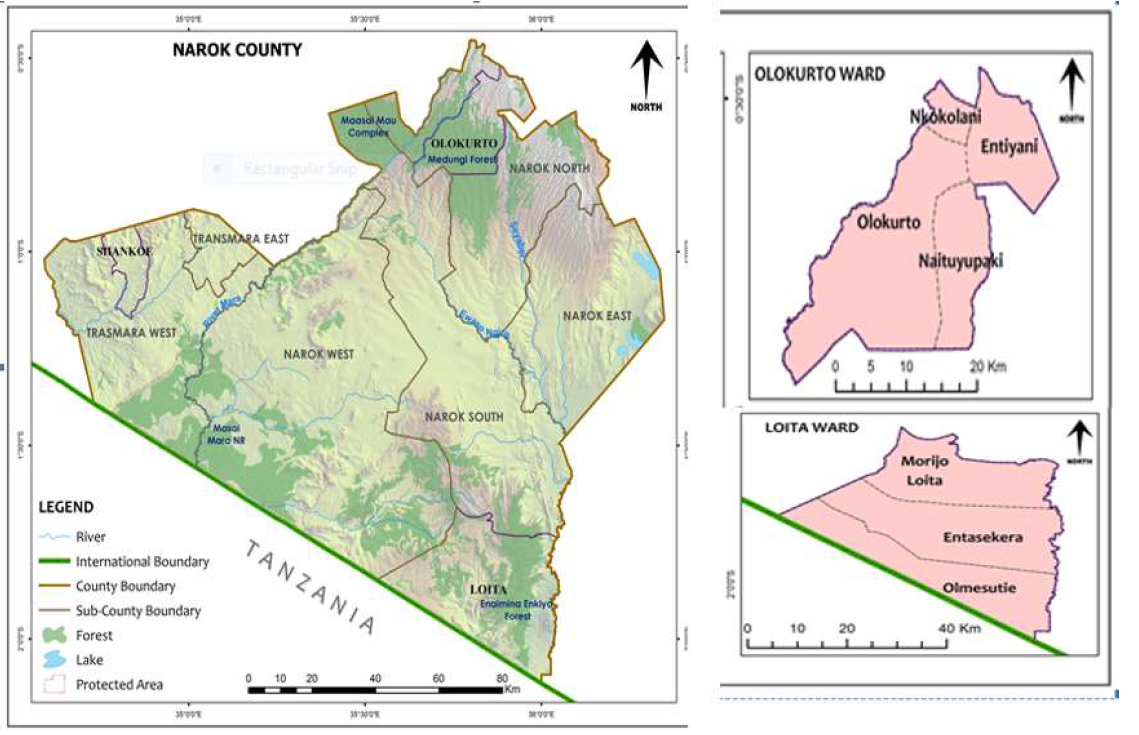
A survey design was adopted for the study. The study area, Loita Ward is within a large protected park known as the Maasai Mara National Game Reserve famous for wild animals like lions, wild-dogs, hyenas, cheetahs, elephants, rhinos, giraffes, zebras, warthogs and buffaloes. Loita Ward is approximately 1,675.55 km2 in size and is made up of Morijo Loita, Entasekera and Olorte locations. It is occupied by the Maasai community who practice a nomadic lifestyle moving with their animals from one place to another in search of pastures, water and minerals lack of which could lead to infections by livestock nutritional deficiency diseases. Cattle, sheep and goats are the main livestock reared for milk, meat, blood and other products while other foods are gotten by trading with other people. Figure 1 shows where the study and pilot test was conducted.
Figure 1: Map Showing the Respective Areas of Study at Loita Ward and Pilot Test at Olokurto
Source: Map Preparation: solohkarani@live.com Service Layer Credits: ESRI, Virtual Kenya and DIVA GIS
The target population was the 30,130 pastoral Maasai households in Narok South Sub-county. The accessible population for the study was 2,437 pastoral Maasai households in Loita Ward. The number of households in Loita Ward by location and sub-location is as shown in Table 1.
Table 1: The Number of Pastoralists’ Households by Ward, Location and Sub-Location
Ward
Location
Sub-location
No. of Households
Loita
Morijo Loita
Morijo
837
Olorte
Olngarua
417
Olorte
558
Mausa
625
Total
2,437
Source: 2009 Kenya Population and Housing Census Volume 1A
Loita Ward in Narok County was purposively selected for the study. This was based on the past knowledge, practices and experiences the pastoralists in Loita Ward have in livestock protection ITK. The sample was drawn from the four sub-locations of Morijo, Olngarua, Olorte and Mausa respectively through proportionate stratified sampling method. A sample size of 120 respondents was selected for the study through proportionate random sampling method. The sampling unit was Maasai household heads who keep livestock in Loita Ward.
Three instruments were developed by the researcher and used to collect the data. The instruments developed include an Interview Schedules for household heads, Key Informants Interviews (KIIs) and Focused Group Discussions (FGDs). Key Informant Interviews (KII) was carried out with professionals (veterinary, Livestock Production Practitioner (LPP), Kenya Forest Service (KFS), administration, NEMA and KWS) and cultural specialists (herbalists or traditional healers, herdsmen, blacksmiths and seers). A total of sixteen elders and youth respondents purposely selected from Morijo Loita and Olorte locations held two separate male and female FGDs. Eliot and Associates, recommend two or three group discussions with the same set of questions on any one topic. This is because a point of saturation would be reached beyond which no anymore new responses are forth coming. Elders were chosen because they are the main custodians of ITK while the youth represented the relatively immediate recipients of learning experiences on ITK in livestock protection. For this study, elders were all men and women above 40 years while youth were those people 18 to 39 years old.
After the three instruments were designed as per the research objectives, thorough examination of the instruments was done to determine the content validity by peers, supervisors and experts at Egerton University’s Faculty of Education and Community Studies. Their comments were used to adjust and improve the instruments thereby yielding valid data from which appropriate, meaningful and useful inferences were made [14,15]. Internal validity of the instrument was improved through triangulation of data sources as multiple people validated the data. In this case study, interactions and conversations with individuals and groups through interviews and discussions helped to triangulate the data [16]. A pilot study was carried out in Olokurto Ward of Narok County where the consistency of the Interview Schedule tool was pilot-tested with 25 respondents. Olokurto Sub-location was appropriate for pilot study because it shared similar livestock characteristics as the population studied. Pastoralists in this place rear similar livestock which suffer same challenges for their survival as those of Loita Ward. The reliability of the survey Interview Schedule tool was estimated to be 0.881 using Cronbach’s Alpha Coefficient, which is a measure of internal consistency [17]. This was high enough to allow such a study be carried out.
Thematic Content Analysis; a systematic way of grouping information into categories or themes that helped make sense of FGD and KII data using an open coding process was employed on qualitative data. Statistical Package for Social Sciences (SPSS) was used in descriptive and inferential statistics analysis of the quantitative data. Descriptive statistics included percentages, frequencies, means and standard deviations. Inferential statistics analysis (Chi square and t-test) was employed in quantitative data analysis where the Null hypothesis was tested at 5% level of significance.
RESULTS AND DISCUSSION
Characteristic of Respondents
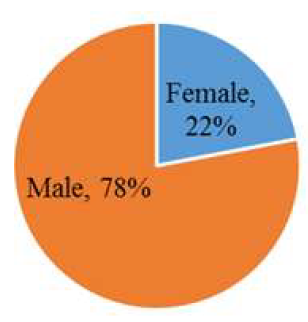
The study participants were the Loita Maasai involved in livestock keeping. Six attributes of the respondents were considered: Gender of the respondents, land tenure system in the area, ownership of livestock by the households, sources of livestock and uses of livestock and livestock manure by the respondents (Figure 2).
Figure 2: Gender of the Respondents
Seventy eight percent of the respondents were male and only 22.0% were female-this implies that majority of the households are headed by men leading to gender inequality. All the respondents agreed that the land they live in Loita Ward is communally owned and pastoralists are granted the grazing rights.
The mean number of cattle kept by the respondents was 48, while for sheep was 71 and goats 51. The numbers varied from as low as 5 to a maximum of 1,345. The more the number of sheep and goats (shoats) a pastoralist has the fewer or no sale or slaughter of cattle for small needs [18]. The cattle, sheep and goats provide meat, milk and blood and other byproducts like livestock manure. Donkeys are kept as ‘beasts of burden’.
The study confirmed that most of livestock types reared by the Maasai in Loita Ward were cattle, sheep and goats and although donkeys are reared, they are never eaten nor their milk taken except for the rare treatment of common colds in children (Table 2).
Table 2: Number of Livestock Owned by Respondents (n = 120)
Livestock type
Mean
Median
Mode
Std. Dev.
Minimum
Maximum
Cattle
47.9
40
30
33.93
5
200
Sheep
71.4
50
50
66.95
5
400
Goats
50.5
30
50
85.67
0
876
Total
171
131
100
152.06
20
1,345
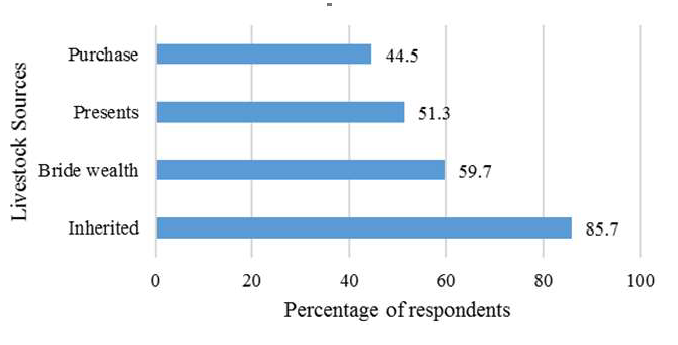
Livestock owned by the respondents of Loita Ward come from different sources as indicated by the results given in Figure 3.
Figure 3: Sources of Livestock Owned by the Respondents in Loita Ward
The study found out that majority (85.7 percent) of the respondents’ livestock originated from inheritance from parents and other relatives. Others came from bride wealth (59.7 percent) in the case of the Maasai community who normally practice a patriarchal system where brides are married off to the bridegroom and presents (51.3 percent) and 44.5 percent were purchased.
The entire life of a Maasai in Loita is nearly all centred around livestock. The study found out that 99.2 percent of the foods (milk, meat, blood) the respondent consume come from livestock (Table 3).
Table 3: Uses of Livestock by Loita Ward Maasai (n = 120)
Uses of Livestock
Frequency
Percent
Foods (milk, meat, blood)
118
99.2
Cultural purposes
77
64.7
Prestige
62
52.1
Sale
61
51.3
Educate children
59
49.6
Most Maasai also derive their pride or prestige (52.1 percent) from livestock which are also used to support their other numerous cultural activities (64.7 percent). Sale (51.3) of livestock is not given a priority and comes as a last resort. Sheep and goats are the ones sold for meeting needs at home including education of children (49.6 percent) or slaughtered in order to spare cattle for other big ceremonial occasions.
The uses of livestock manure cannot be underrated as given by the respondents in Table 4.
Table 4: Uses of Livestock Manure (n = 120)
Manure is used to
Frequency
Percent
Smear or plaster houses for occupation by the community members
53
44.5
Support conservation agriculture, stinging nettle and fodder crops
33
27.7
Attract income
1
0.8
Smear injured tree parts
34
28.6
The respondents use the dung to smear or plaster (44.5 percent) their houses (inkajijik in Maasai language) and 28.6 percent use it to smear on injured parts of plant where herbal medicine has been drawn from while 27.7 percent use it to support conservation agriculture and support the naturally growing plants such as the stinging nettle that livestock feed on during drought.
Manure as a livestock by-product that allows the natural growth of stinging nettle fed upon by livestock during drought also favours conservation agriculture practice where fodder and other crops grow.
This mutual relationship is vital, as livestock manure improves soil fertility that supports the growth of pastures, fodder and other crops that in turn are fed upon by livestock to produce milk, meat and blood for the survival of pastoralists.
Knowledge Pathways used to Transmit and Preserve ITK
This study sought to determine the knowledge path-ways being used to transmit and preserve ITK in livestock protection in Loita Ward of Narok County. The different knowledge pathways used in the transmission of ITK among the Loita Maasai were identified and their level of use was determined based on three levels (high, medium and low) and the results given as in Table 5.
Table 5: Methods used to Transmit ITK and their Level of use in Loita Ward (n = 120)
Instruments used in ITK transmission
Level of use
High
Medium
Low
N
%
N
%
N
%
Mobile phone
4
3.4
62
52.1
53
44.5
Internet
31
26.1
33
27.7
55
46.2
Cultural ceremonies
78
65.5
31
26.0
10
8.40
Elders transmission to young generation
51
42.8
38
31.9
30
25.2
Moran institution
79
66.3
23
19.3
17
14.2
Extension Service Providers (ESPs)
15
12.6
41
34.4
63
52.9
Large Maasai gatherings
72
60.5
37
31.0
10
8.40
The results indicate that the knowledge pathways highly used by the Loita Maasai in transmitting livestock related ITK were: Moran institution (66.3 percent), cultural ceremonies (65.5 percent), large Maasai community gatherings (60.5 percent) and elder to young generation (42.8 percent). Few respondents rated the use of mobile phones (3.4 percent), internet (26.1 percent) and ESPs (12.6 percent) as high. This could be attributed to the fact that few of the respondents own the technology or have knowledge of use.
Generally, as time elapses, the ITK preserved in people’s minds and local practices may be eroded by failing memories and death. As the study would find out, the traditional elders play the dual role of being custodians as well as stewardships of the Maasai cultural values and command enormous community respect. Their role as custodians relates practically to preserving the traditional ways of passing or handing down the cultural traits of sustaining the society from the older to young generation and from one age group to another. Only acceptable ways of behaviour, taboos, initiation and passage of rites are passed on to the younger generation. As cultural stewards, the elders are endowed with the responsibility of enforcing the appropriate observance of cultural values and norms, in accordance with acceptable community cultural norms and standards [19].
The community has an effective, transitional communication system in which news flows very fast and efficiently from one individual to another in a narrative form and from age group to another, as well as from one place to another. Often, communication begins with greetings. Greetings between two individuals or more and begins by one uttering words like sopa (plural- entasopa) and the response is fine, that is, epa or sopa. This is normally followed by narration of information or news at the end of which the narrator says neaku taa lelo ilomon literally translated as, that is the end of news and the partner responds, neaku sere lelo literally translated as, that is the way it is. The detailed information then covers family health especially children and livestock followed by weather or any other information about the general area. The news narration thus covers detailed information of the welfare of all people and their environment.
From the data, just like other societies in the world, the Loita Ward pastoralists have ways of distributing information and sharing ideas [20]. This information and ideas flows from the people’s memories and practices. According to the informants of this study, the evening gathering in one of the grandmother’s house by children and adults allowed oral sharing of stories, songs, folklore, proverbs, a questions and answers session, myths among others that are the traditional means of communication that an ESP may find in a rural area of the Maasai [20,21-24].
During FGDs, some participants managed to narrate some stories, riddles, proverbs, present a questions and answers session and songs regarding livestock protection from among many communication ways. Kipuri [18] describes the Maasai as story tellers per excellence because of their expertise in narration and presentation of the same and had meaning. Examples each of stories, riddles and proverbs are given to best illustrate this. A story (myth or legend) about how women lost the opportunity to own livestock was narrated by Oloonkutati Ntepesi. The story goes:
Long ago wild animals used to be women’s cattle. Then one morning before the cattle were taken out to graze, a cow was slaughtered. Soon the cattle started moving away to graze by themselves and wondered off. One woman told one of the children to go and drive the cattle back before they went too far. When the child’s mother heard this she said: ‘Oh no, my child will not go until he has eaten the kidney’. It followed that whenever a child was asked to go, his mother forbade him to go until he had had a bite of the meat. This went on until the cattle, sheep and goats wandered away into the bush and got lost. When all the children had eaten all the meat, they tried to bring the cattle back, but they found out that they had all gone wild. And so that is how it came about those women lost their cattle. They then went and lived with the men who had all along taken good care of their cattle. This is why up to this day, all the cattle belong to the men and women simply wait for the men to provide for them.
This story was meant to emphasize the need to take care of livestock or else they got lost, eaten by wildlife or even stolen. However, children are forbidden telling stories during day time when they are looking after stock as storytelling and listening can be infectious leading to loss of livestock [18].
Simple types of riddles or Iloyietia were started by using the opening formula oyiote (are you ready?). The response was given as eewuo (let it come).Complex riddles are known as Ilangeni (literally means ‘those for the clever’) and are considered to be advanced after the simple riddles. They are named on account on the formula - Ira ng’en? (Are you clever?). A simple riddle is the one where one calf had the advantage of being suckled by two cows as narrated by Daniel ole Koyie, a participant in FGD. The other discussants became the audience. It goes:
Ole Koyie started by telling the audience: Oyiote and theaudience responded by saying: Eewuo
Eipirri eng’obu. Response:
Olashe ong’ar kishu.
He sips (gulps) as he runs. Response
The calf shares two cows.
When a calf is suckled by two cows, he tends to feed from both cows whenever he gets a chance and this protects him from suffering from hunger.
Proverbs are the other form of communication and forms a very important part of the Maasai oral literature, since they summarize the wisdom of sages. According to the discussants, a proverb summarizes an idea that would otherwise need explaining in very many words. The ‘Maa’ word for proverbs means, ‘the cutters of fine thin leather’- this refers to the precision and brevity of the proverbs [18,19]. The Loita Maasai commonly apply proverbs in community traditional cases and everyday discussions to emphasize the weight of certain matters, like the importance of protecting livestock. An example of such a proverb was given by an elder involved in FGD called Benson ole Ledidi:
Erisiore enkiteng’ elukunya nabo olee (One cow is equal to a man’s head). The other participants were able to unlock its meaning as helping is a reciprocal affair. The Maasai take a lot of pains tending their livestock. This proverb stresses the principle of give and take. The study also found that the other way the community passed or transmitted knowledge among themselves was through a questions and answers session. The method is highly informal but once the right questions are asked, detailed responses are given. The willingness to pass on knowledge from one person to another depends on the nature or type of knowledge [20]. For example, knowledge about the weather, environment and about which type of livestock to rear is generally regarded as public knowledge. Interested members of the village could get such knowledge from elders if they asked for it. On the contrary, knowledge about certain types of medicines is regarded or treated as secret and researchers may not freely obtain such information or knowledge [20]. By putting the implicit or memorable ITK into writing would turn it explicit thereby making it easy to access by many people through reading documents [25].
Given that time was much spent, the discussants could not sing but describe the Maasai songs as full of ‘throat-singing’ where the singers led by olaranyani (song leader) use their throats to produce sounds that closely mimic (cattle) calls [26]. The music comprised of rhythms rendered by a chorus of vocalists singing harmonies, all the while the olaranyani sings the melody that is meant to arouse and draw interests, keenness and attention to the song by the audience. Women sing songs that praise their sons and dance by reciting lullabies and humming songs. Such occasions would bring the community together and Morans took this opportunity to jump as high as they could while remaining vertical and as straight as possible. Those Morans who jump the highest possible are considered strong and more masculine than the others.
Documenting Livestock Protection (LP) techniques makes the knowledge explicit and by codifying it in a format that can be provided in Information and communications Technology (ICT) devices like radio, television, cellular phones, computer network and applications associated with them such as video conferencing and distance learning that would help bring about development [27]. The internet, digital facilities such as standalone electronic could be used by libraries to afford users the opportunity to access library materials with a large quantity of livestock protection ITK and improve media coverage that has been scanty in the past [28].
The ITK custodians among the Loita Maasai of Loita Ward
The respondents were asked to state ways the ITK practices were preserved within the community. The custodians of information were identified and their frequency distributions given in Table 6.
Table 6: Preservation ITK among the Loita Maasai (n = 120)
Custodians of ITK
Frequency
Percent
Pastoralist memories
120
100
Cultural elders
78
65.5
Herbalists
76
63.8
Moran institution
74
62.2
Seers and healers
55
46.2
Cultural centres
52
43.6
Electronics
31
26.1
The respondents identified seven different custodians of ITK in livestock protection within the community, these included: pastoralists’ memories (100 percent), cultural elders (65.5 percent), Herbalists (63.8 percent), Moran institution (62.2 percent), Seers and Healers (46.2 percent), cultural centres (43.6 percent) and electronics (26.1 percent).
The respondents were quite alive to the fact that, among themselves, whichever information they required, was available from the various cultural specialists or sometimes from electronics. The information pathways play a key role in communicating any innovative technologies beneficial to the community. This makes the ultimate users not only aware of the useful information but also motivate them for adoption [29]. Cultural elders, as the main custodians of the ITK, have a lot of information for every subject including the weather and for other areas in livestock protection. Information is the most essential element in the decision making process and its use is directly dependent on its content, relevance and timeliness [27]. In this context, to access the right information at the right time, users have to be aware of the various sources of information, the services being offered and existing information systems [27].
Every custodian of information, according to the respondents of Loita Ward have their contribution to make in livestock protection information just like other specialists in other fields of agriculture have for rural development [30]. The herbalists’ main input in the control and treatment of pests and diseases in livestock is identifying the right herbal medicine to use, how to prepare it and the right dosage for the various livestock types according to their sizes. The Moran institution on the other hand protect livestock and people from external aggressors besides making sure livestock have fresh pastures, water and minerals all the year round and move with them during migrations. The Seers and healers also have a very important function of thwarting any calamities like lightning and pestilence from affecting the community and livestock. They are also the community counselors at the time of stress and they also lead the community in prayers during cultural rituals and ceremonies. Any information coming from outside the local area is welcome because it can bring fresh ideas and awareness of new opportunities. It is believed that knowledge derived from formal research or developed in other localities, could stimulate new thinking and practices [31]. So it is, therefore, obvious that for agricultural development to take place, proper dissemination of information is necessary.
The unfortunate thing to note here is, at some point in the lives of indigenous people, they were dispossessed of this dynamic knowledge and made to believe that it was primitive, outdated and inefficient [9]. This slowed its development and it was not until after attaining independence from colonialism that many Africans resumed to the development of their previously weakened knowledge systems after being seriously disadvantaged in many ways [32]. However, no matter how hard the colonialists tried to kill this knowledge, some knowledge like livestock breeding still thrived and had a wide range of diversity thereby creating a high potential for improving the Maasai livestock for provision of different products. The other advantage of the pastoralists’ knowledge preserved on their behalf by cultural elders, Moran institutions, herbalists, seers and healers has been relevant in conserving the environment and deal with natural disasters for a long time [33].
However, the methods that are used to preserve information are not easy to transmit or retrieve and this has caused loss of the rich ITK developed within the Loita Ward community to get lost. This documented information need be stored in Resource Centres to be developed at various community locations or schools to enable the community, children in school and elsewhere to access and read for themselves. The information may also be published and distributed electronically throughout the community as a means of information sharing and empowerment [34]. The provision of ICTs such as computers and internet would help libraries collect and make indigenous knowledge more accessible and afford users the opportunity to access a large quantity of ITK collected in livestock protection [24].
CONCLUSION
Most custodians of this ITK knowledge are the community members themselves, cultural elders, herbalists, Moran institution, seers and healers who have a lot of information for every subject ranging from weather, herbal medicine and treatment, vegetation, spiritual besides others. The knowledge practices are orally passed from person to person through personal communication channels like stories, songs, proverbs, myths, cultural values and cultural ceremonies. Whoever has this knowledge holds it on behalf the community.
The National Government and the County Government of Narok to safeguard the documented ITK of the pastoralists as it is a vital resource and knowledge from total loss and its exploitation by other people at the expense of the owners, the Maasai. The government should encourage the adoption of livestock intensification and sedentary life by the Loita Maasai as one way of saving livestock from the long journey migrations and its accompanying environmental effects due to habitat destruction, overexploitation of pastures, soil erosion as well as eruption of diseases, snatching of tired and weak animals by predators while passing through bushy areas. More emphasis should be put on community education to raise their literacy level in order to better benefit from the many opportunities arising due to embracing value chain development in the livestock protection practices with the assistance of the ESPs.
The many stories, songs, folklore, proverbs and questions and answers sessions among the Maasai pastoralists were effective oral channels communicated from one person to the other. These pathways are fast, efficient and effective ways of sharing information and have served the Maasai well. The enhancement of the traditional communication methods with Information and Communication Technologies (ICTs) such as computers, internet and libraries will improve accessibility of the integrated ITK. Mainstreaming of this oral channels communication in the new Kenyan Competencies Base Curriculum (CBC) could help improve children oral communication thereby improving their art of listening and comprehending information as they share this through the use of phones, internet and electronics.
REFERENCES
Food and Agriculture Organization of the United Nations. Commission on Genetic Resources for Food and Agriculture: Detailed FAO Progress Report on the Implementation of the Global Plan of Action for Animal Genetic Resources. FAO, 2016, Rome.
Agrawal, A. “The Role of Local Institutions in Adaptation to Climate Change.” Social Dimensions of Climate Change, Social Development Department, World Bank, March 2008, Washington, DC.
Thorne, S. “Towards a framework of clean energy technology receptivity.” Energy Policy, vol. 36, 2008, pp. 2831–2838.
Sen, B. and N.A. Khashmelmous. “Incorporating indigenous knowledge materials: Efforts at Elhafeed Library, Ahfad University, Sudan: A Preliminary Study.” International Information and Library Review, vol. 38, no. 3, 2006, pp. 117–122.
Ryser, R.C. “Indigenous peoples and traditional knowledge.” Berkshire Encyclopedia of Sustainability, vol. 5, 2011.
Nyabundi, D. “Knowledge management practices for the development of Africa’s information systems and services.” Tanzania Library Association Conference, 2008.
Appiah, J. Akan Proverbs as Indigenous Knowings: Pedagogic Relevance for Schooling and Education. Unpublished Thesis, University of Toronto, 2006.
Swanson, B.E. The History and Development of Agro-Cultural Extension. FAO, 2008, Rome.
United Nations Environment Programme. Indigenous Technical Knowledge in Disaster Management in Africa. UNEP, 2008, Nairobi.
Lwoga, E.T. Knowledge Management Approaches in Managing Agricultural Indigenous and Conventional Knowledge in Tanzania. Research paper, 2010.
Rajasekaran, B. and D.M. Warren. Using Indigenous Knowledge for Agricultural Development. World Bank Discussion Paper no. 127, World Bank, 1991; Journal of International Development, vol. 3, no. 1, pp. 1–15.
Rajasekaran, B. and D.M. Warren. “Putting local knowledge to good use.” International Agricultural Development, vol. 13, no. 4, 1993, pp. 8–10.
Miaron, O.J. et al. “Indigenous knowledge: The Basis of the Maasai Ethnoveterinary Diagnostic Skills.” 2004.
Kathuri, N.J. and A.D. Pals. Introduction to Educational Research. Egerton Education Book Services, 1993.
Mutai, B.K. How to Write Quality Research Proposal: A Complete and Simplified Recipe. 1998.
Kristin, E.D. Technology Dissemination among Small-Scale Farmers in Meru Central District of Kenya: Impact of Group Participation. Unpublished doctoral dissertation, University of Florida, 2004.
Fraenkel, J.R. and N.E. Wallen. How to Design and Evaluate Research in Education. McGraw-Hill, 2000.
Kipuri, N. Pastoral Maasai Grassroots Indicators for Sustainable Resource Management. International Development Research Centre, 1996.
Sankan, S.S. The Maasai. East African Literature Bureau, 1971.
Kauzeni, A.S. Gender, Biodiversity and Local Knowledge Systems (LinKS) to Strengthen Agricultural and Rural Development. LinKS Report no. 3, Institute of Resource Assessment, University of Dar es Salaam, 2000.
Owuor, J.A. “Integrating African Indigenous Knowledge in Kenya’s Formal Education System: The Potential for Sustainable Development.” Journal of Contemporary Issues in Education, vol. 2, no. 2, 2007, pp. 21–37.
Kanzikwera, R. Indigenous Knowledge in Agriculture: A Case Study of the Challenges in Sharing Knowledge of Past Generations in a Globalized Context in Uganda. 2007.
Karlsson, J. “Methods of Information Provision to Rural Communities in South Africa.” Seminar on Information Provision to Rural Communities in Africa, edited by E. Johansson, 1995, Gaborone, Botswana.
Jain, P. “Indigenous Knowledge Systems in Africa.” Information and Knowledge Management in the Digital Age: Concepts, Technologies and African Perspective, edited by L.O. Aina et al., Third World Information Service, 2008.
Ngulube, P. “Managing and preserving indigenous knowledge in the knowledge management Era: Challenges and Opportunities.” Information Development, vol. 18, no. 2, 2002, pp. 95–100.
Ombija, R. “Invented in Sweden, Made within Sunny Nairobi.” Travelstart, Online Travel Operations Pty Ltd, 2018, www.travelstart.co.ke.
Jain, P.C. Handbook for New Entrepreneurs. Oxford University Press, 2007.
Kihwelo, P.F. “Indigenous Knowledge: What Is It? How and Why Do We Protect It? The Case of Tanzania.” Journal of World Intellectual Property, 2006.
Gupta, B.K. and D. De. “Media possession and information source utilization pattern of rural women regarding child health care management.” Journal of Communication Studies, vol. 29, 2011, pp. 95–102.
Garforth, C. et al. “Communication research to support knowledge interventions in agricultural development: case studies from Eritrea and Uganda.” Development Studies Association Conference, 2003, Glasgow.
Figueroa, M.E. et al.Communication for Social Change: An Integrated Model for Measuring the Process and Its Outcomes. Communication for Social Change Working Paper Series, no. 1, Rockefeller Foundation, 2002.
Cowley, B.C. Protecting Indigenous Technical Knowledge under International Law. Unpublished thesis, University of Saskatchewan, 2002.
Claxton, M. Indigenous Knowledge and Sustainable Development. Third Distinguished Lecture, Cropper Foundation, University of the West Indies, September 2010.
Nasieku, T.G. “The legal perspectives of the Maasai culture, customs and traditions.” Arizona Journal of International and Comparative Law, vol. 21, no. 1, 2004, pp. 1–10.
Advertisement
Recommended Articles
Research Article
Pedagogic Competencies Provided To Student Teachers through Biology Teacher Education in Universities in Kenya In Light of Classroom Practice
Download PDF
Research Article
Outcome of COVID-19 in Patients with Myasthenia May Not Only Depend on the Immunologic Disease
Josef Finsterer,
...
Ana C Fiorini
Published: 31/10/2020
Download PDF
Research Article
A Study To Understand Research Into The Formation of Educator Profiles for Use by Institutions Whose Primary Mission is The Preparation of Future Educators
Jin Xianzhao,
...
Aminul Islam
Published: 29/07/2024
Download PDF
Research Article
The Effect of a Picture Book on the Pre-Primary School Children's Literacy Skills Development: Implication on the Teacher Education and Child Language Development
Dominion ,
Joanna Ngozi
Published: 15/07/2020
Download PDF
PO Box 101, Nakuru
Kenya.
Email: office@iarconsortium.org
Editorial Office:
J.L Bhavan, Near Radison Blu Hotel,
Jalukbari, Guwahati-India
Kereto, J. K., Nkurumwa, A. O. & Obara, J. (2021). Knowledge Pathways for Transmission and Preservation o f Indigenous Technical Knowledge in Livestock Protection in Loita Ward Of Narok County. International Academic Journal of Education & Literature, 2(1), 1-8.
MLA
Kereto, Josephat K., Agnes O. Nkurumwa and James Obara. "Knowledge Pathways for Transmission and Preservation o f Indigenous Technical Knowledge in Livestock Protection in Loita Ward Of Narok County." International Academic Journal of Education & Literature 2.1 (2021): 1-8.
Chicago
Kereto, Josephat K., Agnes O. Nkurumwa and James Obara. "Knowledge Pathways for Transmission and Preservation o f Indigenous Technical Knowledge in Livestock Protection in Loita Ward Of Narok County." International Academic Journal of Education & Literature 2, no. 1 (2021): 1-8.
Harvard
Kereto, J. K., Nkurumwa, A. O. and Obara, J. (2021) 'Knowledge Pathways for Transmission and Preservation o f Indigenous Technical Knowledge in Livestock Protection in Loita Ward Of Narok County' International Academic Journal of Education & Literature 2(1), pp. 1-8.
Vancouver
Kereto JK, Nkurumwa AO, Obara J. Knowledge Pathways for Transmission and Preservation o f Indigenous Technical Knowledge in Livestock Protection in Loita Ward Of Narok County. International Academic Journal of Education & Literature. 2021 Jan;2(1):1-8.


 Download PDF
 Download XML