Nisin is one of the most significant and studied natural antimicrobial peptides of use and is also one of the most frequently used non-antibiotics. It is produced mostly by Lactococcus lactis bacteria and has high antibacterial activity against other Gram-positive bacteria, is safe to use and is in line with the global trend of clean label foods. The present review summarizes the present knowledge regarding the chemistry, biosynthesis, structural variants and mode of action of nisin. Nisin is high in efficacy against many food- and pathogen-spoiling bacteria since it binds to Lipid II molecules to inhibit cell wall synthesis and to form pores in the cytoplasmic membrane. The antimicrobial spectrum of nisin, factors affecting its activity and the major applications of food preservation are also discussed, especially in dairy products, meat, canned products and seafood’s, and in active food packaging systems and modern preserving methods. Other important problems also addressed are the activity against Gram-negative bacteria, some problems with stability, and current methods enhancing its activity, including micro-encapsulation and nanotechnology, protein engineering, and development of new variants of nisin. Overall, recent studies have shown that nisin is one of the most promising natural preservatives and that recent progress in the production, delivery and food applications improve its use potential and boost the contribution to safer and sustainable food production. You can embed keywords into the content to help users find the right material. Adding keywords to content can assist users in their ability to locate desired content for their given purpose within the system.
Keywords
Nisin
Food Preservation
Natural Antimicrobial Peptides
Lactococcus Lactis
Food Safety
Clean-Label Foods
Antimicrobial Activity
Natural Preservatives
INTRODUCTION
In recent years, natural antimicrobial compounds have become of great interest as potential chemical preservative substitutes due to the increase in demand for clean-label foods and consumer's aversion to hazardous processed food products containing additives. Currently, food industry is dealing with more and more problems regarding the control of microorganisms responsible for food spoilage and foodborne illness and the maintenance of sensory quality, nutritive value and increase the shelf life of the product. This has led to the interest in finding natural effective solutions of preservation [1-2].
Nisin is the most successful and broadly-used bacteriocin in the food sector. An antibiotic (antimicrobial peptide), naturally produced by Lactococcus lactis subsp. lactis Nisin is noted as having broad spectrum activity against Gram-positive bacteria and a long history of safe use and approval in a number of industrial applications, especially those related to food spoilage and food borne illness [3,2].
Nisin was first identified in 1928, and is one of the most studied and applied bacteriocins in the scientific and industrial application realms. It is well known and has been used as a food additive in many countries under the designation E234. Due to its extension of shelf life and its microbial safety certification by the US Food and Drug Administration (FDA) and the European Food Safety Authority (EFSA), its application is authorized to a variety of food products such as dairy and cheeses, canned foods and meat products, that would keep these products safe for consumption for longer [2,4-5].
The applications of nisin have been expanded to other than just a food preservation use in recent years, such as to active food packaging systems, edible food films, nanotechnology, hurdle technology and the development of the food system by combining active food components with natural compounds to improve the antimicrobial activity of nisin. In addition, it was found as a promising biomolecule delivery system and an interesting area for research in bacteria biofilm control as recently pointed out [2,5].
This has renewed the interest in nisin research in recent years, as peptide engineering techniques have been developed, growing processes have improved, controlled release technologies have been developed and the demand for natural and sustainable good-practice solutions for food safety has expanded, especially in the modern food industry [3,5].
The purpose of this review is to update the readers about nisin with its properties, mechanism of action, type, antimicrobial activity, and recently, on its most significant uses in the food industry and its recent developments that have helped maximize its efficiency and applicability.
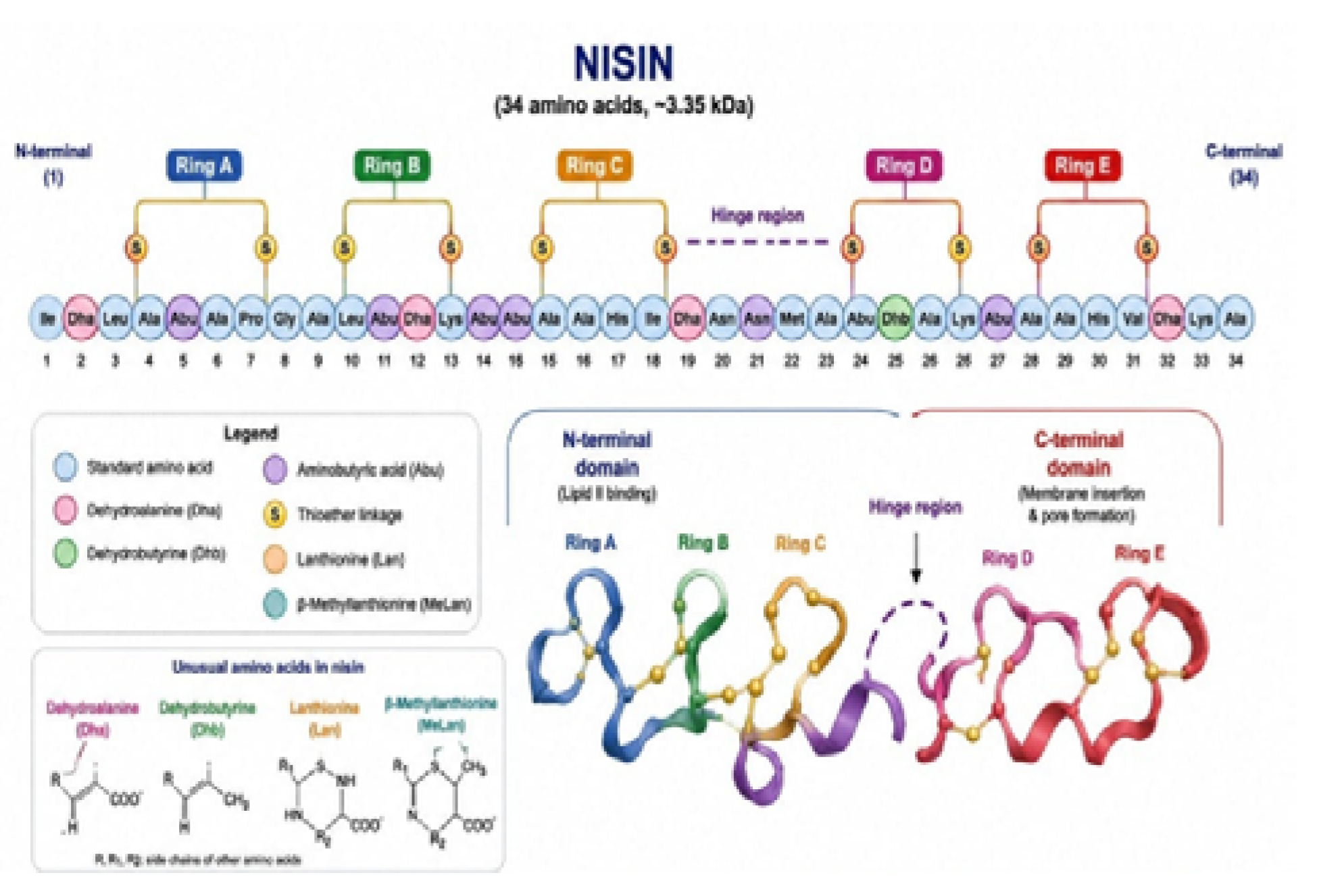
Chemical structure and Physicochemical properties of NisinNisin is a ribosomatic antimicrobial peptide (AMP), which is grouped together with other AMPs of class I, also termed as antibiotics or lanthipeptides. The mature peptide contains 34 amino acids and the molecular weight is around 3.35kDa. Its remarkable structural complexity is due to unique post-translational modifications including several non-canonical amino acids, such as dihydroalanine (DHA), dihydrobutyrin (DHb), lanthionine (Lan) and the beta-methyllanthionine (MeLan). As a result of these changes, nisin develops 5 thioether (A–E) inner rings that confer its structural rigidity, higher resistance to proteolysis, and high antimicrobial activity [3,6]. The amino (N-terminal) end of nisin consists of rings A and B, responsible for binding to Lipid II, the pivotal precursor molecule needed for the synthesis of bacterial cell wall. The C (Carboxyl) terminal end, in contrast contains rings D and E which are linked to a flexible hinge region and are mainly responsible for cytoplasmic membrane penetration and pore formation. On one hand this dual structural organization allows nisin to inhibit the peptidoglycan synthesis on cell walls and on the other hand it permits the disruption of the cell membranes making nisin one of the most effective antimicrobial peptides used in the preservation of food [5,2,3]. Nisin is chemically and physically a cationic and amphiphilic peptide, which promotes the attraction between nisin and the negatively charged bacterial membranes.
It is very stable under acidic conditions and its antimicrobial activity has been found to be optimal at pH levels less than 5.0. It is relatively stable, however, as the pH levels approach the neutral or alkaline range, the stability slowly diminishes. Under acidic conditions nisin also has good thermal stability, keeping the antimicrobial activity through different thermal processing methods, including pasteurization and sterilization. But, it can lose antimicrobial activity after exposure to high temperatures for long periods of time under neutral or alkaline conditions.
Additionally, its physicochemical characteristics changes according to different environmental issues, including pH, ionic strength, and food matrix composition, it affects its stability and antimicrobial activity [1,3,2,5]. The activity of nisin may also be influenced by the composition of food matrices, as protein, phospholipids and lipid globules have affinity for nisin and can either be substrates or interfere with the bioavailability of nisin by adsorption, or by regulating diffusion to the target microorganism. Hence, nisin's efficacy has been found to be highly diet-dependent and the importance of formulating and applying it under conditions that are optimized for the specific food products cannot be overstated [1,3,5]. The structural complexity, physicochemical stability and dual mechanism of action is one of the most important ones that set nisin apart from other bacteriocins and enable its continued success and use as a natural preservative in food products. Moreover, a new generation of synthetic nisin variants featuring other desired physicochemical characteristics and higher stability has emerged during the last decade and some genetically modified versions have shown a wider range of antimicrobial activity.
It is likely that these status changes will facilitate an evolving food preservation industry that will draw on nisin benefit in the coming decades, as well as a clean label approach to food systems [3,5,2].
Production of Nisin
Nisin is produced naturally by lactic acid bacteria, with L. lactis subsp. lactis SB-3 used commercially as a primary producer of nisin. Nisin is biosynthesized as a prepeptide and subsequently modified post-translationally, which results in the synthesis of the variety of amino acids present and in the characteristic lanthionine rings. To gain its active structure and antimicrobial function, these modifications are all essential prior to delivery to the environment in a mature form [3,6] (Figure 1).
The production of nisin can be made by Lactococcus lactis (mainly fermentation). The composition of the culture medium, carbon and nitrogen sources, temperature, pH, aeration, and fermentation time are the directly affecting factors on nisin yield and quality. Thus, optimization of production conditions leads to higher production efficiency, along with strain selection for high production capability, on the industrial level which are some of the most important factors to improve the production efficiency [7,3].
Figure 1: Chemical Structure of Nisin
Nisin is extracted and purified by a suitable technique after the fermentation process depending on the level of purification necessary. Food-grade and research-grade nisin are produced from a degree of purity, with higher degrees of purity being prepared for some biological applications [7].
The recent studies have been concentrating on methods of fermentation improvement, Low cost substrates and methods of Genetic engineering and Strain engineering of nisin production, Improving of extraction and purification. The ultimate goal is to increase productivity and lower manufacturing costs, using nisin in the future in the food industry and biological applications [3,5].
Table 1: Physicochemical Characteristics of Nisin
Property
Description
Classification
Class I bacteriocin (Lantibiotic/Lanthipeptide)
Producer
Lactococcus lactis subsp. lactis
Amino acid residues
34
Molecular weight
~3.35 kDa
Unique amino acids
Dha, Dhb, Lan, MeLan
Lanthionine rings
Five rings (A–E)
Net charge
Cationic
Structure
Amphiphilic peptide
Highest stability under acidic conditions
approximately pH 2–5
Thermal stability
High under acidic conditions
Primary target
Lipid II
Main antimicrobial mechanism
Cell wall inhibition and pore formation
Types of Nisin
However, recent studies have identified that nisin does not exist in a singular form, but rather a group of natural variants in nisin based on some variability in amino acids. These differences can be identified in their physicochemical properties, stability and antimicrobial spectrum. The finding of these variants has broadened the possible use of nisin in the food industry and biotechnology and has led to the production of improved variants by peptide engineering [3] Table 2.
The most studied and widely used one is nisin A. It is made by Lactococcus lactis subsp. lactis and it has the highest activity against Gram-positive bacteria; it is the most common commercial form in food preservation applications. There is only one amino acid substitution between nisin Z and nisin A. The difference, however, accounts for its enhanced solubility around the neutral pH and comparable antimicrobial activity, thus being more suitable for certain food applications [7,6].
Over the past few years, other naturally occurring variants (Nisin F, Nisin Q, Nisin H, Nisin P, and Nisin U) have been discovered and an increasing amount of research has been focused on their properties and applications. The use of nisin in the food industry and in the new preservation technologies has also been improved because of new advances in protein engineering that led to the production of more stable and effective nisin derivatives, in some cases with a wider antimicrobial spectrum [3,5].
Mechanism of Action of Nisin
Nisin is an antimicrobial product which functions in two specific ways: inhibition of bacterial cell walls synthesis and disruption of the integrity of the cytoplasmic membrane. This mechanism imparts high efficacy against most Gram-positive bacteria, and may help minimize risk of resistance as compared to other antimicrobials that are directed against only one site [3,2].
In fact, it is initiated with nisin binding to a critical peptidoglycan (PG) cell wall protein involved in transporting Lipid II, a key molecule in peptidoglycan biosynthesis. This binding gets in the way of cell wall formation and prevent cells growth. At the same time, Lipid II serves as a receptor to grow nisin molecules into the cytoplasmic membrane. It results in the development of pores through which ions and small molecules (such as ATP and potassium, K⁺) can escape. It leads to membrane depolarization, metabolism imbalance and eventually to bacterial cell death [8-10,3].
Antimicrobial Spectrum of Nisin
Nisin displays a wide range of antimicrobial properties and is considered as one of the most potent antimicrobial agents against Gram-positive bacteria, especially food spoilage and foodborne pathogens [2,3].
Nisin is used as one of the most potent naturally occurring preservatives in the food industry since it shows good activity against several nutritionally important bacteria, including Listeria monocytogenes, Staphylococcus aureus, Bacillus cereus, Clostridium botulinum, and some enterococci and streptococci. Its activity against Gram-negative bacteria has been limited, however, because of the outer membrane which obstructs its access to the site of action. However, it can be improved if EDTA or organic acids, which penetrate the membrane, are used alongside, or using the modern technique of high hydrostatic pressure (HHP) [11,1,5].
Nisin also has been shown to inhibit the growth of biofilm, especially Listeria monocytogenes and Staphylococcus aureus. This effectiveness can be further boosted with the use of a nano delivery system or natural antimicrobial agents. Also, several studies have shown that a number of factors other than pH and temperature affect the efficacy of nisin, the most important of which are the concentration level and the nature of the food matrix. It is more stable in acidic conditions while its activity can be affected by interaction with the food components, e.g. proteins and lipids [7,3,5].
Applications of Nisin in the Food Industry
Having been recognised as a natural preservative, nisin is highly effective against various foods spoilage and disease-causing microorganisms and commercially used in the food industry. With the increasing awareness and the movement towards clean label food, its application has been extended to several food sectors solutions to ensure the microbial safety of the food products, to increase the shelf life, and ensure a satisfactory sensory quality as well as a satisfactory nutritional value of the food products [3,5] Table 3.
The areas where nisin is most prominently used are dairy products. It is used to inhibit the proliferation of pathogens and spore formers like Listeria monocytogenes and Bacillus cereus which are present in cheeses, pasteurized milk and dairy products such as cream and yogurt. It also has an inhibitory effect on Clostridium tyrobutyricum, causing delayed bloating in cheeses, being beneficial for the microbial safety and shelf life [8,3].
Nisin is used in conjunction with C. botulinum, in cheeses, pasteurized milk, cream and yogurt as well as other fermented dairy products to inhibit growth of Listeria monocytogenes and other pathogens andmicroorganisms causing spoilage, such as Bacillus cereus. In addition, it inhibits the delayed bloating causing Clostridium tyrobutyricum, adding to its microbial safety and shelf life of cheesemaking [8].
Table 2: Natural Nisin Variants and Nisin-Like Lantibiotics
Nisin variant
Reported producer
Main distinguishing feature
References
Nisin A
Lactococcus lactis subsp. lactis
Prototype and the most extensively studied nisin variant
[11,12]
Nisin Z
Lactococcus lactis
Single amino acid substitution compared with Nisin A (His27→Asn27), improving solubility at near-neutral pH
[11,12]
Nisin F
Lactococcus lactis F10
Differs from Nisin A by substitutions at positions 27 and 30
[11]
Nisin Q
Lactococcus lactis 61-14
Contains four amino acid substitutions compared with Nisin A (positions 15, 21, 27 and 30)
[11]
Nisin H
Streptococcus hyointestinalis
Streptococcal nisin variant with structural differences from lactococcal nisins
[12]
Nisin P
Streptococcus spp.
Streptococcal variant with sequence divergence from Nisin A
[12]
Nisin U
Streptococcus uberis
Distantly related variant with multiple amino acid substitutions compared with Nisin A
[12]
Additionally, nisin provides an inhibitory effect against the growth of pathogens in meat, poultry, fish and seafood products, including Listeria monocytogenes, Staphylococcus aureus, and Clostridium botulinum. It works well in combination with other preservation methods, such as the vacuum packaging, modified atmosphere packaging, essential oils, plant extracts and high hydrostatic pressure. This synergistic effect helps in the improvement of product safety and shelf life [11,1,5].
Table 3: Selected Studies on Nisin Applications in Food Preservation
Food System
Application of Nisin
Target Microorganism(s)
Main finding
Reference
Processed cheese
Direct addition
Listeria monocytogenes
Residual nisin effectively inhibited L. monocytogenes during refrigerated storage, and its concentration was successfully quantified by LC–MS/MS.
[13]
Ricotta cheese
Edible galactomannan coating containing nisin
Listeria monocytogenes
Nisin-incorporated edible coating effectively reduced L. monocytogenes growth and extended refrigerated shelf life.
[14]
Soft cheese
Direct addition of nisin
Staphylococcus aureus, Escherichia coli, and molds
Direct addition of nisin significantly reduced microbial growth and improved the microbiological quality of soft cheese during refrigerated storage.
[15]
Yoghurt
Direct addition of nisin and nisin nanoparticles
Methicillin-resistant Staphylococcus aureus (MRSA) and Escherichia coli O157:H7
Nisin nanoparticles exhibited stronger antimicrobial activity than free nisin, significantly reducing MRSA and E. coli O157:H7 counts while maintaining yoghurt quality.
[16]
Ground beef
Microcapsules containing avocado peel extract and nisin
Aerobic mesophilic, psychrotrophic, and spoilage microorganisms
The combined treatment improved microbiological quality and delayed microbial spoilage during refrigerated storage.
[17]
Beef jerky and sliced ham
Nisin combined with atmospheric pressure plasma
Escherichia coli O157:H7
The combined treatment produced significantly greater bacterial inactivation than either atmospheric pressure plasma or nisin alone.
[18]
Chicken breast meat
Chitosan biofilm containing nisin
Aerobic, proteolytic, and lipolytic bacteria
The chitosan–nisin biofilm significantly reduced microbial counts and improved microbial quality during refrigerated storage.
The composite coating significantly inhibited microbial growth, maintained sensory quality, and prolonged refrigerated shelf life.
[20]
European seabass fillets
Direct application of nisin
Foodborne pathogens and biogenic amine-producing bacteria
Nisin inhibited microbial growth and significantly reduced biogenic amine formation during chilled storage.
[21]
Vacuum-packaged cold-smoked salmon
Chitosan combined with nisin
Listeria monocytogenes
The combination exhibited synergistic bacteriostatic activity and effectively controlled L. monocytogenes during refrigerated storage.
[22]
In meat, poultry, fish and seafood, nisin is a pathogen inhibitor for use against Listeria monocytogenes, Staphylococcus aureus and Clostridium botulinum. Nisin applications have grown to comprise juices, fresh and processed fruits and vegetables, and canned food. It is an anti-spoilage and spore forming bacterial agent which can enable a less aggressive heat process to achieve food quality and safety, while also preserving some of the heat-sensitive nutrients [23,7].
Nisin has been used more and more in the edible packaging wraps and active food packaging systems in recent years. It's used in packaging, and will gradually dissipate onto the food to help provide continuous protection against microorganisms. Recent studies also have revealed that its antimicrobial activity can be further increased, and applications expanded, through the use of organic acids, essential oils, cold plasma, and multi-preservation techniques (Hurdle Technology) to provide safer and clean label food production [1,3,5].
CONCLUSION
This review proved that among the array of natural preservatives, nisin has emerged as one of the most effective to ensure food safety and improve food shelf life. Moreover, applications of nisin are no longer restricted to food preservation but have expanded to include active food packaging systems and edible films—along with other preservation technologies—that have added to its effectiveness and longer shelf-life. But there are some challenges too; limited activity against gram negative bacteria and reduction in activity by some constituents in food matrix. Thus, it becomes important to conduct further research to create alternative and more efficient means with which to increase its usage.
Recent research has shown that peptide engineering, nanotechnology, and controlled release systems, as well as the incorporation of natural compounds with nisin and innovative preservative methods, are potentially beneficial ways to improve the functional properties of nisin and widen its applications. In this context nisin should remain one of the most important natural preservatives and play in a progressive way into the future production systems for safer and more sustainable foods, to be able to adjust more and more to the needs of the current food industry.
REFERENCE
Ng Z.J. et al. “Application of bacteriocins in food preservation and infectious disease treatment for humans and livestock: A review.” RSC Advances, vol. 10, no. 64, 2020, pp. 38937–38964. https://doi.org/10.1039/D0RA06161A
Murphy I.L. et al. “The role of the antimicrobial peptide nisin as a clean label food preservative.” Current Opinion in Microbiology, vol. 92, 2026, article 102786. https://doi.org/10.1016/j.mib.2026.102786
Field D. et al. “After a century of nisin research—Where are we now?” FEMS Microbiology Reviews, vol. 47, no. 3, 2023, article fuad023. https://doi.org/10.1093/femsre/fuad023
EFSA Panel on Food Additives and Nutrient Sources Added to Food (ANS). “Safety of nisin (E 234) as a food additive in the light of new toxicological data and the proposed extension of use.” EFSA Journal, vol. 15, no. 12, 2017, article 5063. https://doi.org/10.2903/j.efsa.2017.5063
Wang X. et al. “Nisin: Harnessing nature's preservative for the future of food safety and beyond.” Critical Reviews in Food Science and Nutrition, vol. 65, no. 34, 2025, pp. 9045–9070. https://doi.org/10.1080/10408398.2025.2517822
De Arauz L.J. et al. “Nisin biotechnological production and application: A review.” Trends in Food Science & Technology, vol. 20, nos. 3–4, 2009, pp. 146–154. https://doi.org/10.1016/j.tifs.2009.01.056
Delves-Broughton J. et al. “Applications of the bacteriocin nisin.” Antonie van Leeuwenhoek, vol. 69, 1996, pp. 193–202. https://doi.org/10.1007/BF00399424
Breukink E. and B. de Kruijff. “Lipid II as a target for antibiotics.” Nature Reviews Drug Discovery, vol. 5, no. 4, 2006, pp. 321–332. https://doi.org/10.1038/nrd2004
Hasper H.E. et al. “An alternative bactericidal mechanism of action for lantibiotic peptides that target lipid II.” Science, vol. 313, no. 5793, 2006, pp. 1636–1637. https://doi.org/10.1126/science.1129818
Martinez-Rios, V. et al. “Antimicrobial effect of nisin in processed cheese: Quantification of residual nisin by LC-MS/MS and development of new growth and growth boundary model for Listeria monocytogenes.” International Journal of Food Microbiology, vol. 338, 2021, p. 108952. https://doi.org/10.1016/j.ijfoodmicro.2020.108952.
Martins, J.T. et al. “Shelf life extension of ricotta cheese using coatings of galactomannans from nonconventional sources incorporating nisin against Listeria monocytogenes.” Journal of Agricultural and Food Chemistry, vol. 58, no. 3, 2010, pp. 1884–1891. https://doi.org/10.1021/jf902774z.
Abd-Elaal, S.F. et al. “Comparison of controlling capabilities of lactobionic acid, nisin, and K-sorbate against dairy-borne Staphylococcus aureus, Escherichia coli, and mold in soft cheese.” Open Veterinary Journal, vol. 14, no. 1, 2024, pp. 594–603. https://doi.org/10.5455/OVJ.2024.v14.i1.55.
Elsherif, W.M. et al. “Natural approach of using nisin and its nanoform as food bio-preservatives against methicillin-resistant Staphylococcus aureus and Escherichia coli O157:H7 in yoghurt.” BMC Veterinary Research, vol. 20, 2024, p. 192. https://doi.org/10.1186/s12917-024-03985-1.
Calderón-Oliver, M. et al. “Effect of the addition of microcapsules with avocado peel extract and nisin on the quality of ground beef.” Food Science & Nutrition, vol. 8, no. 3, 2020, pp. 1325–1334. https://doi.org/10.1002/fsn3.1359.
Lee, H. et al. “Bactericidal effect of combination of atmospheric pressure plasma and nisin on meat products inoculated with Escherichia coli O157:H7.” Food Science of Animal Resources, vol. 43, no. 3, 2023, pp. 402–411. https://doi.org/10.5851/kosfa.2022.e73.
Alkhashab, A. et al. “The effect interacting of chitosan as a biofilm with nisin on the microbial content of chicken breast meat preserved in cold storage.” NTU Journal of Agriculture and Veterinary Science, vol. 4, no. 4, 2024. https://doi.org/10.56286/c8n76k72.
Mehdizadeh, T. et al. “Effects of a chitosan edible coating containing pomegranate peel extract, nisin, and citric acid on the microbiological, chemical, and sensory characteristics of vacuum-packed rainbow trout fillets.” Advances in Food Research, vol. 5, 2025, p. 101308. https://doi.org/10.1016/j.afres.2025.101308.
Uçar, Y. et al. “The effects of nisin on the growth of foodborne pathogens and biogenic amine formation: In vivo and in vitro studies.” Food Bioscience, vol. 43, 2021, p. 101266. https://doi.org/10.1016/j.fbio.2021.101266.
Løvdal, T. et al. “In vitro studies on the synergistic bacteriostatic effects of nisin and chitosan against selected pathogenic and food spoilage bacteria, and a subsequent challenge study with Listeria monocytogenes in vacuum-packaged cold smoked salmon.” Food and Bioprocess Technology, vol. 19, 2025, p. 77. https://doi.org/10.1007/s11947-025-04170-4.
Piper, C. et al. “Bioengineering of a Nisin A-producing Lactococcus lactis to create isogenic strains producing the natural variants Nisin F, Q and Z.” Microbial Biotechnology, vol. 4, no. 3, 2011, pp. 375–382. https://doi.org/10.1111/j.1751-7915.2010.00207.x.
Ghazanfari, N. et al. “A comparative framework of natural nisin variants: Linking genetic basis to future bioengineering applications.” Microbial Cell Factories, vol. 25, 2026, p. 82. https://doi.org/10.1186/s12934-026-02962-7.
Cleveland J. et al. “Bacteriocins: Safe, natural antimicrobials for food preservation.” International Journal of Food Microbiology, vol. 71, no. 1, 2001, pp. 1–20. https://doi.org/10.1016/S0168-1605(01)00560-8
Recommended Articles
Review Article
Rview: Nisin its Importance and Applications
Shaymaa Jawad Mahmood,
...
Sumyia Kh. Badawi
Published: 30/06/2026
Download PDF
PO Box 101, Nakuru
Kenya.
Email: office@iarconsortium.org
Editorial Office:
J.L Bhavan, Near Radison Blu Hotel,
Jalukbari, Guwahati-India
Mahmood, S. J., A. Salih, H. & Badawi, S. K. (2026). Review: Nisin its Importance and Applications. International Academic Journal of Nutrition & Food Sciences, 7(1), 1-5.
MLA
Mahmood, Shaymaa Jawad, Hala A. Salih and Sumyia Kh. Badawi. "Review: Nisin its Importance and Applications." International Academic Journal of Nutrition & Food Sciences 7.1 (2026): 1-5.
Chicago
Mahmood, Shaymaa Jawad, Hala A. Salih and Sumyia Kh. Badawi. "Review: Nisin its Importance and Applications." International Academic Journal of Nutrition & Food Sciences 7, no. 1 (2026): 1-5.
Harvard
Mahmood, S. J., A. Salih, H. and Badawi, S. K. (2026) 'Review: Nisin its Importance and Applications' International Academic Journal of Nutrition & Food Sciences 7(1), pp. 1-5.
Vancouver
Mahmood SJ, A. Salih H, Badawi SK. Review: Nisin its Importance and Applications. International Academic Journal of Nutrition & Food Sciences. 2026 Jan;7(1):1-5.


 Download PDF
 Download XML