The cultivation of crops in greenhouses is a trend which has been on the increase worldwide, primarily due to the advantages stemming from the organic farming production, but also due to the rapid and intensive production of ready-made products. This approach often requires addition of natural and artificial fertilizers; whose adequate use necessitates agrochemical analysis of the soil on a regular basis. As a result of the unspecified and non-professional addition of mineral (organic) fertilizers and aiming to improve soil fertility, there has been balance disorder in the soil and its overload with certain nutrients. Thus, this study elaborates an agrochemical analysis of the soil in a greenhouse in which miscellaneous crops are cultivated, which has been treated with solid animal manure without any prior agrochemical analysis of the soil. Examinations have been made both of soil from the greenhouse and of soil in an uncovered parcel adjacent to the greenhouse, where crops have been cultivated as well. The soil samples were taken from three depths (10, 20 and 30 cm), unified by 5 separate samples. pH, electro conductivity, total amount of nitrogen, easily available phosphorus, potassium and humus have all been specified in these soil samples. A difference in the values of all parameters has been established in both covered and uncovered area, i.e. an increase in the values of the parameters in the covered area. From the analyses and the average values of all parameters, it has been established that the soil has fairly high pH values (8.41 in the greenhouse and 8.32 in the uncovered area), a medium level of total amount of nitrogen (1.66mg/100gr in the greenhouse and 1.3mg/100gr in the uncovered area), quite high concentration of phosphorus (50.72mg/100gr in the greenhouse and 47.23mg/100gr in the uncovered area), quite high potassium values (39.01mg/100gr in the greenhouse and 43.44mg/100gr in the uncovered area) and high values of humus (3.97% in the greenhouse and 3.29% in the uncovered area). On basis of the results obtained, it has been established that the soil is supersaturated with phosphorus and potassium and due to this, the soil itself cannot be fertilized in the following few years.
Keywords
Greenhouse
Agrochemical Analysis
Soil Fertility
Organic Fertilizers
INTRODUCTION
Vegetable production in greenhouses around the world has been increasing more and more. In the Republic of North Macedonia in 2010, greenhouse areas were estimated to be approximately 3 832 ha and this farming method was about 20% of the total crop production [1]. This percent has risen to 22.4% in 2016, as greenhouse areas have reached 6415 ha. [2].
Cultivation of crops in greenhouses is a production method distinguished by many advantages: better aquatic-aerial regime, faster heating of the surface, better development of the root system, decreasing the problems with diseases and pests and harvest which is larger and of higher squality [3]. This enables ‘super’ intensive production of agricultural crops, whose fast growth and development often requires greater import of nutrients and correct combination of fertilization and irrigation [4].
Many of these production systems for improving soil fertility use solid animal manure which contains all the necessary biogen elements. At the same time, many of the individual cultivators add different types and quantities of animal manure, without any prior knowledge concerning soil condition and the necessity for supplementary import of nutrients. This type of natural and artificial fertilizers’ use, often leads to increased nutrients accumulation in the soil, which contributes to its fertility disbalance.
In agriculture, fruit-growing andwine-growing, the surplus of nutriments in the soil is quite rare and isolated, while the crop production in a protected area (greenhouses and orangery) in the last few years’ marks even more examples of excessive use of fertilizers which results in a congruent symptomatology and has a negative impact on the harvest’s quantity and quality [6]. There is some data found in literature that the nitrogen, phosphorus and potassium concentration, as well as the humus quantity, increase side by side with the number of years increase when crop planting in a greenhouse happens and the maximum can be noted after 5 to 10 years [17].
Due to these reasons, the only adequate approach regarding this type of production is an obligatory agrochemical analysis of the soil before picking up the harvest and regular consecutive supervision [5]. The agrochemical analysis of the soil is the best indicator for the soil’s fertility, i.e. its actual capacity and the level of available nutriments, which refers to the need of artificial and natural fertilizers’ use on a scientific ground, aiming to achievement of harvest of high quantity and quality, as well as to protection of the environment[6].
MATERIALS AND METHODS
Field of Examination
An agrochemical analysis of the soil in a greenhouse with cultivated miscellaneous crops has been conducted. This greenhouse has been fertilized with solid animal manure. The greenhouse was constructed in 2014, but there wasn’t any initial soil agrochemical analysis. During the first planting of crops and in the following two vegetation seasons, solid animal (cow’s) manure has been added before planting the crops. The greenhouse is covered with nylon foil whose measurements are 20m by 4m (80m2). Right next to it, there is a parcel with measurements 20m by 10m (200m2). The following crops are planted in the greenhouse: pepper (Capsicum annuum), tomato (Solanum lycopersicum), celery (Apium graveolens), cucumber (Cucumis sativus), lettuce (Latuca sativa), garlic (Allium sativum) and onion (Allium cepa), while in the parcel next to the greenhouse pepper (Capsocum annuum), tomato (Solanum lycopersicum), potato (Solanum tuberosum), carrot (Daucus carota) and bean (Phaseolus vulgaris) are planted.
Experimental Part
Soil samples for the soil’s agrochemical analysis are taken during the period of month October 2018, after the crops’ harvest and after removing the vegetation. The samples are taken according to the guidelines for taking soil samples from agricultural lands [6]. Each soil sample is unified by 5 separate samples taken from 3 depths (10, 20 and 30cm).
For the purpose of determining the influence of external factors, soil samples have been taken both from the parcel and from the greenhouse.
The agrochemical analyses have been made in the authorized agrochemical laboratory ‘Blagoj Kotlarovski’ – Resen, where these samples were delivered in dried state, cleaned from large filth and remainders, adequately packed and labeled. The following parameters have been determined by these laboratory analyses: soil’s pH, electro conductivity, total nitrogen, available phosphorus, potassium and humus. Parameters’ values are determined by standard laboratory procedures.
RESULTS
The values obtained from the examined parameters are displayed in Table 1 and Table 2. The values of examined parameters in soil samples taken from the greenhouse (area under nylon foil) are displayed in Table 1, whereas parameters’ values from the uncovered area adjacent to the greenhouse are displayed in Table 2.
The most commonly used indicators for evaluation of soil quality in the research studies around the world are the pH reaction of soil and the quantity of organic materia. These two indicators are mentioned in 80-90% of the research studies. Beside them, present indicators are also the following: the one of available phosphorus (75%), available potassium (49%) and the total amount of nitrogen (40%) [18].
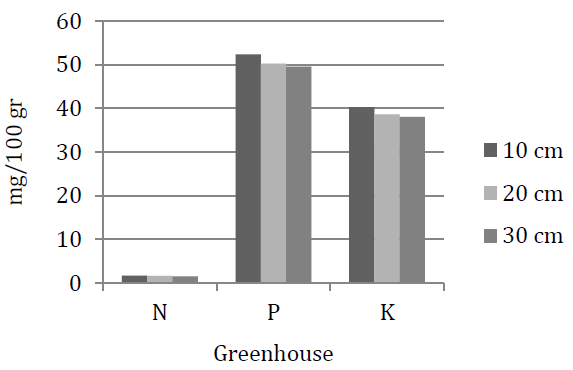
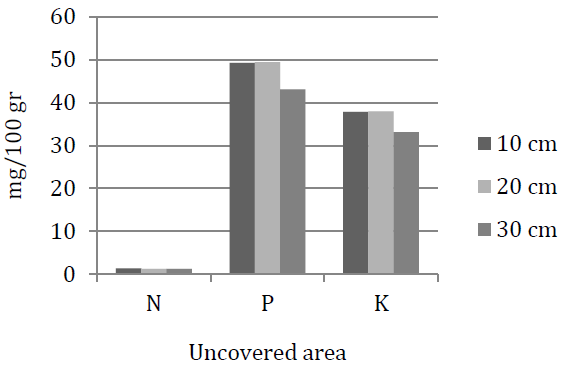
In Figure 1 and Figure 2, there are graphic displays of the average values of total nitrogen, available phosphorus and potassium both in the greenhouse and in the uncovered area, with respective correlation with the soil’s depth where the soil’s samples were taken from.
As expected, there is a difference in the obtained values for soil samples from the greenhouse and the uncovered area next to it. This is due to the fact that greenhouses are permanently closed environments and the temperature and humidity inside them are considerably higher compared to open spaces. At the same time, in the covered greenhouses there is a shortage of natural rainfall which has an impact on nutrients’ distribution in the soil layers.
Figure 1: Greenhouse
Depth (cm)
pH
(1N KCl)
ES
(ppm)
Available forms mg/100g soil
Humus (%)
N (total)
P2O5
K2O
10
8,30
122,62
1,75
52,39
40,30
4,18
20
8,44
129,28
1,69
50,25
38,65
3,98
30
8,5
136,32
1,56
49,53
38,10
3,75
Average value
8.41
129,4
1,66
50,72
39,01
3,97
Figure 2: Uncovered Area
Depth (cm)
pH
(1N KCl)
ES
(ppm)
Available forms mg/100g soil
Humus (%)
N (total)
P2O5
K2O
10
8,4
154,24
1,41
49,24
37,87
3,5
20
8,34
138,88
1,25
49,41
38,00
3,33
30
8,23
133,12
1,21
43,06
33,12
3,05
Average value
8,32
142,08
1,3
47,23
36,33
3,29
Figure 1: N, P, K Concentrations on 10, 20 and 30 cm in the Soil from The Greenhouse
Figure 2: N, P, K Concentration on 10, 20 and 30 cm in the Soil From The Uncovered Area
Thus, it can be evidenced from the obtained values that all examined parameters (pH, total nitrogen, available phosphorus, potassium and humus) in the greenhouse have higher average values compared to the parcel next to the greenhouse. The only feature deviating is the value of soil’s electro conductivity which is greater in the uncovered area. At the same time, it is apparent that concentrations of total nitrogen, available phosphorus and potassium, as well as humus percentage are the greatest in the surface layer of the soil (0-10cm) and that they decrease with the soil’s depth being bigger and reaching the lowest values at 30cm. As a follow-up, an analysis is made of the examined parameters and their values one by one.
Soil’s pH in the Examined Soil Samples
Soil’s pHreactionis one of the main factors which determines mobility and availability of plant’s necessary elements and in general, it varies between 4 and 8.5 [7]. Obtained results of the examined soil samples have average values of 8.41 in the greenhouse and 8.32 in the uncovered area. According to soil classification, this refers to quite high pH soil reaction. The high pH soil reaction is typical for soil where particularly animal manure is used and usually has alkaline value and pH higher than 8.00 [8]. Although many of the crops tolerate a wide range of pH [9], the most favourable pH value for crops is still between 5.5 and 7.0 [10] Soil’s high pH is not favorable since it decreases minerals’ solubility to a condition of nutrients’ shortage. This means that a certain element could be present in the soil in large concentrations, but due to an inadequate pH that same element might not be available for the plants.
So, for example, the availability of phosphorus is considerably decreased in case when pH varies between 7.5 and 8.5 and at the same time the availability of Fe, Mn, Zn, Cu and Ni is low which has a negative impact on vegetable’s growth and development [9]. According to scientific studies, these types of alkaline soil are in need of adding physiologically acid mineral fertilizers in order to decrease this parameter’s high value [11]. On comparison, the agrochemical analysis of soil in the Gevgelija region on depth from 0 to 60cm, has shown that a pH of 7.56 [12] is measured, whereas in the soil of Tikvesh region on depth from 0 to 20cm, a pH value of 7.5 is measured [13]. According to archived data kept by the agrochemical laboratory where the soil samples are examined, it could be evidenced that the greatest number of soil samples which have been agrochemically tested and which are taken from newly-construcetd crop groves without being treated with any natural or artificial fertilizers, an acid pH is present and it is within the limits from 5.6 to 5.95 [14].
Soil Electro-Conductivity
Electro-conductivity of the soil as an indicator of total quantity of solvent salts in the soil is related to its saltiness, which stems from the use of mineral fertilizers in large quantities or from irrigation with water which consists of salt quantities in amounts which are fairly high. Soil’s saltiness increases the amounts of Ca2+, Mg2+, K+, Na+, but at the same time it reduces the exploitation of phosphorus by crops as a result of its decreased availability [6]. Saltiness has its own impact also on the exploitation of other nutriments and causes a combination of complex interactions which have an influence on plant metabolism [15].
In the examined soil samples, this parameter’s values are low, not only in the greenhouse (129.4 ppm), but also in the uncovered area (142.08 ppm) which is an amount <1dS/m. In general, soil’s electro-conductivity increases side by side with the increasing amount of clay inside it, as well as with the increase of porosity and wetness [19,20]. This can be verified by the small amount of increase in soil samples from the uncovered area which in the time period of taking were considerably wetter due to rainfall in the given period.
Total Nitrogen Values in The Soil
As one of the important macroelements, nitrogen in soil is usually found on depths from 0 to 20 cm and its contents depends, above all, on humus quantity, which usually, on the average, contains 5 to 10% of nitrogen [6].
From the data displayed in chart 1 and chart two, it can be stated that the average values in thegreenhouse are slightly higher (1.66mg/100gr) than in the uncovered area (1.3mg/100mg). The data indicate nitrogen’s medium availability and it is decreasing with the increase of depth in both examined areas. Its value are the highest at depth of 10cm and the lowest at depth of 30cm, which refers to its exploitation by the plants’ root systems. On comparison, in a newly-constructed greenhouse grove in the village of Dobrushevo, the measured amounts of nitrogen are only 0.6mg/100gr and this is the reason why a recommendation to introduce an additional amount of nitrogen via artificial fertilizers is given [14]. When analyzing the soil in the Gevgelija region, the measured concentrations of nitrogen at depths between 0 and 20cm are 4.37mg/100gr, in the region of Kavadarci 5.9mg/100gr and in the region of Valandovo the amount of nitrogen is 6.64mg/100mg [12].
Animal natural fertilizers are an important prospect source of nitrogen in the soil. Nevertheless, nitrogen quantity which originates from those natural fertilizers, also depends on the type of cattle where they come from. In general, cattle fertilizers contain 5-18kg N/t, half of which quite rapidly (in a few months period) transforms itself into forms of nitrogen which are available for the plants.In the covered greenhouses these tranformations occur faster as a result of higher indoor temperature, but when it comes to alkaline soil, a big percent of nitrogen could be lost with its transformation in ammonia and its further evaporation. This great loss could take place precisely in soil where animal manure has been used and which usually has alkaline value and pH value higher than 8.00 [8].
Values of Available Phosphorus in the Soil
Determining easily available phosphorus in the soil aims to specify the soil supply with this element necessary for plants’ nourishment and on the basis of this determination to establish the necessity of applying natural or artificial fertilizers. Organic phosphorus exists in the soil via animal and green manure, compost, woodland cover, root remainders and microorganisms which died out, insects and animals which live inside the soil [6]. Measured phosphorus concentrations in the tested soil samples are considerably high. The average values in the covered area of 50.72mg/100gr and 47.23mg/100mg in the uncovered area, refer to quite large availability of this nutrient. As expected, its value decreases with the increase of depth, that being a consequence of its exploitation by the plants. On comparison, a newly-constructed crop grove which has not been fertilized at all, situated in the region of village Dobrushevo, the measured phosphorus concentrations are considerably low (4.44mg/100gr) and they are even 1.71mg/100gr in a newly-constructed grove in the village of Beranci. Similar high values of this nutrient are measured in the soil in the region of Valandovo, where phosphorus is available with average values of 56.86 mg/100gr compared to the soil in the region of Kavadarci where this element is measured with low average values of 7.45mg/100gr [12]. When there are such high values of phosphorus, it is recommended not to use phosphorus fertilizers in the following three years, irrespective of the fact which crop is being cultivated [14].
Values of Available Potassium in the Soil
In a ploughed land of depth between 0 and 20cm, total potassium is usually found in the amount of 1-2% [6]. Average values and individual values of easily available potassium in the greenohouse soil are quite high (on the average 39.01mg/100gr in the covered area and 36.33mg/100gr in the uncovered area). On comparison, in soil from the region of Gevgelija, the average measured values for potassium are 6.81mg/100gr, in the region of Valandovo 21.09mg/100gr, whereas in the region of Kavadarci 37.94mg/100gr. In the Tikvesh region, potassium concentrations are between 24.00 and 27.00mg/100gr at depth between 0 and 20cm, i.e. 23.9-25.8 at depth between 20 and 40 cm[13].
Humus Percentage in the Soil
Organic material in the soil consists of a mixture of plant and animal compounds in different stages of dilapidation, as well as compounds which have been synthesized chemically or biologically. Nevertheless, the quality and quantity of humus also depends on climate, type of soil and agricultural procedures. High humus concentration in the soil has its own influence on elements marks’ activity, especially when it comes to strong fixation of Cu, which leads to toxic effects of the forage [16].
By implementing soil in the agricultural production, there is an inevitable instensifying of degradation processes of organic material and this is where the tendency for decrease of organic material contents in all agricultural areas comes from [6].
Humus values in soil samples from the greenhouse vary between 3.97% in the covered area and 3.29% in the uncovered area. These refer to fair availability according to soil classification regarding humus contents [11] but also when compared to values measured in the region of Tikvesh (from 1.30 to 1,41%) [13].
CONCLUSION
The conducted agrochemical analysis of the soil from a greenhouse with miscellaneous crops, gave results which led to the following established conclusions:
Agrochemical analysis of the soil is the best indicator for soil fertility and concentrations of nutrients at disposal
The values of all examined parameters are higher in the greenhouse compared to the parcel adjacent to it
Concentrations of all parameters have higher values at all depths, but the increase of depth leads to lower values
The highest concentrations of parameters are measured in the surface layer (10cm) and the lowest at depth of 30cm
The soil has high pH value which varies between 8.41 in the greenhouse and 8.32 in the uncovered area
Phosphorus concentrations are considerably high and these values are 50.72mg/100gr in the greenhouse and 47.23mg/100gr in the uncovered area. This is the reason why woil should not be fertilizied in the next vegetation seasons
Nitrogen quantity in soil is with medium quantity available with 1.66mg/100gr in the greenhouse and 1.3mg/100gr in the uncovered area
Available potassium in the soil has quite high values of 39.01mg/100gr in the greenhouse and 36.33mg/100gr in the uncovered area
The soil possesses a fair amount of humus with values of 3.97% in the greenhouse and 3.29% in the uncovered area
As a result of the non-professional addition of mineral (organic) fertilizers, there has been balance disorder in the soil and overload with certain nutrients
Therefore, it has been established that the soil is supersaturated with phosphorus and potassium and due to this, the soil should not be fertilized with organic manure in the following few years
REFERENCES
“Facts and figures 2010.” Ministry of Agriculture, Forestry and Water Economy, Sector for Analysis of Agricultural Policy, R.N. Macedonia, 2010.
“Figures and facts 2018.” Ministry of Agriculture, Forestry and Water Economy, Sector for Analysis of Agricultural Policy, R.N. Macedonia, 2018.
Baudoin, W. et al. Good Agricultural Practices for Greenhouse Vegetable Crops. Food and Agriculture Organization of the United Nations, Plant Production and Protection Division, 2013.
Trajkova, F. and V.Zlatkovski. Guide for Taking Soil Samples from Agricultural Areas. University “Goce Delchev” – Stip, Faculty of Agriculture, 2017.
Merry, R.H. “Acidity and alkalinity of soils.” Environmental and Ecological Chemistry, vol. 2, CSIRO Land and Water, Adelaide, Australia, 2017.
Gulaboski, R. Agrochemistry and Plant Nutrition. University “Goce Delchev,” Stip, 2013.
“Soil factsheet: Soil pH.” Ministry of Agriculture, Food and Fisheries, British Columbia, 2015.
“Nutrient management of vegetable and row crop handbook.” U.S. Department of Agriculture, UF/IFAS Extension Service, University of Florida, 2015.
“Manual for introduction of agro-ecological measures in apple production in prespa.” Epicenter, January 2014.
Trajanovska, F. “The impact of soil fertility on plant nutrition.” Journal of Agricultural, Food and Environmental Sciences, UDC: 631.452(497.714/.715), 2014.
Milenkovska, S. and M.Stojanova. “Influence of soil fertility on the chemical composition of the leaves in two varieties of vines in conditions of the tikvesh vineyard.” Journal of Agricultural, Food and Environmental Sciences, UDC: 631.452:634.8(497.714), 2015.
Agrochemical Laboratory ‘Blagoj A. Kotlarovski’ – Resen. Archival data.
Liang, Y. et al. “Soil degradation and prevention in greenhouse production.” 2010 International Conference on Combating Land Degradation in Agricultural Areas (ICCLD’10), Xi’an City, PR China, October 2010.
Kabata-Pendias, A. Trace Elements in Soils and Plants. 3rd ed., CRC Press, Boca Raton, London, New York, Washington D.C., 2001.
Li, J. et al. “Variations of soil quality from continuously Planting Greenhouses in North China.” International Journal of Agricultural and Biological Engineering, vol. 12, no. 1, 2019. https://doi.org/
Bünemann, E.K. et al. “Soil quality – A critical review.” Soil Biology and Biochemistry, vol. 120, 2018, pp. 105–125. https://doi.org/
Boshevska, M. & Jankuloski, Z. (2021). Agrochemical Analysis of Soil from Greenhouse Treated With Organic Fertilizers. International Academic Journal of Nutrition & Food Sciences, 2(1), 1-5.
MLA
Boshevska, Marija and Zivko Jankuloski. "Agrochemical Analysis of Soil from Greenhouse Treated With Organic Fertilizers." International Academic Journal of Nutrition & Food Sciences 2.1 (2021): 1-5.
Chicago
Boshevska, Marija and Zivko Jankuloski. "Agrochemical Analysis of Soil from Greenhouse Treated With Organic Fertilizers." International Academic Journal of Nutrition & Food Sciences 2, no. 1 (2021): 1-5.
Harvard
Boshevska, M. and Jankuloski, Z. (2021) 'Agrochemical Analysis of Soil from Greenhouse Treated With Organic Fertilizers' International Academic Journal of Nutrition & Food Sciences 2(1), pp. 1-5.
Vancouver
Boshevska M, Jankuloski Z. Agrochemical Analysis of Soil from Greenhouse Treated With Organic Fertilizers. International Academic Journal of Nutrition & Food Sciences. 2021 Jan;2(1):1-5.



 Download PDF
 Download XML