The article analyses the definition of consumer decision-making, theoretical aspects of the consumer purchasing decision model, traditional consumer purchasing decision model, consumer purchasing decision model according to COVID 19. The article is based on the analysis of scientific literature and case studies. The study includes theoretical analysis of the literature, as well as case studies and comparative analysis. A consumer purchasing decision model has been developed in line with COVID 19.
Keywords
Consumer Buying Decision – Making Model
Consumer
Consumer Decision
INTRODUCTION
In recent years (2020-2021), under the conditions of COVID 19, the online shopping of the Lithuanian population has been steadily increasing, therefore most Lithuanian companies were able to enjoy the increased turnover and increased profits. Under such conditions, companies with physical stores are forced to reconsider their strategy and look for new ways to compete. One of the possible ways to maintain and expand your circle of consumers is to study consumer behaviour and influence it.Šarkutė, L. [1] mentioned that decision making research and theory flourished in the middle of twenties centuries and relied primarily on micro-level interpretations of the modern economy. Both decision-making theory’s goal of economics is the same - to create an individual model that would allow predict human behaviour. As essential advantage of decision-making theory is that it pays special attention devoted to analysis of how individuals and groups understand the world and interacts with it. Consumer behaviour answers questions about how consumers make decisions to buy or not to buy, what factors influence those decisions, how marketers can use this information to create value for the consumer and gain a competitive advantage. The consumer is an individual (person) with desires or desires, making a purchase, consuming a product, disposing of a product. Consumers can take the form of organizations or groups. Consumer behaviour is the processes of the consumer's mind, emotional and physical activity related to the search for, acquisition, evaluation and elimination of products that meet the needs / desires (solve problems). Consumer behaviour also includes contact with advertising media, reaction to sponsorship actions, information retrieval, influence of other persons, influence of other persons. Consumers make purchasing decisions and profits for an organization when making purchasing decisions, so they are vital to the organization. Users are the cornerstone of an organization. When consumers buy goods or services, they drive the company’s sales and profits, meeting their needs. There is a close connection between a company and its users. The question is, how do consumers choose goods and services? How they react to prices, advertising, stores interior, product packaging, product colours and design? How can marketers answer these questions? If marketers knew the answers, they would be more likely to make the right decisions, increase the company’s profits and sales. Although the field of consumer behaviour science is a new discipline, since ancient times, the aim has been to find out the consumer's needs, their characteristics, behavioural trends, the factors determining consumer behaviour and their possible influence. This knowledge was especially relevant for people working in the field of marketing, market choice, long-term company plans must be based on the knowledge of their customers and meeting their needs.
MATERIALS AND METHODS
Scientific Issue
Consumer buying decision making model is very popular, is also relevant in the 21st century. Current situation causes a problem because the consumer buying decision making in terms COVID 19 very is not established in scientific literature.
The Aim of the Research
is to investigate of consumer buying decision making in terms COVID 19.
Objectives of the Study
To analyse consumer decision - making definition
To analyse the theoretical aspects of the concept of consumer buying decision making model
To examine traditional consumer buying decision - making model
To analyse Consumer buying decision model in terms of COVID 19
Consumer Decision - Making Definition
According to Stankevich, A. [2] consumer behaviour has always been a relevant marketing topic because knowing how and why consumers behave in a certain way when making purchasing decisions helps companies to improve their marketing strategies and be more successful in the marketplace. So, the challenge that all marketers face today is how to influence consumer behaviour in favour of their products or services. Younus, S. et al. [3] argued that the intention to buy has another aspect that the consumer will purchase the product after evaluating. There are many factors for the intention to buy like customer knowledge, consumer perception, product packaging or design and celebrity endorsement, etc. As stated, Blackwell, R.D. et al. [4] consumer decision making a certain brand based on internal and external environment. Based on internal information, it is gathered from previous experience for advertising, etc., and external information may be collected from peers or a marketplace.
Consumer Buying Decision – Making Model
Madhavan and Chandrasekar [5] mentioned that there are Nicosia model, Howard Sheth model, Engel Kollat Blackwell model, Psychoanalytic model, Learning model, Sheth Newman’s Gross model, Anderson model, Black box model, Sociological model in scientific literature. Consumer Decision Making Models describe the process of making or selecting consumer decisions (Table 1).
Table 1: Consumer Buying Decision Making Model
Model name
Authors, which describe model
Emphasized aspects
Nicosia model
Xu, B., Chen., J. [6]
Highlight information about consumer attitudes, product evaluation, deed of purchase, feedback with consumer.
The Howardo Sheth model
Madhavan, M., Chandrasekar, K. [5]
The model highlights three levels of learning: comprehensive problem-solving, problem-solving limitation, and routine response.
Engel-Kollat-Blackwell Model.
Xu, B., Chen., J. [6]
Emphasize consumer psychological activities.
Psychoanalytic model
Madhavan, M., Chandrasekar, K. [5]
The model explains individual user behavior. in four sections.
Learning model
Yadav, R. [7]
Yadav, R. [7] emphasizes that learning is a process in which consumer behaviour can change semi-permanently. Behaviour can to exchange experience, qualifications, skills and information to help improve the individual performance.
Sheth Newman’s Gross model
Sheth, J.N., Newman, B.I. and Gross, B.L. [8]
Highlight consumption values that influence consumer choice behaviour.
Anderson model
Anderson, W.T. and Golden, L.L. [9].
It emphasizes that consumer behaviour includes consumers experience in recognizing their needs.
Black box model
Madhavan, M., Chandrasekar, K. [5]
The black box model shows how stimuli interact.
Sociological model
Jisana T. K. [10]
Highlight consumer role and influence in society. Consumer behaviour influenced by the people. For example, a manager may have different buying habits depending on their respective roles in the company in which they work.
Traditional Consumer Buying Decision Making Model
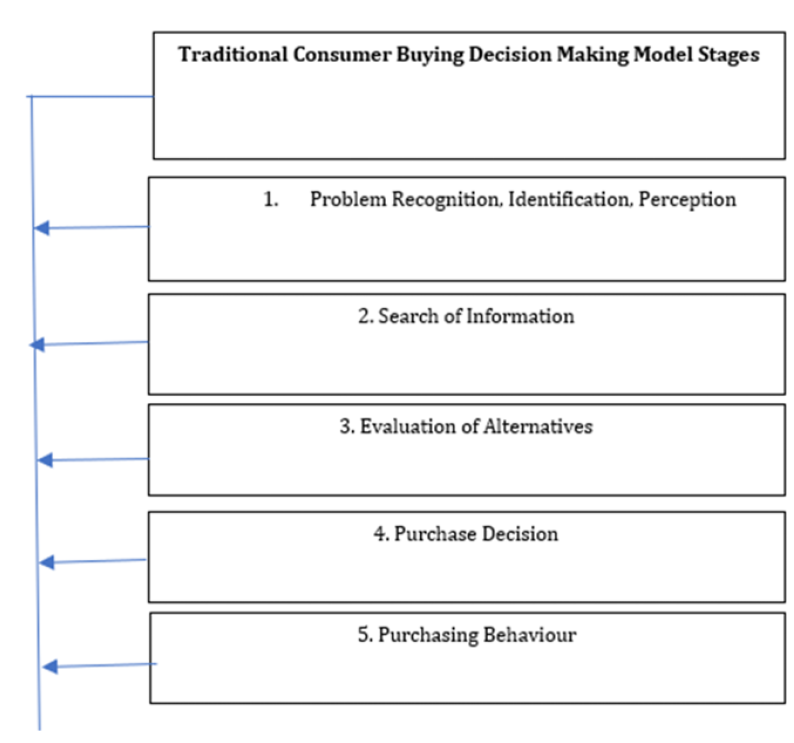
Stankevich, A. [2] argues that the traditional model of the consumer decision making process involves five steps that consumers go through when purchasing a product or service. The marketer needs to understand these steps to properly motivate the consumer to buy the product, communicate effectively with the consumers, and complete the sale (Figure 1).
Figure 1: Traditional Consumer Buying Decision Making Model
Recognition of the Problem
A problem is any state of deprivation, discomfort, or intolerance (physical or psychological) that an individual feels. Acknowledging a problem is the realization that he or she needs to acquire something to return to the desired state — physical or psychological. This difference challenges, activates the decision-making process. Actual state - how an individual perceives his senses and situation in the current state. Desired state - how an individual wants to feel or in what situation to be in the future.
Information Retrieval
Internal or external retrieval of information to reduce perceived risk and provide a basis for the evaluation of alternatives. Internal retrieval is a search in long-term memory to determine whether a satisfactory solution is known. An external search is performed if a satisfactory solution is not found after an internal search, the search is diverted to external information sources.
Evaluation of Alternatives
The user gathers information about the features that the alternatives have, uses the appropriate selection rule, and makes the optimal choice.
Choosing and Purchasing a Place of Purchase
The process of choosing a place of purchase is the same as choosing a product, user recognizes a problem that requires the choice of place of purchase performs internal and external information search evaluates alternatives uses selection rules to select the place of purchase. The place of purchase (outlet) is the source of receipt of a product or service for the consumer. In-home shopping is a relatively small but constantly growing shopping place. Consumers see and hear about products through catalogs, direct mail, television, radio, internet and then buy them: by mail phone, by computer order. When all the criteria are equal, the consumer chooses the nearest store. Consumers prefer larger stores. Factors influencing in - store and online shopping are price reduction and promotion, atmosphere, missing desired item (stockouts), website operation, sales staff.
Purchasing Behaviour
Product evaluation is based on trying the product after it is purchased.
Lithuanian Consumer Buying Habits During a Pandemic
The fact that shopping habits have changed should not come as a surprise to businesses. It is very important to make sure that the business does not lag behind and tries to adapt to these new consumer habits. This is very important for Lithuanian small and medium-sized enterprises. But while some things change, others remain the same - people keep buying. Consumer behaviour is gradually normalizing and people around the world are learning to live by the new COVID-19 rules. The most noticeable changes during a pandemic are the following:
Conscious Spending
Moving to values and necessities. As many people expect COVID-19 to affect not only their daily lives but also their finances in the near future, consumers are more closely monitoring their spending and switching to cheaper products. It is not intended to reduce costs for essentials (groceries, household goods, etc.), but is willing to save more with unnecessary purchases.
Increased Online Buying Volume
During the pandemic, demand for most product categories grew by more than 10 percent. Many consumers say they plan to continue shopping online even after quarantine and restrictions. In addition to e-commerce, other digital and contactless services such as post offices, pick-up points, delivery and shipping services are also noticing much higher demand than before. Although this increased demand is a consequence of the pandemic, their demand is not projected to decline even after the end of the pandemic.
Decreased Consumer Loyalty
COVID-19 is a major challenge for certain products and companies and their supply chains. When consumers could not find their favorite products, they switched to competitors. During the pandemic, many consumers tried a new brand or shopped in a new location. Value, affordability, quality and organic products were the main reasons why consumers tried another brand.
Health and the Economics of 'Care'
Consumers have begun to pay more attention to how companies "deal" with the pandemic and to the security measures they apply, such as protective barriers and proper disinfection of premises. During a pandemic, people tend to buy from companies that have preventative measures in place and that take care of their employees. During this period, consumers pay close attention to how businesses contribute to and help the community. The actions the company took during this pandemic are likely to remain in the memory of consumers for a long time to come.
Home-Based Economy
In most countries, people do not yet feel safe and avoid spending time in public places. For more than three-quarters of consumers who changed their daily routine during this pandemic, even easing government restrictions is not a sufficient incentive to return to their former rhythm. Still, consumers plan to return to their usual routine, and in-store shopping is at the top of that list. On the other hand, big events and air travel are at the bottom of that list. Knowing how customers ’shopping habits have changed, it’s time to look at your business and whether it satisfies them. Maybe it’s time to change communications, marketing channels, or certain products?
Lithuanian consumers habits changes can be seen by analysing the consumer shopping cart. Although the amount of the average shopping cart is growing slightly, in 2020 it has resulted in smaller and more diverse goods, and the demand for some categories of goods has grown significantly. During the pandemic, many Lithuanians set up comfortable places to work, leisure or study at home. Kačerauskas, E. [11] stated that greater interest in previously niche e. categories of jewelery and foodstuffs held in trade. In order to meet all the customer's expectations, the Pigu.lt online shopping center has recently added such an unconventional category as live flowers to its range. Another rapidly growing category of goods - clothing, footwear, accessories. According Kačerauskas, E. [11] representatives of this segment trading through Pigu.lt e. trading platform, say they feel the interest of customers and the need to develop their range even more widely. Lithuanian e-shop Pigu. lt established the Marketplace less than six months before the pandemic. Although there was a lot of interest from traders before the quarantine, the number of people willing to trade through the "Pigu" platform during the quarantine has almost tripled. With the closure of physical stores, many had to look for other ways to trade. A number of those who have not yet traded online have rushed to do so. Start selling via Pigu.lt e. trading platform for many of them proved to be the most convenient and fastest the main goal of Pigu.lt is to meet the needs of both sellers and buyers. Therefore, we constantly invest in both e. improving the functionality of the platform as well as customer service. According to the Department of Statistics, the retail turnover last year shows that long-standing foodstuffs and some other goods were only swept by people in March last year. In November, the Lithuanian population was no longer inclined to stockpile and was in no hurry to procure non-perishable foodstuffs, medicines or hygiene products. Food trade in 2020 in December, an increase of 1.1 percent. This is not at all reminiscent of the situation in March last year, when before the first wave of the pandemic, Lithuanians simply swept goods from store shelves. According to the Department of Statistics, in the spring of 2020, food trade grew particularly sharply. According to the Department of Statistics, in March, compared to February, trade in food products increased by 5.5 percent. Mail order and online sales in December 2020, compared to November, increased by 35%, and compared to 2019 in December - as much as 84 percent. Internet and mail sales grew at a record rate throughout the year, with an annual increase of 50%. Last year, online sales increased by 20%. In total, the volume of retail trade decreased by 6.2 percent last December compared to November. However, retail sales increased over the year. According to the Department of Statistics, annual growth was 2.5 percent. According to A. Ramaškevičienė, a positive balance could have been achieved at the expense of other more successful months. In addition, according to the specialist, the December turnover was also saved by the intensified trade in non-specialized stores (supermarkets), which are dominated by food products, due to the holiday period. Last December, sales in non-specialized stores, where people could buy not only food but also, for example, cosmetics or toys, even increased by 1.2 percentage points compared to November. The turnover of non-food stores decreased by as much as 11.6 percent last December. According to preliminary data from the Department of Statistics, tightened quarantine has affected the trade in books and cosmetics in specialized stores. Trade in textiles, clothing and footwear declined the most. According to preliminary data, last December, compared to November, the turnover of this group of goods decreased by 30%, and compared to 2019. in December - 42 percent. Over the year, trade in clothing and footwear decreased by 14.2 percent.
Consumer buying decision model in terms of COVID 19: Literature Review
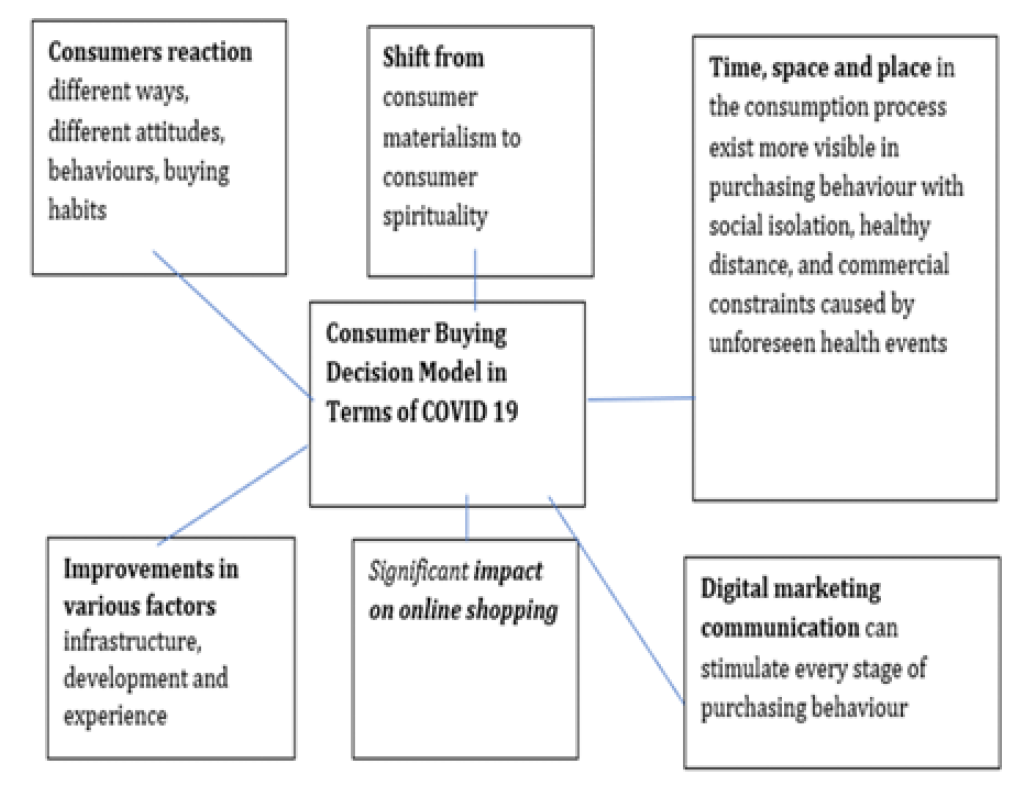
The COVID-19 pandemic has changed in the world as we know it. Consumers buy differently in pandemic conditions and think in many ways differently. Retailers are closing doors. Consumers around the world are looking at products and brands through a new lens. Once new habits are formed, it will permanently endure and change what we value after this crisis; how and where we shop; and how we live and work. Consumers are very concerned about COVID-19 from an economic perspective. Consumers react in different ways and different attitudes, behaviours, and buying habits.
Tyagi and Pabalkar [12] mentioned that not surprisingly, more and more customers have turned to the online store to buy the goods they need and want, because many brick-and-mortar stores have so far closed their doors and shoppers have a tendency to reduce the risk of staying in their home in COVID-19 pandemic. In shopping customer behaviour, after the travel industry is facing rapid and significant changes local movement restrictions and restrictions due to widespread health problems. The last two years have seen a consistent acceptance of shoppers in online shopping. A pervasive change in consumer behaviour is observed as a result of improvements in various factors infrastructure, development and experience. A big change is also noticeable consumer shopping methods after the COVID-19 pandemic. The growth of the Internet shopping will remain constant even after a pandemic as a new routine. This becomes important so that brands can create new opportunities in the online marketplace to ensure a positive experience consumers and reach the digital angle. This can be achieved by passing them on valuable suggestions otherwise to learn how to handle the end of a digital operation. In shopping behaviour of customers, rapid and great changes are faced by the industries after the travel restrictions and limitation of local movement because of the widespread of health concerns. In the last 2 years, a consistent increase has been observed in the buyer adoption of online shopping.
Akter and Sultana [13] stated that the impact of digital shopping through the COVID-19 situation in Bangladesh is creating a lot of customers as they stay at home using products specifically related to branded cosmetics. Most customers in Bangladesh order branded cosmetics (COVID-19) online in Bangladesh. Primary data were collected from Dhaka (the capital of Bangladesh) online using a convenient sample, and the sample size was 665. Research shows that during this pandemic, digital communication channels such as Websites, social media were used / tracked via smartphones or computers, and in Bangladesh, branded cosmetics were purchased specifically in Dhaka. The identification of needs and post-purchase behaviour were greatly affected in the purchasing decision process. The results show that digital marketing communication can stimulate every stage of purchasing behaviour by actively participating in the purchase of branded cosmetics. This study also showed that customers feel positive about digital platforms during this pandemic (COVID-19). Figure 2 show Suggested consumer buying decision model in terms of COVID 19.
Figure 2: Suggested Consumer Buying Decision Model in Terms of COVID 19
CONCLUSION
The paper presents a consumer purchasing decision model based on COVID 19 based on the scientific literature. It is very important to understand the consumer purchasing decision model in terms of COVID 19 terms components such as: consumers reaction: different ways, different attitudes, behaviours, buying.
REFERENCE
Šarkutė, L. “Sprendimų priėmimo samprata ir tyrimų tradicijos.” Sociologija. Mintis ir Veiksmas, 2009, pp.105-119.
Stankevich, A. “Explaining the consumer decision-making process: critical literature review.” Journal of International Business Research and Marketing, vol.2, no.6, 2017, pp.7-14.
Younus, S. et al. “Identifying the factors affecting customer purchase intention.” Global Journal of Management and Business Research: Administration and Management, vol.15, no.2, 2015.
Blackwell, R.D. et al.Consumer Behavior. The Dryden Press, 2001.
Madhavan, M. and K. Chandrasekar. “Consumer buying behavior—an overview of theory and models.” St. Theresa Journal of Humanities and Social Sciences, vol.1, no.1, 2015, pp.74-112.
Xu, B. and J. Chen. “Consumer purchase decision-making process based on the traditional clothing shopping form.” Journal of Fashion Technology & Textile Engineering, vol.5, no.3, 2017.
Yadav, R. “Consumer behaviour and its model.” International Journal of Science Technology and Management, vol.4, no.1, 2015, pp.670-677.
Sheth, J.N. et al. “Why we buy what we buy: A theory of consumption values.” Journal of Business Research, vol.22, no.2, 1991, pp.159-170.
Anderson, W.T. and L.L. Golden. “Lifestyle and psychographics: a critical review and recommendation.” Advances in Consumer Research, 1984, pp.405-411.
Jisana, T.K. “Consumer behaviour models: An overview.” Sai Om Journal of Commerce & Management, vol.1, no.5, 2014, pp.34-43.
Kačerauskas, E. “Pandemija stipriai pakeitė lietuvių apsipirkimą: Prie šių naujovių jau turėsime priprasti.” Delfi, 2021, https://www.delfi.lt/mokslas/login/pandemija-stipriai-pakeite-lietuviu-apsipirkima-prie-siu-naujoviu-jau-turesime-priprasti.d?id=87167631.
Tyagi, P. and V. Pabalkar. “Impact of COVID-19 over purchasing behaviour of the consumers.” European Journal of Molecular & Clinical Medicine, vol.8, no.2, 2021, pp.561-571.
Akter, M. and N. Sultana. “Digital marketing communication and consumer buying decision process in pandemic standpoint (COVID-19): An empirical study of Bangladeshi customers in branded cosmetics perspective.” 2020.
Recommended Articles
Research Article
Developing Social Media Marketing Visual Contents to Increase Engagement Rate (A Case Study of Healthy Tails Animal Clinic in Malang City)
Aditya Nirwana,
...
Felicia Joscelind Verrel
Published: 20/11/2022
Download PDF
Research Article
Longitudinal Research into the History of Debts
Kathleen Okafor
Published: 20/03/2022
Download PDF
Research Article
Responsibility Accounting in Food Enterprises – A Case Study at Kinh do Holdings Company Limited
Thi Ngoc Lan,
...
Ta Thi Thuy Hang
Published: 08/07/2023
Download PDF
Research Article
The Determinants of the Financial Behaviour of SMEs: Empirical Evidence from an Emerging Economy
Santiago Hernandez,
...
Remo Roscigno
Published: 20/03/2022
Download PDF
PO Box 101, Nakuru
Kenya.
Email: office@iarconsortium.org
Editorial Office:
J.L Bhavan, Near Radison Blu Hotel,
Jalukbari, Guwahati-India



 Download PDF
 Download XML