The Role of Strategic Awareness in Organizational Integrity: An Analytical Study of the Opinions of a Sample of Employees at the Al-Anbar Technical Institute
Aqeel Ibrahim Ali Al-hamadani
1
,
Oday Awad Mahdi
2
1
Assistant Lecturer, University of Fallujah, College of Administration and Economics, Iraq
The research aimed to measure the role of strategic awareness in organizational integrity at the Al-Anbar Technical Institute. To achieve this objective, a set of hypotheses was adopted, addressing the relationships of correlation and influence between the research variables. The current study relied on the descriptive-analytical method to present and discuss the data, as this method combines describing the situation with analysing it and deriving the corresponding results. For the purpose of collecting the required data to solve the research problem, a questionnaire was used and distributed to a sample of (100) employees working in the investigated field. Through the application of a set of statistical methods, the data of the practical aspect were analysed, which included the analysis of the responses and opinions of the surveyed individuals, in addition to testing the research hypotheses. The study reached several findings, the most important of which is the existence of correlation and influence relationships between strategic awareness and organizational integrity.
Keywords
Strategic Awareness
Organizational Integrity
Al-Anbar Technical Institute
INTRODUCTION
Organizational integrity is a vital topic in administrative thought and literature, emerging as a result of the ethical and financial collapse witnessed by most business organizations across various organizational fields, whether at the individual or collective level. Studies and research addressing the concept of organizational integrity have confirmed that it represents a revival of ethics and administrative behaviour founded on virtue and human values. The subject of organizational integrity has attracted the attention of researchers and practitioners in recent years due to the ethical breakdowns experienced by many organizations, which has driven them to focus on reinforcing positive and virtuous values and principles within the workplace.
The foundations and principles of organizational integrity emphasize reviving the ethical traditions of Islam and other divine religions, all of which have urged adherence to principles of integrity and the dissemination of virtue-based behaviours that extend to social relations, with the aim of achieving positive outcomes and benefits for organizations. Strategic awareness is considered one of the contemporary strategic concepts, given its significant role in helping organizations understand their internal and external environments in order to identify and exploit opportunities, avoid threats posed by external environmental factors and mitigate their negative effects. This is particularly crucial within the competitive environment in which organizations operate, ensuring their sustainability and achieving competitive advantage.
MATERIALS AND METHODS
Research Problem
Business organizations seek to achieve multiple objectives within their external environment, among them success, growth and adaptation. These objectives cannot be achieved unless work practices within the internal environment are characterized by acceptance, justice and integrity. When the process of evaluating the performance of individuals working in the organization lacks objectivity and is unjust, the prospects for achieving organizational integrity become relatively weak. Accordingly, the study examines the extent to which performance evaluation results can be utilized to achieve organizational integrity in its five dimensions: integrity, trust, tolerance, empathy and optimism. The main research problem is to answer the following question: What is the effect of strategic awareness on organizational rectitude at Al‑Anbar Technical Institute? The following sub-questions derive from it:
What is the level of the respondents’ perception of strategic awareness and which of its dimensions are more recognized and applied
What is the level of the respondents’ perception of organizational rectitude and which of its dimensions are more recognized and applied
What is the nature of the correlation between strategic awareness and organizational rectitude according to the perspective of the surveyed sample in the field
What is the effect of strategic awareness on organizational rectitude according to the perspective of the surveyed sample in the field
Research Objectives
To identify the status of strategic awareness and organizational rectitude in the field under study
To determine the nature of the correlation between strategic awareness and organizational rectitude in the field under study
To determine the extent of the effect of strategic awareness on organizational rectitude in the field under study
To provide the field under study with a set of recommendations that may develop strategic awareness among its leaders and thereby contribute to strengthening organizational rectitude
Hypothetical Research Model
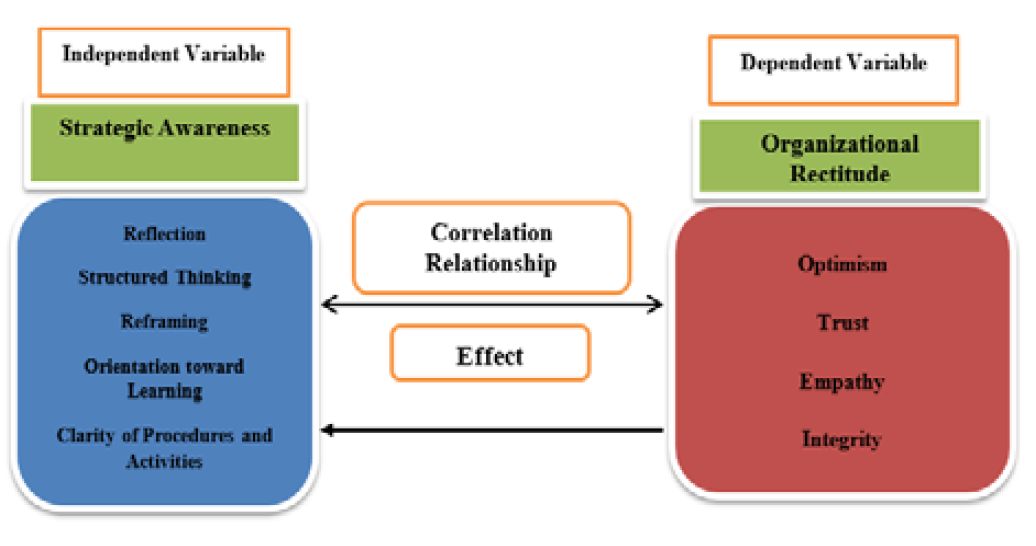
To specify and clarify the research hypotheses, it is necessary to construct a hypothetical model that illustrates the causal and correlational relationships between the study’s main and sub-variables. To understand the research model, the following can be noted:
The independent variable is strategic awareness and its dimensions: reframing, reflection, structured thinking and a learning orientation; this was adopted from the study by Al‑Kinani and Shalaka
The dependent variable is organizational rectitude and its dimensions (optimism, trust, empathy, integrity, tolerance); this was adopted from the study by Al‑Saadi and Al‑Mujahid
Research Hypotheses
Based on the research problem and objectives and with the aid of the hypothetical diagram, the hypotheses were formulated as follows:
Primary Hypothesis One
There is a correlational relationship between strategic awareness and organizational integrity; from this we derive the following sub-hypotheses:
There is a statistically significant correlational relationship between strategic awareness and optimism
There is a statistically significant correlational relationship between strategic awareness and trust
There is a statistically significant correlational relationship between strategic awareness and empathy
There is a statistically significant correlational relationship between strategic awareness and integrity
Primary Hypothesis Two
Strategic awareness has a statistically significant effect on organizational integrity; from this we derive the following sub-hypotheses:
Strategic awareness has a statistically significant effect on optimism
Strategic awareness has a statistically significant effect on trust
Strategic awareness has a statistically significant effect on empathy
Strategic awareness has a statistically significant effect on integrity
Figure 1: Hypothetical Study Diagram is an Academic English Translation of the Provided Arabic text, With No Additions
Research Boundaries
Subject-matter boundaries: The subject-matter scope of the study was limited to examining the variables of organizational integrity and strategic awareness
Spatial boundaries: The study was applied at the Al-Anbar Technical Institute within the limits of Al-Anbar Governorate
Temporal boundaries: The temporal scope of the study covered the period from 01/01/2025 to 10/05/2025
Human boundaries: The study sample included (100) individuals from faculty members and staff in the researched field
Research Method
The analytical descriptive method was used, which is based on describing the phenomenon, analysing it and then interpreting it, based on the data collected.
Methods of Data Collection and Information Analysis
Theoretical Aspect: Numerous Arabic and foreign academic sources were used, including books and journals, in addition to using the World Wide Web (Internet).
Field Aspect
The questionnaire form constituted the primary source relied upon by the researcher to obtain empirical data. It included (44) items distributed across three main sections. The first section concerned demographic information (gender, age, qualification, years of experience). The second section included the independent variable of the study (strategic awareness), which comprised (20) items divided into four dimensions: reflection, systems thinking, reframing and learning orientation, with (5) items for each dimension. The dependent variable of the study (organizational integrity) also comprised (20) items divided into four dimensions: optimism, trust, empathy and integrity, with (5) items for each dimension. To obtain data and information covering the empirical aspect, the following methods and sources were used:
Frequency distribution and percentages: To describe respondents’ answers
Arithmetic means: To determine the trends of responses within the specified scale
Standard deviations: To determine the extent of dispersion of responses around their mean
Pearson correlation coefficient: To indicate the type of correlation between the study variables
Simple linear regression: To measure the effect of the independent variable on the dependent variables
Theoretical Framework
Concept of Strategic Awareness: The literature contains numerous definitions of strategic awareness: some define it as an “ability,” which therefore requires managerial leadership; others define it as a “way of perceiving,” which necessitates broadening the awareness of those leaders; still others describe it as a set of activities, an understanding of strategies, or a “skill” that requires appropriate mechanisms for its development and utilization. The term “strategic awareness” emerged in the 1980s and evolved into a high‑level managerial concept that considers all members of the organization as well as the role of external and internal factors [1]. The literature shows that some researchers link strategic awareness with strategic intent; it has been stated that strategic awareness reflects the overall strategic intent regarding mission, purpose, objectives, core processes, system and organizational culture that facilitate the achievement of goals [2]. Strategic awareness is the decision‑maker’s ability to comprehensively understand all aspects of the organization and its external environment; this includes the ability to avoid risks, seize opportunities and possess knowledge and experience concerning the internal environment and the organization’s human resources [3]. Strategic awareness is closely related to environmental factors. Kazem et al. [4], described strategic awareness as the degree of openness and systematic understanding of the environment, awareness of prevailing conditions and comprehension of how to compete dynamically to meet requirements [4].
Importance of Strategic Awareness
Before addressing the concept of strategic awareness, it should be noted that strategic awareness overlaps with other concepts such as strategic thinking, strategic management and strategic planning. Strategic thinking represents the first step in the strategic management process for achieving strategic awareness.
Faisal [5], argues that the importance of strategic awareness lies in individuals’ awareness of the need to consider others, as well as in analysing their performance levels and ideas through a concise and robust measure of cognitive capacity and uncovering beliefs in terms of intuition and cognitive ability, which are the basis of the thinking process and explain individuals’ behaviours; only those with high cognitive capacity determine their choices in constructing beliefs related to cognitive skills.
The importance of strategic awareness is further clarified by various researchers as follows:
Strategic awareness helps identify blind spots in strategic mindsets; blind spots are areas in which the leader lacks understanding or impartiality in their field of work [6]
Strategic awareness distinguishes successful leaders from less successful ones who operate in the same environment with similar context and strategic thinking [7]
The ability to think and possess strategic awareness is important for managing rapid environmental change. Strategic awareness enables employees to use a wide range of information and perceive things in a broader context
The greater the strategic awareness among subordinates, the higher the likelihood of completing projects and achieving pre‑set objectives
Strategic awareness acts as a link between the vision and intuition of the decision‑maker
Strategic awareness serves as a bridge when there are gaps in organizational planning, allowing the decision‑maker to verify the consistency and validity of the decision taken
It enables organization members to know the organization’s current status and where the organization aspires to be in the future, which is reflected in employee performance and attitudes toward the organization [8]
Dimensions of Strategic Awareness
The present study relies on the dimensions identified by Turkay et al. because most studies and research have adopted them and because they are comprehensive and suitable for the nature of the current field. The dimensions can be described as follows:
Reflection
Reflection includes the ability to assemble logical and rational thought and to utilize perceptions, experiences and information to evaluate past events and formulate intuitive principles to guide future actions [9]. Schneider [10], indicated that reflection is a cognitive strategy that helps learners whether individuals or organizations to think about experiences, actions and decisions taken. Reflection is a systematic process of active understanding rather than mere thinking: it creates a deeper comprehension of relationships and connections through ideas and experiences. Halis et al. [8], affirmed that reflection is an organized and active activity aimed at finding meaning, not merely thinking about something. It produces a deeper understanding of the relationships and linkages between experiences and ideas. Creativity, innovation and a future-oriented vision are fundamental factors that determine strategic thinking.
Systems Thinking
Systems thinking is a way of viewing the world not as separate parts but as a system of relationships. It focuses on the relationships and interactions among parts and subsystems. Systems thinking helps manage complexity, deal with reality and interpret what we encounter. It shows that if we want to strengthen a system, we need to create stronger relationships; in other words, to improve a system’s condition we need to connect it to itself. Systems thinking is based on higher-order thinking and does not operate at lower levels of thought; it requires a broad vision [11]. Arnold and Wade [12], explained that systems thinking is a set of analytical skills that work together to improve the ability to identify and understand systems, predict their behaviour and modify them to produce desired effects. These skills operate together as a single system. Clarifying the concept of systems thinking will support many current implementation efforts where systems thinking is applied across scientific disciplines and practical fields. Systems thinking draws on general systems theory and has been applied to a wide range of domains and disciplines. It is powerful for solving complex problems that cannot be addressed by traditional reductionist thinking. It can be used to interpret nonlinear dynamic behaviours such as market reactions to new product introductions or predator–prey relationships [13], to understand complex socio‑economic problems such as the effects of marijuana legislation and to explain seemingly irrational behaviours of individuals, states and organizations such as provocative actions [14].
Reframing
Reframing in organizations operates at three levels within the organizational structure: the micro, the meso and the institutional or macro level. These levels are closely linked to the cognitive frames within the organization. The micro level focuses on individual managerial awareness and decision‑making in organizations. The meso level investigates how individuals and groups are constructed and how they interact. Finally, the institutional macro level analyses and discusses the concept of cognitive frames across a variety of organizational contexts and in the identification and establishment of new strategic and organizational plans [15]. Systems thinking is a set of analytical skills that work together to enhance the ability to identify systems, understand and predict their behaviour and make adjustments to achieve desired effects [12]. Reframing is a mode of thinking intended to provide a comprehensive, rather than partial, view of the nature of the system, using an individual’s thinking and analytical skills to identify strengths in relationships among system parts and to detect present and future complex problems.
Learning Orientation
Hakala [16], describes learning orientation as an organization‑level activity aimed at creating and employing knowledge to strengthen competitive advantage. This includes acquiring information about customer needs and sharing it, monitoring market changes and competitors’ actions and developing new technologies to create services and products superior to those offered by competitors. Similarly, Calantone et al. [17], indicate that learning orientation is closely linked to organizational innovation. Innovation involves creating, accepting and implementing new ideas, processes, products, or services. Many researchers emphasize the importance of this orientation for enhancing innovative capacity. Learning largely occurs through the organization’s interaction with and observation of its environment. Regarding innovation, environmental factors such as uncertainty about customer demand, technological disruption and competitive uncertainty are important.
Concept of Organizational Integrity
The first to refer to organizational integrity was Kim Cameron, with the earliest references appearing in 2003 when he noted that organizational integrity is one of the important concepts in positive psychology and can be incorporated into individual activities, teamwork, cultural characteristics and organizational processes [18]. Integrity can be defined as the ideas and actions of employees that serve the interests of the organization. “Organizational integrity includes the following: employee behaviours at the individual and group levels, the characteristics of organizational culture and the processes that enable the dissemination and preservation of integrity and virtue throughout the organization.” Integrity in organizations refers to the noble and elevated behaviour of organization members [19]. Organizational integrity refers to the ideal state of excellence in the characteristics of human resources or organizational attributes. Accordingly, organizational integrity can be defined as creating, encouraging, protecting and nurturing behaviours, habits, practices and various aspects of sublime traits such as humanity, honesty, tolerance, trust and loyalty at both the individual and collective levels across the organization [20]. In the management literature, the term organizational integrity is closely and logically associated with organizational behaviour as well as with concepts of excellence, strength, commitment, belonging and organizational innovation [21]. Integrity comprises internal processes, desires and human beliefs that are directed and managed toward creating a positive impact on others through human interactions. These internal processes may be initiated by the individual or activated as positive activities and factors affecting others within organizations [22]. Organizational integrity is the altruistic and generous behaviour displayed by organization members, manifested in individual actions and collective organizational behaviour. People help one another without expecting reciprocity; relationships may include mutual exchange, rewards and recognition [23].
Importance of Organizational Integrity
The importance of organizational integrity is evident in the positive factors it provides as a significant opportunity for leaders to enhance their organizations’ performance; organizations that possess organizational integrity substantially outperform others [24]. Organizational integrity also contributes to achieving positive outcomes and enables organizations to grow and sustain themselves, in addition to motivating contextual performance [18]. Organizations characterized by integrity contribute to corporate social responsibility programs by adopting and implementing environmentally friendly strategies [25]. Researchers have found that organizational integrity is associated with increased innovation, higher customer retention, reduced employee turnover, improved quality and increased profitability [26]. Al‑Sarraf [27], indicated that organizational integrity contributes to building an internal strength characterized by wisdom and rationality that helps elevate decision quality, enhances positive performance and fosters a higher level of employee innovation, ultimately achieving strategic excellence. Bright et al. [28], compared organizational integrity, integrity within organizations and integrity through organizations. They note that integrity within organizations relates to individual behaviour in organizational environments that help people flourish as human beings, whereas integrity through organizations pertains to the factors that enable organizations to promote and sustain integrity.
Dimensions of Organizational Integrity
The present study relies on the dimensions identified by Cameron and Bright because most studies and research have adopted them and because they are comprehensive and suitable for the nature of the current field. The dimensions can be described as follows:
Optimism
Smith et al. [29] indicate that optimism is an explanatory style that increases the likelihood of success in many domains because it leads to greater determination and resilience. It means that members of the organization develop an organizational belief and succeed in doing good work even when facing significant challenges. The literature has emphasized optimism through the fact that positive relationships in the workplace can generate optimism among individuals; it has been identified as a fundamental element and source of growth, vitality, learning and a condition that leads to individual and collective flourishing [30].
Trust
Al-Khafaji asserts that trust is the fundamental factor in determining the effectiveness of building personal relationships and the freedom to express oneself honestly; its absence leads to the deterioration of personal relationships. "Organizational trust" refers to the overall climate of trust within the organization, manifested in employees’ positive expectations about the intentions and behaviours of many organizational members based on organizational roles, relationships and experiences. It also denotes the prevailing belief that the organization is competent, open and honest and that its goals, rules and values are aligned with the values and objectives of its employees. Al-Hardan [31], views organizational trust as an individual’s pride in the goals and policies of the organization where they work, which increases their affection, loyalty and sense of belonging to it and to their colleagues.
Integrity
The concept of organizational integrity has been linked to ethical values and the integration of values and integrity has empowered organizations that adopt this philosophy [32].
Boudrias et al. state that the perception of organizational integrity refers to the extent to which organizational representatives adhere to values or ethically accepted practices and work to sustain thempractices perceived as normative within the organizationmeaning that positive employee behaviours are treated fairly and respectfully, while unethical behaviours are sanctioned by the organization.
Kahveci et al. also noted that it refers to consistency with principles, values, procedures and methods; that is, alignment with the founding values.
Forgiveness
Araybi and Saeed added that forgiveness represents the willingness to forgo negative judgment, the right to resentment and indifferent behaviour toward those who have wronged and caused harm, while fostering empathy and benevolence toward them. In organizations, it is considered part of the error‑reduction process positive social transformative process that affects both parties’ lives with positive thoughts and feelings. It has been defined as “an internal process requiring personal courage that leads to the cognitive, emotional and behavioural healing of the painful event within the workplace”.
Practical Aspect
Description of the Survey Sample: Questionnaires were distributed to a sample consisting of 100 employees. The survey collected responses from a sample drawn from the Al‑Anbar Technical Institute. The personal information gathered included gender, age, academic qualification and number of years of experience as shown in Table 1.
Table 1: Description of the Surveyed Individuals
(%)
Number
Categories
Description
85%
85
Male
Gender
49%
49
Female
15%
15
Less than 25
Age
41%
41
25–35 years
52%
52
36–45 years
26%
26
More than 45
35%
35
Bachelor’s
Academic Qualification
30%
30
Diploma
25%
25
Master’s
10%
10
Doctorate
50%
50
Less than 5 years
Years of Experience
34%
34
5 to 10 years
50%
50
More than 10 years
Gender
Males accounted for 85%, while females accounted for 49% of the surveyed sample.
Age
It is observed that the age group under 25 years obtained 15%, the age group 25–35 years obtained 41%, the age group 36–45 years obtained 52% and finally the age group over 45 years obtained 26% of the surveyed sample.
Qualification
It is observed that the category of bachelor’s degree and below obtained 35%, the diploma category obtained 30%, the master’s category obtained 25% and finally the doctoral category obtained 10% of the surveyed sample.
Years of Experience
It is observed that years of experience less than 5 years obtained 50%, years of experience from 5 to 10 years obtained 34% and years of experience more than 10 years obtained 50% of the surveyed sample.
Statistical Description of the Study Variables
In this section, the study variables will be described and diagnosed by calculating response rates, the overall mean, frequency distributions, arithmetic means and standard deviations for the strategic awareness variable and the organizational integrity variable, as shown in Table 2.
Table 2: Overall Mean, Frequency Distributions, Arithmetic Means, Standard Deviations, Coefficient of Variation and Response Rates for The Studied Variables
Items
Response Scale
Arithmetic Mean
Standard Deviation
Relative Importance %
Item Ranking
Strongly Agree (5)
Agree (4)
Neutral (3)
Disagree (2)
Strongly Disagree (1)
number
%
number
%
number
%
number
%
number
%
Strategic Awareness
37
37
33
33
15
15
5
5
10
10
4.30
0.841
80.052
1
Organizational Integrity
34
34
26
26
20
20
10
10
10
10
3.78
0.817
79.612
2
The Table 2 show that the strategic awareness variable has a mean of 4.30 with a standard deviation of 0.84. The organizational integrity variable has a mean of 3.78 with a standard deviation of 0.81.
Testing the Study Hypotheses
In this section the study hypotheses will be tested as follows:
Correlation Hypothesis
Main Hypothesis One: There is a statistically significant correlation (a<=0.05) between strategic awareness and organizational integrity
Sub-hypotheses: There is a correlation between the individual dimensions of strategic awareness (reflection, systems thinking, reframing, learning orientation) and organizational integrity (optimism, trust, integrity, forgiveness)
From Table 3, it is observed that the correlation coefficient between the strategic awareness variable and the organizational integrity variable was positive, indicating that the relationship between the two variables was direct. It is also noted that the value of the correlation coefficient was (0.57) and this coefficient was statistically significant as indicated by p (0.003), which is less than 0.05. In addition, both the lower and upper bounds of the 95% confidence interval (Lower, Upper), which were (0.676, 0.841) respectively, showed similar signs at the significance level (0.05). This leads to accepting the main hypothesis, which states that there is a significant correlation between the strategic awareness variable and the organizational integrity variable. At the level of the sub-hypotheses, all results were positive and thus all sub-hypotheses are accepted.
Table 3: Correlation Between the Strategic Awareness Variable and The Organizational Integrity Variable
95% Confidence Interval
p-value
Correlation Coefficient
Second Variable
Direction of Relationship
First Variable
Upper
Lower
0.841
0.676
0.003
0.57
Organizational Integrity
↔
Strategic Awareness
0.587
0.547
0.000
0.44
Organizational Integrity
Reflection
0.964
0.412
0.000
0.35
Organizational Integrity
Structured Thinking
0.752
0.549
0.000
0.47
Organizational Integrity
Reframing
0.854
0.621
0.001
0.29
Organizational Integrity
Learning Orientation
Effect Hypothesis
Main Hypothesis Two: There is a statistically significant effect of strategic awareness on organizational integrity
Sub-hypotheses: There is a statistically significant effect of the individual dimensions of strategic aware-ness (reflection, systems thinking, reframing, learning orientation) on organizational integrity
Table 4: Results of the Significant Effect of the Strategic Awareness Variable On the Organizational Integrity Variable
Independent variable
Direction of Effect
Dependent Variable
Regression Coefficient Estimate (β)
Standard Error of Regression Coefficient (S.E.(β))
p-value
95% Confidence Interval
Lower
Upper
Strategic awareness
→
Organizational Integrity
0.681
0.247
0.003
0.560
1.540
Reflection
→
Organizational Integrity
0.321
0.312
0.000
0.478
1.321
Systems thinking
→
Organizational Integrity
0.254
0.214
0.002
0.397
1.245
Reframing
→
Organizational Integrity
0.211
0.378
0.001
0.425
1.124
Learning orientation
→
Organizational Integrity
0.421
0.411
0.000
0.324
1.247
From Table 4, which shows the estimated parameter associated with the strategic awareness variable, the value reached 0.681, indicating that this relationship is positive, as reflected by the positive sign of this estimated parameter. The standard error (S.E.) was 0.247 and the effect of strategic awareness on organizational integrity was statistically significant because the p-value 0.003 obtained for this relationship was less than 0.05. In addition, the confidence interval 95% Confidence Interval appeared with similar signs represented by the lower and upper bounds 1.540, 0.560, respectively. Thus, according to the above results, a decision can be reached to accept the hypothesis that there is an effect of the strategic awareness variable on the organizational integrity variable; this effect is positive and statistically significant at the significance level 0.05>α. At the level of the sub-hypotheses, all results were positive and thus all sub-hypotheses are accepted.
CONCLUSION
The results of the descriptive analysis revealed that the sampled individuals agreed on the presence of the dimensions of strategic awareness in the studied field, which indicates that the respondents possess a high level of strategic awareness and understand its requirements in the current developmental context
There is a correlation between strategic awareness and organizational integrity, which indicates that the greater the level of strategic awareness, the stronger the organizational integrity
The dimension of reframing showed the strongest correlation with organizational integrity, indicating that the more the institute’s management attends to reframing, the more organizational integrity is realized at the institute level
Regression results indicated a significant effect of strategic awareness on organizational integrity, suggesting that if the institute’s management wishes to achieve organizational integrity, it must provide and maintain all dimensions of strategic awareness
The learning orientation dimension was found to be among the most influential dimensions affecting organizational integrity, indicating that emphasis on this dimension contributes to advancements in organizational integrity within the studied institute
Recommendations
The institute’s management should continuously recruit individuals with high cognitive capacities by forming high-level committees composed of skilled and experienced personnel to select suitable candidates
The institute’s management must pay attention to strategic awareness due to its role in meeting the requirements of organizational integrity, making it part of the institute’s culture and promoting it across all institutional facets
The institute should organize regular meetings and provide training and development programs for leaders and staff to transfer knowledge and ideas in the fields of strategic awareness and organizational integrity
The institute should cultivate an organizational culture that supports organizational integrity by attending to lower-level administrations and empowering them in all decision-making processes
Attention should be given to talented and creative individuals by sponsoring them and meeting their creative needs, thereby facilitating the transformation of their innovative ideas into products that serve the educational process and the community
REFERENCES
Moreno, V.M. et al. “The role of strategic awareness in strategy formulation: A theoretical approach.” Journal of Baku Engineering University - Economics and Administration, vol. 8, no. 1, 2024, pp. 57-67.
Tugba, C. Strategic Awareness, Sector Analysis, the Basic Components of Strategy and the Relationships Between Performance: A Qualitative Analysis. Master’s thesis, Duzce University Institute of Social Sciences Division of Business Management, 2019.
Seifoori, Z. “Negotiated strategic awareness-raising at postgraduate level: Contributions to reading comprehension and content retention.” Iranian Journal of Language Teaching Research, vol. 8, no. 2, 2020, pp. 115–132.
Kazem, J.R. et al. “The effect of strategic awareness on creative performance: An analytical study of the opinions of faculty members at a university level.” South Asian Journal of Social Sciences and Humanities, vol. 3, no. 3, 2022, pp. 53–72.
Faisal, M.M. Entrepreneurial Marketing in the Context of Strategic Awareness. Master’s thesis, College of Administration and Economics, University of Baghdad, 2021.
Menon, A. “Bringing cognition into strategic interactions: Strategic mental models and open questions.” Strategic Management Journal, vol. 39, no. 1, 2018, pp. 168–192.
Pisapia, J. et al. “Developing the leader’s strategic mindset: establishing the measures.” Leadership Review, vol. 5, no. 1, 2005, pp. 41–68.
Halis, M. et al. “Institutional strategic consciousness and its reflections: research on qualified hotels in Istanbul.” Journal of Global Strategic Management, no. 8, 2010, pp. 160–170.
Pisapia, J. et al. “A comparison of the use of strategic thinking skills of aspiring school leaders in Hong Kong, Malaysia, Shanghai and the United States: An exploratory study.” International Education Studies, vol. 2, no. 2, 2009, pp. 46–58.
Schneider, D. Refection. 2002. https://edutechwiki. unige.ch/en/reflection
Martin, Philip Lerux and Vivienne O’Connor. Systemic Thinking for Peacebuilding and the Rule of Law. United States Institute of Peace, 2019. Peace Works Report No. 133.
Arnold, R.D. and J.P. Wade. “A definition of systems thinking: A systems approach.” Procedia Computer Science, vol. 44, 2015, pp. 669–678.
Cabrera, D. and L. Cabrera. “What is system’s thinking?” Learning, Design and Technology: An International Compendium of Theory, Research, Practice and Policy, Springer International Publishing, 2023, pp. 1495–1522.
Monat, J.P. and T.F. Gannon. “What is system’s thinking? A review of selected literature plus recommendations.” American Journal of Systems Science, vol. 4, no. 1, 2015, pp. 11–26.
Mukherjee, M. et al. “Scenarios research and cognitive reframing: Implications for strategy as practice.” Saïd Business School Working Paper, no. 7, 2016.
Hakala, H. “Strategic orientations in management literature: Three approaches to understanding the interaction between market, technology, entrepreneurial and learning orientations.” International Journal of Management Reviews, vol. 13, no. 2, 2011, pp. 199–217.
Calantone, R.J. et al. “Learning orientation, firm innovation capability and firm performance.” Industrial Marketing Management, vol. 31, no. 6, 2002, pp. 515–524.
Singh, Yajna and Joey Buitendach. “Psychological Capital, Subjective …” 2014.
Cameron, K. and A. Caza. “The amplifying and buffering effects of virtuousness in downsized organizations.” Journal of Business Ethics, vol. 64, 2006, pp. 249–258.
Ravaji, M. “The effect of organizational virtuousness and psychological capital role on employees’ creativity in tehran water and wastewater company.” Journal of Scientific Management and Development, vol. 4, no. 12, 2016, pp. 496–506.
Gukiina, J. et al. “Organizational virtuousness: The customers’ perspective.” International Journal on Customer Relations, vol. 5, no. 2, 2017, p. 18.
Tsachouridi, I. and I. Nikandrou. “The role of prosocial motives and social exchange in mediating the relationship between organizational virtuousness’ perceptions and employee outcomes.” Journal of Business Ethics, 2019, pp. 1–17.
Asad, H. et al. “Mediating effect of ethical climate between organizational virtuousness and job satisfaction.” Pakistan Journal of Commerce and Social Sciences (PJCSS), vol. 11, no. 1, 2017, pp. 35–48.
Ziapour, A. et al. “The relationship between organizational virtuousness and employee engagement.” International Research Journal of Applied and Basic Sciences, vol. 9, no. 8, 2015, pp. 1442–1447.
Shimek, Michael et al. “Approaching virtuousness through organizational ethical quality: Toward a moral corporate social responsibility.” Business Ethics: A European Review, vol. 24, no. 2, 2015, pp. 144–155.
Schuyler, K.G. “The possibility of healthy organizations: Toward a new framework for organizational theory and practice.” Journal of Applied Sociology, no. 2, 2004, pp. 57–70.
Al-Sarrafah, S.N.H. Employing Employee Performance Evaluation Results in Achieving Organizational Integrity: A Field Study at the Technical Institute of Mosul. Master’s thesis, 2019.
Bright, D.S. et al. “The amplifying and buffering effects of virtuousness in downsized organizations.” Journal of Business Ethics, vol. 64, no. 3, 2006, pp. 249–269.
Sadler-Smith, Eugene. “Toward organizational environmental virtuousness.” Journal of Applied Behavioural Science, vol. 49, no. 1, 2013, pp. 123–148.
Ragins, B.R. and J.E. Dutton. “Positive relationships at work: an introduction and invitation.” Exploring Positive Relationships at Work: Building a Theoretical and Research Foundation, Lawrence Erlbaum Associates, 2007, pp. 3–25.
Al-Hardan, N.F.R. The Emotional Intelligence Level of Public Secondary School Principals and Its Relationship to Teachers’ Organizational Trust from Their Perspective. Unpublished master’s thesis, Middle East University, Department of Educational Administration and Curricula, College of Educational Sciences, 2017.
Polowczyk, P.Ł. “Organizational ethical integrity: good and bad illusions.” Palgrave Communications, vol. 3, no. 1, 2017, pp. 1–11.
Recommended Articles
Research Article
Agentic AI in Information Systems: Toward Autonomous Decision-Making in Organizations
Duoha Suhail Najm
Published: 30/07/2026
Download PDF
Research Article
Developing Social Media Marketing Visual Contents to Increase Engagement Rate (A Case Study of Healthy Tails Animal Clinic in Malang City)
Aditya Nirwana,
...
Felicia Joscelind Verrel
Published: 20/11/2022
Download PDF
Research Article
A Comparative Study of Online Fashion Promotion: Hennes & Mauritz (H&M) and Label in India
Riya Jamble
Published: 20/07/2021
Download PDF
Research Article
The Determinants of the Financial Behaviour of SMEs: Empirical Evidence from an Emerging Economy
Santiago Hernandez,
...
Remo Roscigno
Published: 20/03/2022
Download PDF
PO Box 101, Nakuru
Kenya.
Email: office@iarconsortium.org
Editorial Office:
J.L Bhavan, Near Radison Blu Hotel,
Jalukbari, Guwahati-India
Ibrahim Ali Al-hamadani, A. & Awad Mahdi, O. (2025). The Role of Strategic Awareness in Organizational Integrity: An Analytical Study of the Opinions of a Sample of Employees at the Al-Anbar Technical Institute. IAR Journal of Business Management, 6(2), 1-8.
MLA
Ibrahim Ali Al-hamadani, Aqeel and Oday Awad Mahdi. "The Role of Strategic Awareness in Organizational Integrity: An Analytical Study of the Opinions of a Sample of Employees at the Al-Anbar Technical Institute." IAR Journal of Business Management 6.2 (2025): 1-8.
Chicago
Ibrahim Ali Al-hamadani, Aqeel and Oday Awad Mahdi. "The Role of Strategic Awareness in Organizational Integrity: An Analytical Study of the Opinions of a Sample of Employees at the Al-Anbar Technical Institute." IAR Journal of Business Management 6, no. 2 (2025): 1-8.
Harvard
Ibrahim Ali Al-hamadani, A. and Awad Mahdi, O. (2025) 'The Role of Strategic Awareness in Organizational Integrity: An Analytical Study of the Opinions of a Sample of Employees at the Al-Anbar Technical Institute' IAR Journal of Business Management 6(2), pp. 1-8.
Vancouver
Ibrahim Ali Al-hamadani A, Awad Mahdi O. The Role of Strategic Awareness in Organizational Integrity: An Analytical Study of the Opinions of a Sample of Employees at the Al-Anbar Technical Institute. IAR Journal of Business Management. 2025 Jul;6(2):1-8.


 Download PDF
 Download XML