The use of electronic devices and internet facilities has become greatly unavoidable, this can be seen from people in accessing the internet for online business transactions such as online trading, learning and shopping amongst others. The study examines the effect of cyber-loafing on employees’ productivity in the public service of Lagos state. A survey research design was used and data were collected by using instruments adopted from previous studies. Population of the study is 264 and a sample size of 250 was taken using Krajcie and Morgan sample size table. 189 staff of Lagos state public service was taken representing 75.6%. The study utilized regression analysis as data analytical method. Two hypotheses were formulated. The result established that there is significant negative effect of cyber-loafing on service delivery and worker’ assigned duties in selected MDAs of Lagos State public service. The study therefore recommended that government should pay more attention in improving employees’ productivity towards service delivery and assigned responsibilities by equipping and regulating its entirety staff with the information and communication technology.
Keywords
Cyber-loafing
Job Content
Service Delivery
Work-Related Activities
Productivity
INTRODUCTION
The use of the internet has increasingly become a necessity for human activities around the global working environment. Norms of electronic devices and internet facilities has become greatly unavoidable, this can be seen from people in accessing the internet for online business transactions such as online trading, learning and shopping amongst others. The activity of exploring various sites online is not a tiring thing to do because it is simply with a click of a mouse and a few touches of a finger on the smartphone screen. Indeed, in this rapid technological era, it inevitably shows that the internet is most often used to do businesses, chatting, modelling and surfing social media that individual who uses internet at work more than specified work hours engages in excessive cyber-loafing. Cyber-loafing is coined as Internet misuse at the workplace. It can be considered as aberrant workplace behaviour [1].
In Nigeria, internet usage became prominent after the Federal Government broke the monopoly of its telecommunication sector, launched the private individual to venture into the handling of the Country communication mobility in the year 2001. The reformation was geared towards reducing inability to have access to the global world and making the emerging internet business more innovative, stronger and reliable [2]. The telecommunication sector reform compelled Nigeria to be among the globalized economy since 2002. This has made business organizations strived for improved customer service delivery through technology adoption strategy. The attempt for improved customer’s service delivery could be traced to increasing demand for better services by the customers who would like to transact their businesses online at any time and at a convenient location [3]. With this, it is imperative to learn what cyber-loafing is, since it is a deliberate deed of employees in a common work place.
E-business is the focal point that recently enhanced organizations to thrive and have edge over its competitors in the global village. This is because organization workers are seriously under pressure against cyber-loafing thereby using the organization website for personal usage which might affect its effectiveness and efficiency in the discharge of sole responsibility to achieve its establishment purposes [4]. Cyber loafing is a type of production deviance of personal internet use in which organizations will to recognize and tolerate to a certain level whereas others developed organizational policies consisting various degree of disciplinary action.
Lim [5] provides a broad definition of cyber-loafing as employees’ voluntary use of company’s internet facility during official hours to surf non-job related for personal purposes, including checking personal e-mails. Blau and Kahn [6] classified cyber-loafing into three separate categories, namely; browsing-related, non-work-related email and interactive cyber-loafing. Mangkunegara [7] mentioned that an organization will not develop when its employees were not well coordinated against wastage and thus, her human resources will not have a sense of belonging and desire to advance the organization within themselves if not properly managed. Therefore, the management must pay adequate attention to job specification and content of its employees in order to achieve the organization predetermined targets. However, the purpose of this paper is to explore the cyber-loafing behaviour and its effect on employees’ productivity in selected agencies in Lagos State public service. In addition, this research will also investigate employees’ activities when they are cyber-loafing and analyze these activities to determine whether they are work-related.
The Problem
Nations across the world have witnessed success stories as a result of using improved technology for service delivery in organizations’, such as internet banking, shopping and trading (buying and selling) etc., Technologies like local area network (LAN), wider area network (WAN), and online web portal are essentials for such businesses. Moreover, the information filling system and client information filling (CIF) systems are now electronically done and being routinely used by many organizations to ensure efficient and effective operations [8]. Electronic business such as e-payment system is being noted as vital part of e-commerce, imperatively, the wider patronage of e-commerce is being said to pivot upon the availability of a guaranteed and trusted e-business system [9,10].
Many researchers have investigated the effect of cyber-loafing on service delivery [11]. The outcomes of their study have shown positive effects between cyber-loafing and employees’ productivity, while others in related research have given a negative report [12,13]. The findings seem inconclusive; because such study has not been carried out in the public sector hence, this study tends to empirically investigate effect of cyber-loafing on employees’ productivity in selected Ministry, Departments and Agencies of Lagos State public service. The Ministry of Science and Technology saddled with the responsibility of overseeing the usage of government internet facilities among the MDAs. Thus, the usage of the adoptive Ministry of Science and Technology apparatus for personal obligation over the years have been given mixed outcome, hence the need for this study.
To provide answer to the relevant questions highlighted above, the following hypotheses were formulated:
Cyber-deviance does not significantly influence service delivery of Lagos Sate public service
cyber-slacking has not significantly affected obligation of Lagos State public service workers
Literature and Conceptual Review
Cyber-loafing
Lim [5] defines cyber loafing as the act of employees using their organizations’ internet access for personal purposes during work hours this could include browsing non-job-related websites like social networking, sports, news and entertainment, checking and sending personal e-mails and other activities such as online shopping and online gaming. Cyber-loafing concept was described by terms such as “cyber-slacking” [14,15] “cyber deviance” [16], and “cyber-loafing” [5] “cyber-budging”. In developed economies such as Turkey, cyber-slacking and cyber-loafing equivalents were used [17].
Cyber-loafing is a personal decision to utilize work time in a non-productive manner and therefore can be considered as deviant workplace behaviour. Employee deviance is defined by Robinson and Bennett [18] as, voluntary behaviour that violates significant organizational norms and in so doing threatens the well-being of an organization, its members or both. Potential negative impacts of cyber-loafing include losses of intellectual property, sexual harassment law suits, security threats, and network bandwidth overload.
Jandaghi [19] stated that cyber-loafing impacts the organizations financially and it appears to happen when the workload on the employee is low, thus, system control and audit check of organization human resource alone cannot prevent cyber-loafing; managers must make policies to raise the awareness among employees of internet usage. Regina declared that employees’ cyber-loafing the organization’s internet can cost the organizations not to break-even rather accrued deficit. This translates to damages to employees’ productivity, problems in broadband, legal issues, and other associated costs and problems.
Blanchard and Henle [15] described cyber-loafing as use of e-mail and internet for non-work-related purposes. Ugrin, Pearson and Odom pronounced cyber-loafing as spending time on internet unproductively. Kalayci defined cyber-loafing in educational perspectives as tendencies or behaviours’ to use internet for things unrelated to studies during the class time. Yasar [20] stated that there are four different types of cyber-loafing activities. These are individual (shopping, travel, job search, carrier, online banking), social (social networking sites, discussion boards, instant messaging, e-mail), search (searching, pictures, video etc. on search engines) and news.
Ahmad and Omar [21] categorized cyber-loafing into two dimensions: Minor and serious. Minor is relating to the use of personal emails, i.e., viewing other sites that are not work-related. On the other hand, serious cyber-loafing behaviours’ are the use of unsecured sites that might damage the organization system. The researchers stated further that male employees engage in cyber-loafing than female employees and lack of self-control could play a factor in deviant behaviour.
Employee Productivity
Littere 1883 cited in Onuorah and Ugochukwu [22] defined employees’ productivity as knowledge and technology of production. It was stated further that employees’ Productivity is maximization of utilizing the resources, human force and schemes scientifically to decrease expenses and increase employees, managers and consumers' satisfaction.
In the organizational context, employee productivity is usually defined as the extent to which an organizational member contributes to achieving the set goals of the organization. Mathias and John defined employee productivity as a measure of the quantity and quality of work done, considering the cost of the resources used to carry out the task. McNamara stated that employee productivity is being determined by the final and specific outputs anticipated from the employee. Consequences of employees’ productivity are often expressed as products or services for an organization internal or external consistency. These may be in terms of financial accomplishments, impact on a service delivery whose results are expressed in terms of cost, quality, quantity or time [23].
Moreover, human force productivity is considered as appropriate maximized utilization of human force towards goals of the organization with the lowest time and minimum expense.
Job Obligation
Job obligation is the main duty or key performance expanse of workers in an organization. Cushway [24] defines job obligation as the state description of any particular assignment derived from job analysis. Employee duty is a clear and concise depiction of job duties [25]. Silverstein affirmed that job specification is both a hiring blueprint and performance management tools in an organization. Obligation can be referred to as factors controlled by the individual in work place such as requirement, commitment and responsibility
The distinct description between worker’s obligation and specification/ profile is a product of job analysis and statement of the employee’s skills, knowledge and other attributes needed for effective performance in the job.
Arthur [26] mentioned that obligation make it incumbent clear about the duties and responsibilities expected to perform by employees in organizations. However, major element of obligation differs from organizations but its basic functions are job identification, duties and responsibilities, delegation of attributes, working relationship and working condition of employees by the employer.
Service Delivery
Service delivery has been defined as the extent to which an organization meets or exceeds expectations of customers or beneficiaries. Every organization is made up of people and thus acquiring their services and skills to high levels of performances ensuring that they continue to maintain their commitment to the organization to achieve aimed goals [27]. Perceived service quality is derived from comparisons by customers, of expectations with what they perceive of service delivery by the suppliers [27].
The standard of service delivery in the public sector, no doubt; plays an increasingly significant role in a given economy. Nwekeaku & Obiora [28] stated that, delivering quality service in all sectors is considered as an essential strategy for success and survival in today’s global competitive and technological environment. Many organizations embark on improving customer satisfaction by getting the latest technology to improve their organization performance with the aim that acquisition of latest technology will improve operating practices and the quality and quantity of their goods and services [29]. Customers’ expectations, according to Bitner, Booms and Mohr [30], are their perceptions of service that serve as standards against which service performance is judged. The attempt for improved service delivery by organization employees could be traced to increasing demand for better services by the customers who would like to transact their businesses at any time and at a convenient location [3].
Cyber-Slacking
Cyber-slacking refers to employees’ use of work computers and other resources during work hours for non-work-related purposes. When an employee is cyber-slacking, they will be using the employer's devices, internet connection, or other resources for personal affairs and even entertainment. Employees’ cyber-slack by means of engaging employer's devices, internet connection, or and other resources for personal affairs and even entertainment. Cyber-slacking is also referred to as "cyber-loafing," and is an update of the term "goldbricking," which referred to employees who tried to look busy while doing less work than they were truly capable of Cyber-slacking is more rampant as internet-connected computers and devices are a necessity for the normal functioning of most of today’s businesses. As most businesses require the internet for communications and transaction, it becomes more difficult to differentiate between cyber-slacking and carrying out the tasks they are being remunerated on. In most cases, cyber-slackers are surfing the web rather than working.
Cyber-Deviance
Researchers in criminology, sociology, and management have recently focused on deviant behaviors with technology termed cyber deviance. This term refers to inappropriate or criminal behavior in a digital context. Weatherbee [31] stated that cyber-deviance is the misuse of technology and violation of the organizational norms regarding minimal quantity of production; it occurs when employees waste time using company resources.
Social media publicizes cyber-deviant behaviour, like doxing and cyber-smearing, by increasing an audience’s access to misinformation [32]. Problematic perpetration of anonymity and indiscriminate spread of misinformation across international borders were as a result of deviation information received through technology. The degree of publicity of the cyber-deviance, and viewers’ inclination to tune into the misinformation, increase the audience impacted by doxing and cyber-smearing. Perpetrators may also add inappropriate activity to a coworker’s Internet usage [32,33]. The outcomes of personal cyber-aggression for targets are also relevant for targets of cyber-deviance as many of these behaviors may fit adverse categories such as flaming, cyber-stalking. Shifting to broader considerations, subjective and social norms and the extent to which an employee can hide the behavior also contribute to cyber-deviance. An employee’s perceptions of supervisor and coworkers’ lack of support for cyber-loafing can deter employee’s computer misuse [34].
Work Related Activity
Work related activity refers to other task employees engaged upon that is in relation with assigned responsibility but not part of schedule of duty. Employees associated with an unsolicited activity explores opportunities through underline development and acknowledge opportunities to cyber engagements [13]. Derin & Guravsar [35] asserted that employees’ innovativeness to cyber-loaf has positive effect on work behaviour as lack of research attention to the role of personality is astonishing such that individuals’ dispositions significantly predict job attitudes over a time span. It was observed that cyber-loafing does not only depend on the psychological factors but also on the work environment and personal needs of the employees [36]. In managing the reality of constructive way of cyber-loafing, Yogun [2] examined the role cyber-loafing plays in inventive work behaviour of employees’, the result of the study concluded other related activities such as informative functions, social functions and leisure functions of an employee improves organization activities in given environment.
However, Banerjee and Thakur [23] opined that other work-related jobs not only enhance relationship between employee productivity and organization profitability, it rather improves customers’ patronage and organizations’ goodwill. It is observed that employees who feel redundant in their work environment are more likely to engage in other work-related forms which may have effect on the job performance.
Internet Addiction
Internet addiction is a definition for uncontrolled harmful internet use [37]. Several studies about the personality dimensions related to internet addiction concluded that age, gender, parents age, parents’ education level, sibling number, internet access at home, school and grade levels. Also, psycho-social variables such as loneliness, perceived social support, life satisfaction, romantic relationship with opposite gender determines addiction with internet [38]. In addition, employees occupying themselves with other activities such as browsing on social media sites, checking email, reading news, instant messaging, photo sharing etc. beside the assigned work with mobile tools and interne facilities to facilitate delivery of assigned responsibilities is a common occurrence of cyber-loafing. Besides, employees use internet at an addiction level at any environment or context. For these reasons, determining the relationship between cyber-loafing and internet addiction deemed to be important.
Theoretical Review
The underpinning theory central to this study is the theory of Interpersonal Behaviour (TIB). The theory examined that research relating to TIB include perceived consequences, social factors and facilitating conditions, as well as affect for cyber-loafing, intent to cyber-loaf and habit. It examines how interpersonal and informational justice can lead to employees’ justifying the decision to cyber-loaf through merger of the ledger. The merger of the ledger is a neutralization technique through which the employee posits that their positive actions outweigh their negative actions and therefore may feel that he/she may misbehave without feeling guilty.
Empirical Review
Numerous empirical studies have been conducted regarding to cyber-loafing around the world. Çınara and Karcıoglub [39] carried out research study about the relationship between cyber-loafing and organizational citizenship behaviour (OCB): A survey study in Erzurum/Turkey, the result showed the level of cyber-loafing was found as low and the level of OCB was found as high. It was observed that there were statistically significant differences between the levels of cyber -loafing and OCB according to the demographic characteristics of workers.
Lim [11] examined browsing and e-mailing: impact of cyber-loafing on work attitudes, the result showed data obtained from 191 working professionals, the researcher found that browsing activities were associated with work facilitation and emailing activities were associated with work depletion. Work facilitation and depletion in turn affect work productivity and organizational commitment.
Arshad, Aftab and Bukhari [40] conducted study about the impact of job characteristics and employees’ attitude on cyber-loafing: the case of Pakistan. Data was gathered on five core values of job characteristics (skill variety, task identity, task significance, job autonomy, and feedback) only skill variety and job autonomy have impact. Furthermore, out of three types of role stressors which is role ambiguity and role conflict were found to have impact on cyber-loafing whereas role work overload does not show significant impact on cyber-loafing.
Hussain and Parida [13] discover cyber-loafing in Madda Walabu University, situated in South-central Ethiopia. The research was conducted aiming at employees’ attitudes, opportunities and addictions to cyber-loafing and how it has changed their life style. It determines the employees’ attitude, opportunities, developments and to specify the addiction of cyber-loafing. The participants of this research are females working as secretaries of 11 different departments of Madda Walabu University and having internet connection on their office computer. The study is qualitative with interview (n = 20) as a tool and snow- ball sampling as a sampling technique. The findings suggest that most of the cyber-loafers showed positive attitude, acknowledged opportunities; confirmed development and addiction into their lives due to cyber engagements. Sawitri [41] conducted study about the effect of work stressor on cyber-loafing moderated by employee internet experience. The results indicated a positive significant relationship between role ambiguity, role conflict and cyber-loafing. Ideally, employees with a role overload will not use cyber-loafing because of business to perform many tasks.
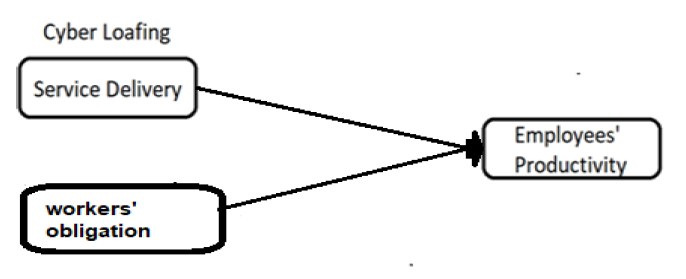
Review of several studies above however showed that cyber-loafing has significant influence on employees’ productivity and work-related activities. Accordingly, the findings are able to attest that cyber-loafing in a given organization determines the employees’ attitude, opportunities and developments, and thus affects their productivity (Figure 1).
Figure 1: Conceptual Models of Cyber-Loafing
MATERIALS AND METHODS
Survey research design was adopted in the study. This is because it gives accurate explanation of the characteristics of the target population such as view, ability and opinion of a particular situation. The population for the study covers employee of selected ministries, departments and agencies (MDAs) of Lagos State government such as Ministry of Establishments, training and pensions (ETP), Office of Creativity Technology and Innovation (OCTI) and Lagos State emergency management agency (LASEMA). There are 264 staff working in the selected MDAs. The study was carried out in Lagos State because the state represents one of the most urbanized states in Nigeria where technological advancement has been revolutionized. Lagos is Nigeria commercial nerve Centre and serves as a pace setter for technological advancement in Nigeria where creativity, innovation and technology progression has been advanced and thus, cyber-loafing could be experienced hence; it was purposively nominated for the study (Table 1).
Employees of the Lagos State government were purposively selected for this study to look at the effect of cyber-loafing on employees’ productivity. The table below showed the respective population of each agency selected and proportionate questionnaire that were administered on the respondents. The study using Krejcie and Morgan [42] sample size table at 5% confident interval arrived at 250 employees as sample size. The sample technique used was convenient sampling technique to distribute the questionnaire to management staff of the selected MDAs.
Table 1: Survey Research Design
S/N
Name
Population
Apportionment Questionnaire
1.
ETP
115
109
2.
OCTI
97
92
3.
LASEMA
52
49
4.
TOTAL
264
250
The research instrument designed by Olajide et al. [4] was adopted in this study. The instrument was modified to include other aspects of cyber-loafing in the public sector of Nigeria economy. The research instrument was structured into two sections. The first section of the questionnaire contains general questions relating to the respondents’ bio-data information while the second segment concentrated on information relating to cyber-loafing and its subsets for the employees of selected MDAs of Lagos State government through the Ministry of Science and Technology that oversees the usage of the State government internet facility. The questionnaire was designed in such a way that alternatives were provided for the respondents to choose from and options were expected to expressed. The research instrument was structured in four (4) Likert scale measurement of 4 represent strongly agreed (SA), 3 - agreed (A), 2 - disagreed (D), and 1 - strongly disagreed (SD).
The study used primary data and the questionnaire administered was used to gather primary data. Two hundred and fifty (250) copies of the questionnaires were administered to management staff of Lagos state government that was allowed to attend to special duty assignments. Out of the total number of the copies of the questionnaire administered, one hundred and eighty-nine (189) copies of the questionnaire were retrieved representing 75.6% and were used for the analysis in this study. The lower size of the questionnaire retrieved was not unconnected with the COVID-19 pandemic that ravaged the world and the social distance directives by the state government.
Content validity was adopted in this study. Cronbach Alpha was employed to ascertain the reliability of the research instrument. In order to measure the cyber-loaf in the Lagos state public sector, this study adopted research instrument designed by Olajide et al. [4]. The instrument was modified by the researcher to include other aspects of cyber-loaf in public sector of the state economy. The result of coefficient Alpha is presented below.
The test of reliability measures the internal consistency of the measurement scales of the items of each of the variables for primary data analysis. Table 1 above presents the Cronbach’s alpha result. The coefficients of the Cronbach’s alpha of the variables; cyber-deviance and service delivery is (0.713) and cyber-slack and workers’ obligation is (0.748) respectively. Since each of the coefficients stands between 0.7 and 1.00, this is an indicator of consistency that the responses measure the same characteristics of the same construct (service delivery and job content of cyber-deviance). Consequently, there is consistency in the measurement scales given by responses. This indicates that 71.3%, and 74.8% of variance in these scores of the variables respectively is reliable. The remaining percentage out of 100% represents error variance. The study adopts descriptive statistics and regression analysis using SPSS version 24 (Table 2-4).
Table 2: Result of Reliability Test Using Cronbach’s Alpha
S/N
Variable
No. of Items
Coefficient Alpha
1
Cyber-deviance and Service delivery
5
0.713
2
Cyber-slacking and workers’ obligation
5
0.748
Sources: Researcher’s computation 2020
Table 3: Result of the Regression Analysis between Cyber-Deviance and Service Delivery
No.
Beta
Std Err
T-statistic
P-value
Decision
N
Cyber-Loafing
-0.522
0.041
-12.632
0.000
Rejected
189
Table 4: Result of the Regression Analysis between Cyber-Slacking and Workers’ Obligation
No.
Beta
Std Eror
T-Statistic
P-value
Decision
N
Cyber-Loafing
-0.561
0.026
-18.591
0.000
rejected
189
Data Analyses and Interpretation
Test of Hypothesis I:
Ho: Cyber-deviance does not significantly influence service delivery of Lagos Sate Public service.
Dependent Variable: Service Delivery
Table 2 presents regression analysis of cyber-deviance and service delivery by Lagos State government workers. The results depicts that there is a negative effect of cyber-deviance on the service delivery of civil servants in Lagos State as the beta value indicates negative sign. The result is significant since the p-value (0.000) is less than 5% (0.05) indicating the rejection of the null hypothesis. This implies that there is a significant influence of cyber-deviance on workers service delivery in Lagos State public service.
Test of Hypothesis II
Ho:Cyber-slacking has not significantly affected workers’ obligation of Lagos State Public Service.
Dependent Variable: Workers Obligation
Table 3 presents analysis of cyber-slacking and workers’ obligation by Lagos State government workers. Cyber-slacking has a negative effect on work related activities of the workers as the beta value is negative. The result is also significant since the p-value (0.000) is less than 5% (0.05) indicating the rejection of the null hypothesis. This implies that there is significant effect of cyber-slacking on workers career in Lagos State public service.
DISCUSSION
The main purpose of this study was to stare at the effects of cyber-loafing on employees’ productivity in Lagos State government, Nigeria. The findings show that there is significant effect of cyber-loafing on workers’ productivity in Lagos State public service. The result of hypothesis one shows that there is negative effect of cyber-deviance on service delivery amongst employees of Lagos State government. This implies that employees of Lagos State government use the office internet for their own personal browsing objectives which affects the way and manner which they discharge their official duties. The finding of hypothesis one is aligned with the study of Arshad, Aftab and Bukhari [40].
Hypothesis two revealed that there is significant effect of cyber-slacking on workers duty in Lagos State public service. Also, a negative effect of cyber-loafing revealed on workers assigned responsibilities. This is evidenced that assigned responsibilities of employees of Lagos State government was not tasking enough which gives room for cyber-loafing. This finding collaborates with the study of Hussain and Parida [13].
CONCLUSION
After examining the findings and discussing the result, the researcher concluded that cyber- loafing does significantly affect employees’ productivity because employees’ use the time for official duties for their own personal browsing objectives. It was also asserted that internet was always used frequently for personal needs such as reading online news to quench boredom and refresh minds.
Recommendation
The following recommendations were made. Lagos State government should regulate the accessibility of internet facilities by the employees in order to avoid abuse of the internet facilities and to make the staff focus on their daily task. It is important for the government to pay more attention in improving employees’ productivity towards service delivery and work-related activities by equipping its entirety staff with the usage of information and communication technology to ease prompt delivery of assigned responsibilities. It is advisable for future researchers to involve more informants in this research kind and use other research tools to find out more about cyber-loafing and employee productivity in the public sector.
REFERENCE
Lim, V. et al. “The relation between staff cyber-loafing and organizational commitment in organization of environmental protection.” Journal of Environmental Protection, vol. 3, no. 7, 2014, pp. 59–71.
Yogun, A. E. “Cyberloafing and innovative work behavior among banking.” International Journal of Business and Management Review, vol. 3, no. 10, 2015, pp. 61–71.
Oladejo, M. O. “E-Payment adoption and customers’ service delivery in Nigeria deposit money banks.” International Journal of Application or Innovation in Engineering and Management, vol. 5, no. 3, 2016, pp. 130–138.
Olajide, O. et al. “Effect of cyber-loafing on employee performance among deposit money banks in Kaduna Metropolis.” Journal of Arts, Management and Social Sciences, vol. 3, no. 1, 2018, pp. 27–37.
Lim, V. “The IT way of loafing on the job: Cyber-loafing and organizational justice.” Journal of Organizational Behaviour, vol. 23, 2002, pp. 675–694.
Blau, G. and J. Kahn. “Testing measure of cyber-loafing.” Journal of Allied Health, vol. 35, no. 1, 2006, pp. 9–12.
Mangkunegara, P. Anwar. “Employee satisfaction analysis with human resources index.” ResearchGate, 2017, www.researchgate.net/publication/314082607.
Okoro, A. S. “Impact of electronic banking instruments on the intermediate efficiency of the nigeria economy.” International Journal of Accounting Research, vol. 1, no. 6, 2014, pp. 1–9.
Baddeley, M. “Using E-cash in the new economy: An economic analysis of micro payment systems.” Journal of Electronic Commerce Research, vol. 5, no. 7, 2004, pp. 239–253.
Sumanjeet, S. “Emergence of payment system in the age of electronic commerce: The state of art.” Asia Pacific Journal of Finance and Banking Research, vol. 3, no. 3, 2009, pp. 18–40.
Lim, Vivien K. G. and Don J. Q. Chen. “Cyber-loafing at the workplace: Gain or drain on work?” Behaviour & Information Technology, vol. 31, no. 4, 2012, pp. 343–353.
Ahmad, Z. and H. Jamaluddin. “Employees’ attitude toward cyber-loafing in Malaysia.” Creating Global Economies through Innovation and Knowledge Management: Theory & Practice, 2015, pp. 409–418.
Hussain, S. and T. Parida. “Exploring cyber-loafing behavior in south-central Ethiopia: A study at madda walabu university.” Journal of Media and Communication Studies, vol. 9, 2017, pp. 10–16.
Lavoie, J.A.A. and T.A. Pychyl. “Cyberslacking and the procrastination superhighway: A web-based survey of online procrastination.” Social Science Computer Review, vol. 19, 2001, pp. 431–444.
Blanchard, A.L. and A.C. Henle. “Correlates of different forms of cyber-loafing.” Computers in Human Behavior, vol. 24, 2008, pp. 1067–1084.
Vitak, J. et al. “Personal internet use at work: understanding cyber slacking.” Computers in Human Behavior, vol. 27, no. 5, 2011, pp. 1751–1759.
Mills, J. E. et al. “Cyber-slacking: A liability issue for wired workplaces.” Cornell Hotel and Restaurant Administration Quarterly, vol. 42, 2001, pp. 34–47.
Robinson, S.L. and R. J. Bennett. “A typology of deviant workplace behaviour.” Academy of Management Journal, vol. 38, no. 2, 1995, pp. 555–572.
Jandaghi, G. “Cyber-loafing management in organizations.” Iranian Journal of Management Studies, vol. 8, no. 3, 2015, pp. 335–349.
Yasar, S. Effects of Students’ Locus of Control and Attitudes toward Computer Laboratory on Their Cyber-Loafing Behaviour. Master’s thesis, Hacettepe University, Ankara, 2013.
Ahmad, A. and Z. Omar. “Understanding who cyber-loafs from the self-control perspective: A study in the public service sector.” International Journal of Advanced and Applied Sciences, vol. 4, no. 8, 2017, pp. 123–128.
Onuorah, A.N. and C. Ugochukwu. International Journal of Advanced Research in Management and Social Science, vol. 9, no. 2, 2020.
Banerjee, S. and S. Thakur. “A critical study of factors promoting cyber-loafing in organizations.” International Conference on Information and Communication Technology for Competitive Strategies, ACM, 2016.
Cushway, B. Handbook of Model Job Descriptions. London, 2013.
Murder-Clark, R. The Job Description Handbook. Nolo, Berkeley, 2015.
Arthur, D. The Manager’s Guide to Performance Appraisal. New York, 2013.
Zeithaml, Valerie A. et al.Delivering Quality Service. Free Press, New York, 1990.
Nwekeaku, C. and B. Obiora. International Journal of Developing and Emerging Economies, vol. 7, no. 4, 2019, pp. 30–40.
Dauda, Y. A. and W. A. Akingbade. “Technological change and employee performance in selected manufacturing industry in lagos state of Nigeria.” Australian Journal of Business and Management Research, vol. 1, no. 5, 2011, pp. 32–43.
Bitner, M. J. et al. “Critical service encounters: The employee’s viewpoint.” Journal of Marketing, vol. 58, 1994, pp. 95–106.
Weatherbee, T. G. “Counterproductive use of technology at work: Information and communication technologies and cyberdeviancy.” Human Resource Management Review, vol. 20, no. 1, 2010, pp. 35–44.
Douglas, D. M. “Doxing: A conceptual analysis.” Ethics and Information Technology, vol. 18, no. 3, 2016, pp. 199–210.
Workman, M. “Rash impulsivity, vengefulness, virtual-self and amplification of ethical relativism on cyber-smearing against corporations.” Computers in Human Behavior, vol. 28, no. 1, 2012, pp. 217–225.
Liberman, B. et al. “Employee job attitudes and organizational characteristics as predictors of cyber-loafing.” Computers in Human Behavior, vol. 27, 2011, pp. 2192–2199.
Derin, N. and S. Güravşar. “Are cyber-loafers also innovators? A study on the relationship between cyber-loafing and innovative work behavior.” Procedia – Social and Behavioral Sciences, 2016, pp. 694–700.
Kim, K. et al. “When do employees cyber-loaf? An interactionist perspective examining personality, justice, and empowerment.” Human Resource Management, vol. 55, no. 6, 2016, pp. 1041–1058.
Şahin, A. and N. Korkmaz. “Adaptation of internet addiction scale.” ResearchGate, 2011.
Ayas, T. and I. Tas. “Effects of psychoeducational program for reducing psychological symptoms on internet addiction among adolescents.” Education and Science, vol. 43, 2018, pp. 257.
Çınar, A. and F. Karcıoğlu. “Effect of organizational citizenship behavior on employee performance in the banking sector.” 2015.
Arshad, M. et al. “The impact of job characteristics and role stressors on cyber-loafing: The case of Pakistan.” International Journal of Scientific and Research Publications, vol. 6, no. 1, 2016.
Sawitri, H.S.R. “Role of internet in moderating influence of work stressor on cyber-loafing.” International Conference on Asia Pacific Business Innovation and Technology Management, 2012, pp. 320–324.
Krejcie, R.V. and D.W. Morgan. “Determining sample size for research activities.” Educational and Psychological Measurement, vol. 30, 1970, pp. 607–610.
Recommended Articles
Research Article
Agentic AI in Information Systems: Toward Autonomous Decision-Making in Organizations
Duoha Suhail Najm
Published: 30/07/2026
Download PDF
Research Article
A Comparative Study of Online Fashion Promotion: Hennes & Mauritz (H&M) and Label in India
Riya Jamble
Published: 20/07/2021
Download PDF
Research Article
Developing Social Media Marketing Visual Contents to Increase Engagement Rate (A Case Study of Healthy Tails Animal Clinic in Malang City)
Aditya Nirwana,
...
Felicia Joscelind Verrel
Published: 20/11/2022
Download PDF
Research Article
The Determinants of the Financial Behaviour of SMEs: Empirical Evidence from an Emerging Economy
Santiago Hernandez,
...
Remo Roscigno
Published: 20/03/2022
Download PDF
PO Box 101, Nakuru
Kenya.
Email: office@iarconsortium.org
Editorial Office:
J.L Bhavan, Near Radison Blu Hotel,
Jalukbari, Guwahati-India
Kotun, A. I., Adeoye, A. O. & N. S., A. (2021). Effects of Cyberloafing on Employees’ Productivity (A Study of Selected Agencies in Lagos State Public Service). IAR Journal of Business Management, 2(2), 1-7.
MLA
Kotun, Ahmed I., Abayomi O. Adeoye and Alaka N. S.. "Effects of Cyberloafing on Employees’ Productivity (A Study of Selected Agencies in Lagos State Public Service)." IAR Journal of Business Management 2.2 (2021): 1-7.
Chicago
Kotun, Ahmed I., Abayomi O. Adeoye and Alaka N. S.. "Effects of Cyberloafing on Employees’ Productivity (A Study of Selected Agencies in Lagos State Public Service)." IAR Journal of Business Management 2, no. 2 (2021): 1-7.
Harvard
Kotun, A. I., Adeoye, A. O. and N. S., A. (2021) 'Effects of Cyberloafing on Employees’ Productivity (A Study of Selected Agencies in Lagos State Public Service)' IAR Journal of Business Management 2(2), pp. 1-7.
Vancouver
Kotun AI, Adeoye AO, N. S. A. Effects of Cyberloafing on Employees’ Productivity (A Study of Selected Agencies in Lagos State Public Service). IAR Journal of Business Management. 2021 Jul;2(2):1-7.


 Download PDF
 Download XML