Research was conducted to observe the influence of the information system at Harapan Bersama Singkawang Hospital (RSUHB). The population in this study are RSUHB outpatients, in total 90 respondents. This research uses a Structural Equation Model (SEM) approach with a measurement model using the SmartPLS version 3.2.9 program to measure the intensity of each research variable and a structural model to analyze data and research hypotheses. The results obtained shows that the management information system has a significant effect on patient satisfaction, the management information system has a significant effect on patient loyalty, patient satisfaction has a significant effect on patient loyalty, and finally the management information system has a significant effect on patient loyalty. patient satisfaction is mediated by patient satisfaction.
Keywords
Management Information System
RSUHB
Patient Satisfaction
Patient Loyalty
INTRODUCTION
Hospitals are a form of health service provider that can be established by the government or the private sector. The health services provided by the hospital include outpatient, inpatient and emergency services which involve medical aspects and medical support. Health services are a different type of service from goods. A good is an object, thing, or tool, while a service is an action or performance carried out. Evaluation of the quality of health services in hospitals cannot be done by patients before they actually experience it. After receiving health services, patients will compare their experiences with their expectations. If the experience does not match the patient's expectations, the patient will feel dissatisfied and disloyal to the hospital. However, if the experience matches or even exceeds expectations, the patient will feel satisfied and will maintain a long-term relationship with the hospital and become a loyal patient.
Hospitals as health service providers must be able to maintain patient satisfaction and maintain their loyalty. According to Kartika et al. [1] loyal patients will not find other option and will continue to use these health services when necessary. Patients with high loyalty will be good and economical for the hospital. Most hospitals experience various problems, one of which is the achievement of patient visits that have not reach the target [2]. In the current digital era, diverse hospital services and consumer preferences have a significant impact on management policy making in the hospital business. The ability and intelligence of hospital business subjects is very important in studying the market competition situation and market opportunities to determine the quality of the policies taken and also the ability to face the market. One of the important policies that must be formulated is implementing a good management information system and increasing patient satisfaction.
Hospital information systems have an important role in clinical and administrative services. Information management in hospitals has begun to use electronic-based systems (SIMRS), especially in supporting decision making. Hospital information systems called SIMRS, used for their functions through the information and types of services offered. To support patient care and administration, SIMRS supports the provision of information, especially about patients, in a correct, relevant and up-to-date way, easily accessible to the right people in different places/locations and in a format that can be used. Service transaction data is also collected, stored, processed, and documented to produce information about the quality of patient care and about hospital performance and costs. This suggests that the hospital information system must be able to communicate high quality data between various units in the hospital. Apart from internal communication, another important goal of SIMRS is the exchange of electronic data between health service providers (practitioners, primary facilities and hospitals).
The hospital management information system (SIMRS) used in a hospital must provide operational convenience and must be able to overcome obstacles to patient service in the hospital.
In the aspect of patient satisfaction, it is related to loyalty, when patients feel satisfied with the services provided by the hospital, the patient will tend to be more inclined to continue choosing that hospital in the future. Satisfied patients tend to become loyal customers, returning to use hospital services for their health needs and recommending them to others. This is in line with the statement of Ahri et al. [4], satisfaction provides encouragement to patients to establish a strong relationship with the hospital. This is also in line with research conducted by Hendrata et al. [4]; Yaqub et al. [5] found that customer satisfaction has a positive effect on customer loyalty. In the research of Ahri et al. [4] found that customer satisfaction has no effect on customer loyalty.
Based on the phenomena that occur and comparison with previous researches, the objectives achieved from this research are to determine
The influence of management information systems on patient satisfaction,
The influence of management information systems and patient satisfaction on patient loyalty
The influence of management information systems on patient satisfaction mediated by patient satisfaction.
This research is expected to provide broad benefits for practitioners, academics, companies and other stakeholders in understanding and managing patient loyalty at RSUHB. Based on the description and results of previous research, there are still research gaps. So, the researcher intends to conduct research entitled "The Influence of Management Information Systems at Harapan Bersama Singkawang Hospital".
LITERATURE REVIEW
Loyalty
Loyalty, according to Kotler et al. [6], is a firm commitment to continue using or subscribing to a product or service in the future, despite external circumstances or management initiatives that would tempt customers to switch to other goods. Customer loyalty was further defined by Hendrata et al. [4] as attitudes and intentions to behave, demonstrated through commitment to make repeat purchases, referrals to others, and financial capacity to spend more. Customer loyalty according to Putra et al. [7], is the behavior of clients who promise to consistently buy the same product over time.
Management Information System
According to Hendrata et al. [4] management information systems are systems that involve people, tools, and procedures designed to collect, analyze, and present data accurately. The aim is to provide support to management in the decision-making process. Furthermore, Erpurini [8] defines a management information system as consisting of people, equipment and procedures to collect, sort, analyze, evaluate and distribute the required information in a timely and accurate manner to decision makers in the field of management and is useful for companies in making important decisions about existing opportunities and possibilities.
Customer Satisfaction
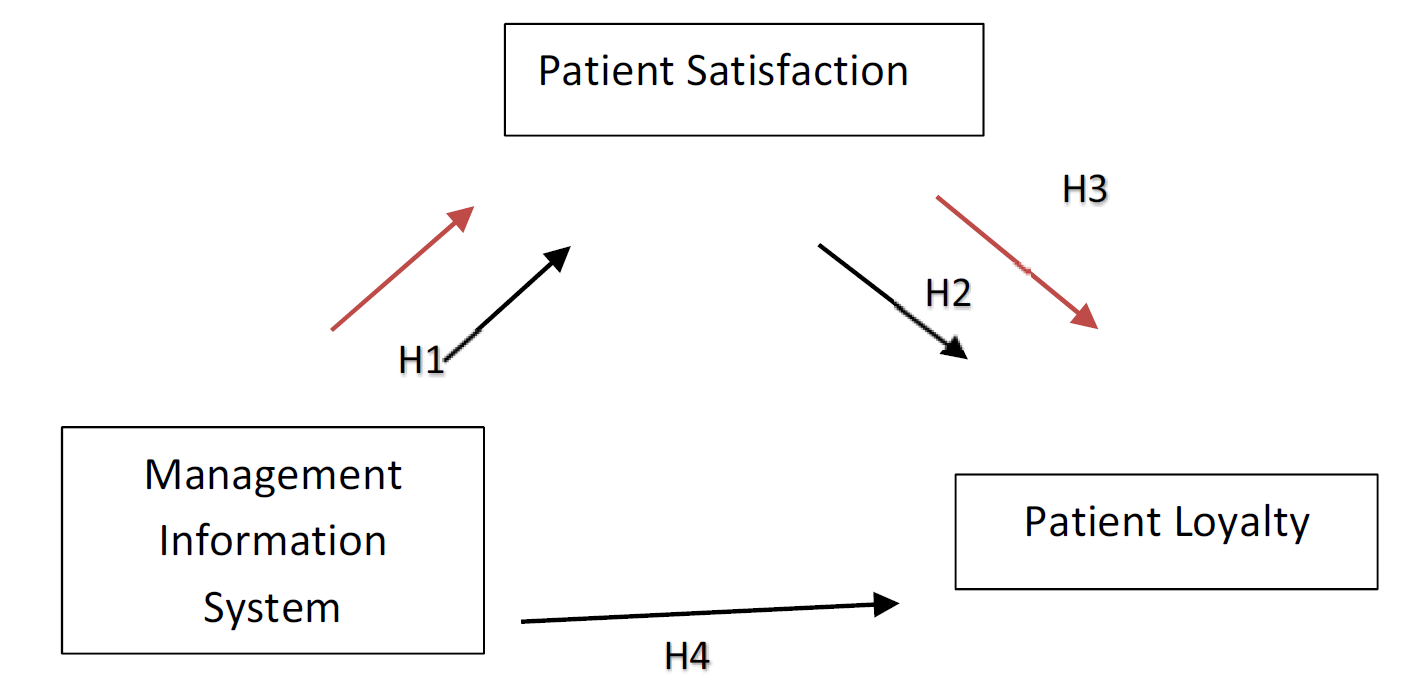
According to Erpurini [8] customer satisfaction is an emotional evaluation that arises after someone compares the performance or results of a product with their expectations. Customer satisfaction occurs when product performance or results meet or even exceed previously estimated expectations. Customer satisfaction is a positive feeling that can lead to customer loyalty and recommendations to others. Ahri et al. [4] defines satisfaction as the consumer's feeling after feeling the difference between what he received and his desired expectations. Customers will feel satisfied if the value provided by the product or service can satisfy customers for a long time. Patient satisfaction is the level of feeling that arise after a patient receives health services and compares them with what was expected. From the previous theoretical description, the research model is presented as in Figure 1.
Figure 1: Framework
The hypotheses proposed in this research include:
H1: Management information systems influence patient satisfaction
H2: Management information systems influence patient loyalty
H4: Management information systems have an effect on patient loyalty which is mediated by patient satisfaction.
MATERIALS AND METHODS
To explain how a variable influences or is responsible for changes in other variables, this research uses quantitative techniques with an explanatory or causal design [9]. In this research, there is a mediating variable (Z) apart from the dependent variable (X) and the independent variable (Y). The management information system is the independent variable for the research, and patient loyalty is the dependent variable. Patient satisfaction is the next mediating factor. Primary data sources were collected through surveys conducted using online questionnaires using Google Forms as a data collection tool for this project. All outpatients at RSUHB were used as the research population. With a measurement model that measures the intensity of each research variable using Smart PLS version 3.2.9 software and a structural model that analyzes research data and hypotheses, this research uses the Structural Equation Model (SEM) methodology.
RESULTS AND DISCUSSION
Calibration of Research Instruments
Testing of data analysis requirements in this study was obtained from the results of the PLS algorithm calculation which shows the value of factor loading or outer loading to determine convergent validity, cross loading to determine discriminant validity, composite reliability, Cronbach alpha and AVE (Average Variance Extracted) to determine reliability
All loading factor values for each indicator used to measure all variables are known to be greater than 0.7. This shows that all metrics used to measure patient happiness, patient loyalty, and management information system variables are accurate or have achieved convergent validity. Therefore, the researcher decided to combine all indicator items for each variable.
The management information system factors, patient happiness, and patient loyalty shown in Table 2, which provide an explanation of the findings of discriminant validity testing by looking at the AVE value. All variables in the research model have values above 0.5, meaning that the AVE value required for the discriminant validity test has been met. As a result, both the convergent validity test and the discriminant validity test were successful.
Each variable in the research model has a Composite Reliability value above 0.7, with the management information system variable having the lowest value of 0.907 and the patient loyalty variable having the highest value of 0.952. These findings indicate that the research model meets the requirements for composite reliability.
Each variable in the research model has a Cronbach's alpha value of more than 0.6, with the highest value being the patient loyalty variable (0.941) and the lowest value being the management information system variable (0.872). These findings indicate that the research model meets Cronbach's Alpha requirements.
Table 1: Research Variable Loading Factor Values
Variable
Indicator
Loading Provision Value
Factor
Description
Management Information System
SIP1
SIP2
SIP3
SIP4
SIP5
0.816
0.835
0.821
0,788
0.891
>0.7
>0.7
>0.7
>0.7
>0.7
Valid
Valid
Valid
Valid
Valid
Patient Satisfactory
KP1
KP2
KP3
KP4
KP5
0.877
0.766
0.831
0.822
0.912
>0.7
>0.7
>0.7
>0.7
>0.7
Valid
Valid
Valid
Valid
Valid
Patient Loyalty
LP1
LP2
LP3
LP4
LP5
0.772
0.828
0.811
0.827
0.851
>0.7
>0.7
>0.7
>0.7
>0.7
Valid
Valid
Valid
Valid
Valid
Source: Data Processing Results using SmartPLS 3.2.9 (2023)
Table 2: AVE (Average Variance Extraction) Model Research Results
Variable
AVE Value
Management Information System
Patient Satisfactory
Patient Loyalty
0.656
0.712
0.824
Source: Data Processing Results using SmartPLS 3.2.9 (2023)
Table 3: Composite Reliability Results of Research Models
Variable
Composite reliability
Management Information System
Patient Satisfactory
Patient Loyalty
0.907
0.923
0.952
Source: Data Processing Results using SmartPLS 3.2.9 (2023)
Tabel 4: Hasil Cronbach's Alpha Model Penelitian
Variable
Cronbach’s Alpha
Management Information System
Patient Satisfactory
Patient Loyalty
0.872
0.895
0.941
Source: Data Processing Results SmartPLS 3.2.9 (2023)
Structural Model Testing
Coefficient of determination / Squared Test (R2): The coefficient of determination attempts to measure the extent to which variations in the dependent variable can be explained by the model. There is a range of 0 to 1 in the coefficient of determination. The R2 number, or coefficient of determination, is very close to 1. The R-Square (R2) score shows how well the independent variable proposed by the equation can explain the dependent variable.
The R-square value of the patient satisfaction variable is 0.360, which means that 36.0% of the patient satisfaction variable is likely to be influenced by the management information system. This figure can be used to describe the relationship between constructs. Patient satisfaction and management information systems can each influence 47.2% of the patient loyalty variable, corresponding to an R-square value of 0.472 for this variable.
Hypothesis Test
In this research, the path coefficient, t-statistic and p-value are used for hypothesis testing. T-statistic > 1.96 or p-value 0.05 (5%) is a general guideline used in this research to determine whether there is a significant relationship between the independent variable and the dependent variable. Figure 3 displays the results of the research model, and Table 6 displays the results of hypothesis testing.
The Table above shows that all research hypotheses can be accepted, this is because this is because it obtained a sig. value smaller than 0.05.
The Influence of Management Information Systems on Patient Satisfaction
The first hypothesis shows that the management information system has a significant effect on patient satisfaction for patients at Hospital X. This shows that the higher quality and effectiveness of the management information system implemented, the higher level of patient satisfaction at Hospital research by Erpurini and Zulyanti [8] found that management information systems have a big influence on consumer happiness. Customer satisfaction is significantly influenced by management information system, according to the same findings presented by Erpurini [8].
The Influence of Management Information Systems on Patient Loyalty
The second hypothesis shows that the management information system has a significant effect on patient loyalty to patients at Hospital X. This shows that the higher quality and effectiveness of the management information system implemented, the higher level of patient loyalty at Hospital includes collecting data from various relevant sources, both internal and external. The data collected includes information about markets, customers, competitors, industry trends, and environmental factors that influence company management activities. These results support research conducted by Yuliani et al. [10] which states that management information systems have an important role in increasing sales. In research conducted by Hendrata [4], and Hidayatullah et al. [11] found that management information systems have no direct effect on loyalty.
The Influence of Patient Satisfaction on Patient Loyalty
The third hypothesis shows that patient satisfaction has a significant effect on patient loyalty to patients at Hospital X. This shows that the higher the patient's satisfaction with the services provided, the higher level of patient loyalty showed at Hospital X. Patient satisfaction is a measure of how satisfied the patient is with the services provided. In this case, patient satisfaction describes the success of health services in meeting needs [12]. According to Wartiningsih [13] patient satisfaction can be increased through comprehensive services, including promotive, preventive and rehabilitative services. The results of this research are in line with research conducted by Hendrata et al. [4], Yaqub et al. [5] who found that customer satisfaction has a positive effect on customer loyalty.
The Influence of Management Information Systems on Patient Loyalty Mediated by Patient Satisfaction
The fourth hypothesis shows that the management information system has a significant effect on patient satisfaction which is mediated by patient satisfaction for patients at Hospital X. This shows that there is an indirect influence between the management information system on patient loyalty which is mediated by patient satisfaction. A good management information system can collect and analyze data about customer needs and preferences. With a deep understanding of individual needs, hospitals can provide better services and fulfill customer expectations. This can increase customer satisfaction and in turn encourage patient loyalty. The results of this research are in line with research conducted by Hendrata et al. [4] that customer satisfaction perfectly mediates the influence of management information systems on customer loyalty.
CONCLUSION
Referring to the research results that have been described, it can be seen that the management information system has a significant effect on outpatient satisfaction, the management information system has a significant effect on patient loyalty, patient satisfaction has a significant effect on outpatient loyalty, and finally the management information system has a significant effect on patient satisfaction. outpatient care mediated by patient satisfaction. A limitation of the research is that the sample used was only RSUHB outpatients, so it does not reflect the condition at large and cannot describe the actual situation. Lastly, the variables used in this research are limited because this does not include all factors that can influence customer loyalty. Based on the results and limitations of this research, suggestions for further research are expand the research sample by involving a wider number of samples and representing a larger population. Apart from that, it is also recommended to use other hospitals as research subjects. Future research can also use other research variables that are thought to influence customer loyalty, such as price factors, hospital reputation, service quality, and accessibility, which will provide a better understanding.
REFERENCES
Kartika, R.C. et al. “Upaya Peningkatan Loyalitas Pasien melalui Peningkatan Kepuasan Pasien di Rumah Sakit.” Jurnal Ilmiah Permas: Jurnal Ilmiah STIKES Kendal, vol. 13, no. 3, 2023, pp. 701–708.
Mosadeghrad, A.M. “Factors Affecting Medical Service Quality.” Iranian Journal of Public Health, vol. 43, 2014, pp. 210–220.
Ahri, R.A. et al. “Pengaruh Kualitas Pelayanan dan Citra Merek terhadap Minat Kembali Pasien Rawat Inap melalui Kepuasan sebagai Mediasi di Rumah Sakit Umum Sisaldjufrie Palu.” Jurnal Ekonomika, vol. 7, no. 1, 2023, pp. 171–184.
Hendrata, K. et al. “The Influence of Marketing Information Systems on Customer Loyalty in the Denpasar Automotive Industry in the Time of Covid-19.” Jurnal Ekonomi & Bisnis JAGADITHA, vol. 8, no. 1, 2021, pp. 81–89.
Yaqub, R.M.S. et al. “Effect of Service Quality, Price Fairness, Justice with Service Recovery and Relational Bonds on Customer Loyalty: Mediating Role of Customer Satisfaction.” Pakistan Journal of Commerce and Social Sciences, vol. 13, no. 1, 2019, pp. 62–94.
Kotler, P., and Armstrong, G. Principles of Marketing. 17th ed., Pearson Education, 2018.
Putra, A.R. et al. “Pengaruh Gaya Hidup, Lingkungan Fisik, dan Persepsi Harga terhadap Loyalitas Pelanggan Lottemart.” Jurnal Ekonomi dan Manajemen, vol. 2, no. 1, 2022, pp. 71–85.
Erpurini, W., and Zulyanti, R. “Pengaruh Sistem Informasi Pemasaran dan Kualitas Produk terhadap Kepuasan Pelanggan.” Jurnal Sains Manajemen dan Bisnis Indonesia, vol. 9, no. 2, 2019, pp. 230–237.
Cooper, D.R., and Schindler, P.S. Metode Penelitian Bisnis. 12th ed., vol. 1, translated by Rahma Wijayanti and Gina Gania, Salemba Empat, 2017.
Yuliani, I.K. et al. “Peran Sistem Informasi Pemasaran dalam Meningkatkan Penjualan pada PT Machiko Jaya Indonesia.” J-MAS (Jurnal Manajemen dan Sains), vol. 8, no. 1, 2023, pp. 814–819.
Hair, J.F. et al.Multivariate Data Analysis. Pearson Education, 2014.
Wartiningsih, M., and Setyawan, F.E.B. “Analisis Kepuasan dan Loyalitas Pasien di Rumah Sakit Kristen Mojowarno.” Jurnal Manajemen Kesehatan Yayasan RS Dr. Soetomo, vol. 9, no. 1, 2023, pp. 196–208.
Wartiningsih, M. “Patient Satisfaction Improvement by Comprehensive Holistic Services at X Primary Health Care Surabaya.” KEMAS: Jurnal Kesehatan Masyarakat, vol. 18, no. 2, 2022.
None
Recommended Articles
Research Article
The Employee Training and Development Programme at Principal Education Department Quelimane–Zambezia-2010 to 2015
Manuel Bana
Published: 31/10/2021
Download PDF
Research Article
The ‘Evolution’ of Retired and Experienced Employees in Quelimane District Zambezia Province - Mozambique
Manuel Bana,
Chiome Chrispen
Published: 25/07/2021
Download PDF
Research Article
Political Economy Transforming Into Financial Freedom for the Improvement of Business Diplomacy
Md. Enamul Kabir
Published: 25/07/2021
Download PDF
Research Article
The Contribution of Evaluation of Employee Performance in the Provision of Public Services: At Damião Full Primary School - Mocuba District - Zambezia Province - Mozambique (2017 - 2019)
Manuel Bana,
Chrispen Chiome
Published: 20/11/2021
Download PDF
PO Box 101, Nakuru
Kenya.
Email: office@iarconsortium.org
Editorial Office:
J.L Bhavan, Near Radison Blu Hotel,
Jalukbari, Guwahati-India
Perdana Putra, M. D., None, V., Andre Simatupang, S. M., Paramarta, V. & Bahtiar, M. Y. (2024). The Influence of Management Information Systems at Harapan Bersama Singkawang Hospital. Scientific Research Journal of Review of Public Administration and Management, 4(1), 1-5.
MLA
Perdana Putra, Muhammad D., et al. "The Influence of Management Information Systems at Harapan Bersama Singkawang Hospital." Scientific Research Journal of Review of Public Administration and Management 4.1 (2024): 1-5.
Chicago
Perdana Putra, Muhammad D., Veridiana , Sahat M. Andre Simatupang, Vip Paramarta and Mohammad Y. Bahtiar. "The Influence of Management Information Systems at Harapan Bersama Singkawang Hospital." Scientific Research Journal of Review of Public Administration and Management 4, no. 1 (2024): 1-5.
Harvard
Perdana Putra, M. D., None, V., Andre Simatupang, S. M., Paramarta, V. and Bahtiar, M. Y. (2024) 'The Influence of Management Information Systems at Harapan Bersama Singkawang Hospital' Scientific Research Journal of Review of Public Administration and Management 4(1), pp. 1-5.
Vancouver
Perdana Putra MD, Veridiana V, Andre Simatupang SM, Paramarta V, Bahtiar MY. The Influence of Management Information Systems at Harapan Bersama Singkawang Hospital. Scientific Research Journal of Review of Public Administration and Management. 2024 Jan;4(1):1-5.



 Download PDF
 Download XML