Background: Chronic renal disease is a significant health concern that necessitates regular hemodialysis for patients with end-stage renal disease (ESRD). Aim: The aim of this study was to assess the role of bacterial urinary tract infection in the progression of renal failure. Materials and Methods: This cross-sectional hospital-based study was conducted from December 1, 2023, to May 31, 2024, at the hemodialysis unit of Tikrit Teaching Hospital, including 240 patients with chronic renal disease aged 15-75 years, clinically diagnosed by nephrologists as end-stage renal disease (ESRD) patients undergoing hemodialysis. Forty healthy individuals were included as a control group. Urine samples were collected and cultured on blood agar and MacConkey agar for 24 hours. Microscopic examination involved centrifuging and examining sediment for pus cells, erythrocytes, crystals, bacteria, and epithelial cells. Conventional biochemical tests were conducted and difinitve diagnosis was performed using the Vitek 2 system. disk diffusion method was used for bacterial susceptibility testing. Results: This study investigated the prevalence and antibiotic sensitivity patterns of urinary tract infections (UTIs) among hemodialysis patients. Conducted at Tikrit Teaching Hospital, 96 patients were enrolled, including 77 (80.21%) with positive urine cultures and 19 (19.79%) with negative urine cultures. Escherichia coli was the most prevalent bacteria, found in 40 patients (51.95%), followed by Staphylococcus aureus (15.58%) and Proteus mirabilis (10.39%). The antibiotic sensitivity patterns revealed significant variability. Staphylococcus saprophyticus exhibited high sensitivity to Vancomycin (80%) and Meropenem (60%) but showed resistance to Cefepime (100%), Amikacin (80%), and Trimethoprim (60%). Staphylococcus aureus showed moderate sensitivity to Meropenem (66.67%) and Cefepime (58.33%), while Enterococcus faecalis was most sensitive to Levofloxacin (60%), Ceftriaxone (60%), and Meropenem (60%). Gram-negative bacteria demonstrated high resistance to several antibiotics. Proteus mirabilis showed resistance to Gentamicin (75%), Trimethoprim (87.5%), Ceftriaxone (100%), Cefepime (100%), and Amikacin (100%), with Meropenem being the most effective. Klebsiella pneumoniae exhibited complete resistance to Gentamicin (100%) and Ceftriaxone (100%) but had moderate sensitivity to Meropenem (66.67%) and Cefotaxime (83.33%). Escherichia coli displayed high resistance to Gentamicin (80%) and Trimethoprim (75%) but better sensitivity to Meropenem (52.5%). The study also examined demographic characteristics and found no significant association between urine culture results and factors such as sex, age, residence, or associated infections like HCV, HBV, diabetes, or hypertension. Additionally, the duration of dialysis did not significantly impact the likelihood of positive or negative urine cultures. The findings highlight the need for targeted antibiotic therapy and continuous monitoring of antibiotic resistance patterns in hemodialysis patients.
Keywords
UTI
Hemodialysis
Antibiotic Resistance
CKD.
INTRODUCTION
Chronic kidney disease (CKD) is usually describing chronic renal failure with an abnormal kidney function and/or structure. It is usually developed after an acute renal disease such as acute glomerulonephritis, nephrotic syndrome, or from acute renal failure that results from acute hypervolemia (1). The risk of developing CKD also increases with age. As kidney function deterioration progresses, the coexisting conditions become more common and increase in severity. People with CKD are usually five to ten times more likely to die early in his life than they are to progress to end stage renal disease (2). Over the last decades several investigations have focused on the pathogenesis of immunologically mediated kidney diseases. Autoimmunity is a process by which the loss of self-tolerance results in an immune attack against the body own tissues and organs. For autoimmunity to occur, various elements serving as triggers were described by which infections are considered one of the leading factors (3). Urinary tract infections (UTIs) affect almost 50% of women and 5% of men during their lifetime and are usually defined as more than 105 colony-forming units/mL (CFU/mL) on culture with signs and symptoms of infection, like suprapubic pain, dysuria, or urgency (4). However, more recent studies argue that even a number as low as 102 CFU/mL can mean a UTI, especially in acutely symptomatic women (5,6). Two other possible findings should not be overlooked: asymptomatic bacteriuria and pyuria. The first one is defined as more than 105 CFU/mL, but with no signs or symptoms of urinary infection (7,8). In women, it should be repeated after two weeks, because between 10–60% of them do not have persistent bacteriuria. The second refers to the presence of a minimum of 10 leucocytes/μL or a minimum of 50 leucocytes/high-power field (HPF) from unspun urine, either due to UTIs or to an inflammation of the kidney (9). These findings are of utmost importance because they can reveal not only individual particularities but also, as it is argued by some studies, an increased risk for the progression of CKD (10,11). The aim of this study was to assess the role of bacterial urinary tract infection in the progression of renal failure.
MATERIALS AND METHODS
A cross-sectional hospital-based study was done from 1st December 2023 to the end of May 2024 including 240 patients with chronic renal disease whose ages were between 15-75 years and they admitted to hemodialysis unit of Tikrit Teaching Hospital. They were clinically diagnosed by nephrologists as ESRD patients (on hemodialysis), based on their history, clinical examination, renal function tests and other laboratory tests, undergoing hemodialysis. The study also included 40 healthy individuals as control group- Approval of the research committee /Saladin Health Directorate/ Ministry of Health/Republic of Iraq was obtained for the proposal of the study, and the practical study to be done in Tikrit Teaching Hospital (160, 08/03/2023).
The study involved collecting midstream, clean catch urine specimens from patients and discontinuing antibiotics 72 hours before sending them for culture and sensitivity testing. Urine samples were cultured in blood agar and MacConkey agar for 24 hours, and microscopic examination was performed as the first step in diagnosing urinary tract infections. The urine was centrifuged at 3000 rpm for 5 minutes, and the supernatant was decanted and the sediment suspended in the remaining urine. A single drop was transferred to a clean glass slide and cover slip for direct microscopic examination using a LOMO Micmed 2-Russia microscope. Gram staining was performed on one drop of unspun freshly voided urine, and any bacteria under oil immersion field suggested the presence of more than 105 bacteria/ml of urine. Media were prepared and sterilized according to the manufacturer's instruction, and the media used for isolation, determination of the viable count, identification, and susceptibility testing were carried out after being solidified. Semiquantitative urine culture was employed, and quantitative bacterial culture of a urine specimen was done by inoculating appropriate media with a measured amount of urine. A 0.01ml loop was used to inoculate all urine specimens, and the inoculated plates were incubated overnight at 37°C.
Conventional biochemical tests included the Catalase Production Test, Oxidase Test, Indole Production Test, Methyl Red Test, Voges-Proskauer Test, Citrate Utilization Test, Urease Production Test, Mannitol Fermentation Test, and Carbohydrates Fermentation and Gas Production test. The Vitek 2 System is an automated microbiology system using growth-based biotechnology, available in three formats (compact, standard, and XL) that automates identification and susceptibility tests using colorimetric reagent cards, accommodating Gram-negative and Gram-positive organisms. The motility test involves inoculating a medium with pure culture using a straight needle, incubating at 37°C for 24 hours, and observing growth patterns indicating motility. Short-term preservation involves storing isolates on nutrient agar slopes at 4ºC, while long-term preservation uses sterile glycerol suspensions stored at -20ºC. The disk diffusion test follows the modified Kirby-Bauer method, where pure inoculum is prepared and incubated in broth, matched to McFarland turbidity standards, and inoculated on Mueller-Hinton medium. Antibiotic discs are applied, incubated overnight at 37°C, and inhibition zones are measured and compared to standards.
Statistical analysis.
Computerized statistically analysis was performed using Minitab version 17 statistic program. Comparison was carried out using Chi-square (X2) for determination of probability value which was interpreted as follows (126):
P value>0.01: Highly Significant (HS).
≤ (P value) ≤ 0.5: Significant (S)
P valus< 0.05 : Non-significant (NS).
RESULTS
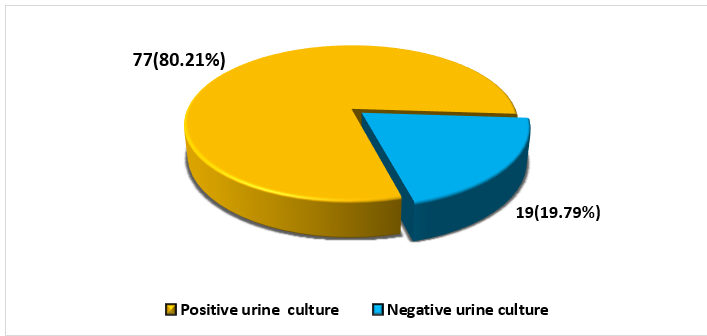
In the current study, a significant majority, 77 patients (80.21%), had positive urine cultures, indicating the presence of a urinary tract infection. In contrast, 19 patients (19.79%) had negative urine cultures. Table 1.
Table 1: Result of urine culture among hemodialysis patients
Result of urine culture
No.
%
Positive culture
77
80.21%
Negative culture
19
19.79%
Total
96
100%
Figure 1: Result of urine culture among hemodialysis patients
The study showed that the most prevalent bacteria isolated was Escherichia coli, found in 40 patients, accounting for 51.95% of the cases. This was followed by Staphylococcus aureus, isolated in 12 patients (15.58%), and Proteus mirabilis in 8 patients (10.39%). Klebsiella pneumoniae was identified in 6 patients (7.79%), while both Staphylococcus saprophyticus and Enterococcus faecalis were found in 5 patients each, making up 6.49% of the cases respectively. Enterobacter cloacae was the least common, isolated in only 1 patient (1.30%). Table 2.
Table 2: Isolated bacteria from hemodialysis patients with UTI
Bacteria species isolated from UTI
No.
%
Staphylococcus saprophyticus
5
6.49%
Staphylococcus aureus
12
15.58%
Proteus mirabilis
8
10.39%
Klebsiella pneumoniae
6
7.79%
Escherichia coli
40
51.95%
Enterococcus faecalis
5
6.49%
Enterobacter cloacae
1
1.30%
Total
77
100%
The study showed that the antibiotic sensitivity patterns of Gram-positive bacteria isolated from hemodialysis patients with urinary tract infections (UTIs) demonstrate significant variability in resistance across different antibiotics. Staphylococcus saprophyticus exhibited high sensitivity to Vancomycin (80%) and Meropenem (60%), but showed notable resistance to antibiotics such as Cefepime (100%), Amikacin (80%), and Trimethoprim (60%). Staphylococcus aureus displayed moderate sensitivity to Meropenem (66.67%) and Cefepime (58.33%), suggesting these as potential treatment options, while showing high resistance to Trimethoprim (91.67%), Vancomycin (75%), and Cefotaxime (83.33%), indicating these antibiotics may be less effective. Enterococcus faecalis showed the highest sensitivity to Levofloxacin (60%), Ceftriaxone (60%), and Meropenem (60%), but significant resistance was observed with Cefepime (80%), Ampicillin (80%), and Vancomycin (60%). Table 4.3
Table 3: Antibiotic sensitivity patterns of Gram-positive bacteria isolated from UTIs
Antibiotics
Isolated G+ve bacteria from hemodialysis patients with UTI
S. saprophyticus
S. aureus
E. faecalis
No.
%
No.
%
No.
%
Gentamicin
sensitive
3
60%
4
33.33%
3
60%
Resistant
2
40%
8
66.67%
2
40%
Trimethoprim
sensitive
2
40%
1
8.33%
3
60%
Resistant
3
60%
11
91.67%
2
40%
Cefotaxime
sensitive
2
40%
2
16.67%
2
40%
Resistant
3
60%
10
83.33%
3
60%
Ceftriaxone
sensitive
2
40%
4
33.33%
3
60%
Resistant
3
60%
8
66.67%
2
40%
meropenem
sensitive
3
60%
8
66.67%
3
60%
Resistant
2
40%
4
33.33%
2
40%
Vancomycin
sensitive
4
80%
3
25.00%
2
40%
Resistant
1
20%
9
75.00%
3
60%
Cefepime
sensitive
0
0%
7
58.33%
1
20%
Resistant
5
100%
5
41.67%
4
80%
Amikacin
sensitive
1
20%
5
41.67%
2
40%
Resistant
4
80%
7
58.33%
3
60%
amoxicillin
sensitive
1
20%
4
33.33%
2
40%
Resistant
4
80%
8
66.67%
3
60%
Levofloxacin
sensitive
2
40%
6
50%
3
60%
Resistant
3
60%
6
50%
2
40%
Ampicillin
sensitive
1
20%
4
33.33%
1
20%
Resistant
4
80%
8
66.67%
4
80%
The antibiotic sensitivity patterns of Gram-negative bacteria isolated from urinary tract infections (UTIs) in hemodialysis patients reveal significant resistance to several commonly used antibiotics. Proteus mirabilis showed high resistance to Gentamicin (75%), Trimethoprim (87.5%), Ceftriaxone (100%), Cefepime (100%), and Amikacin (100%), with Meropenem being the most effective, showing an 87.5% sensitivity rate. Klebsiella pneumoniae exhibited complete resistance to Gentamicin (100%) and Ceftriaxone (100%), but had moderate sensitivity to Meropenem (66.67%), Amikacin (66.67%), and Cefotaxime (83.33%). Escherichia coli displayed high resistance to Gentamicin (80%), Trimethoprim (75%), Ceftriaxone (80%), and Cefepime (52.5%), with better sensitivity to Meropenem (52.5%) and Amikacin (55%). Table 4
Table 4: Antibiotic sensitivity patterns of Gram-negative bacteria isolated from UTIs
Antibiotics
Isolated G-ve bacteria from hemodialysis patients with UTI
P. mirabilis
K. pneumoniae
E. coli
No.
%
No.
%
No.
%
Gentamicin
sensitive
2
25%
0
0%
8
20%
Resistant
6
75%
6
100%
32
80%
Trimethoprim
sensitive
1
12.5%
1
16.67%
10
25.00%
Resistant
7
87.5%
5
83.33%
30
75.00%
Cefotaxime
sensitive
3
37.5%
5
83.33%
18
45.00%
Resistant
5
62.5%
1
16.67%
22
55.00%
Ceftriaxone
sensitive
0
0%
0
0%
8
20%
Resistant
8
100%
6
100%
32
80%
meropenem
sensitive
7
87.5%
4
66.67%
21
52.50%
Resistant
1
12.5%
2
33.33%
19
47.50%
Vancomycin
sensitive
2
25%
1
16.67%
18
45.00%
Resistant
6
75%
5
83.33%
22
55.00%
Cefepime
sensitive
0
0%
3
50%
19
47.50%
Resistant
8
100%
3
50%
21
52.50%
Amikacin
sensitive
0
0%
4
66.67%
22
55.00%
Resistant
8
100%
2
33.33%
18
45.00%
amoxicillin
sensitive
3
37.50%
2
33.33%
10
25.00%
Resistant
5
62.50%
4
66.67%
30
75.00%
Levofloxacin
sensitive
3
37.50%
1
16.67%
16
40%
Resistant
5
62.50%
5
83.33%
24
60%
Ampicillin
sensitive
1
12.50%
3
50%
9
22.50%
Resistant
7
87.50%
3
50%
31
77.50%
Males were more likely to have positive urine cultures (59.74%) compared to females (40.26%), but this difference was not statistically significant (P = 0.16). Age-wise, the highest proportion of positive urine cultures was seen in the 50-59 age group (20.78%), followed by the 40-49 age group (19.48%). Patients aged 60-69 and 70-79 also showed considerable rates of positive cultures (16.88% and 15.58%, respectively). For residence, urban patients had a slightly higher proportion of positive urine cultures (54.55%) compared to rural patients (45.45%), with a P-value of 0.18 indicating no significant difference.
Table 5: The demographic characteristics of hemodialysis patients with positive and negative urine cultures
Demographic characteristics of hemodialysis patients
Urine culture
P-value
Positive
Negative
No.
%
No.
%
Sex
Male
46
59.74%
8
42.11%
0.16
Female
31
40.26%
11
57.89%
Total
77
100%
19
100%
Age (year)
20-29
10
12.99%
1
5.26%
0.26
30-39
11
14.29%
1
5.26%
40-49
15
19.48%
1
5.26%
50-59
16
20.78%
5
26.32%
60-69
13
16.88%
6
31.58%
70-79
12
15.58%
5
26.32%
Total
77
100%
19
100%
Residence
Rural
35
45.45%
12
63.16%
0.18
Urban
42
54.55%
7
36.84%
Total
77
100%
19
100%
Males were more likely to have positive urine cultures (59.74%) compared to females (40.26%), but this difference was not statistically significant (P = 0.16). Age-wise, the highest proportion of positive urine cultures was seen in the 50-59 age group (20.78%), followed by the 40-49 age group (19.48%). Patients aged 60-69 and 70-79 also showed considerable rates of positive cultures (16.88% and 15.58%, respectively). For residence, urban patients had a slightly higher proportion of positive urine cultures (54.55%) compared to rural patients (45.45%), with a P-value of 0.18 indicating no significant difference.
Table 6: The demographic characteristics of hemodialysis patients with positive and negative urine cultures
Blood group and Rh
Urine culture
P-value
Positive
Negative
No.
%
No.
%
Blood group
A
18
23.38%
3
15.79%
0.61
AB
3
3.90%
0
0.00%
B
26
33.77%
6
31.58%
O
30
38.96%
10
52.63%
Total
77
100%
19
100%
Rh
Positive
73
94.81%
18
94.74%
0.14
Negative
4
5.19%
1
5.26%
Total
77
100%
19
100%
The analysis of associated infections and diseases in relation to urine culture outcomes shows no statistically significant associations. Specifically, 9.09% of patients with positive urine cultures were HCV positive compared to 5.26% with negative urine cultures (P-value 0.58), and 6.49% of patients with positive urine cultures were HBV positive compared to none with negative cultures (P-value: 0.25). For diabetes, 54.55% of patients with positive urine cultures had diabetes compared to 42.11% with negative cultures (P-value 0.28), and 59.74% of patients with positive urine cultures had hypertension compared to 47.37% with negative cultures (P-value 0.32). These results indicate that there is no significant association between HCV, HBV, diabetes, or hypertension and the outcomes of urine cultures in the studied patient population.
Table 7: Analysis of associated infections and diseases in relation to urine culture outcomes
Assoctaied infection and diseases
Urine culture
P-value
Positive
Negative
No.
%
No.
%
HCV
Positive
7
9.09%
1
5.26%
0.58
Negative
70
90.91%
18
94.74%
Total
77
100%
19
100%
HBV
Positive
5
6.49%
0
0.00%
0.25
Negative
72
93.51%
19
100%
Total
77
100%
19
100%
Diabetes
Present
42
54.55%
8
42.11%
0.28
Absent
35
45.45%
11
57.89%
Total
77
100%
19
100%
Hypertension
Present
46
59.74%
9
47.37%
0.32
Absent
31
40.26%
10
52.63%
Total
77
100%
19
100%
The analysis of dialysis duration in relation to urine culture outcomes indicates no significant association. Among patients with positive urine cultures, 48.05% had been on dialysis for 2-4 years, 31.17% for 5-7 years, and 20.78% for 8 or more years. Similarly, among patients with negative urine cultures, 47.37% had been on dialysis for 2-4 years, 31.58% for 5-7 years, and 21.05% for 8 or more years. The P-value of 0.99 suggests that there is no statistically significant difference in urine culture outcomes based on the duration of dialysis, indicating that the length of time a patient has been undergoing dialysis does not significantly impact the likelihood of positive or negative urine cultures in this patient population. Table 8.
Table 8: Analysis of dialysis duration in relation to urine culture outcomes
Dialysis duration (year)
Urine culture
Positive
Negative
No.
%
No.
%
2-4
37
48.05%
9
47.37%
5-7
24
31.17%
6
31.58%
≥8
16
20.78%
4
21.05%
Total
77
100%
19
100%
P-value: 0.99
DISCUSSION
In the current study, a significant majority, 77 hemodialysis patients (80.21%), had positive urine cultures, indicating the presence of a urinary tract infection. In contrast, 19 patients (19.79%) had negative urine cultures. 4.11. Isolated bacteria from hemodialysis patients with UTI. The also study showed that the most prevalent bacteria isolated was Escherichia coli, found in 40 patients, accounting for 51.95% of the cases. This was followed by Staphylococcus aureus, isolated in 12 patients (15.58%), and Proteus mirabilis in 8 patients (10.39%). Klebsiella pneumoniae was identified in 6 patients (7.79%), while both Staphylococcus saprophyticus and Enterococcus faecalis were found in 5 patients each, making up 6.49% of the cases respectively. Enterobacter cloacae was the least common, isolated in only 1 patient (1.30%). This high prevalence of UTIs among hemodialysis patients is consistent with findings from other studies (1,2). For instance, Thapa et al (3) and Mlugu et al (4) reported a high incidence of UTIs in dialysis patients due to their immunocompromised state and frequent use of catheters and other invasive procedures. Several studies were identified that the most prevalent bacteria causing UTIs among the hemodialysis patients was E. coli (5,6,7). Hossain et al (8) and Negri et al (9) indicated that the most prevalent bacteria causing UTIs among the hemodialysis patients was E. coli and Staphylococcus aureus was the second most common pathogen. This result was similar to the results reported by Idbeis et al (10) where these pathogens were frequently isolated from dialysis patients with UTIs. Additionally, in the current study, both Staphylococcus saprophyticus and Enterococcus faecalis were found in 5 patients each, making up 6.49% of the cases respectively. Enterobacter cloacae was the least common, isolated in only 1 patient (1.30%). The presence of a diverse range of bacterial pathogens highlights the need for targeted antimicrobial therapy in this population. Alhhazmi et al (11) and Ye et al (12) also observed a varied bacterial spectrum in hemodialysis patients, emphasizing the importance of appropriate and timely microbial identification and treatment. In the current study, Staphylococcus saprophyticus isolated from urine of hemodialysis showed high sensitivity to vancomycin and meropenem. However, the bacterium exhibited complete resistance to Cefepime and significant resistance to Amikacin and Trimethoprim. These findings align with previous research by Thapa et al. (3), and Chhakchhuak et al. (13), who also reported that Staphylococcus saprophyticus isolated from urine of hemodialysis were with high sensitivity rates toward vancomycin and meropenem and high resistance to Amikacin and Trimethoprim. Staphylococcus aureus demonstrated moderate sensitivity to Meropenem and Cefepime, indicating their potential as treatment options. However, the bacterium showed high resistance to Trimethoprim, Vancomycin, and Cefotaxime. These findings were in agreement with a study done by Rahman et al. (14), who also suggested sensitivity rate to Meropenem and Cefepime, and high resistance to Trimethoprim, Vancomycin. Shami et al. (15), also found that bacterial S. aureus isolates were resistant to ampicillin and cefotaxime. The high resistance to Vancomycin in this study was particularly concerning given its common use as a last-resort antibiotic for Gram-positive infections. This resistance pattern is consistent with findings by Sumon et al. (16), who documented similar resistance profiles in Staphylococcus aureus strains isolated from hemodialysis patients. Enterococcus faecalis exhibited the highest sensitivity to Levofloxacin, Ceftriaxone, and Meropenem, suggesting these antibiotics as effective treatments for UTIs caused by this bacterium. However, significant resistance was observed with Cefepime, Ampicillin, and Vancomycin. These findings were in agreement with a study done by Dahal et al. (17), who also suggested sensitivity rate to significant resistance was observed with Cefepime, Ampicillin, and Vancomycin. In our study, Escherichia coli displayed high resistance to Gentamicin, Trimethoprim, Ceftriaxone, and Cefepime, with better sensitivity to Meropenem and Amikacin. The high resistance rates to these antibiotics are consistent with previous research by Ky et al. (18), and Lin et al. (19), who documented similar resistance patterns in E. coli isolated from hemodialysis patients. Proteus mirabilis exhibited high resistance to several antibiotics, including Gentamicin, Trimethoprim, Ceftriaxone, Cefepime, and Amikacin. The high resistance to these antibiotics indicates that they are largely ineffective against this pathogen in the context of UTIs in hemodialysis patients. Meropenem emerged as the most effective antibiotic, showing a high sensitivity rate. This resistance pattern is consistent with findings from studies by Chojeta et al. (20), and Rubic et al. (21), which also reported high levels of resistance in Proteus mirabilis to commonly used antibiotics. Klebsiella pneumoniae demonstrated complete resistance to Gentamicin and Ceftriaxone, with moderate sensitivity to Meropenem, Amikacin, and Cefotaxime. The complete resistance to Gentamicin and Ceftriaxone is alarming and aligns with the global trend of increasing resistance in Klebsiella species, as reported by Al-Baz et al. (22), andAwoke et al. (23). Thapa et al. (3), The majority of Klebsiella pneumoniae bacteria were found to be resistant to beta-lactam antibiotics, ampicillin, ceftriaxone, cefotaxime, and ceftazidime, while polymyxin, colistin, vancomycin, meropenem, and imipenem were the most sensitive antibiotics. The study revealed significant variability in antibiotic resistance patterns among Gram-positive and Gram-negative bacteria isolated from hemodialysis patients with urinary tract infections (UTIs), highlighting the complexity of managing infections in this population. Both types of bacteria demonstrated high resistance to commonly used antibiotics such as cefepime, trimethoprim, and gentamicin. This shared resistance pattern underscores the limited effectiveness of several standard treatments and the necessity for empirical therapy guided by local antibiograms and routine susceptibility testing. Antibiotic resistance in hemodialysis patients arises from several interrelated factors. These patients are more prone to infections due to their compromised immune systems and frequent use of invasive devices like catheters, leading to repeated and prolonged antibiotic use that selects for resistant bacterial strains. The hospital environment, where many hemodialysis treatments occur, is a reservoir for multidrug-resistant organisms due to high antibiotic usage and the concentration of vulnerable patients (24). Frequent hospital visits and hospitalizations increase exposure to healthcare-associated infections (HAIs) and resistant bacteria. Additionally, biofilm formation on dialysis catheters and other medical devices protects bacteria from antibiotics and the immune system, promoting persistent infections and resistance development (13,14). The immunocompromised state of these patients necessitates frequent antibiotic treatments, increasing the selection pressure for resistant strains. Inadequate or inappropriate antibiotic use, such as incorrect dosing or duration, further contributes to resistance (23,24). The analysis of dialysis duration in relation to urine culture outcomes shows no significant association, suggesting that the length of time a patient has been on dialysis does not significantly impact the likelihood of having positive or negative urine cultures. Among patients with positive urine cultures, the distribution of dialysis duration was 48.05% for 2-4 years, 31.17% for 5-7 years, and 20.78% for 8 or more years. Similarly, for those with negative urine cultures, the distribution was 47.37% for 2-4 years, 31.58% for 5-7 years, and 21.05% for 8 or more years. The P-value of 0.99 indicates no statistically significant difference. This finding was consistent with previous studies that have explored the relationship between dialysis duration and infection rates. For example, a study by Wagenlehner et al. (27) found that while hemodialysis patients are at high risk for infections, the duration of dialysis was not a significant predictor of infection rates. Similarly, Öztürk et al. (28) reported that factors such as underlying health conditions and the presence of indwelling catheters were more influential in determining infection risk than the duration of dialysis treatment. The lack of association between dialysis duration and urine culture outcomes suggests that other factors may play a more critical role in the susceptibility to urinary tract infections in hemodialysis patients. These factors could include the overall health and immune status of the patient, the presence of comorbid conditions, and the type and frequency of catheter use.
CONCLUSION
The study reveals that urinary tract infections (UTIs) are prevalent among hemodialysis patients, with Escherichia coli being the most common cause. Antibiotic resistance patterns are evident, requiring targeted therapy. Demographic factors and dialysis duration do not significantly impact UTI outcomes. Regular monitoring is crucial.
REFERENCES
Kilpatrick R, Boutzoukas AE, Chan E, Girgis V, Kinduelo V, Kwabia SA, Yan J, Clark RH, Zimmerman KO, Greenberg RG. Urinary tract infection epidemiology in NICUs in the United States. American journal of perinatology. 2024 May;41(S 01):e2202-8.DOI: 10.1055/s-0043-1771015
Ky, A., Tondé, I., Dienderé, E.A., Ky, A.Y., Tamini, J.R., Sanou, M. and Sanou, I., 2024. Bacteriological profiles of urinary tract infections in patients admitted to the nephrology-haemodialysis department of the Bogodogo University Teaching Hospital (CHU B), Ouagadougou, Burkina Faso: Profils bactériologiques des infections urinaires chez les patients admis au service de néphrologie-hémodialyse du CHU de Bogodogo (CHU B), Ouagadougou, Burkina Faso. African Journal of Clinical and Experimental Microbiology, 25(3), pp.295-302.
Thapa TB, Pokhrel S, Lamichhane A, Singh VK, Shrestha O, Sapkota M, Khanal PR. Prevalence and antibiogram of bacteria causing urinary tract infection among patients with chronic kidney disease. Open Medicine. 2023 Oct 19;18(1):20230824. DOI:10.1515/med-2023-0824
Mlugu EM, Mohamedi JA, Sangeda RZ, Mwambete KD. Prevalence of urinary tract infection and antimicrobial resistance patterns of uropathogens with biofilm forming capacity among outpatients in morogoro, Tanzania: a cross-sectional study. BMC infectious diseases. 2023 Oct 5;23(1):660.
Shamhuyashe G, van Zyl N, van Rooyen C, Bisiwe F, Musoke J. Colonisation with multidrug-resistant organisms among dialysis patients at Universitas Academic Hospital. Southern African Journal of Infectious Diseases. 2024 Jul 9;39(1):8. DOI: 10.1093/cid/ciae010
Ernest R, Lema N, Yassin S, Joachim A, Majigo M. Bacterial aetiology, antimicrobial susceptibility patterns, and factors associated with urinary tract infection among under-five children at primary health facility, North-Western Tanzania. Plos one. 2024 May 6;19(5):e0303369. DOI: 10.1371/journal.pone.0303369
Scherberich JE, Estner H, Segerer W. Impact of different immunosuppressive regimens on antigen-presenting blood cells in kidney transplant patients. Kidney Blood Press Res. 2004;27(3):177–180. DOI:10.1159/000079807
Hossain MJ, Azad AK, Shahid MS, Shahjahan M, Ferdous J. Prevalence, antibiotic resistance pattern for bacteriuria from patients with urinary tract infections. Health Science Reports. 2024 Apr;7(4):e2039. DOI: 10.1002/hsr2.2039
Negri M, Lima BM, Woloszynek RD, Molina RA, Germano CM, Melo DG, Souza LC, Avó LR. Prevalence and antimicrobial resistance profile of pathogens isolated from patients with urine tract infections admitted to a university hospital in a medium-sized Brazilian city. Revista do Instituto de Medicina Tropical de São Paulo. 2024 Jan 5;66:e3.
Idbeis HI, AL-Aidy SR, Aifar SA. Analysis of bacterial uropathogens and antimicrobial resistance profiles among diabetic patients in Al-Kut City, Iraq. Journal of Science in Medicine and Life. 2024 Apr 30;2(4):61-70. doi: 10.1371/journal.pone.0259602
Alhhazmi AA, Alhazmi RA, Alahmadi ES, Almuallim WM, Aljurfi ZI, Alturkostani MA. Prevalence and Resistance Patterns of Urinary Tract Infection in Al-Madinah Al-Munawarah, Saudi Arabia: A Retrospective Study. Discovery Medicine. 2024 Apr 1;36(183):853-64. DOI: 10.3390/healthcare11060861
Ye H, Ding H, Gan W, Wen P, Zhou Y, Cao H, He W. Hemodialysis. Chronic Kidney Disease: Diagnosis and Treatment. 2020:209-31. DOI:10.1039/C8EE02656D
Chhakchhuak M, Chaturvedy M, Agarwal J, Tak V, Bajpai NK. Retrospective Analysis of Spectrum of Infections and Antibiotic Resistance Pattern in Chronic Kidney Disease Patients on Maintenance Hemodialysis in a Tertiary Care Centre in North India. Indian Journal of Nephrology. 2023 May 1;33(3):177-82 DOI:10.4103/ijn.ijn_238_21
Rahman MS, Ahmed MU, Uddin BM, Chowdhury RK, Rasid HU, Begum A. Bacteriological Profile and Their Antimicrobial Susceptibility Pattern of Urinary Tract Infection Patients Attending at the Nephrology Department of Enam Medical College and Hospital, Savar, Dhaka. Medicine Today. 2022 Apr 24;34(1):51-6. DOI:10.3329/medtoday.v34i1.58677
Shami A, Al-Mijalli S, Somily A, Albarakaty FM, AbduRahim SA. Incidence and susceptibility patterns of urine bacterial flora in young females. bioRxiv. 2020 Mar 18:2020-03. DOI:10.22207/JPAM.16.4.52
Sumon AS, Al-Mahmood MR, Islam KA, Karim AE, Aker P, Ullah A, Rashid MA, Hasan MN. Multidrug resistance urinary tract infection in chronic kidney disease patients: an observational study. Cureus. 2023 May;15(5). DOI: 10.7759/cureus.38571
Dahal A, Shrestha K, Karki R, Bhattarai S, Aryal S, Deo SK, Regmi B, Willcox M, Mishra SK. Antimicrobial Resistance and Biofilm Production in Uropathogens from Renal Disease Patients Admitted to Tribhuvan University Teaching Hospital, Nepal. Journal of Clinical Pharmacy and Therapeutics. 2023;2023(1):4867817. DOI:10.1155/2023/4867817
Ky A, Tondé I, Dienderé EA, Ky AY, Tamini JR, Sanou M, Sanou I. Bacteriological profiles of urinary tract infections in patients admitted to the nephrology-haemodialysis department of the Bogodogo University Teaching Hospital (CHU B), Ouagadougou, Burkina Faso: Profils bactériologiques des infections urinaires chez les patients admis au service de néphrologie-hémodialyse du CHU de Bogodogo (CHU B), Ouagadougou, Burkina Faso. African Journal of Clinical and Experimental Microbiology. 2024 Jul 2;25(3):295-302. doi: 10.1155/2022/3085950
Lin WH, Zhang YZ, Liu PY, Chen PS, Wang S, Kuo PY, Thuy TT, Duong TT, Wen LL, Hsieh YH, Wang MC. Distinct characteristics of Escherichia coli isolated from patients with urinary tract infections in a medical center at a ten-year interval. Pathogens. 2021 Sep 8;10(9):1156. doi: 10.1186/s12866-023-02820-1
Chojeta D, Smarz-Widelska I, Koziol MM. Pathogen profile of urinary tract infections in Nephrology Unit. Current Issues in Pharmacy and Medical Sciences. 2021;34(4):201-5. DOI:10.2478/cipms-2021-0036
146- Rubic Z, Soprek S, Jelic M, Novak A, Goic-Barisic I, Radic M, Tambic-Andrasevic A, Tonkic M. Molecular characterization of β-lactam resistance and antimicrobial susceptibility to possible therapeutic options of AmpC-producing multidrug-resistant Proteus mirabilis in a University Hospital of Split, Croatia. Microbial drug resistance. 2021 Jan 1;27(2):162-9. DOI: 10.1007/s10123-023-00327-3
Al-Baz AA, Maarouf A, Marei A, Abdallah AL. Prevalence and antibiotic resistance profiles of carbapenem-resistant Klebsiella pneumoniae isolated from Tertiary Care Hospital, Egypt. The Egyptian Journal of Hospital Medicine. 2022 Jun 8;88(1):2883-90. DOI:10.21608/ejhm.2022.242765
Awoke T, Teka B, Seman A, Sebre S, Yeshitela B, Aseffa A, Mihret A, Abebe T. High prevalence of multidrug-resistant Klebsiella pneumoniae in a tertiary care hospital in Ethiopia. Antibiotics. 2021 Aug 20;10(8):1007. DOI:10.3390/antibiotics10081007
Wang TZ, Kodiyanplakkal RP, Calfee DP. Antimicrobial resistance in nephrology. Nature Reviews Nephrology. 2019 Aug;15(8):463-81. DOI:10.1038/s41581-019-0150-7
150- Pérez-De-Lis M, Retamozo S, Flores-Chávez A, Kostov B, Perez-Alvarez R, Brito-Zerón P, Ramos-Casals M. Autoimmune diseases induced by biological agents. A review of 12,731 cases (BIOGEAS Registry). Expert opinion on drug safety. 2017 Nov 2;16(11):1255-71. DOI: 10.1080/14740338.2017.1372421
151- Dinse GE, Parks CG, Weinberg CR, Co CA, Wilkerson J, Zeldin DC, Chan EK, Miller FW. Increasing prevalence of antinuclear antibodies in the United States. Arthritis & rheumatology (Hoboken, NJ). 2020 Jun;72(6):1026. DOI:10.1002/art.41214
Wagenlehner FM, Bjerklund Johansen TE, Cai T, Koves B, Kranz J, Pilatz A, Tandogdu Z. Epidemiology, definition and treatment of complicated urinary tract infections. Nature Reviews Urology. 2020 Oct;17(10):586-600. DOI: 10.1007/s00345-011-0757-1
Öztürk R, Murt A. Epidemiology of urological infections: a global burden. World journal of urology. 2020 Nov; 38:2669-79. DOI: 10.1007/s00345-019-03071-4
Recommended Articles
Research Article
Histopathological Spectrum of Endometrial Biopsies in Abnormal Uterine Bleeding in Mosul City Iraq
Farah Talal Abdulraheem
Published: 30/06/2026
Download PDF
Research Article
A Study on the Levels for mRNA Gene Expression of NF-κB and miR-34a Genes in Human Patients with Breast Cancer: An Indication for Resistance to Chemotherapy
Najlaa O.H. Aljubury,
Salim Hussein Jari
Published: 15/12/2023
Download PDF
Research Article
Molecular Study to Detect Some Virulence Factors in Methicillin – Resistance Staphlococcus Aureus Isolated from Eye Infections in Wasit Province
Nofel Hossin Amhi Alshammari,
Haider Kareem Jassem
Published: 15/12/2023
Download PDF
Research Article
Occurrence of Multi-Drug Resistance of E. coli Isolated from Urinary Tract Infection in Najaf City
Alaa Hamza Jaber Al-Jelehawy,
...
Haneen Ali Kadham
Published: 05/10/2025
Download PDF
PO Box 101, Nakuru
Kenya.
Email: office@iarconsortium.org
Editorial Office:
J.L Bhavan, Near Radison Blu Hotel,
Jalukbari, Guwahati-India
Ahmed, S. T. & Salih, N. I. (2024). The relationship between bacterial urinary trat infection and renal failure. Scientific Research Journal of Medical Sciences, 4(2), 1-10.
MLA
Ahmed, Saba T. and Nadia I. Salih. "The relationship between bacterial urinary trat infection and renal failure." Scientific Research Journal of Medical Sciences 4.2 (2024): 1-10.
Chicago
Ahmed, Saba T. and Nadia I. Salih. "The relationship between bacterial urinary trat infection and renal failure." Scientific Research Journal of Medical Sciences 4, no. 2 (2024): 1-10.
Harvard
Ahmed, S. T. and Salih, N. I. (2024) 'The relationship between bacterial urinary trat infection and renal failure' Scientific Research Journal of Medical Sciences 4(2), pp. 1-10.
Vancouver
Ahmed ST, Salih NI. The relationship between bacterial urinary trat infection and renal failure. Scientific Research Journal of Medical Sciences. 2024 Jul;4(2):1-10.


 Download PDF
 Download XML