Contents
Download PDF
pdf Download XML
183 Views
43 Downloads
Share this article
Research Article | Volume 4 Issue 2 (July-Dec, 2024) | Pages 1 - 6
The occurrence of asymptomatic bacteriuria in the pregnant women in Tikrit city
 ,
1
M.B.CH.B. HDGO, Kirkuk Health Directorate, Iraq, Prof Dr. Gynecology and Obstetrics. College of Medicine, Tikrit University
Under a Creative Commons license
Open Access
Received
May 5, 2024
Revised
June 20, 2024
Accepted
July 20, 2024
Published
Aug. 8, 2024
Abstract

Background: Asymptomatic bacteriuria also called asymptomatic urinary infection, is a common finding in healthy women, and in women and men with abnormalities of the genitourinary tract. The characterization and introduction of the quantitative urine culture in the 1950s first allowed the reliable recognition of asymptomatic bacteriuria. It is a condition in which urine culture reveals a significant growth of pathogens but without symptoms of urinary tract infection (UTI) such as dysuria, urgency, and frequency. Aim: This study was carried out to determine the occurrence of asymptomatic bacteriuria in pregnant women. Materials and Methods: A total of 124 pregnant women were recruited for this study. All subjects were clinically having no signs and symptoms of UTI. Clean catch midstream urine sample was collected from each patient into sterile universal container. The samples were examined microscopically and cultured. Identification of isolates was by standard microbiological technique. Results: Age group between (20-30) constitute (61%). Staphylococcus aureus was the most predominant organism constitute (39%). Norfloxacin are found to be effective antibiotics against it. Conclusion:(ABU) is common among antenatal patients in the population studied. Routine urine cultural test might be carried out to diagnose vage symptoms of lower abdominal pain in atenatal care patients

Keywords
INTRODUCTION

Asymptomatic bacteriuria (ASB) is when a person has a lot of bacteria in their urine but no signs of inflammation in their urinary system in the lab or in the real world. One reason why pregnant women are more likely to get ASB is because of hormonal, metabolic, and mechanical changes that make it easier for microbes to grow in their urine. As a result, pregnant women with ASB are more likely to go into labor early (about 13.3% vs. 7.6% in the normal obstetric population), have their amniotic sac rupture early (more often), have oligohydramnios or polyhydramnios (more often), and lose their babies more than once during their pregnancy. The pros and cons of regular ASB screening for pregnant women have also been talked about in this context.(4) The rate of acute pyelonephritis is 20% to 30%, and there is a chance of urosepsis, higher maternal mortality, and bad results during pregnancy.(5) The rate of ASB during pregnancy changes from country to country and region to area.Asymptomatic bacteriuria is when bacteria are found in large enough numbers to be caused by growth in the bladder or kidneys from a properly gathered urine sample from a person who doesn't have any severe signs or symptoms related to the genitourinary tract (7). For voided tissues, the right numeric count is 105 or more cfu/mL. (8) The risk goes up with age, especially for women, and is very rare in healthy guys younger than 60 years old.10 Some groups are more likely to have problems with urination, including people with spinal cord injuries who need intermittent catheterization, men who have had sphincterotomies, people who have long-term indwelling catheters (12), and women with diabetes. This is mostly because neurological problems related to diabetes make it harder to empty the bladder, but it's not more common in men with diabetes (13).  To be sure, though, pregnant women are still a special group. Treatment of silent bacteriuria found in early pregnancy has been shown to lower the risk of pyelonephritis later in pregnancy, which leads to better results for the fetus (21). This study was carried out to determine the occurrence of asymptomatic bacteriuria in pregnant women.

MATERIAL AND METHOD

Study design, setting: This is a cross-sectional study that included a convenience sample of 124 pregnant women who attended to obstetrics and gynecology outpatient department Tikrit teaching Hospital at Tikrit, Iraq, and who agreed to participate in this study.

Sampling technique: The pregnant women were asked to give their verbal consent. Data were collected using a pre-designed questionnaire through which women were interviewed. This questionnaire included the following variables: maternal socio-demographic factors, and childbirth.


Specimen processing: Clean-catch midstream urine was collected from each patient into a sterile universal container. Samples were cultured on dried plates of blood agar and cysteine lactose electrolyte deficient agar (CLED), using a calibrated drop delivering 0.002ml of urine. Plates were incubated aerobically of 37°C overnight. Colony counts yielding bacterial growth of 105/ml or more of pure isolates were regarded as significant for infection. Similarly, 10ml of each patient urine was transferred into sterile centrifuge tubes and then centrifuged at 3000rpm for 10-15 minutes. The supernatant was discarded and the deposit examined microscopically at high magnification for pus cells, red blood cells, epithelial cells, casts, crystals, yeast-like cells and Trichomonas vaginalis. Pus cells > 5 per high power field were also considered significant for infection. Antimicrobial in-vitro susceptibility testing was performed using agar disc diffusion method.


Ethical aspect: The study protocol was reviewed and permission was granted by the Ethical Committee of the College of Medicine, Tikrit University, Iraq.

RESULTS

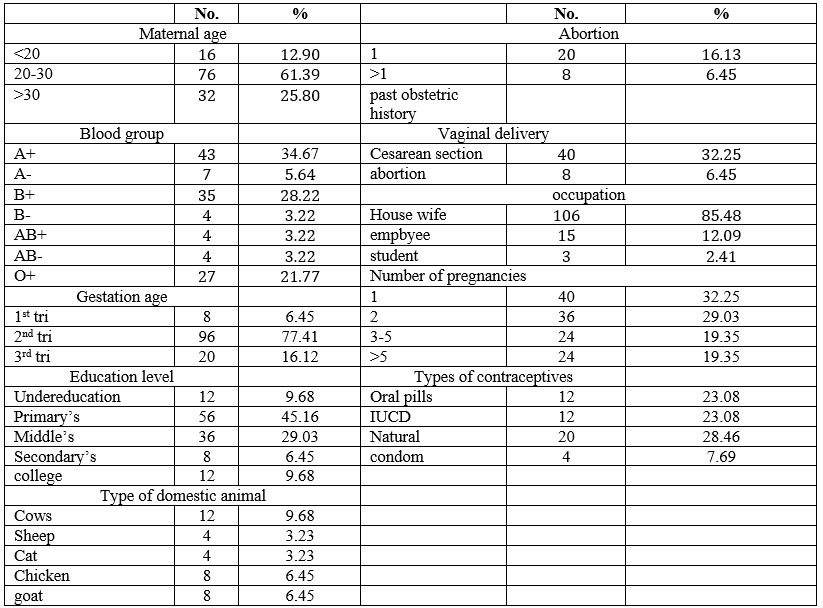
Table (1) shows women age mean is (20-30), which constitute 61.39%, and the most women have blood type (A+), and its 34.67%. The gestational age of them in the first trimester is (41%).


Table (1) The Socio-demographic features of the sample.


Table (2) The gynecological history of the sample

Gynecological use

Frequency

Yes


%

Frequency

No


%


Contraceptive5241.947258.06
Previous vaginal discharge9277.423225.81
Previous infection9277.423225.81


Table (3) reveals microorganisms that were in the samples of the women participating in study, the majority of the women have Staph.Aureus infection with 38.71%. Klebsiella pneumonia is the second one isolated in the samples is (6.13%).


Micro-organism 

frequency

%

Staphylococcus aureus

48

38.71

Klebsiella pneumonia

20

20

S. epidermidis

12

9.67

S agalactia

12

9.67

E. coli

12

9.67

Acinetobacter spp

8

6.45

Pseudomonas aeruginosa

4

3.22

No growth

8

6.45


Table (4) The antibiotics sensitivity patterns of the isolated bacteria in the study


Organisms


Antibiotic Sensitivity%


Nov          Cip          Ami         Olf           Nor         Imi          Azt           Rif           Amo        Dox


Tet

S.   aureus

16

20

28

32

32

24

28

28

12

20

-


(33.33)

(41.66)

(58.33)

(66.66)

(66.66)

(50.0)

(58.33)

(58.33)

(25.0)

(41.66)

-


E.coli

12

-

12

8

8

12

-

-

-

4

8


(100)

-

(100.0)

(66.66)

(66.66)

(100)

-

-

-

(33.33)

(66.66)


Streptococcus

Agalactiae

12

12

12

4

-

8

8

-

4

-

8


(100.0)

(100.0)

(100.0)

(33.33)

-

(66.66)

(66.66)

-

(33.33)


(66.66)


Staph.

Epidermi-dis

-

12

12

12

12

-

12

12

12

-


-

(100.0)

(100.0)

(100.0)

(100.0)

-

(100.0)

(100.0)

(100.0)


Klebsielle

Pneumo-nia

8

16

16

-

8

8

12

-

-

-

-


(40.0)

(80.0)

(80.0)

-

(40.0)

(40.0)

(60.0)


Acinetob-actor

Bauman-nii

-

-

-

-

-

-

8

-

-

-

-


(100.0)


Pseudom-onas

Aerugino-sa

-

-

4

-

-

-

-

-

-

-

-


(100.0)


No growth

ND

ND

ND

ND

ND

ND

ND

ND

ND

ND

ND


 Nov=Novibiopcin; Cip=Ciprofloxacin; Ami=Amikacin; Olf=olfoxacin; Nor=Norfloxacin;

Imi=Imipenem; Azt=Azithromycin; Rif=Rifampin; Amo=Amoxicillin; Dox=Doxycycline; Tet=tetracycline.

DISCUSSION

Different studies could be caused by differences in geography, area, and year of study in subgroup analysis. The bacteria that caused the most ASB and UTIs in pregnant women in Tikrit was Staph. Aureus (387.1%).    Several things affect the frequency of bacteriuria during pregnancy, including having had more than one pregnancy, being older, having diabetes, having a history of urinary tract infections, not taking care of your personal cleanliness, and your socioeconomic position. This study has some advantages over others that have been published before: it uses a larger sample size, cross-sectional studies, doesn't include studies with a non-randomized sample, and gets rid of similar articles that published data more than once. Before, none of the suggested factors were thought to affect the final judgment or the accuracy of the prevalence rate. This is something that these new factors could do. (28)     To find out how common ASB is among pregnant women in Tikrit, we looked at the different stages of pregnancy and found that it was most common in the first three months. Before getting pregnant and again at 6 to 10 weeks, women should have been checked for urinary tract infections. Not getting care before getting pregnant may raise the chance of UTIs in the first three months of pregnancy. But the different rates of ASB around the world may have something to do with the third stage of pregnancy. (29)


The rate of ASB seems to vary by location, and we haven't been able to figure out why. Some possible reasons are changes in race (Tikrit has a lot of different racial groups), socioeconomic status, schooling, access to good health care, and women's health.


About 61.39% of women between the ages of 20 and 30 have had a urinary tract infection. This is because the rate of urinary tract infections in pregnant women is high. When pregnant women get UTIs, they may have a baby early, be born prematurely, or have a baby with low birth weight. They may also have high blood pressure or eclampsia, anemia, and the death of both the mother and the baby. (300)


One study found that this problem happens less often among people with better levels of schooling. And so, pregnant women, especially those with less schooling, need to be taught and made aware of these things.

Staph. Aureus was the most common type of ASB found in pregnant women in Tikrit (387.1%). In other studies, Escherichia coli was the bacteria most often found in women with ASB. Escherichia coli is the main cause of ASB in 65-84% of pregnant women, 77% of sexually active young American women, and 72% of school-age girls. (31)


The goal of ASB treatment is to keep pee clean without harming the mother or the baby while the mother is pregnant. But it's not yet clear what the best way is to do this. In low-income countries, things are worse because people don't know much about how drugs used to treat UTI in pregnancy can become resistant, drugs are expensive, and people can't get information about the safety and effectiveness of new antibiotics.32.   


Some people in Tikrit don't agree on the issue of drug resistance in urinary tract illnesses. In different tests, the amounts of antibiotic resistance and susceptibility have been found to be different. In the yolk study, however, gentamicin and amikacin worked very well against E. coli, while trimethoprim-sulfamethoxazole and ampicillin did not work as well. Because empirical treatment is so important for doctors, it seems necessary to do a thorough study and meta-analysis to find out how patterns of microbial drug resistance against UTI show up in Tikrit.33
CONCLUSIONS

Urinary tract infections and asymptomatic bacteriuria are very common in pregnant women in Tikrit. The most common microorganisms involved in the etiology of ASB in pregnant women of the study in Tikrit are E. coli and Staph. Aureus.


Recommendations:

Further larger studies are needed for ante-natal mothers in antenatal care unit for screening for asymptomatic bacteriuria. Pregnant women should be provided with complete information about complications of urinary tract infection during pregnancy. There is need to revise and establish antibiotic policy so as to guide against the emergence of resistant organisms that cause asymptomatic bacteriurea in ante-natal mothers

REFERENCES
  1. Gulfareen H, Nishat Z, AftabAfroze M, Ambreen H. Risk factors of urinary tract infection in pregnancy. J Pak Med Assoc. 2017;60(3):213–6. https://pubmed.ncbi.nlm.nih.gov/20225781/

  2. MacLean AB. Urinary tract infection in pregnancy. Int J Antimicrob Agents. 2015;17(4):273–6. DOI: 10.1016/s0924-8579(00)00354-x

  3. Girishbabu RJ, Srikrishna R, Rameshs T. Asymptomatic bacteriuria in pregnancy. Int J Biol Med Res. 2019;2(3):740–2.

  4. Totsika M, Moriel DG, Idris A, Rogers BA, Wurpel DJ, Phan MD, et al. Uropathogenic Escherichia coli mediated urinary tract infection. Curr Drug Targets. 2017;13(11):1386–99. DOI: 10.2174/138945012803530206

  5. Counningham FG, Leveno KJ, Bloom SL, et al. Williams Obstetrics. 22nd ed. New York: McGraw_hill; 2020. p. 1095. https://books.google.co.in/books/about/Williams_Obstetrics.html?id=2zZjuYaK9eUC&redir_esc=y

  6. Giraldo PC, Araújo ED, Junior JE, Amaral RLGD, Passos MRL, Gonçalves AK. The prevalence of urogenital infections in pregnant women experiencing preterm and full-term labor. Infect Dis Obstetrics Gynecol. 2019; 2012:1–4. DOI: 10.1155/2012/878241

  7. Raza S, Pandey S, Bhatt CP. Microbiological analysis of isolates in Kathmandu medical college teaching hospital, Kathmandu, Nepal. Kathmandu Univ Med J (KUMJ). 2015;9(36):295–7. DOI: 10.3126/kumj.v9i4.6348

  8. Glaser AP, Schaeffer AJ. Urinary Tract Infection and Bacteriuria in Pregnancy. Urol Clin North Am. 2015;42(4):547–60. https://doi.org/10.1016/j.ucl.2015.05.004. Epub 2015 Aug 1.

  9. Bánhidy F, Acs N, Puhó EH, Czeizel AE. Maternal urinary tract infection and related drug treatments during pregnancy and risk of congenital abnormalities in the offspring. BJOG. 2006; 113:1465–71. DOI: 10.1111/j.1471-0528.2006.01110.x

  10. Khalid RW, Humada YH, Alazzawy MA. Detection of HPV-16 in Cervical Swab in Woman with Recurrent Pregnancy Loss by Real-Time PCR.   Issue 1 Vol 8 No 1 2023 DOI:10.21931/rb/css/s2023.08.01.25

  11. Smaill F, Vazquez JC. Antibiotics for asymptomatic bacteriuria in pregnancy. Cochrane Database Syst Rev. 2015;8:CD000490.doi: 10.1002/14651858.CD000490.pub3.

  12. Vejdani MH, Gourabchi H, Nahaie MRSM. Study of asymptomatic bacteriuria in pregnant women and antibiotic-sensitivity of isolated bacteria in Tabriz 1996. J Kerman Uni Med Sci. 2016;5(4):165–70.

  13. Farajzadegan Z, Mirmoghtadaee P, Mehrabian F. Screening of asymptomatic bacteriuria: urinalysis or urine culture? Which one is more cost- effective? J Isfahan Med School. 2019;26(89):119–26. https://doi.org/10.2147/ijwh.s256943

  14. Shirazi MH, Ranjbar R, Daneshyar E, Sadeghian S, Sadeghifard N. Urinary tract pathogens in asymptomatic bacteriuria and their antimicrobial resistance in pregnant women in Hamedan. IJIDTM J. 2007;12(36):53–8.

  15. Safari M, Yazdanpanah B, Yazdanpanah S. High risk pregnancy and some of related factors in women who Refered to Vasouj health and medical centers. Sci J Hamadan Nurs Midwifery Fac. 2008;16(2):18–28. https://www.semanticscholar.org/paper/High-Risk-Pregnancy-and-Some-of-Related-Factors-in-Safari-Yazdanpanah/257014b2ad92b86d9f97a538d743c6caf22b3879

  16. Mobsheri E, Tabbraei A, Ghaemei E, Mojerloo M, Vakili MA, Dastforooshan M, et al. Distribution of asymptomatic bacteriuria in pregnant women referring to Dezyani Hospital in Gorgan. J Gorgan Uni Med Sci. 2002;4(1):42–6. https://doaj.org/article/a9ba6d8f6136454b97a7e7f60cfae610

  17. Kameli M, Badiee M, Rafiee M. Prevalence of asymptomatic bacteriuria and its treatment in pregnant women referred to health centers of Torbat Haydarieh in 2013. J Torbat Heydariyeh Uni Med Sci. 2013;1(3):58–64. https://doi.org/10.1371/journal.pone.0158031

  18. Soofizadeh N, Farhadifar F, Kalantar E, Shahsavari S. Evaluating the prevalence of asymptomatic urinary tract infection and Anemia in pregnant women in first trimester. IJOGI. 2012;15(8):11–6.

  19. Azizzadeh Sh, Ashtiani M, Baygi D. Evaluate the frequency of asymptomatic bacteriuria in pregnant women and diagnostic value of urine analysis in screening with its during 1999. [dissertation]. Tehran: Tehran Univ Med Sci; 1999.

  20. Aaron H, Salari D. The prevalence of asymptomatic bacteriuria in pregnant women referred to Afzalipour haspital in Kerman. [Dissertation]. Kerman: Kerman Univ Med Sci; 2008. 

  21. Aghaee alamouti M, Moheit M. The prevalence of asymptomatic bacteriuria and social factors that influence the prevalence among women referred to hospitals in Tehran. [Dissertation]. Tehran: Islamic Azad Univ Med Sci; 2010.

  22. Yousofzadeh Sh. Determine the prevalence of asymptomatic and symptomatic urinary tract infection in pregnant women referred to prenatal care in Kashan. [Dissertation]. Kashan: Kashan Univ Med Sci; 1995.

  23. Necohesh L, Karimi MR. The Survey of bacterial agents of rinary tract infection among pregnant women in Ghods city in 2004–2005. [Dissertation]. Tehran: Islamic Azad Univ Med Sci; 2005.

  24. Namazi A, Alizadeh S. The frequency of bacteriuria and its relationship with demographic characters in pregnant women of Gilan, 2009–11. J Kermanshah Univ Med Sci. 2012;16(3):263–8. DOI:10.22110/JKUMS.V16I3.556

  25. Shojaee H. Microbiologic evaluation of bacteriuria in pregnant women in Shahrekord 1999. Pejouhandeh Q Res J. 2000;5(19):337–43. https://www.semanticscholar.org/paper/MICROBIOLOGIC-EVALUATION-OF-BACTERIURIA-IN-PREGNANT-Shodjai/cb8221086b404b59a7dbc12e09b9efae2f894788

  26. Zarganj Fard A. The prevalence of asymptomatic bacteriuria in pregnant women who were referred to health centers of Arak city from November 1998 to March 1999. Arak Univ Med Sci (Rahavard Danesh). 2000;3(10):21–4.

  27. Khorshidi A, Khakbazan S, Mousavi SGA, Hoshyaran A. Epidemiologic study of urinary infections without clinical symptoms among pregnant women: Diagnostic values of Nitrate among subjects referred to the Dr. Shabikhani Hospital, 1996. KAUMS Journal (FEYZ). 1997;1(3):53–60. https://www.semanticscholar.org/paper/Epidemiologic-study-of-urinary-infections-without-Khorshidi-Khakbazan/15026f109ea3ef01bc4bc3bc9e378baf36e21141

  28. Hazhir S. Asymptomatic bacteriuria in pregnant women. Urol J. 2007;4(1):24–7. https://pubmed.ncbi.nlm.nih.gov/17514607/

  29. Motaghi M, Sadegh-Al-Hosseini A, Yaghoubi MA. Assessment of the risk factors of asymptomatic bacteriuria among pregnant and non-pregnant married women. Zahedan J Res Med Sci (ZJRMS). 2012;13(suppl 1):4. https://brieflands.com/articles/zjrms-93888

  30. Dadkhah F, Kashanian M, Noori M. A Comparison between Diagnostic Value of Pyuria and Bacteriuria in Asymptomatic Bacteriuria in Pregnant Women. IJOGI. 2011;14(1):48–53. https://www.researchgate.net/publication/287477579_A_Comparison_between_diagnostic_value_of_pyuria_and_bacteriuria_in_asymptomatic_bacteriuria_in_pregnant_women

  31. Kalantar E, Fariba F, Bahram N. Asymptomatic bacteriuria among pregnant women referred to outpatient clinics in Sanandaj, Iran. Int Braz J Urol. 2008;34(6):699–704. DOI: 10.1590/s1677-55382008000600004

  32. Kasraeian M, Asadi N, Ghaffarpasand F. Prevalence of asymptomatic bacteriuria among pregnant women in shiraz, Iran. Saudi Med J. 2009;30(7):917–20. https://pubmed.ncbi.nlm.nih.gov/19618007/

  33. Jazayeri Moghadas A, Irajian G. Asymptomatic urinary tract infection in pregnant women. Iran J Pathol. 2009;4(3):105–8. https://www.semanticscholar.org/paper/Asymptomatic-urinary-tract-infection-in-pregnant-Moghadas-Irajian/11caf86dde363172f099e76b43b3dfd46cae9192

Recommended Articles
Research Article
Histopathological Spectrum of Endometrial Biopsies in Abnormal Uterine Bleeding in Mosul City Iraq
Published: 30/06/2026
Download PDF
Research Article
A Study on the Levels for mRNA Gene Expression of NF-κB and miR-34a Genes in Human Patients with Breast Cancer: An Indication for Resistance to Chemotherapy
Published: 15/12/2023
Download PDF
Research Article
Molecular Study to Detect Some Virulence Factors in Methicillin – Resistance Staphlococcus Aureus Isolated from Eye Infections in Wasit Province
Published: 15/12/2023
Download PDF
Research Article
Occurrence of Multi-Drug Resistance of E. coli Isolated from Urinary Tract Infection in Najaf City
...
Published: 05/10/2025
Download PDF
Chat on WhatsApp
Flowbite Logo
PO Box 101, Nakuru
Kenya.
Email: office@iarconsortium.org

Editorial Office:
J.L Bhavan, Near Radison Blu Hotel,
Jalukbari, Guwahati-India
Useful Links
Order Hard Copy
Privacy policy
Terms and Conditions
Refund Policy
Shipping Policy
Others
About Us
Team Members
Contact Us
Online Payments
Join as Editor
Join as Reviewer
Subscribe to our Newsletter
+91 60029-93949
Follow us
MOST SEARCHED KEYWORDS
Copyright © iARCON International LLP . All Rights Reserved.