The Association of Zonulin with Obesity and Metabolic Parameters in Polycystic Ovary Syndrome Compared to Healthy Women
Asan Hussein Mohammed Ali
1
,
Miami Abdul Hassan Ali
2
1
M.B.Ch.B., Iraqi Board for Medical Specializations, Scientific Council of Obstetrics and Gynecology, Azadi Teaching Hospital, Kirkuk, Iraq
2
M.B.Ch.B - F.I.C.O.G. Professor in Obstetric and gynecology. The Chairman of Scientific Council of Obstetrics and Gynecology. Iraqi Board for Medical Specialization, Iraq
Background:Polycystic ovary syndrome (PCOS) is a common endocrine–metabolic disorder characterized by insulin resistance, obesity, and multiple metabolic disturbances. Zonulin, a physiological modulator of intestinal tight junctions, is considered a marker of increased intestinal permeability and has been implicated in systemic inflammation and metabolic dysfunction, suggesting a potential role in the pathophysiology of PCOS. Aim: To evaluate the association of serum zonulin with obesity and metabolic parameters in women with PCOS compared to healthy controls. Methods: This case–control study included 90 women aged 20–40 years: 40 women with PCOS (18 obese and 22 non-obese) and 50 healthy ovulatory women. The study was conducted at the gynecological and infertility clinics, Azadi Teaching Hospital, Kirkuk. Serum zonulin levels were measured, and insulin resistance was assessed using the Homeostatic Model Assessment for Insulin Resistance (HOMA-IR). Results: Women with PCOS demonstrated significantly higher body mass index (BMI), waist circumference, luteinizing hormone (LH), LH/FSH ratio, free testosterone, triglycerides, low-density lipoprotein cholesterol (LDL-C), HOMA-IR, C-reactive protein (CRP), and zonulin levels compared with controls, while high-density lipoprotein cholesterol (HDL-C) was significantly lower. Obese women with PCOS exhibited significantly higher metabolic and hormonal parameters, including zonulin, compared with non-obese PCOS women. Serum zonulin levels were significantly elevated in PCOS patients compared to controls (49.3±12.5 vs 35.37±10.55 ng/mL, p<0.05). Zonulin showed positive correlations with BMI, waist circumference, HOMA-IR, triglycerides, total cholesterol, CRP, LH, and free testosterone, and a negative correlation with HDL-C. At a cut-off value of 40.63 ng/mL, zonulin demonstrated 70% sensitivity and 70% specificity (PPV 65%, NPV 74%). Conclusion: Serum zonulin levels are elevated in women with PCOS, particularly in obese women, and are associated with insulin resistance, inflammation, dyslipidemia, and hyperandrogenism. These findings support a potential role for zonulin in the metabolic and inflammatory pathophysiology of PCOS.
Keywords
PCOS
Zonulin
Obesity
Insulin Resistance
INTRODUCTION
Polycystic ovary syndrome (PCOS) is a common and complex endocrine–metabolic disorder characterized by ovarian dysfunction, hyperandrogenism, and metabolic abnormalities, including insulin resistance and obesity. According to the Rotterdam criteria, PCOS is diagnosed when at least two of the following are present: oligo- and/or anovulation, clinical or biochemical hyperandrogenism, and polycystic ovarian morphology on ultrasound, after excluding other etiologies [1]. PCOS is considered the leading cause of anovulatory infertility and secondary amenorrhea among women of reproductive age, reflecting its significant reproductive and endocrine burden.
The global prevalence of PCOS ranges from 6% to 20% depending on the diagnostic criteria and population studied, making it one of the most prevalent endocrine disorders in women [2]. In Iraq, the prevalence is estimated to range between 12% and 21%, with a higher frequency observed among overweight and obese women, and it contributes substantially to infertility rates [3]. The etiology of PCOS is multifactorial, involving genetic predisposition, environmental influences, and metabolic disturbances. Studies suggest a strong hereditary component, with heritability estimates reaching up to 70%, while factors such as obesity, insulin resistance, and prenatal androgen exposure may trigger disease expression in genetically susceptible individuals [4].
The pathophysiology of PCOS is complex and involves interactions between endocrine, metabolic, and inflammatory pathways. Insulin resistance plays a central role, where compensatory hyperinsulinemia enhances ovarian androgen production and suppresses sex hormone-binding globulin (SHBG), leading to increased circulating free androgens [5]. In addition, chronic low-grade inflammation contributes to metabolic dysfunction, while emerging evidence highlights the role of gut dysbiosis and increased intestinal permeability in disease progression. Alterations in gut microbiota composition may promote translocation of endotoxins such as lipopolysaccharides, triggering systemic inflammation and exacerbating insulin resistance and hyperandrogenism [6].
Zonulin, a physiological regulator of intestinal tight junctions, has recently gained attention as a marker of intestinal permeability. Elevated zonulin levels indicate disruption of the intestinal barrier (“leaky gut”), allowing translocation of microbial products into the circulation and promoting systemic inflammation [7]. Increased zonulin levels have been associated with obesity, insulin resistance, dyslipidemia, and inflammatory conditions, all of which are key features of PCOS [8]. Furthermore, studies have demonstrated that zonulin may correlate positively with metabolic and hormonal disturbances, suggesting that intestinal permeability may play a role in the pathophysiology of PCOS [9]. Given the growing evidence linking gut permeability, inflammation, and metabolic dysfunction, zonulin may serve as a potential biomarker reflecting underlying pathophysiological processes in PCOS. The present study aimed to assess the association of serum zonulin with obesity and metabolic parameters in women with polycystic ovary syndrome compared to healthy controls.
MATERIAL
This case–control study was conducted at the Gynecological and Infertility Clinics of Azadi Teaching Hospital, Kirkuk, Iraq, over an 8-month period from January to August 2025.
The study protocol was approved by the Scientific Council of Obstetrics and Gynecology, Iraqi Board for Medical Specializations (Approval No. Ob/Gyn 258). Additional permission was obtained from the Scientific Committees of the Obstetrics and Gynecology Department at Azadi Teaching Hospital. The study adhered to the principles of the Declaration of Helsinki, and verbal informed consent was obtained from all participants prior to enrollment. Confidentiality was ensured by anonymizing patient data.
A total of 90 women aged 20–40 years were included and divided into two groups: 40 women diagnosed with polycystic ovary syndrome (PCOS) and 50 healthy ovulatory women as controls. The PCOS group was further subdivided into 18 obese and 22 non-obese women. The diagnosis of PCOS was established according to the Rotterdam criteria (2003), requiring at least two of the following: oligo- and/or anovulation, clinical or biochemical hyperandrogenism, or polycystic ovarian morphology on ultrasound, after exclusion of other etiologies.
Women were excluded if they were pregnant or lactating, had endocrine disorders (diabetes mellitus, thyroid disease, hyperprolactinemia, congenital adrenal hyperplasia, Cushing’s syndrome, or androgen-secreting tumors), hepatic or renal dysfunction, hypertension or cardiovascular disease, malignancy, gastrointestinal diseases affecting intestinal permeability, recent infections, or use of medications affecting metabolic or endocrine function within the previous three months.
Data were collected using a structured questionnaire that included demographic data, menstrual and obstetric history, gynecological and medical history, drug history, family history, and symptoms of hyperandrogenism. Physical examination included blood pressure measurement, waist circumference assessment, body mass index (BMI) calculation according to WHO classification, and Ferriman–Gallwey scoring for hirsutism.
Fasting venous blood samples (10 mL) were obtained after 8–12 hours of fasting. Biochemical parameters included fasting glucose, insulin, lipid profile, white blood cell count, and C-reactive protein. Insulin resistance was calculated using the Homeostatic Model Assessment for Insulin Resistance (HOMA-IR). Hormonal assays included luteinizing hormone (LH), follicle-stimulating hormone (FSH), free testosterone, and prolactin. Serum zonulin levels were measured using a sandwich ELISA technique.
Ultrasound examination (transvaginal or abdominal) was performed to assess ovarian morphology and exclude other pathologies. Serum samples were stored at −80°C until analysis.
Statistical analysis was performed using SPSS version 25. Continuous variables were expressed as mean ±standard deviation, and categorical variables as frequencies and percentages. Group comparisons were conducted using independent t-tests or Mann–Whitney U tests, while chi-square tests were used for categorical data. Pearson correlation and ROC curve analysis were applied. A p-value <0.05 was considered statistically significant.
RESULTS
The study included 90 women aged 20–40 years, divided into 40 women with PCOS and 50 healthy ovulatory controls. The PCOS group was further subdivided into 18 obese and 22 non-obese women.
Age did not differ significantly between the PCOS and control groups, indicating comparable age distribution. However, BMI and waist circumference were significantly higher among women with PCOS, reflecting greater adiposity and central obesity in this group (Table 1).
Table 1: The Distribution of Demographic Data Between the Studied Groups
Parameters
PCOS group N= 40
Control group N=50
*p-value
Age (years) Mean± SD
29.2±5.8
30.0±5.7
0.48
BMI (kg/m²) Mean± SD
28.6±4.3
26.6±1.1
˂0.001
Waist circumference (cm) Mean± SD
92.1±8.5
81.4±4.5
˂0.001
*Independent t-test, p value >0.05: Not significant, P value ˂0.05 is statistically significant, p˂0.001 is highly significant, SD: standard deviation. BMI: body mass index
Hormonal analysis showed no significant difference in FSH levels, while LH, LH/FSH ratio, free testosterone, and prolactin were significantly higher in women with PCOS. These findings reflect the typical endocrine profile of PCOS, particularly hyperandrogenism and increased LH activity (Table 2).
Table 2: The Distribution of Hormonal Parameters Between the Studied Groups
Parameters
PCOS group N=40
Control group N= 50
*p value
FSH (mIU/ml)
6.8±2.9
7.34±1.75
0.32
LH (mIU/ml)
15.1±6.3
4.86±1.09
˂0.001
LH/FSH ratio
2.22±1.0
0.66±0.18
˂0.001
Free testosterone(pg/mL)
2.8±2.5
2.5±0.6
0.03
Prolactin (ng/mL)
14.2±5.0
11.71±2.83
0.02
*Independent t-test
Metabolic and inflammatory parameters showed significant differences between groups. Women with PCOS had significantly higher triglycerides, LDL-C, fasting blood sugar, HOMA-IR, and CRP, while HDL-C was significantly lower. Total cholesterol and WBC count showed no significant differences (Table 3).
Table 3: The Distribution of Metabolic and Inflammatory Parameters between the Studied Groups
Parameters
PCOS group N=40
Control group N=50
*p-value
Triglycerides (mmol/l) Mean± SD
1.78±0.48
1.34±0.07
<0.001
Total cholesterol (mmol/l) Mean± SD
5.1±0.55
4.96±0.15
0.12
HDL-C (mmol/l) Mean± SD
1.21±0.21
1.43±0.04
<0.001
LDL-C (mmol/l) Mean± SD
3.2±0.35
2.85±0.05
<0.001
FBS (mmol/l) Mean± SD
5.6± 1.1
5.0±0.16
<0.001
HOMA-IR Mean± SD
3.5±1.2
1.40±0.60
<0.001
CRP (mg/L) Mean± SD
4.0±0.7
2.0±0.5
<0.001
WBC (103/µL) Mean± SD
7.5±1.2
6.8±1.0
0.08
*Independent t-test
Serum zonulin levels were significantly elevated in the PCOS group compared with controls, suggesting increased intestinal permeability and its possible involvement in PCOS-related metabolic and inflammatory dysfunction (Table 4).
Table 4: The Comparison of Zonulin Levels between the Studied Groups
Parameters
PCOS group N=40
Control group N= 50
*p-value
Zonulin level ( ng/ml) Mean±SD
49.3±12.5
35.37±10.55
<0.001
*Independent t-test
Among women with PCOS, obese patients had significantly higher BMI, waist circumference, HOMA-IR, triglycerides, total cholesterol, LDL-C, LH, LH/FSH ratio, free testosterone, zonulin, and CRP compared with non-obese patients, while HDL-C was significantly lower. No significant differences were observed in age, FBS, FSH, prolactin, or WBC count (Table 5).
Table 5: The Distribution of Clinical, Biochemical and Inflammatory Parameters between Obese and Non-Obese Patients in PCOS Group
Parameters
Obese PCOS group N=18
Non-obese PCOS group N=22
*p-value
Age (years) Mean± SD
31.4±5.2
29.5±5.1
0.08
BMI (kg/m2) Mean± SD
32.8±2.1
25.9±2.2
<0.001
Waist circumstance (cm) Mean± SD
92.4±6.5
87.4±8.4
<0.001
FBS (mmol/l) Mean±SD
6.0±1.1
5.2±0.9
0.12
HOMA IR Mean± SD
4.1±1.3
2.6±1.0
<0.001
Triglyceride (mmol/mL) Mean± SD
2.0±0.5
1.5±0.4
<0.001
Total cholesterol (mmol/L) Mean± SD
5.3±0.5
4.8±0.5
0.002
HDL-C (mmol/L) Mean± SD
1.1±0.2
1.3±0.2
0.001
LDL-C (mmol/L) Mean± SD
3.4±0.4
2.9±0.4
<0.001
Zonulin (ng/ml) Mean± SD
54.2±12.3
43.1±11.0
<0.001
FSH (mIU/ml) Mean± SD
6.1±1.6
6.4±1.8
0.38
LH (mIU/ml) Mean± SD
19.8±5.6
12.7±6.0
<0.001
LH/FSH ratio Mean± SD
3.9±1.2
1.6±0.8
<0.001
Free testosterone (pg/ml) Mean± SD
3.6±1.2
2.5±1.1
0.004
Prolactin (ng/mL) Mean± SD
16.0±4.8
12.8±3.5
0.09
CPR (mg/L) Mean± SD
4.8±0.6
3.5±0.5
<0.01
WBC (103/µL) Mean± SD
7.9±1.1
7.2±1.0
0.2
*Independent t-test
Correlation analysis demonstrated that serum zonulin was positively associated with BMI, waist circumference, HOMA-IR, triglycerides, total cholesterol, LH, free testosterone, and CRP, and negatively correlated with HDL-C. These findings support a possible link between zonulin, obesity, insulin resistance, dyslipidemia, inflammation, and hormonal imbalance in PCOS (Table 6).
Table 6: The Correlation of Zonulin with Anthropometric, Metabolic, and Hormonal Parameters in the PCOS Group
Parameters
Zonulin level
r
*p-value
BMI (kg/m²)
0.52
<0.001
Waist circumference
0.60
<0.001
Fasting glucose
0.35
0.21
HOMA IR
0.40
0.02
Triglyceride
0.42
0.001
Total cholesterol
0.30
0.04
HDL-C
-0.442
0.042
LDL-C
0.28
0.05
FSH
-0.09
0.54
LH
0.42
0.01
Prolactin
0.07
0.61
Free testosterone
0.38
0.015
CRP
0.48
0.002
WBC
0.12
0.34
*r: Pearson correlation
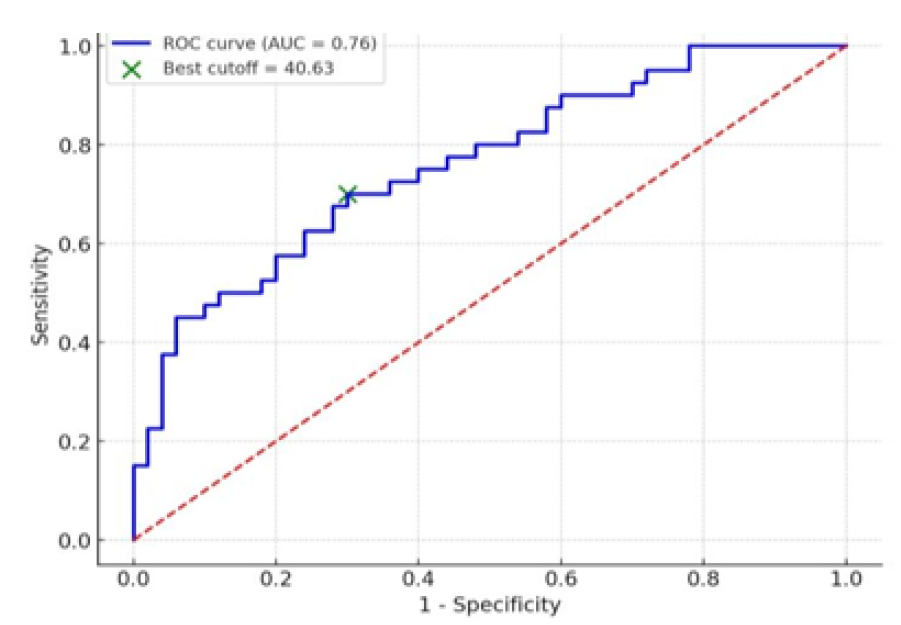
ROC curve analysis showed that serum zonulin at a cutoff value of 40.63 ng/mL had fair diagnostic performance for identifying PCOS, with an AUC of 0.7605, sensitivity of 70%, specificity of 70%, PPV of 65%, and NPV of 74% (Table 7) (Figure 1).
Figure 1:Roc Curve Analysis of Serum Zonulinfor Prediction of Pcos Patients
Table 7:ROC Curve Analysis of Serum Zonulinfor Prediction of PCOS Patients
Cut-off
40.63
Area Under Curve(AUC)
0.7605
Sensitivity
70%
Specificity
70%
Positive Predictive Value(PPV)
65%
Negative Predictive Value(NPV)
74%
Standard error
0.052
DISCUSSION
Polycystic ovary syndrome (PCOS) is widely recognized as the most common endocrine–metabolic disorder among women of reproductive age and is strongly associated with obesity, insulin resistance, dyslipidemia, chronic low-grade inflammation, and increased long-term cardiometabolic risk [3]. In the present study, age did not differ significantly between the PCOS and control groups, indicating appropriate matching and minimizing age-related confounding. In contrast, BMI and waist circumference were significantly higher in women with PCOS, reflecting increased general and central obesity. These findings are consistent with previous studies reporting higher adiposity in PCOS, particularly among obese phenotypes [4,5]. Visceral adiposity plays a crucial endocrine role by promoting insulin resistance, metabolic dysregulation, and systemic inflammation. Regarding hormonal parameters, the present study demonstrated significantly higher LH, LH/FSH ratio, free testosterone, and prolactin levels in women with PCOS, while FSH levels showed no significant difference. These findings reflect the classical endocrine abnormalities of PCOS, characterized by hypothalamic–pituitary–ovarian axis dysregulation and hyperandrogenism. Similar findings were reported by Azziz et al. [7], Khaleel et al. [8], and Li et al. [9], who documented elevated LH levels, increased LH/FSH ratio, and androgen excess in PCOS patients. With respect to metabolic and inflammatory parameters, women with PCOS exhibited significantly higher triglycerides, LDL-C, fasting blood glucose, HOMA-IR, and CRP levels, along with significantly lower HDL-C levels. These findings support the well-established association between PCOS, insulin resistance, dyslipidemia, and chronic low-grade inflammation [10–12]. Chronic inflammation is increasingly recognized as a central mechanism contributing to metabolic dysfunction in PCOS.
The most important finding of the present study was the significant elevation of serum zonulin levels in women with PCOS compared with controls. Zonulin is a key regulator of intestinal tight junctions and a biomarker of increased intestinal permeability. Elevated zonulin may facilitate the translocation of bacterial endotoxins into systemic circulation, thereby triggering inflammation and worsening insulin resistance [13–15]. These findings are in agreement with Zang et al. [4] and Kabakchieva et al. [16], who reported elevated zonulin levels in PCOS, particularly among obese women. However, Cetin et al. [17] reported no significant differences, suggesting that variability may be attributed to differences in sample size, ethnicity, or assay methods.
Comparison between obese and non-obese PCOS patients revealed that obese women had significantly higher BMI, waist circumference, HOMA-IR, triglycerides, total cholesterol, LDL-C, LH, LH/FSH ratio, free testosterone, zonulin, and CRP, along with lower HDL-C levels. These findings indicate that obesity exacerbates metabolic, hormonal, inflammatory, and gut permeability disturbances in PCOS. Similar findings were reported by Martínez-García et al. [5] and Zhao et al. [6], confirming the additive effect of obesity on PCOS severity.
Correlation analysis demonstrated that zonulin levels were significantly positively correlated with BMI, waist circumference, HOMA-IR, triglycerides, total cholesterol, LH, free testosterone, and CRP, while negatively correlated with HDL-C. These results support the role of zonulin as a potential link between intestinal permeability, metabolic dysfunction, inflammation, and hormonal imbalance in PCOS [13,18–20].
ROC curve analysis showed that serum zonulin at a cutoff value of 40.63 ng/mL had fair diagnostic accuracy (AUC=0.76), with sensitivity and specificity of 70%. These findings suggest that zonulin may serve as a supportive biomarker reflecting metabolic severity rather than a standalone diagnostic tool. Most previous studies focused on mean zonulin levels and correlations without establishing diagnostic thresholds [18,21–23].
Overall, the findings of the present study support the concept that PCOS is a multifactorial disorder involving endocrine, metabolic, inflammatory, and gastrointestinal components. Elevated zonulin levels suggest that increased intestinal permeability may contribute to PCOS pathophysiology and its associated metabolic complications. Further large-scale and longitudinal studies are required to validate these findings and to explore zonulin as a potential therapeutic target [24–28].
Conflict of Interest
The authors declare that there is no conflict of interest regarding the publication of this study.
REFERENCE
Escobar-Morreale, H.F. “Polycystic ovary syndrome: pathophysiology, diagnosis and treatment.” Nature Reviews Endocrinology, vol. 19, 2023, pp. 270–287.
Teede, H.J. et al. “International evidence-based guideline for the assessment and management of PCOS 2023.” Fertility and Sterility, 2023.
Diamanti-Kandarakis, E. and Dunaif, A. “Insulin resistance and the polycystic ovary syndrome revisited: an update.” Endocrine Reviews, vol. 43, 2022, pp. 92–120.
Zang, Y. et al. “Elevated zonulin and metabolic derangements in obese women with polycystic ovary syndrome.” International Journal of Women’s Health, 2025.
Martínez-García, M.A. et al. “Obesity and PCOS influence on intestinal permeability and metabolic biomarkers.” Food Research International, 2024.
Zhao, L. et al. “Gut barrier markers and insulin resistance in women with central obesity and PCOS.” Frontiers in Endocrinology (Lausanne), vol. 14, 2023, Article 1123456.
Azziz, R. et al. “The prevalence and features of polycystic ovary syndrome.” Journal of Clinical Endocrinology and Metabolism, vol. 110, 2025, pp. 123–134.
Khaleel, A.S. et al. “Hormonal parameters in PCOS patients: correlation with metabolic profiles.” Cellular and Molecular Biology, vol. 71, no. 10, 2025, pp. 82–88.
Li, X. et al. “Hormonal and metabolic interactions in obese and non-obese PCOS women.” Journal of Endocrinological Investigation, vol. 47, 2024, pp. 1021–1032.
Karakus, S. et al. “Chronic low-grade inflammation in women with PCOS.” Journal of Endocrinological Investigation, vol. 47, 2024, pp. 215–225.
Aubead, N.M., Hasan, S.M. and Kareem, N.A. “Inflammatory indices in PCOS and metabolic risk.” Medical Journal of Babylon, vol. 22, 2025, pp. 45–52.
Zhang, H. et al. “Systemic inflammation and insulin resistance in PCOS.” Frontiers in Endocrinology (Lausanne), vol. 14, 2023, Article 1109876.
Fasano, A. “Zonulin and its regulation of intestinal barrier function.” Physiological Reviews, vol. 91, no. 1, 2011, pp. 151–175.
Tripathi, A. et al. “Identification of zonulin as prehaptoglobin-2.” Proceedings of the National Academy of Sciences USA, vol. 106, no. 39, 2009, pp. 16799–16804.
Moreno-Navarrete, J.M. et al. “Circulating zonulin is increased in obesity and insulin resistance.” PLoS One, vol. 7, no. 5, 2012.
Kabakchieva, P. et al. “Zonulin in PCOS: associations with obesity and insulin resistance.” Diabetology and Metabolic Syndrome, vol. 16, 2024, p. 12.
Cetin, M. et al. “Serum zonulin levels and metabolic parameters in PCOS.” Journal of Obstetrics and Gynaecology, vol. 39, no. 2, 2019, pp. 216–221.
Polak, K. et al. “New markers of insulin resistance in PCOS.” Journal of Endocrinological Investigation, vol. 40, 2017, pp. 1–8.
El Asmar, R., Rahmani, S. and Fasano, A. “Zonulin in chronic inflammatory disorders.” Current Medicinal Chemistry, vol. 32, 2025, pp. 6547–6562.
Zhou, H.Y. et al. “Zonulin and intestinal permeability in metabolic diseases.” Current Medicinal Chemistry, vol. 32, 2025, pp. 6547–6562.
Zhang, Y. et al. “Zonulin and metabolic dysfunction in PCOS.” Frontiers in Endocrinology (Lausanne), vol. 14, 2023.
Kabakchieva, P. et al. “Zonulin and metabolic parameters in PCOS women.” Diabetology and Metabolic Syndrome, vol. 16, 2024, p. 12.
Zhao, L. et al. “Gut permeability and PCOS severity.” Frontiers in Endocrinology (Lausanne), vol. 14, 2023, Article 1123456.
Barber, T.M. and Franks, S. “The etiology of PCOS: genetic and environmental interaction.” Clinical Endocrinology (Oxford), vol. 95, no. 2, 2021, pp. 123–130.
Rosenfield, R.L. “Current concepts of PCOS pathogenesis.” Current Opinion in Pediatrics, vol. 32, no. 5, 2020, pp. 698–706.
Spahis, S. et al. “Adipose tissue inflammation and metabolic disease.” Obesity Reviews, vol. 26, 2025, Article e13390.
Wondmkun, Y.T. “Obesity, insulin resistance, and metabolic disease.” Diabetes, Metabolic Syndrome and Obesity, vol. 13, 2020, pp. 3611–3620.
Geng, L. et al. “Gut microbiota and metabolic regulation in PCOS.” Advanced Science (Weinheim), vol. 12, 2025, Article e2412558.
Recommended Articles
Research Article
Histopathological Spectrum of Endometrial Biopsies in Abnormal Uterine Bleeding in Mosul City Iraq
Farah Talal Abdulraheem
Published: 30/06/2026
Download PDF
Research Article
A Study on the Levels for mRNA Gene Expression of NF-κB and miR-34a Genes in Human Patients with Breast Cancer: An Indication for Resistance to Chemotherapy
Najlaa O.H. Aljubury,
Salim Hussein Jari
Published: 15/12/2023
Download PDF
Research Article
Molecular Study to Detect Some Virulence Factors in Methicillin – Resistance Staphlococcus Aureus Isolated from Eye Infections in Wasit Province
Nofel Hossin Amhi Alshammari,
Haider Kareem Jassem
Published: 15/12/2023
Download PDF
Research Article
Occurrence of Multi-Drug Resistance of E. coli Isolated from Urinary Tract Infection in Najaf City
Alaa Hamza Jaber Al-Jelehawy,
...
Haneen Ali Kadham
Published: 05/10/2025
Download PDF
PO Box 101, Nakuru
Kenya.
Email: office@iarconsortium.org
Editorial Office:
J.L Bhavan, Near Radison Blu Hotel,
Jalukbari, Guwahati-India
Ali, A. H. M. & Ali, M. A. H. (2026). The Association of Zonulin with Obesity and Metabolic Parameters in Polycystic Ovary Syndrome Compared to Healthy Women. Scientific Research Journal of Medical Sciences, 6(1), 1-5.
MLA
Ali, Asan H. M. and Miami A. H. Ali. "The Association of Zonulin with Obesity and Metabolic Parameters in Polycystic Ovary Syndrome Compared to Healthy Women." Scientific Research Journal of Medical Sciences 6.1 (2026): 1-5.
Chicago
Ali, Asan H. M. and Miami A. H. Ali. "The Association of Zonulin with Obesity and Metabolic Parameters in Polycystic Ovary Syndrome Compared to Healthy Women." Scientific Research Journal of Medical Sciences 6, no. 1 (2026): 1-5.
Harvard
Ali, A. H. M. and Ali, M. A. H. (2026) 'The Association of Zonulin with Obesity and Metabolic Parameters in Polycystic Ovary Syndrome Compared to Healthy Women' Scientific Research Journal of Medical Sciences 6(1), pp. 1-5.
Vancouver
Ali AHM, Ali MAH. The Association of Zonulin with Obesity and Metabolic Parameters in Polycystic Ovary Syndrome Compared to Healthy Women. Scientific Research Journal of Medical Sciences. 2026 Jan;6(1):1-5.


 Download PDF
 Download XML