Poly Cystic Ovarian Syndrome (PCOS) is the most common endocrinopathy in women of reproductive age, resulting from insulin resistance and the compensatory hyperinsulinemia. This results in adverse effect on multiple organ systems and may result in alteration in serum lipids, anovulation, abnormal uterine bleeding and infertility. It is the primary cause of infertility nowadays. In Ayurveda all gynecological disorders are explained under Yonivyapadas. Based on the principles PCOS can be diagnosed and treated as well. Following is a case study of a female having infertility due to PCOS. Her reports showed PCOS with unovulatory cycles. She was treated with different Ayurveda treatment modalities like Shodhana and Shamana. The results revealed that, infertility due to PCOS can be cured successfully by using this Ayurveda treatment.
Keywords
Poly Cystic Ovarian Syndrome
Infertility
Yonivyapada
Hyperinsulinemia
INTRODUCTION
Polycystic ovarian syndrome is a disorder of the endocrine system caused by hormonal imbalance. It is characterized by excess androgen production by ovaries or adrenals which interferes growth of ovarian follicles. It consists of three diagnostic criteria – chronic anovulation hyperandrogenism and polycystic ovaries. It is the leading cause of infertility. 5-10 % of child bearing age women have PCOS.
Poly Cystic Ovarian Syndrome is a condition that has cysts on the ovaries that prevent the ovaries from performing normally. Symptoms of Poly Cystic Ovarian Syndrome include Amenorrhea or infrequent menstruation, irregular bleeding, infrequent or no ovulation, multiple immature follicles, increased levels of male hormones, male pattern baldness or thinning hair, excess facial and body hair growth, acne, oily skin or dandruff, dark coloured patches of skin specially on neck, groin, underarms, chronic pelvic pain, increased weight or obesity, diabetes, lipid abnormalities and high blood pressure [1].
Fertility problems experienced by women with Poly Cystic Ovarian Syndrome may be related to the elevated hormone, insulin or glucose levels, all of which can interfere with implantation as well as development of the embryo. Increased Leutenizing hormone reduces the chance of conception and increase miscarriage. Additionally, abnormal insulin levels may also contribute to poor egg quality, making conception more difficult [1].
The conventional treatment for PCOS with infertility is metformin, OC pills and ovulation induction drugs. Long term use of these drugs can cause side effects like GIT symptoms, ovarian hyperstimulation syndrome and hepato toxicity also. But PCOS should be treated for infertility as well as menstrual disorders and to prevent long standing metabolic diseases.
In Ayurveda PCOS is not described as a separate disease. The clinical features, etio pathogenesis can be correlated to different gynaecological disorders. In Ayurveda all gynaecological disorders are incorporated in Yonivyapadas and Aartavadushti. Based on these principles PCOS and infertility can be considered as Rasa, Rakta, dushti, Vata dushti predominantly, associated Kapha or Pitta dushti and Dhatavagni mandya. As all female reproductive organs lie in pelvic area the Apana vayu governs all the physiological functions. So the management in PCOS should be targeted at Agni deepana, Pachana, Vatanulomona and Rasarakta prasadana.
Case Report
A female of 30 years came to our Out-Patient Department (OPD) of Patanjali Ayurveda Hospital on 27.02.2021 with primary infertility and willing for conception. Her married life was 3.5 years. She was taking allopathy treatment for last 3 years with ovulation induction drugs, laproscopic ovarian drilling and failed to conceive.
Her Other Complaints: Constipation frequently, P/V white discharge, Anxiety
Menstrual History: 3-4/50-60 days, irregular cycle, moderate flow sometimes with clots, dysmenorrhea Personal history: No allergies, occupation: housewife. Diet: Irregular timings, Sleep: disturbed, insomnia sometimes, Psychological aspects: disturbed, stressed, anxious, irritable Clinical examination: Patient well conscious, oriented
O/E: P -76/min, BP -100/60, Ht.-152cm, Wt.-54.5 kg, motion - sometimes constipation, urine- WNL, P/A – soft, non -tender, P/V- uterus-AVAF, fx clear, cervical motion non tender. P/S –Cervix healthy
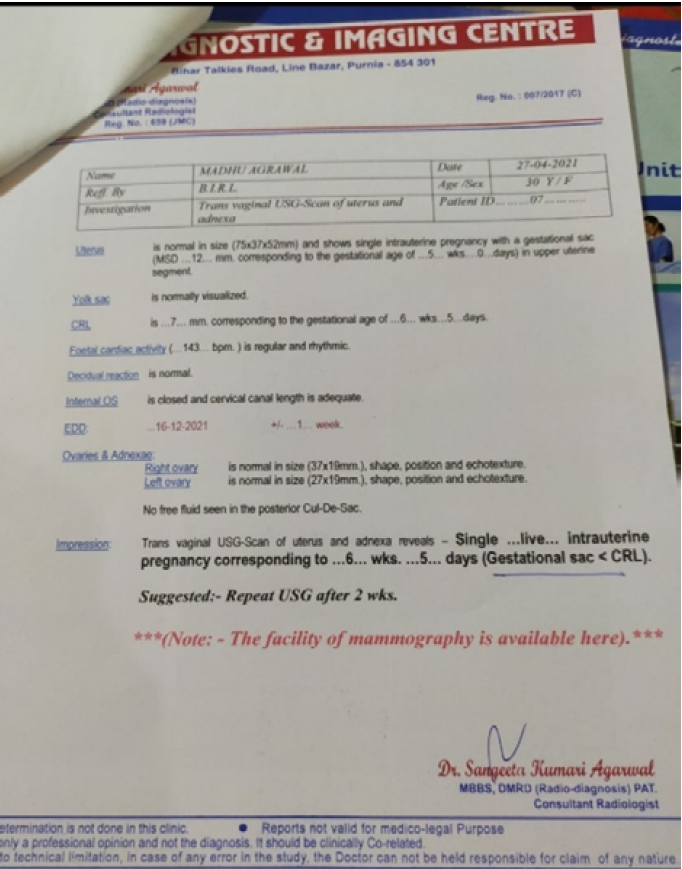
The treatment was carried out with Virechan Karma along with following medicines (Table 1 and 2). During this period the patient was advised to take Samayaka ahara (nutritive diet like milk, fresh fruits and vegetables, almonds etc.) and avoid Amla, Lavana,Vidahi (Spicy) and Snigdha (oily) ahara. After the treatment, the sonography report on 27/04/2021 showed early intra uterine pregnancy with normal cardiac activity.
Table 1: Medicines used for Virechan Karma
Name of the drugs
Days
DOSE
Snehapana with Bruhata Shatavari Ghrita and Phala Ghrita
6 days
Starting from 30 ml then increased gradually up to Samyak Sneha-Siddhi Lakshan (170 ml)
Abhyanga (with Mahanarayan Tail) followed by Sarvanga Swedan
*Before Snehapana, Agnitundii Vati (2 tds) + Panchakola phanta (15ml bd) is given for three days (for improving Agni-Deepna and Pachana property of patient)
Table 2: Shamana Yoga
Name of Drug
Dose
Anupana
Kanchnaar gugglu
250 mg
Jal
Vriddhibadhika vati
250mg
Jal
Varunadi kashaya
15 ml
Jal
Pushpadhanva rasa
250 mg
Jal
*Twice daily
OBSERVATION AND RESULT
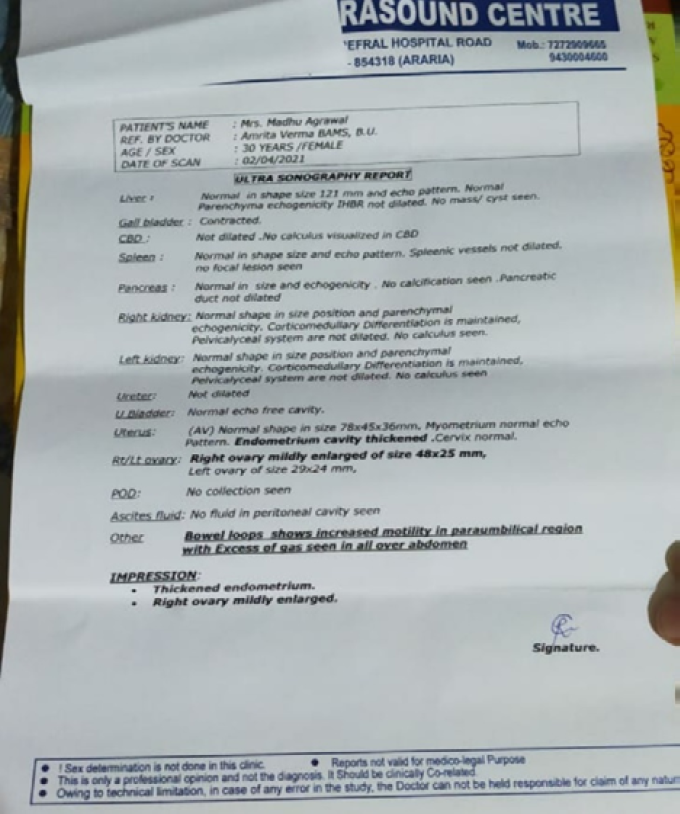
The patient had followed the Ahara and drug restriction strictly. The finding of sonography after treatment is data.
Figure 1: Ultrasound Report Showing Pelvic and Abdominal Findings
Figure 2: Transvaginal Ultrasonography Report Showing Single Live Intrauterine Pregnancy
REFERENCE
Dutta D.C. “Textbook of gynaecology.” Textbook of Gynaecology, 4th ed., New Central Book Agency Ltd., Calcutta, pp. 421, 431, 523, 549, 558.
Bhaskurani S. “Management of vandhyatva with chitrakadi ghrutam and phala ghrutam.” International Journal of Ayurveda Medicine, 2013.
Sharma R. “Role of virechan in infertility: case report.” Journal of Ayurvedic and Herbal Medicine, 2017.
Anonymous. “Rasatarangini, parishishta.” Rasatarangini, p. 766.
Anonymous. “Rasa tantra sara siddha prayoga sangraha.” Rasa Tantra Sara Siddha Prayoga Sangraha, Krishnagopal Ayurveda Bhavan, Rajasthan, part 1, p. 288.
Recommended Articles
Case Report
OROFACIAL GRANULOMATOSIS: A CASE REPORT
Diksha Thakur,
...
Mandeep Kaur
Published: 19/11/2024
Download PDF
Research Article
The Study of Suicide in Adolescents in The Context of Cognitive Brain Change
Zhang Wen,
...
Amiya Bhaumik
Published: 29/07/2024
Download PDF
Research Article
Role of First Trimester HbA1c in Screening of Gestational Diabetes Mellitus
Anu Berwal,
...
Geetika Gupta Syal
Published: 28/12/2025
Download PDF
Case Report
The Utility of Maternal Serum Amyloid a in the Prediction of Preterm Birth in Symptomatic Women
Enas Hussein Ahmed,
Aseel Ghazi Rifat
Published: 30/06/2024
Download PDF
PO Box 101, Nakuru
Kenya.
Email: office@iarconsortium.org
Editorial Office:
J.L Bhavan, Near Radison Blu Hotel,
Jalukbari, Guwahati-India
Monika, C. (2021). Ayurvedic Management of Pcos with Infertilty-A Case Study. Scientific Research Journal of Medical Case Reports, 1(1), 1-3.
MLA
Monika, Chauhan. "Ayurvedic Management of Pcos with Infertilty-A Case Study." Scientific Research Journal of Medical Case Reports 1.1 (2021): 1-3.
Chicago
Monika, Chauhan. "Ayurvedic Management of Pcos with Infertilty-A Case Study." Scientific Research Journal of Medical Case Reports 1, no. 1 (2021): 1-3.
Harvard
Monika, C. (2021) 'Ayurvedic Management of Pcos with Infertilty-A Case Study' Scientific Research Journal of Medical Case Reports 1(1), pp. 1-3.
Vancouver
Monika C. Ayurvedic Management of Pcos with Infertilty-A Case Study. Scientific Research Journal of Medical Case Reports. 2021 Jul;1(1):1-3.


 Download PDF
 Download XML