The present study aimed to investigate the mediating role of speaking confidence in the relationship between the level of classroom interaction and listening comprehension scores in English Special Education (ESP) courses in Iraqi universities. This is a descriptive-survey study of an applied type and correlational in terms of the relationships between variables. The statistical population of the study is students from selected Iraqi universities (such as the University of Baghdad, the University of Mosul, etc.) who enrolled in specialized courses with English language units in the 2024-2025 academic year, a total of 380 of these individuals were selected using a stratified random sampling method and were selected based on the suitability of the field and level of education, and the questionnaire was distributed among them. The data of this study were collected using standard questionnaires. SmartPLS3 statistical software was also used for statistical analysis. According to the results obtained from the model fitting, classroom interaction has an effect on listening comprehension scores and speaking confidence also has a mediating role in the relationship between the level of interaction and listening comprehension.
In today’s era, the increasing globalization of industries and the rapid advancement of technology have led to an increasing need for specialized English language skills tailored to specific professional fields. English for Specific Purposes (ESP) is a branch of language teaching that meets these requirements by equipping learners with the language skills needed to progress in their chosen fields, such as law, medicine, engineering or business [1]. The acquisition of integrated skills – reading, writing, listening and classroom interaction – is crucial for learners in ESP courses, and improving psychological and educational indicators can help them improve these key skills. One of these key skills is listening [2].
For students who take specialized courses, acquiring information and learning English is very essential, and listening well is one of the skills that allows a person to expand their vocabulary and become proficient in skills such as speaking, reading, and writing. However, the challenge facing these students is that they are mostly faced with a wide range of vocabulary that makes it difficult to memorize. Also, the existence of various dialects in this language and the low level of effective interactions in the classroom have caused students' listening comprehension to not be sufficiently strengthened [3].
This has also led to students having less listening practice and being unable to ask and answer questions and ultimately interact usefully with others, which ultimately leads to a decrease in confidence in speaking skills. This decrease in self-confidence in individuals can be a factor that indirectly affects the listening skills of language learners because when a language learner does not have enough self-confidence to start a conversation or participate in class interaction, they experience fear, anxiety, and stress, and ultimately lose their ability to concentrate and cannot achieve high levels of listening comprehension and understand the material correctly [4].
Classroom interaction is another component related to improving listening comprehension in ESP courses and plays an important role in the language learning process of students. Active participation of students in class and interaction with the teacher and other classmates causes the language learner to actively use specialized vocabulary, and when the student actively participates in class discussions, the fear of making mistakes is reduced and the feeling of mastery of the language is strengthened. This continuous participation, especially in traditional educational environments that are mainly teacher-centered, such as Iraqi universities, can prepare a safe space for speaking practice and encourage students to listen more actively and pay more attention to auditory messages [5]. Meanwhile, speaking confidence plays a fundamental role in the relationship between the level of classroom interaction and listening comprehension scores. Students who have higher self-confidence in speaking and interacting with others show less fear and anxiety when faced with auditory texts and can focus more on understanding auditory texts. In fact, this confidence makes the student listen more actively and guess the meaning of unfamiliar words using the context of the audio text and confidently ask for further explanation if he does not understand the desired text. According to the above, it can be said that high interaction in the classroom not only directly affects listening comprehension, but also leads to improved listening scores of ESP students by strengthening their speaking confidence [6].
Therefore, it can be said that the improvement of students' listening comprehension and obtaining a higher score in this skill is not simply affected by listening to audio and auditory sources, but this skill is in direct connection with interactive and emotional factors in the classroom. Active participation in the classroom and interaction in an effective way leads to the use of English vocabulary and improved self-confidence, which in turn leads to improved listening comprehension scores by reducing anxiety, increasing concentration and more active participation in listening activities [7]. Therefore, speaking self-confidence can be a key mediating variable to explain how and why the level of classroom interaction affects the listening comprehension scores of ESP students; an issue whose investigation makes the necessity of conducting the present study more obvious than ever.
Theoretical Foundations and Research Background
Classroom Interaction and Listening Comprehension Scores: The study of listening skills in the context of ESP education has attracted much attention in the past few decades. Researchers have investigated effective methods and technologies for enhancing these skills and have confirmed their essential role in improving learners' listening comprehension. Listening is recognized as a fundamental skill in language learning, which is essential for effective communication and comprehension And interaction and conversation provide a context for improving listening comprehension and language learning. Research in the field of English language learning has widely supported the role of conversational interaction in language development [8]. Through interaction and conversation, ESP learners can have greater access to understandable inputs, gain opportunities to express their communicative purpose in a meaningful way and receive corrective feedback on their language production [9]. This is very important for learning specialized vocabulary in ESP courses. Through semantic negotiation to achieve mutual understanding, both parties to the conversation often use appropriate communication tools such as asking for further explanation, checking comprehension, and checking confirmation to continue the conversation with less skilled speakers in educational and natural settings, which can improve the active participation of members in the conversation and strengthen students' listening comprehension. However, conversational interaction is not always present in many language classes in Iraq due to many factors, such as traditional, teacher-centered teaching methods and the lack of authentic learning environments [10]. Peer interaction has been suggested to provide similar benefits, but interaction between highly proficient or native speakers and learners is in many ways more beneficial [11]. According to Mukhtorova and Ilxomov [12], by engaging in collaborative learning environments and interacting with each other and using learning applications such as podcasts and docs, learners can create a personalized and engaging listening environment that promotes active participation and gradual improvement in listening comprehension.
Speech Confidence in the Relationship Between Classroom Interaction and Listening Comprehension Scores
Conversation and interaction are considered one of the most challenging skills among the four language skills, especially in English and in specialized language courses. In addition to requiring the production of grammatically accurate sentences, this skill must also convey meaning fluently and confidently. Among the affective variables affecting verbal interaction, self-confidence plays an important role. Students who are highly confident are more risk-taking in their communication, have less anxiety during conversation, persevere in challenges, and actively participate in oral activities [13].
Self-confidence is an inherent aspect of human existence that plays an important role in satisfying basic needs such as happiness, progress, and ultimately success. Being liked and being worthy are two basic dimensions of self-confidence that manifest themselves in the early stages of each individual's development [14]. In addition, self-confidence makes people achieve more success in their personal and social lives. For example, people with high self-confidence are more successful in their personal, social, and academic lives and achieve high grades more easily [15]. Empirical studies have also shown that high self-confidence in students can be effective in strengthening their perseverance in achieving academic success. In fact, people with high self-confidence can more easily cope with academic challenges and problems and have acceptable academic performance [16].
Learning English is very important for achieving success in work and education, especially for people who are studying in specialized courses. Meanwhile, to improve language skills, students need cognitive skills in addition to language skills, one of which is self-confidence [7]. Strengthening self-confidence plays a significant role in improving language learners' skills because it increases people's belief in their abilities and makes them willing to face and deal with problems and issues that arise during language learning [17].
Various theorists have commented on self-confidence. For example, Vygotsky in a theory called sociocultural theory addresses the point that the growth of cognitive indicators such as self-confidence in individuals and their social interactions are directly related to each other. In fact, where students begin to interact and cooperate with their capable classmates without worry and fear; this can also lead to their growth. In this context, Ulpa et al. [18]) state that peer interactions and participation increase the level of mutual respect between them and students feel safe in the educational environment. Students who feel calm and secure participate more easily in class discussions and their anxiety about making mistakes reaches its lowest level. This increases classroom interactions in a managed manner, and ultimately the student interacts with others with high self-confidence, which will also have an impact on improving his listening comprehension [19-20].
Iraqi university students who participated in specialized courses and were registered in English language units were studied in this study. These individuals were selected from the University of Baghdad, Mosul, etc. through a stratified random method, and the sample size was estimated to be 380 using the Cochran formula. A structured questionnaire was prepared to measure the variables present in the research model, and its validity and reliability were examined and confirmed. The questionnaires used in the study consisted of the Classroom Interaction Questionnaire, which was adapted from "Plos One (2024): The Impact of Classroom Interaction on Willingness to Communicate". Scribd Speech Confidence Questionnaire, 2014, and finally, a standardized test (Teacher-Made ESP Listening Test) was used to measure students' listening comprehension. The listening tests were taken from scientific and specialized sources in the relevant field. This test had 30 multiple-choice questions and the score obtained from it was included as the dependent variable in the structural equation model. Finally, the collected information was analyzed using the structural equation modeling method.
Research Findings
The data were analyzed in two parts. First, the central and dispersion indices were examined in the descriptive statistics section. The estimate of the mean self-confidence (m = 3.56) showed that this index was acceptable in students and indicated an appropriate level of self-confidence in these students. In addition, the mean interaction score based on the questionnaire results was 3.71, indicating a good motivation to participate in group and interactive language learning activities. The listening comprehension test scores also showed a mean of 23, indicating good listening comprehension in specialized ESP courses.
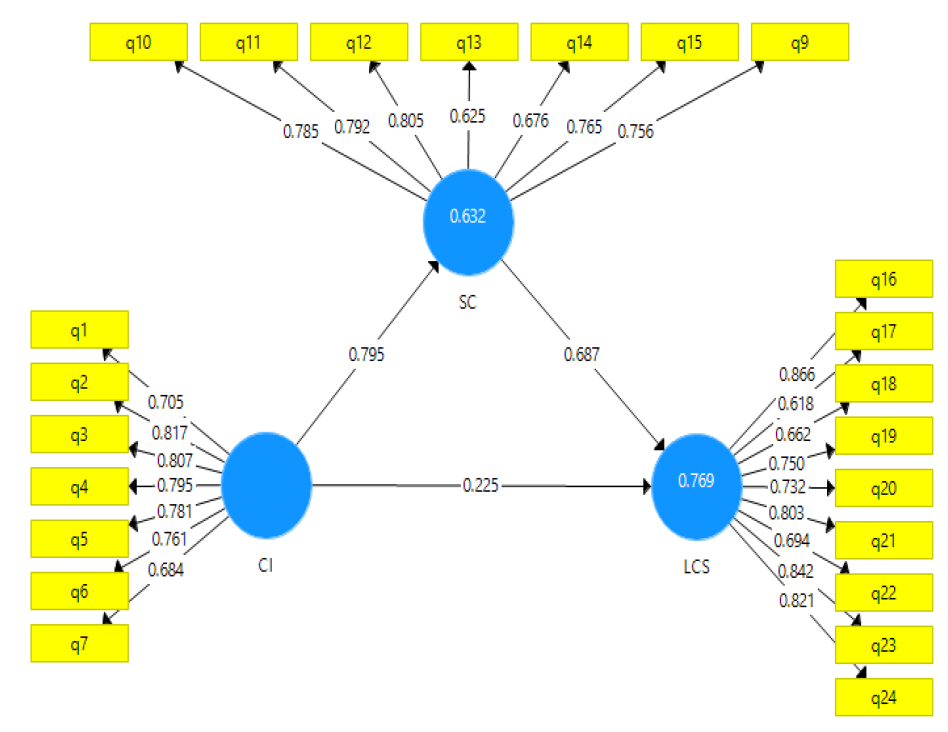
In the second stage, the research model was evaluated and the following pre-tests were performed. Internal consistency reliability was calculated using Cronbach's alpha (CA) and composite reliability (CR), which obtained strong internal consistency with values above 0.70. Convergent validity was also examined through the average variance extracted (AVE), in which all constructs exceeded the value of 0.50, indicating the confirmation of convergent validity. Discriminant validity was also confirmed using the Fornell-Larker criterion. These tests showed and ensured the differentiation of each construct from other constructs, so it can be said that there is no overlap between the measured constructs (Table 1).
Table 1: Results of Validity and Reliability Analysis of the Variables
Parameters | Cronbach's Alpha | Composite Reliability | Average Variance Extracted (AVE) |
CI | 0.882 | 0.908 | 0.586 |
LCS | 0.906 | 0.923 | 0.575 |
SC | 0.865 | 0.897 | 0.557 |
The results of the model fit indices in Table 2 indicate that the coefficient of determination (R²) has taken an acceptable value, the model quality index (Q²) was also reported to be more than 0.35, which indicates the quality of the model fit. The goodness of fit index (GOF) is also within the range that indicates the goodness of the fitted model.
Table 2: Results of Goodness‑of‑Fit Assessment of the Model
Parameters | R Square | Q2 | GOF |
CI | ---- | 0.44 | 0.573 |
LCS | 0.769 | 0.41 | |
SC | 0.632 | 0.39 |
In general, the set of statistical indices in Table 2 confirms the validity of the proposed structural model and shows that the model is sufficient for path analysis and hypothesis testing.
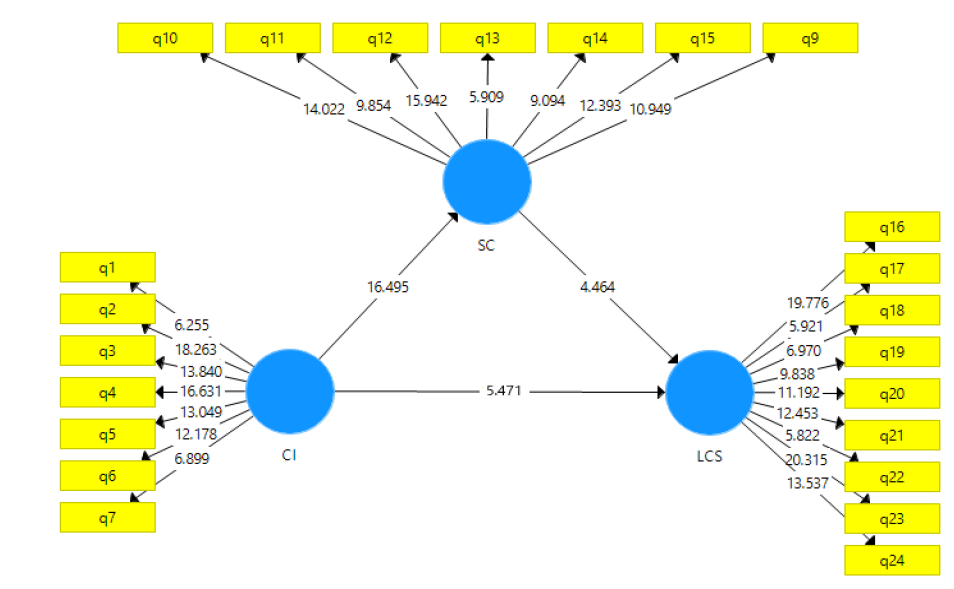
In the continuation of the structural model analysis, the results of the path analysis showed that the level of interaction(CI) in the classroom is effective on the listening comprehension scores (LCS) of students in specialized courses. Also, increasing the level of interaction in the classroom with professors and other classmates can improve self-confidence(SC) in interactions, and by reducing the fear of making mistakes in conversation, the range of interactions between people increases, which leads to the expansion of the vocabulary of individuals and exposure to new specialized vocabulary. This can gradually have a positive effect on the students' listening comprehension and ultimately their listening comprehension scores(LCS) will also improve.
Table 3: Results of Research Hypotheses
| Parameters | Original Sample (O) | Standard Deviation (STDEV) | T Statistics (|O/STDEV|) | p-Values |
| CI -> LCS | 0.225 | 0.041 | 5.471 | 0.004 |
| CI -> SC | 0.795 | 0.048 | 16.495 | 0.000 |
| SC -> LCS | 0.687 | 0.154 | 4.464 | 0.000 |

Figure 1: Confirmatory Factor Analysis Using Partial Least Squares (PLS)

Figure 2: Significance Model of the Study (t‑Value Statistics)
This paper examined the mediating role of speaking confidence in the relationship between classroom interaction and listening comprehension scores in English for Special Purposes (ESP) courses in Iraqi universities. The findings indicated the impact of speaking interactions on listening comprehension. In explaining these results, it can be added that classroom interaction plays an important role in the learning process of Iraqi students. Active participation of students in the classroom and interaction with the teacher and other classmates causes the learner to actively use specialized vocabulary, and when the student actively participates in class discussions, the fear of making mistakes is reduced and the feeling of mastery of the language is strengthened. This ongoing participation, especially in traditional educational environments that are predominantly teacher-centered, such as Iraqi universities, can provide a safe space for speaking practice and encourage students to listen more actively and pay more attention to auditory messages. The results also showed that speaking confidence played a mediating role in the relationship between students' interactions and their listening comprehension scores. Students who have higher confidence in speaking and interacting with others show less fear and anxiety when encountering audio texts and can focus more on understanding audio texts. In fact, this confidence makes students listen more actively and use the audio text to guess the meaning of unfamiliar words and confidently ask for further explanation if they do not understand the text. According to the above, it can be said that high classroom interaction not only directly affects listening comprehension, but also leads to improved listening scores of ESP students by strengthening their speaking confidence. Tran et al [9] stated in this regard that through classroom interaction, English language learners can access more understandable inputs, gain opportunities to express their communicative purpose in a meaningful way, and receive corrective feedback on their language production. Through semantic negotiation to achieve mutual understanding, both parties to the conversation often use appropriate communication tools such as asking for further explanation, checking comprehension, and checking confirmation to continue the conversation with less skilled speakers in educational and natural settings, which can improve the active participation of members in the conversation and strengthen students' listening comprehension. Mukhtorova & Ilxomov, [12] and Ulpa et al [18] also found similar results in their studies. They reached this conclusion. Overall, our study makes a comprehensive contribution to understanding how cognitive and emotional factors influence the improvement of listening comprehension in students in specialized courses. By explaining how interactions and confidence in conversation can affect students' listening comprehension, this study provides useful insights for students trying to improve their skills. This study provides specific insight into the importance of paying attention to emotional and psychological factors to improve students' self-confidence and ultimately improve language skills.
Limitations and Future Studie
We also faced some limitations in this study. For example, the use of a questionnaire made all data measurements based on the views of students attending ESP courses, which is somewhat subjective. In future studies, professors and students who have participated in other English courses can also provide their complementary opinions to fill the existing gaps. Second, this study only used questionnaire distribution to examine the impact of classroom interaction and listening comprehension scores, so future studies can use qualitative methods and study, discuss, and examine the opinions of experts and professors in this field. Finally, our study only studied English language students attending ESP courses in Iraq, whose conditions may be different from other regions and countries, thus limiting the generalizability of the findings.
Mmadaliyeva, Z. and Sultona, A. “English for specific purposes (ESP): A specialized approach to language learning.” Synapses: Insights across the Disciplines, vol. 2, no. 3, 2025, pp. 153–157.
Agzamovna, T.U. “Bridging language and professional skills: effective ESP pedagogy for diverse learner needs.” Current Research Journal of Pedagogics, vol. 5, no. 10, 2024, pp. 36–41.
Tilavova, M. “Integrating listening and speaking skills in ESP (English for specific purposes) classes.” Maktabgacha va Maktab Ta’limi Jurnali, vol. 3, no. 11, 2025.
Fouda, S.A. “A proposed ESP program for developing listening skills of Delta University students.” Delta University Scientific Journal, vol. 8, no. 1, 2025, pp. 325–338.
Ionitiu, I. “Practicing speaking skills in the ESP context to prepare students for their careers.” Analele Universităţii Ovidius din Constanţa. Seria Filologie, vol. 35, no. 1, 2024, pp. 291–304.
Zulfa, P.F. et al. “ESP students’ perception on role playing for boosting their speaking skill.” English Education and Literature Journal, vol. 4, no. 2, 2024, pp. 187–199.
Nst, M. and Hamzah, H. “Enhancing speaking performance: the role of self-regulated learning, self-confidence, and social interaction among English department students.” Al-Ishlah: Jurnal Pendidikan, vol. 17, no. 3, 2025, pp. 4216–4225.
Turmuhammadova, S. and Akhmedova, M. “How to improve listening skills of both ESL and EFL students.” Obshchestvennye Nauki v Sovremennom Mire: Teoreticheskie i Prakticheskie Issledovaniya, vol. 4, no. 5, 2025, pp. 96–100.
Tran, N. et al. “Enhancing EFL learners’ speaking and listening skills through authentic online conversations with video conferencing tools.” Innovation in Language Learning and Teaching, 2024, pp. 1–11.
Al-Shamarti, A.D.M. “Methods to improve the students’ English language speaking skills in Iraq (study on Kufa University).” Academic Journal of Nawroz University, vol. 1, no. 1, 2025.
Long, M.H. “The psycholinguistics of second language interaction.” The Routledge Handbook of Second Language Acquisition and Psycholinguistics, edited by A. Godfroid and H. Hopp, Routledge, 2022, pp. 335–347.
Mukhtorova, M. and Ilxomov, X. “How to improve listening skills of both ESL and EFL students.” Qo‘qon Universiteti Xabarnomasi, vol. 11, 2024, pp. 84–86.
Sachiya, F. et al. “A comparative analysis of Indonesian and Korean verbs: A semantic and pragmatic perspective.” International Journal of Arts and Social Science, vol. 8, no. 3, 2025, pp. 89–97.
Li, J. et al. “Boosting learners’ confidence in learning English: Can self-efficacy-based intervention make a difference?” TESOL Quarterly, vol. 58, no. 4, 2024, pp. 1518–1547.
Fielding, R. and Harbon, L. “Teacher perception of the link between professional learning and professional identities and confidence in integrating content and language.” Teacher Development for Content-Based Language Education: International Perspectives, Multilingual Matters, 2024.
Narzillayevna, A.S. “The impact of self-confidence on the acquisition of English language skills: a systematic review.” Eurasian Journal of Entrepreneurship and Pedagogy, vol. 2, no. 1, 2024, pp. 11–16.
Zhang, Q. et al. “Foreign language enjoyment and willingness to communicate: The mediating roles of communication confidence and motivation.” System, vol. 125, 2024, article 103346.
Ulpa, S. et al. “Teachers’ perceptions of speaking confidence strategies: A case study at Cambridge English School.” ELS Journal on Interdisciplinary Studies in Humanities, vol. 8, no. 2, 2025, pp. 370–378.
Karubaba, S. et al. “Comparison of pronominal systems in Yapen languages.” Proceedings of the 4th International Conference on Linguistics and Culture (ICLC-4 2023), Atlantis Press, 2024, pp. 360–374.
Ko, Y. et al. “Revisiting EPS TOPIK: Addressing linguistic and cultural challenges for migrant workers in South Korea.” International Journal of Current Science Research and Review, vol. 8, no. 2, 2025, pp. 904–910.