The Intermolecular free Length (Lf), relaxation Time (t), Molar Volume (Vm) and Molar sound velocity (R) have been calculated using experimental values of density, viscosity and ultrasonic velocity of the various compositions of liquid mixtures of aqueous solutions of Lithium Chloride (LiCl) and Lithium Sulphate (Li2SO4) measured at 303,308,313 and 318K and at atmospheric pressure. The acoustical analysis revealed the possibility of the intermolecular interactions taking place between the mixtures of present study.
Keywords
Ultrasonic Velocity
Intermolecular Free Length
Relaxation Time
Molar Volume
Molar Sound Velocity
INTRODUCTION
In recent years the thermo-acoustical study of molecular interactions in various binary liquid mixtures has got considerable importance in developing theoretical models as well as its application in industry and engineering [1-4]. The study of intermolecular interaction is of considerable importance for the elucidation of formation of complexes and plays an important role in the study liquid mixtures. The properties which may be regarded as useful for the interpretation of molecular interaction and molecular association in binary mixtures are mainly density, refractive index, ultrasonic velocity, sound velocity, compressibility, molar volume, free volume, intermolecular free length, Rao's constant etc.
The aim of present study is to investigate the variation of thermo acoustical parameters of binary liquid mixture of aqueous solutions of Lithium sulphate and Lithium chloride with variable molar concentrations and temperatures. The variation of these parameters with molar concentration may be helpful in pharmaceutical and food industries to prepare various drug dosages, solution, tablets, capsule, gel and injection in solution form [5-9].
MATERIALS AND METHODS
The chemicals Lithium Chloride (LiCl) and Lithium sulphate (Li2SO4) used in the present work were the products of AR grade with minimum assay of 99.9%. Therefore, all these chemicals were used without further purification.
The solutions were left for sufficient time to allow them to have complete ionization. The binary mixtures of desired compositions were prepared by mixing known volumes of two prepared solutions. The ultrasonic velocities were measured at 2MHz with a single crystal variable path interferometer (F-81 D Mittal make) with an accuracy of 0.01%. The densities of aqueous solutions and mixtures were measured with a pycnometer of bulb volume 10cc. The viscosity of the liquids was measured by an Ostwald Viscometer.
The thermo-acoustical parameters such as Intermolecular free Length (Lf), relaxation Time (t), Molar Volume (Vm) and Molar sound Velocity (R) have been calculated using standard empirical relations [10-14].
RESULTS AND DISCUSSION
The experimental values of viscosity and calculated values of Intermolecular free length (Lf), relaxation time (t), Molar volume (Vm) and Molar sound velocity (R) with the varying mole fractions of the binary mixture and with the varying temperature are presented in Tables 1-5 using experimental values of density and ultrasonic velocity reported somewhere else [15]. The variations of these parameters with varying mole fraction are also presented in Figure 1-5 for the binary mixtures.
Viscosity
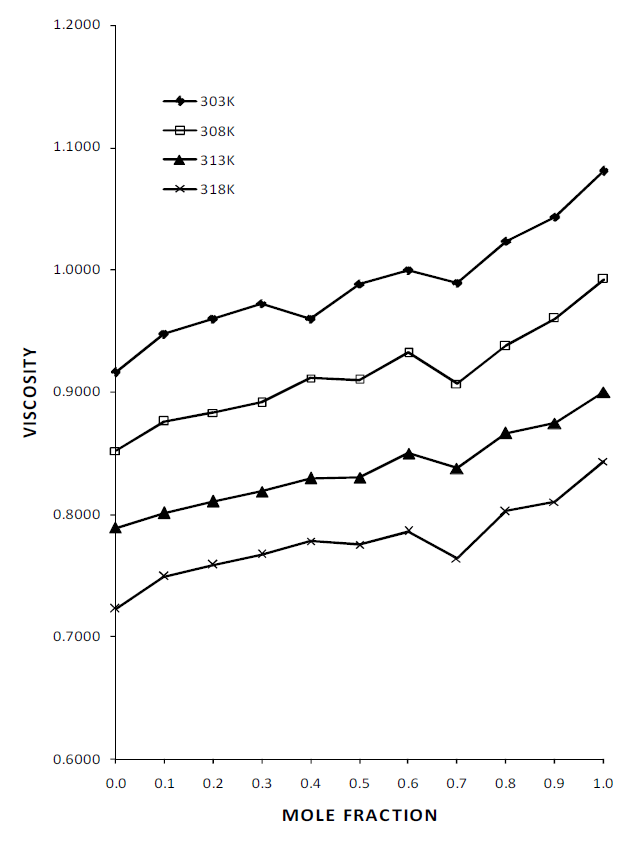
Figure 1 shows that the viscosity of binary mixture increases non linearly with increasing mole fraction of Li2 SO4. The increase in viscosity of the solution on increasing salt concentration is confirmed by some other workers [13,17]. At a specific mole fraction (0.7) of Li2SO4 the viscosity shows a sudden decrease in its value. On further increasing the mole fraction of Li2SO4 the viscosity again starts rising which confirms the solute-solvent interactions in the mixture. The sudden decrease in viscosity occurs at the specific mole fraction 0.7which is same as obtained for the ultrasonic velocity, which supports the formation of complexes at 0.7 mole fraction of Li2SO4 in binary mixture. As usual on increasing the temperature the viscosity of mixture decreases for all mole fractions and the amount by which the viscosity suddenly decreases at complex forming mole fraction (0.7) is more at higher temperature.
Table 1: Values of Viscosity (Centipoise) for the Binary Mixture of LiCl and Li2SO4 with Varying Mole Fraction
Mole fraction of
Temperature K
LiCl
Li2SO4
303K
308K
313K
318K
1.0
0.0
0.9165
0.8519
0.7889
0.7227
0.9
0.1
0.9473
0.8757
0.8009
0.7490
0.8
0.2
0.9596
0.8831
0.8105
0.7586
0.7
0.3
0.9725
0.8914
0.8187
0.7668
0.6
0.4
0.9600
0.9116
0.8295
0.7778
0.5
0.5
0.9888
0.9098
0.8298
0.7752
0.4
0.6
0.9995
0.9321
0.8499
0.7858
0.3
0.7
0.9889
0.9068
0.8373
0.7636
0.2
0.8
1.0237
0.9377
0.8665
0.8023
0.1
0.9
1.0435
0.9601
0.8747
0.8101
0.0
1.0
1.0810
0.9923
0.8999
0.8434
Table 2: Values of Inter Molecular Free Length (Lf°) for the Binary Mixture of LiCl and Li2SO4 with Varying Mole Fraction
Mole fraction of
Temperature K
LiCl
Li2SO4
303K
308K
313K
318K
1.0
0.0
426.58
428.58
431.08
433.21
0.9
0.1
425.63
427.78
430.16
432.11
0.8
0.2
424.90
426.28
428.74
430.84
0.7
0.3
423.94
425.58
427.76
430.12
0.6
0.4
423.62
425.00
427.27
429.18
0.5
0.5
423.04
424.23
426.72
428.52
0.4
0.6
421.18
422.77
425.25
426.80
0.3
0.7
422.92
424.11
426.44
427.88
0.2
0.8
419.09
420.49
423.60
425.79
0.1
0.9
418.29
419.18
422.72
424.84
0.0
1.0
416.90
418.58
421.00
423.89
Table 3: Values of Relaxation Time (×10-10 sec.) for the Binary Mixture of LiCl and Li2SO4 with Varying Mole Fraction
Mole fraction of
Temperature K
LiCl
Li2SO4
303K
308K
313K
318K
1.0
0.0
4935
4544
4179
3795
0.9
0.1
5078
4654
4224
3914
0.8
0.2
5126
4660
4247
3941
0.7
0.3
5172
4688
4270
3970
0.6
0.4
5098
4783
4317
4009
0.5
0.5
5236
4807
4307
3983
0.4
0.6
5446
4838
4381
4006
0.3
0.7
5209
4718
4327
3905
0.2
0.8
5320
4815
4462
4070
0.1
0.9
5403
4899
4455
4092
0.0
1.0
5562
5049
4546
4241
Table 4: Values of Molar Volume (m3/mole) for the Binary Mixture of LiCl and Li2SO4 with Varying Mole Fraction
Mole fraction
Temperature K
LiCl
Li2SO4
303K
308K
313K
318K
1.0
0.0
0.04166
0.04173
0.04180
0.04189
0.9
0.1
0.04990
0.04999
0.05008
0.05018
0.8
0.2
0.05810
0.05820
0.05831
0.05842
0.7
0.3
0.06636
0.06647
0.06659
0.06673
0.6
0.4
0.07404
0.07416
0.07430
0.07445
0.5
0.5
0.08265
0.08279
0.08294
0.08311
0.4
0.6
0.09083
0.09098
0.09115
0.09134
0.3
0.7
0.09935
0.09951
0.09969
0.09990
0.2
0.8
0.10683
0.10701
0.10720
0.10742
0.1
0.9
0.11495
0.11514
0.11535
0.11559
0.0
1.0
0.12286
0.12306
0.12328
0.12354
Table 5: Values of Molar Sound Velocity for the Binary Mixture of LiCl and Li2SO4 with Varying Mole Fraction
Mole fraction
Temperature K
LiCl
Li2SO4
303K
308K
313K
318K
1.0
0.0
0.4829
0.4846
0.4861
0.4880
0.9
0.1
0.5785
0.5806
0.5825
0.8548
0.8
0.2
0.6737
0.6764
0.6787
0.6812
0.7
0.3
0.7699
0.7727
0.7754
0.7783
0.6
0.4
0.8590
0.8622
0.8653
0.8687
0.5
0.5
0.9591
0.9650
0.9664
0.9704
0.4
0.6
1.0550
1.0589
0.1063
1.0669
0.3
0.7
1.1534
1.1580
1.1616
1.1664
0.2
0.8
1.2418
1.2466
1.2501
1.2548
0.1
0.9
1.3366
1.3419
1.3457
1.3508
0.0
1.0
1.4296
1.4348
1.4395
1.4443
Figure 1: Variation of Viscosity (Centipoise) for the Binary Mixture of LiCl and Li2SO4 with Varying Mole Fraction
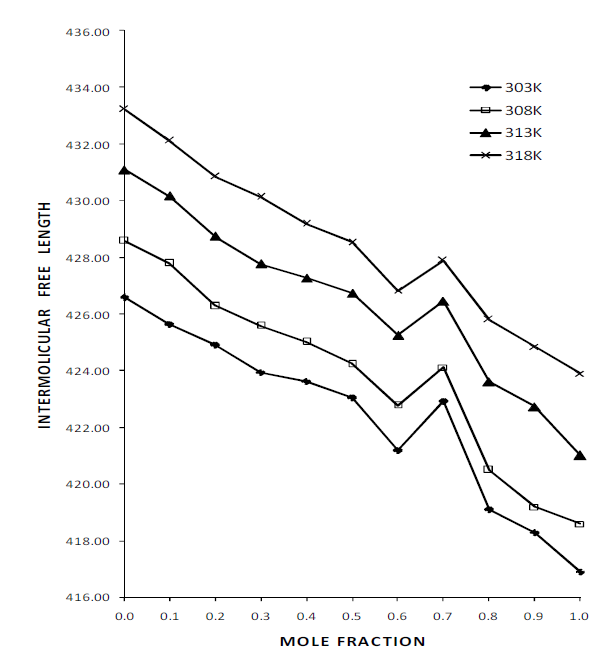
Figure 2: Variation of Inter Molecular Free Length (A°) for the Binary Mixture of LiCl and Li2SO4 with Varying Mole Fraction
Intermolecular Free Length (Lf)
The values of intermolecular free length (Lf) for binary mixture at temperature 303K, 308K, 313K and 318K are presented in Table 2. Intermolecular free length in binary liquid mixtures can be used to access the attraction between the component molecules. It denotes the magnitude of either the ion-ion interaction or the ion solvent interaction or both in a binary mixture. Intermolecular free length depends upon the adiabatic compressibility and show a behavior similar to that of the compressibility and inverse to the ultrasonic velocity.
The graphical representation of intermolecular free length is shown in Figure 2 where the free length decreases with increasing mole fraction of Li2SO4. The reason is that increasing the number of larger ions in a given volume leads to decrease in gap between the molecules of two species (solute-solvent). The decreasing free length shows a sudden increase at a specific mole fraction (0.7) of Li2SO4 and on further increasing the mole fraction the intermolecular free length again decreases non linearly, there by indicating that there is a significant interaction present between solute and solvent molecules, due to which structural arrangements are considerably affected. A number of other workers also indicated the similar trends about intermolecular free length as indicated in present study [16,17].
Relaxation Time ()
When we pass ultrasonic waves in any liquid some energy is transferred to the molecules of solution as the finite acoustic impedance of liquid restricts the free movement of ultrasonic wave through it. The amount of energy passed to a given volume of liquid grows exponentially with time to its final value and is characterized by a finite time constant which is known as the relaxation time (t). The Shear's relaxation time is a better and more informative parameter than the compressibility (b) as it incorporates Sear's viscosity effect also.
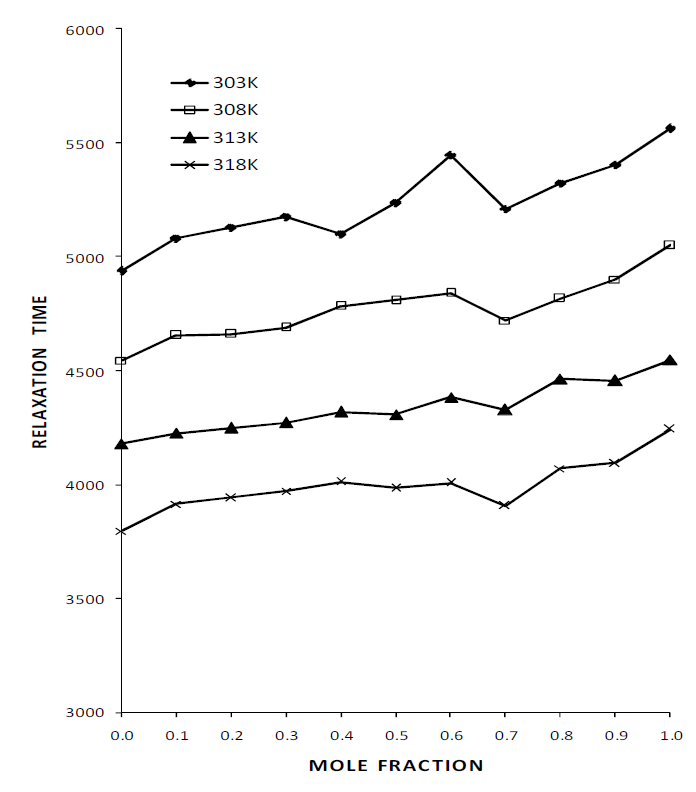
The values of relaxation time (t) for all possible mole fractions of binary mixture are presented in Table 3 at temperature 303K, 308K, 313K and 318K and the variation of relaxation time with increasing mole fraction of Li2SO4 is shown graphically in Figure 3 On increasing mole fraction of Li2SO4 the relaxation time increases non linearly and at a specific mole fraction (0.7) it shows a sudden decrease and on further increasing the mole fraction, the relaxation time again starts increasing. This specific mole fraction is exactly same as that observed in case of velocity, adiabatic compressibility, acoustic impedance and intermolecular free length which confirm the complex formation and strong ion solvent interactions in binary mixture at 0.7 mole fraction of Li2SO4. Dange [13] has reported the increase in relaxation time with increasing mole fraction in binary mixtures of Nicotinic acid in methanol solutions at 288, 298 and 308 K and indicated the presence of molecular interactions by addition of solute concentration at given temperature. He also reported decrease in relaxation time with increase in temperature at all mole fractions. Similar results are shown in Figure 3 in our present study.
Molar Volume
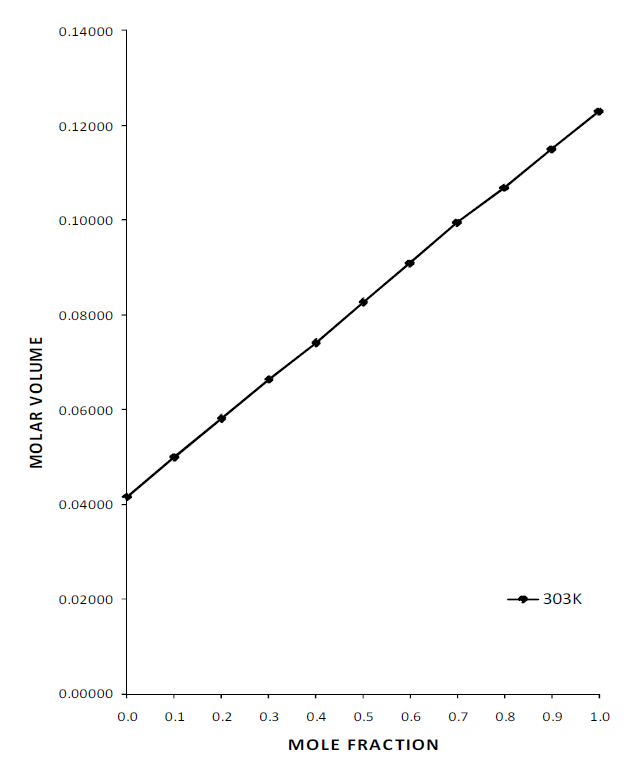
For the binary mixture the values of molar volume (Vm) are presented in Table 4 for all mole fractions at temperature 303K, 308K, 313 and 318K. Since in a binary mixture two components are mixed in varying proportions thus to calculate the molar volume, we have first calculated the effective mass (Meff) of all combination of binary mixture. Then dividing the effective mass of binary mixture of any specific mole fraction by its density (determined experimentally) we have calculated the molar volume of binary mixture for every mole fraction under consideration.
Graphical representation of molar volume is show in Figure 4 where molar volume increases non linearly with increasing mole fraction and with increasing temperature the molar volume gets increased for every mole fraction. As for any specific mole fraction Meff remains the same at all temperature and density decreases with increasing temperature thus molar volume gets increased with increase in temperature.
Figure 3: Variation of Relaxation Time (×10-10sec.) for the Binary Mixture of LiCl and Li2SO4 with Varying Mole Fraction
Figure 4: Variation of Molar Volume (m3/mole) for the Binary Mixture of LiCl and Li2SO4 with Varying Mole Fraction
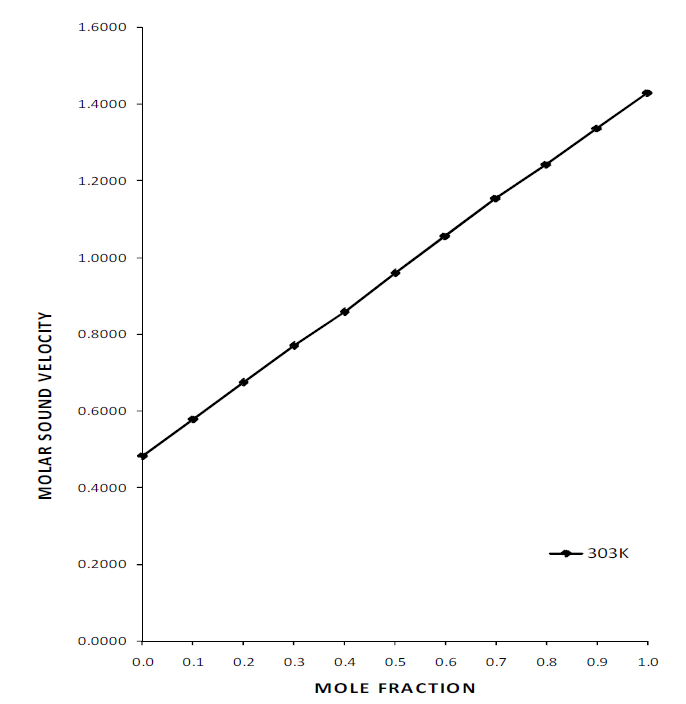
Figure 5: Variation of Molar Sound Velocity for the Binary Mixture of LiCl and Li2SO4 with Varying Mole Fraction
Molar Sound Velocity
Using the values of molar volume, we have calculated the values of an important parameter called molar sound velocity or Rao's molar sound function (R). The values of molar sound velocity are presented in Table 5 and their graphical representation is shown in Figure 5 for binary mixture at temperature 303K, 308K, 313K and 318K. On increasing the mole fraction of Li2SO4 molar sound velocity increases non linearly at all temperatures which again supports the existence of ion solvent interactions and complex formation. Similar nonlinear behavior of molar sound velocity is reported earlier by Thorat [18]. The molar sound velocity depends directly on cube root of ultrasonic velocity thus it shows the behavior quite similar to that shown by ultrasonic velocity. The molar sound velocity also increases on increasing the temperature for all mole fractions.
CONCLUSION
From the above discussion it is quite clear that the variation of acoustic and thermodynamic parameters with concentration and temperature strongly supports the existence of molecular interactions in the binary mixture. Further the sudden rise or fall in various parameter at the same specific mole fraction (0.7) of Li2SO4 confirm the complex formation at this mole fraction.
REFERENCES
Pal, A. et al. “Ultrasonic speeds and isentropic functions of mixtures of N-Methyl-2-Pyrrolidinone and branched Alcohols at 298.15 K.” Indian Journal of Pure and Applied Physics, vol. 41, 2003, pp. 113–117.
Rastogi, M. et al. “Molecular association of aliphatic ketones and phenol in a non-polar solvent: Ultrasonic and IR study.” Journal of Molecular Liquids, vol. 107, nos. 1–3, 2003, pp. 185–204
Nikam, P.S. et al. “Molecular interaction between aniline and n-Alkanols (C5–C10) Molecules: An ultrasonic study.” Indian Journal of Pure and Applied Physics, vol. 38, 2000, pp. 693–697.
Reddy, B.R. and D.L. Reddy. “Ultrasonic measurements in ethyl acetate and n-Butanols.” Indian Journal of Pure and Applied Physics, vol. 37, 1999, pp. 13–19.
Syal, V.K. et al. “Ultrasonic velocity, viscosity and density studies in binary mixtures of dimethyl formamide and ethyl methyl ketone at different temperatures.” Indian Journal of Pure and Applied Physics, vol. 37, 1999, pp. 366–370.
Bansal, R.K. A Textbook of Organic Chemistry. 2nd Edn., Wiley Eastern Ltd., 1990, p. 477.
Ramanathan, K. and S. Ravichandran. “Ultrasonic study of mixed salt solutions of ammonium and ammonium chloride.” Indian Journal of Pure and Applied Ultrasonics, vol. 26, 2004, pp. 12–17.
Chimankar, O.P. et al. “Intermolecular interaction studies in some amino acids with aqueous NaOH.” Journal of Chemical and Pharmaceutical Research, vol. 3, no. 3, 2011, pp. 587–596.
Eshwarbhat, J. et al. “Acoustic behaviour of citric acid in aqueous and partial aqueous media.” Indian Journal of Pure and Applied Physics, vol. 48, 2010, pp. 875–879.
Geetha, D. and C. Rakkapan. “Ultrasonic studies on solutions of hydroxypropyl methyl cellulose phthalate in alcohols and acetone mixtures.” Indian Journal of Physics, vol. 77B, 2003, pp. 525–528.
Sudarmozhi, G. et al. “Ultrasonic studies in the mixture of lithium hydroxide and lithium sulphate.” Proceedings of the 15th National Symposium on Ultrasonics, 2006, p. 85.
Kannappan, A.N. and R. Palani. “Studies on molecular interaction in ternary liquid mixtures by ultrasonic velocity measurement.” Indian Journal of Physics, vol. 70B, 1996, pp. 59–65.
Dange, S.P. et al. “Physicochemical analysis of binary liquid mixture of nicotinic acid at different temperatures.” Indian Journal of Pure and Applied Physics, vol. 59, 2021, pp. 132–137.
Nikam, P.S. et al. “Molecular interactions in binary mixtures of bromobenzene with normal alkanols (C1–C4): An ultrasonic study.” Indian Journal of Pure and Applied Physics, vol. 38, no. 3, 2000, pp. 170–173.
Rathore, N. et al. “Physicochemical studies of liquid mixtures.” Research Journal of Physical Sciences, vol. 3, no. 1, 2015, pp. 1–5.
Selvakumar, M. and D. Krishanabhat. “Molecular interactions of polymethyl methacrylate and polyethylene glycol solutions in tetrahydrofuran.” Indian Journal of Pure and Applied Physics, vol. 46, 2008, pp. 712–716.
Sumathi, T. and U. Maheshwari. “Ultrasonic and theoretical studies of some ternary liquid mixtures at various temperatures.” Indian Journal of Pure and Applied Physics, vol. 47, 2009, pp. 782–786.
Thorat, H.N. and A. Murugkar. “Thermo-acoustical properties of carbamide and N,N-Dimethylformamide binary mixture at different temperatures.” Indian Journal of Pure and Applied Physics, vol. 58, 2020, pp. 141–146.
Recommended Articles
Research Article
Some Properties of Fuzzy g-Regular Spaces
Hassan Abid Al-Hadi Ahmed,
Noor Al-Huda A. Haider
Published: 10/12/2025
Download PDF
Research Article
Predictive Security Analytics for Large-Scale Multi-Tenant Linux Shared Hosting Environments: An Empirical Study
Ayad A. Yass
Published: 25/02/2026
Download PDF
Research Article
Harnessing Nanotechnology to Conserve Energy in Buildings
Nada S. Abdulmajeed
Published: 30/10/2022
Download PDF
Research Article
Sentence Representation using LSTM for Question Retrieval
Khanh-Linh Dinh,
...
Thi Hang Dao
Published: 30/12/2022
Download PDF
PO Box 101, Nakuru
Kenya.
Email: office@iarconsortium.org
Editorial Office:
J.L Bhavan, Near Radison Blu Hotel,
Jalukbari, Guwahati-India
Rathore, N. & Singh, A. K. (2021). Study of Molecular Interactions in Liquid Mixtures of Aqueous Solution of Lithium Chloride and Lithuum Sulphate. Scientific Research Journal of Engineering and Computer Sciences, 1(1), 1-6.
MLA
Rathore, Neeraj and Ajay K. Singh. "Study of Molecular Interactions in Liquid Mixtures of Aqueous Solution of Lithium Chloride and Lithuum Sulphate." Scientific Research Journal of Engineering and Computer Sciences 1.1 (2021): 1-6.
Chicago
Rathore, Neeraj and Ajay K. Singh. "Study of Molecular Interactions in Liquid Mixtures of Aqueous Solution of Lithium Chloride and Lithuum Sulphate." Scientific Research Journal of Engineering and Computer Sciences 1, no. 1 (2021): 1-6.
Harvard
Rathore, N. and Singh, A. K. (2021) 'Study of Molecular Interactions in Liquid Mixtures of Aqueous Solution of Lithium Chloride and Lithuum Sulphate' Scientific Research Journal of Engineering and Computer Sciences 1(1), pp. 1-6.
Vancouver
Rathore N, Singh AK. Study of Molecular Interactions in Liquid Mixtures of Aqueous Solution of Lithium Chloride and Lithuum Sulphate. Scientific Research Journal of Engineering and Computer Sciences. 2021 Jul;1(1):1-6.



 Download PDF
 Download XML