This paper examines the extent adoption of quantitative methods drives the operations and performance of commercial banks in Nigeria. The rationale is due to the fact that decision making has because more complex in an ever changing business environment that traditional or rule-of-thumb methods are not fit to meet the needs of decision makers. Structured questionnaire and oral interview were used to elicit information from the sampled respondents. Data collected were analyzed using descriptive statistics involving simple percentages and relative frequencies. Results showed that forecasting, decision (tree) analysis and simulation models are the most adopted which significantly impact performance of the banking sector in Nigeria. The results were contrary to apriori expectations that commercial banks do not adopt quantitative techniques in the decision circle. It was concluded that commercial banks management in Nigeria apply QT models in their decision making. It was recommended that more QT models be applied by commercial banks and enhancement of efficiency through in-housing training, workshop and seminars frequency organized for staff to improve their knowledge and skills in contemporary QT models.
Keywords
QT Models
Banks’ Performance
Decision Making Circle
INTRODUCTION
Work done by previous researchers have tended to focus more on the empirical analysis of Quantitative methods and performances in manufacturing organizations that produce tangible goods, while little has been done in researching the application of Quantitative Techniques (OT) in commercial banks in Nigeria and analyzing how they drive performance in these banks.
In any economy, there are five key components of the financial environment. These are money, financial markets, financial instruments, rules and regulations. Banks are the most active payers (among the various financial institutions) and fundamental components in the financial system. The performance of a bank is usually discussed in different terms, such as profitability, efficiency, competition, concentration and productivity. In order to resist negative shocks and contribute to the overall stability of the financial system, banks seek to acquire better performance and implementation of strategies.
From a strategic and financial management point of view, the main commercial bank functions include loans and credit administration, liquidity management decision, operation management decision and investment decision. These functions are vital for efficiency and profitability because of their impact on the firm’s value and shareholder’s funds.
Whether the use of Quantitative methods in Nigeria Banks drives their performance is of consideration concern to the researchers. The unique nature of banks as financial intermediaries have made it relatively difficult to determine which banking related problems are conformed to Quantitative Techniques (QT) and to what extent.
Again, deposit and revenue growth, operating cost efficiency and customer convenience are becoming increasingly important to stakeholders in Nigerian commercial banks. This has resulted in issues with cash inventory management, asset management, determining the appropriate cash reserve and optimal deposit withdrawal timing and among others. Bank difficulty has been exacerbated by loan decisions, operations management decisions and the quality of investment decisions. This has resulted in bank frauds, lower profitability and inefficient customer service delivery.
Objectives of the Study
The objectives of this study is logically derived from the problem identified, thus:
To determine if commercial banks in Nigeria adopt Quantitative Technique models in their day in day operations
To determine which Quantitative Technique models are adopted by commercial banks in Nigeria
To measure the extent to which the adoption of Quantitative Technique models by Commercial Banks in Nigeria drive their performance
Research Questions
The research has the main task of finding out the following:
Do Commercial banks in Nigeria make use of Quantitative Technique models?
What Quantitative Techniques or Operations Research models do commercial banks in Nigeria use?
Does the adaption of Quantitative Technique models in Nigeria commercial banks drive their performance?
Hypothesis Development
Ho: The adoption of Quantitative Technique models has not led to improved performance of commercial banks in Nigeria
Significance of the Study
This research is driven by the ever-changing business environment, which may be linked to technological advancement, a scarcity of raw materials, the evolvement of customers as activists and the ever-changing taste and performance, as well as the shifting demographic environment. When performing research, students will find the study useful as a reference.
This study will also be useful to practicing bankers since it will show them how quantitative methodologies influence the performance of commercial banks in Nigeria.
Finally, the study attempts to bring stability to the financial sector of the Nigeria economy, making it extremely important to Nigerian citizen and policy and regulatory authorities.
Scope of the Study
A few quantitative methods will be examined in this study deem relevant to banking operations. Again, because this is an experimental study, there will be no need for a pretest and post-test analysis, as well as an experiment and control group analysis. It is an exploratory study research that will focus on commercial banks in Nigeria.
Representative Banks studied included First Bank Plc, Union Bank Plc and United Bank of Africa Plc, Zenith Bank Plc, Access Bank Plc and GT Bank Plc. As a result, data gathering and other essential information was restricted to these banks’ management and staff.
Review of Related Literature
Quantitative techniques also referred to as operations research focused on the use of mathematics and sophisticated tools and models to generate quantitative data for management decision-making [1]. It focuses on developing models that may be used in industries, businesses and government, for example with models like linear programming, nonlinear programming, integer programming, simulation, queuing theory, innovation control, project management, transportation and forecasting.
Despite the existing economic and political uncertainties in the local and international business environment, these strategies have been utilized in the key functions of commercial banks both in Nigeria and beyond in order to attain higher efficiency. Due to the inherent uncertainties in cash flow, cost of funds and return on investment, Nigerian commercial banks have no choice but to strive for greater efficiency in asset and liability management. As a result, these quantitative methodologies may have been used in Nigerian commercial banks to reduce costs while also enhancing profitability [2].
Four fundamental roles of commercial banks in Nigeria are assessed as well as the impact of quantitative approaches on them and their limitation.
Loans and Credit Administration
The allocation of cash to deficit parts of the economy is part of the loan and credit administration choices made by Nigerian commercial banks. These are frequently individuals or institutions with financial needs that exceed their available funds and must borrow to bride the short fall.
Nigerian commercial banks often provide customer and commercial loans to individuals and businesses to help them carry out productive operations and to help them purchase goods and services that would help better their living standards. This loan activity has enabled bank clients to fulfil their needs as they arise and to repay when they are due, either in full (bullet) or in installments from future revenue streams.
This Loan and credit Administration function also typically involves the management of the bank’s assets (risk assets) such as loans, advances and discounted bills in order to control credit facilities with the goal of collecting debts in the shortest time possible, reducing the likelihood of criticized assets (bad debts) and thus increasing profit and organizational growth over time.
In Nigerian commercial banks, quantitative approaches have been widely used in credit investigation and analysis, as well as in assessing information obtained from credit applications, setting credit limits and even modelling repayment plans and programs for loans provided to clients.
Investment Decision
Commercial banks’ investment decision, according to Brealey and Myers [3], usually entail allocating funds to viable investment projects that promise future advantages that will assure high returns to clients and investors, usually over the long term. The long-term advantages of Nigerian commercial banks’ investment decision are rarely easily quantifiable [4].
Quantitative approaches are commonly used in investment decisions and activities such as portfolio optimization, financial investment pricing in competitive financial markets and statutory bond and corporate debenture research. Nigerian commercial banks use a variety of quantitative methodologies, either separately or in combination, to solve specific problems. Some commercial banks, for example, use a combination of forecasting tools, simulation modeling, linear programming and decision theory. Computers have recently made it easier for busy executives (who may or may not have a strong mathematical background) to use pre-configured Quantitative techniques computer packages [5].
Liquidity Management Decision
Liquidity management in Nigerian commercial banks necessitates strict attention to money market portfolio management, as well as deposit and credit activities, due to the large volume and frequent turnover of assets and liabilities. Given the amount of constraints on such activities in Nigerian commercial banks, quantitative methods such as Linear Programming, Goal programming and Probabilistic Programming may be the most effective way to manage liquidity [6]. For example, current asset management should be done effectively (using Quantitative Techniques) to protect the bank from illiquidity and insolvency.
As a result, given the probability distribution of deposit variations and relevant interest rates, it might be possible to generate a well-defined mathematics spread using quantitative methods, both for alternative means of placing funds and for raising funds in commercial banks in Nigeria.
Operations Management Decision
This entails the careful management of an organization’s entire production and service-delivery system, including product design, product development, production and distribution, purchases, facility waiting time reduction and queue control, inventory control, quality control, storage and logistics, process efficiency and effectiveness, as well as the proper measurement, management and effective coordination of all internal organizational processes.
As a result, Operation Management guarantees that organizational business activities operates smoothly, utilizing fewer resources to produces a higher quantity and quality of output while meeting all client needs in terms of product or service. It also includes the control of all input, throughput and output processes in manufacturing or service delivery. It especially refers to the design of financial products and the provision of necessary services to bank clients in Nigerian commercial banks.
In the areas of funds allocation to bank’s competing projects, bank liquidity management activities, cash reserve management, branch site selection and location problem, lock box management and so on and quantitative methods may be used in operations management in commercial banks in Nigeria. Forecasting models, queuing techniques, decision theory, probabilistic programming and simulation techniques are among the quantitative methodology models use [7].
The Relevance and Limitation of Quantitative Methods
Business decisions are influenced by a slew of interconnected elements. Because the components are often hidden, it is difficult to make excellent decisions solely on intuition, experience and common sense, especially in a continuously changing environment. As a result, quantitative approaches might be critical in the following situations:
When a manager is faced with a difficult problem that cannot be solved without the application of quantitative tools
When the number of choice element is the too great to handle and the employment of a quantitative method is unavoidable
When the problem is critical and necessitates a full investigation prior to allocating cash
When new difficulties emerge and managers have no prior experience with them
When management is concerned about the accuracy of the risk assessment for a project
When an organization’s data is not being used effectively
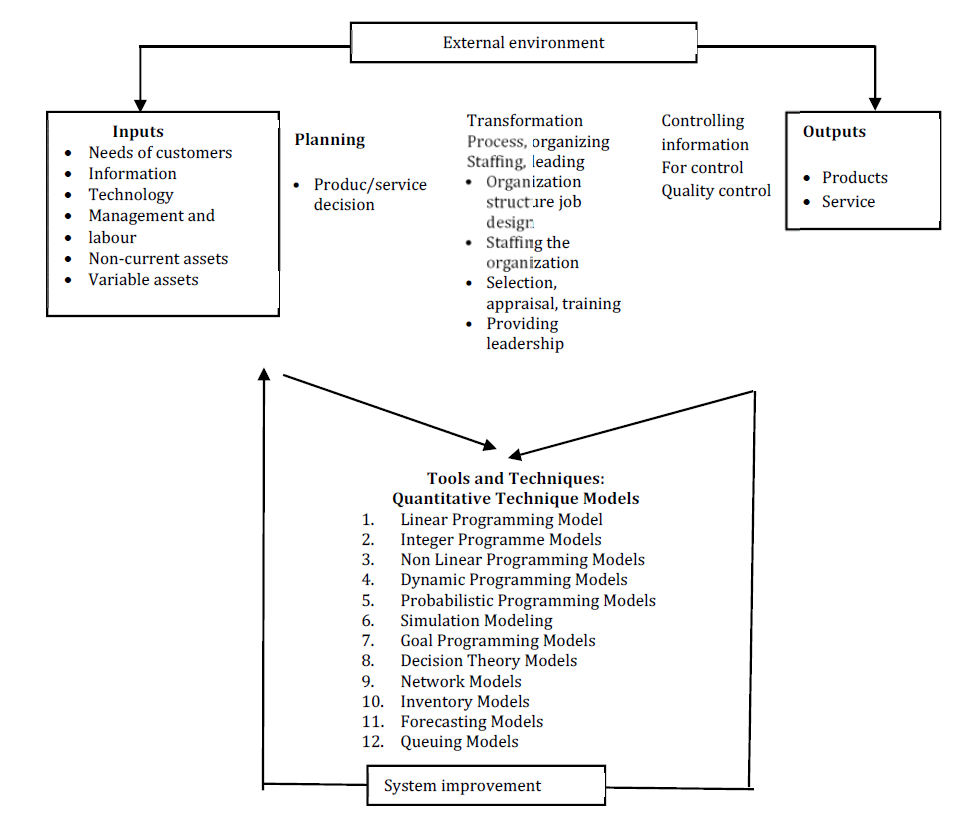
Operation Management System
Quantitative methods may be used to improve manufacturing and service processes, resulting in increased productivity, as shown in the diagram above. Despite their importance, quantitative methodologies, according to Griffen, cannot fully account for qualitative (intangible) elements in decision making. Quantitative methods have the drawback of not always being realistic because a variable may go unnoticed, causing the expected resulting to change after implementation (Figure 1). According to Idolor [8], quantitative methodologies have the following drawbacks:
A lot of time and effort may be wasted trying to solve problems that are not even relevant
A manager’s practical experience and initiative may be a better judgment than overly meticulous mathematical study in some cases
It is time and resource intensive
Figure 1: Operation Management System
Source: Adopted from Etim (2021)
Gap in Literature
In the past, a number of international scholars have advocated for the adoption of quantitative approaches in developing nations like Nigeria to improve organizational efficiency and profitability, according to the literature. However, to the best of the researchers’ knowledge, no attempt has been undertaken in recent years to describe the level of adaptation of various quantitative models in Nigerian commercial banks.
MATERIALS AND METHODS
The Research Methods are Discussed in this Section
Research Design: This study was based on Primary data that was obtained from respondent of selected commercial banks in Nigeria. To study the behavior of each bank over time and across space, the researchers used frequency count and percentage analysis as its data analysis methods.
Source and Nature of Data, Population and Sample Size
Data was sourced from respondents administered 544 questionnaire who are employees of 3 large old generation and 3 large new generation banks thus: First Bank Plc, Union Bank/Plc, United Bank for African Plc, Zenith Bank Plc, GT Bank Plc and Access Bank Plc. The sampling technique adopted was a non-probability purposive or convenience sampling technique potential respondents or population elements are not availed the same probabilistic chance of inclusion in a sample, for non-probabilistic sampling technique.
The rationale of using the aforementioned data with the sample and data collection method is to answer questions about the use of quantitative tools to drive performance in Nigerian commercial banks. To support this, a questionnaires designed for the study was distributed to respondents in Nigeria’s southern regions. This region was chosen because of its ethno-diversity as well as its reputation as a major entry and exit point into and out of Nigeria. In addition, the region is home to Nigeria’s major commercial nerve centers as well as a number of notable federal institutions. These factors have contributed to the region’s highly sophisticated, educated and diverse population, with potential Quantitative backgrounds.
The questionnaire was verified for face validity before being administered. Two commercial bank management personnel were required to examine the questionnaire for proper coverage of relevant elements of the research objectives in terms of potential issue areas and Quantitative models in their commercial banks. As a result, their recommendations and criticism aided in the final development of the questionnaire used in prior study, which is beneficial to this research.
Conceptual and Empirical Models (Data Analysis Tools)
Where necessary, quantitative analysis was performed and questions in the questionnaire were evaluated using percentage analysis in a tabular format. The difficulty of comparison was made easier by displaying qualitative features in numerical form.
Frequency count and percentage analysis were used to analyze the data in this study.
RESULTS AND DISCUSSION
Response Rate
From the statistics, 535 of the 544 questionnaire issued to respondents were successfully retrieved, with 515 rated eligible for use, resulting in a questionnaire retrieval and completion rate of 94.85%, approximately 95%. In the section, the data gathered through the questionnaires was examined analyzed and presented.
Demographical Characteristics of Respondents
The responses were divided into 301 male and 214 female, according to the result of the analysis. A total of 202 respondents are in the highest age bracket (above 40 years), while 20 are in the lowest age bracket (under 30 years). The model age bracket is ‘‘>40 years’’, with a frequency of 202 matching to it. Respondents held a total of 403 postgraduate decrees/ qualifications, 95 HND/B.Sc decrees and 17 ND/Diploma. 37 0f the 515 respondents had less than five years of banking experience, 177 had between ‘’16-20 years’’ of experience and the remaining 156 had more than twenty years of banking experience. Customer service is represented by 19.22% of the respondents, cash management is represented by 23.30% money transfer is represented by 22.14% and foreign operation is represented by 4.08% Nigerian commercial banks cut across the primary commercial count and percentage analysis in Table 1-3 show this information.
Findings on Operations Research Applications
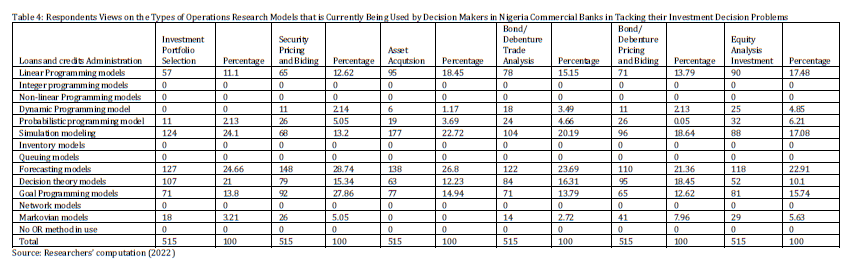
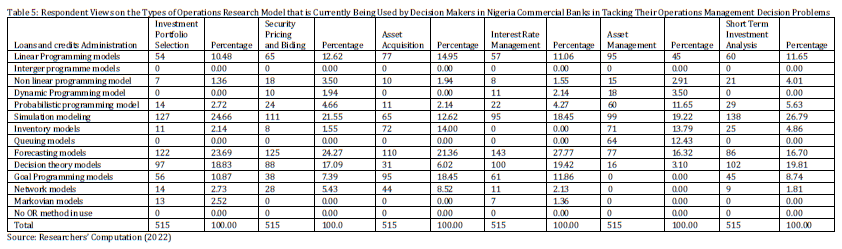
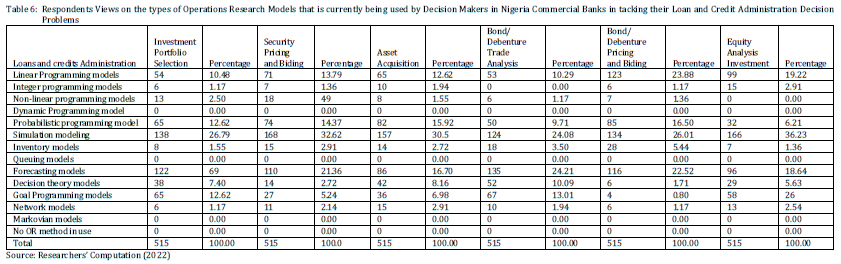
Table 4-8 reflect the findings from the field, correspondingly. Furthermore, the results demonstrate that each problem area is connected with many ways, implying that commercial banks tackled each problem area using multiple methods or even a combination of methods. The models that have a higher frequency of use in the Nigerian commercial banking industry are those that apply operations research methodologies with higher frequencies or percentages.
Table 4 indicates the frequency of usage of various quantitative (model) methodologies in the Nigerian banking industry for six different defined areas of problem bordering on investment decisions. The finding reveals disparities in the use of quantitative methodologies to identified areas of struggle. The percentages and absolute numbers of the respondents’ responses are displayed. According to the respondent’s findings, linear programming models (11.10%), probabilistic programming models (2.13%), simulation models (24.10), forecasting models (24.66), decision theory models (21.00), goal programming models (13.80) and markovian models (3.21%), are all used to solve Nigerian commercial banks’ investment portfolio selection problems. According to the respondent’ responses, linear programming models (5.05%), simulation models (13.20%), forecasting models (28.74%), decision theory models (15.34%), goal programming models (17.86%) and markovian models (5.50%) are used for security pricing and abiding investment decision problem. For assets acquisition investment decision problem, the result from the responses of respondents showed that linear programming models (18.45%), dynamic programming models (1.17%), probabilistic programming models (3.69%), simulation models (22.72%), forecasting models (26.80%), decision theory models (12.23%) and goal programming models with 14.94% are utilized with respect to the problem.
Table 1: Respondents’ sex, Age Distribution and Level of Education
Variable
Age distribution (years)
Level of Education
Gender
<30
30-35
36-40
>40
Nil response
Total
Nil response
ND/Diploma
HND/B.S.C.
Post graduate degree
Male
301
20
39
40
202
0
301
0
10
75
216
Female
214
10
55
34
115
0
214
0
7
20
187
Total
515
30
94
74
317
0
515
0
17
95
403
Source: Researchers’ Computation from field Data (2022)
Table 2: Years of Services in the Banking Industry
Variable
Length of Service (Years)
Sex
<5
5-10
11-15
16-20
>20
Male
301
18
17
25
130
111
Female
214
19
33
70
47
45
Total
515
37
50
95
177
156
Source: Researchers’ Computation from field data (2022)
Table 3: Banking Unit/Department.
Unit
Percentages (%)
Customer service unit
19.22
Cash management unit
23.30
Funds Transfers Unit
22.14
Clearing unit
18.84
Domestic Treasury Operation unit
12.42
International Operation Unit
4.08
Total
100
Source: Researchers’ Computation from Field Data (2022)
Table 8: Cumulative Frequency of Use in Banking Problem Areas
OR Technique
Frequency of Use in Problem Area
Investment
Decision
Problems
Liquidity
Management
Decision Problems
Loan and Credit
Administration
Decision Problems
Operations
Management
Decision Problems
Total
Frequency of use
of the method
Rank
Linear programing models
456
408
465
373
1702
3
Integer programming models
0
13
44
0
57
13
Non-linear programming models
0
79
52
14
145
12
Dynamic programming models
71
39
0
63
173
10
Probabilistic programming models
138
160
388
125
811
6
Simulation modeling
597
635
887
815
2934
1
Inventory models
0
187
90
116
393
7
Queuing models
0
64
0
261
325
8
Forecasting models
763
663
665
478
2569
2
Decision theory models
483
421
181
373
1455
4
Goal programming models
457
295
257
366
1375
5
Network models
0
106
61
106
273
9
Markovian models
128
20
0
0
148
11
No OR method in use
0
0
0
0
0
-
Source: Data from Fieldwork, (2022)
In addition, respondent’ responses revealed that linear programming models (15.15%), dynamic programming models (3.96%), probabilistic programming models (4.66%), simulation models (20.19%), forecasting models (23.6%), decision theory (16.31%) are used to solve the bond/debenture trade analysis investment problems. In terms of bond/debenture pricing and abiding investment problems, respondents indicated that linear programming models (13.79%), dynamic programming models (2.13%), probabilistic programming models (5.05%), simulation models (18.64%), forecasting models (21.36%), decision theory (18.45%), goal programming models (12.62%) and Markovian models (7.96%) are the Quantitative Technique models in use.
Linear programming, models (17.48%), dynamic programing models (4.85%), probabilistic programming models (6.21%), simulation modeling (17.08%), forecasting models (22.91%), decision theory models (10.10%), goal programming models (15.74%) and markovian models (5.63%) were the Quantitative technique models used in equity analysis and investment decision problems, according to the responses. Forecasting models, simulation models, linear programming models, goal programming models and decision theory models are the most commonly used models. According to the results of the percentage analysis and frequency count. Integer programming models, none linear programming models, inventory models, queuing models and network models were not used to solve investment choice problems in Nigerian banking operation (base on the responses). Furthermore, the data demonstrated that each problem area is connected with multiple quantitative approaches, implying that commercial banks in Nigeria tackled each problem area using multiple methods or a combination of methods. Larger frequencies or percentages in the quantitative technique suggest models that are used more frequently in Nigeria commercial banks.
Table 5 demonstrate how frequently the various quantitative models are utilized for six different bank problems involving for Nigeria commercial banks’ liquidity management choices. The result clearly indicate the disparities in the use of quantitative methodologies for the issue area been identified. The responses are shown in both absolute numbers and percentages. In order to solve the cash inventory management problem, linear programming models (10.48%), nonlinear programming models (1.36%), probabilistic programming models (2.72%) and simulation modeling (24.66%), inventory models (2.14%), forecasting models (23.69%), decision theory models (18.88%) and markovian models (2.52) are used. The respondents did not react to the remaining Quantitative method models.
The following are the responses to the Question about determining the optional cash reserve: dynamic programming models (12.63%), nonlinear programming models (3.50%), dynamic programming models (1.94%), probabilistic programming models (4.66%), simulation modeling (21.55%), inventory models (1.55%), forecasting models (24.27%), decision theory models (17.09%), Goal programming models (7.39%) and a combination of these models (7.39%). Integer programming models, Queuing models and Markovian models all received zero responses. Linear programming models (14.95%), nonlinear programming models (1.94%) and probabilistic programming (2.14%), simulation modeling (12.62%), inventory modeling (14.00%), forecasting models (21.36%), decision theory models (6.02%), goal programming models (18.45%) and network models are the responses to the question about liability management (8.52%).
The responses for interest rate management problems was (11.06%) for linear programming models, 1.55% for none linear programming models 2.13% for dynamic programming models, 4,27% for forecasting models, 19.42% for decision theory models, 11.86% for goal programming models. The respondents did bot respond to the inventory and queuing models. Optimal deposit withdrawal timing and management yielded 18.45% for linear programming models, 2.53% for integer programming models. 2.91% for nonlinear programming models, 3.50% for dynamic programming models, 19.22% for simulation modeling, 12.42% for inventory models and 0.58% for decision theory models. Asset management models yielded 11.65% for linear programming, 4.01% for nonlinear programming, 5.63% for probabilistic programing, 26.79% for simulation modeling, 4.86% for inventory models, 16.70% for forecasting models, 19.81% for decision theory models, 8.74% for goal programming models, 1.81% for network models. The respondents gave zero responses to integer programming models, programming models, queuing models. And markovian models.
Furthermore, a combination of ways was associated with a problem area. Implying that Nigerian commercial banks tackle each problem area using more than one method, if not a combination of methods. In addition, quantitative techniques with a larger frequency count or percentage imply models that are used more frequently inn Nigeria commercial banking.
Table 6 depicts the frequency with which various quantitative methodologies are applied to six different problem area related to loans and credit administration decision made by Nigerian commercial banks. The result show that the use of quantitative methodologies for the stimulated bank problems differs. The responses are shown in both absolute numbers and percentages. The results show that linear programming models (10.48%), integer programming models (1.17%), nonlinear programming models (2.50%), probabilistic programming models (12,63%), simulation modeling (26.79%), inventory models (1.55%), forecasting models (23.69%), decision theory models (7.40%), goal programming models (12.63%) and network models (1.17%) are used to solve commercial loan problems. The respondents did not react to the remaining Quantitative method models, with zero responses on the table.
Linear programming models (13.79%), integer programming models (1.36%), nonlinear programming models (3.49%), probabilistic programming models (14.37%) and simulation modeling (32.62%), inventory models (2.91%), forecasting models (21.36%), decision theory models (2.72%), goal programming models (5.24%) and network models were to the responses to the question about investment portfolio selection. The respondents gave negative responses to the remaining models, which included dynamic programming models, queuing models and markovian models.
Linear programming models (12.62%), integer programming models (1.94%), nonlinear programming models (1.55%), probabilistic programming models (2.72%), forecasting models (16.70%), inventory models (2.72%), forecasting models (16.70%), decision theory models (8.16%), goal programming models (6.98%) and network models (2.91%) were the top responses for commercial customer’ credit analysis. The respondents did not answer to the remaining quantitative approaches models, with zero responses on the table.
Linear programming (10.29%), nonlinear programming (1.17%), probabilistic programming (9.71%), simulation modeling (24.08%), inventory models (3.50%), forecasting models (26.21%), decision theory models (10.09%), goal programming models (13.01) and network models (1.94%) are used for installment customer credit analysis. Quantitative approaches that were not used generated no results. Linear programming (23.88%), integer programming (7.17%), nonlinear programming (1.36%), probabilistic programming (16.50%), simulation modeling (25.01%), inventory models (5.44%), forecasting models, (22.52%), decision theory (1.17%), goal programming models (0.80%) and network models (1.17%) were the methods used to determine the best credit limit problems. The respondents did not answer to the remaining Quantitative techniques models, with zero responses
Linear programming (19.22%), integer programming (2.91%), probabilistic programming (6.21%), simulation modeling (32.23%), inventory models (1.36%), forecasting models (18.64%), decision theory models (5.63%), goal programming models (11.26%) and network models (2.54%) were used to determine the optimum repayment period. All of the remaining Quantitative method models returned zero responses.
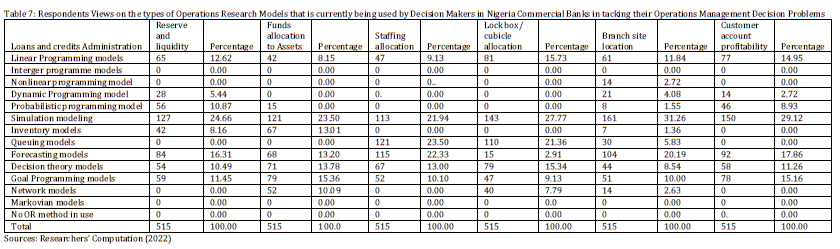
Table 7 indicates the frequency with which various quantitative methodologies are used in six different domain bordering on operation management decision problems in Nigerian commercial banks. The outcome demonstrates how different Quantitative Techniques are used to solve the specified bank problems. According to the respondents’ responses, linear programming models had a frequency of 28 (5.44%), probabilistic programming models had 56 (10.87%), simulation modeling had 127 (24.66%), inventory models had 42 (8.16%), forecasting models had 84 (16.31%) and decision theory had 84 (16.31%) for managing reserve and liquidity requirement (11.45%). There were no responses for the remaining models, with zero percentages.
Linear programming models 42 (8.15%), probabilistic programming models 15 (2.91%), simulation modeling 121 (23.50%), inventory models 67 (13.01%), forecasting models 68 (13.20%), decision theory model 71 (13.78%), goal programming models 79 (15.36%) and network models 52 were found to be the most effective in allocating funds to bank assets (10.09%). The linear programming models 47 (9.13%), simulation modeling 113 (21.94%), queuing model 121 (23.50%), forecasting model 115 (22.33%), decision theory model 67 (13.00%) and goal programming model 52 are all used to solve the teller staffing or allocating problems (10.10%). The respondents gave zero responses to the remaining models.
Linear programming model 81 (15.73%), stimulation modeling 143 (27.77%), queuing model 110 (21.36%), forecasting model 15 (2.91%), decision theory model 79 (15.34%), goal programming model 47 (9.13%) and network model 40 were the top responses in terms of lock box/cubicle location (7.76%). The respondents gave zero responses to the remaining Quantitative models.
The linear programming model 61 (11.86%), nonlinear programming model 14 (2.72%), dynamic programming model 21 (4.08%). Probabilistic programming model 8 (1.55%), simulation modeling 161 (31.26%), inventory model 7 (1.36%), queuing model 30 (5.83%), forecasting model 104 (20.19%), decision theory models 44 (8.54%), goal programming model 51 (10.00%) were found to be the best solution to the branch site selection and location problem (2.63%).
Linear programming models 77 (14.95%), dynamic programming 14 (2.72%), probabilistic programming model 46 (8.93%), simulation modeling 150 (29.12%), forecasting models 92 (17.86%), decision theory model 58 (11.26%) and goal programming model 78 (15.16%) were used to determine optimum customer account profitability. All of the remaining Quantitative method models recorded zero results. Additionally, Quantitative Techniques models with greater frequency count or percentage represent models that are used more frequently in the Nigerian commercial banking business. Furthermore, the data demonstrated that each problem area is connected with multiple quantitative approaches, implying that commercial banks in Nigeria tackled each operations management problem area operation management problem area sing multiple methods or a combination of methods.
Table 8 summarizes the data, which suggest disparities in quantitative model usage. For the many bank problem areas examined in the study, this is presented on a cumulative basis. The number and relative variances in complexity of the approaches chosen demonstrate this. The table also show cumulative value for the frequency of use of each Quantitative Technique based on the responses of the respondents previously mentioned. The total result of how frequently Quantitative technique model are used is also presented in Table 8 and it depicts the tendency for Quantitative model users to utilize the same model in multiple issue areas.
The applicability of Quantitative method and the respondents familiarity with the used and integration of operation research and other related Quantitative techniques for resolving challenge facing business organization in competitive internet and external organizational business environment have a significant impact on the magnitude of the frequency. Further estimations of potential applicability could be easily obtained by looking at the number of issue area in which quantitative methods are applied in Nigerian commercial banks. Most users, for example, use queuing models and networks using the Project Evaluation and Review Technique (PERT) and the Critical Path Method (CPM). However, a closer examination of the two methodologies (as demonstrated in the preceding Tables) indicates discrepancies in their application patterns when compared to the results in Table 8. Queuing model techniques are used primarily for Operations Management decision problems (Teller, personnel, cubicle location, Site Selection and Location), whereas network models (though in limited use per problem area) are used for a broader range of problems.
Simulation models are the Quantitative Technique model with the highest frequency of usage in the Nigerian commercial banking industry, according to the rankings (based on cumulative frequencies). Forecasting models, linear programming models, decision theory models goal programming models, inventory models, queuing models, network models, dynamic programming models, Markovian models, nonlinear programming models and integer programming models are all listed after that in that order. The rankings are in line with expectations for the models that are used more frequently and those that are used less frequently. It is rather simple to deduce possible reasons for the empirically derived ranks.
For one thing, it’s reasonable to predict that simpler models will be used more frequently. Simplicity in this context relates to the ease with which a seemingly non-technical yet busy Nigerian commercial bank management may edit, use and reduce outcomes from Quantitative Technique models. Simplicity can also refer to the simplicity with which the applied Quantitative Technique model can be used to derive realistic and practical optimal solutions. When compared the theory models, goal programming models and probabilistic programming models, simulation modeling techniques, forecasting modeling techniques and linear programming modeling approaches can all be described as simple models.
Second, models with a wider range of applicability are the most popular. This could explain why simulation modeling techniques have such a high score. It could also be the explanation for forecasting and linear programming models’ high rankings, especially when it comes to complicated organizational real-world challenges. It is important to consider the creativity of Quantitative technique method users, their level of skill, the resources required to implement Quantitative technique solutions and the user’s particular set of needs when classifying the extent of application of Quantitative technique models. Furthermore, expert decision loops (scenarios) may find some of the Quantitative technique models with lower rank to be highly valuable in the future, especially if they have access to the requisite input data and logically efficient algorithms.
CONCLUSION
The researcher assumed that extend of use of Quantitative technique models in decision making in Nigeria banking institution would be very low before conducting the research. This was due to the nature of services as well as expected conservative nature of the commercial banking industry in Nigeria. The finding of study did not support any of this viewpoints. Our finding suggest that managers and employees in Nigeria commercial banks are increasingly combining executive judgment and expertise with the application of logical Quantitative technique models. The increasing levels of information available to Nigeria commercial bank employees, the increased use of consultants and the ever-increasing desire of Nigerian commercial banks to survive in the ever-changing and tumultuous local and global commercial banking environment may explain these shifts in perception and approach.
These advantages can be easily attained by providing commercial bank employees with access to specialized in-house training, workshops and seminars where academic resources can deliver lectures on relatively simple Quantitative technique that can help Nigerian commercial banks gain a competitive advantage over their competitors. We also recommend that more quantitative methods be used in Nigerian commercial banks and other related commercial banking institutions, that operations research departments be established strengthen and improve the awareness of quantitative models in Nigerian commercial banks. Quantitative approaches have been shown to be a vital instrument for the successful functioning of a wide range of corporate organizations in advanced countries such as the United Kingdom and the United States of America up to present day. However, when compared to industrialized nations, its application in Nigerian commercial banks leaves a lot to compare. It is consequently beneficial for Nigeria commercial banks to be aware of emerging development in the application of quantitative models. As new applications are developed, commercial banks in Nigeria will benefit more if they can quickly adapt, integrate and use them in their commercial banking activities.
Suggestion for Futher Research
The outcomes of the study could be improved by looking into how Quantitative technique models can be utilized to simulate risk exposure and profile of Nigerian commercial banks under uncertain conditions. The study might also be broadened to include other developing countries throughout the world with similar economic models and conditions, such as Nigeria and used as further experience for them. More robust data analyses tools as OLS may be applied if secondary data are obtained.
Limitations of the Study
Data used in the study were as provided by respondents to the structured questionnaire and interviews which may suffer from personal bias. Also, the QT model selected for the study and descriptive analytical tools may be a drawback. However, with due care taken in observing all research principles, the results obtained are a true representation of the practitioners disposition on the issue investigated and fit for Policy formulation and implementation in the financial services sector.
Conflict of Interest
No ethical issues are associated with this study and no external funding from any source other than expenses by the researchers in the development and other distribution of the research instrument and other associated cost relevant to the study.
REFERENCE
Etim, E.O. Operational Research and Management Techniques. Unpublished lecture notes, 2021.
Idolor, E.J. and J.O. Okolie. “Utilization and Integration of Operations Research Techniques in Nigerian Commercial Banking Institutions.” DELSU Journal of Management Sciences, vol. 4, no. 1, 2015, pp. 18-31.
Brealey, R.A. and S.C. Myers. Principles of Corporate Finance. McGraw-Hill, 2006.
Chandra, P. Investment Analysis and Portfolio Management. New McGraw-Hill, 2008.
Fisher, D.E. and R.J. Jordan. Security Analysis and Portfolio Management. Prentice Hall of India, 2008.
Fielitz, B.D. and T.A. Loeffler. “A Linear Programming Model for Commercial Bank Liquidity Management.” Financial Management, vol. 8, no. 3, 1997, pp. 41-50.
Idolor, E.J. and J.O. Okolie. “The Application of Operations Research Models in Nigerian Deposit Money Banks.” Amity Journal of Operations Management, vol. 2, no. 3, 2017, pp. 73-86.
Idolor, E.J. Utilization and Integration of Operations Research Techniques in Nigerian Commercial Banking Institutions. Doctoral dissertation, University of Nigeria, Nsukka, 2012.
Recommended Articles
Research Article
The Effect of Employer Attractiveness and Compensation on Job Persuit Intention to Fmcg Companies in Indonesia: Coporate Reputation as an Intervening Variable
Download PDF
Research Article
Country of Origin and Foreign Branding on Perceived Quality of Local Products in Indonesia: The Moderating Role of Consumer Ethnocentrism
Download PDF
Research Article
The Effect of Self-Efficacy and Working Environment on Work Achievement with Organizational Commitment as Mediation
Sri Wahyuni,
...
Veithzal Rivai Zainal
Download PDF
Research Article
The Effect of Information Technology Utilization, Apparatus Competence, and Organizational Commitment on Managerial Performance of Financial Management in the SKPK Simeulue District Government
Cut Nining Rapinus,
...
Indayani
Download PDF
PO Box 101, Nakuru
Kenya.
Email: office@iarconsortium.org
Editorial Office:
J.L Bhavan, Near Radison Blu Hotel,
Jalukbari, Guwahati-India
Osim Etim, E., Ayanyinka Ayandele, I., George Etuk, S. & Raymond Enang, E. (2023). Adoption of Quantitative Methods on Commercial Banks Operations in Nigeria. Scientific Research Journal of Economics and Business Management, 3(1), 1-11.
MLA
Osim Etim, Etim, et al. "Adoption of Quantitative Methods on Commercial Banks Operations in Nigeria." Scientific Research Journal of Economics and Business Management 3.1 (2023): 1-11.
Chicago
Osim Etim, Etim, Isaac Ayanyinka Ayandele, Samuel George Etuk and Ekwere Raymond Enang. "Adoption of Quantitative Methods on Commercial Banks Operations in Nigeria." Scientific Research Journal of Economics and Business Management 3, no. 1 (2023): 1-11.
Harvard
Osim Etim, E., Ayanyinka Ayandele, I., George Etuk, S. and Raymond Enang, E. (2023) 'Adoption of Quantitative Methods on Commercial Banks Operations in Nigeria' Scientific Research Journal of Economics and Business Management 3(1), pp. 1-11.
Vancouver
Osim Etim E, Ayanyinka Ayandele I, George Etuk S, Raymond Enang E. Adoption of Quantitative Methods on Commercial Banks Operations in Nigeria. Scientific Research Journal of Economics and Business Management. 2023 Jan;3(1):1-11.



 Download PDF
 Download XML