This study was conducted to examine the nexus between entrepreneurship and sustainable development of Nigeria. This is premise on the fact that there seem disconnect between official policies and sustainable development in the country and the need for paradigm shift to entrepreneurship. To draw sample from a large population across the country, Taro Yamene’s table for determining sample size for large population was used to draw 342 respondents used for the study. Survey research design was adopted involving structured questionnaire to gather data which were analyzed using Pearson Product Moment Correlation Coefficient descriptive analytical technique. The finding of the study indicated a significant positive relationship (Entrepreneurial education r = 0.71 p>0.05, employment creation r = 0.86, p>0.05) between the independent variables and sustainable development of Nigeria. It was concluded, therefore, that there is a significant relationship among the variables of the study and recommended that government at all level pay attention to entrepreneurship orientation, processes and practices and entrepreneurial education as well as technical and funding support to foster entrepreneurial development.
Keywords
Entrepreneurial Education
Employment Creation
Sustainable Development
INTRODUCTION
The recurring budget deficits occasioned by revenue shortfalls of the Nigerian government as a result of the mono-product nature of the economy driven by almost absolute dependence on crude-oil exportation has dealt serious consequences on the sustainable development of the country over time. This is evidenced on lack of and poor infrastructures (roads, railway, power, education, health and among others), high unemployment and underemployment, among other failure of the government in meeting the basic necessities that should enhance the well-being of the citizens. There is need to rethink entrepreneurship as the thrust to enhancing sustainable development for the country. Two major sustainability responsibility of any government is provision of qualitative education and employment opportunity for its teeming active population. These two roles seem completely lost in the Nigerian politico economic ecosystem, as data from relevant institutions and agencies such as the Nigeria Bureau of Statistics (NBS) and the World Bank have reported between 32.5% and 42% unemployment rate for the country [1].
Entrepreneurship may be construed as a ‘dynamic process of vision, change and creation. It requires an application of energy and passion toward the creation and implementation of new ideas and creative solutions. Essential ingredients include the willingness to take calculated risk in terms of time, equity or career; the ability to formulate an effective venture team; the creative skill to marshal needed resources; the fundamental skill of building a solid business plan; and, finally, the vision to recognize opportunity where others see chaos, contradiction and confusion’ [2]. The process by which individuals pursue opportunities without regard to resources they currently control.
In general, entrepreneurship entails the preparedness of individuals to seek investment opportunities in the environment and be able to establish and run an enterprise successfully based on the identified opportunities. This implies that for the entrepreneur to succeed, he must have the capacity to explore the environment for economic opportunities that will increase its economic value in business and the economic growth of the society in general. Entrepreneurship might be the key to the development of any society, because the entrepreneur perceives the market opportunities and poses the motivation, drive and the ability to mobilize the resources to exploit it. There exist a linkage between entrepreneurship and sustainable development.
According to Adejumo [3], sustainable development is a development that meets the needs of the present without compromising the ability of future generations to meet their own needs. It is a development that meets human development goals while sustaining the ability of natural systems to continue to provide the natural resources and ecosystem services upon which the economy and society depends.
Zaman and Goschin [4] opined that, sustainability is built upon three pillars: a sustainable society, sustainable environment and sustainable economy. A sustainable society is one that provide adequately for its citizens without undermining future generation. Sustainable economy is one that affords the citizens the highest possible per capita income without compromising the per capita income of the future generation.
Sustainable development may therefore be subsumed to be a product of entrepreneurial activities. Entrepreneurship creates employment opportunities, serves as a linkage between sectors, wealth creation and income redistribution, import substitution and export promotion, revenue generation for government, improved standard of living, utilization of local raw materials and indigenous technology and many other roles in economic growth and development. How well entrepreneurship outfits in Nigeria has achieved these lofty roles compared to developed economies of the world like USA, Britain, Japan, Germany and other Asian Tiger’s calls for empirical investigation.
Objectives of the Study
The study was conducted to ascertain the relationship between entrepreneurship and sustainable development in Nigeria. Specific objectives are:
Examine the relationship between Entrepreneurial education and sustainable development in Nigeria
Investigate the relationship between employment creation and sustainable development in Nigeria
Research Questions
The following research question guided the investigation:
What is the relationship between Entrepreneurial Education and sustainable development in Nigeria?
Does any relationship subsist between employment creation and sustainable development in Nigeria?
Hypotheses of the Study
The following null hypothesis guided the study.
Ho1: There is no significant relationship between Entrepreneurial Education and sustainable development in Nigeria
Ho2: There is no significant relationship between employment creation and sustainable development in Nigeria
Significance of the Study
Researches are meant to proffer solutions to societal problems thereby improving the citizen wellness. Findings from this investigation are a blueprint for government and its agencies for the formulation and implementation of policies to enhance entrepreneur businesses and sustainable development. Development experts, consultants and the academia would find the research useful in discharging their various roles and further researchers.
Scope and Limitations of the Study
Entrepreneurial activities pervade every aspect of economic growth and development with web-like link of all sectors in any economy. We isolate two core areas assumed fundamental to sustainable development- entrepreneurial education and employment for study. Other areas that might be relevant are captured in the model as error factor (e). Also, the Nigerian population engaged in entrepreneurial activities is large population but using the Taro Yamane’s formula for very large greater than 100,000, we used a simple size of three hundred and forty-two (342) respondent for the study. The sample size may ordinarily seem inadequate but since all entrepreneurs possess common features, the data gathered, analyzed and findings there from are deemed good for policy analyzes.
Review of Related Literature
In this section of the paper, the review of related literature is presented looking at conceptual, theoretical and empirical reviews.
Conceptual Review
The key concept and construct of the research are summarized in this sub-section.
Concept of Entrepreneurship
A derivative from French word “ENTREPREDRE” means to undertake. A process of creating a business venture. Nwafor [5] defined it as “a process of creating something different with value by devoting the necessary time and effort assuming the business financial, psychological and social risk and receiving the resulting reward of monetary and personal satisfaction”. Entrepreneurship involves the ability to accept risks and combine the factors of production in order to produce goods and services. An entrepreneur must have the capacity to study the environment for economic opportunities that will increase it economic value in business and economic growth and development of the society. Entrepreneurship is recognized as the key to the development of societies exploring economic opportunities, mobilizing resources to exploit the opportunities, combine and coordinates other factors of production to achieve economic motive of wealth and employment creation. There is, thus, a link between entrepreneurship and sustainable development.
Concept of Sustainable Development
Sustainability aims at “JUSTICE” in the domain of individual-nature relationship and consider three specific relationship: “Justice between individuals of different generation; justice between individuals of the present generation and justice between individuals and nature” [6]. It cut across such platform as business, government and civil society, economic, environmental and societal dimensions. Economic sustainability is concerned with business survival and sustainability (management of business resources). Environmental sustainability ensure that business operate without harming the ecosystem. Social sustainability ensures that businesses manage their business operations according to the stakeholder needs, which should be in accordance with the value system of the community [7].
From the above, some pillars of sustainability development can be highlighted to include: the environmental pillars (reducing or lessening the effects of entrepreneurial activities on the environment, the social pillar being socially responsible to stakeholders including immediate community; the economic pillars with address issues of compliance, proper governance and risk management to ensure business are profitable both in short and long runs.
Zaman and Goschin [4], observed that sustainable development is built on these three pillars which anchors on a sustainable society, sustainable environment and sustainable economy.
Sustainable entrepreneurship is thus “focused on the preservation of nature, life support and community in the pursuit of perceived opportunities to bring into existence future products, processes and services for gain, where gain is broadly construed to include economic and noneconomic gain to individuals, the economy and society [2].
Theoretical Framework of the Study
This study anchor on the ECONOMIC THEORY propounded by knight in 1978. The theory views an entrepreneur as an agent of economic change. Knight [8] suggested that the reaction of some economic forces can lead to changes either in the environment or organizations. Economists assumed that entrepreneur behave rationally towards some economic forces (business, opportunities, resources and among others) that result to change in environment in the form of enterprise. This theory is related to this study since entrepreneurship activities affect sustainable development either as destructive or transformative agents of the environment, economic resources, society and among others.
Empirical Review
For a summarize picture of the empirical literature reviewed, Table 1 shows at a glance, empirical studies, reviewed.
Gap in the Empirical Literature
The reviewed empirical literature for this study revealed that no particular study was designed to investigate the nexus between entrepreneurship and sustainable development, which is the focus of this present study. Most of the investigations were on social entrepreneurship, entrepreneurship and job creation, as well as government policies on entrepreneurship. This study findings would contribution to knowledge in this all important area of contemporary development studies.
METHODOLOGY
The research method adopted for this study are discussed in this section.
Research Design
Descriptive survey research design was adopted for the study. The design was chosen due to the nature of the research problem and objectives of the investigation. The survey research design provides a fast, efficient and reliable means of accessing information about a population.
Source and Nature of Data
Data for the study were obtained basically through primary source. This was made possible through the use of structured questionnaire.
Population, Sampling Technique and Sample Size
The population is assumable large consisting of all entrepreneurial business operators in Nigeria. As a consequence, the Taro Yamene’s table for population size above 100,000 was used to arrive at 342 respondents to represent the sample size using purpose sampling technique.
Research Instrument Development and Validation
The instrument for the study was a structured questionnaire titled “Entrepreneurship and Sustainable Development Questionnaire” (ESDQ) designed in two parts. First part for demographic data of respondents and second part for entrepreneurial education, employment generation and sustainable development in Nigeria. Each sub-section of the second part has five questions with responses following Likert scale for Strongly Agree (SA) 4 points, Agree (A) 3 Point, Disagree (D) 2 points, Strongly Disagree (SD) one point and Not sure (NS) Zero Point.
The validation of the instrument was carried out by the researchers with input from test and measurement experts in terms of items, language used, logical sequence and appropriateness of the questions in relation to the objectives of the study.
Table 1: Summary of Empirical Review
S/No.
Author(s)/year
Topic/ main objective
Method of study
Main Finding
i.
Anietie et al. [9]
Social Entrepreneurship: A panacea for correcting economic growth and development paradoxes in less developing countries -A case of Nigeria Economy.
Survey research approach involving descriptive and inferential data analyses.
Findings revealed that social entrepreneurship is a potent force in enhancing economic growth and development of Nigeria.
ii.
Anietie and Etim [10]
Environmental influences and entrepreneurship development: The Nigerian Economy perspective.
Primary data study using questionnaire to gather data from selected entrepreneurs.
Results showed that resource base factor, population and economic factors are entrepreneurship development influences.
iii.
Orishede and Ezenwakwelu [11]
Empirical analysis of Entrepreneurial development and implication for Nigerian economic growth.
Descriptive research design involving questionnaire to gather data analysed using chi-square statistic.
Ending showed that low level of creativity and innovation affected contribution of social entrepreneurship in Nigeria.
iv.
Obinna and Nwaiwu [12]
Social entrepreneurship and sustainable development in Nigeria.
Survey research using questionnaire to obtain data and using percentage, frequencies and mean value.
Social entrepreneurship is a key component of sustainable development in Nigeria.
v.
Sunday and Kamah [13]
Entrepreneurship, employment and sustainable development in Nigeria.
Co-integration and VECM estimation using secondary data.
The variables were found to be statistically significant implying that entrepreneurship is vital for sustainable development.
vi.
Oleremi and Gbenga [20]
Entrepreneurship, employment generation, empowerment and economic growth of Nigeria
Survey research design involving primary data collection and analysis using descriptive statistics.
Funding, established that entrepreneurial activities have positive relationship with stimulation of economic growth.
vii.
Jack and Anderson [14]
Government policies and entrepreneurial education.
Ex-post facto research design involving regression analysis.
Entrepreneurial education enhanced employment, wealth creation and economic growth.
Source: Researchers’ compilation (2022)
Table 2: Cronbach’s Alpha Reliability Results
Variable
K
S12
r-coe
Entrepreneurial Education
30
0.24
0.61
0.79
Employment creation
30
0.25
0.65
0.78
Sustainable development in Nigeria
30
0.25
0.64
0.77
Average Reliability
0.78
Source: Researchers’ Computation (2022)
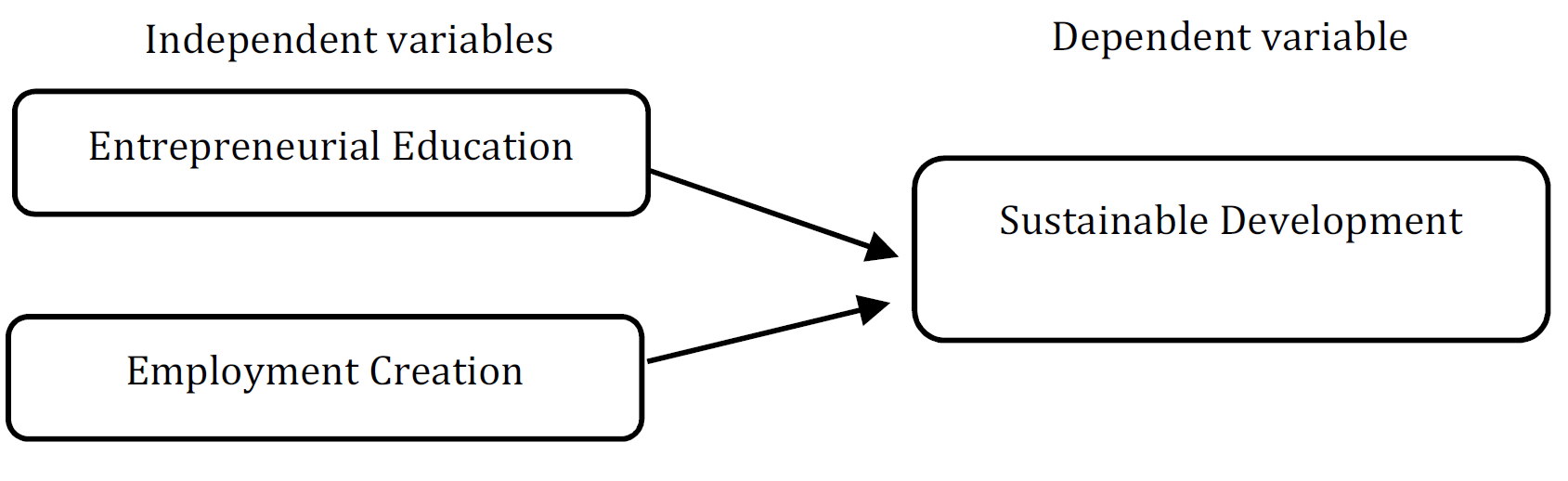
Figure 1: Conceptual Model of the Study
Reliability of the Instrument
Cronbach’s alpha reliability coefficient was used to measure the research instrument reliability. The co-efficient computations and results are shown on Table 2.
From the Table 2, the average reliability coefficient for all items in the questionnaire was 0.78, signifying that the instrument was adjudged very reliable and appropriate for the study.
Conceptual Specification of Model
Conceptually, the model specified for this study is derived from the objectives of the study and Presented on Figure 1.
Empirical Specification of Model
The econometric Model developed for this study is derived from the conceptual model. In the general form it is stated as:
Y= a+x+e
(1)
Specifically, we have:
SD = 0+ 1 Ee+2EC+e
(2)
Where:
SD = Sustainable Development
Ee = Entrepreneurial Education
Ec = Employment Creation
0 = intercept (Constant)
1, 2 = Coefficients of the Independent variables
The apriori expectation is that the independent variables will affect sustainable development positively.
Method of Data Analysis
The data gathered were analyzed using Pearson Product moment Correlation analysis and regression analysis to test the null hypothesis.
Data Analysis, Results and Findings
The analysis of data is based on research questions and test of hypothesis.
Analysis of Research Question
Research Question 1: What is the relationship between Entrepreneurial Education and sustainable development in Nigeria?
This research question sought to find out the relationship between entrepreneurial education and sustainable development in Nigeria. To address the question, Pearson Product moment correlation was used to determine the relationship the result is presented on Table 3.
The result in Table 3 indicated that the calculated r-value between entrepreneurial education and sustainable development is 0.71 (71%). This shows a very high correlation between the variable of interest.
Analysis of Research Question II
Research Question II: Does any relationship subsist between employment creation and sustainable development in Nigeria.
The research question sought to find out the relationship between employment creation and sustainable Development in Nigeria. To answer the research question, Pearson product moment correlation was used to calculate the relationship. The result is presented in Table 4.
The result in Table 4 indicated that the calculated r-value between employment creation and sustainable development is 0.86 (86%). This means that there is a very high relationship between employment creation and sustainable development in Nigeria.
Test of Hypothesis
The hypotheses of the study are tested in this section of the paper.
Hypothesis One
There is not significant relationship between entrepreneurial Education and Sustainable Development in Nigeria.
The result of data analysis relating this hypothesis is presented in Table 5.
The result shown in Table 5 revealed the calculated r-value of 0.71 is greater than the critical r-value of 0.312 at 340 degrees of freedom and 0.05 alpha level. The null hypothesis was therefore rejected. This implies that there is significant relationship between entrepreneurial education and sustainable development in Nigeria.
Hypothesis Two
There is no significant relationship between employment creation and sustainable development in Nigeria. The data analysis result relating to the hypothesis is presented on Table 6.
The result in Table 6 shows that the calculated r-value of 0.86 is greater than the critical r-value of 0.312 at 340 degrees of freedom and 0.05 alpha level. The null hypothesis is rejected implying that, there is significant relationship between employment created and sustainable development in Nigeria.
Table 3: Pearson Product Moment Correlation Analysis for the Relationship between Entrepreneurial Education and Sustainable Development in Nigeria
Source: Researchers’ computation (2022)
Table 4: Pearson product moment correlation Analysis of the Relationship between Employment Creation and sustainable Development
Source: Researchers’ Computation (2022)
Table 5: Correlation Analysis between Entrepreneurial education and sustainable Development
Source: Researchers’ Computation (2022)
Table 6: Correlation analysis between employment creation and sustainable Development
Source: Researchers’ Computation (2022)
Discussion of the Findings
Entrepreneurial Education and Sustainable Development in Nigeria
The result of data analysis relating to hypothesis one revealed a significant relationship between entrepreneurial education and sustainable development in Nigeria. This findings is in line with those of Zhang and Matlay [15], Erkilla [16], Burger et al. [17] and Nnazor [18] who reported that entrepreneurship education prepare individuals to undertake and develop sustainable businesses as a result of the skills, abilities and attitudes acquired. Also, research evidence from different sources seems to suggest that individuals attending entrepreneurship courses and programmes have a higher tendency to start their own business at some point in their life. This findings is also in line with our apriori expectations.
Employment Creation and Sustainable Development in Nigeria
The result relating to this hypothesis revealed that a significant relationship exist between employment creation and sustainable development in Nigeria. The findings is supported by some other studies such as Adejumo [3], Gurol and Atsan [19], Ajayi [20] and Oleremi and Gbenga [21] which had established positive relationship of entrepreneurship with stimulation of economic growth, employment generation and empowerment of the disadvantaged segment of the population, which include women and the poor, it is on record that Entrepreneurship businesses account for about 90% of businesses in all sectors of the economy. This implies that with purposeful entrepreneurship development programmes, unemployment in the country currently at about 40% will be reduced to the barest minimum.
Summary
The study was conducted to examine the thrust between entrepreneurship and sustainable development in Nigeria. Data were obtained through survey research design and analyzed using Pearson product Moment Correlation Coefficient. From the Findings, the following was derived:
A significant relationship between entrepreneurial education and sustainable development existed in Nigeria
There exists a significant relationship between employment creation and sustainable development in Nigeria
CONCLUSION
Based on the results, it is concluded that entrepreneurship is a thrust for sustainable development of Nigeria particularly as it relates to economic growth and development, employment, creation and enhancement of per capita income (standard of living).
Recommendations
From the findings, the following recommendations are made:
Governments at all levels in Nigeria should pay attention to entrepreneurial orientation, processes, practices and opportunities to strengthen the sectored participants (entrepreneur)
Policy maker should step-up the level of entrepreneurial education at all levels of educational trainings in Nigeria
Technical and funding supports should be enhanced to substantive and prospective entrepreneurs in order to foster their operations to booster economic growth and development
Business Implications of the Findings
The findings is a call for government (policy makers) to put in place policies and programmes to develop entrepreneurial activities. Entrepreneurial education programme and courses should form a major component of educational curricula at all levels of education in the country.
Suggestions for Further Researches
Further studies can be carried out on:
Government intervention programmes and Entrepreneurship development in Nigeria
Evaluation of the linkage between infrastructures development and Entrepreneurship in Nigeria
Acknowledgment
We extend our appreciation to all entrepreneurs who willingly responded to the research instrument and anonymous reviewers of the article.
Conflict of Interest
No ethical issues and conflict interest exists in the research authorship, publication and funding from any external sponsors.
REFERENCE
World Bank. World Development Report: Knowledge for Development. Oxford University Press, 2022.
Kuratko, D.F. “Understanding the Dynamics of Entrepreneurship through Framework Approaches.” Small Business Economics, vol. 45, no. 1, 2014, pp. 1-13.
Adejumo, G. “Indigenous Entrepreneurship Development in Nigeria: Characteristics, Problems and Prospects.” Advances in Management: Journal of the Department of Business Administration, University of Ilorin, vol. 2, no. 1, 2000, pp. 112-122.
Zaman, G. and Z. Goshin. Multidisciplinary, Interdisciplinary and Transdisciplinary. 2010.
Nwafor, P.Z. “Practical Approach to Entrepreneurship Education in Ensuring Economic Empowerment and Development.” Journal of Business Administration and Education, vol. 4, no. 1, 2007, pp. 35-36.
Baumgartner, S. and M. Quaas. “What Is Sustainable Economics?” EconStor - The Open Access Publication Server of the ZBW, 2009.
Besler, S. Kurumsal Sürdürülebilirlik. UK, 2009.
Knight, G.A. “Cross-Cultural Reliability and Validity of a Scale to Measure Firm Entrepreneurial Orientation.” Journal of Business Venturing, vol. 12, 1978, pp. 213-225.
Anietie, E. Efi et al. “Social Entrepreneurship: A Panacea for Correcting Economic Growth and Development Paradoxes in Less Developing Countries: A Case of the Nigerian Economy.” Academic Journal of Interdisciplinary Studies, vol. 3, no. 4, 2014, pp. 485-494.
Anietie, E. Efi and E.O. Etim. “Environmental Influences and Entrepreneurship Development: The Nigerian Economy Perspective.” International Journal of Research in Commerce, Economics and Management, vol. 4, no. 1, 2014, pp. 1-5.
Orishede, F. and C.A. Ezenwakwelu. “Empirical Analysis of Entrepreneurial Development and Implication for Nigerian Economic Growth.” European Journal of Business and Management, vol. 6, 2014, pp. 30-47.
Obinna, I.C. and B.N. Nwaiwu. “Social Entrepreneurship and Sustainable Development.” Journal of Poverty, Investment and Development, vol. 5, 2014, pp. 126-129.
Sunday, R.T. and M. Kamah. “Entrepreneurship, Employment and Sustainable Development in Nigeria.” International Journal of Academic Research in Economic and Management Sciences, vol. 4, no. 1, 2015, pp. 13-21.
Jack, S.L. and A.R. Anderson. “Entrepreneurship Education within the Enterprise Culture.” International Journal of Entrepreneurial Behaviour and Research, vol. 5, no. 3, 1999, pp. 110-125.
Zhang, Y. and C. Matlay. “The Role of Entrepreneurship Education as a Predictor of University Students’ Entrepreneurial Intention.” International Entrepreneurship and Management Journal, vol. 10, 2003, pp. 623-641.
Erkilla, K. Entrepreneurial Education. Garland, 2000.
Burger, L. et al. “The Impact of Previous Knowledge and Experience on the Entrepreneurial Attitude of Grade Learners.” South African Journal of Education, vol. 25, no. 2, 2005, pp. 29-44.
Nnazor, R. “Adult Education in Nigeria: The Consequences of Neglect and Agenda of Action.” International Education Journal, vol. 6, no. 4, 2005, pp. 530-536.
Gurol, Y. and N. Atsan. “Entrepreneurial Characteristics amongst Students.” Education and Training, vol. 48, no. 1, 2006, pp. 25-38.
Ajayi, O.D. “Entrepreneurship, Economic Growth and Infrastructures Development in Oyo State, Nigeria.” Journal of Small Business Management, vol. 13, no. 2, 2012, pp. 103-118.
Oleremi, H.A. and M.A. Gbenga. “Environmental Factors and Entrepreneurship Development in Nigeria.” Journal of Sustainable Development in Africa, vol. 13, no. 4, 2011, pp. 51-67.
Recommended Articles
Research Article
The Effect of Employer Attractiveness and Compensation on Job Persuit Intention to Fmcg Companies in Indonesia: Coporate Reputation as an Intervening Variable
Download PDF
Research Article
Country of Origin and Foreign Branding on Perceived Quality of Local Products in Indonesia: The Moderating Role of Consumer Ethnocentrism
Download PDF
Research Article
The Effect of Self-Efficacy and Working Environment on Work Achievement with Organizational Commitment as Mediation
Sri Wahyuni,
...
Veithzal Rivai Zainal
Download PDF
Research Article
The Effect of Beauty Vlogger on Purchase Decision for Local Skincare Products in Indonesia: Brand Image as a Mediating Variable
Download PDF
PO Box 101, Nakuru
Kenya.
Email: office@iarconsortium.org
Editorial Office:
J.L Bhavan, Near Radison Blu Hotel,
Jalukbari, Guwahati-India
Etim, E. O., Ayandele, I. A., Etuk, S. G. & Inyang, A. B. (2022). Entrepreneurship: The Thrust For Sustainable Development For Nigeria: An Empirical Analysis. Scientific Research Journal of Economics and Business Management, 2(2), 1-7.
MLA
Etim, Etim O., et al. "Entrepreneurship: The Thrust For Sustainable Development For Nigeria: An Empirical Analysis." Scientific Research Journal of Economics and Business Management 2.2 (2022): 1-7.
Chicago
Etim, Etim O., Isaac A. Ayandele, Samuel G. Etuk and Augustine B. Inyang. "Entrepreneurship: The Thrust For Sustainable Development For Nigeria: An Empirical Analysis." Scientific Research Journal of Economics and Business Management 2, no. 2 (2022): 1-7.
Harvard
Etim, E. O., Ayandele, I. A., Etuk, S. G. and Inyang, A. B. (2022) 'Entrepreneurship: The Thrust For Sustainable Development For Nigeria: An Empirical Analysis' Scientific Research Journal of Economics and Business Management 2(2), pp. 1-7.
Vancouver
Etim EO, Ayandele IA, Etuk SG, Inyang AB. Entrepreneurship: The Thrust For Sustainable Development For Nigeria: An Empirical Analysis. Scientific Research Journal of Economics and Business Management. 2022 Jul;2(2):1-7.


 Download PDF
 Download XML




 0+
0+






