Present Indian tax system is very complex as it includes cascading effects of tax. GST, being one single indirect tax scheme for the entire nation will attempt to make India united common market. GST referred as Goods and services tax is major taxation scheme developed for achieving economic growth. GST is huge reform for indirect taxation of India, the likes of which the country has not seen post Independence. GST will simplify indirect Taxation, reduce complexities and remove the cascading tax effect. Expert believes that it will have a huge impact on businesses both Big and small and change the way the economy Functions.
Keywords
Income Tax
Direct Tax
Indirect Tax
Company Law Income Tax Return
Income Tax File
E-Filing of Income-Tax Return
File Income Tax Return in India
INTRODUCTION
The GST was launched at midnight on 1 July 2017 by the President of India and the Government of India. The launch was marked by a historic midnight (30 June-1 July) session of both the houses of parliament convened at the Central Hall of the Parliament. The Goods and Services Tax (GST) is a vast concept that simplifies the giant tax structure by supporting and enhancing the economic growth of a country. GST is a comprehensive tax levy on manufacturing, sale and consumption of goods and services at a national level. The Goods and Services Tax Bill or GST Bill, also referred to as The Constitution (One Hundred and Twenty-Second Amendment) Bill, 2014, initiates a Value added Tax to be implemented on a national level in India. GST will be an indirect tax at all the stages of production to bring about uniformity in the system [1,2].
On bringing GST into practice, there would be amalgamationof Central and State taxes into a single tax payment. It would also enhance the position of India in both, domestic as well as international market. At the consumer level, GST would reduce the overall tax burden, which is currently estimated at 25-30% [3].
Under this system, the consumer pays the final tax but an efficient input tax credit system ensures that there is no cascading of taxes-tax on tax paid on inputs that go into manufacture of goods [4].
In order to avoid the payment of multiple taxes such as excise duty and service tax at Central level and VAT at the State level, GST would unify these taxes and create a uniform market throughout the country. Integration of various taxes into a GST system will bring about an effective cross-utilization of credits. The current system taxes production, whereas the GST will aim to tax consumption [5,6].
Experts have enlisted the benefits of GST as under:
It would introduce two-tiered One-Country-One-Tax regime
It would subsume all indirect taxes at the center and the state level
It would not only widen the tax regime by covering goods and services but also make it transparent
It would free the manufacturing sector from cascading effect of taxes, thus by improve the cost-competitiveness of goods and services
Goods and Services Tax GST (India) what is GST? Indirect Tax Law Explained
What is GST?: GST is an Indirect Tax which has replaced many Indirect Taxes in India. The Goods and Service Tax Act was passed in the Parliament on 29th March 2017. The Act came into effect on 1st July 2017; Goods & Services Tax Law in India is a comprehensive, multi-stage, destination-based tax that is levied on every value addition.
In simple words, Goods and Service Tax (GST) is an indirect tax levied on the supply of goods and services. This law has replaced many indirect tax laws that previously existed in India.
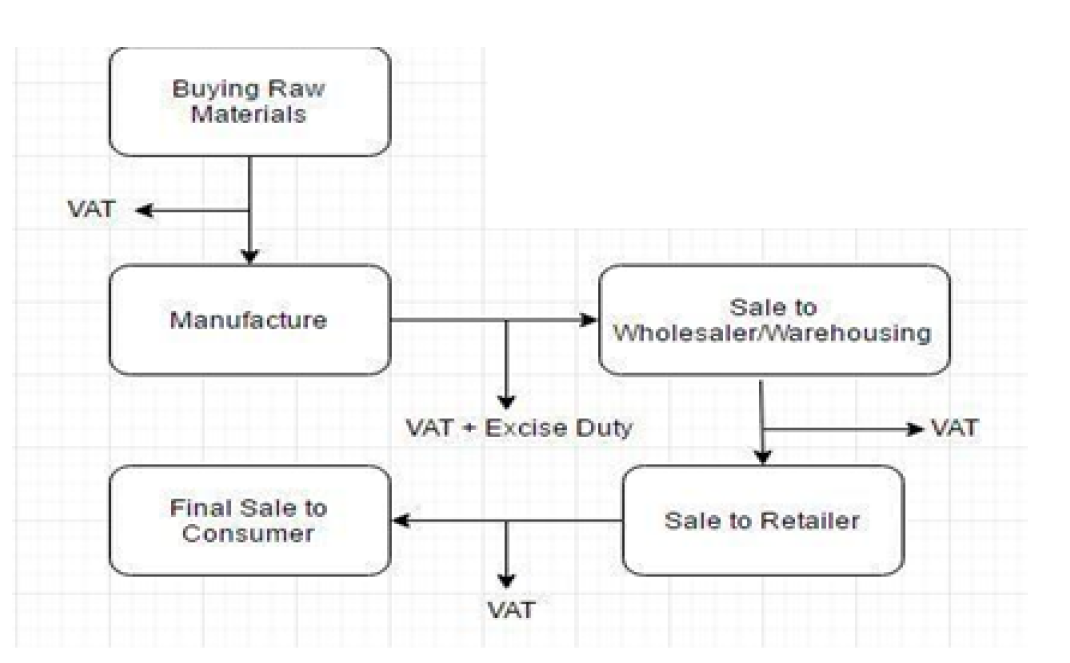
GST is one indirect taxfor the entire country. So, before Goods and Service Tax, the pattern of tax levy was as follows in Figure 1.
Figure 1: The Pattern of Tax Levy
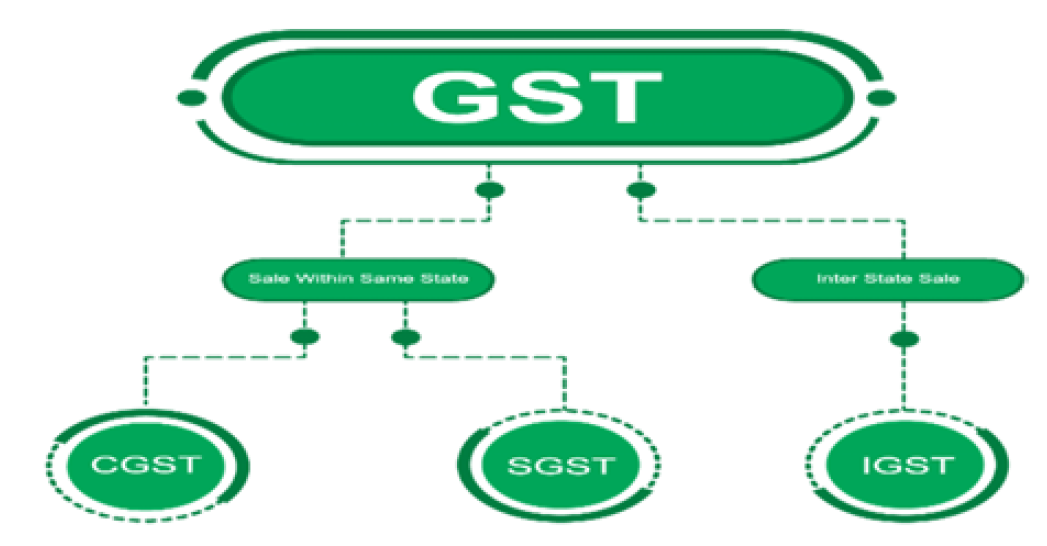
Under the GST regime, the tax is levied at every point of sale. In the case of intra-state sales, Central GST and State GST are charged. Inter-state sales are chargeable to Integrated GST.
Now let us try to understand the definition of Goods and Service Tax-“GST is a comprehensive, multi-stage, destination-based tax that is levied on every value addition.”
Multi-stage
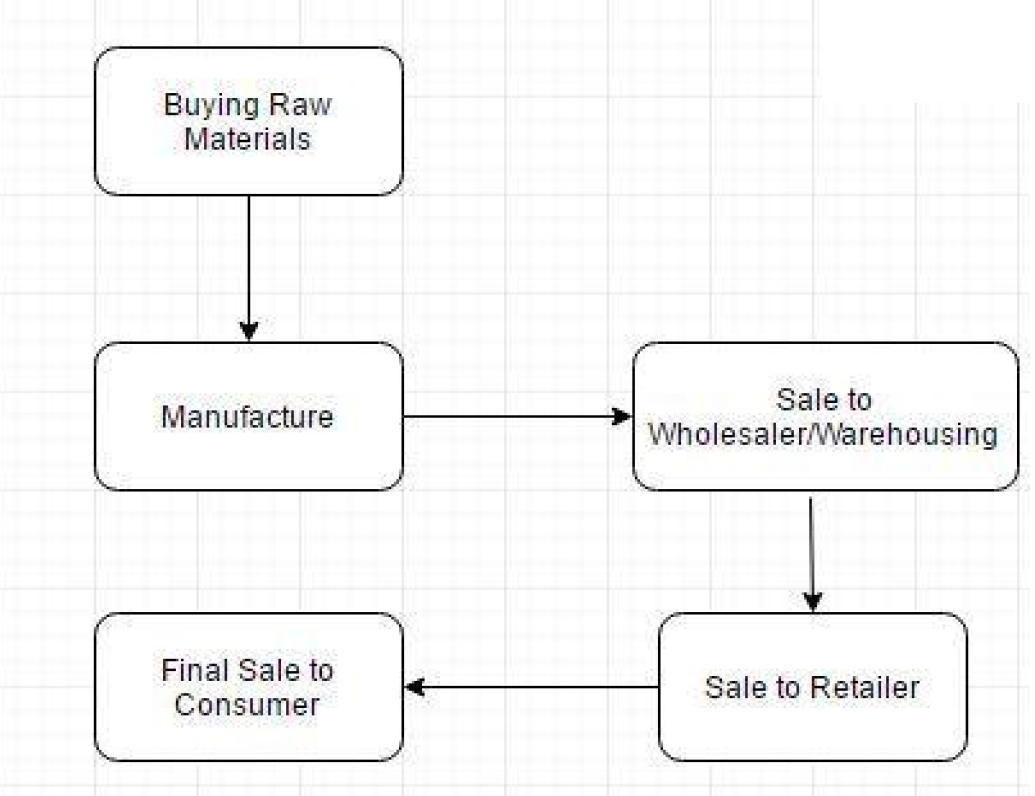
There are multiple change-of-hands an item goes through along its supply chain: From manufacture to final sale to the consumer (Figure 2).
Figure 2: Supply Chain: From Manufacture to Final Sale
Let us consider the following case:
Purchase of raw materials
Production or manufacture
Warehousing of finished goods
Sale to wholesaler
Sale of the product to the retailer
Sale to the end consumer
Goods and Services Tax is levied on each of these stages which makes it a multi-stage tax.
Value Addition
The manufacturer who makes biscuits buys flour, sugar and other material. The value of the inputs increases when the sugar and flour are mixed and baked into biscuits (Figure 3).
Figure 3: The Manufacturer then Sells the Biscuits
The manufacturer then sells the biscuits to the warehousing agent who packs large quantities of biscuits and labels it. That is another addition of value after which the warehouse sells it to the retailer.
The retailer packages the biscuits in smaller quantities and invests in the marketing of the biscuits thus increasing its value.
GST is levied on these value additions i.e., the monetary value added at each stage to achieve the final sale to the end customer.
Journey of GST in India
The GST journey began in the year 2000 when a committee was set up to draft law. It took 17 years from then for the Law to evolve. In 2017 the GST Bill was passed in the Lok Sabha and Rajya Sabha. On 1st July 2017 the GST Law came into force.
Advantages of GST
GST has mainly removed the Cascading effect on the sale of goods and services. Removal of cascading effect has impacted the cost of goods. Since the GST regime eliminates the tax on tax, the cost of goods decreases.
GST is also mainly technologically driven. All activities like registration return filing, application for refund and response to notice needs to be done online on the GST Portal; this accelerates the processes.
What are the components of GST?
In most cases, the tax structure under the new regime will be as follows in Table 1.
Table 1: The Tax Structure Under the New Regime
Transaction
New Regime
Old Regime
Sale within the State
CGST+SGST
VAT+Central Excise/Service tax
Revenue will be shared equally between the Centre and the State
Sale to another State
IGST
Central Sales Tax+Excise/ Service Tax
There will only be one type of tax (central) in case of inter-state sales. The Centre will then share the IGST revenue based on the destination of goods.
Let us assume that a dealer in Gujarat had sold the goods to a dealer in Punjab worth Rs. 50,000. The tax rate is 18% comprising of only IGST
In such case, the dealer has to charge Rs. 9,000 as IGST. This revenue will go to the Central Government:
The same dealer sells goods to a consumer in Gujarat worth Rs. 50,000. The GST rate on the good is 12%. This rate comprises of CGST at 6% and SGST at 6%
The dealer has to collect Rs. 6,000 as Goods and Service Tax. Rs. 3,000 will go to the Central Government and Rs. 3,000 will go to the Gujarat government as the sale is within the state.
Tax Laws before GST
In the earlier indirect tax regime, there were many indirect taxes levied by both state and centre. States mainly collected taxes in the form of Value Added Tax (VAT). Every state had a different set of rules and regulations.
Interstate sale of goods was taxed by the Centre. CST (Central State Tax) was applicable in case of interstate sale of goods. Other than above there were many indirect taxes like entertainment tax, octroi and local tax that was levied by state and centre.
This led to a lot of overlapping of taxes levied by both state and centre.
For example, when goods were manufactured and sold, excise duty was charged by the centre. Over and above Excise Duty, VAT was also charged by the State. This lead to a tax on tax also known as the cascading effect of taxes.
The following is the list of indirect taxes in the pre-GST regime:
Central Excise Duty
Duties of Excise
Additional Duties of Excise
Additional Duties of Customs
Special Additional Duty of Customs
Cess
State VAT
Central Sales Tax
Purchase Tax
Luxury Tax
Entertainment Tax
Entry Tax
Taxes on advertisements
CGST, SGST and IGST has replaced all the above taxes
However, the chargeability of CST for Inter-state purchase at a concessional rate of 2%, by issue and utilization of c-Form is still prevalent for certain Non-GST goods such as:
Petroleum crude
High-speed diesel
Motor spirit (commonly known as petrol);
Natural gas
Aviation turbine fuel
Tax calculations in earlier regime is shown in Table 2.
Table 2: Tax Calculations in Earlier Regime
Action
Cost
10% Tax
Total
Manufacturer
1,000
100
1,100
Warehouse adds a label and repacks @ 300
1,400
140
1,540
Retailer advertises @ 500
2,040
204
2,244
Total
1,800
444
2,244
Along the way, the tax liability was passed on at every stage of the transaction and the final liability comes to rest with the customer. This is called the Cascading Effect of Taxes where a tax is paid on tax and the value of the item keeps increasing every time this happens.
WHAT IS SGST, CGST ANS IGST?
Suppose goods worth Rs 20000/- are sold by manufacturer A in Lucknow to dealer B in Lucknow. B resells them to traders C in Delhi for Rs 27500/- Trader C finally sells to end user C in Delhi for Rs 45000/-.
Suppose CGST = 9% and SGST = 9%, Then IGST 9+9 = 18% science A is selling this to B in Lucknow itself it is an interstate sales and both CGST and SGST will apply at the rate of 9% each.
B (Lucknow) is selling to C (Delhi) since it is an interstate sale IGST at rate of 18% apply.
C Delhi if selling to D is also in Delhi. Once again it is intra-state sales and both CGST and SGST will apply at the rate of 9% each.
Salient features of GST are shown in Figure 4. The salient features of GST are as under:
Figure 4: Salient Features of GST
GST is applicable on ‘supply’ of goods or services as against the present concept on the manufacture of goods or on sale of goods or on provision of services
GST is based on the principle of destination-based consumption taxation as against the present principle of origin-based taxation
It is a dual GST with the Centre and the States simultaneously levying tax on a common base. GST to be levied by the Centre would be called Central GST (CGST) and that to be levied by the States would be called State GST (SGST)
An Integrated GST (IGST) would be levied an inter-state supply (including stock transfers) of goods or services. This shall be levied and collected by the Government of India and such tax shall be apportioned between the Union and the States in the manner as may be provided by Parliament by Law on the recommendation of the GST Council
Import of goods or services would be treated as inter-state supplies and would be subject to IGST in addition to the applicable customs duties
CGST, SGST and IGST would be levied at rates to be mutually agreed upon by the Centre and the States. The rates would be notified on the recommendation of the GST Council. In a recent meeting, the GST Council has decided that GST would be levied at four rates viz. 5, 12, 16 and 28%. The schedule or list of items that would fall under each of these slabs has been worked out. In addition to these rates, a cases
Would be imposed on “demerit” goods to raise resources for providing compensation to States as States may lose revenue owing to the implementation of GST
GST would replace the following taxes currently levied and collected by the Centre:
Central Excise Duty
Duties of Excise (Medicinal and Toilet Preparations)
Additional Duties of Excise (Goods of Special Importance)
Additional Duties of Excise (Textiles and Textile Products)
Additional Duties of Customs (commonly known as CVD)
Special Additional Duty of Customs (SAD)
Service Tax
Cesses and surcharge in so far as they relate to supply of goods and services
State taxes that would be subsumed within the GST are:
State VAT
Central Sates Tax
Purchase Tax
Luxury Tax
Entry Tax (All forms)
Entertainment Tax and Amusement Tax (except those levied by the local bodies)
Taxes on advertisements
Taxes on lotteries, betting and gambling
GST Rate Revision in 42nd GST Council Meeting
The 42nd GST council meeting was held on 05 October 2020 and the following decisions have been taken regarding GST rates
Decisions taken by GST Council
Some of the major decisions taken by the GSTC so far are:
There would be four tax rates under the GST regime, i.e., 5, 12, 18 and 28%. Some goods and services were also classified as exempt from tax
A cess above the peak rate of 28% would be levied on certain sin and luxury goods
The administrative control over 90% of taxpayers with turnover less than Rs.1.5 crore would be with the State tax administration. 10% of control would be with the Central tax administration
Administrative control over taxpayers having turnover above Rs.1.5 crore would be equally divided between the State and Centre tax administration.
Goods and Services Tax Network
Goods and Services Tax Network (GSTN) was set up as a private company in 2013 by the Government under Section 25 of the Companies Act, 1956. GSTN is expected to offer the front-end services of registration, payment and returns to taxpayers. It would also develop back-end technical modules that will be utilized by 25 states that have opted in.
GSTN has also identified 34 IT and financial technology companies and tagged them as GST Suvidha Providers (GSPs). These organizations will develop applications that will be used by taxpayers when they interact with GSTN.
Key features of the GST regime
The GST system is characterized by the following features:
GST is applicable on the “supply” of services or goods as opposed to the earlier concept of taxation on goods manufacture, sale of goods or service provision
GST is a destination-based tax structure unlike the origin-based structure that existed previously
CGST, IGST and SGST/UTGST are levied at rates that would be mutually agreed upon by the states and Centre
GST will replace the central taxes mentioned below:
Duties of Excise (medicinal and toilet needs)
Central Excise Duty
Additional Duties of Excise (Goods of Special Importance)
Additional Duties of Customs (CVD)
Service Tax
Special Additional Duty of Customs(SAD)
Additional Duties of Excise (Textiles and Textile Products)
Cesses and surcharges
GST will subsume the following state taxes:
Central Sales Tax
Entry Tax
State VAT
Luxury Tax
Purchase Tax
Entertainment Tax, except that levied by local entities
Taxes on lotteries and gambling
Taxes on advertisements
State cesses and surcharges
Taxpayers with annual turnover of Rs.20 lakh is exempt from GST. For special category states, this cut-off is Rs.10 lakh. An option of compounding is available to small-scale taxpayers with annual turnover of Rs.50 lakh or below. The choice of threshold exemption and the compounding scheme are optional.
Input credit of CGST shall be used only for paying CGST on the output. Similarly, input credit of SGST/UTGST will be used only for the payment of SGST/UTGST. Therefore, the two channels of input tax credit cannot be cross-utilized, except for the payment of IGST for inter-state supplies
Benefits of GST Implementation
Key benefits of the GST announcement are detailed as follow:
As mentioned above, the GST system will create a common national market that boosts foreign investment
The cascading effect of taxation will be mitigated
There will be uniformity in laws, rates of tax and procedures across states
The GST regime is expected to boost manufacturing activities and exports. This would, in turn, generate more employment and lead to the growth of the economy
Indian products would be more competitive in the international markets
The GST system is likely to improve the overall investment climate in India
Uniformity in the rates of SGST and IGST will reduce tax evasion to a large extent
The final price of most goods will be lower when taxation is at the new GST rates. There will also be a seamless input tax credit flow between the manufacturer, retailer and supplier of service
REFERENCE
Government of India. Goods and Services Tax (GST) Portal. https://www.gst.gov.in.
Goods and Services Tax Network (GSTN). Official Website. http://www.gstn.org/.
GST India. “Types of Invoices in GST.” GST India, http:// www.gstindia.com/types-of-invoices-in-gst/.
The Economic Times. “GST.” https://economictimes. indiatimes.com/gst.
ClearTax. “GST Law: Goods and Services Tax.” ClearTax, https://cleartax.in/s/gst-law-goods-and-services-tax.
GST India. “About.” GST India, http://www.gstindia.com/ about/.
Recommended Articles
Research Article
Country of Origin and Foreign Branding on Perceived Quality of Local Products in Indonesia: The Moderating Role of Consumer Ethnocentrism
Download PDF
Research Article
The Effect of Employer Attractiveness and Compensation on Job Persuit Intention to Fmcg Companies in Indonesia: Coporate Reputation as an Intervening Variable
Download PDF
Research Article
The Effect of Beauty Vlogger on Purchase Decision for Local Skincare Products in Indonesia: Brand Image as a Mediating Variable
Download PDF
Research Article
The Effect of Self-Efficacy and Working Environment on Work Achievement with Organizational Commitment as Mediation
Sri Wahyuni,
...
Veithzal Rivai Zainal
Download PDF
PO Box 101, Nakuru
Kenya.
Email: office@iarconsortium.org
Editorial Office:
J.L Bhavan, Near Radison Blu Hotel,
Jalukbari, Guwahati-India
Gupta, R. K. & Singh, G. (2022). Role of GST and It’s Impact in Indian Economy. Scientific Research Journal of Economics and Business Management, 2(1), 1-5.
MLA
Gupta, Rahul K. and Gajraj Singh. "Role of GST and It’s Impact in Indian Economy." Scientific Research Journal of Economics and Business Management 2.1 (2022): 1-5.
Chicago
Gupta, Rahul K. and Gajraj Singh. "Role of GST and It’s Impact in Indian Economy." Scientific Research Journal of Economics and Business Management 2, no. 1 (2022): 1-5.
Harvard
Gupta, R. K. and Singh, G. (2022) 'Role of GST and It’s Impact in Indian Economy' Scientific Research Journal of Economics and Business Management 2(1), pp. 1-5.
Vancouver
Gupta RK, Singh G. Role of GST and It’s Impact in Indian Economy. Scientific Research Journal of Economics and Business Management. 2022 Jan;2(1):1-5.



 Download PDF
 Download XML