While a lot research has been devoted to the exploration of the antecedents of organizational commitment, less attention has been focused on the significant causal relationships among antecedents especially in the context of Saudi Arabia. Using data from 234 employees of two Saudi public sector organizations, this study examined the causal relationships of organizational practices with trust and role ambiguity in influencing organizational commitment composed of the three dimensions i.e., affective, continuance and normative commitments as developed by Meyer and Allen. This study also examined the effect of organizational commitment on altruism. Results of Linear Structural Relations (LISREL) analyses showed that human resource-oriented practices, such as career development and training, are more directly related to affective and normative commitment, while organizational process-oriented practices, such as communication and participation in decision-making, are indirectly related to them through role ambiguity and trust. However, no hypothesized antecedent was found to affect significantly continuance commitment. As an outcome of organizational commitment, altruism was predicted by affective commitment and role ambiguity. These findings highlight the importance of understanding the nature of organizational commitment in the public sector and provide useful theoretical and practical implications for the elicitation of desirable attitudes and behaviors among government employees.
Keywords
Commitment
Affective
Continuance
Normative
Antecedents
Outcomes
INTRODUCTION
Organizational Commitment (OC) is an important concept in the management and behavioral sciences. It is concerned with the relationship between an organization and its employees. The roots of organizational commitment go back to the human relations movement of the early to mid-20th century. At that time, the concept was reflected in focusing on the feelings and behaviors among employees toward the organizations they worked for [1]. The importance of organizational commitment refers to its presumed relationship with important organizational outcomes such as turnover, absenteeism and performance. Committed employees are expected to identify with and to feel loyal toward their organization; to feel the importance of the agency's values, goals and mission; and also to feel that their job responsibilities are compatible with their personal values and ethics [2].
LITERATURE REVIEW
The Effects of Organizational Practices on Role Ambiguity in the Process of Organizational Commitment
In regard to the relationship between management practice and role ambiguity, Rizzo et al. [3] reported that emphases on organizational practices, such as personal development, adequacy of communication and horizontal communication, tend to be associated with lower role ambiguity. In addition, focusing on the effect of participation in decision-making on role ambiguity, researchers [4] have argued that employees’ participation in decision-making processes allows employees to verify performance reward contingencies and permits them to engage in role clarification, thereby influencing their organizational attitudes such as job satisfaction and commitment. In regard to the effect of role ambiguity on organizational commitment, Mowday et al. [5] argued that the impact of role-related factors on commitment will be positive as long as the employee has clear and challenging job assignments. Several studies have reported that role ambiguity is negatively related to affective and normative commitments but not significantly related to continuance commitment [6-8].
Hypothesis 1a: Government employees’ positive perceptions of organizational practices will decrease their levels of perceived role ambiguity
Hypothesis 1b: Government employees’ higher levels of perceived role ambiguity will decrease their levels of affective commitment
Hypothesis 1c: Government employees’ higher levels of perceived role ambiguity will decrease their levels of normative commitment
The Effects of Organizational Practices on Trust in the Process of Organizational Commitment
Trust is often examined in terms of supervisory trust, which can be defined as the extent to which a person is confident in and willing to act on the basis of, the words, actions and decisions of his or her supervisor [9]. Psychological climate theorists [10] stress the mediating effect of trust on the relationship between organizational practices and organizational commitment. Psychological climate is the employee’s affective and cognitive representation of the organizational environment in terms of the significance and meaning of organizational environment to the individual. It has been argued that an individual’s perception of climate in his or her organization is the result of that individual’s numerous activities, interactions, feelings and other daily experiences in his or her organizational life and thus affects the person’s attitudes and behaviors. In this context, organizational practices can be seen as a part of the organization’s efforts to create or maintain a working environment and trust can be seen as a key dimension of psychological climate that represents the individual’s preference for the environment:
Hypothesis 2a: Government employees’ positive perceptions of organizational practices will increase their levels of trust
Hypothesis 2b: Government employees’ higher levels of trust will increase their levels of affective commitment
Hypothesis 2c: Government employees’ higher levels of trust will increase their levels of continuance commitment
Hypothesis 2d: Government employees’ higher levels of trust will increase their levels of normative commitment
Altruism as an Outcome of Organizational Commitment
This study focuses on the effects of organizational commitment on altruism, which has been suggested as the most pro-active citizenship behavior [11]:
Hypothesis 3a: Government employees’ higher levels of affective commitment will increase their levels of altruism.
Hypothesis 3b: Government employees’ higher levels of normative commitment will increase their levels of altruism.
Hypothesis 3c: Government employees’ higher levels of continuance commitment will decrease their levels of altruism
Previous Studies on Leadership and Organizational Commitment in Saudi Arabia
A review of the literature revealed that neither the area of leadership nor organizational commitment has been given much attention in Saudi Arabia. In Saudi Arabia serious studies of leadership generally have been absent in the field of organizational behavior, despite the existence of specific governmental programs aim to improve the current and future skills of managers. Furthermore, it has been found that the classical or traditional way of management that ignores the human side of employees is the dominant style in Saudi society and organizations. Also, Al-Harran reported that Saudi public managers perceived their management as less responsive to the public and less committed to the organization. The bureaucratic rules and regulations were perceived by Saudi managers as an impediment to enhancing public organizations. For example, Al-Meer [12] investigated the level of organizational commitment among employees working in different organizations (largely private) and representing 14 countries. The sample was divided into four groups: Saudi, Arab, Western and Asian. Al-Meer found that the Saudi group was less committed to their organizations compared to Asian and Arab groups. Similarly, Bhunian et al. [13] conducted a study on employees to investigate the influence of job satisfaction, job autonomy, job variety, task identity, feedback and employee demographics on organizational commitment among Self-Initiated Expatriates (SIEs) in Saudi Arabia. An examination of a sample of 481 SIEs reveals that only job satisfaction and job variety are related to organizational commitment. The rest-job characteristics and demographics-are unrelated to organizational commitment. In a most recent study conducted by Razali and Talat [14], they found that increased Participation in Decision-Making (PDM) would increase commitment to the organization among the Saudis non-management professional staff who perceive their superiors as having favorable attitudes toward PDM.
METHODS
Participants and Data Collection Procedures
The sites for this study were Headquarters of two Ministries Offices located in Riyadh, Saudi Arabia. The two Ministries selected are Ministry of Education and Ministry of Labor Riyadh. The research participants were government employees who work in a position equal to or below the level of middle manager. The sample included 182 male and 52 female respondents. Their average age was 39.3 and their average tenure with the organization was 12.1 years. Eighty-three percent (83%) of respondents had education at the level of college or above.
Measurements
Measures for all question items in the survey questionnaire were measured on a seven-point scale ranging from 1 (strong disagreement) to 7 (strong agreement).
Organizational Commitment
Organizational commitment was measured by Meyer et al. [7] six-item versions of affective, continuance and normative commitment scales. They reported that the reliability estimates for the affective, continuance and normative commitment scales were 0.82, 0.74 and 0.83, respectively.
Training
Training was measured by three items modified from Smith [15] four-item scale of training satisfaction. She reported that the reliability estimate was 0.90.
Career Development
Career development was measured by three items from Smith [15] five-item scale. Smith [15] scale examines employees’ perception of the organization’s interest in career development (three items) and individual development and promotion (two items). The reliability estimates for organization’s interests in career development and individual development and promotion were 0.88 and 0.83, respectively, in one sample and 0.91 and 0.90, respectively, in the other sample.
Participation in Decision Making
Participation in decision making was measured by three items adapted from Nyhan [16] five-item scale. He reported that the reliability estimate was 0.86.
Communication
Communication was measured by three items modified from O’Reilly and Roberts’ five-item scale of communication openness. They reported that the reliability estimate was 0.85.
Trust
Trust was measured by three items taken from McAllister [9] five-item scale of the affect-based trust. He reported that the reliability estimate was 0.89.
Role Ambiguity
Role ambiguity was measured by three items taken from Rizzo et al. [3] six-item scale of role ambiguity. They reported that the reliability estimates for role ambiguity in two samples were 0.78 and 0.81.
Altruism
Altruism was measured by four items taken from Smith et al. [17] six-item scale of altruism. They reported that the reliability estimate was 0.88.
Data Analysis
The analysis of data to test the hypotheses was performed using LISREL 9.30 using a covariance matrix as input and a maximum likelihood solution. LISREL analysis was performed by the two-stage procedure [18]. The first stage involves the evaluation of the measurement model, using Confirmatory Factor Analysis (CFA) to verify the measurement items’ factor structure. Due to the large number of measurement items, separate CFAs for three categories of variables-organizational commitment, its antecedents and its consequence were conducted on the basis of their conceptual distinctiveness. The second stage tests were the theoretical model and a sequence of alternative models to identify the most acceptable model. At this stage, measurement items that reflect a common construct were aggregated to derive composite scale scores of single indicators.
In estimating latent variables by single indicators in the structural equation models, measurement errors in the scale scores were adjusted by taking one minus the reliabilities times the observed variance cited by Joreskog and Sorbom [19]. The structural equation models were evaluated by following Bollen [20] recommendation for interpreting multiple indices of model fit.
RESULTS
CFAs of Organizational Commitment, Its Antecedents and Its Consequence
The initial CFA for the organizational commitment scales indicated that the measurement model fit the datapoorly (X2 = 880.02, df = 132, p<0.001, Standardized RMR = 0.09, NFI = 0.71, CFI = 0.74, GFI = 0.70). Based on the item content evaluation and inspection of modification indices, six items were eliminated from the original scales as a preferred solution for poor fit [18]. Three items of continuance commitment and one item of normative commitment were eliminated because they showed poor factor loadings. In addition, one item of affective commitment and one item of normative commitment were eliminated because their factor loadings were relatively low and these items loaded redundantly on both affective and normative commitments. Doing this resulted in a substantially improved model fit(X2 = 182.94, df = 51, p<0.001),Standardized RMR = 0.07, NFI = 0.90, CFI = 0.93, GFI = 0.90). Although the chi-square statistic was still significant and not consistent with perfect model fit, the measurement model was deemed acceptable, given the other supportive indices. Table 1 shows factor loadings for the revised scales of organizational commitment.
Table 1: Results of CFA for Organizational Commitment Measurement Items
Measurement Items
Lambdas*
Affective Commitment
I would be very happy to spend the rest of my career with this organization
0.74
I really feel as if this organization’s problems are my own.
0.76
I do not feel a strong sense of belonging to my organization.
0.86
I do not feel emotionally attached to this organization.
0.94
I do not feel like part of the family at my organization.
0.89
This organization has a great deal of personal meaning for me.
-
Continuance Commitment
I feel that I have too few options to consider leaving this organization.
0.78
If I had not already put so much of myself into this organization,
-
One of the few negative consequences of leaving this organization would be the scarcity of available alternatives.
0.81
Right now, staying with my organization is a matter of necessity as much as desire.
-
Too much of my life would be disrupted if I decided I wanted to leave my organization now.
-
Normative Commitment
Even if it were to my advantage, I do not feel it would be right to leave my organization now.
0.79
I would feel guilty if I left this organization now.
0.84
I would not leave my organization right now because I have a sense of obligation to the people in it.
0. 74
I owe a great deal to my organization.
0.70
I do not feel any obligation to remain with my current employer.
-
This organization deserves my loyalty.
-
*The lambdas reported are from the maximum likelihood solution, (X2 = 182.94, df = 51, p<0.001, Standardized RMR = 0.07, NFI = 0.90, CFI = 0.93, GFI = 0.90)
The CFA for antecedents of organizational commitment verified factor structures of organizational practices, role ambiguity and trust as presented in Table 2.
Table 2: Results of Confirmatory Factor Analysis (CFA) for Antecedents of Organizational Commitment
Measurement Items
Lambdas*
Training
I think my organization places the right amount of emphasis or importance on training.
0.75
My training was useful or helpful to me.
0.95
I am satisfied with the training I have received so far.
0.90
Communication
Except for necessary security information, all personnel have relatively easy access to information that directly to their immediate jobs
0.61
It is easy to communicate openly to all members of this group.
0.85
It is easy to ask advice from any member of this group.
0.76
Career Development
My organization takes an interest in my career development or advancement.
0.79
I think I am or will be given the opportunity to develop my full potential in my organization.
0.95
My organization provides me with sufficient challenge.
0.8
Participation in Decision Making
Employees in this organization work cooperatively to solve problems.
0.82
The organization encourages its managers and supervisors to involve employees in decision making.
0.81
Employees in this organization participate in planning and decision making.
0.78
Role Ambiguity
I feel certain about how much authority I have.
0.97
I know what my responsibilities are.
0.95
I know clearly planned goals and objectives of my job.
0.86
Trust
I can talk freely to my supervisor about difficulties I am having at work and know that he/she will want to listen.
0.92
My supervisor and I would both feel a sense of loss if one of us was transferred and we could no longer work together.
0.73
If I shared my problems with my supervisor, I know he/she would respond constructively and caringly.
0.84
*The lambdas reported are from the maximum likelihood solution, (X2 = 256.18, df = 120, p<0.001, Standardized RMR = 0.06, NFI = 0.91, CFI = 0.95, GFI = 0.90)
Although the chi-square statistic was significant (X2 = 256.18, df = 120, p<0.001, Standardized RMR = 0.06, NFI = 0.91, CFI = 0.95, GFI = 0.90), other model fit indices supported well the measurement model. As presented in Table 3, the CFA for altruism strongly supported that it is one factor (X2 = 5.34, df = 2, p = 0.069, Standardized RMR = 0.02 NFI = 0.99, CFI = 0.99, GFI = 0.99).
Table 3: Results of CFA for Altruism
Measurement Items
Lambdas*
I often volunteer for things that are not required.
0.70
I often help others who have heavy workloads.
0.85
I often assist supervisor with his or her work voluntarily.
0.85
I frequently make innovative suggestions to improve my department.
0.60
*The lambdas reported are from the maximum likelihood solution, (X2 = 256.18, df = 120, p<0.001, Standardized RMR = 0.06, NFI = 0.91, CFI = 0.95, GFI = 0.90)
Reliabilities and Correlations
Table 4 reports means, standard deviations, reliabilities and correlations for the 10 variables. All reliabilities of scales exceeded the 0.70 threshold cited by Nunnally [21] as being acceptable. Bivariate statistics suggested that all organizational practices, trust, role ambiguity, affective commitment, normative commitment and altruism were significantly correlated, with an exception of a correlation between communication and normative commitment. However, no variable showed a significant correlation with continuance commitment.
Table 4: Means, Standard Deviations, Reliabilities* and Correlations** of the Study Variables (N = 234)
Variable
MEAN
SD
1
2
3
4
5
6
7
8
9
10
Altruism
4.87
0.95
(0.81)
-
-
-
-
-
-
-
-
-
Affective commitment
5.30
1.33
0.44
(0.90)
-
-
-
-
-
-
-
-
Continuance commitment
4.34
1.37
0.05
0.03
(0.78)
-
-
-
-
-
-
-
Normative commitment
3.65
1.33
0.31
0.50
0.05
(0.83)
-
-
-
-
-
-
Role ambiguity
2.3
1.13
-0.45
-0.44
-0.05
-0.23
(0.92)
-
-
-
-
-
Trust
4.47
1.21
0.37
0.46
-0.07
0.39
-0.39
(0.84)
-
-
-
-
Training
3.94
1.28
0.22
0.36
0.09
0.42
-0.24
0.39
(0.88)
-
-
-
Communication
4.55
1.06
0.28
0.30
-0.01
0.16
-0.27
0.44
0.35
(0.76)
-
-
Career development
3.77
1.27
0.32
0.40
0.05
0.44
-0.20
0.40
0.49
0.45
(0.86)
-
Participation
4.13
1.12
0.35
0.42
0.06
0.32
-0.24
0.60
0.47
0.52
0.56
(0.83)
Reliabilities are reported along the diagonal, **Correlations equal to or above 0.20 are significant at p<0.01
The Structural Equation Modeling Results
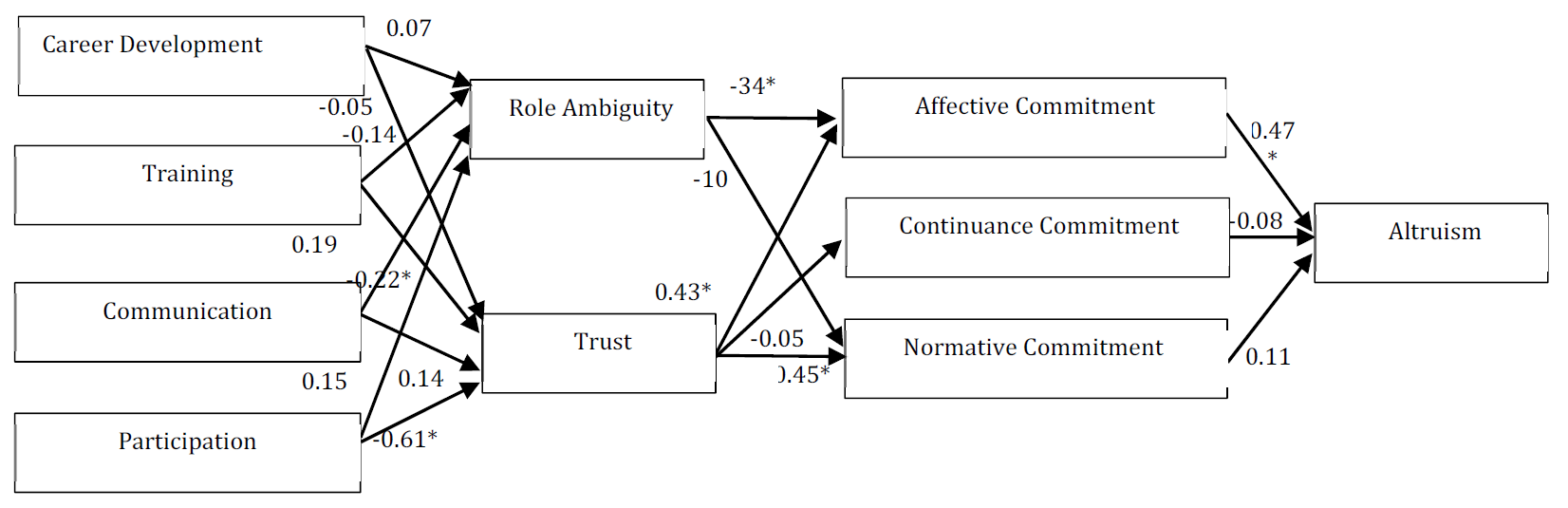
In specifying the structural equation models, it was assumed that the exogenous variables were correlated. And, error terms of affective and normative commitments were allowed to be correlated because a strong reciprocal relationship between these two commitments has been generally confirmed in the literature. Figure 1 shows the theoretical structural equation model. The model fit indices indicate that the model did not acceptably fit to the data (c2 = 98.30, df = 22, p<0.001, Standardized RMR = 0.08, NFI = 0.86, CFI = 0.88, GFI = 0.92). Accordingly, the structural equation model was revised to identify the most acceptable model by eliminating and adding paths from the theoretical model on the basis of modification indices. Then, the theoretical model was compared to constrained models generated from the revision process [18].
Figure 1: Structural Path Estimates of the Hypothesized Process Model of Organizational Commitment*
A less constrained model refers one in which one or more paths are added to the theoretical model, while a more constrained model refers one in which one or more paths are removed from the theoretical model. A less constrained model (Model 2) that added paths from role ambiguity and trust to altruism produced a better model fit (c2 = 75.73, df = 20, p<0.001, Standardized RMR = 0.07, NFI = 0.89, CFI = 0.92, GFI = 0.94). The chi-square difference, 22.57 with 2 degrees of freedom, between the theoretical model and Model 2 indicates significant relationships of role ambiguity and trust to altruism. However, a more constrained model (Model 3) that eliminated paths from trust to continuance commitment and from continuance commitment to altruism showed no improvement in the model fit (X2 = 99.94, df = 24, p<0.001, Standardized RMR = 0.08, NFI = 0.86, CFI = 0.88, GFI = 0.92).
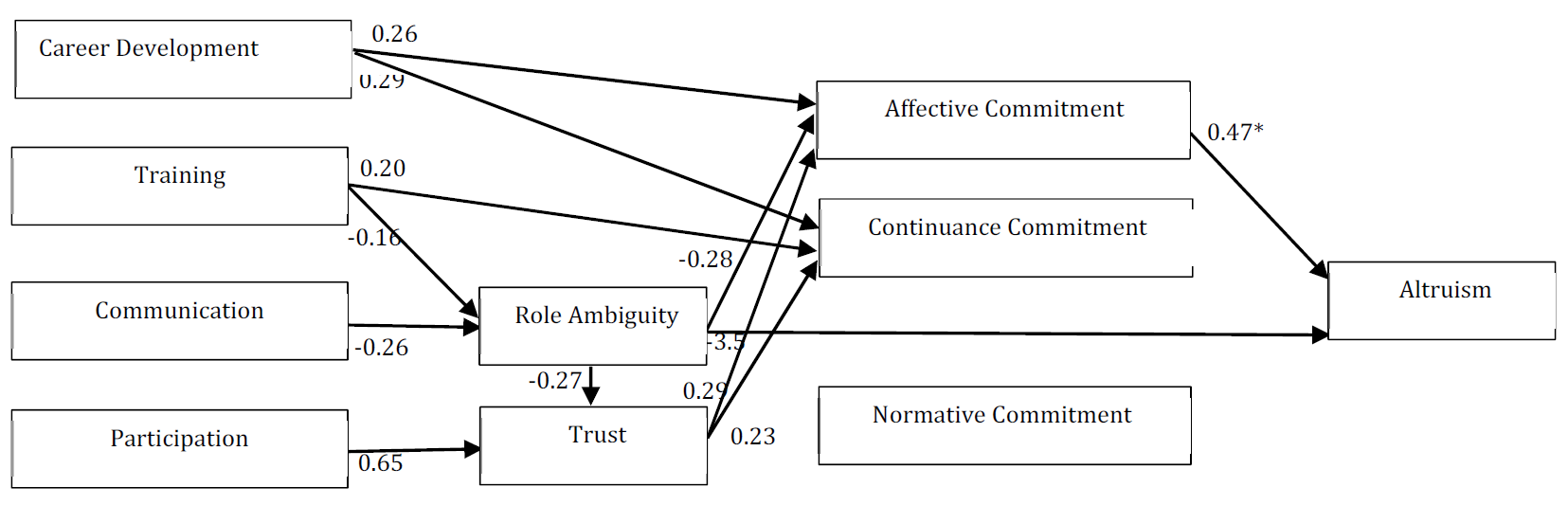
After a series of modifications, the final model(Model 4) that fit well to the data was identified (X2 = 37.06, df = 26, p = 0.074, Standardized RMR = 0.04, NFI = 0.95, CFI = 0.98, GFI = 0.97). The insignificant chi-square and other acceptable model fit indices indicate that Model 4 was consistent with the perfect model fit. As presented in Figure 2, Model 4 consisted of twelve significant paths including seven hypothesized paths and five newly added paths. Results showed that R2 associated with equations for affective commitment, normative commitment and altruism in Model 4 are 0.27, 0.32 and 0.09, respectively. Table 5 presents a summary of the model fit indices for structural equation models.
Figure 2: Structural Path Estimates* of the Final Process Model (Model 4) of Organizational Commitment**
Table 5: The Model Fit Results of the Structural Equation Models
Model
X2
df
p-value
Standardized RMR
NFI
CFI
GFI
Theoritical Model
98.30
22
0.001
0.08
0.86
0.88
0.92
Model 2*
75.73
20
0.001
0.07
0.89
0.92
0.94
Model 3**
99.94
24
0.001
0.08
0.86
0.88
0.92
Model 4
37.06
26
0.74
0.04
0.95
0.98
0.97
DISCUSSION
The purpose of this study was to examine the effects of organizational practices on the psychological processof organizational commitment. It was hypothesized that organizational practices would affect organizational commitment indirectly through trust and role ambiguity. Even though the results of this study provided only partial support for the hypothesized process model of organizational commitment, the results represent a step forward in understanding the psychological process of organizational commitment that explains the employee-organization linkage in the public sector. The final structural equation model, modified from the hypothesized model, provides strong support for several relationships among the hypothesized antecedents of organizational commitment and between the hypothesized antecedents and organizational commitment. This allows us to construct a psychological process of organizational commitment among Saudi government employees.
First, the effects of organizational practices on role ambiguity (Hypothesis 1a) and trust (Hypothesis 2a) were partially supported. Communication was found to have a direct effect on role ambiguity and participation in decision-making was found to have a direct effect on trust. Career development was also found to have direct effects on affective and normative commitments. Training was also found to have direct effects on normative commitment, as well as on role ambiguity. This pattern of results implies that organizational practices are key sources, directly and indirectly via role ambiguity and trust, of the psychological process of government employees’ organizational commitment and that each of organizational practices has different effects.
Second, even though hypotheses of the effects of role ambiguity (Hypothesis 1b, c) and trust (Hypothesis 2b-d) on organizational commitments were only partially supported, the importance of role ambiguity and trust in the psychological process of organizational commitment was strongly supported. Employees’ perception of role ambiguity was found to affect only affective commitment but it was also found to affect (negatively) trust. In turn, trust was found to affect (positively) affective and normative commitments. These results emphasize the importance of role ambiguity in the process of organizational commitment and imply that an employee who has less role ambiguity has higher trust and stronger affective attachment to the organization.
While all antecedents suggested in this study, including the four organizational practices, role ambiguity and trust, were found to have significant direct or indirect effects on affective and normative commitments, no hypothesized antecedent was found to affect significantly continuance commitment. This result is consistent with Liou and Nyhan [22] study. In their study of the distinctive natures of affective and continuance commitments, Liou and Nyhan [22] reported that government employee motives and commitment are primarily based on their identification with and involvement in their public organizations but less concerned with the costs associated with staying with or leaving their organization.
Third, altruism was significantly predicted only by affective commitment (Hypothesis 3a). This result implies strongly that, even though affective and normative commitments are significantly related (r = 0.50), these two dimensions of organizational commitment may have distinctive natures in predicting employees’ organizational behaviors.
It was also found that role ambiguity has a significant direct effect on altruism, as well as an indirect effect via affective commitment. This result implies that an employee with less role ambiguity has a stronger tendency to show voluntarily extra-role behaviors that are beyond what is formally required in the organization and promote organizational effectiveness.
Directions for Future Research
This study suggests useful directions for future research. First, longitudinal studies and cross-cultural studies will be useful to generate more generalizable knowledge of the psychological process of organizational commitment in future research.
Second, future research needs to extensively investigate antecedents and outcomes of organizational commitment and the nature of their relationships in the public sector.
Third, this study identified no substantial difference in employees’ perceptions of organizational practices between two ministries. Future research that reflects the effects of real differences in organizational practices and organizational culture among public organizations on the psychological process of organizational commitment may provide useful knowledge for human resource management in the public sector.
Implications for Theory and Practice
The results of this study have practical implications because they focus on the effects of organizational management practices on multidimensional aspects of organizational commitment in the public sector. This provides useful guidelines for managers who aim to elicit desirable attitudes and behaviors from government employees. Perhaps of greater importance, this study revealed the significant influence of organizational management practices on employees’ affective and normative commitments in the public sector. This study provides clear evidence that government employees’ affective and normative commitments are likely to be enhanced either directly or indirectly by employees’ perceptions of how they are treated in the organization. In particular, the significant paths from participation in decision-making to trust and in turn, from trust to affective and normative commitments shed light on the importance of trust-building management practices on government employees’ attitudes. This study also highlights the important effects of role ambiguity on employees’ attitudes and behaviors in the public sector.
Thus, it is imperative that managers engage in management practices, such as communication and training that will enhance an employee’s role clarity. In sum, if managers want to increase employees’ organizational commitment and, in turn, employees’ organizational citizenship behaviors, they should foster employees’ opportunities to participate in decision-making processes as a key source of trust-based working environments and to have training and open communication of information as key sources of lower role ambiguity.
Acknowledgment
The author would like to express his sincere appreciation and gratitude for all the participants who were involved in data collection.
REFERENCE
Balfour, D.L. and B. Wechsler. “Organizational Commitment: Antecedents and Outcomes in Public Organizations.” Public Productivity & Management Review, vol. 19, 1996, pp. 256-277.
Romzek, B.S. “Employee Investment and Commitment: The Ties That Bind.” Public Administration Review, vol. 50, 1990, pp. 374-382.
Rizzo, J.R. et al. “Role Conflict and Ambiguity in Complex Organization.” Administrative Science Quarterly, vol. 15, 1970, pp. 150-163.
Smith, C.S. and M.T. Brannick. “A Role and Expectancy Model of Participative Decision Making: A Replication and Theoretical Extension.” Journal of Organizational Behavior, vol. 11, 1990, pp. 91-104.
Mowday, R. et al. Employee Organizational-Linkages: The Psychology of Commitment, Absenteeism and Turnover. New York: Academic Press, 1982.
Allen, N.J. and J.P. Meyer. “The Measurement and Antecedents of Affective, Continuance and Normative Commitment to the Organization.” Journal of Occupational Psychology, vol. 63, 1990, pp. 1-18.
Meyer, J.P. et al. “Commitment to Organizations and Occupations: Extension and Test of a Three-Component Conceptualization.” Journal of Applied Psychology, vol. 78, 1993, pp. 538-551.
Kao, H.S.R. and S.H. Ng. “Organizational Commitment: From Trust to Altruism at Work.” Psychology and Developing Societies, vol. 5, 1993, pp. 43-60.
McAllister, D.J. “Affect- and Cognition-Based Trust as Foundations for Interpersonal Cooperation in Organizations.” Academy of Management Journal, vol. 38, 1995, pp. 24-59.
Sommer, S.M. et al. “Organizational Commitment across Cultures: The Impact of Antecedents on Korean Employees.” Human Relations, vol. 49, 1996, pp. 977-993.
Shore, L.M. and S.J. Wayne. “Commitment and Employee Behavior: Comparison of Affective Commitment and Continuance Commitment with Perceived Organizational Support.” Journal of Applied Psychology, vol. 78, 1993, pp. 774-780.
Al-Meer, A.A. “The Relationship between Job Stress, Organizational Commitment, Job Performance, Job Satisfaction and Demographic Variables: Comparative Study.” Public Administration, vol. 35, no. 21, 1995.
Bhunian, S.N. et al. “Work-Related Attitudes and Job Characteristics of Expatriates in Saudi Arabia.” Thunderbird International Business Review, vol. 43, no. 1, 2001, pp. 21-32.
Razali, M.Z. and A.N. Talat. “The Effects of Participation in Decision Making on Organizational Commitment: Some Empirical Evidences.” Paper presented at the Third Business & Management Conference, Lisbon, Portugal, organized by the International Institute of Social and Economic Sciences, March 2016.
Smith, C.A. Human Resource Practices and Policies as Antecedents of Organizational Commitment. Doctoral dissertation, University of Western Ontario, Canada, 1995.
Nyhan, R.C. The Interrelationships of Organizational Commitment, Trust and Participatory Decision-Making Practices in Public Organizations. Doctoral dissertation, Florida Atlantic University, 1994.
Smith, C.A. et al. “Organizational Citizenship Behavior: Its Nature and Antecedents.” Journal of Applied Psychology, vol. 68, 1983, pp. 653-663.
Anderson, J.C. and D.W. Gerbing. “Structural Equation Modeling in Practice: A Review and Recommended Two-Step Approach.” Psychological Bulletin, vol. 103, 1988, pp. 411-423.
Joreskog, K.G. and D. Sorbom. LISREL 8: User’s Reference Guide. Chicago: Scientific Software, 1996.
Bollen, K.A. “Overall Fit in Covariance Structural Models: Two Types of Sample Size Effects.” Psychological Bulletin, vol. 107, 1990, pp. 256-259.
Nunnally, J.C. Psychometric Theory. New York: McGraw-Hill, 1978.
Liou, K.T. and R.C. Nyhan. “Dimensions of Organizational Commitment in the Public Sector: An Empirical Assessment.” Public Administration Quarterly, vol. 18, 1994, pp. 99-118.
Recommended Articles
Research Article
The Effect of Employer Attractiveness and Compensation on Job Persuit Intention to Fmcg Companies in Indonesia: Coporate Reputation as an Intervening Variable
Download PDF
Research Article
Country of Origin and Foreign Branding on Perceived Quality of Local Products in Indonesia: The Moderating Role of Consumer Ethnocentrism
Download PDF
Research Article
The Effect of Self-Efficacy and Working Environment on Work Achievement with Organizational Commitment as Mediation
Sri Wahyuni,
...
Veithzal Rivai Zainal
Download PDF
Research Article
The Effect of Knowledge Capital in Enhancing Cognitive Performance: The Mediating Role of Organizational Learning Requirements
Download PDF
PO Box 101, Nakuru
Kenya.
Email: office@iarconsortium.org
Editorial Office:
J.L Bhavan, Near Radison Blu Hotel,
Jalukbari, Guwahati-India
Zin, R. M. & Al-Shehri, M. A. (2021). Organizational Commitment: An Empirical Analysis of Antecedents and Outcomes. Scientific Research Journal of Economics and Business Management, 1(1), 1-7.
MLA
Zin, Razali M. and Mohsin A. Al-Shehri. "Organizational Commitment: An Empirical Analysis of Antecedents and Outcomes." Scientific Research Journal of Economics and Business Management 1.1 (2021): 1-7.
Chicago
Zin, Razali M. and Mohsin A. Al-Shehri. "Organizational Commitment: An Empirical Analysis of Antecedents and Outcomes." Scientific Research Journal of Economics and Business Management 1, no. 1 (2021): 1-7.
Harvard
Zin, R. M. and Al-Shehri, M. A. (2021) 'Organizational Commitment: An Empirical Analysis of Antecedents and Outcomes' Scientific Research Journal of Economics and Business Management 1(1), pp. 1-7.
Vancouver
Zin RM, Al-Shehri MA. Organizational Commitment: An Empirical Analysis of Antecedents and Outcomes. Scientific Research Journal of Economics and Business Management. 2021 Jan;1(1):1-7.


 Download PDF
 Download XML