The study examined the role that intellectual capital plays in achieving organizational excellence. It seeks to provide a theoretical framework for some writers and researchers who tested the variables of the study, as well as the practical framework for the opinions of (47) Iraqi instructors (a sample of Iraqi universities through a questionnaire). Intellectual capital has been expressed as an independent variable through its three elements (human capital, structural capital, relational capital), while organizational excellency was expressed as dependent variable through its four indicators (leadership excellence, strategic excellence, operations excellence, employees' excellence). The study used the questionnaire as a main tool for measuring the study variables and the use of a set of statistical tools such as the arithmetic mean, standard deviation and the simple correlation coefficient (Pearson) to examine the correlation between the two variables, regression analysis to test the impact of the independent variable on the dependent variable. The most important result was the presence of a significant relationship between the two variables: intellectual capital; the independent variable and organizational excellency; the dependent variable.
Keywords
Intellectual Capital
Organizational Excellency
Strategic Planning
Human Capital
Knowledge Management
INTRODUCTION
Intellectual capital is the real capital of organizations as the basis in the process of innovation and renewal and is the guide in the process of change and creativity and therefore can transform knowledge into value and then into competitive value. So, it has become a requirement of the current work environment to focus on how to develop its intellectual capital in achieving an element superior to its competitors whether it is at the level of quality performance, product, service or other excellent strategies. The importance of intellectual capital stems from the importance of the status of the category that holds it, a category with accumulations of knowledge and valuable experiences that not only allow the organization to overcome the obstacles and challenges that hinder its natural growth, but also to introduce fundamental modifications to everything and to create new businesses that allow it to adapt to its surroundings and home on the one hand and remain in the leadership on the other hand [1].
Organizational excellency is based on the organizations' investment of essential opportunities preceded by effective strategic planning and commitment to adopting a common vision dominated by clarity of purpose, adequacy of resources and keenness on performance. So, the majority of organizations have focused on achieving this goal and this can only be done by raising the level of performance of employees and paying attention to training and motivating them, in a way that ensures business organizations survival and continuity in an intense competitive environment [2].
Organizational excellency is a state of administrative excellency and creativity that can achieve advanced levels of performance as a result of tight implementation of events and marketing operations, productivity and finance. The consequent achievements surpass other competitors and satisfy all stakeholders [3]. It is represented by a number of dimensions that enable the organization to excel in the event of implementing its requirements, such as: leadership excellence, strategic excellence, operations excellence and subordinate excellence taking into account the integration of all these dimensions.
Based on the importance of intellectual capital and in continuation with previous academic efforts in increasing knowledge enrichment in this field, this study came to highlight the importance of intellectual assets in organizations in general and knowledge organizations (universities) in particular. It also aims to indicate the impact of these assets on organizational excellence.
This study included the following chapters:
The first chapter (previous studies and study methodology) includes two sections/the first section included previous studies The second section included the methodology of the study (the problem of the study, its importance, objectives, hypotheses as well as the sample population and the limits of the study and its statistical methods)
The second chapter included the theoretical aspect of three sections/the first section the concept of intellectual capital and its importance and the elements and components of intellectual capital
The second section was the concept of organizational excellency and the dimensions and elements of organizational excellence.
The third section was the relationship of intellectual capital with organizational excellence.
The third chapter reported the applied aspect of the two sections/the first section presented the results of the analysis of the variables of the study.
The second section included personal data and descriptive statistics.
Chapter IV included the conclusions and recommendations of the study
MATERIALS AND METHODS
Some Previous Studies
Studies Related To Intellectual Capital: Hamdan and Saleh [4], conducted a field study on the Iraqi and Jordanian insurance industry companies. The study sample consisted of (75) people and the researchers used the method of personal interviews and questionnaire in collecting information and the study aimed to identify the impact of spending on intellectual capital in the success of the Iraqi and Jordanian insurance industry companies. It found an indirect impact of spending on intellectual capital combined contribute to the success of the companies surveyed more than the direct impact of one element of those Items.
Al-Anzi [5], adopted the office method mainly in the collection and analysis of information and the aim of the study was to demonstrate the methods of developing intellectual capital and its impact on increasing the effectiveness of organizations. The study came out with several possible stages to affect the investment and management of intellectual capital, which are as follows: A - Continuity of raising performance standards for all employees in the organization. B- The sincerity of the organization's management to the success of the capabilities of its members. C- Modifying each of the interfaces of the work environment from the culture, structure and policies to facilitate the development of managers and their rewards. D- Using the Human Resources Department as an active organizational unit for positive change in the organization.
Miller [6], conducted a theoretical study that adopted the office method and its goal was to answer the following question: ((How to stimulate intellectual capital in organizations? The study came out with a number of conclusions, the most important of which is that the means of stimulating intellectual capital are:
Expanding intelligence by participating in ideas
Encouraging creativity by creating the appropriate atmosphere
Training workers to work in a team spirit
Dzinkowski [7], used the office method and its goal was to indicate the management of intellectual capital and to determine the characteristics of the organizations that deal with it and the study came out with the conclusion that the characteristics of organizations that deal with intellectual capital are:
Identify the needs and desires of customers with an understanding of the market environment
Maintaining strong and solid relationships with key customers
Clarity, flexibility and avoidance of red tape or bureaucracy
Studies Related to Organizational Excellence
Al-Mobaideen [8], aimed to measure the effectiveness of organizational performance evaluation and its impact on organizational excellency by soliciting the opinions of a stratified random sample of (260) individual employees in the Jordanian Social Security Corporation. The study showed a high level of organizational excellency (3.61) on the Likert five-point scale. It also showed a statistically significant impact of the effectiveness of the performance appraisal system in organizational excellency in the Social Security Corporation in Jordan. It recommended the need to work on developing an equal incentive system for all employees according to their level of performance to ensure high levels of performance that affect the overall level of excellence of the organization.
Al-Nuwaiqa [9], identified the level of empowerment of work teams at Taif University and its impact on achieving organizational excellency (leadership excellence, subordinate excellence, organizational structure excellence and culture excellence) through a study of a group of university work teams, where the questionnaire was used to collect information from about (110) members of those teams. The study showed that there was a statistically significant positive impact to enable work teams to achieve the dimensions of organizational excellency at the university and that the level of excellence for all dimensions of excellence was high at a value of (3.70) on the five-year Likert scale. The study recommended the need to pay attention to the entrance of work teams as a method to achieve organizational excellence.
Azadeh et al. [10], applied the European quality management model to evaluate the quality of service provided by the National Library in the State of Iran through self-evaluation using the questionnaire of the European Organization for Quality Management. The questionnaire included about (90) questions and workshops for the library staff, (22employees), while it was filled out by (18) of them only. The results of the study indicated that the nine criteria for excellence management achieved (492) out of (1000), where the dimension of resources and partnerships (69%), followed by human resources (58%), while leadership achieved (56%). While achieving overall performance results (64%) and community outcomes (52%). The results also confirmed the ability of this tool to demonstrate the strengths and areas of improvement needed. The study also pointed to the difficulty of understanding the principles of the European model by managers, which necessitated researchers to distribute some publications related to standards and hold an educational workshop for the same content.
Qawasmeh et al. [11], demonstrated the role of organizational culture in achieving organizational excellency at Jadara University. A questionnaire was used to collect information about the variables of the study, where the filled questionnaires valid for analysis reached (158) questionnaires after distributing about (450) questionnaires to all employees at the university. Organizational excellency was measured through four dimensions: management excellence, personnel excellence, organizational structure excellence and strategy excellence. The study showed that organizational culture is associated with organizational excellency with a strong positive relationship and statistically significant (0.889). The results also indicated a high level of organizational excellency of about (3.6) on the Likert five-year scale. The study recommended the need to provide training and development opportunities for university employees and recommended conducting future studies to evaluate organizational excellency from the point of view of students as the main axis in university higher education and the most important element in the Jordanian higher education strategy.
The Problem of the Study
The achievement of organizational excellency is very important for organizations, as the lack of organizational excellency results in the organization's inability to compete and leads to a low level of performance in institutions, which results in the loss of the organization's market share. Intellectual capital plays a pivotal role in improving the quality of life, solving problems, bringing about change and increasing the efficiency and effectiveness of the organization. Good work is also no longer enough today to survive in the volatile competitive environment and institutions urgently need to focus on achieving an important part of that organizational excellency through the optimal use of resources effectively. Based on the above, the study problem can be formulated through the following questions:
What are the main pillars of intellectual capital in the competitive environment
What are the main aspects of organizational excellency in the competition environment
Is there a significant correlation of intellectual capital with organizational excellence
Is there a significant impact of intellectual capital in achieving organizational excellence
The Importance of the Study
Nowadays, intellectual capital has increasing interest by organizations aiming to achieve organizational excellency because we live in an environment with complex climates that require facing its dynamic challenges. Both innovative and creative minds and leaders bring about change at the organizational level to ensure their success and continuity.
Hence, the importance of this study is evident in the following:
The importance of intellectual capital and its creative products and innovative methods and methods of work that add value to the organization
The significance of organizational excellency as one of the strategic goals that contributes to the quality and excellence of the performance of organizations that organizations seek to achieve
Intellectual capital contributes to the development of the current state of the organization through the production and investment of new ideas and innovations
Intellectual capital is the main source of competitive advantage and the factor affecting the success of organizational performance, as it enhances the competitive position of the organization by introducing new products
The use of organizational excellency is a crucial element in its success by information technology and the adoption of its tools to achieve the desired goals in the organization and help it respond to threats and opportunities
Intellectual capital has become the backbone of the life of business organizations, as it plays a key role in the survival and continuity of these organizations and the determination of their competitive position in the business environment
Objectives of the Study
This study seeks to achieve the following objectives:
Developing a theoretical perception of the concept of intellectual capital and its various elements in achieving organizational excellency and methods of measuring it according to the scientific sources available to researchers about these two variables
Diagnosing the nature of the relationship between intellectual capital with its various elements and achieving organizational excellency in organizations with its various indicators
Identifying the level of organizational excellency in the study sample
Allocating the role that intellectual capital can play in reaching a distinguished performance level
Showing the dimensions of intellectual capital that have the most important role in achieving organizational excellence
Consolidating the intellectual basis of the relationship between intellectual capital and organizational excellence
Hypotheses of the Study
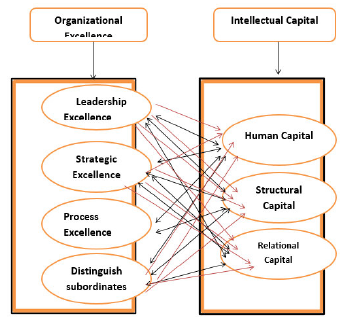
The main hypothesis is There is a statistically significant and significant correlation between intellectual capital in terms of its dimensions and organizational excellence:
There is a statistically significant correlation and impact between human capital and the dimensions of organizational excellence
There is a statistically significant correlation and impact between structural capital and the dimensions of organizational excellence
There is a statistically significant correlation and impact between relational capital with the dimensions of organizational excellence
Study Population
The study population represents Iraqi public and private universities through a questionnaire published electronically.
Study Sample
The study sample includes a random sample of a number of professors and employees of Iraqi universities through a questionnaire published electronically through the WhatsApp application, which consisted of (70) samples of opinions and the number of fully responsive electronic forms was (47).
Study Methodology
The researchers adopted the descriptive analytical approach by relying on the relevant scientific sources as well as the information available in the international information network (Internet).
Limits of the Study
Spatial boundaries/a number of Iraqi universities through a questionnaire that was published electronically
Time limits/The time range for practical research is limited to the time period ranging from (2/12/2021 - 5/4/2022)
Figure 1: Hypothetical Scheme of the Study
The plan is prepared by researchers. (represents a correlation) (represents an effect relationship)
Statistical Methods
With regard to intellectual capital, the questionnaire used in the study [12],was relied upon. As for the questions of the variable organizational excellence, the study was relied on Abdul and Al-Rafii [13], Hassouni [14] and Qawasmeh et al. [11]. It relied on the ready-made statistical program in the analysis of data SPSS and extracting the following statistical results: central tendency, arithmetic mean, measures of dispersion, standard deviation, statistical frequencies, the value of the coefficient of determination R2 and the correlation coefficient (simple Pearson) and regression analysis.
Theoretical Aspect
Intellectual Capital Concept, Importance, Components and Dimensions: Chris Ashton argues that there are six types or forms: human capital, structural capital, customer capital and organizational capital, which creates the curse of operational capital and the creative capital that generates it in intellectual property and moral assets.
As for Scandia, it divides intellectual capital into two main components called (value program):
Human: pivotal abilities, skills, key individuals, privileges and creativity
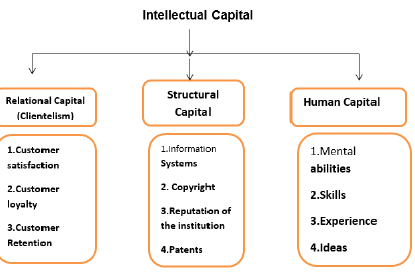
Structural: Information technology systems, customer databases, distribution systems. Stewart classified intellectual capital into three: structural capital, which refers to the system of labor, human capital, which refers to workers and customer capital, which refers to customers [15]
Through these researches and studies, we notice that the majority of researchers presented other components, but they did not depart from these three components: human capital, structural (organizational) capital and relational capital (clientelism) [16].
The Concept of Intellectual Capital
The subject of intellectual capital is one of the administrative topics raised by the contemporary administrative literature. It showed interest in it by researchers at the beginning of the nineties of the last century, as the literature showed multiple topics that changed the traditional view of the concept of capital and profitability, so capital is no longer that traditional concept, individuals working today are the real capital of organizations [17]. Bontis [18], defined intellectual capital as the reservoir of knowledge (which settles in the minds of workers), a shadow of the stock of knowledge that is established in products, systems and structures.
While it is defined as the product of interaction between a set of human resources, organizational materials and relational resources [19]:
Human resources: It represents the human capital in the organization and is related to the knowledge, skills and experiences of employees
Organizational resources: It is the category of resources that remain in the organization when employees leave and that include explicit coded knowledge, systems, methods and procedures of work
Relational resources: It represents the third category of intellectual capital components that relate to the organization's relations with customers, suppliers and stakeholders
In line with the foregoing, we can determine the orientations of researchers on the nature of intellectual capital and in a way that indicates a set of contents, revealing several indications and then revealing the directions of its representative as follows:
A direction that embodies mental aspects
A trend that expresses all that is accumulated and inherited
A trend that reflects organizational capabilities
A trend that combines the mental and organizational aspect
Direction expresses everything that is tangible
A trend that indicates that intellectual capital begins with intellectual value and ends with economic value
On this basis, the following procedural concept has been adopted in expressing intellectual capital as the value derived from transforming the tacit knowledge, information, experiences and skills of employees into tangible forms that can be traded. It enables the organization to build a mental position and distinguished relationships with the beneficiaries with the aim of competitive superiority.
The Importance of Intellectual Capital
Intellectual capital is of great importance as follows [25]:
Intellectual capital is a competitive advantage for the organization that lies in the ability of workers to learn faster and represents for it the hidden force that ensures its survival and development
Table 1: Concepts Of Intellectual Capital According to the Opinions of a Sample of Researchers
Researcher
Concept
Noe [20]
Awareness of knowledge and advanced skills, understanding of system, creativity and self-motivation of creativity
Berman [21]
Knowledge that can be turned into profit, includes two components of human capital and intellectual assets.
Al-Ali [22]
Knowledge, experience, mental ability of employees as well as knowledge resources stored in the organization's databases, systems, processes, culture, philosophy.
Hamdan and Saleh [4]
Mental ability capable of generating ideas related to the creative and strategic development that ensures the organization in a rapidly changing work environment.
Al-Tai
The set of knowledge, information, skills and experience of economic value that can be applied to achieve economic growth and development.
Hussein [23]
Knowledge does not become capital, unless it is found and invested so that it can be used for the benefit of the organization.
The table is prepared by researchers
Table 2: Components of Intellectual Capital According to the Opinions of Researchers
Contents
Researcher
Human Capital
Structural Capital
Clientele Capital
Commitment
Merit
posture
Intellectual agility
Relationship
marshalling
Renewal and development
Intellectual Property and Intellectual Property
Brooking (1996)
Edvinsson &
Holly Jr. (1997)
Jack Jack (1997)
Jackson (1997)
Sveiby (1997)
Florence (1998)
Ulrich (1998)
Sullivan (2000)
Total
8
7
5
1
2
1
1
1
1
1
2
%
100
87
62
12
25
12
12
12
12
12
25
Source: [24]
Intellectual capital represents a buried treasure that needs to be searched for and extracted for existence and practice and the process of disseminating knowledge is one of the methods of extracting it to enhance practical capabilities that build and maintain work
Intellectual capital is a source of wealth generation and development for the organization and employees through its ability to patent
The importance of intellectual capital also comes from being the most valuable asset in the twenty-first century in an economy called the "knowledge economy" because it represents a scientific force capable of introducing fundamental modifications to everything in the work of its organizations in order to avoid their successive innovations [26].
Thus, intellectual capital is the most valuable asset of the organization and cannot be easily imitated by other organizations as an important and essential source of gaining the competitive advantage of information and knowledge age organizations. It is also the engine for all organized operations and activities.
Components and Dimensions of Intellectual Capital
The components of intellectual capital are multiplied by the multiplicity of opinions of researchers, despite their agreement on the essence and importance of intellectual capital.
It is clear from the table 2 that the components (human, structural, clientelism) are the ones that took the highest percentages of researchers' opinions and therefore will be adopted as components of intellectual capital for the purposes of this study.
Human Capital
The concept of human capital is not new, as it was used by economists back to Adam Smith in the eighteenth century, but it was recently attributed to the economist Theodore W. Schultz, who won the Nobel Prize. He was the first to use the term Human Capital in his article Huma Capital Investment in, published in the American Economic Review in 1961. 2006: 200, that human capital is of great importance because it is the source of creativity and strategic innovation, it contributes to improving the skills of workers and new re-engineering and the essence of human capital is the intelligence of workers absolutely.
Structural Capital
Structural capital represents the second component of intellectual capital. It serves as the supporting structure for human capital, which can be owned and traded.
Tsan [27], suggested that it is the infrastructure that can help support workers in their pursuit of intellectual performance and, in doing so, organizational work. It represents all non-human knowledge stores in the organization such as databases, organizational charts, process manuals, strategies, routines.
Structural capital can be viewed more deeply and comprehensively, as it includes systems, procedures, structures and strategies, according to which the production system, the timely delivery of products to customers and compatibility with environmental variables are achieved [28].
Consistent with the above, structural capital is part of the knowledge structure of the organization and expresses its organizational capacity as an asset owned by the organization that it can trade, promote, maintain and work to raise its value through the efficient use of this asset. Its most prominent components are: copyright, intellectual rights, patents, information systems, organizational structure.
Clientelistic (Relational) Capital
It is the third component of intellectual capital and refers to the value contained in the organization's relationships with its customers and customer satisfaction and loyalty to the organization, also called relational capital or external capital.
Burud and Tumolo [29], referred to a worker's ability to relate to others, as well as the ability to enter the network of contacts and relationships and then find answers more quickly about products, allocate resources and create collaboration inside and outside the organization.
Others have pointed out that it contains market relations, supplier-customer relationships, as well as other external influences. Managers need to realize that they do not need to work in a self-sufficient organization but instead can enter into the wealth of knowledge from their network of customers and processors towards more effective achievement of organizational goals. Customers and suppliers can also test products, give continuous feedback on organizational practices, propose new ideas and perspectives to explore and deliver new products that attract new customers and act as customer sensitivity, revealing the evolution of the organization's competitive position [30].
In summary, intellectual capital with its basic components, human capital, structural capital and customer capital has become an important resource in most contemporary organizations and in order for organizations to survive, continue and compete for them, to focus on intellectual capital, hence competition between organizations has become highly dependent on the development and development of intellectual capital to achieve competitive advantages.
Figure 2: Stewart's Intellectual Capital Classification
Table 3: Dimensions of Distinction between Intellectual Capital and Physical Capital
Dimension
Intellectual Capital
Physical capital
Formative
Intangible ethereal
Tangible material
Time
Heading towards the future
Grounded in the past
Content & Content
is a value
is the cost of
Nature
Non-financial
cash
Sustainability
Continuous
Time
Use
Increasing in use
Decreases in use and destroys
Qualitative/Quantitative
Qualitative
Quantitative
Source [19]
The researchers believe that organizations that have intellectual capital will be able to carry out human resource management activities, including employee performance management and then formulate integrated programs and strategies that integrate goal setting, evaluation and performance development with a unified framework coherent with the unified goal, to combine individual performance goals with the overall goals of the organization.
Organizational Excellency (Concept, Importance, Dimensions and Components)
Distinguished organizations are those that are keen to translate their vision, mission and goals into reality, in order to achieve their ambitions, through which they seek to support and encourage excellence and creativity in various activities and fields of their work. This is because excellence has become an inevitability imposed by many circumstances and external forces, in light of the changes taking place, organizations are no longer required only to achieve performance, but to excel in it as a necessity for survival and continuity [31].
Organizational excellency has become the subject of interest and wide discussion by various researchers, because the age of knowledge and information has become dependent on elements that are characterized by excellence, plurality and diversity of knowledge, as achieving excellence requires the organization to adopt vital and effective systems [32].
The Concept of Organizational Excellence
There are many organizations at the present time looking for excellence, but few of them are able to achieve this goal, as well as organizational excellency is the health state that organizations should be and it is not achieved by chance, but by the overall efforts of employees, the excellence of leaders and the excellence of employees, under the influence of an organizational culture that supports this excellence [33,34]. Organizational excellency is defined as the ability of organizations to contribute and compete strategically by excelling in their performance and solving their problems and then achieving their goals effectively that distinguishes them from other organization [32].
It is defined as: excellence in the knowledge possessed by individuals, as it is the focus of the work carried out by organizations, which contributes to the continuous superiority of organizations over the best international practices in performing their tasks and knows the capabilities of their competitors, weaknesses, external strengths and the surrounding environment [14].
Organizational excellency is also defined as: a state of administrative creativity and organizational excellence, which achieves unusually high levels of performance and implementation of production, marketing, financial and other processes in the organization, resulting in achievements that exceed what competitors achieve and satisfies customers and all stakeholders in the organization [35].
Organizational excellency is characterized by strengths such as leadership, empowerment and growth to increase job satisfaction and improve performance [36, 37]. It is a planned organizational effort, aimed at not achieving the organization's objectives, strategies and operations, to achieve the organization's permanent competitive advantage [38].
The Importance of Organizational Excellence
Achieving organizational excellency is one of the most important strategic objectives of organizations and its importance appears in the following:
Directing efforts to achieve efficiency and effectiveness, achieving distinctive goals and developing the mechanisms of work of organizations, which reflects positively on economic and social growth, in order to achieve the continuity and success of organizations
Facilitate effective communication between employees of the organization at all administrative and functional levels and in all directions, as well as between the organization, the community and the external environment [8]
The ability to manage operations and use resources in a manner commensurate with the needs of beneficiaries, in order to reach positive results, attract customers and achieve their loyalty, through the excellence of the level of performance of the organization
Achieving rapid rates of change, achieving unlimited competition and maintaining organizational position, to face the rapid surrounding changes and the high level of competition between organizations
Providing efficient leadership, competent employees and a distinguished organizational culture, which is reflected in the organizational environment, achieves high levels of performance and achieves creativity, excellence and innovation [39]
The ability of organizations to face challenges and difficulties, deal with crises and accept difficult work, through rapid learning, investing in growth opportunities and improving operations
Expanding the scope of experiences away from work, where organizations have expertise outside the scope of work, such as community service, which offers many opportunities to gain excellence in performance
Providing continuous learning opportunities for the organization's members, through training and development programs, which are constantly available to improve performance and develop skills and capabilities
Accuracy in all the work of the organization, selection of the best methods to perform tasks and continuous improvement and development of products and processes
Adopting process re-engineering, in order to shift from traditional organizations to distinct organizations, by redesigning all activities, from inputs to reaching outputs, in order to change current performance methods to more distinctive method [34].
Dimensions and Elements of Organizational Excellence
Leadership Excellence: Leadership is not equal to the traditional concept of authority, as it revolves around the ability to influence others (employees) using and possessing certain abilities and traits. Leadership has been described as "how to work in a team and participate in decision-making to achieve the goals of the group and individuals at the same time through a strategy and leadership that has effective power" [40]. Referring to the leadership mechanism, Al-Ali [22], stated that "leadership consists of guiding and managing a group of individuals in the organization to move towards the set goals, which in turn includes influence, influence and legal authority.
The administrative leader in particular must be characterized by some skills, the most important of which are: the ability to form effective working relationships, the ability to spread the spirit of positive competition among individuals to motivate them to put forward creative ideas, as well as the need to adopt an open-door policy that supports direct contact with employees, which facilitates the effective exchange of information [41].
Strategic Excellence
The strategy expresses a broad general plan developed to achieve long-term goals and the end result of strategic planning is "a comprehensive long-term action plan. It defines the method and path to achieve long-term goals using available resources and constitutes a platform that guides management in making key decisions" [42].
The strategic distinction applied by the general organizations is different for them, as they work to implement their vision by developing a strategy that focuses on all employees and takes into account the services they provide to the organization and then policies, plans, objectives and processes are developed in light of this and it is recognized that the adoption of the strategic method achieves many benefits, the most important of which are: It helps the organization to define a roadmap, through which it determines its position within the geography of the business in the future and contributes to increasing its capacity or the possibility of achieving continuous competitive advantage. Finally, strategic excellence provides opportunities for participation at all levels of management, reducing resistance to change and increasing the chances of integration and coherence between the organization's processes [43].
Process Excellence
Organizations of all kinds, whether productive or service, seek to achieve excellence in their products to compete in gaining the satisfaction of the beneficiaries and this is done only by adopting a method that illustrates how their inputs are transformed into goods or services that achieve the benefits required by the beneficiary customers and use effectiveness to the point of achieving the goals expressing the organization's mission, which explains the reason for its existence and the work to be carried out [44].
The official website of the European Foundation for Quality (EFQM) has suggested some specific issues to identify the basic processes to achieve the organization's objectives: discussing processes and activities with employees, interviewing individuals affected and influential in administrative processes or hiring the services of an external consultant [45], by dividing the organization's operations into four types:
Substantial operations: They are operations that are directly related to the provision of the product or service to the customer and therefore they are called value-added operations
Auxiliary operations: They are the operations that help and support the core operations and these operations do not create added value for the customer, but help in creating them
Administrative processes: They are the processes of planning, organization, guidance and control practiced by the different administrative levels in the organization
Inter-Organization Operations: These are the operations that take place between the organization and external parties, such as purchases between suppliers
Operations management is one of the fields of knowledge that has attracted the attention of many scientists and researchers and the most important thing on which this scientific field is based and the management and organization of:
Audit of resources (inputs) to production units, production processes (transformation) to create added value and new benefit and the flow of production (outputs) to the surrounding environment
Excellence of Subordinates
Subordinates are the key to organizational excellence and we mean by subordinates every individual belonging to the organization and practicing activities within it and thus linking to its decisions is the source of wealth and is a combination of characteristics represented (abilities, skills, competencies, experience). They are therefore considered the most expensive asset used of their assets. Also, the most important resource requires the organization to invest in it through the optimal exploitation of those characteristics as represents the degree of characterization of its members in the performance of its tasks by possessing mental abilities and creative potential distinct help them overcome the obstacles without complaining and encouraging others to participate effectively that enhance the achievement of the overall goals of the organization [46].
The Applied Aspect
In this chapter, the results of the study will be presented by the (Likert five-point) scale consisting of five gradations starting with (completely disagree, disagree, neutral, agree, completely agree) in order to know the opinions of the study sample and their response to them.
It also includes the use of statistical tools represented by the arithmetic mean, standard deviation, as well as frequencies and percentages, as well as the simple correlation coefficient (Pearson), regression analysis and the determination coefficient R2 to determine the extent of harmony and compatibility and the contribution of each independent variable within the framework of the objectives of the study and its achievement.
Personal Data
Gender: It was found through the study that the percentage of males in the respondents out of the number of responses in the study is the highest. Their percentage was (54.2%) while the percentage of females was (12.9%) and that the missing percentage of answering this question is ((32.9) as shown in the countries (Table 4).
Job Title
Statistics indicate the percentage of job titles as shown in the Table 5. The percentage of the teacher category was the highest percentage (25.6%), followed by the percentage of the head of technical trainers’ category (15.5%), then the percentage of assistant teacher, engineer and observer (5.7), followed by the percentage of the accountant category (4.3%). Finally, the percentage of the university professor category (2.8%) appears.
Educational Achievement
The master's degree reached (%) (22.8), then the bachelor's degree was (20.0%) and then the diploma degree ((12.9%), while the doctoral degree, the percentage was (11.4%) as shown in the Table 6.
Age group
The highest percentage was for the age group (from 31-40) and (from 51 and above) by (21.4%), followed by the age group (from 41-50) by (12.9%), while the age group (from 20-30) was (11.4%) as shown in the Table 7.
Years Of Service
The statistical results according to the years of service indicate that the highest percentage was within (less than 10 years), as the percentage was (20.0), while from (10 years to less than 15 years), their percentage was (15.7), then from (25 years to less than 30 years), their percentage was (11.4), while the category of (30 years and more) was (8.6). Then comes (20 years to less than 25 years) their percentage was (7.1) and finally the category from (15 years to less than 20 years) was (4.3) (Table 8).
Table 4: Distribution of the Ratio of Males and Females
Sex
Repetition
%
male
38
54.2
Female
9
12.9
Total
47
67.1
Missing answer values
23
32.9
Total
70
100
Table 5: Distribution of Sample Members by Job Title
Job Title
Repetition
%
University professor
2
2.8
Teacher
18
25.6
Assistant Lecturer
4
5.7
Engineer
4
5.7
Head Technical Trainer
11
15.5
Accountant
3
4.3
Observant
4
5.7
Total
46
65.3
Missing values
24
34.7
Total
70
100
Table 6: Distribution of Sample Members by Academic Achievement
Education
Repetition
%
Doctor
8
11.4
Master
16
22.8
Bachelor
14
20.0
Diploma
9
12.9
Total
47
67.1
Missing values
23
32.9
Total
70
100
Table 7: Distribution of Sample Members by Age Group
lifetime
Repetition
%
From 20-30
8
11.4
From 31-40
15
21.4
From 41-50
9
12.9
of 51 above
15
21.4
Total
47
67.1
Missing values
23
32.9
Total
70
100
Table 8: Distribution of Sample Members by Years of Service
Years of service
Repetition
%
Less than 10 years
14
20.0
From 10 years to less than 15 years
11
15.7
From 15 years to less than 20 years
3
4.3
From 20 years to less than 25 years
5
7.1
From 25 years to less than 30 years
8
11.4
From 30 years and above
6
8.6
Total
47
67.1
Missing values
23
32.9
Total
70
100
Descriptive Statistics
The First Axis/Independent Variable (Intellectual Capital)
The dimension of human capital for the intellectual capital variable (Table 9)
The dimension of the structural capital of the intellectual capital variable (Table 10)
The relational capital dimension of the intellectual capital variable (Table 11)
According to the Table 11, the arithmetic means of the intellectual capital variable according to its three main dimensions was (3.34) with a standard deviation of (0.635) which indicates that there is harmony in the answers of the study sample towards the basic dimensions of this variable
The Second Axis//The Dependent Variable (Organizational Excellence)
As presented in the tables 12, 13, 14 and 15, the arithmetic means of the organizational excellency variable according to the four main dimensions was (3.36) with a standard deviation of (0.692), which indicates that there is harmony in the answers of the study sample towards the basic dimensions of this variable.
According to the above, the general arithmetic means of the intellectual capital variable according to its main dimensions was (3.34) with a standard deviation of (0.635). The general arithmetic mean of the organizational excellency variable was (3.36) and the standard deviation was (0.692). Which indicates the existence of harmony in the answers of the study sample.
Table 16 shows that the correlation coefficient is (0.84). That is, the degree of correlation between the independent variable intellectual capital and the dependent variable organizational excellency is positive and significant at a confidence level (0.01). Thus, the research hypothesis is accepted. There is a statistically significant and significant correlation between intellectual capital in terms of its dimensions and organizational excellence.
Table 19 shows that the regression analysis B (0.926) with a significant level of (0.000) which is less than (1%). That is, the degree of influence between the independent variable intellectual capital and the dependent variable Organizational excellency is significant. Thus, the research hypothesis is accepted. There is a statistically significant relationship for intellectual capital in terms of its dimensions in organizational excellence.
Table 9: Arithmetic Mean and Standard Deviation of the Role of Intellectual Capital (Human Capital)
Items
Answers
Arithmetic mean
Standard deviation
The college attracts in employing high-quality faculty
47
3.34
0.891
The college encourages faculty members to complete scientific research
47
3.83
0.902
The college provides full support to faculty members
47
3.24
1.099
Faculty members make groups with students and work with them
47
3.39
1.000
Faculty members devote the majority of their time to study and teaching
47
3.11
1.159
The college has leaders with a clear vision
47
3.28
0.935
Table 10: Arithmetic Mean and Standard Deviation of the Role of Intellectual Capital (Structural Capital)
Items
Answers
Arithmetic mean
Standard deviation
The information technology system allows supporting infrastructure for the purposes of teaching and scientific study
47
3.51
1.061
There is a wide diversity of specializations for students
47
3.47
0.929
There is a wide variety of courses taught in the college
47
3.30
1.041
The college provides library and information services to support faculty and students
47
3.32
1.181
Table 11: Arithmetic Mean and Standard Deviation of the Role of Intellectual Capital (Relational Capital)
Items
Answers
Arithmetic mean
Standard deviation
The college seeks to attract students with good scientific levels
47
2.91
1.176
The college maintains strong partnerships with the corresponding educational institutions
47
3.26
1.113
The college provides the expertise needed by external stakeholders
47
3.40
0.993
Table 12: Arithmetic Mean and Standard Deviation of the Organizational Excellency Variable (Leadership Excellence)
Items
Answers
Arithmetic mean
Standard deviation
The college is keen to communicate its vision and values to all its employees
47
3.36
0.870
The management of the organization encourages the independence and empowerment of its employees
47
3.13
1.135
The College participates and supports continuous improvement processes.
47
3.57
0.994
The college interacts with employees, customers and community representatives.
47
3.36
0.965
Table 13: Arithmetic Mean and Standard Deviation of the Variable of Organizational Excellency (Strategic Excellence)
Items
Answers
Arithmetic mean
Standard deviation
The college is working on formulating a strategy capable of creating a kind of balance between the strengths and weaknesses of its internal environment and the opportunities and threats to its external environment
47
3.32
1.002
The college seeks to spread values and beliefs that are in harmony with the level of the approved strategy
47
3.19
0.970
The college's strategy is consistent with the desired goals
47
3.36
0.987
The college has a future vision towards what it seeks to achieve.
47
3.38
0.990
The college's strategy is directed towards bringing about change for the benefit of the college
47
3.55
1.039
The college's strategy is based on improving services beyond what competitors have accomplished.
47
3.30
0.883
The college's strategy is based on directing all capabilities to satisfy the recipients of the service
47
3.26
0.920
Table 14: Arithmetic Mean and Standard Deviation of the Organizational Excellency Variable (Process Excellence).
items
Answers
Arithmetic mean
Standard deviation
The college designs and manages operations in a systematic manner
47
3.43
1.058
The college is keen to improve its operations as needed in order to achieve benefits for its employees, students and stakeholders
47
3.32
1.125
New majors and programs are introduced based on the needs and expectations of students and market needs
47
3.32
0.935
The college is keen to provide educational service to students and researchers of the highest quality
47
3.43
0.972
The college is keen to maintain dialogue with students and employees in a manner based on openness, transparency and trust.
47
3.43
1.037
The college maintains relations by communicating with students after they graduate and join the labor market.
47
2.98
1.093
Table 15: Arithmetic Mean and Standard Deviation of the Organizational Excellency Variable (Subordinate Excellence)
Items
Answers
Arithmetic mean
Standard deviation
The staff of the college is characterized by enthusiasm and perseverance in accomplishing the work entrusted to them
47
3.57
0.853
The college staff possesses the mental and creative abilities to face the internal and external challenges of the college
47
3.60
0.851
Senior management believes in the active participation of its employees in decision-making that ensures the achievement of the goals of individuals and the college together
47
3.30
1.020
Senior management seeks to develop its employees continuously
47
3.38
1.134
Table 16: Correlation for the Rate of the First and Second Axes
The rate of the first axis
Second axis rate
0.849**
1
Pearson Correlation First Axis Rate
0.000
-
Sig. (2-tailed)
47
47
N
1
0.849**
Pearson Correlation Second Axis Rate
-
0.000
Sig. (2-tailed)
47
47
N
Correlation is significant at the 0.01 level (2-tailed**)
Table 17: Regression Model Equation
Std. Error of the Estimate
Adjusted R Square
R Square
R
Model
0.370
0.715
0.721
849A
1
The rate of the first axis, (a. Predictors: (Constant)
Table 18: ANOVAa Analysis
Sig.
F
Mean Square
Df
Sum of Squares
Model
0.000b
116.509
15.912
1
15.912
Regression 1
-
-
0.137
45
6.146
Residual
-
-
-
46
22.058
Total
Dependent Variable Rate: a: Dependent Variable, Rate of the independent variable b: Predictors: (Constant)
Table 19: Coefficients
Sig.
t
Standardized Coefficients
Unstandardized Coefficients
Model
Beta
Std. Error
B
0.374
0.898
0.292
0.262
(Constant) 1
0.000
10.794
0.849
0.086
0.926
The rate of the first axis
Second axis rate: a: Dependent Variable
CONCLUSION
Iraqi universities have shown a clear interest in their human resource and this is what the results of the analysis indicated by paying attention to developing their skills and abilities and providing a suitable environment for them in their teaching and academic work
The results of the analysis also indicated the high degree of interest in its structural capital by obtaining a high arithmetic average level and this indicates that Iraqi universities have an encouraging and supportive culture of innovation and creativity
The study indicated that Iraqi universities pay medium attention to its relational capital, through the fluctuation of social interaction with the business community with the aim of creating wealth
The results of the study proved the existence of a significant correlation between all components of its intellectual capital and the dimensions of organizational excellency in it, which confirms the interest of Iraqi universities in these components if it wants to achieve higher positive results
There is a clear trend among Iraqi universities to pay attention to providing a pure environment supportive of teaching and scientific study, both with regard to library and information services necessary for the work of faculty members
The study indicated that there is an average interest in responding to the wishes of students and other stakeholders, especially with regard to their involvement in the preparation of teaching plans and programs
Through all that was concluded and according to what reflected the study that there is a statistically significant and significant impact relationship for intellectual capital as an independent variable in achieving organizational excellency as a dependent variable and this is characterized by the main hypothesis and sub-hypotheses emanating from it.
Recommendations
The need for university institutions to pay increasing attention to intellectual capital in its three dimensions (human capital, structural capital, relational capital) because of its importance in achieving organizational excellency in the college
Working to attract staff with high scientific qualifications to benefit from their experiences and abilities in applying modern scientific methods with the best possible performance
The need to pay attention to the material and moral support for each work in which creativity and excellence or any innovation or identification, as well as in the field of authorship and completion of scientific research
Enhancing the process of disseminating information and sharing at the level of knowledge and best practices by building effective and encouraging information systems characterized by modernity. And the appropriate timing for the purpose of reaching levels limited to performance
There is a need to pay attention to the infrastructure in private university institutions with regard to the provision of supplies and services for study such as laboratories, equipment, computer network, Internet and scientific references related to scientific specializations
The relationship between university institutions and society should not be limited to graduating students and a list of teaching only, but must go further in embodying its basic mission, which is to strengthen the link between society so that teaching and scientific study are in the service and development of society
Focusing attention on the relational aspect and interacting with society in order to create a wealth of knowledge in it
REFERENCES
Abdul, D.H. and A.A.A.H. Al-Rafii. "The impact of strategic capabilities in achieving organizational excellence: An applied study in the southern cement general company." Al-Ghari Journal of Economic and Administrative Sciences, vol. 15, no. 3, 2018.
Al-Anzi, S.A.H. "Intellectual capital, the real wealth of business organizations in the twenty-first century." Journal of Economic and Administrative Sciences, vol. 8, no. 25, 2001.
Al-Mobaideen, M.D. "The effectiveness of the organizational performance evaluation system and its impact on organizational excellence: an applied study on the general corporation for social security in Jordan." Jordanian Journal of Business Administration, vol. 9, no. 4, 2013.
Al-Nuwaiqa, A.B. "The impact of empowering work teams in achieving organizational excellency at taif university: an applied study." Jordanian Journal of Business Administration, vol. 10, no. 3, 2014.
Al-Saeed, H.M. Intellectual Capital. Dar Al-Sahab for Publishing and Distribution, 2008.
Al-Ziyadi, S.H. "The role of intellectual capital in achieving distinguished university performance: an analytical study of the performance of university leaders at Al-Qadisiyah university." 2012.
Azadeh, F. et al. "Evidence of excellence based on the EFQM model: a case study of the national library and archives of Iran." Libri, vol. 63, no. 3, 2013, pp. 240–249.
Bashwa, L.A. "The reality of organizational excellency and academic accreditation: An oriental study of the requirements of excellence for higher education institutions in the Arab World." Arab Journal of Quality and Excellence, vol. 2, no. 3, 2016.
Bontis, N. "Managing an organizational learning system by aligning stocks and flows of knowledge." Academy of Management Proceedings, 1999.
Dzinkowski, R. "Managing the brain trust." CMA Management, vol. 73, no. 8, 1999, pp. 14–18.
Hamdan, K.M.T.B. and A.A. Saleh. "The impact of spending on intellectual capital on the success of business organizations." The First Scientific Conference, College of Administration, Economics and Administrative Sciences: The Challenges Facing the Management of Organizations at the Beginning of the Third Millennium, 2002.
Hassouni, A.A.A. "Strategic leadership practices and their role in enhancing organizational excellence: an analytical study in the general company for mechanical industries." Al-Kut Journal of Administrative and Economic Sciences, vol. 1, no. 2, 2010.
Khairi, O.M. Organizational Discrimination. Dar Al Raya for Publishing and Distribution, 2014.
Maryam, Z. "The role of intellectual capital in the continuity of the institution: A case study of some institutions in the state of Sayyid Abbas." 2017.
Noe, R.A. Employee Training and Development. 5th ed., Paul Ducham, 2010.
Qawasmeh, F. et al. "The role of organization culture in achieving organizational excellence: Jadara University as a case study." International Journal of Economics and Management Sciences, vol. 2, no. 7, 2013, pp. 5–19.
Rashid, S.A.-R. and S.H.S. Al-Ziyadi. "The role of intellectual capital in achieving distinguished university performance: An analytical study of the opinions of university leaders in a sample of colleges at Al-Qadisiyah University." Al-Qadisiyah Journal of Administrative and Economic Sciences, vol. 16, no. 3, 2014.
Yassin, S.G. Knowledge Management: Systems, Technologies. Manahj Department for Publishing and Distribution, 2007.
Yousef, A.A.H. "Studying and evaluation of intellectual capital in business companies." Fifth Scientific Conference, Al-Zaytoon University of Jordan, 2005.
Abdul-Wahab, M.O. "Administrative transparency and its impact on organizational excellence." Al-Mustansiriya Journal of Arab and International Studies, no. 53, 2016.
Al-Ali, N. Comprehensive Intellectual Capital Management: Step-by-Step. John Wiley & Sons, 2003.
Al-Azab, H.M. and F.S. Al-Anzi. "The impact of human resources management functions on achieving organizational excellence: an applied study, Saudi Customs Authority." Mu’ana for Research and Studies, vol. 4, no. 28, 2013.
Al-Baroudi, M.A. The Distinguished Leader and the Secrets of Leadership Creativity. 1st ed., Arab Group for Training and Publishing, 2015.
Al-Buhaisi, A.-M.i.M. "The role of empowering employees in achieving organizational excellence: A field study on technical colleges in the Gaza strip governorate." Unpublished, 2014.
Al-Dhala’in, A. "The impact of administrative empowerment on organizational excellence: a field study in the Jordan telecommunications company." Studies, vol. 37, 2010.
Al-Hilali, A.-H.A.-S. and A.A.-S. Ghabour. "Introduction to excellence management and requirements for its application at Al-Mansour University." Future Journal of Arab Education, 2012.
Al-Kharsha, Y.K. et al. "The impact of change factors on achieving organizational excellency: The Arab potash company as a model." Administrative Sciences Studies, vol. 40, no. 2, 2013.
Al-Muhyawi, Q.N.A. and I.M. Al-Zaalouk. "The role of intellectual capital in enhancing the culture of creativity in business organizations." Scientific Conference—Modern International Trends in Business Organizations, Zarqa University, 2006.
Al-Nusour, A.S. "The impact of organizational characteristics related to achieving organizational excellence: an applied study in the jordanian ministry of higher education and scientific studies." Middle East University, College of Business, 2010.
Berman, B. From Ideas to Assets: Investing Wisely in Intellectual Property. John Wiley & Sons, 2002.
Burud, S. and M. Tumolo. Leveraging the New Human Capital: Adaptive Strategies, Results Achieved and Stories of Transformation. People, 2004.
Chatzkel, J. "A conversation with Göran Roos." Journal of Intellectual Capital, vol. 3, no. 2, 2002, pp. 96–117.
Dehaghan, Z. and M. Pourtaher. "A study on effective factors on organizational excellency based on Booneh and Johnson Model: Case Study Medical Science University of Yasuj." WALIA Journal, vol. 30, no. 52, 2014, pp. 141–146.
Hafez, A.N.A. and H.A. Kahya. "The impact of leadership styles in enhancing organizational excellence: A field study in the technical education authority." Al-Mamoun University College Journal, no. 24, 2014.
Hussein, L.S.A. "The role of human resources in building responsive learning organizations: A theoretical and analytical study." Mabuhutha Journal, no. 13, 2006.
Saleh, A.A. "Strategic thinking patterns and their relationship to factors of maintaining intellectual capital: A field study in a sample of a socialist industrial sector company." U of Baghdad, 2001.
Sultan, H.R. "The role of intellectual capital components in the possibility of applying total quality management: A study in a sample of industrial companies in Nineveh governorate." Rafidain Development Journal, vol. 28, no. 81, 2006.
Tsan, W.-N. "Measurement and comparison of its industrial intellectual capital in Taiwan." 2003.
Ungerer, M. "Developing Core Capabilities in a Financial Services Firm: An Intellectual Capital Perspective." 2004.
Arad, S. et al. "A framework for the study of relationships between organizational characteristics and organizational innovation." The Journal of Creative Behavior, vol. 31, no. 1, 1997, pp. 42–58.
Al-Naimi, M.A.a.-A. and R. Suwais. Achieving Accuracy in Quality Management: Concepts and Applications. Ithraa Publishing and Distribution, 2008.
Al-Nasr, M.M.A. Future Leaders, New Distinguished Leadership. Arab Group for Training and Publishing, 2012.
Al-Saudi, M.A. "The relationship between the application of the concept of total quality management and organizational excellency in public commercial banks in Jordan: A field study." The Jordanian Journal of Business Administration, vol. 4, 2008.
Porter, L. and S. Tanner. Assessing Business Excellence. Routledge, 2012.
Willcocks, L. and G. Smith. "IT-enabled business process reengineering: Organizational and human resource dimensions." The Journal of Strategic Information Systems, vol. 4, no. 3, 1995, pp. 279–301.
Recommended Articles
Research Article
Country of Origin and Foreign Branding on Perceived Quality of Local Products in Indonesia: The Moderating Role of Consumer Ethnocentrism
Download PDF
Research Article
The Effect of Beauty Vlogger on Purchase Decision for Local Skincare Products in Indonesia: Brand Image as a Mediating Variable
Download PDF
Research Article
The Effect of Employer Attractiveness and Compensation on Job Persuit Intention to Fmcg Companies in Indonesia: Coporate Reputation as an Intervening Variable
Download PDF
Research Article
The Effect of Self-Efficacy and Working Environment on Work Achievement with Organizational Commitment as Mediation
Sri Wahyuni,
...
Veithzal Rivai Zainal
Download PDF
PO Box 101, Nakuru
Kenya.
Email: office@iarconsortium.org
Editorial Office:
J.L Bhavan, Near Radison Blu Hotel,
Jalukbari, Guwahati-India
Al-Hatem, A., Salih Jarallah, S., Zein Alia, Z. & Hasan Sherif, A. (2025). The Relationship Between the Intellectual Capital and the Organizational Excellency: Analytical Study for a sample from Iraqi Universities Faculties. Scientific Research Journal of Economics and Business Management, 5(2), 1-13.
MLA
Al-Hatem, Abdulhadi, et al. "The Relationship Between the Intellectual Capital and the Organizational Excellency: Analytical Study for a sample from Iraqi Universities Faculties." Scientific Research Journal of Economics and Business Management 5.2 (2025): 1-13.
Chicago
Al-Hatem, Abdulhadi, Safaa Salih Jarallah, Zelal Zein Alia and Ahmed Hasan Sherif. "The Relationship Between the Intellectual Capital and the Organizational Excellency: Analytical Study for a sample from Iraqi Universities Faculties." Scientific Research Journal of Economics and Business Management 5, no. 2 (2025): 1-13.
Harvard
Al-Hatem, A., Salih Jarallah, S., Zein Alia, Z. and Hasan Sherif, A. (2025) 'The Relationship Between the Intellectual Capital and the Organizational Excellency: Analytical Study for a sample from Iraqi Universities Faculties' Scientific Research Journal of Economics and Business Management 5(2), pp. 1-13.
Vancouver
Al-Hatem A, Salih Jarallah S, Zein Alia Z, Hasan Sherif A. The Relationship Between the Intellectual Capital and the Organizational Excellency: Analytical Study for a sample from Iraqi Universities Faculties. Scientific Research Journal of Economics and Business Management. 2025 Jul;5(2):1-13.


 Download PDF
 Download XML