The Impact of Integrated Resource Planning on Enhancing the Career Succession Strategy and its Reflection on Human Resources Readiness
(Case study / Wasit Health Department)
Labeeb Ali Hussein
1
1
College of Administration and Economics, Department of Business Administration, Wasit University, Iraq
This research aims to analyze the impact of resource planning on enhancing the succession strategy, and its reflection on the readiness of human resources in organizations. The research focuses on explaining the role of integrated resource planning in ensuring the continuity of the flow of competencies and managerial leadership, which contributes to raising the degree of institutional resilience and enhancing competitiveness. The descriptive-analytical approach has been relied upon by reviewing the literature and previous relevant studies. Theoretical results indicate that resource planning is a fundamental variable in enabling organizations to build effective succession plans, which leads to improving the readiness of human cadres and developing their capabilities to face future challenges.
Keywords
Resource Planning
Succession Strategy
Job Readiness
Human Resources
INTRODUCTION
In today's business environment, organizations are more than ever required to focus on human capital sustainability and develop integrated HR management policies. Resource Planning Integration is one of the essential tools that enables an organization to link its strategic needs with the capabilities of its human and technical staff, ensuring the optimal utilization of resources and providing a solid base for the application of succession strategies.
The literature has confirmed that succession is a strategic process that aims to qualify alternative leaders on an ongoing basis, ensuring that the flow of leadership skills is not interrupted [1]. Recent studies have also shown that organizations that rely on integrated resource planning achieve higher organizational readiness and the ability to face changes [2].
Research Problem
The problem is that many organizations, especially in developing environments, suffer from a weak link between HRP and succession requirements, leading to gaps in job readiness and difficulty in compensating critical leaders when they leave.
Research Gap
Although there are studies that have dealt with the topic of succession and human resource planning separately, studies that have examined the interactive relationship between resource planning and the promotion of the succession strategy and its reflection on human resource readiness are still limited, especially in the Arab environment.
Importance of the Study
Highlight the role of integration in resource planning as a critical factor in enhancing succession
Data Providing a theoretical framework that helps institutions raise the readiness of their human cadres
Contributing to the Arabic literature related to succession and linking it to strategic resource planning
Objectives of the study
Analyze the concept of resource planning and its dimensions
Demonstrate the impact of this integration on enhancing the succession strategy
Clarify the impact of the relationship on the readiness of human resources
Provide practical recommendations to activate the integration between planning and succession
MATERIALS AND METHODS
Study Variables
Independent variable: Resource planning
The intermediate variable: the succession strategy
Dependent variable: Human resources readiness
First Topic
The Theoretical Framework of Resource Planning
The Concept of Resource Planning: Resource planning refers to the process by which various planning activities within an organization - whether human, financial, physical or technological - are linked in a unified and coordinated framework that ensures the optimal use of these resources. Integration here is not just about combining resources, but also consolidating them into a strategic system that contributes to achieving the goals of the organization [3].
Rather than being seen in isolation from human, financial and technological resources, integration allows them to be seen as interconnected elements that work harmoniously to strengthen an organization's ability to cope with changes and respond flexibly to future challenges.
The Historical Development of the Concept of Resource Planning
Traditional Phase (1950s - 1970s): Planning was associated with the physical aspect (material and inventory management) without sufficient attention to the human side
Expansion Phase (1980s - 1990s): The focus began on integrating human resource planning with financial and productive resources, as organizations realized that humans are the primary drivers of other resources
Integrated Systems Phase (since 1990): With the emergence of ERP systems, it has become possible to consolidate the data of different resources into a single system
Digital Transformation and AI (2005-present): The concept of planning integration has expanded to include predictive analytics, artificial intelligence, and intelligent systems in predicting future needs
Theoretical Foundations of Resource Planning
Resource and Capacity Theory (RBV): It holds that sustainable competitive advantage is achieved through unique and scarce resources, and that integrated planning ensures that these resources are invested efficiently [4]
Systems Theory: It assumes that an organization is an integrated system that is interconnected with parts, and that any flaw in the planning of one resource is reflected on the rest of the system
Contingency Theory: It emphasizes the need for the planning style to be compatible with the nature of the work environment and the circumstances surrounding the organization
Human Capital Theory: It emphasizes that investing in the development of individuals through proper planning achieves a long-term return on organizational performance
Resource Planning Dimensions
Human Dimension: Includes forecasting career needs, training programs, talent management, and career planning
Financial Dimension: Focuses on efficiently allocating financial resources to development and recruitment programs
Technological dimension: Integrating digital transformation tools, ERP systems, and artificial intelligence to support planning
Organizational and Administrative Dimension: It is concerned with enhancing coordination between administrative units, and preventing duplication and waste of resources
Resource Planning Tools and Models
Enterprise Resource Planning (ERP) Systems: They integrate HR, financial, and productivity data into a unified database
Scenario-based planning: Allows organizations to anticipate the future and build multi-probabilistic resource plans
Predictive analytics: It relies on big data and artificial intelligence to predict human and physical resource needs
Core Competencies Models: Focus on identifying core resources that achieve a competitive advantage and ensuring their integration into planning
The Importance of Resource Planning
Operational efficiency: Reduces waste and ensures optimal use of resources
Enhancing organizational resilience: Makes the organization able to adapt to changes and crises
Supporting decision-making: By providing senior management with comprehensive and reliable information
Enable succession: by providing accurate data on current and future skills
Increased competitiveness: thanks to balanced investment in human and technological resources
Challenges to Resource Planning
Weak organizational culture: Employees resist change and move to new systems
Lack of funding: Integration requires significant investments in technology and training
Inadequacies of technical systems: In some organizations, systems are still traditional and disconnected
Administrative complexity: due to the lack of coordination between the different units and the duplication of roles
Characteristics of Resource Planning
The integration provides an accurate database of competencies and skills
It helps identify employees with leadership potential.
It ensures the provision of career development programs linked to succession plans
Second Topic
The Theoretical Framework of the Succession Strategy
The Concept of Succession: Succession is the process by which individuals who possess the necessary potential to assume leadership positions in the future are identified and developed. This requires careful planning and collaboration between the various management units [5].
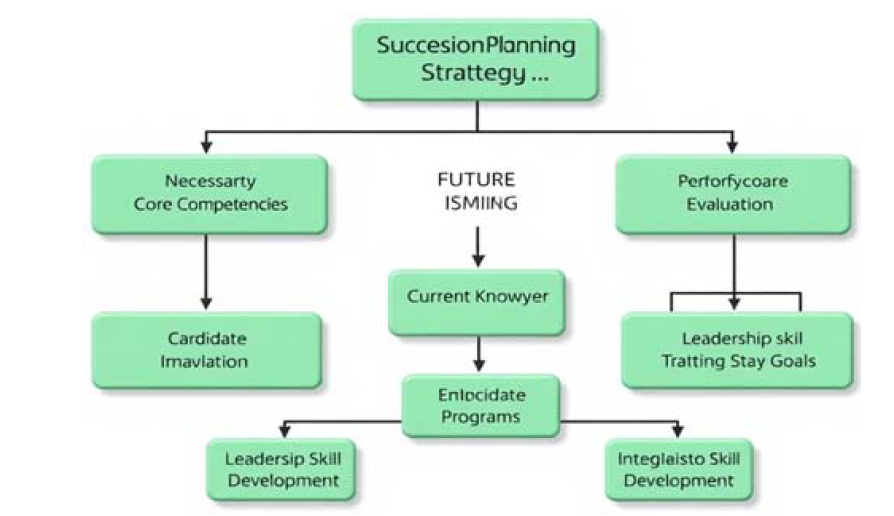
The Importance of the Succession Strategy (Figure 1)
Business continuity: A succession strategy helps ensure that there are alternate leaders who can fill vital positions when current leaders leave, reducing leadership gaps
Performance Improvement: Succession enhances organizational performance by creating qualified leaders
Enhanced Stability: Reduces turbulence caused by sudden driving changes, facilitating a smooth transition of power
Competency Development: Helps identify skills gaps and provide appropriate training to individuals to be promoted
Figure 1: Succession model
Dimensions of the Succession Strategy (Figure 2)
Identify core competencies: Succession requires recognition of the skills and knowledge needed for leadership positions
Performance appraisal: Performance appraisal plays an essential role in the succession process
Training and Development: Succession requires the provision of the necessary training programs to develop the skills of individuals
Future planning: Succession should include the development of plans that are in line with the organization's strategic goals
Challenges Facing the Succession Strategy (Figure 3)
Lack of administrative support: The strategy has difficulty getting adequate support from senior management
Resistance to change: Employees may resist changes associated with succession
Policy Ambiguity: The absence of clear policies can lead to the futility of the strategy
Setting criteria: Difficulty in defining the appropriate criteria for selecting substitute leaders
Figure 2: Succession Dimensions
Figure 3: Challenges to succession
The Relationship between Resource Planning and Succession Strategy
Providing accurate data: Resource planning ensures that accurate data is collected about available skills and abilities
Rapid response to changes: Integration helps strengthen the ability of organizations to respond quickly to changes in leadership
Promote leadership development: Ensure that there are integrated career development programs that support succession
Variables Affecting the Adoption of the Succession Strategy
Internal Variables
Enterprise Culture: Organizational culture plays a crucial role in the success of a succession strategy. If the culture encourages employee development and the appreciation of competencies, the strategy will be more effective. For example, organizations that promote the value of continuous learning tend to develop more competent leaders.
Organizational Structure:
Organizational structure influences how successions are managed. Flexible structures that allow for collaboration between teams contribute to faster identification of potential leaders. In contrast, a rigid structure can hinder the development of leaders due to a lack of opportunities for growth and advancement.
Available Resources
Training and development programs require financial and human resources. Organizations that invest in training and upskilling their employees are better able to implement succession strategies effectively. The support of senior management of these programs also enhances their chances of success.
External Variables
Changes in the Labor Market: Changes in the labor market, such as the growing demand for technical skills, require adjusting succession strategies to meet new needs. For example, the emergence of new technologies such as artificial intelligence may require the development of new skills in leaders.
Technological Advancements
The strategy must take into account how technology affects the work environment. Technology can change the nature of work, requiring new skills from leaders. Organizations that successfully embrace digital transformation will have a greater ability to adapt succession strategies to technological variables
Economic Conditions
Economic conditions affect organizations' ability to invest in employee development. In tough economic times, organizations may need to reduce expenses, which negatively impacts succession programs. Strategies must be flexible to adapt to economic changes.
The Effect of Variables on the Succession Strategy
Flexibility and Adaptability: The succession strategy should be flexible and adaptable to different variables. This requires a periodic review of the strategy and updating it based on current circumstances.
Training and Continuous Development
The strategy should include ongoing training and development programs to ensure that potential leaders possess the skills to meet future challenges.
Performance Evaluation and Follow-up
It is essential that the strategy includes mechanisms to evaluate performance and track progress. This helps to identify skills gaps and direct efforts towards developing them.
Module 1: A Network of 9 Succession Planning Funds
The 9-box grid is a popular tool used in succession planning to evaluate employees based on two key factors: performance and potential. This model helps identify high-potential employees who can be prepared for leadership positions.
Module 2: Internal Succession Planning Factors vs. External Factors
The decision to promote from within (internal succession) or to hire externally depends on several factors. Internal candidates may maintain culture and have organizational knowledge, while external employees can bring new perspectives and skills.
Third Topic
Human Resources Readiness - Expanded Vision: The readiness of human resources is one of the main pillars of the success of any organization, as it reflects the extent to which human cadres are able to face environmental and technological challenges and changes, and respond effectively to the requirements of institutional development. Building a competitive organization requires the presence of qualified and prepared human resources capable of constantly adapting to changes.
Defining Human Resources Readiness
HR readiness is defined as the extent to which employees are prepared in terms of skills, knowledge, and motivation to perform their tasks efficiently, and adapt to strategic and technical changes, ensuring continuity of organizational performance and achieving long-term goals.
Components of Human Resources Readiness
Technical readiness: Individuals possess the technical and managerial skills necessary to perform their jobs
Behavioral readiness: values, attitudes, and motivation towards achieving the organization's goals
Organizational readiness: Flexibility of systems and policies that provide a supportive environment for employees
Knowledge readiness: The accumulation of experiences and knowledge that enhances the organization's ability to innovate
Figure 4: The 9-box network model for talent assessment
Figure 5: Factors Affecting Internal Succession Planning vs. External Planning
The Role of Training and Development in Enhancing Readiness
Continuing training and professional development are pivotal tools in raising the level of human resource readiness. It contributes to:
Update employees' knowledge in line with technological changes
Close the skill gaps arising from shifts in the business environment
Enhance the leadership and innovation capabilities of individuals
Challenges Facing Human Resources Readiness
Resistance to change: Some employees refuse to adapt to new regulations and policies
Underfunding: Poor financial resources allocated to training and development programs
Skill gaps: resulting from the rapid development of technology versus the slow pace of rehabilitation programs
Weak organizational culture: Lack of a supportive culture for continuous learning and innovation
Strategies to Enhance Human Resources Readiness
Investing in specialized and comprehensive training programs
Adopting flexible policies that motivate employees to self-develop
Building an organizational culture that encourages creativity and continuous learning
Adopt strategies to manage talent and attract outstanding talent
RESULTS AND DISCUSSION
Fourth Topic
Questionnaire Analysis using Statistical Software (AMOS)
Data Preparation Tables: Preliminary data table collected from the questionnaire.
Independent Variables (Table 1)
Enterprise Culture (Culture Support)
Organizational Structure (Structure Support)
Available Resources (Available Resources)
Dependent Variable (Table 1)
Success in Succession Strategy
Table 2 Interpretation
Estimate: Shows how each independent variable affects the dependent variable
S.E.: Standard error of estimation
CR: The critical value, which indicates the significance of the relationship
P-value: If the value is less than 0.05, it means that there is a statistical significance
Assessment of Suitability
You can create a table to assess the suitability of the model as Table 3 is constructed.
Table 1: Dependent and independent variables
Sequencing
Supporting culture
Chassis
Support
Available
Resources
Succession
Success
1
4
5
4
5
2
3
3
3
4
3
5
4
5
5
4
2
2
3
3
5
4
5
4
4
6
3
4
3
3
7
5
5
5
5
8
2
3
2
2
9
4
4
4
4
10
3
2
3
3
...
...
...
...
...
100
3
4
3
4
Table 2: Significance of relationship in variables
Path
Estimate
S.E.
CR
p-Value
Cultural support → success
0.45
0.10
4.50
0.000
Supporting structure → success
0.30
0.12
2.50
0.012
Resources available → success
0.25
0.09
2.78
0.005
Table 3: Assessment of Suitability
Suitability Index
Value
Acceptable Range
Explanation
CFI
0.92
> 0.90
Very good
RMSEA
0.06
< 0.08
Good fit
Kai/DF box
1.50
< 3.00
Acceptable Fit
TLI
0.90
> 0.90
Very good
Non-food items
0.89
> 0.90
Close to the required standard
Table 4: Direct and Indirect Impact Analysis
Path
Direct Impact
Indirect Impact
Overall Impact
Cultural support → success
0.45
0.00
0.45
Supporting structure → success
0.30
0.00
0.30
Resources available → success
0.25
0.00
0.25
Table 3 Interpretation
CFI: Indicates the quality of the model. A value of 0.92 means that the model fits well
RMSEA: A value of 0.06 indicates that the model fits well with the data
Kai/df square: A value of less than 3 means a good fit
TLI: A value of 0.90 indicates that the pattern is good
NFI: Indicates that the model is close to the standard, but can be improved
Direct and Indirect Impact Analysis
You can add a table to illustrate the direct and indirect effects as Table 4.
Table 4 Interpretation
Direct Impact: The direct impact of each variable on success
Indirect effect: Indirect effect (in this case, we assumed that there is no indirect effect)
Total Impact: Total Direct and Indirect Effects
CONCLUSION
The Importance of the Organization's Culture
The results showed that the culture of the organization has the greatest impact on the success of the succession strategy. The more supportive the culture of the organization, the greater the chances of employees succeeding in leadership positions.
Conclusion
Organizations should focus on building a positive culture that promotes the values of collaboration and continuous learning.
Impact of the Organizational Structure
Organizational structure was also an influential factor, with results showing that having a flexible organizational structure facilitates the succession process. A clear structure and specific responsibilities help employees understand their career paths.
Conclusion
Organizations should regularly review their organizational structures to ensure that they align with succession goals.
The Role of Available Resources
The results showed that available resources, such as training and financial support, have a positive impact but less compared to the organization's culture. This means that investments in skills development can enhance the chances of success.
Conclusion
Organizations must secure the necessary resources, but not separately from fostering culture and structuring work.
The Relationship Between the Variables
Analyses have shown that there are positive correlations between independent variables (organization culture, organizational structure, resources) and succession success. This suggests that improving one of these factors can positively impact others.
Conclusion
Organizations must adopt an integrated approach when developing succession strategies.
Recommendations
Promoting Organizational Culture:
Programs should be developed to promote an organizational culture that encourages innovation and learning. This can be done by:
Organizing workshops to promote shared values
Encourage the active participation of all staff in decision-making
Improving the Organizational Structure
The organizational structure should be reviewed to ensure its flexibility and ability to support succession. This can be done by:
Create cross-functional teams that foster collaboration between departments
Define clear career paths for employees
Providing the Necessary Resources:
Organizations should invest in employee skills development by:
Providing ongoing training programs that include leadership and management skills
Providing financial support to facilitate participation in training courses
Performance Evaluation and Continuous Review
Organizations should adopt a periodic performance appraisal system that includes:
Clear measurement indicators for the success of succession strategies
Periodically review strategies based on feedback from employees
Enhance Communication
Communication channels between management and staff should be strengthened to ensure an open dialogue about expectations and opportunities. This can be done by:
Creating internal platforms for communication and exchanging ideas
Organize regular meetings to discuss progress and challenges
REFERENCE
Rothwell, W.J. and H.C. Kazanas. Effective Succession Planning: A Practical Guide to Succession Planning for Leaders and Managers. Berrett-Koehler Publishers, 2022.
Alkhalifah, A. and A. Aldaihani. “Integrated resource planning for enhanced organizational readiness: A systematic review.” Journal of Human Resource Management, vol. 11, no. 1, 2023, pp. 45-60.
Snell, S.A. and G.W. Bohlander. Managing Human Resources. Cengage Learning, 2020.
Barney, J.B. and W.S. Hesterly. Strategic Management and Competitive Advantage: Concepts and Cases. Pearson, 2021.
Saunders, K.A., and P. Lewis. Research Methods for Business Students. Pearson, 2021.
Kaplan, R.S. and D.P. Norton. The Balanced Scorecard: Translating Strategy into Action. Harvard Business Review Press, 2021.
Jackson, S.E. et al. “An aspirational framework for strategic human resource management.” The Academy of Management Annals, vol. 8, no. 1, 2014, pp. 1-56.
Ulrich, D. and J.H. Dulebohn. “Are we there yet? What’s next for HR?” Human Resource Management, vol. 54, no. 2, 2015, pp. 1-15.
Teece, D.J. “Dynamic capabilities as (ordinary) capabilities: A bounded rationality perspective.” Journal of Management Studies, vol. 55, no. 1, 2018, pp. 18-23.
Armstrong, M., and S. Taylor. Armstrong’s Handbook of Human Resource Management Practice. Kogan Page, 2020.
Recommended Articles
Research Article
The Effect of Employer Attractiveness and Compensation on Job Persuit Intention to Fmcg Companies in Indonesia: Coporate Reputation as an Intervening Variable
Download PDF
Research Article
Country of Origin and Foreign Branding on Perceived Quality of Local Products in Indonesia: The Moderating Role of Consumer Ethnocentrism
Download PDF
Research Article
The Effect of Self-Efficacy and Working Environment on Work Achievement with Organizational Commitment as Mediation
Sri Wahyuni,
...
Veithzal Rivai Zainal
Download PDF
Research Article
The Effect of Beauty Vlogger on Purchase Decision for Local Skincare Products in Indonesia: Brand Image as a Mediating Variable
Download PDF
PO Box 101, Nakuru
Kenya.
Email: office@iarconsortium.org
Editorial Office:
J.L Bhavan, Near Radison Blu Hotel,
Jalukbari, Guwahati-India
Ali Hussein, L. (2025). The Impact of Integrated Resource Planning on Enhancing the Career Succession Strategy and its Reflection on Human Resources Readiness
(Case study / Wasit Health Department). Scientific Research Journal of Economics and Business Management, 5(2), 1-7.
MLA
Ali Hussein, Labeeb. "The Impact of Integrated Resource Planning on Enhancing the Career Succession Strategy and its Reflection on Human Resources Readiness
(Case study / Wasit Health Department)." Scientific Research Journal of Economics and Business Management 5.2 (2025): 1-7.
Chicago
Ali Hussein, Labeeb. "The Impact of Integrated Resource Planning on Enhancing the Career Succession Strategy and its Reflection on Human Resources Readiness
(Case study / Wasit Health Department)." Scientific Research Journal of Economics and Business Management 5, no. 2 (2025): 1-7.
Harvard
Ali Hussein, L. (2025) 'The Impact of Integrated Resource Planning on Enhancing the Career Succession Strategy and its Reflection on Human Resources Readiness
(Case study / Wasit Health Department)' Scientific Research Journal of Economics and Business Management 5(2), pp. 1-7.
Vancouver
Ali Hussein L. The Impact of Integrated Resource Planning on Enhancing the Career Succession Strategy and its Reflection on Human Resources Readiness
(Case study / Wasit Health Department). Scientific Research Journal of Economics and Business Management. 2025 Jul;5(2):1-7.


 Download PDF
 Download XML