The study was carried out under the fabric shade of the Medicinal and Aromatic Plants Unit, which is part of the College of Agriculture at the University of Basrah, on the one-year-old shrub rose plant Rosa hybrida L. Sultani variety. The plants were exposed to low temperatures in winter and high temperatures in summer. Two variables were included in the study: the first was heat stress (summer temperature at an average of 49°C and winter temperature at an average of 20°C) and the second one was treatment with amino acid glutathione at 0, 150 and 250 mg L⁻1. The study's results showed effect heat stress and stress protectants on the number of lateral branches in the shrub rose plant. The highest rate was recorded in the winter growth season, reaching 8.83 lateral branches, while the lowest rate was recorded in the summer, reaching 6.53 lateral branches. The treatment with glutathione also significantly affected the number of lateral branches in the plant. A concentration of 250 mg L⁻1 had the best results, with a maximum of 9.72 lateral branches, compared to the other treatments. There were 5.2 lateral branches at their lowest in the control group. The interaction between the winter growth season. Additionally, the treatment with 250 mg L⁻1 of glutathione resulted in the highest rates of plant height and flower number, reaching 86.34 cm and 11.19 flowers, respectively. The lowest rates were observed when the summer growth season was combined with a glutathione concentration of 0 mg L⁻1, reaching 59.65 cm and 6.66 flowers, respectively. Heat stress and stress protectants also affected anatomical leaves of shrub rose plant. The highest rate of cuticle layer thickness and tannin layer thickness was recorded in the summer growth season, reaching 20.75 and 35.96 µm, respectively, while lowest rates were recorded in winter growth season, reaching 15.51 and 28.27 µm, respectively. The treatment with glutathione also significantly affected the rate of cuticle layer thickness and tannin layer thickness. The treatment at 0 mg L⁻1 significantly outperformed the other treatments and recorded highest value of 22.39 and 40.29 µm, respectively. In comparison, the treatment at a concentration of 250 mg L⁻1 recorded the lowest value of 14.2 and 25.23 µm, respectively.
Keywords
Stress Protectants
Stress
Environmental Stress
Heat Stress
Vegetative
Floral
Anatomical
Shrub Rose
INTRODUCTION
Shrub rose (Rosa sp.) belongs to the Rosaceae family, which contains 20 species and many varieties, especially hybrids from cultivated varieties. The rose is considered one of the most commercially grown plants and one of the world's most important cut flower plants. Its flowers are used in the worship rituals of many religions and socially in exchanging different emotions between people. It is also used in producing perfumes and flavors for human use and in the pharmaceutical industries. The rose is grown in gardens to add beautiful colors and scents to the garden. It is also grown in pots; in many cases, garden roses are used as a source of cut flowers [1].
It was planted in botanical gardens and awareness of ornamental plants and roses grew, becoming an economic phenomenon and a profitable commercial activity, which witnessed a boom at the local and international levels. The rose is considered one of the most important ornamental plants, as it provides color, shape, texture and fragrance, all adding joy and pleasure to the soul. Seeds, softwood cuttings, layering and grafting propagate the rose. Plants grown from seeds show significant differences and may extend to flower colors. While varieties produced by other methods express homogeneous traits of a single lineage, the rose is generally successful with terminal cutting. It is in plants that tolerate dependence on their roots, such as old rose varieties and shrub roses. Other varieties cannot withstand, especially modern hybrids, as they are grafted on rose rootstocks such as Banksia, Natal briar, Rosa damascene and other rootstocks [2].
Agricultural and environmental variables, including temperature extremes and light levels, impact plant growth [3-5]. When it comes to stresses that affect plant development and growth, drought is among the most significant. Protein transformations and nucleic acid synthesis in plant tissues seem to be reduced in response to the majority of plant stressors [6]. According to Challa and Van Beusichem [7], stress causes changes in the plant's morphology, structure and anatomy, which are the direct results of the stressor. Drought is one of the types of non-living environmental stress that occurs when the soil water decreases due to lack of rainwater or industrial irrigation or when water loss through transpiration exceeds water absorption through the roots, which directly leads to changes in the plant and its physiological and chemical work [8,9].
Some plant functions become dysfunctional due to heat stress. According to Hussain et al. [10], this process triggers oxidative stress, which in turn raises reactive oxygen species levels. These ROS have a domino effect on cell toxicity and damage the fatty membranes of cell walls, which impacts the regulation of cellular exchange. For better crop yields when heat stress is present, some studies have focused primarily on mineral nutrition, as plant nutrients are important for plant growth, metabolic performance and stress regulation. Also, the compounds responsible for the environmental response are sulfur-containing thiol derivatives the amino acids glutathione (GSH), methionine (Met) and cysteine (Cys). To build efficient defense systems to deal with different stressors, plants require these biomolecules that include sulfur [11]. A number of shrub rose characteristics were examined in this study to determine how heat stress and stress treatments affected them.
MATERIALS AND METHODS
This research took place in the College of Agriculture's Fabric Shade at the University of Basrah's Medicinal and Aromatic Plants Unit, on the shrub rose plant Rosa hybrida L. Sultani variety, one year old growing in pots of 15 cm in size. The river silt was used as a growth medium and before starting the planting operations, the growth medium was sterilized with formaldehyde at a concentration of 40%. Large pots with a diameter of 35 cm were prepared, after thoroughly washing them with water, sterilizing them with formaldehyde and filling them with the sterilized growth media, the plants were carefully transplanted to them, one plant per pot. The plants were served symmetrically by pruning, fertilizing, watering and covering. The compound fertilizer (20-20-18) with Jordanian provenance was likewise applied to all of the experimental plants N, P, K. The watering of the plants was carried out whenever necessary and before the cultivation medium was exposed to drought. The plants were also exposed to low temperatures in winter and high temperatures in summer.
The experiment factors:
First: Heat stress
Summer temperature (average 49°C)
Winter temperature (average 20°C)
Second: treatment with the amino acid glutathione at 0, 150 and 250 mg L⁻1
Study Indicators
Branches Number: According to number of lateral branches of the stem.
Leaves Average Number
Leaves number for each plant was calculated after the end of the experiment.
Plant Height (cm)
The plants height (cm) was measured by a tape measure.
Number of Flowers
The number of flowers for each plant was counted.
Anatomical Characteristics of Leaves
In accordance with the procedures outlined in Al-Najjar et al. [12] in F.A., leaf samples were gathered and preserved. Half a day's worth of remedy. Following a series of steps that involved passing the sliced pieces through ethyl alcohol of increasing concentrations, the samples were heated to 58°C and embedded in paraffin wax. The next step was to use a Rotary Microtome to slice the samples to a 10 micrometer thickness. After that, they were placed on slides and stained with safranin dye. Then, they were placed in Fast green dye. Finally, drops of DPX were added and the slides were covered. After that, the anatomical features of the leaves were examined. The measurements were recorded in micrometers (µm) using an Olympus optical microscope with an attached camera and a computer.
Analysis of Statistical
Two factors and three replicates were utilized in the experiment, which was a factorial design based on a complete randomized block design (R.C.B.D.). The factorial treatments were randomly distributed among 18 plants, which served as the number of experimental units. Using the SPSS statistical tool, we performed an analysis of variance on the collected data to verify that the features under study did, in fact, differ significantly. Additionally, the averages were examined and examined for significance using the LSD test at a 0.05 level of probability. According to Bashir in 2003.
RESULTS AND DISCUSSIONS
Number of Branches
Table 1 showed the effect heat stress and stress protectants on the number of lateral branches in shrub rose plants. The highest average was recorded in the winter growth season, reaching 8.83 lateral branches, while the lowest average was recorded in the summer, reaching 6.53 lateral branches. The treatment with glutathione also significantly affected the number of lateral branches in plant. The treatment of 250 mg L⁻1 significantly outperformed and recorded the highest value of 9.72 lateral branches, while control treatment recorded lowest value of 5.2 lateral branches.
As for the interaction between heat stress conditions and stress protectants, the interaction between the winter growth season and the treatment with glutathione at 250 mg L⁻1 recorded the highest average number of lateral branches of 11.23 lateral branches, Interactions between the summer growth season and a glutathione content of 0 mg L⁻1 resulted in shrub rose plants having an average of 4.25 lateral branches, the lowest number.
Table 1: Effect of Heat Stress, Stress Protectants on the Number of Lateral Branches of Shrub Rose Plants
Temperature stress
Glutathione concentrations (mg L⁻1)
Average temperature effect
0
150
250
Summer temperature (average 49°C)
4.25
7.14
8.21
6.53
Winter temperature (average 20°C)
6.15
9.12
11.23
8.83
Average glutathione effect
5.2
8.13
9.72
-
L.S.D.
Temperature = 9.55 glutathione = 1.00 Interaction = 1.22
Table 2: Effect of Heat Stress, Stress Protectants on Plant Height (cm) of shrub rose plants
Temperature stress
Glutathione concentrations (mg L⁻1)
Average temperature effect
0
150
250
Summer temperature (average 49°C)
59.65
76.43
80.24
72.11
Winter temperature (average 20°C)
73.76
83.54
86.34
81.21
Average glutathione effect
66.71
79.99
83.29
-
L.S.D.
Temperature = 1.11 glutathione = 1.65 Interaction = 2.11
Table 3: Effect Heat Stress, Stress Protectants on Number of Flowers of Shrub Rose Plants
Temperature stress
Glutathione concentrations (mg L⁻1)
Average temperature effect
0
150
250
Summer temperature (average 49°C)
5.34
7.34
8.78
7.15
Winter temperature (average 20°C)
6.66
10.34
11.19
9.4
Average glutathione effect
6
8.84
9.99
-
L.S.D.
Temperature = 0.72 glutathione = 0.88 Interaction = 1.01
Table 4: Effect of Heat Stress and Stress Protectants on Number of Leaves of Shrub Rose Plants
Temperature stress
Glutathione concentrations (mg L⁻1)
Average temperature effect
0
150
250
Summer temperature (average 49°C)
70.42
80.23
86.65
79.1
Winter temperature (average 20°C)
77.54
99.22
111
95.92
Average glutathione effect
73.98
89.73
98.83
-
L.S.D.
Temperature = 3.27 glutathione = 4.26 Interaction = 5.39
Plant Height (cm)
Table 2 showed effect of heat stress, stress protectants on plant height of shrub rose plants. The highest average was recorded in the winter growth season, reaching 81.21 cm, while the lowest average was recorded in the summer, reaching 72.11 cm. The treatment with glutathione also significantly affected the plant height. The treatment with 250 mg L⁻1 significantly outperformed and recorded highest value of 83.29 cm, while control treatment recorded 66.71 cm.
The interaction between heat stress conditions, stress protectants, the interaction between winter growth season and the treatment with glutathione at 250 mg L⁻1 recorded the shortest average plant height of 59.65 cm for shrub rose plants, whereas the interaction between the summer growth season and a concentration of 0 mg L⁻1 of glutathione registered the tallest average plant height of 86.34 cm.
Number of Flowers
Table 3 showed effect of heat stress, stress protectants on number of flowers in shrub rose plants. The highest average was recorded in the winter growth season, reaching 9.40 flowers, while the lowest average was recorded in the summer, reaching 7.15. The treatment with glutathione also significantly affected the number of flowers in plant. The treatment with 250 mg L⁻1 significantly outperformed and recorded highest value of 9.99 flowers, while control treatment recorded lowest value of 6.00 flowers.
As for the interaction between heat stress conditions and stress protectants, the interaction between the winter growth season and the treatment with glutathione at 250 mg L⁻1 recorded highest number of flowers in the plant of 11.19 flowers, while interaction between summer growth season and a 0 mg L⁻1 of glutathione recorded the lowest average number of flowers in the shrub rose plant of 6.66 flowers.
Number of Leaves
Table 4 showed effect heat stress, stress protectants on number leaves in shrub rose plants. The highest average was recorded in the winter growth season, reaching 95.92 leaves, while the lowest average was recorded in the summer, reaching 79.1 leaves. The treatment with glutathione also significantly affected the number of leaves in the plant. The 250 mg L⁻1 treatment achieved a maximum of 98.83 leaves, which was significantly higher than the control treatment's 73.98 leaves.
The interaction between heat stress conditions and stress protectants, the interaction between the winter growth season and the treatment with glutathione at 250 mg L⁻1 recorded highest number of leaves in plant of 111 leaves, while the interaction between the summer growth season and 0 mg L⁻1 of glutathione recorded lowest number of leaves in shrub rose plant of 70.42 leaves.
Cuticle Thickness
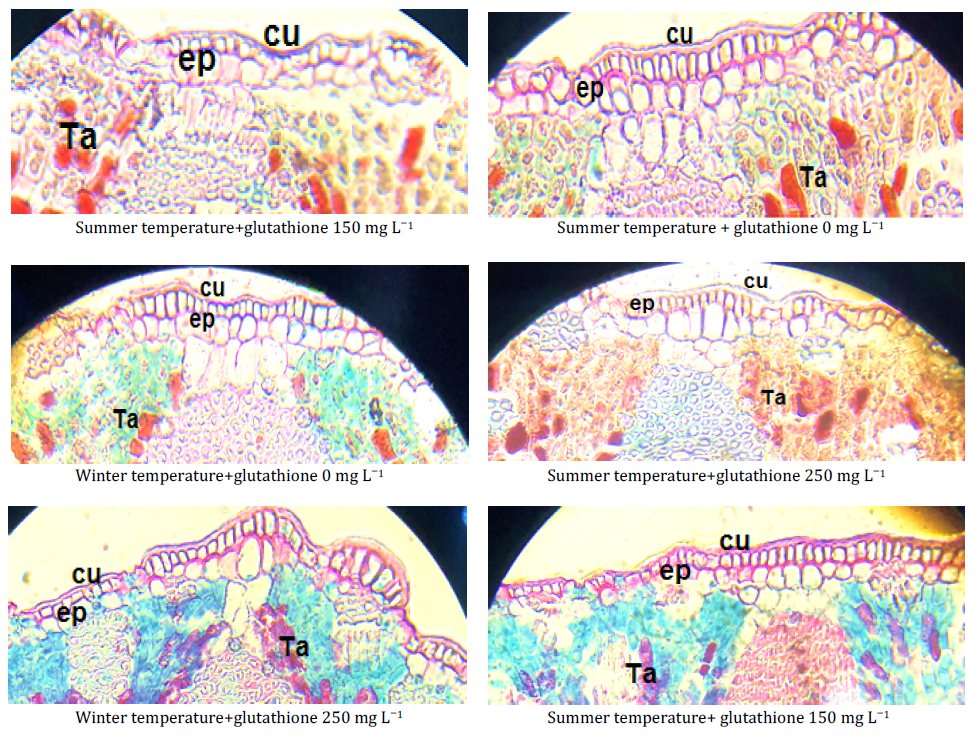
The study's results shown in Table 5 showed effect heat stress and stress protectants on the anatomical of leaves of shrub rose plants. The highest average thickness of cuticle was recorded in summer growth season, reaching 20.75 µm, while lowest average was recorded in the winter growth season, reaching 15.51 µm. The treatment with glutathione also had a significant effect on the average thickness of the cuticle. The treatment with 0 mg L⁻1 outperformed significantly and recorded highest value of 22.39 µm, while the treatment with 250 mg L⁻1 recorded lowest value of 14.24 µm.
The interaction between heat stress conditions and stress protectants, the interaction between the summer growth season and the treatment with glutathione at 0 mg L⁻1 recorded highest average thickness of cuticle of 23.54 µm. In contrast, the interaction between the winter growth season and 250 mg L⁻1 of glutathione recorded lowest cuticle thickness in leaves of shrub rose plants at 10.12 µm.
Table 5: Effect of Heat Stress and Stress Protectants on Cuticle Thickness in Shrub Rose Leaves (µm)
Temperature stress
Glutathione concentrations (mg L⁻1)
Average temperature effect
0
150
250
Summer temperature (average 49°C)
23.54
20.35
18.36
20.75
Winter temperature (average 20°C)
21.23
15.17
10.12
15.51
Average glutathione effect
22.39
17.76
14.24
-
L.S.D.
Temperature = 2.12 glutathione = 2.87 Interaction = 3.22
Table 6: Effect of Heat Stress and Stress Protectants on Cuticle Cell Thickness in Shrub Rose Leaves (µm)
Temperature stress
Glutathione concentrations mg L-1
Average temperature effect
0
150
250
Summer temperature (average 49°C)
13.52
27.32
33.34
24.73
Winter temperature (average 20°C)
21.23
39.46
43.45
34.71
Average glutathione effect
17.38
33.39
38.4
-
L.S.D.
Temperature = 2.87 glutathione = 3.22 Interaction = 4.34
Table 7: Effect of Heat Stress and Stress Protectants on Tannin Layer Thickness in Shrub Rose Leaves (µm)
Temperature stress
Glutathione concentrations mg L-1
Average temperature effect
0
150
250
Summer temperature (average 49 °C)
42.22
35.32
30.34
35.96
Winter temperature (average 20 °C)
38.36
26.34
20.12
28.27
Average glutathione effect
40.29
30.83
25.23
-
L.S.D.
Temperature = 2.87 glutathione = 3.00 Interaction = 3.39
Cuticle cell thickness
The study's results shown in Table 6 showed effect heat stress, stress protectants on the anatomical of leaves of shrub rose plants. The highest thickness of cuticle cells was recorded in winter growth season, reaching 34.71 µm, while lowest average was recorded in summer growth season, reaching 24.73 µm. The treatment with glutathione also had a significant effect on the average thickness of the cuticle cells. The treatment with 250 mg L⁻1 outperformed significantly and recorded highest value of 38.40 µm, while treatment with 0 mg L⁻1 recorded lowest value of 17.38 µm.
As for the interaction between heat stress conditions and stress protectants, the interaction between the winter growth season and the treatment with glutathione at 250 mg L⁻1 recorded highest thickness of cuticle cells of 43.45 µm, while interaction between summer growth season and 0 mg L⁻1 of glutathione recorded lowest thickness of cuticle cells in the leaves of shrub rose plants of 13.52 µm.
Tannin Layer Thickness
The study's results shown in Table 7 showed effect heat stress, stress protectants on the anatomical leaves of shrub rose plants. The highest thickness of tannin layer was recorded in summer growth season, reaching 35.96 µm, while the lowest average was recorded in the winter growth season, reaching 28.27 µm. The treatment with glutathione also significantly affected the average thickness of the tannin layer. The treatment with a concentration of 0 mg L⁻1 outperformed significantly and recorded the highest value of 40.29 µm, while the treatment with 250 mg L⁻1 recorded the lowest value of 25.23 µm.
As for the interaction between heat stress conditions and stress protectants, the interaction between the summer growth season and the treatment with glutathione at 0 mg L⁻1 recorded highest thickness of the tannin layer of 42.22 µm. In contrast, the interaction between the winter growth season and 250 mg L⁻1 of glutathione recorded lowest thickness of tannin layer in leaves of shrub rose plants at 20.12 µm.
The decline in vegetative and floral growth traits during the summer growth season may be due to increase level hydrogen peroxide due to heat stress. Hydrogen peroxide (oxidative stress) causes damage to cell components, leading to accelerated leaf aging and oxidation of cell membranes [13]. Chlorophyll pigments are also degraded due to the toxic effect of hydrogen peroxide in chloroplasts and cytosol [14]. It is also believed that increased hydrogen peroxide leads to reduced photosynthetic efficiency.
Glutathione has a hormonal effect, impacting the plant's protoplasm and cell wall, which in turn causes the cells to divide and expand more rapidly, ultimately resulting in more plant growth [15]. It also accumulates sugars, amino acids and enzymes and helps in photosynthesis. It also increases root growth strength through increased dry and wet weight and lateral branching (Figure 1). It also increases nutrient absorption by the plant [16].
Glutathione acts as an antioxidant, reacting with atomic oxygen, superoxide and hydroxide and thus indirectly trapping free radicals. It also stabilizes the composition of plant membranes by removing acyl peroxide formed from lipid peroxidation. It also acts as a reducing agent, which converts the oxidized form of ascorbic acid to the reduced form by the enzyme dehydroascorbate reductase and GSH reduces dehydroascorbate by a non-enzymatic process [17].
According to the latest research, glutathione has a notable impact on the structural features of shrub rose plant leaves. The structural features of the leaves suggest that this might be because glutathione enhances cell division activity and growth circumstances. Plants are able to absorb more nutrients because the concentration of those nutrients in the soil rises. Because of this, root and leaf growth may be stimulated, which could improve the leaves' anatomical features [18].
The increase thickness of cuticle layer and thickness of tannin layer in the leaves may be due to some changes in anatomical structure that occur in plant as a result of exposure to some types of stress as a defense mechanism to reduce water loss by increasing thickness of cuticle layer. Heat stress causes plant to enter under influence of second stress type, water stress (drought). Challa and Van Beusichem [7] explained that these effects cause plant morphological, structural and anatomical changes.
Figure 1: Effect of Heat Stress and Stress Protectants on the Anatomical Characteristics of the Leaves of Shrub Rose Plants (µm)
REFERENCE
Wahba, T. Propagation of Levantine Rose Cuttings. Master’s thesis, Damascus University, 1996.
Viji, M.O. et al. “Effects of Light Intensity and Imbibition Frequency of In Vivo and In Vitro Propagated Seeds of Withania somnifera L. on Germination.” International Journal of Current Microbiology and Applied Sciences, vol. 2, no. 11, 2013, pp. 354-360.
Letchamo, W. “Comparative Study of Chamomile Yield, Essential Oil and Flavonoid Content under Two Sowing Seasons and Nitrogen Levels.” Acta Horticulturae, vol. 306, 1995, pp. 375-384.
Vishwanath, R.D. et al. “Effect of Time and Method of Sowing on Growth and Root Yield of Ashwagandha (Withania somnifera Dunal).” Research Journal of Agriculture and Biological Sciences, vol. 6, no. 4, 2010, pp. 548-551.
Popp, M. “Physiological Adaptation to Different Salinity Levels in Mangroves.” International Conference on High Salinity Tolerance in Arid Regions, UAE, 1990, pp. 91-101.
Challa, I.H. and M.L. Van Beusichem. Effects of Salinity on Substrate-Grown Vegetables and Ornamentals in Greenhouse Horticulture. Digital version, January 2004. ISBN 90-5808-190-7.
Yassin, B.T. Basics of Plant Physiology. College of Science, Qatar University, 2001.
Qandil, A.A. “Growing Fodder and Pasture Plants in Sandy and Salty Lands without Irrigation and Fertilization.” The Third Conference on Marketing Applied Research and University Services, Mansoura University, 2009, pp. 55-59.
Hussain, H.A. et al. “Interactive Effects of Drought and Heat Stresses on Morpho-Physiological Attributes, Yield, Nutrient Uptake and Oxidative Status in Maize Hybrids.” Scientific Reports, vol. 9, no. 1, 2019, pp. 1-12. https://doi. org/10.1038/s41598-019-40362-7.
Rennenberg, H. and C. Herschbach. Sulfur Metabolism in Plants. Springer, 2012. https://doi.org/10.1007/978-94-007-4450-9.
Al-Najjar, M.A.H. et al.Laboratory Manual: Laboratory Analysis Guide for Graduate and Undergraduate Students. Enheduanna House for Printing, Publishing and Distribution, 2021.
Sehar, Z. et al. “Ethylene- and Proline-Dependent Regulation of Antioxidant Enzymes to Mitigate Heat Stress and Boost Photosynthetic Efficacy in Wheat Plants.” Research Article, vol. 21, no. 2, 2022, pp. 324-332.
Khan, M.H. and S.K. Panda. “Induction of Oxidative Stress in Roots of Oryza sativa L. in Response to Salt Stress.” Biologia Plantarum, vol. 45, no. 4, 2002, pp. 625-627.
Samavat, S. and M. Malakoti. The Necessity of Producing and Utilizing Organic Acids for Increasing the Quality and Quantity of Agricultural Products. Sana Publisher, 2005.
Hartwigson, I.A. and M.R. Evans. “Humic Acid Seed and Substrate Treatments Promote Seedling Root Development.” HortScience, vol. 35, no. 7, 2000, pp. 1231-1233.
Saqr, M.T. Basics of Biochemistry and Plant Physiology. Faculty of Agriculture, Mansoura University, 2006.
Chen, Y. et al. “Stimulatory Effect of Humic Substances on Plant Growth.” Soil Organic Matter in Sustainable Agriculture, Magdoft, F. and R. Ray (Eds.), CRC Press, 2004, pp. 130-142.
Recommended Articles
Research Article
The Impact of Medicinal Plant Extracts on Entamoeba histolytica Parasite in Rats: A Study on Hematological and Biochemical Parameters
Haneen Mohanad Maher,
...
Noor Rassam kamil
Published: 28/02/2026
Download PDF
Research Article
The use of dual spectrum reflectivity (NDSI, SI) in diagnosing the distribution of some types of salts in the founding organelle in the sura and wasit contacts.
Saadia M. Saleh
Published: 30/10/2023
Download PDF
Research Article
Determination of the Factors that Define the Tropism of Astroviruses in Established Cell Lines
Marwah Ali Oudah,
...
Shahad Ahmed Bakheet
Published: 15/12/2025
Download PDF
Research Article
Genetics study of Leptin Gene Polymorphism for Adolescent obese of Thi-Qar Province
Taleb K. Odah,
Huda Taher Faisal
Published: 25/08/2023
Download PDF
PO Box 101, Nakuru
Kenya.
Email: office@iarconsortium.org
Editorial Office:
J.L Bhavan, Near Radison Blu Hotel,
Jalukbari, Guwahati-India
Al-Ibrasim, W. F. F., N.S.Al-Showily, A. & Alnajjar, M. A. H. (2023). Effect of some heat stress protectants on vegetative, floral, and anatomical traits of shrub rose plant. Scientific Research Journal of Agriculture and Life Sciences, 3(2), 1-6.
MLA
Al-Ibrasim, Wasan F. F., Abdui-Kadum N.S.Al-Showily and Mohammed A. H. Alnajjar. "Effect of some heat stress protectants on vegetative, floral, and anatomical traits of shrub rose plant." Scientific Research Journal of Agriculture and Life Sciences 3.2 (2023): 1-6.
Chicago
Al-Ibrasim, Wasan F. F., Abdui-Kadum N.S.Al-Showily and Mohammed A. H. Alnajjar. "Effect of some heat stress protectants on vegetative, floral, and anatomical traits of shrub rose plant." Scientific Research Journal of Agriculture and Life Sciences 3, no. 2 (2023): 1-6.
Harvard
Al-Ibrasim, W. F. F., N.S.Al-Showily, A. and Alnajjar, M. A. H. (2023) 'Effect of some heat stress protectants on vegetative, floral, and anatomical traits of shrub rose plant' Scientific Research Journal of Agriculture and Life Sciences 3(2), pp. 1-6.
Vancouver
Al-Ibrasim WFF, N.S.Al-Showily A, Alnajjar MAH. Effect of some heat stress protectants on vegetative, floral, and anatomical traits of shrub rose plant. Scientific Research Journal of Agriculture and Life Sciences. 2023 Jul;3(2):1-6.



 Download PDF
 Download XML