Effect of spraying with boron and phosphate fertilization on vegetative growth characteristics and mineral content in leaves of two dry white bean varieties (Phaseolus vulgaris L.)
Sara Raid Mahmood Altaee
1
,
Kamal Benyamin Esho
1
1
College of Agriculture and Forestry, Horticulture Science and landscape Design, Mosul Univ, Iraq
The study has been carried out in the field of vegetable research, affiliated with the Department of Horticultural Sciences and Landscape Engineering, College of Agriculture and Forestry, Univ. of Mosul, during growing season of spring 2021, for the purpose of studying the effects of spraying with boron and phosphate fertilization on characteristics of vegetative growth and mineral content in the leaves of two varieties of dry white beans.Two varieties of beans, Argentinean and Iranian, were used in the study,which had three concentrations of Boron (borax acid) which were 0, 25, and 50 mg.l-1, and three levels of triple superphosphate fertilizer P2O5, which were 0, 20 and 40kg.ha-1, The most prominent results obtained are that the Iranian variety was significantly superior in the characteristics of plant height (cm), wet and dry weight of vegetative growth (gm), the total chlorophyll content in leaves, and the area of one leaf and the (cm2), and in the phosphorous content in leaves (%) and boron (ppm), whereas concentration of 25mg.l-1 of boron had given the highest significant difference at the 5% probability level for the same characteristics above, and in the percentage of nitrogen, protein, and phosphorous, and boron (parts per million). The average phosphate fertilizer gave the highest significant difference at the 5% level in the percentage of potassium in leaves: as for dual interaction treatment between Iranian variety and spraying with 25 mg.l-1 of boron, the highest significant difference in plant height characteristics, vegetative growth wet weight, total chlorophyll content, single leaf areaand the percentage of each element. Nitrogen, protein, and boron (ppm), and the dual interaction treatment between Argentinian variety and fertilization at a 20 kg.ha-1rate of phosphate fertilizer had produced highest significant difference in the characteristics of the number of lateral branches of each one of the plants. The dual interaction treatment between spraying with boron at a 25 mg.L-1concentration and fertilizing with an average of 20 kg of phosphate fertilizer had the highest significant difference at the probability level of 5% for the traits for most of the studied traits, and treatment of the triple interaction between each of Iranian variety and spraying with 25 mg.l-1 boron and the fertilization at a 40kg. ha-1rate of phosphate fertilizer had the highest significant difference in plant height characteristics, vegetative growth wet weight, total chlorophyll content in leaves, leaf area(cm2), and boron content ppm.1) Part of MSc. Thesis for the first researcher.
Keywords
Bean varieties
Boron
Phosphate fertilizer
Vegetative growth
Mineral content
Protein
INTRODUCTION
The bean plant Phaseolus is one of the plants of the leguminous family Fabaceae: its scientific name is (Phaseolus vulgaris L.), and the original habitated of the bean is South America [1]. The bean plant is a crop with a short growing season, where the period from the emergence of seedlings until the time of maturity and harvest is about 65 to 110 days, according to varieties Buruchara [2]. Yield for producing green pods and dry seeds at the end of June and second autumnal date is used only for production of green pods. It starts from the end of August or the beginning of September and gives the yield of green pods in October and the second [3]. Dry seeds of the beans are considered an important food in all countries around the world and are one of the important sources of the protein, vitamins, calories, fiber and minerals [4]. The dry seeds contain 20% protein [5]. French beans are grown all over the world and are kno w by their common names: in Ethiopia, it is called Adagola, adigura-tsada, and ashanguare: in Hungarian, it is called Bab, and in German, it is Bohne, and as Bonchi Kai in Sri Lanka, in South Africa, it is called Roontje, and in Indonesia it is Boontijis. Myanmar is Bo-sa-pe, and Bush bean in Rhodesia, in Philippines (Butingi), in Brazil (Chumbinhoopaco): in Zambia (Chilemba):in USA (Cranberry bean), in Uganda (Edihimba), in Italy (Fagiola), and Fasulia in Sudan, and Turkey (Fasulya), as Harico a couper in France, and Zaire, Haricot nain, and in Japan as Ingen (mame), [6]. Boron also plays a major role in pollination and fertilization and in increasing the rate of knots in flowers due to its effect on vitality of pollen grains. It also has an important role in the developing tops, as it enters the processes of cell division and gathers in the leaves and reproductive organs [7]in addition to the fact that the phosphorous element, which is more concentrated in the seeds and fruits than it is in the leaves, plays an important role in the completion and maturity of the seeds in the pods. At the physiological maturity stage [8]. Also, [9-11], when studying to evaluate varieties of beans, indicated that the varieties differed among themselves in the properties of the vegetative growth and mineral content of nutrients in the leaves. Santalla et al. [12] showed in their study of a group of bean varieties, there were significant differences among them in the characteristics of vegetative growth represented by plant height and wet weight of vegetative growth. Rodino et al. [13] showed that their study of 30 bean varieties had shown considerable differences in plant height after 10 and 20 days after germination and in the wet and dry weight of vegetative growths. Harmankaya et al. [14] mentioned in their study of six varieties of beans that there are clear discrepancies between them in the characteristics of plant height. Prolla et al. [15] in Brazil indicated that the varieties in beans varied among themselves in the contents of (P, Mg, Ca, Cu, Mn, Zn and Fe) mg/100 g dry matter, where the varieties Minuano, Guapo, Brithante and Carioca) gave the highest readings of these elements. Arunga et al. [16] in Kenya, when they studied 25 bean varieties, these varieties varied between them in plant height at the flowering stage. Plant and number of lateral branches. Kazemi et al. [17] showed in Iran in 2010-2009, two varieties of white beans, where Shokofa variety, outperformed the Danshekadeh variety in plant height. The two varieties did not differ significantly in the amount of branches/plant. Darkwa et al. [18] in Ethiopia in their study evaluated 11 Genetic structures in beans that there are significant differences for these structures in the total chlorophyll content. Alemu et al. [19] in Ethiopia assessed the association and path analyses of the yield of green pods and their components in the varieties of 36 bean varieties, indicated that the analyses of the variance table had shown that there were considerable differences between these structures about plant height, leaf area/plant and number of leaves. Esho [20] indicated in his study for evaluation and performance of genetic parameters in 12 varieties of beans, that they differed significantly among them in plant height, number of stems/plants, and leaf area. Jasim and Esho [21] indicated in their study of 12 varieties of beans that they differed significantly between them in the characteristics of plant height and number of side branches/plant. Pandma et al. obtained when studying the use of different levels of boron, which is 2.5 - 5.0 ppm borax, when sprayed twice for the plant stage 20 and 40 days after planting, which caused increases in plant height, number of side branches/plant, and number of leaves/plants, in addition to leaf area. And a leafy surveyor's guide to the Arka Komal bean variety. Singh et al. [22] showed that the level of 1.0 kg boron/ha caused toxicity to the bean plant and also reduced the plant height. Kalyani et al. [23] found that spraying with concentrations of Boron (Boric Acid 200, 300, 400 ppm) caused significant increases in plant height, vegetative growth, and index ofleaf area in peas. Goldbach et al. [24] indicated that spraying the boron element on the bean plant led to a considerable increase of vegetative growth properties that are represented by the height of the plant and the number of branches. Harmankaya et al. [14] have stated in their study of the response of bean varieties to spraying and the addition of boron to the soil that the plant height and boron concentration in the leaves were high when adding 3 kg/ha of boron to the soil and spraying 0.3 kg/ha. Samet et al. [25] showed with an experiment to use 3 levels of potassium, 0, 200, and 400 mg/kg, as a source of K2SO4 and four levels of boron which are 0.5, 10, 20 mg/kg of borax H3BO3 caused increases in both the weight of vegetative growths and in the content of vegetative growth. when using nutrients containing iron, boron and zinc affected the content of nutrients and protein in cowpea seeds, and the three concentrations (0, 1, 2 ppm) of the added microelements solution (Fe, B, Zn) sprayed over 15 days caused increases in nutrient and protein values as a percentage of nutrients (P, K, Ca, Mg, Na and Cl)). Hemantaranjan et al. [26] obtained from their study when treating bean plants with concentrations (0, 2, and 3 mg boron/kg of soil) that a concentration of 2 mg/kg soil gave the best results in vegetative growth characteristics. El-Dahshouri et al. [27] when spraying the boron element with concentrations (0, 250 and 500 ppm) on the bean plant that the high concentration caused significant increases in the characteristics of vegetative growth and also caused significant increases in the concentration of each of the elements (N, P, K, Ca). Hamouda et al. [28] found when studying the effect of levels of zinc and boron 250 ppm 500 ppm and spraying once beforefloweing or twice before and after flowering on growth, the concentration of elements and nutrients, yield and yield components of beans.The results showed that the spraying with zinc and boron had a significant positive effect on both From plant height, number of lateral branches/plant, number of leaves, wet and dry weight of vegetative growth, the results showed that zinc and boron spraying caused significant positive increases in content of major elements (N, K, Ca) in the content of leaves. Adding quantities of fertilizers is key to increasing yield and improving it by 40-30% when adding N-P-K, and it returns as an important rulein plant nutrition [29]. Bennett [30] indicated that phosphorous plays a major role in growth, development, and leaf area. Roy and Parthasarathy [31] indicated that the seed yield was high when 120 kg of phosphate was added compared to low levels, and in general, the increase in N.P.K levels, or the increase in the ratio of nitrogen to phosphorous, caused an increase in the yield of pods compared with low levels of phosphate. Shubhashree [32]: and Khadem et al. [33] have reported that phosphate fertilizer at level of 75kg of P2O5/ha caused significant increases in number of the branches/plant, plant height, and plant dry weight compared to control, which is zero for bean plants. Rahman et al. [34] found that in their study, when spraying beans with N.P.K. fertilizer (20:20:20) at levels, there were significant increases in the characteristics of plant height, number of side branches for each one of the plants, and plant wet weight. The same result was mentioned by Abdul Kadir et al. [35]. Phosphate fertilizer had resulted in a significant increase in N content and an increase of 48% compared to non-fertilized plants. Abdul-Jabbar found, in their study, the effect of foliar fertilization of mineral fertilizer N.P.K. (0,1,1.5,2) ml/liter with liquid micro-elements fertilizer at concentrations (0,0.5,75.1), a research review of 19 concentrations ml/liter of the characteristics of the Barcelona plant. The high levels of the compound mineral fertilizer and the elemental fertilizer with microelements caused significant increases in both (N, P, K, Fe, Mn, Zn and Cu) concentrations, which caused an increase in vegetative growth. Zebire and Gelgelo [36] showed when using phosphorous fertilizer at levels (0,23,46, and 69 kg/ha) that the level of 46 kg/ha of phosphate fertilizer caused a significant increase of leaf area characteristics and amount of side branches for each plant.
The study aims to know the effect of spraying with boron and phosphate fertilizer and the interaction between them on the vegetative growth characteristics and mineral content of two white bean varieties under the conditions of Mosul / Iraq.
MATERIALS AND METHODS
The study has been carried out in the field vegetable experiments of Department of Horticulture and Landscape design / College of Agriculture and Forestry / Univ. of Mosul during the growing season of spring 2021: the experimental field was divided by manual plow into experimental units. In terms of the area of experimental unit (2.4 m2) with cultivation of an experimental unit at the beginning of each sector that was used as guard plants, the seeds of two varieties of Argentine and Iranian dry beans were planted on 17/3/2021. The seeds have been placed in the hole from one to two and covered with soil with the Drip irrigation system, to research effect of spraying with boron and phosphate fertilizer on vegetative growth traits and mineral content in two white bean varieties. The seeds of two Argentine and Iranian white bean varieties , and three levels of boric acid were used, which are 0, 25, and 50 mg/L., and three levels of phosphate fertilizer P2O5 kg/hectare, so the experiment included 18 experimental units (2x3x3), with 3 replications for every one of the experimental units, as the boron spraying process was carried out after the appearance of the second and third true leaf, and the second A second after 15 days of the first spray, and the third after 20 days of the second. As for phosphate fertilization, it was added once to all experimental units and to each repeater on 21/4/2021. The data were taken as an average of ten plants randomly from each experimental unit and for the three replicates on the characteristics of vegetative growth: plant height (cm), number of lateral branches for each plant, wet weight of vegetative and dry growth (gm), single leaf area (cm2) and total leaf area of plant (g). cm 2), total chlorophyll content in the plant, the content of the mineral elements in the leaves of each of N, P, K, boron, and protein based on the method of Cresser and Parsons [37]. Kjeldahl. Percentage of protein % = percentage of total nitrogen x6.25 and potassium according to Richards [38]. And boron, according to Black et al. [39]. Data have been analyzed statistically via electronic computer, and the program [40] was used in the statistical analysis, and the averages were tested at a probability level of 5% for Duncan's polynomial test [41].
RESULTS
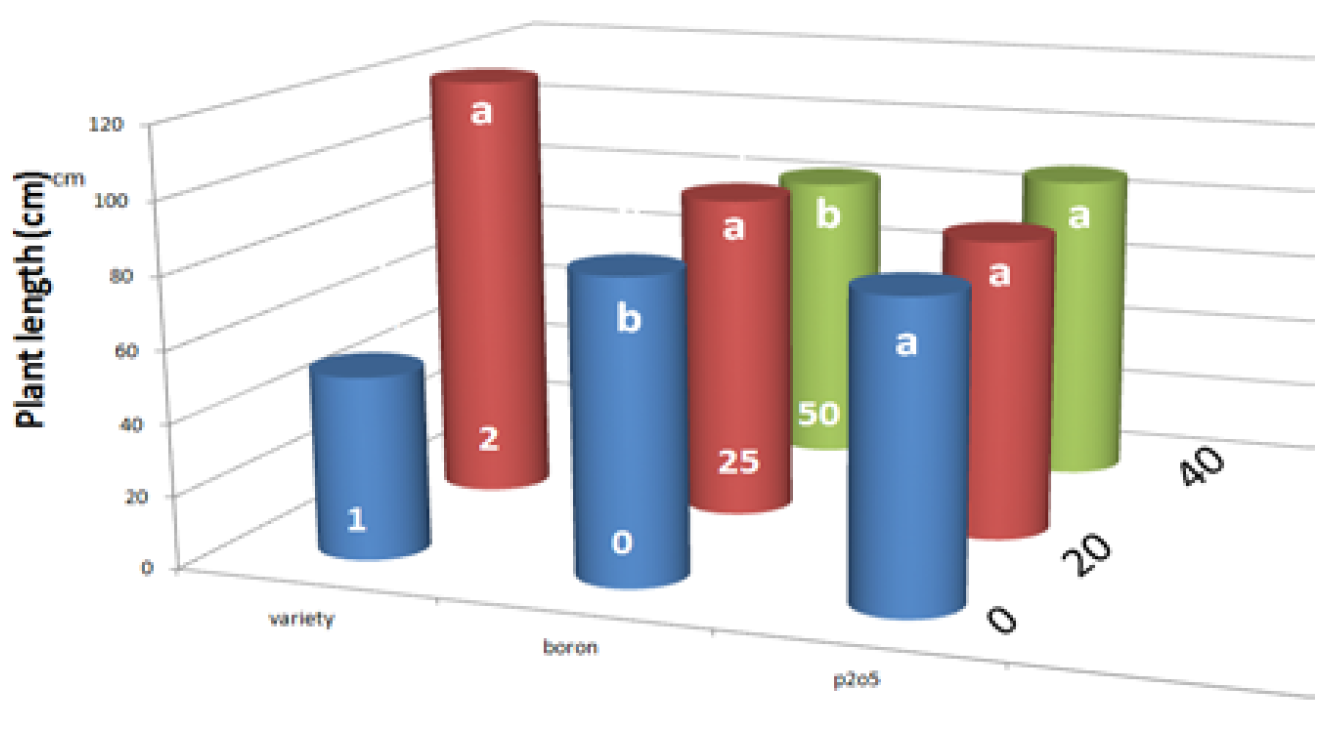
From Figure 1, it is noted that the varieties had a considerable effect on height of the plant, as Iranian gave the highest height in that, amounting to 119,516 cm. It also appears from the same figure that the boron element had significant effects on this trait and gave the 25mg.L-1concentration.The highest rise in it, as it also appears from the figure that the levels of phosphate fertilizer didn’t reach the significance level in this property. It is noted from the Table 1 that the interaction coefficients between the varieties and the different concentrations of boron had considerable effect on character of the height of theplant (cm), as Iranian with 25 mg.l-1 of boron gave the highest height in that amounted to 125,811 cm and differed significantly. The treatment of the interaction between Argentinian and spraying with 0 mg.l-1 of boron produced the lowest height,which amounted to 49.181 cm. It also appears from same table that the interaction between varieties and phosphate fertilizer levels significantly affected the plant height, as the interaction between variety two and fertilization with 0 kg.ha-1 of P2O5 produced the highest height that amounted to 121.702 cm, and differed significantly.
Figure 1: Effects of Variety, Boron, and P2O5 on Plant Length of (Cm)
Table 1: Effects Of the Spraying with The Boron and Phosphate Fertilizer on Plant Height (Cm) in Two Varieties of Beans for the Growing Season 2021*
Variety
Boron (mg/l.)
P2O5 (kg/ha.
Interaction
(variety x Boron)
0
20
40
Argentinean
0
53.773 d
48.440 d
45.330d
49.181 c
25
52.663 d
55.110d
50.997 d
52.923 c
50
53.773 d
51.110 d
47.550 d
50.811 c
Iranian
0
112.887 bc
120.553 bc
121.887 b
118.442 b
25
118.887 bc
119.887 bc
138.660 a
125.811 a
50
113.333 bc
108.220 c
121.330 bc
114.294 b
Interaction (Boron x P2O5)
0
20
40
-
0
83.330b
84.497 b
83.608 b
-
25
85.775 b
87.498 b
94.828 a
-
50
83.553 b
79.665 b
84.440 b
-
Interaction (variety x P2O5)
0
20
40
-
1
53.403 b
51.553 b
47.959 b
-
2
121.702 a
116.220 a
120.626 a
-
* The Averages That Share the Same Alphabet Are not Significantly Different from One Another Based on Duncan's Polynomial Tests At 5% Level of Probability
Table 2: The Effect of Spraying with Boron and Phosphate Fertilizer on the Number of the Branches in Two Varieties of Beans for the Growing Season 2021*
Variety
Boron (mg/l.)
P2O5 (kg/ha.
Interaction
(variety x Boron)
0
20
40
Argentinean
0
10.107 ab
11.217 a
11.110 ab
10.811 a
25
9.553 a-c
10.440 a
9.110 a-d
9.7011 a
50
9.220 a-c
9.887 ab
11.663 a
10.257a
Iranian
0
7.530 be
4.107 g
6.553 d-g
6.063 bc
25
5.663 e-g
7.107 c-f
7.440 b-e
6.737 b
50
4.667 fg
5.330 e-g
4.330 g
4.776 c
Interaction (Boron x P2O5)
0
20
40
-
0
8.818 ab
7.662 ab
8.832 a
-
25
7.608 ab
8.773 a
8.275 ab
-
50
6.944 b
7.608 ab
7.99 b
-
Interaction (variety x P2O5)
0
20
40
-
1
10.774 a
10.514 a
9.480 a
-
2
5.953 b
5.514 b
6.108 b
-
* The Averages That Share the Same Alphabet Aren’t Considerably Different from One Another Based on Duncan's Polynomial Test At 5% Level of Probability
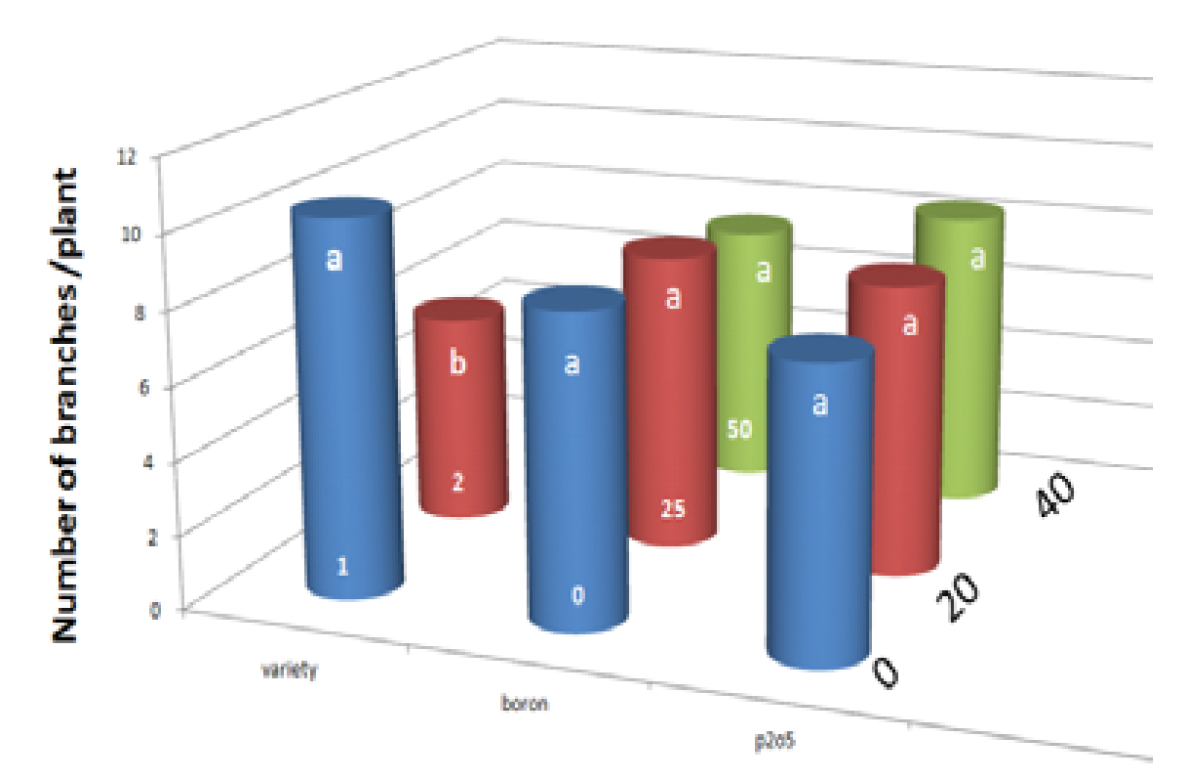
Figure 2: Effects of Variety, Boron,And P2O5 on The Number of Branches/Plant
With the levels of phosphate fertilizer and type 1 of beans, the dual interaction treatment also produced a concentration of 25mg.L-1 of elemental Boron and 40kg P2O5. ha.-1, the maximum plant height was 94.828 cm 2, and it differed significantly from the rest of the second interaction treatments, and it produced Bilateral interaction treatment between 50 mg.L-1 of Boron and 20 kg P2O5. Hectare-1, the lowest length, was 79.665 cm. As for the effect of the triple interaction between the varieties and spraying with boron and phosphate fertilizer levels, it had considerable impact on the plant height Table 1 if the triple interaction treatment was given between Iranian and spraying with 25 mg.L-1 of Boron and 40 kg P2O5.ha-1 higher the height of the plant was 138.660 cm. In contrast, the triple interaction treatment between Argentinean and 0 mg.l-1 boron and 40 kg P2O5.ha-1 gave the minimal plant height with a length of 45.330 cm. It is noted from Figure 2 that Argentinean was significantly superior to Iranian in the number of lateral branches for each plant and produced the highest value of 10,256 branches/plant. It is also noted from the same figure that there is no significant effect between boron concentrations and fertilizer levels. Phosphate in this capacity. As for the effect of the binary interaction on this trait, it appears from Table 2 that the treatment of the binary interaction between the Argentinean and 0 mg.l-1 of boron produced the highest number of side branches for each plant, amounting to 10,811 branches for each plant, and this is a significant difference with the treatment of the interaction between Iranian variety and spraying with 50 mg.L-1 of Boron amounted to 4.775 branches per plant.
Whereas the treatment of the interaction between Argentinean and 0 kg P2O5. hectare-1 was superior to the treatments of the bilateral interaction between Iranian and the different levels of phosphate fertilizer and gave 10,774 branches for each plant. The least number of branches resulted from the interaction between variety two and fertilization with 20 kg P2O5ha.-1amounted to 5.514. The highest number of branches was obtained from the interaction between spraying with Boron 0 mg.L-1 with 40 kg P2O5. Per hectare, it was 8.831 branches, and it differed significantly with the dual interaction treatment between 50 mg.L-1 of Boron with 0 kg P2O5 per hectare, which produced the least number of side branches, reached 6.944 branches per plant.
Table 3: Effects Of Spraying with Boron and Phosphate Fertilizer on Freshweight of Vegetative Growth in Two Varieties of Beans for the Growing Season 2021*
Variety
Boron (mg/l.)
P2O5 (kg/ha.
Interaction
(variety x Boron)
0
20
40
Argentinean
0
83.00 bc
76.66 bc
71.22 bc
76.96 b
25
110.22 a-c
119.33 a-c
103.44 a-c
111.00 ab
50
108.88 a-c
65.22 c
73.22 bc
82.44 b
Iranian
0
86.77 bc
116.11ab
113.89 ab
105.59 b
25
118.11 ab
133.11 ab
166.69 a
139.29 a
50
81.55 bc
100.22 ab
108.89 ab
96.89 ab
Interaction
(Boron x P2O5)
0
20
40
-
0
84.89a
96.39 a
118.94 a
-
25
114.165 a
118.72 a
108.67 a
-
50
95.22 a
82.72 a
91.05 a
-
Interaction
(variety x P2O5)
0
20
40
-
1
100.70 ab
87.07 b
82.63 b
-
2
95.476 ab
116.48 ab
129.74 a
-
* The Averages That Share the Same Alphabet Aren’t Considerably Different from One Another Based on Duncan's Polynomial Test At 5% Level of Probability
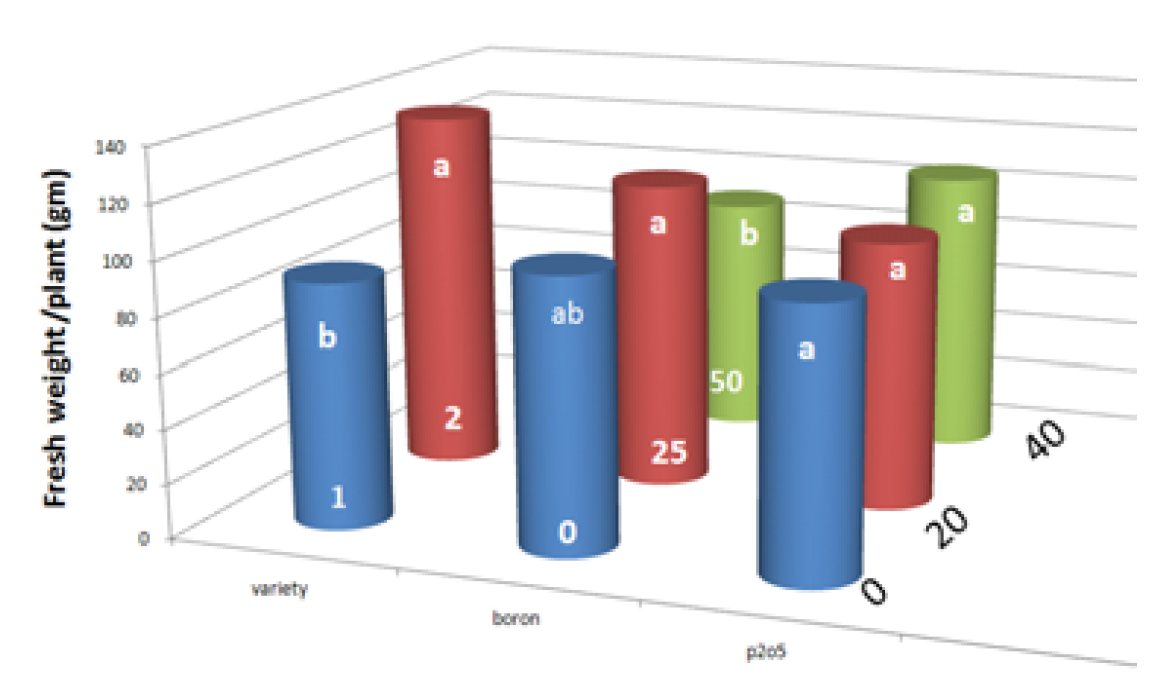
Figure 3: Effects of Variety, Boron, and P2O5 on Fresh Weight (Gm/Plant)
As for the effects of the triple interaction between the studied factors, it appears in the same table. The treatment of the triple interaction between Argentinean variety and spraying with 50 mg.L-1 of Boron and fertilizing at a level of 40 kg P2O5. H.-1 gave the highest number of 11,663 branches for each plant in Triple interaction treatment between Iranian variety and 0 mg.L-1 boron and 20 kg P2O5. The lowest number of hectares was 4.107 branches for each plant. It also appears from Figure 3 that Iranian was significantly superior in the wet weight characteristic of vegetative growth over variety one and produced the highest weight in that amounted to 133,923 g.plant-1 as it appears from the same figure that the concentration of 25mg.L-1 of the element boron had maximal wet weight. It reached 113.85 g and differed significantly with the concentration of 50mg.L-1. As for levels of phosphate fertilizer P2O5, it did not reach a significant level by its effect on this trait.
As for the dual interaction treatments between varieties and spraying with boron, it appears from Table 3 that they significantly affected the wet weight characteristic of vegetative growth, as the highest wet weight of vegetative growth was obtained as a result of the interaction between variety two and spraying with 25 mg.L-1 boron, which amounted to 139.29 g and these differed significantly with the dual interaction treatment between Argentinean variety and spraying with 0 mg.L-1 boron, which produced the lowest wet weight of 76.96 g.
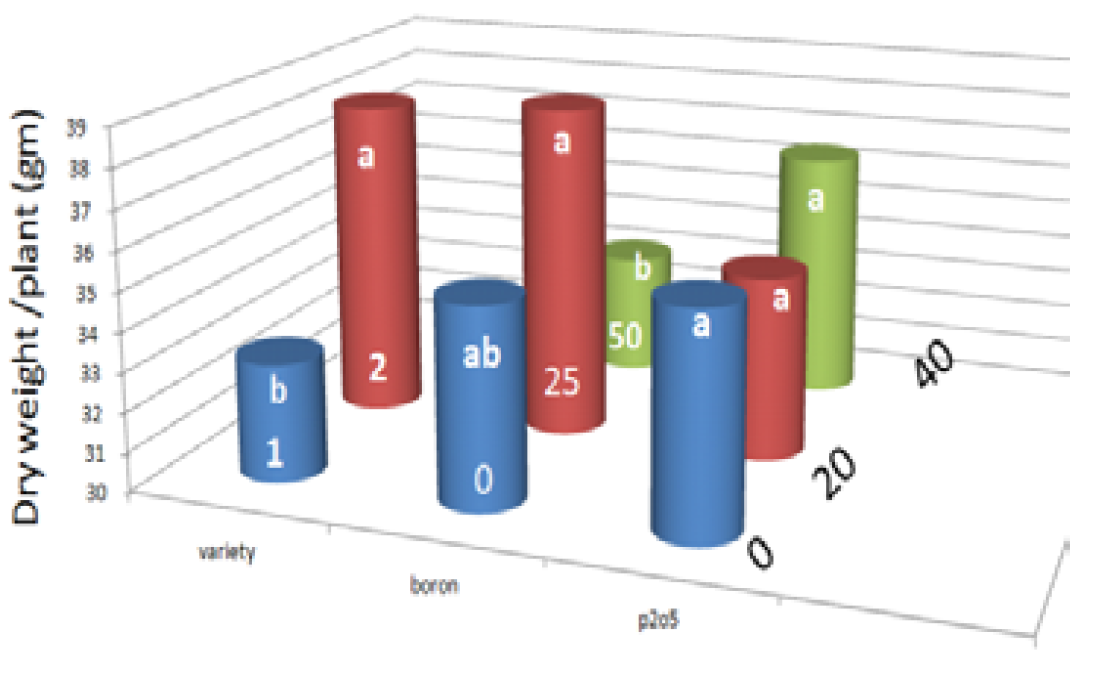
Figure 4: Effects of Variety, Boron, and P2O5 on Dry Weight of Plant (Gm/Plant)
On the other hand, the dual interaction treatment between Iraninian variety and fertilization at a level of 40kg P2O5.ha-1 gave highest wet weight of 129.74 g, and it differed significantly from the dual interaction treatment between Argentinean variety and level of 40kg P2O5ha.-1, which amounted to 82.63 g wet weight. The dual interaction treatment between spraying with 0 mg.L-1 boron and the level of 40 kg P2O5 ha-1 gave maximum fresh weight of vegetative growth, amounting to 118.94 g, which was significantly different from the dual interaction treatment between 50 mg.L-1 boron and 20 kg P2O5 ha-1Which produced the least weight in it was 82.72 g. As for the effect of triple interaction between factors under study in Table 3, the treatment of the triple interaction between Iranian variety and spraying with a 25mg.l-1concentration of the boron and a level of 40 kg P2O5 gave the highest wet weight of vegetative growth reached 166.69 g. The lowest Wet weight of vegetative growth resulted from the treatment of triple interaction between Argentinean and 0 mg.L-1 of Boron and rate of 40kg P2O5ha.-1, which amounted to 71.96 gm wet weight.
Figure 4 shows a significant superiority of Iranian variety over Argentinean in the dry weight characteristic of vegetative growth, and it produced the highest weight in that, amounting to 38.207 g/plant. As for the effect of boron and phosphate fertilizer did not reach a significant level on the dry weight characteristic of vegetative growth.
Table 4: Effects of Spraying with Boron and Phosphate Fertilizer on Dry Weight of Vegetative Growth in Two Varieties of Beans for the Growing Season 2021*
Variety
Boron (mg/l.)
P2O5 (kg/ha.
Interaction
(variety x Boron)
0
20
40
Argentinean
0
32.440 ab
30.667 ab
28.883 ab
30.663 a
25
38.887 ab
37.997 ab
35.883 ab
37.589 a
50
36.777 ab
25.777 c
29.663 bc
30.739 a
Iranian
0
32.773 ab
38.997 ab
46.777 a
39.516 a
25
42.553 ab
37.887 ab
38.107 ab
39.516 a
50
30.330 ab
36.997 ab
39.440 ab
35.589 a
Interaction (Boron x P2O5)
0
20
40
-
0
32.607 a
34.832 a
37.830 a
-
25
40.720 a
37.942 a
36.995 a
-
50
33.553 a
31.387 a
34.552 a
-
Interaction (variety x P2O5)
0
20
40
-
1
36.034 ab
31.480 b
31.477 b
-
2
35.219 ab
37.960 ab
41.441 a
-
* The Averages That Share the Same Alphabet Aren’t Considerably Different from One Another Based on Duncan's Polynomial Test at 5% Level of Probability
Table 5: Effects of Spraying with Boron and Phosphate Fertilizer on Total Chlorophyll (Mg.G-1fresh Weight) in Two Varieties of Beans for the Growing Season 2021*
Variety
Boron (mg/l.)
P2O5 (kg/ha.
Interaction
(variety x Boron)
0
20
40
Argentinean
0
194.68 e-g
176.88 fg
191.38 e-g
187.65 c
25
167.12 g
203.52 d-g
191.15 e-g
187.26 c
50
188.15 fg
188.55 e-g
209.12 d-g
195.27 c
Iranian
0
220.15 c-e
243.62 b-c
243.20 b-c
235.656 ab
25
234.78 b-g
273.31 ab
292.84 a
266.97 a
50
199.01 c-g
240.56 bc
262.562 a-c
269.31 a
Interaction (Boron x P2O5)
0
20
40
-
0
207.415 b
210.25 bc
217.29 a-c
-
25
200.95 c
238.41 ab
241.999 a
-
50
193.58 c
214.55 bc
235.84 a
-
Interaction (variety x P2O5)
0
20
40
-
1
183.32 c
189.65 c
197.22 c
-
2
263.39 a
238.65 b
234.64 b
-
* The Averages That Share the Same Alphabet Aren’t Considerably Different from One Another Based on Duncan's Polynomial Test At 5% Level of Probability
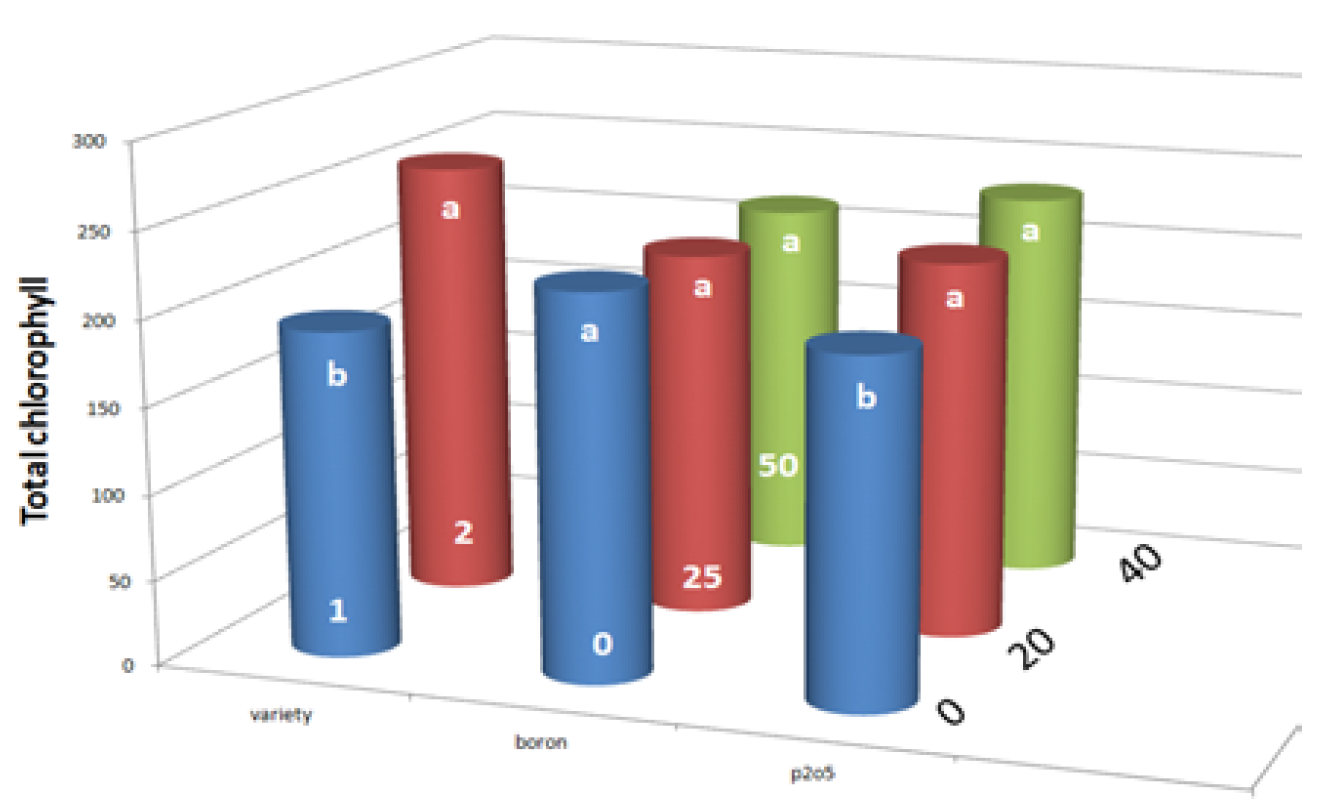
Figure 5: Effects of Variety, Boron, and P2O5 on Total Chlorophyll
Concerning the effect of the binary and triple interaction between the factors under study, it appears from Table 4 that no significant difference was shown for the interaction between the two varieties and the different concentrations of boron. It appears from the same table that the treatment of the bilateral interaction between Iranian variety and fertilization at a level of 40 kg P2O5 per hectare The highest dry weight was 41,441 g and the lowest dry weight resulted from the treatment of binary interaction between Argentinean variety and fertilization with 40 kg P2O5 ha.-1, which reached 31.477 gm dry weight. Also, there have not been any significant differences in effects of binary interaction treatment between the different concentrations of boron and the levels of phosphate fertilizer.
It also shows from the data of Table 4 of the triple interaction between the studied factors that the treatment of the triple interaction between Iranian and 0 mg.L-1 boron and the level of 40 kg P2O5 ha gave the highest dry weight for vegetative growth of 46.777 g, and the lowest dry weight appeared from the triple interaction treatment. Between Argentinian and 50 mg.L-1 boron and 20 kg P2O5 per hectare reached 25.777 g dry weight.
Figure 5 shows the effects of varieties, Boron and phosphate fertilizers on the total chlorophyll content, as it appears from the figure that their effect was in line with the dry weight characteristic of vegetative growth. As for the effect of the dual interaction between the studied factors, it appears from Table 5 that the treatment of the two interactions between Iranian varieties and spraying with concentration of 50mg.l-1 boron had the highest significant content in that, amounted to 269.31, and it differed significantly with the dual interaction treatment between Argentinian variety and 25 mg. L-1 boron, on the other hand, the binary interaction treatment between Iranian variety and 0 kg P2O5 per hectare gave the highest total chlorophyll content amounted to 263.39, and the lowest content was when the binary interaction between Argentinian variety and 0 kg P2O5 per hectare amounted to 183.32. It also appears from the same table that the dual interaction treatment between 25 mg.L-1 boron and 40 kg P2O5 per hectare had the highest significant difference in the total chlorophyll content of 241.999, and the lowest chlorophyll content resulted from the dual interaction treatment between 50 mg.L-1 boron And 0 kg P2O5 per hectare, which amounted to 193.58.
Table 6: Effects of Spraying with Boron and Phosphate Fertilizer on the Leaf Area (Cm2) in Two Varieties of Beans for the Growing Season 2021*
Variety
Boron (mg/l.)
P2O5 (kg/ha.
Interaction
(variety x Boron)
0
20
40
Argentinean
0
88.59 d-f
101.73 c-f
90.83 d-f
93.72 c
25
127.89 a-f
132.84 a-g
107.62 b-g
122.78 bc
50
130.36 a-g
58.28 h
70.63 gh
86.42 c
Iranian
0
111.15 a-g
146.37 a-f
173.15 a-f
143.55 b
25
196.42 a
189.58 ab
197.15 a
194.39 a
50
122.36 a-f
157.48 a-f
181.19 a-c
153.68 ab
Interaction (Boron x P2O5)
0
20
40
-
0
99.87 b
124.05 ab
131.99 ab
-
25
162.16 a
161.21 a
152.39 ab
-
50
126.36 ab
107.88 ab
125.91 ab
-
Interaction (variety x P2O5)
0
20
40
-
1
115.61 bc
97.62 c
89.69 c
-
2
143.31 ab
164.48 a
183.83 a
-
* The Averages That Share the Same Alphabet Aren’t Considerably Different from One Another Based on Duncan's Polynomial Test At 5% Level of Probability
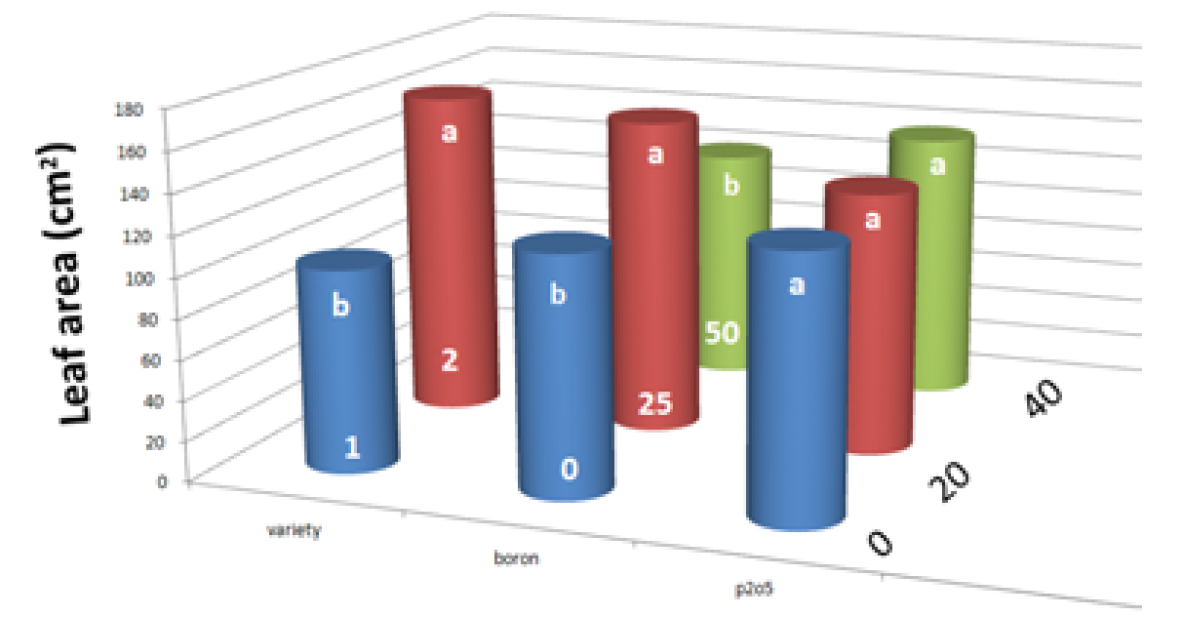
Figure 6: Effects of Variety, Boron, and P2O5 on Leaf Area (Cm2/Leaf)
As for effects of the triple interaction between the factors studied, it appears from Table 5 that the treatment of the triple interaction between Argentinian variety and spraying with a 25 mg.L-1concentration of the boron and an average of 40 kg of phosphate fertilizer gave the highest content in total chlorophyll that reached 292.84.In the lowest content produced From the triple interaction treatment between Argentinian variety and spraying with 25 mg L-1 boron and fertilizing at the rate of 0 kg P2O5 per hectare, it has been 167.12. Figure 6 shows a significant superiority of Iranian over Argentinian in terms of the area of one leaf per cm2, as it produced the highest area per leaf of 163.87 cm2. At the same time, it appears from the same figure that the concentration of 25mg.L-1 of the element boron in one leaf area was 158.58 cm2 and it varied significantly with concentrations 0 and 50 mg.l-1, and phosphate fertilizer had no significant effect on this trait. As it appears from Table 6 that the treatment of the two interactions between Iranian variety and spraying with a 25mg.l-1concentration of the boron gave maximum the area of one leaf was 194.39 cm2, and this differed significantly with the dual interaction treatment between Argentinian variety and spraying with 50 mg.l-1 of boron amounted to 93.72 cm2. The treatment of interaction between Argentinian variety and fertilization at a rate of 40 kg P2O5 ha has been significantly superior to the treatment of binary interaction between variety one and at the level of 40 kg P2O5 per hectare, which amounted to 183.83 and 89.69 cm2 respectively. From the same table, it appears that the highest area of a single leaf resulted from the dual interaction treatment of 25 mg.L-1 of Boron and fertilization at a rate of 0 kg P2O5 per hectare amounted to 162.16 cm2, and this differed significantly with the dual interaction treatment between spraying with 0 mg.L- 1 boron and 0 kg P2O5 per hectare, which amounted to 99.87 cm2, didn’t differ considerably from the rest of other two-interference coefficients.
As it appears from Table 6, the treatment of the triple interaction between the factors under study shows that the highest significant difference resulted from the interaction between Iranian variety and spraying with 25 mg.L-1 boron and fertilizing at a rate of 40 kg P2O5 per hectare with the highest area of one leaf amounted to 197.15 cm 2. The triple interaction between Argentinean variety and spraying with 0 mg.L-1 boron and 0 kg P2O5 per hectare gave the least significant difference of 88.59 cm2.
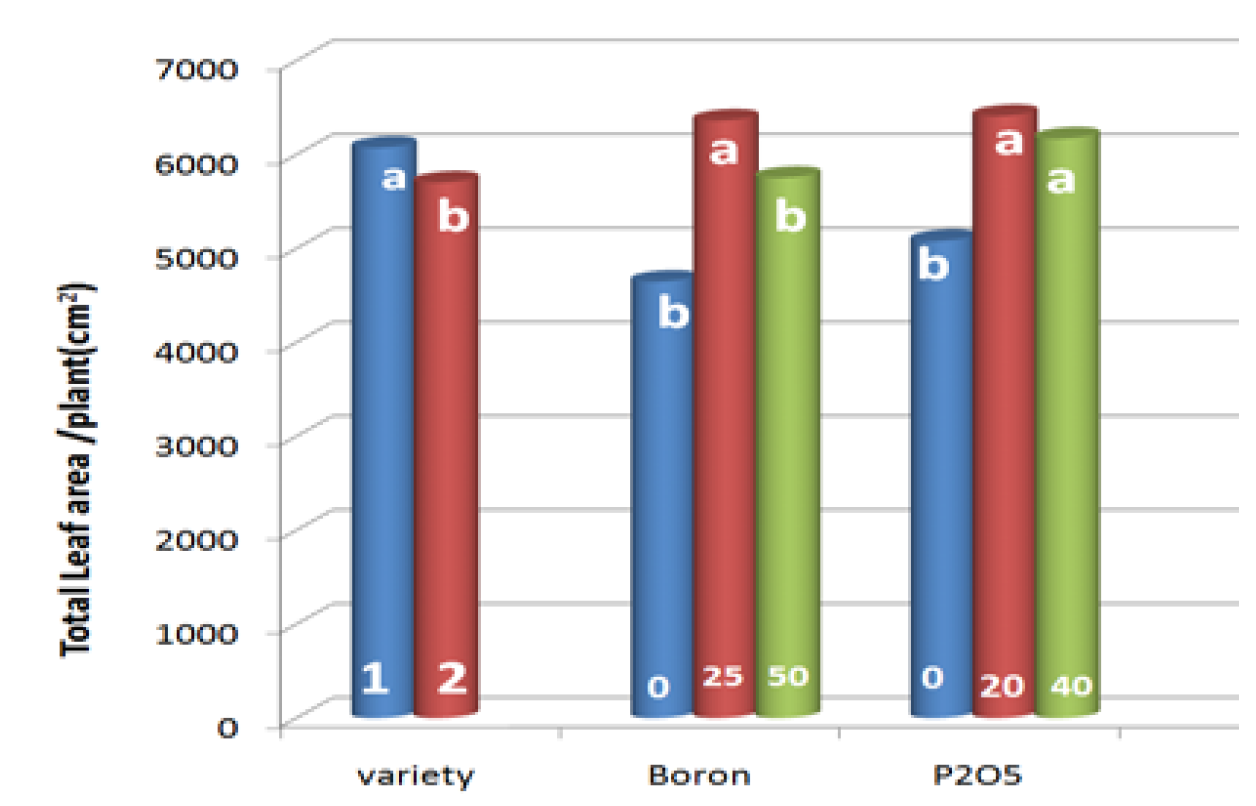
From Figure 7, it appears that Argentenian variety was significantly superior to Iranian variety in the characteristic of total leaf area of the plant(cm2), and the concentration of 25mg.L-1 gave the highest total leaf area of the plant, and 20 kg of P2O5 gave the superior value in total leaves aerea for plant than the two levels of phosphate fertilizer.
Table 7: Effects Of Spraying with Boron and Phosphate Fertilizer on Total Leaf Area (Cm2) in Two Varieties of Beans for the Growing Season 2021*
Variety
Boron (mg/l.)
P2O5 (kg/ha.)
Interaction (variety x Boron)
0
20
40
Argentinean
0
5265.29c
5447.89c
6279.53b
5664.33bc
25
6104.05b
6667.79a
6763.26a
6511.70a
50
5360.85bc
7251.54a
5524.04bc
6045.47b
Iranian
0
4312.00d
7215.58a
5364.13c
5630.57bc
25
5266.34c
6243.67ab
6536.01a
6015.34b
50
4182.40d
5642.63bc
6562.58a
5462.53c
Interaction (Boron x P2O5)
0
20
40
-
0
4788.645c
6331.735b
5821.83b
-
25
5685.195b
6455.73a
6649.635a
-
50
4771.625c
6447.085a
6043.31ab
-
Interaction (variety x P2O5)
0
20
40
-
1
5576.73c
6455.74a
6188.943b
-
2
4586.913d
6367.293a
6154.42b
-
* The Averages That Share the Same Alphabet Aren’t Considerably Different from One Another Based on Duncan's Polynomial Test At 5% Level of Probability
Table 8: Effects Of Spraying with Boron and Phosphate Fertilizer on (N%) in Two Varieties of Beans for the Growing Season 2021*
Variety
Boron (mg/l.)
P2O5 (kg/ha.)
Interaction
(variety x Boron)
0
20
40
Argentinean
0
2.967 ab
2.383 b
3.133 ab
2.828 ab
25
2.940 ab
3.033 ab
2.837 ab
2.937 ab
50
3.297 a
2.383 b
3.100 ab
2.927 ab
Iranian
0
2.837 ab
2.547 ab
2.383 b
2.589 b
25
3.33 a
3.230 ab
2.807 ab
3.122 a
50
3.037 ab
3.167 ab
2.38 b
2.861 ab
Interaction (Boron x P2O5)
0
20
40
-
0
2.902 ab
2.465 b
2.758 ab
-
25
3.135 a
3.132 a
2.822 ab
-
50
3.167 a
2.775 ab
2.74 ab
-
Interaction (variety x P2O5)
0
20
40
-
1
3.077 a
2.600 ab
3.023 a
-
2
3.077a
2.981 a
2.523 b
-
* The Averages That Share the Same Alphabet Aren’t Considerably Different from One Another Based on Duncan's Polynomial Test at A 5% Level of Probability
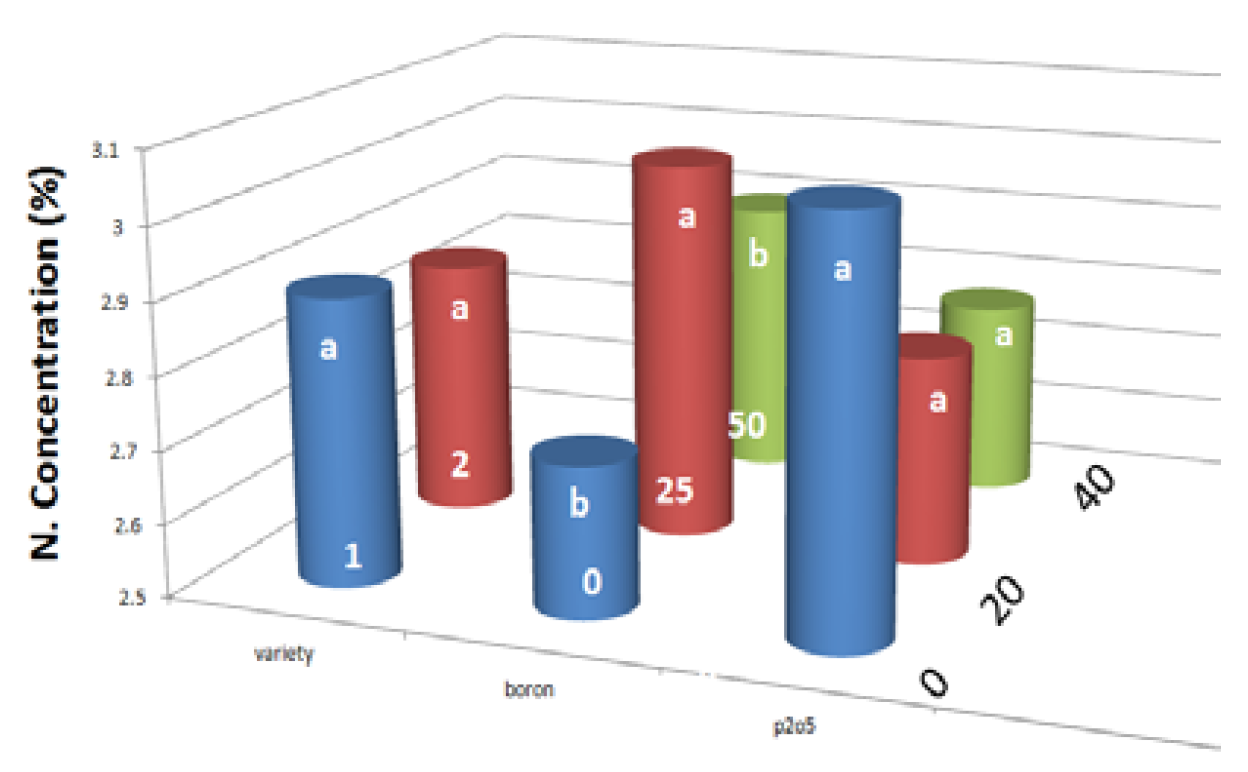
Figure 8: Effects of Variety, Boron, and P2O5 on N. Concentration in Leaf (%)
It is noted from Table 7 that the dual interaction treatment between the Argentinian variety and spraying with 25 mg.L of boron element produced the highest total leaf area which was 6511.7 cm2 and it differed significantly with the dual interaction treatment between the Iranian variety and spraying with 50 mg.L boron, which produced the least total area which reachd 5462.53 cm2. As for the treatments of the bilateral interaction between spraying concentrations of boron and levels of phosphate fertilization on this trait, it appears from the same table that the treatment of bilateral interaction between spraying with 25 mg.L-1 boron with 20 kg P2O5/ha produced the highest total leaf area of the plant amounted to 6455.73 cm2 and differed significantly with the dual interaction treatments between 0 mg.l of boron and the three levels of P2O5 fertilizer, and also with the edual interaction treatment between spraying with 50 mg.l-1 of boron and fertilization with 0 kg P2O5/ha, which produced the least leaf area in it. It is also noted from the same table that the bilateral interaction between the Argentinian variety and the fertilization at a level of 20 kg P2O5/ha produced the highest total leaf area of the plant amounted to 5455.74 cm2 and this differed significantly with most of the two interaction treatments between the two varieties and the levels of phosphate fertilizer, but it did not differ significantly with treatment of the interaction between the Iranian variety and the level of 20 kg P2O5/ha of phosphate fertilizer. As for the treatments of the triple interaction between bean varieties , spraying with the element boron and phosphate fertilizing on this trait, it may appear from the same table that the treatment of the triple interaction between the Argentinian variety with spraying 50 mg.L-1 boron and 20 kg P2O5/ha produced the highest total leaf area of the plant amounted to 7,251.54 cm2 and this differed significantly with some of the triple interaction treatments among the factors under study, and the triple interaction treatment between the Iranian variety and spray produced 50 mg.L-1 boron and 0 kg P2O5/ha less a total leaf area of 4182.4 cm 2 .
From Figure 8, it appears that the varieties and phosphate fertilizer didn’t have significant effect on the percentage of nitrogen in the leaves, while the 25mg.L-1concentration of Boron gave the highest significant percentage in that, amounting to 3.0294%.
Table 8: Effects Of Spraying with Boron and Phosphate Fertilizer on (N%) in Two Varieties of Beans for the Growing Season 2021*
Variety
Boron (mg/l.)
P2O5 (kg/ha.)
Interaction
(variety x Boron)
0
20
40
Argentinean
0
2.967 ab
2.383 b
3.133 ab
2.828 ab
25
2.940 ab
3.033 ab
2.837 ab
2.937 ab
50
3.297 a
2.383 b
3.100 ab
2.927 ab
Iranian
0
2.837 ab
2.547 ab
2.383 b
2.589 b
25
3.33 a
3.230 ab
2.807 ab
3.122 a
50
3.037 ab
3.167 ab
2.38 b
2.861 ab
Interaction (Boron x P2O5)
0
20
40
-
0
2.902 ab
2.465 b
2.758 ab
-
25
3.135 a
3.132 a
2.822 ab
-
50
3.167 a
2.775 ab
2.74 ab
-
Interaction (variety x P2O5)
0
20
40
-
1
3.077 a
2.600 ab
3.023 a
-
2
3.077a
2.981 a
2.523 b
-
* The Averages That Share the Same Alphabet Aren’t Considerably Different from One Another Based on Duncan's Polynomial Test at A 5% Level of Probability
Table 9: Effects Of Spraying with Boron and Phosphate Fertilizer on the Percentage of Protein in Two Varieties of Beans for the Growing Season 2021*
Variety
Boron (mg/l.)
P2O5 (kg/ha.
Interaction
(variety x Boron)
0
20
40
Argentinean
0
18.547 ab
14.897 b
19.583 ab
17.676 ab
25
18.377 ab
18.960 ab
17.730 ab
18.356 ab
50
20.607 a
14.897 b
19.377 ab
18.293 ab
Iranian
0
17.730 ab
15.917 ab
14.897 b
16.181 b
25
20.817 a
20.187 ab
17.543 ab
19.516 a
50
18.980 ab
19.793 ab
14.877 b
17.883 ab
Interaction (Boron x P2O5)
0
20
40
-
0
18.138 ab
15.407 b
17.240 ab
-
25
19.597 a
19.573 a
17.637 ab
-
50
19.793 a
17.345 ab
17.127 ab
-
Interaction (variety x P2O5)
0
20
40
-
1
19.177 a
16.251 ab
18.897 a
-
2
19.176 a
18.632 a
15.772 b
-
* The Averages That Share the Same Alphabet Aren’t Considerably Different from One Another Based on Duncan's Polynomial Test At A 5% Level of Probability
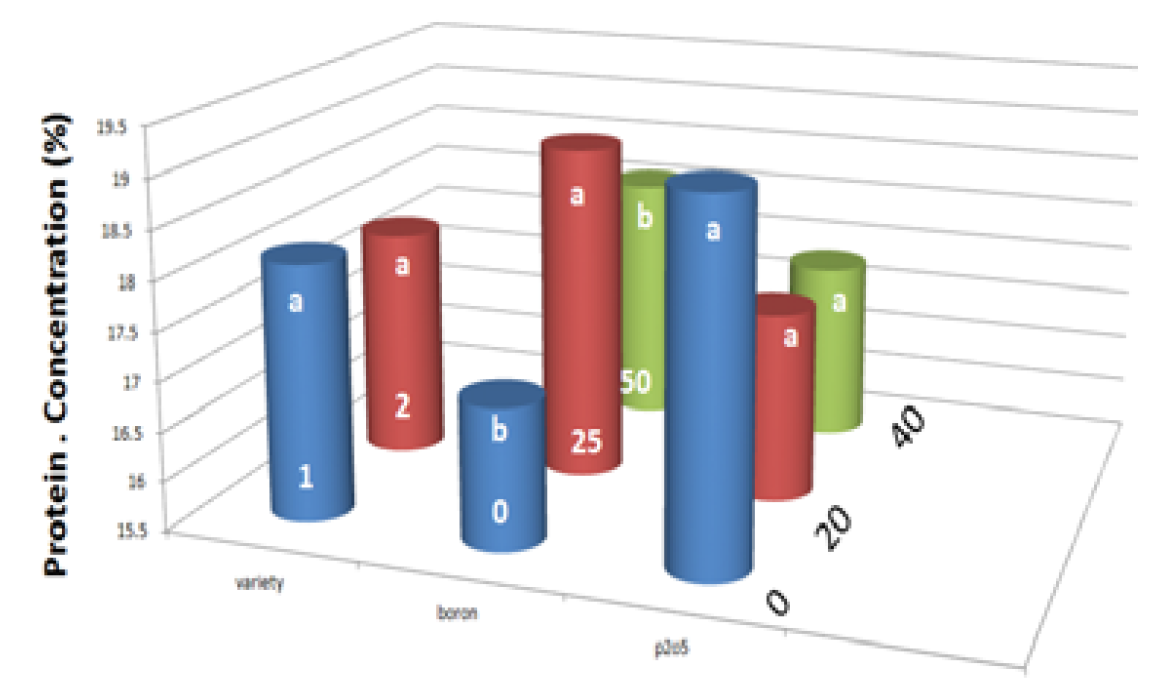
Figure 9: Effects of Variety, Boron, and P2O5 on Protein Concentration in Leaf (%)
It is noted from Table 8 that the highest percentage of nitrogen in vegetative growths resulted from the treatment of the binary interaction between Iraninian variety and spraying with 25 mg.L-1 of Boron, which amounted to 3.122%, and the bilateral interaction between Argentinean and Iranian varieties , the fertilization at a rate of 0 kg gave P2O5. ha.-1, highest significant difference in that amounted to 3.067% for the two types.
The dual interaction treatment between spraying with 50 mg.L-1 boron and fertilizing at rate of 0 kg P2O5 per hectare produced the highest percentage of nitrogen, which was 3.1667%. From the same table, it appears that the triple interaction treatments between the studied factors had a significant effect on this ratio, as the triple interaction treatment between Iranian and 25 mg.L-1 boron and 0 kg P2O5 per hectare gave the highest percentage of 3.330%. The lowest percentage resulted from the triple interaction between the Iranian and spraying with 0 mg. L-1 boron and 20 kg P2O5 per hectare amounted to 2.383%.
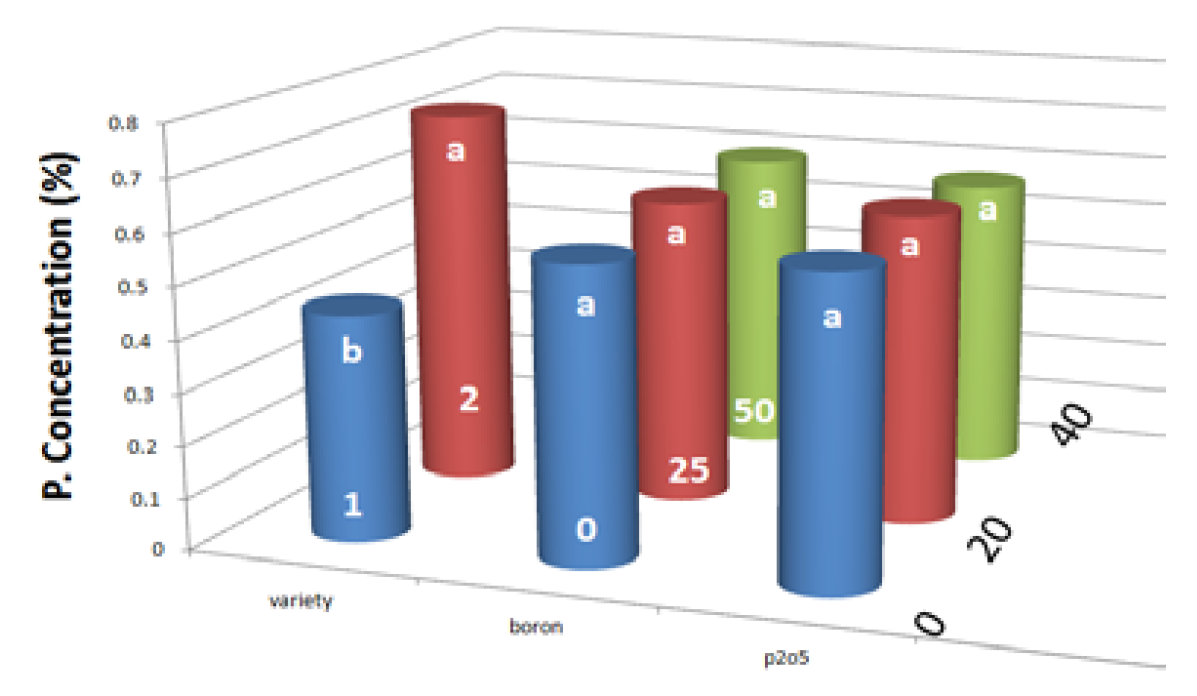
Figure 10: Effects of Variety, Boron, and P2O5 on P. Concentration in Leaf (%)
The percentage of protein in leaves, it took the same direction by being affected by the three factors, with the effect of these factors on the percentage of nitrogen Figure 9. The results were consistent in Table 9, as they took the same approach to the effect of the two- and the three-way interaction between the studied factors in their effect on the protein content in vegetative growths. While it is noted from Figure 10 that Iranian variety was significantly superior to Argentinean variety by its effect on the percentage of phosphorous in leaves (%),the effect of spraying with different concentration levels of boron and different levels of phosphate fertilizer had no significant effect on the percentage. For phosphorous in vegetative growths in beans.
Table 10: Effects of Spraying with Boron and Phosphate Fertilizer on (P%) in Two Varieties of Beans for the Growing Season 2021*
Variety
Boron (mg/l.)
P2O5 (kg/ha.
Effect of variety x Boron
0
20
40
Argentinean
0
0.450 e-g
0.3567 g
0.5167 d-g
0.4411 b
25
0.4667 e-g
0.580 c-g
0.3733 fg
0.4733 b
50
0.390 fg
0.3833 fg
0.420 fg
0.3978 b
Iranian
0
0.660 ab
0.8267 a
0.600 bc
0.6956 a
25
0.773 a-c
0.5767 a-d
0.7767 a-c
0.7089 a
50
0.7800 a-c
0.8667 a
0.7367 a-d
0.7944a
Interaction (Boron x P2O5
0
20
40
-
0
0.555 a
0.5917 a
0.5583 a
-
25
0.6200 a
0.5783 a
0.575 a
-
50
0.585 a
0.625 a
0.578 a
-
Interaction (variety x P2O5)
0
20
40
-
1
0.440 b
0.440 b
0.4367 b
-
2
0.7378 a
0.7567 a
0.7044 a
-
* The Averages That Share the Same Alphabet Aren’t Considerably Different from One Another Based on Duncan's Polynomial Test at A 5% Level of Probability
Table 11: The Effect of Spraying with Boron and Phosphate Fertilizer on (K%) in Two Varieties of Beans for the Growing Season 2021*
Variety
Boron (mg/l.)
P2O5 (kg/ha.
Interaction
(variety x Boron)
0
20
40
Argentinean
0
4.533 a-c
2.640 b-d
5.047 ab
4.0733 a
25
0.940 cd
2.133 b-d
4.463 a-c
2.5122 a
50
3.423 a-d
2.283 b-d
2.427 b-d
2.711 a
Iranian
0
1.873 b-d
6.667 a
0.680 d
3.0733 a
25
1.960 b-d
5.600 ab
0.830 cd
2.7967 a
50
4.207 a-d
4.733 ab
0.620 d
3.1867 a
Interaction (Boron x P2O5)
0
20
40
-
0
3.203 ab
4.653 a
2.863 ab
-
25
1.450 b
3.867 ab
2.647 ab
-
50
3.815 ab
3.508 ab
1.523 b
-
Interaction (variety x P2O5)
0
20
40
-
1
2.966 b
2.3522 bc
3.979 ab
-
2
2.680 b
5.667 a
0.710 c
-
* The Averages That Share Same Alphabet Aren’t Considerably Different from One Another Based on Duncan's Polynomial Test at A 5% Level of Probability
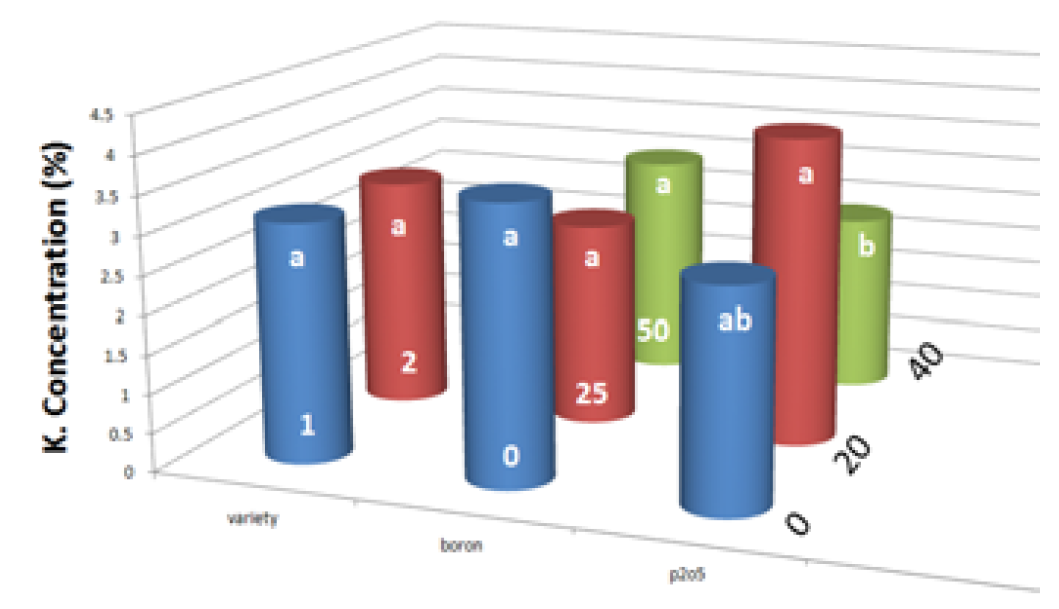
Figure 11: Effects of Variety, Boron, and P2O5 on K. Concentration in Leaf (%)
Table 10 showed the interaction treatments between Iranian variety and spraying with different concentrations of boron produced the highest percentage of phosphorous in vegetative growths, which differed significantly with the same concentrations and Iranian of beans. Phosphate fertilizer P2O5 kg per hectare at a probability level of 5%, compared with Argentinian variety and the different levels of phosphate fertilizer used. There has also been no significant impact of binary interaction between spraying with different levels of boron and phosphate fertilizer P2O5 on this trait. As for the effect of triple interaction of factors under study, it appears from the table that in treatment of triple interaction between Iranian variety and 0 mg.L-1 boron and 0 kg P2O5 per hectare, the highest percentage of phosphorous was 0.8266% and this differed significantly with the rest of the treatments of the triple interaction between the factors under consideration
It is noted from Figure 11 that there is no significant effect of each of the varieties and the different concentrations of boron on the percentage of potassium in the leaves (%): on the other hand, significant differences appeared for the levels of phosphate fertilizer P2O5 on this trait, as it gave the level of 20 kg. ha-1, the highest percentage was 4.009%. It appears from Table 11 that there is no significant effect of interaction between the variety and spraying with different concentrations of boron on the percentage of potassium in the vegetative growths.
The highest percentage of potassium in vegetative growths was obtained from the interaction between Iranian variety and fertilization at a rate of 20 kg P2O5 per hectare, which amounted to 5.666%, and it significantly outperformed the rest of the dual interaction treatments. While the dual interaction treatment between spraying with 0 boron and 20 kg P2O5 per hectare gave The highest percentage in that amounted to 4.653%, and it differed significantly with spraying with 25 mg.L-1 boron and 0 kg of phosphate fertilizer, while it did not reach the level of significancewith some binary interference coefficients.As for the triple interaction treatments between each of the varieties , the spraying with boron, and the levels of phosphate fertilizer, it appears from Table 11 that the treatment of the triple interaction between the Iranian variety and spraying with 0 mg.l-1 boron and the fertilization at a rate of 20 kg P2O5 per hectare produced the highest percentage of potassium in The vegetative growths reached 6.667%. This treatment was significantly superior to some treatments of the triple interaction, in the lowest percentage came from the triple interaction between Iranian variety and spraying with 25 boron and 40 kg of phosphate fertilizer amounted to 0.620%.
Table 12: Effect Of Spraying with Boron and Phosphate Fertilizer on Boron Concentration (Pp M) in Two Varieties of Beans for the Growing Season 2021*
Variety
Boron (mg/l.)
P2O5 (kg/ha.
Interaction
(variety x Boron)
0
20
40
Argentinean
0
67.533 de
63.733 ef
68.433 de
66.567 de
25
70.233 c-e
77.567 a-d
68.167 de
71.989 cd
50
77.767 a-d
76.000 b-d
66.867 de
73.544 c
Iranian
0
63.900 ef
53.767 f
68.267 de
61.978 e
25
82.633 ab
86.167 a
88.500 a
85.767 a
50
83.267 ab
75.500 b-d
80.367 a-c
79.711 b
Interaction (Boron x P2O5)
0
20
40
-
0
65.717 d
58.750 e
68.350 cd
-
25
76.433 a
81.867 a
78.333 ab
-
50
80.517 ab
75.750 ab
73.617 bc
-
Interaction (variety x P2O5)
0
20
40
-
1
71.844 bc
72.433 bc
67.822 c
-
2
76.600 ab
71.811 bc
79.044 a
-
* The Averages That Share Same Alphabet Aren’t Considerably Different from One Another Based on Duncan's Polynomial Test at A 5% Level of Probability
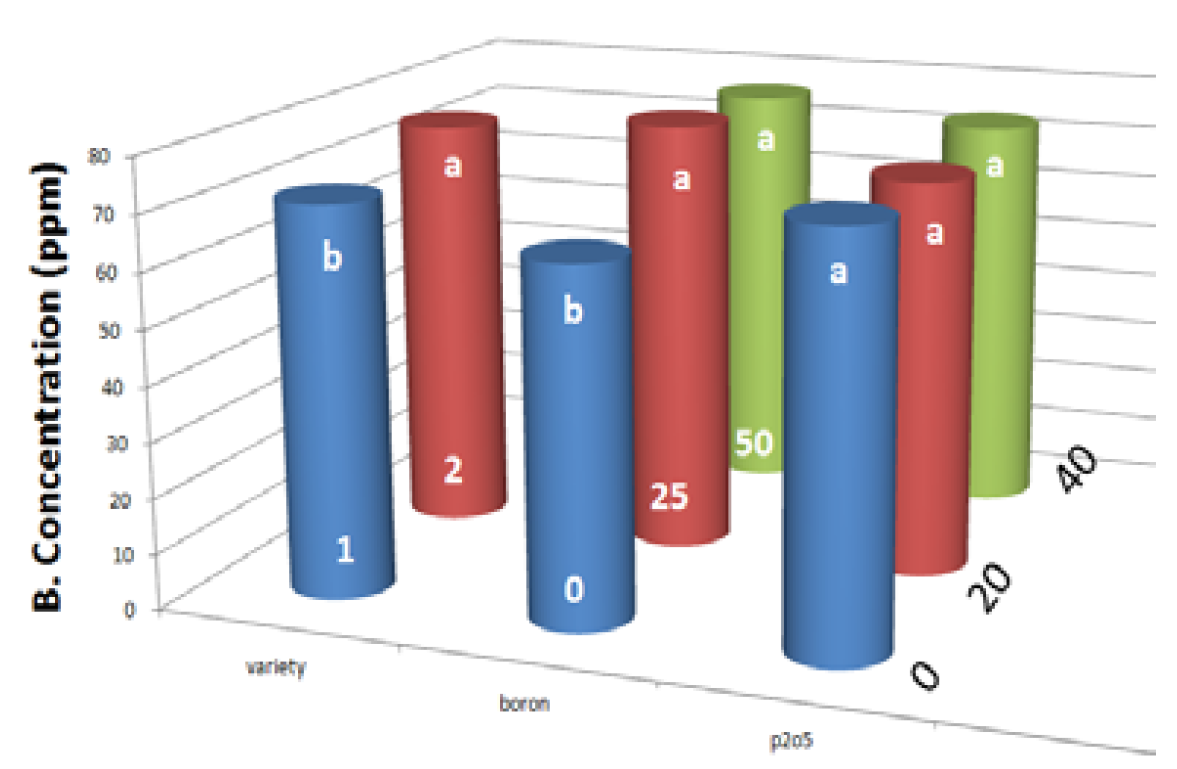
Figure 12: Effects of Variety, Boron, and P2O5 on Bo. Concentration in leaf(ppm)
Figure and Table 12 shows that variety two significantly outperformed Argentinean cultiva in boron content in vegetative growths, as it reached 75.819 ppm, and a concentration of 25 mg.L-1 of Boron produced the highest value in that amounted to 78.878 ppm. It differed significantly with the treatment of 0 mg.L.-1 of Boron, but it did not significantly with spraying with concentration of 50mg.L-1 of Boron. The effect of phosphate fertilizer levels on the trait did not reach the level regarding significance in effect on that. As for the dual interaction treatments between Iranian variety and spraying with 25 mg.L-1 of elemental Boron, they significantly outperformed the rest of the dual interaction treatments, as they reached 79,711 ppm of boron in vegetative growths in bean plant. The treatment of bilateral interaction between Iranian variety and fertilizing at a rate of 40 kg of phosphate fertilizer gave maximum value, amounting to 79,044 ppm of the element boron. And the dual interaction treatment between sprays produced 25 mg. 1 liter of boron and 20 kg of P2O5 per hectare, the highest percentage of that amounted to 81.867 ppm.
As for the triple interaction treatments, the triple interaction treatment between Iranian variety and spraying with 25 mg of boron and fertilizing at a rate of 40kg of phosphate fertilizer gave maximum reading, which amounted to 88.500 ppm. Between Iranian variety and 0 mg of boron and 20 kg of phosphate fertilizer amounted to 53.767 ppm.
DISCUSSION
Figures 1, 2, 3, 4, 5, 6 and 7 showed that the bean varieties under study varied significantly in vegetative growth characteristics, as the Iranian variety outperformed the Argentine variety in both plant height (cm) and wet weight. The dry and dry growth of vegetative growth (g) and in the total chlorophyll content in the leaves and the leaf area cm2 for each plant, while the Argentine variety outperformed the Iranian variety in the number of lateral branches for each plant. This result may explain the influence of genetic factors for each variety within its genome in addition to the extent of the variety's response and adaptation to the prevailing environmental conditions, its different genetic characteristics, and the conditions suitable for growth in an area and carrying out metabolic processes, and also the extent of the effect of genetic interaction with the environment for the Iranian variety, which has adapted to environmental conditions in a higher degree than the Argentine variety, may also be due to the variation in its ability to absorb nutrients, that these conditions are genetically controlled. These results are in line with many researchers who studied the characteristics of vegetative growth by evaluating bean varieties and concluded that there are considerable differences between studied bean varieties in these traits. [9,11,13-14,16,18-21,42] when studying the evaluation of bean varieties that the varieties differed among themselves in vegetative growth characteristics, and were consistent with what Abdel-Mawgoud et al. [43], Kazemi et al. [17]. For plant height in beans, Bakry et al. [44], Masoud and El-Waraky [45] for some lateral branches of bean varieties, Janeczek et al. [46] for wet and dry weight in bean varieties, and Helal [47], and with Abdul Jalil et al. [48] who obtained significant differences in the characteristics of vegetative growth between the varieties of the beans and beans respectively. It also appears from the above problem that the boron element had a significant effect on characteristics of plant height (cm), wet weight (gm), and leaf area (cm2) for each plant, as the concentration of 25 mg/L produced the highest value in that. The results indicate the role of the necessary element of boron in the division and growth of cells and its role in transporting the sugars manufactured in the leaves to the plant parts. The transfer of sugars combined with boron is faster and easier than the transfer of polarized sugars alone, which causes an increase in growth The vegetable is represented by plant height, wet weight, number of lateral branches and leaf area [49]. Boron facilitates the movement of food processing products in the leaves to active areas. Foliar feeding provides the plant with the necessary elements for growth [50]. It also enters into the formation of the amino acid tryptophan, responsible for the elongation of cells [51], and an increase in vegetative growth characteristics as a result of spraying with boron. This cycle increases the possibility of leaves absorbing solar rays and increasing the efficiency of the photo-synthesis. There was an increase in the accumulation of manufactured nutrients, and spraying boron on plant increased the absorption efficiency of plant for this element and its transmission within the plant due to small molecules, which led to the availability of time and effort for the plant to represent it and benefit from it in vital processes, which was reflected in an increase in the characteristics of vegetative growth in The plant.The results of boron spraying on bean plants and its effect upon the vegetative growth properties have been consistent with [14,23-25,27-28,52-53] that boron had a significant effect on plant height and weight. Wet and dry weight vegetative growth and total chlorophyll content in each bean plant's leaf area.As for the effect of phosphorous fertilizer represented by the element phosphorous, no significant differences appeared as a result of using phosphate fertilizer in the characteristics of plant height, the number of lateral branches for each plant, wet and dry weight of vegetative growth, total chlorophyll content in the leaf and the leaf area of each bean plant. Note that the high levels produced the highest non-significant values: this may explain these results. The addition of phosphate fertilizer positively increased the dry weight of each of the shoots. Phosphorus increases the soil's acidity, which works and increases vegetative growth [54]. These results are consistent with what was mentioned by Kolawole et al. [55] in the cowpea plant. To Shubhashree [32] and Khadem et al. [33], phosphate fertilizer plays an important role in the characteristics of vegetative growth in bean plants. As for the effect of binary interaction between varieties and spraying with the element boron, it appears from Tables 2, 3, 4, 5, 6, 7 that the vegetative growth characteristics have been significantly affected by spraying with boron. The interaction treatment between the Iranian variety with spraying at a concentration of 25 mg/L produced boron significantly affected plant height, wet and dry weight, total chlorophyll content in leaves, and leaf area of plants. These results may explain the Iranian variety's efficiency in spraying with boron. The two interaction treatments between the bean varieties and the phosphate fertilization were also produced, as it appears from the above tables that the treatment of the two interactions between the Iranian row and the levels of phosphate fertilization showed considerable superiority in characteristics of plant height, wet and dry weight for each plant and in leaf area. The interactions between the Argentine variety and phosphate fertilizer levels produced significant differences in the rest of the vegetative growth traits. As for the effect of the dual interaction between spraying with boron element and phosphate fertilizer, the dual interaction treatment between 25 mg/l of boron and levels of phosphate fertilizer produced significant differences in the height of theplant, wet and dry weight of vegetative growth, and leaf area for each plant. As for the triple interaction treatments among the three studied factors, they significantly affected the vegetative growth characteristics, as the triple interaction treatment between the Iranian variety and 0 mg/L boron and 0 kg/ha phosphate fertilizer produced the highest plant height in Table 2, and the triple interaction treatment between The Argentine variety and 50 mg/L boron and 0 kg/ha phosphate had the highest significant value in number of branches per plant Table 3, and the triple interaction treatment between the Argentine variety and 0 mg/L Boron and 40 kg/ha of phosphate fertilizer had the highest significant value in The wet weight of the vegetative growth and the dry weight of the vegetative growth in Table 4 and 5, while the triple interaction treatment between the Argentine variety and 25 mg/L of boron and 20 kg/ha of phosphate produced the highest significant value in the total chlorophyll content in leaves Table 6, and the highest significant value In the leaf area of each plant, fed came from the effect of the triple interaction between the Argentine variety and 25 mg / liter of boron and 40 kg / hectare of phosphate fertilizer Table 7.These results may explain the effects of the bilateral and triple interaction between the studied factors on vegetative growth characteristics (plant height, number of lateral branches, wet and dry weight of vegetative growth, and total chlorophyll content in leaves and leaf area of the plant), as these two. Three interactions between the factors are in line with The moral effect of the cumulative effect, and the positive singular for each factor fulfilled their interpretation, also with the presence of the effect of cumulative and additional activities for each factor when they overlap together and physiological role of elements of boron and phosphate fertilizer.It also appears from Figures 8, 9, 10, 11, 12 that the varieties had no significant effect on the percentage of nitrogen, protein, and potassium. However, the varieties varied significantly among themselves in the percentage of phosphorous and boron, as variety two outperformed on variety1 in percentage of both phosphorous and boron in leaves, this result may explain the effect of genetic factors and the gene responsible for uptake of phosphorous and boron within the genome complex of half two and also its interaction with the environmental conditions prevailing in the area of implementation of the research and the response of variety2 to these conditions. In addition to the superiority of Iranian in the characteristics of plant height, wet weight of vegetative and dry growth, total chlorophyll content, single leaf area, and total plant area Figures 1, 3, 4, 5, 6, 7, respectively, as its growth was stronger than the growth of the half one which Positively reflected in its efficiency in the absorption and representation of nutrients in its life cycle. This result is in line with Prolla et al. [15]: Bakrey [44] in the bean, Masoud and El-Waraky [45] in the cowpea, and Jasim [42] that bean varieties vary in mineral content in the leaves. As it appears from the above figures, spraying with 25mg.L-1 of Boron gave the highest significant reading in the leaf percentage of nitrogen, protein, and boron. These results may explain the role of boron, which is necessary in cell division and growth, and its role in the process of transporting The sugars manufactured in the leaves to the plant parts , and that the transfer of sugars combined with boron is faster and easier than the transfer of polarized sugars alone, which causes an increase in vegetative growth represented in plant height, wet and dry weight, area per leaf and the total area of the plant Figures, 1, 3, 4, 6, 7 respectively [49], and boron facilitates the movement of food processing products in the leaves to the active areas, and that foliar feeding provides the plant with the necessary elements for growth [50], also enters into the formation of the amino acid tryptophan, which is responsible for cell elongation [51], and an increase in vegetative growth characteristics as a result of spraying with boron, a cycle in increasing the possibility of leaves absorbing solar rays and increasing the efficiency of metabolism As a result, there was an increase in accumulation of manufactured nutrients, and the spraying of boron on a plant increased the absorption efficiency of the plant for this element and its transfer within the plant due to its small molecules, which led to the availability of time and effort for the plant to represent it and benefit from it in vital processes, which was reflected in an increase in growth characteristics Vegetative in plants. This result has been in line with both Rahman et al. [34], El-Dahshouri et al. [27], and Hamouda et al. [28] that boron worked on a high efficiency in plants for nutrient uptake, which caused an increase in its content in vegetative growthsin the bean plant. The element phosphorous also played a great role in increasing the phosphorous content in the bean plant leaves, as it produced a level of 20 kg. hectare-1. The best results in that nuclear, it has a major role in enzymatic reactions, enter the element phosphorous in the composition of acids: this result explains the role of the element phosphorous In improving vegetative growth in bean plants. This result is in line with Samet et al. [25], and Hemantaranjan et al. who have reported that feeding the bean plant with phosphorous fertilizer increases the phosphorous content of the plant vegetative. Due to the effect of binary and triple interactions between the studied factors to the cumulative and cumulative effect of these three factors taken together, nitrogen, protein, phosphorous, potassium, and boron Tables 8, 9, 10, 11, 12 may be used to explain the increase in the content of nutrients in the vegetative growths of the bean plant. On enhancing bean vegetative growth, which in turn raised the amount of nutrients present.
CONCLUSION
Through the results of this study, we conclude that the Iranian variety has significantly outperformed in most of the studied traits, and that spraying with 25 mg/L of boron produced the best results for the characteristics of vegetative growth and mineral content of elements N, P, K, and B, and the best interaction between the Iranian variety and spraying with 25 mg/L of boron. The dual interaction treatment between spraying with 25 mg/L of boron and fertilizing at a level of 20 kg P2O5/ha produced the best results in vegetative growth characteristics and mineral content in vegetative growth.
Acknowledgments
The authors would like to express their utmost thanks to the Univ. of Mosul/College of Agriculture and Forestry for the facilities they have provided that have been helpful in improving this research paper's quality. Thank for Dr. Maan M. Salih for analysis the data according to the desing use in the research.
REFERENCE
Hassan, A.Abdel. et al. “Vegetable production.” Faculty of Agriculture, Cairo University, 2003, 437 pages.
Buruchara, R. “Background information on common beans (Phaseolus vulgaris L.) in biotechnology, breeding and seed systems for African crops.” The Rockefeller Foundation, 2007.
Al-Rikabi, F.H. and Abd.J. Al-Mishal. “Vegetable production.” Ministry of Higher Education and Scientific Research, Institute of Technical Institutes, 1981.
Akcin, A. “Yemeklik dane baklagiller.” Selçuk Üniversitesi, Ziraat Fakültesi Yayın 8, 1988.
Fageria, N.K. et al. “Mineral nutrition of field crops.” C.R.C. Press, 3rd ed., 2011.
Kay, D.E. “Food legumes.” Crop and Product Digest No. 3, Tropical Products Institute, 1979, pp. 124–125.
Al-Ta'i, T.A.A. “Fertilizers and soil conditioners.” Ministry of Higher Education and Scientific Research, University of Salah al-Din, 1989, 816 pages.
Mohamad Izz al-Din, S. “Production of vegetable seeds.” Ministry of Higher Education and Scientific Research, University of Mosul, 1985, 380 pages.
Yoseph, T. et al. “Evaluation of common bean (Phaseolus vulgaris L.) varieties for yield and yield components.” Journal of Biology, Agriculture and Healthcare, vol. 4, no. 17, 2014, pp. 22–26.
Santalla, M. et al. “Genetic diversity of Argentinean common bean and its evolution during domestication.” Euphytica, vol. 135, 2004, pp. 75–87.
Bagheri, M. et al. “Study on genetic variation and morpho-phenologic traits in common bean (Phaseolus vulgaris L.).” Biharean Biologist, vol. 11, no. 1, 2017, pp. 43–47.
Santalla, M. et al. “Allozyme evidence supporting southwestern Europe as a secondary centre of genetic diversity for the common bean.” Theoretical and Applied Genetics, vol. 104, 2002, pp. 934–944.
Rodino, A.P. et al. “Assessment of runner bean (Phaseolus coccineus L.) germplasm for tolerance to low temperature during early seedling growth.” 2007.
Harmankaya, M. et al. “Response of common bean (Phaseolus vulgaris L.) varieties to foliar and soil applied boron in boron-deficient calcareous soils.” African Journal of Biotechnology, vol. 7, no. 18, 2008, pp. 3275–3282.
Prolla, L.V.O. et al. “Variety, harvest year and storage conditions affecting nutritional quality of common beans (Phaseolus vulgaris L.).” Ciência e Tecnologia de Alimentos, vol. 30, suppl. 1, 2010, pp. 96–102.
Arunga, E.E. et al. “Diallel analysis of snap bean (Phaseolus vulgaris L.) varieties for important traits.” African Journal of Agricultural Research, vol. 5, no. 15, 2010, pp. 1951–1957.
Kazemi, E. et al. “Variability of grain yield and yield components of white bean (Phaseolus vulgaris L.) varieties as affected by different plant density in western Iran.” Journal of Agricultural and Environmental Science, vol. 12, no. 1, 2012, pp. 17–22.
Darkwa, K. et al. “Evaluation of common bean (Phaseolus vulgaris L.) varieties for drought stress adaptation in Ethiopia.” The Crop Journal, 2016, pp. 367–376.
Alemu, Y. et al. “Correlation and path analysis of green pod yield and its components in snap bean (Phaseolus vulgaris L.) varieties.” International Journal of Research in Agriculture and Forestry, vol. 4, no. 1, 2017.
Esho, K.B. “Study of genetic parameters in Phaseolus.” International Journal of Advances in Science Engineering and Technology, vol. 7, no. 1, 2019, pp. 25–30.
Jasim, Es.Abd. and K.B. Esho. “Correlation and path coefficient analysis in some varieties of Phaseolus (Phaseolus vulgaris L.).” International Journal of Science and Research, vol. 9, no. 8, 2020, pp. 948–952.
Singh, B.P. et al. “Influence of phosphorus and boron on picking behaviour and quality of French bean (Phaseolus vulgaris L.) under limited irrigation.” Indian Journal of Agricultural Sciences, vol. 59, no. 8, 1989, pp. 541–543.
Kalyani Ratna, R. et al. “Effect of foliar application of boron on crop growth and yield of pigeonpea (Cajanus cajan L.).” Indian Journal of Plant Physiology, vol. 4, 1993, pp. 223–226.
Goldbach, H.E. et al. “Rapid response of roots to boron deprivation.” Journal of Plant Nutrition and Soil Science, vol. 164, no. 2, 2001, pp. 173–181.
Samet, H. et al. “Interactive effects of boron and potassium on the growth and mineral composition of bean (Phaseolus vulgaris L.).” Soil-Water Journal, vol. 2, no. 1, 2013.
Hemantaranjan, A. et al. “Growth, flowering and yield of (Phaseolus vulgaris L.) as influenced by micronutrient boron.” Journal of Bio Innovation, vol. 5, 2016, pp. 31–41.
El-Dahshouri, M.F. et al. “Improving seed production of common bean (Phaseolus vulgaris L.) plants as a response to calcium and boron.” C.I.G.R. Journal, 2017, pp. 211–219.
Hamouda, H.A. et al. “Growth and yield of dry bean (Phaseolus vulgaris L.) as affected by Zn and B foliar application.” Middle East Journal of Agriculture Research, vol. 7, no. 2, 2018, pp. 639–649.
Tahir, M. “Wheat production manual.” Pakistan Agricultural Research Council, 1980, 259 pages.
Bennett, W.F. “Nutrient deficiencies and toxicities in crop plants.” The American Phytopathological Society, 1993.
Roy, N.R. and V.A. Parthasarathy. “Note on phosphorus requirement of French bean (Phaseolus vulgaris L.) varieties planted at different dates.” Indian Journal of Horticulture, vol. 56, no. 4, 1999, pp. 317–320.
Shubhashree, K.S. “Response of rajmash (Phaseolus vulgaris L.) to the levels of nitrogen, phosphorus and potassium during rabi in the northern transition zone.” 2007.
Khadem, S.A. et al. “Effect of animal manure and super absorbent polymer on corn leaf relative water content, cell membrane stability and leaf chlorophyll content under dry condition.” Australian Journal of Crop Science, vol. 4, 2010, pp. 642–647.
Rahman, I.Ur. et al. “Growth and yield of Phaseolus vulgaris as influenced by different nutrient treatments in Mansehra.” International Journal of Agronomy and Agricultural Research, vol. 4, no. 3, 2014, pp. 20–26.
Abdulkadir, M. et al. “Effects of rhizobium inoculation and supplementation with P and K on growth, leaf chlorophyll content and nitrogen fixation of bush bean varieties.” American Journal of Research Communication, vol. 2, no. 10, 2014, pp. 49–87.
Zebire, D.A. and S. Gelgelo. “Effect of phosphorus fertilizer levels on growth and yield of haricot bean (Phaseolus vulgaris L.) in South Ommo Zone, Ethiopia.” Agricultural Science Digest, vol. 39, no. 1, 2019, pp. 55–58.
Cesser, M.S. and J.W. Parsons. “Sulphuric-perchloric acid digestion of plant material for determination of nitrogen, phosphorus, potassium, calcium and magnesium.” Analytica Chimica Acta, vol. 109, 1979, pp. 431–436.
Richards, A. “Diagnosis and improvement of saline and alkali soils.” Agriculture Handbook no. 60, USDA, 1954, pp. 145.
Black, C.A. “Method of soil analysis. Part 1: physical properties.” American Society of Agronomy, 1965, pp. 545–566.
S.A.S. “Statistical analysis system.” S.A.S. Institute Inc., 2001.
Steel, R.G.D. and J.H. Torrie. “Principles and procedures of statistics: a biometrical approach.” McGraw Hill Book Company Inc., 1980.
Jasm, Es.Abd. “Response of two snap bean varieties to sowing rate, organic and chemical fertilizers on quantity and quality of dry seeds yield.” PhD thesis, Mosul University, 2017.
Abdel-Mawgooud, A.M.R. et al. “Performance of some snap bean varieties as affected by different levels of mineral fertilizers.” Journal of Agronomy, vol. 4, no. 3, 2005, pp. 242–247.
Bakry, B.A. et al. “Effect of row spacing on yield and its components of some faba bean varieties under newly reclaimed sandy soil condition.” Journal of Agricultural Sciences, vol. 7, no. 1, 2011, pp. 68–72.
Masoud, A.M. and Y.B. El-Waraky. “Effect of plant population and nitrogen fertilizer levels on seed yield and its components of some different cowpea varieties.” Alexandria Journal of Research, vol. 57, no. 3, 2012, pp. 221–230.
Janeczek, E. et al. “Effect of foliar fertilization with microelements on common bean (Phaseolus vulgaris L.) development and seed yielding.” Electronic Journal of Polish Agricultural University, vol. 7, 2004, pp. 1.
Helal, F.A. “Effect of plant density on growth, yield and its components, seed germination and chemical composition of some cowpea varieties.” Zagazig Journal of Agricultural Research, vol. 27, no. 4, 2000, pp. 859–874.
Abdel-Jalil, A.A. et al. “Response of two varieties of faba bean to different levels of nitrogen, phosphorus and potassium under sandy soil conditions.” 2003, pp. 1789–1808.
Abdoul, K.S. “Physiology of microelements in plants.” Dar Al-Kutub for Printing and Publishing, 1988, 684 pages.
Abu Dahi, Y.M. and M.A. Al-Younis. “Plant nutrition guide.” Dar al-Kutub for Printing and Publishing, 1988, 411 pages.
Hassan, N.Abd. and H.Y. Al-Dulaimi. “Soil fertility and fertilizers.” Ministry of Higher Education and Scientific Research, 1990.
Hams, B. and E.T. Puttaiah. “Residual effect of zinc and boron on growth and yield of French bean (Phaseolus vulgaris L.) in rice cropping system.” International Journal of Environmental Sciences, vol. 3, no. 1, 2012, pp. 167–171.
El-Afifi, S.T. et al. “Effect of different levels of NPK fertilizers with foliar application of iron, zinc and boron on vegetative growth and yield of cowpea.” Journal of Plant Production, vol. 7, no. 12, 2016, pp. 1245–1254.
Kisinyo, C.O. et al. “Effects of lime and phosphorus application on early growth of Leucaena in acid soils.” 2005.
Kolawole, G.O. et al. “Differential response of cowpea lines to application of P fertilizer.” Proceedings of the World Cowpea Conference, 2002, pp. 319–329.
Recommended Articles
Research Article
The Impact of Medicinal Plant Extracts on Entamoeba histolytica Parasite in Rats: A Study on Hematological and Biochemical Parameters
Haneen Mohanad Maher,
...
Noor Rassam kamil
Published: 28/02/2026
Download PDF
Research Article
The use of dual spectrum reflectivity (NDSI, SI) in diagnosing the distribution of some types of salts in the founding organelle in the sura and wasit contacts.
Saadia M. Saleh
Published: 30/10/2023
Download PDF
Research Article
Determination of the Factors that Define the Tropism of Astroviruses in Established Cell Lines
Marwah Ali Oudah,
...
Shahad Ahmed Bakheet
Published: 15/12/2025
Download PDF
Research Article
Genetics study of Leptin Gene Polymorphism for Adolescent obese of Thi-Qar Province
Taleb K. Odah,
Huda Taher Faisal
Published: 25/08/2023
Download PDF
PO Box 101, Nakuru
Kenya.
Email: office@iarconsortium.org
Editorial Office:
J.L Bhavan, Near Radison Blu Hotel,
Jalukbari, Guwahati-India
Altaee, S. R. M. & Esho, K. B. (2023). Effect of spraying with boron and phosphate fertilization on vegetative growth characteristics and mineral content in leaves of two dry white bean varieties (Phaseolus vulgaris L.). Scientific Research Journal of Agriculture and Life Sciences, 3(2), 1-15.
MLA
Altaee, Sara R. M. and Kamal B. Esho. "Effect of spraying with boron and phosphate fertilization on vegetative growth characteristics and mineral content in leaves of two dry white bean varieties (Phaseolus vulgaris L.)." Scientific Research Journal of Agriculture and Life Sciences 3.2 (2023): 1-15.
Chicago
Altaee, Sara R. M. and Kamal B. Esho. "Effect of spraying with boron and phosphate fertilization on vegetative growth characteristics and mineral content in leaves of two dry white bean varieties (Phaseolus vulgaris L.)." Scientific Research Journal of Agriculture and Life Sciences 3, no. 2 (2023): 1-15.
Harvard
Altaee, S. R. M. and Esho, K. B. (2023) 'Effect of spraying with boron and phosphate fertilization on vegetative growth characteristics and mineral content in leaves of two dry white bean varieties (Phaseolus vulgaris L.)' Scientific Research Journal of Agriculture and Life Sciences 3(2), pp. 1-15.
Vancouver
Altaee SRM, Esho KB. Effect of spraying with boron and phosphate fertilization on vegetative growth characteristics and mineral content in leaves of two dry white bean varieties (Phaseolus vulgaris L.). Scientific Research Journal of Agriculture and Life Sciences. 2023 Jul;3(2):1-15.


 Download PDF
 Download XML