The research study assessed the direct and indirect consequences of rural banditry in Zamfara state, Nigeria. Interview schedule was used to collect data from 360 respondents that were selected for the study. A multi stage and simple random sampling technique was used in selecting the respondents. Descriptive statistical tools (mean, percentages, frequency distribution) and inferential statistics (logic regression analysis, paired sample T-test and Spearman`s correlation coefficient) were used for data analysis. The results of the study reveals that majority of the respondents were married with an average household size of 8 persons and income level of less than N 20,000/month. The result on the direct consequences of rural banditry indicates that rural banditry causes loss of wealth that was accumulated over the years with a mean 3.53 and death with a mean of 3.75. The findings further reveals the ranking of indirect consequences of rural banditry with behavioral susceptibility, psychological trauma, migration and disruption of development programme was ranked 1st, 2nd, 3rd and 4th, respectively. This implies that there is strong positive relationship between direct consequences of rural banditry and respondents’ participation in IFAD-CASP. Based on the finding of the study, it could be concluded that rural banditry poses poor economic growth, increased rural poverty, poor participation and poor programme implementation and induces fear and uncertainty. The study therefore, recommend that urgent provision of adequate security personnel to Mann the porous borders, prompt enrollment of the vulnerable into government social investment programmes, organize training/seminars for peace building purpose and also government should register all mining site and their activities properly monitored.
Rural banditry has become a widespread social phenomenon that is fast ravaging several societies of the world. In most cases rural banditry is usually the decision of individual centrally organized parties geared to engage in open armed clashes in disputes about power over government and territory and such conflicts are caused by several factors [1]. Among the factor include is insincerity on the part of one or the parties that were involved, is the disappointment from either of the parties that were involved, is internal disagreement [2], is inability to address the root cause of a long-standing conflict, is the proliferation of weapons and arms, that causes armed conflict, according to Hazen [3], is the ethnic factor. According to Henderson [4], rural banditry can only be made possible when weapons are made available to fight, thereby inflicting injuries and sometime death of individuals. Similarly, mischievous individuals take advantage of it to cause disturbance in order to achieve their interest [5].
According to Gall et al. [6], rural banditry is fast becoming popular in developing countries than in developed ones. It is also fast becoming an integral part of the activities in most developing nations like Nigeria. Earlier researchers [7], have shown that the aftermath of armed conflicts in society has been consistently negative, for instance, it increases the rate of poverty, resulting to an increase in the number of internal displacement of several persons, causes outbreak of diseases, reduce food security and stunt impediment in economic growth.
Just like other developing nations, Nigeria has in the last five decades, experienced various forms of armed conflict, most notably after independence. It has occurred in almost all the six geopolitical zones of the country. Even though the incidences do not cut across every state in each geographical zones, yet almost all the states have suffered from its negative consequences either directly or indirectly [8]. Thus, the consequences of rural banditry on the Nigerian society are negative and endless because besides affecting almost all the states of the federation it also affected virtually every other area in the state where it occurred. For instance, in Zamfara, it has led to massive loss of lives and properties and caused disease and disabilities. It has also increased the numbers of widows, widowers and orphans. It has raised up the rate of depression, trauma, mental retardation, suicide and environmental destruction with dire consequences for agricultural production and food shortages [9].
The conflict has accounted for the severe food crisis and insecurity in several parts of Zamfara state. Similarly, several agricultural lands have equally been destroyed. It has also accounted for environmental changes, degradation of agricultural soil, erosion of the genetic base of agricultural biodiversity, water scarcity, poor governance, growing demand and changes in consumption patterns, uncontrolled deforestation, export-oriented agricultural development policies and political malfunctions [2].
In a bid to cushion the effects of hardship posed by conflict in the rural areas of Zamfara State, the state government introduced various programmes such as amnesty. This programme is aimed at relegating the effects of rural banditry on the people of Zamfara State. It was observed that similar strategy was adopted at the Niger Delta by the Federal Government of Nigeria through the amnesty programme when the military force failed to deter the militants and bring normalcy to the region [10], where people have been forced to device coping strategies to ensure that they survive.
Before the occurrence of rural banditry in Zamfara state, the federal government introduced International Fund for Agricultural Development-Climate Change Adaptation and Agribusiness Support Programme as a strategy to efficiently combat hunger and poverty, in seven northern Nigerian States Kebbi, Sokoto, Zamfara, Katsina, Jigawa, Yobe and Borno Bello, [11]. In these States, women and farmers with small farm holdings were the most vulnerable group of people because they suffer from hunger and poverty. Since the incessant rural banditry began in Zamfara State, the socio-economic status of these people has become extremely low apparently caused by decreased participation in rural development programmes which by implication pose a threat to the IFAD -CASP.
Study Area
This study was conducted in Zamfara State, the capital of Zamfara State is Gusau. The state was established in 1996 by the then military administration of the Late General Sani Abacha. Zamfara State was carved out of Sokoto State. It comprises of fourteen (14) Local Government Areas, with an area landmass of 38,418 sq. km. The state stretches between Latitude 10 21’ to 13 15’N and Longitude 60 20’E Figure 1. Zamfara Sate is bordered in the North by Niger Republic, in the South by Kaduna State, in the East by Katsina State and in the West by Sokoto, Kebbi and Niger States respectively, the state lies in the Sudan Savannah Agro Ecological Zone of Nigeria and has a population of 4,515,400 according to (NPC 2019) projection.
Statistics have shown that more than 80% of the people living in Zamfara State engage in various forms of agricultural activities ranging from crop production of millet, guinea corn, maize, rice, groundnut, cotton, tobacco and beans to livestock and fish farming. The climate exhibits a definite mark of wet and dry seasons. Tropical continental air mass predominates during the dry season while harmattan last from December to February and wet season June to mid-October. Rainfall distribution varies from 675mm to 1000mm with an average annual temperature of between 26 and 30 degrees centigrade.
Sampling Techniques and Sample Size
The population of the study comprises of participating crop producers of IFAD-CASP in Zamfara State, North West Nigeria. The State is divided into three agricultural zones namely: Northern Zone (Birnin Magaji, Kaura Namoda, Shinkafi and Zurmi LGAs), Central Zone (Bungudu, Gusau, Maru and Tsafe LGAs) and Western Zone (Anka, Bakura, Bukkuyum, Gumi, Maradun and Talata Mafara LGAs).
A comprehensive list of CDAs was obtained from IFAD-CASP office in Gusau, then the selection of sample for the study was done using multi-stage sampling technique. At the first stage, from each of the three agricultural zones, three LGAs were purposively selected to obtain a total of nine LGAs. At the second stage, twelve CDAs were selected from each of the LGA selected to obtain a total of thirty-six CDAs.
Table 1: Showing Agricultural Zones of the Study Area
| S/N | Zones | No of LGAs in the zones | No of LGAs selected | No of CDA Groups in the selected LGAs | No of CDA Groups selected | No of Respondent selected in each CDA | Total Sample Size |
| 1 | Northern Zone | 4 | 3 | 29 | 12 | 10 | 120 |
| 2 | Central Zone | 4 | 3 | 26 | 12 | 10 | 120 |
| 3 | Western Zone | 6 | 3 | 42 | 12 | 10 | 120 |
| Total | 14 | 9 | 97 | 36 | 30 | 360 |
Source: Field Survey, 2020
At the third and final stage, ten respondents were selected using simple random sampling from each of the selected CDA to obtain a total of three hundred and sixty respondents (Table 1).
Method of Data Collection
The researcher engaged the services of research assistants. Both the researcher and the research assistants administered the structured questionnaire directly to the respondents and immediately retrieved them upon completion. While secondary information was obtained through journal, books, magazines, internet, past thesis, Online Library, encyclopedias and research proceedings etc.
Method of Data Analysis
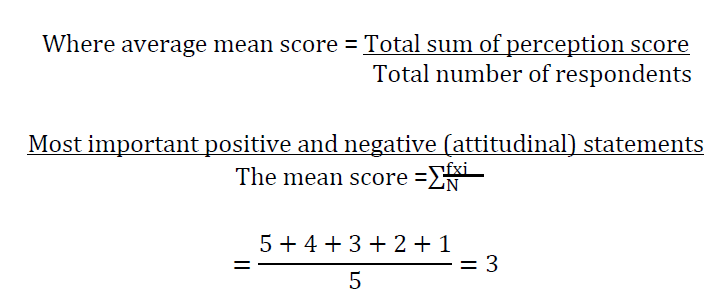
After the data collection process, the researcher reviewed, sorted and labeled the instruments before the commencement of the analysis. This was done using the variables in line with the research instruments. Data were analyzed using descriptive statistics such as frequencies, percentages mean and ranking. Similarly, 5 point Likert scale was also used for data analysis.
Models Specification
Likert Scale: This scale falls under the criterion group instrument whereby items are collected and analyzed against a criterion. Each item has a weight or score attached to it. A person’s score on the final attitude scale is simply the sum of the weight of the alternatives he/she has checked. Weights are usually assigned to that high scores which indicated favorable attitude.
For perception scale under positive statement, scores assigned are:
Strongly Agreed………………………………5
Agreed……………………………………………4
Undecided………………………………………3
Strongly Disagreed …………………………2
Disagreed …………………………………….....1
While for negative statements, the scores assigned are:
Strongly Disagreed…………………………1
Disagreed……………………………………….2
Undecided………………………………………3
Strongly Agreed………………………………4
Agreed………………………………………........5

Then an arbitrary number of 0.5 will be added to 3.0 to obtain3.5 while 0.5 will be subtracted from 3.0 to obtain 2.5 for negative statements. Hence, the important positive statements will be all those from 3.5 and above while the negative statements will be those below 3.5.
Decision Rule
Mean less than 3 were not affected by direct consequence of rural banditry while mean greater than or equal to 3 were affected by direct consequence of rural banditry (Table 2, 3,4).
Table 2: Distribution of Socio-Economic Characteristic of the IFAD-CASP Participating Crop Producers in Zamfara State N = 360
| Variables | Frequency | Percentage |
Sex | ||
| Male | 259 | 71.9 |
| Female | 101 | 28.1 |
Age | ||
| 18-27 | 56 | 15.5 |
| 28-37 | 117 | 32.5 |
| 38-47 | 79 | 21.9 |
| 48-57 | 80 | 22.2 |
| 58< | 28 | 7.9 |
Marital Status | ||
| Single | 49 | 13.6 |
| Married | 280 | 77.8 |
| Divorced | 9 | 2.5 |
| Separated | 5 | 1.4 |
| Widowed | 17 | 4.7 |
Income/Month | ||
| >20,000 | 199 | 55.3 |
| 20,001-50,000 | 132 | 36.7 |
| 50,001-80,000 | 16 | 4.4 |
| 80,001-110,000 | 10 | 2.8 |
| 110,001< | 3 | 0.8 |
Residence | ||
| Rural | 298 | 82.7 |
| Urban | 62 | 17.3 |
Household Size | ||
| 0-5 | 122 | 33.8 |
| 6-10 | 135 | 37.5 |
| 11-15 | 70 | 19.4 |
| 16-20 | 33 | 9.3 |
Table 3: Distribution of the IFAD-CASP Participating Crop Producers According to Direct Consequences of Rural Banditry
| Direct Consequence of Rural banditry | SA | A | U | D | SD | Sum | Mean | Rank | |||||
| Freq | % | Freq | % | Freq | % | Freq | % | Freq | % | ||||
| Death | 138 | 38.3 | 90 | 25.0 | 66 | 18.3 | 36 | 100 | 30 | 8.3 | 1350 | 3.75 | 1st |
| Injury | 102 | 28.3 | 84 | 23.3 | 63 | 17.5 | 60 | 16.7 | 51 | 14.2 | 1206 | 3.35 | 4th |
| Loss of Wealth | 117 | 32.5 | 81 | 22.5 | 72 | 20.0 | 57 | 15.8 | 33 | 9.2 | 1272 | 3.53 | 2nd |
| Abduction | 123 | 34.2 | 69 | 19.2 | 69 | 19.2 | 51 | 14.2 | 48 | 13.3 | 1248 | 3.46 | 3rd |
| Rape | 99 | 27.5 | 81 | 22.5 | 66 | 18.3 | 60 | 16.7 | 54 | 15.0 | 1191 | 3.30 | 5th |
| No consequence | 27 | 7.5 | 33 | 9.2 | 48 | 13.3 | 87 | 24.2 | 165 | 45.8 | 750 | 2.08 | 6th |
*S/A: Strongly Agree Scored 5, *A: Agree Scored 4, * UD: Undecided Scored 3, * D: Disagree Scored 2 and * S/D: Strongly Disagree Scored 1
Source: Field Survey 2020
Table 4: Distribution of the IFAD-CASP Participating Crop Producers According to Indirect Consequences of Rural Banditry
| Indirect Consequences of Rural banditry | Frequency | % | Ranking |
| Behaviour susceptibility | 85 | 23.6 | 1st |
| Psychological Trauma | 79 | 21.9 | 2nd |
| Migration | 70 | 19.4 | 3rd |
| Infrastructure loss | 60 | 16.8 | 5th |
| Destruction of Biosphere | 5 | 1.4 | 6th |
| Destruction of developmental projects | 59 | 16.4 | 4th |
| No consequence | 2 | 0.5 | 7th |
| Total | 360 | 100 |
Source Field Survey 2020
Table 2 shows the Socio-Economic Characteristic of the IFAD-CASP Participating Crop Producers. Socio-economic information of the IFAD-CASP participating crop producers with regards to impact assessment of rural banditry is very important as studies have shown that outstanding factors which include age, gender, marital status, educational level, income, residence and household size are considered as the major socio-economic characteristics in this study area.
The gender of the IFAD-CASP participating crop producers is expected to have effect on the level of involvement in farming activities and also IFAD-CASP, this are accredited to the religious and cultural background of IFAD-CASP participating crop producers in the study area, Majority 71.9% of the participating crop producers of IFAD-CASP were male due to their active involvement in outdoor activities such as farming and animal rearing. While female participates mostly in indoor farming activities such as small animal rearing, processing, threshing and packaging of farm produce this is so because Islam is the predominant religion and has put some restrictions on women to interact freely outside the matrimonial homes and getting responses from such category is sometimes impracticable. These discrepancies are believed to have been influenced by the nature of the study theme- rural banditry which is highly practiced by the male counterparts [6]. Again, some women felt this is not their area of interest because they hardly participate. Even though they are also directly affected by these harmful acts as they are mostly the victims of rape abduction and other forms of sexual abuses [8].
The age of IFAD-CASP participating crop producers has effect on the level of activities. It determines the level of participation in the programme and it is an important measure of farm productivity. The age grouping can be divided into say the active group and dependent age group. Table 2 shows that about 32.5% of the IFAD-CASP participating crop producers were between the age ranges of 28-37years which is the active age range. At this age, the respondents are expected to be virile and able to do a lot of farm work if given proper incentives. According to Baumann et al., [12], majority of the respondents were within their youthful ages of active involvement in rural occupations which are mostly farming and rearing of domestic animals and invariably became more affected by the problem of cattle rustling as they are usually the target.
This agrees with the findings of Ani et al., [13], who posited that youth perform most active farm operation and majority of the youth are between the ages brackets of 18-35years. This was an expected indicator based on the fact that the youths have been highlighted as the main players in the rural banditry activities. This agrees with the findings of Dimelu, [8], who opined that Majority (52.2%) of the farmers were below the mean age indicating that the farmers were still in their active and productive years. Consequently, they may respond violently to conflict issues or become very aggressive to herdsmen due to youthful exuberance. Also, the results show the dominance of male in farming probably because men are more energetic and capable of involving in tedious production activities associated with farming than women.
It is believed that married couples are likely to participate more in IFAD-CASP than single parent families due to labour supply in farming activities and access to productive resources in agriculture [14]. The research findings show that, majority of the IFAD-CASP participating crop producers are married having 77.8%, single having 13.6%, widowed 4.7% and divorced 2.5%. This implies that most of the participating crop producers have some responsibilities; therefore, marital status is an important factor to be considered in any programme of change to be introduced to the study area since family decision will be required in any activity to be embarked upon Adamu and Yau, [15].
Zamfara State Climate Change Adaptation and Agribusiness Support Programme Officer (IFADCASP), said that the Programme was aimed to providing access to improved seeds and technologies that has helped farmers increase production as well as their income. According to the State Programme Officer raising the income of farmers through the provision of improved seeds and farming practices, which the farmers adopt has recorded high yields. “The programme has helped many farmers by increasing their yields and enhancing the farmers' income”. However, this research finding was in disagreement with the above statement due to rising issue of rural banditry and rural banditry in the study area. Majority 53.3% of the IFADCASP participating crop producers in the study area has an income of <N20,000. This implies that participating crop producers suffer more loss such as reduction in output and income from crop as a result of the destruction of crops and indiscriminate bush burning by rural bandits. The findings of Abbas [16], shows that majority of the farmers suffer more losses from farmer-pastoralist conflicts, especially economic losses such as reduction in output 20.0%, loss of properties 28.3% and scarcity of food 23.3% were regarded as severe economic losses experienced by farmers. A larger percentage 46.7% of the farmers indicated loss of properties as a major economic loss encountered as a result of conflict. It is necessary to establish the residence of the participating crop producers, in such a way to find out the location of the participating crop producers either urban or rural dwellers. Majority of IFAD-CASP participating crop producers 83% are rural dwellers in the study area which are more affected by the issue of rural banditry and rural banditry while 17% are urban dwellers.
According to Dimelu [8], in his studies on Livelihood issues in herdsmen-farmers’ conflict among farming communities in Kogi State, find out that 22% of the farming family lives in urban area. This could negatively affect the farmers’ perception of conflict situation and subsequently their behavior and altitude to conflict. This might be one of the reasons why farmer-herders’ conflict has remained unabated and a regular phenomenon in Zamfara state. This is in agreement with finding of this research which revealed 83% of IFAD-CASP participating crop producers are rural dwellers
Relatively the larger the family size of the IFAD-CASP participating crop producers may mean more people to cater for and more labour force will be available to work on the farm and help with other farming activities. The result in Table 1 shows that majority 33.8% IFAD-CASP participating crop producers have a household size of 0-5, followed by 37.5% of the participating crop producers have household sizes of 6-10 people. This implies that most of the IFAD-CASP participating crop producers have a larger household size which may have resulted from the need for family labour which may increase household productivity and larger household size may consequently result to more dependent family members.
The result in Table 2 reveals the direct consequences of rural banditry on IFAD-CASP participating crop producers. The respondents are of the view that rural banditry could lead to death with a mean of 3.75, injury with a mean of 3.35, loss of wealth with a mean 3.53, abduction with a mean of 3.46, rape with a mean of 3.30 and no consequence with of 2.08. The reason for the mean less 3 was that IFAD-CASP participating crop producers are residence in urban center with availability of heavy security operatives [8].
The direct consequences of rural banditry on IFAD-CASP participating crop farmers are the immediate effects on the crop producers resulting from the conflict which hinder with the aims and objectives of the programme. These direct consequences include variables like death, injury, abduction, rape, loss of properties etc. These have direct bearing on the participating crop producer’s livelihoods and economic survival (Table 3).
The result in Table 4 explains that, 23.6% of the respondents which ranked 1st are of the view that rural banditry lead to behavior susceptibility, 21.9% viewed rural banditry lead to psychological trauma ranked 2nd19.4% lamented that rural banditry could lead to migration of crop producers from the original settlements to places which could be an IDP Camp or friends and family houses for safety.16.8% of the respondents were of the opinion that loss of infrastructural facilities is accompanied by an indirect consequences of armed conflict,1.4% says rural banditry lead to destruction of the biosphere while 16.4% agreed that participating crop producers were bedeviled with disruption of developmental programme which could have enhanced a sustainable livelihoods of the crop producers. Only a negligible percentage of 0.5% reveals that rural banditry has no consequence with a rank of 7th. This might be because these categories of respondents were not affected during conflict issues or could be residence in urban area.
The indirect consequence of rural banditry on IFAD-CASP participating crop producers are those aftermath worries or disturbances that surfaces after the direct consequences which might not be seen immediately but later on emerges and as a result pose a lot of threat to the lives and social wellbeing of the participating crop producers and/or the IFAD-CASP programme in general. This indirect consequence includes the following behaviours susceptibility, psychological trauma, social displacement and migration, disruption of biosphere, Infrastructural loss and destruction of developmental programmes and projects. This indirect variable has continued to linger in the social and economic wellbeing of IFAD-CASP participating crop producers and reducing the participating crop producers to beggars and exposing them to much vulnerability which IFAD-CASP intended to tackle.
Based on the summary finding of this study, the research established that majority of IFAD-CASP participating crop producers were male, married with a mean age of 33 years and an average income of less than N 20,000/ month. The factors influencing the participation of IFAD-CASP participating crop producers in the programme appears positive and statistically significant. This implies that a probability increase in the independent variables (conflict, insecurity, fear, location and experience in conflict) would led to decrease in dependent variable (participation). Further established was widespread poverty, proliferation of small arms and weapons competition for gold mines and dispute over farm land account for causes of rural banditry in the study area, resulting to economic, social and physical decline in livelihood of the crop producers. These conflict engagements have drastically affected the activity of IFAD-CASP in carrying out its mandate to the respondents in the study area. In addition, IFAD-CASP participating crop producers were perceived to derive less benefit from the programme.
The research therefore concluded that rural banditry has significantly affected IFAD-CASP participating crop producers in Zamfara State Nigeria.
Recommendations
The following recommendation were deemed necessary with a view to make IFAD-CASP viable instrument for the implementation of Agriculture, rural poverty and development:
The Federal Ministry of Humanitarian Affair, Disaster Management and Social Investment in collaboration with States, Local Government and Non-Government agencies should enroll the vulnerable into its social support investment programmes such N-power, Presidential youth empowerment scheme (P-YES) conditional cash grant, market money and other special intervention scheme
Government should as a matter of urgency provide adequate security to Mann the porous borders of the north-western states. This can be achieved through the Nigeria immigration service and other sister security and intelligence communities.
Federal Government in conjunction with State and Local Government should hence forth register all mining sites and the activities of mining companies be properly monitored by the Nigeria police force, security agencies and the community
Both primary and secondary stakeholders like the community, traditional leaders, politicians, government and NGO should focus on providing information for early warning, organize training, workshop and seminar on peace building process and reconciliations. Promises made during such gathering should respected and redeemed
John, P.O. "Herdsmen/farmers conflict and its effects on socio-economic development in Nigeria." Journal of Peace, Security and Development, vol. 4, no. 1, 2018, pp. 143-158.
Kuna, M.J. and J. Ibrahim, editors. Rural Banditry and Conflicts in Northern Nigeria. Center for Democracy and Development, 2015.
Hazen, M.J. Small Arms, Armed Violence and Insecurity in Nigeria: The Niger Delta Perspective. Small Arms Survey, Occasional Paper No. 20, 2008.
Henderson, E.A. "Culture or contiguity: Ethnic conflict, the similarity of states and the onset of war, 1820-1989." Journal of Conflict Resolution, vol. 41, no. 5, 1997, pp. 649-668.
Given, L.M., editor. The Sage Encyclopedia of Qualitative Research Methods. Sage Publications, 2008.
Gall, M.D. et al. Educational Research: An Introduction. 8th ed., Pearson, 2007.
Folarin, S.F. "Types and causes of conflict." 2015, pp. 1-12, http://eprints.covenantuniversity.edu.ng/3241/1/Folarin%2025.pdf.
Dimelu, M.U. "Livelihood issues in herdsmen-farmers’ conflict among farming communities in Kogi state, Nigeria." African Journal of Agricultural Research, vol. 12, no. 24, 2017, pp. 2105-2115.
Castro, D. Genership: Beyond Leadership Toward Liberating the Creative Soul. 2017, www.amozon.com/genership-beyond-leadership-leberating-creative/dp/19.
Best, S.G., editor. Introduction to Peace and Conflict Studies in West Africa – A Reader. Spectrum Books Ltd., 2005.
Bello, A. "Herdsmen and farmers conflicts in north-eastern Nigeria: Causes, repercussions and resolutions." Academic Journal of Interdisciplinary Studies, vol. 2, no. 5, 2017, p. 129.
Baumann, M. et al. "Land-use change in the Caucasus during and after the Nagorno–Karabakh conflict." Regional Environmental Change, vol. 15, no. 17, 2014, pp. 103-116.
Ani, M.I. et al. "Effects of farmer-grazer conflicts on rural development: A socioeconomic analysis." Journal of Agricultural Science, vol. 4, no. 3, 2015, pp. 113-120.
Barnett, J. and W.N. Adger. "Climate Change, Human Security and Violent Conflict." Political Geography, vol. 26, no. 6, 2007, pp. 639-655.
Adamu, A. and Y.A. Ya'u. "Causes and consequences of herders-farmers conflict and its gender implication in plateau state." International Education & Research Journal [IERJ], vol. 4, no. 10, 2018.
Abbas, I.M. "No retreat no surrender: conflict for survival between fulani pastoralists and farmers in northern Nigeria." European Scientific Journal, vol. 8, no. 1, 2012, pp. 331-346.