In Kerala, libraries are shifting towards automation and IT application. This is more prominent in the case of college libraries. Generally, college libraries are positive towards automation and the application of IT in library operation and services. Application of IT helps to provide more advanced effective and efficient services in college libraries. The novel coronavirus (COVID-19) disease presented unique challenges to all the stakeholders of education system especially colleges. The sudden and unexpected outbreak of the virus forced the library professionals, to ascertain ways of working in a rapid time frame like shifting to digital platform wherever possible and to provide adequate remote services to the users. College libraries are using advanced information technology for accessing and retrieving information widely before the epidemic periods like covid 19.
College libraries are getting bibliographic and full text databases through on- line. The introduction of CD-ROM technology has made immense possibility in the storage, retrieval and dissemination of information in college libraries. The introductions of barcode technology, digital library services, etc are help to improve the college library services. The explosive growth of Internet and wide spread acceptance of networking has made possible to access any type of information anywhere in the world. There are different tools/services/utilities in Internet to get information. E-mail, www, FTP, Telnet, News groups etc are some of them. The introduction of online journals and Library and information networks had revolutionized information handling capabilities of college libraries [1,2].
In this way the resources of college libraries will be used in an effective way. It will also be helpful in resource sharing and network project like INFLIBNET. In this manner, college libraries may be in apposition information support to colleges in future.
Electronic Libraries
The invention of computers, digital telecommunication technology, CD-ROMs, Multimedia, Computer Networks, Internet, have paved the way to the development of Electronic publishing and have changed the traditional libraries to Electronic/Digital libraries. Electronic libraries are global networked virtual Libraries in which all of its holdings are in machine-readable form. To provide instant information service by retrieving the required information from the midst of fast emerging and ever-growing information explosion, it is very essential to digitize the libraries [3,4].
Electronic libraries, which is often called ‘Digital Library’ denotes a library in which all or virtually all of its holdings are in machine readable form. Electronic library is a global virtual library of thousands of networked electronic libraries. They are the dynamic store houses of digitized information [5].
Need for Electronic Libraries
One version of using electronic library technology is to manage large amount of digital content such as thousands of images or hundreds of audio clips. Another need is to perform quick searchers that are difficult manually. The vast amount of information being created and stored each day makes it more difficult to find specific information later.
Documents and other materials housed in collections are deteriorating at rapid rate. While much work is done to conserve and preserve collections in their original form, digitizing their contents enables it to preserve in an additional way. This is difficult with traditional printed materials in many cases due to physical limitations of library facilities and the fragility of the materials in the collection [6,7].
Availability of precise and timely information is important for the benefit and progress of an individual or organization. But information is growing at an exponential rate and the amount of new information is bewildering the users. Obviously the challenge was to make this vast and latest information available to the researchers, academic communities and other kind of users. To achieve this, it is essential to digitize the libraries [8,9].
The components of an electronic library are
Local library systems with adequate PCs having LAN facility
Local databases in machine readable form, CD-ROMs, Multimedia facilities
E-mail service
Access to services and remote databases
Networks including Internet facility
Well trained manpower
Variety of system functions to co-ordinate and manage the entry and retrieve data
Functions of Electronic library
The key functions of electronic library are
To manage large amount of digital/Electronic contents such as thousands of images or hundreds of audio clips
To enable one to perform searches that are not practical manually
To manage contents from multiple locations
To preserve unique collections through digitization
To enable greater access to information
To provide means to enrich the teaching and learning environment
To protect content owners to information
Reduces distribution and storage overhead
Increases user effectiveness and productivity and
Standards are necessary for the exchange/interchange of information
Digital Information Services Provided Through Electronic Libraries
Following are some of the electronic/Digital information services, which can be provided by Electronic libraries:
On-line public Access catalogue (OPAC)
CD-ROM Network Service
On-line Circulation Transaction
E-mail Service
Bulletin-Board Service
CAS (Current Awareness Service)
SDI (Selective Dissemination of Information)
Indexing and abstracting service
Content page service
Intranet and Internet service
Other bibliographical service and demand
Advantage of Electronic Libraries
Electronic libraries have tremendous capacity to store huge data
Save a lot of space in the library
Can be updated every minute
Bibliographic data is fed only once
Afford very large and multi approach searching capabilities
Use of Boolean Operators is possible
Can easily be integrated with document acquisition and circulation systems
Information is always available and not limited by physical location
Electronic document can be shared by many at a time
Quick, accurate and easy to locate information
Provide access to current information
Electronic clipping and reference services can be provided
Very easy to copying and printing materials in library
Issues and Challenges in Developing Electronic Libraries
In the context of digital image, libraries face greater challenges in capturing, storing, formatting, retrieval and reproduction of non-textual information. Because it is a new area of developing source of information and experiences are few. As the arrival of electronic libraries are imminent, libraries are forced to re-educate themselves to meet the new challenge. The principal categories of information sources are text, video and voice. The visual representation of objects, colors and shapes has always been an integral part of human culture. Hence the representation of visual phenomena through photography; motion film and video have become part of our daily lives, for information to be communicated broadly, it needs to be stored outside the human memory.
Users Preference of Online Resources
In the present scenario, though print resources are still vital to our collection and community of users, many students prefer resources in an electronic format for certain activities such as searching within the text and quick reference information. Above all, students like e-resources due to the convenience of being able to use the resource where and when needed. Libraries need to embrace e-resources to keep up with changing needs of our users. With many high-use materials such as books in a reserve collection, we see that print and electronic books are being well used by our students and that sometimes both print and electronic versions of a book are needed [10,11].
Libraries need to embrace e-resources to keep up with changing needs of our users, but academic libraries also needed to develops flexible collection management strategies meeting their user’s needs. In general, researchers are very happy with online e-resources, considering the fact that online books overcome problems peculiar to print collections. Moreover, searching in e-resources can be far more comprehensive and extends to full text, unlike searching in an OPAC where only titles are searchable [12].
Features of Electronic Library
Development in Telecommunication Technology: The transmission of data from one point and reception at a remote point, using wire, fiber optics, radio waves, microwaves or another medium of transmission. In association with computing, it forms the defining technology of the information age. Although traditionally associated with the transmission of voice data, telecommunication systems are now universally used for transmitting digitized data of all kinds [13].
Electronic Data Interchange (EDI)
EDI is the method for conducting business transactions across networks, with the exchange of invoices, orders and other documentation carried out in a standardized manner between the computers of trading companies. A major objective is, by standardizing and simplifying, to shorten the time between ordering and delivery. There are thousands of companies using EDI throughout the world. The European Union supported its expansion in the mid-1990s through a number of cross border pilot projects, designed to show that it can benefit both small and large business. EDI is a critical tool for E-COMMERCE, not least in the book trade and hence in the process of library supply [14].
FAX (Facsimile Transmission)
Fax stands for “facsimile” which means “a copy” more especially it stands for “facsimile” transmission. It was invented Alexander Baln in the year 1842. A fax machine scans an image and sends a copy of it in the form of electronic signals over transmission lines to a receiving fax machine. The receiving machine re-creates the image on paper [15].
A facsimile machine is a telephone copy machine. When we insert the original document into the machine the copy comes out another facsimile machines elsewhere in the world at the cost of a phone call.
The two types of machines are:
Dedicated fax
Fax modems
Video Text
It is the generic name for the group of electronic communication system, which makes use of television screens to display computer-based information. It transmits text or graphics stored in computer database via the telephone network for display on a television screen. They make the database stored on powerful computer system assessable through the television set and a telephone.
In order to function, videotext system needs a telephone line, to which a television is connected via electronic interface.
Information is displayed as frames and each frame is identified by a unique code. Frames can be traced via their unique code or by searching, using menus or key words, depending on the system [16].
Tele Text
Tele text is a text based information system in which the information is transmitted by the television authorities using spare lines in the television signal. The broadcast signal is received and decoded by a suitable adapted television set. The information in Tele text system is structured as a series of pages on the broadcasting organization computer. These pages are broadcast on the spare lines in the TV signal as a continuous loop of pages. The signals can be received by anyone with a television set which has been fitted with the appropriate Tele text adapter [17].
Video Conferencing
Video conferencing is the use of television as, video and sound technology as well as computer technology to enable people in different locations to see, hear and talk with one another. Video conferencing can still consist of people meeting in separate conference rooms (or) booths with specially equipped television cameras. However, modern vide conferencing equipment, such as Intel’s pro share hardware and software, can be set upon people’s desks, with a camera and microphone to capture the person speaking and a monitor and speakers for the person being spoken to it. It requires modems, sound and video capture cards [18].
A relatively new development is an initiative to deliver video mail, video message that are sent, stored and retrieved like e-mail. One version would use the pro share windows based video conferencing product and oracle’s media server, a computer storage system developed for movies on demand technologies [19].
Hypertext
A text document that contains linked to other documents and thus can be read in a non-linear fashion. Ted Neloon coined the term HYPERTEXT in 1965. A traditional text in the form of a book is typically defined as sequential or liner because there is an order in which the text must be read page two follows page one and so on. There are many advantages to this method of presenting information. It provides a logical sense of order. It can however, be an in efficient way to access large bodies of information [20].
A variety of mechanism can speak a user’s search for information within documents. For example, a book such as this one uses an index, table of contents and section headings to speed access to various bits of information. The index provides a mapping from an idea to a particular page in the document containing these related pieces of information. Non-sequential ways to access information such as footnotes, references and indexes are useful way to deal with navigating and organizing large bodies of related information. With the amount of information available for consumption, exploring an alternative to sequential access seems appropriate. This is where the idea of hypertext comes in. A hypertext document is an electronic document that contains link to related pieces of information. It could be characterized as providing generalized footnotes. It is a non-liner way to have an access to information.
Hypermedia
A generic term now widely used for multimedia applications of the HYPERTEXT principle. This permits the user to follow associative links between units of information by clinking on a HOT SPOT with a mouse. Web-delivered documents are the most familiar form of hypermedia.
Network
A network is a system of interconnected computers, telephones or other communication devices that can communicate with each other and share application and data. It provides tremendous benefits.
Simultaneous access to critical programs & data
Sharing of peripheral devices, such as a printer & scanner
Streamlined personal communications
Easier backup of data
Computer linked by a Telecommunications System Networks offers two resources. First, they offer access to the people who use computer on the network, by means of ELECTRONIC MAIL, conferencing or chat facilities. Second, networks permit the use of files (text, graphics, sound and video) software, databases and peripherals (like printer or fax machines) stored on, or attached to, computers on the network.
Electronic Information Environments
An electronic environment allows changes and updating of original information, provides different views/reading of the same document, integrates multimedia sources of information, permits interchange of data and offers software support online. All these facilities while being useful for some types of publication are not appropriate for every kind of book; different kinds of reading requirement make electronic translation more or less useful for the reader.
Electronic Information Resources
Any information resource that is accessible through computers or network can be termed as electronic resources. It is also available through the Internet or through online databases. Electronic Information Resources (EIRs) originally published information in electronic form or in print form made available electronically.
Electronic media has proved its advantages over the print media. Any information resource that is accessible through computer or network can be termed as electronic resources like e-journals, e-books and e-data bases have increased considerably. Computer storage devices such as optical disk, CD ROM/DVD-ROM Databases accessible through Internet and other networks can be used or stored for further use.
Analysis and Interpretations of Data
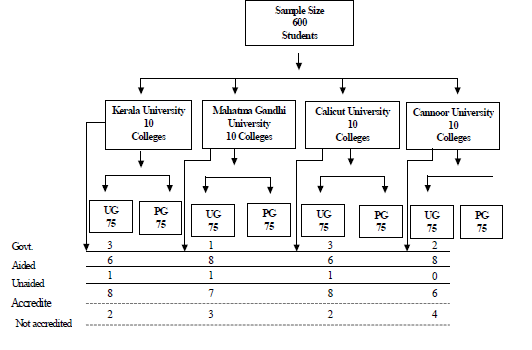
The purpose of the study was to identify the use pattern of electronic information resources in the college libraries in Kerala before the epidemic period; an analytical study. The investigator attempted to discover whether the undergraduate and postgraduate students of the arts and science colleges using the modern Information Technology which is the electronic information resources (Figure 1).
Sample Population
Table 1 shows that out of 800 questionnaires distributed and 678 questionnaires were returned but 78 were found to be invalid; they were incomplete and thus rejected from the ultimate sample. A completely filled 600 questionnaires were formed the sample for the study.
Table 1: Sample Population
| Category | Respondent | Questionnaire Distributed | Questionnaire Returned | Response rate |
Students | 600 | 800 | 678 | 84.75 |

Figure 1: Categorized Distribution of Sample Size
The investigator designed a questionnaire to obtain data necessary to examine the use of electronic information resources in the college library in Kerala. Analysis of data involves a number of closely related operations which are performed with the purpose of summarizing and organizing the collected data to find out answer to the computation of certain measure along with searching for pattern of relationship that exists among groups.
The investigator designed a questionnaire to obtain a data necessary to examine the research problem. The instrument was administered directly by the investigator to 800 students of the various colleges under the four universities in Kerala. The investigator given preference to the NAAC accredited arts and science colleges because those colleges have more facilities than that of the non-accredited colleges. This data has been analyzed, summarized and presented in tables using totals and percentages. SPSS was used for producing descriptive statistics.
This chapter presents the analysis of data providing a descriptive examination of general characteristics of respondents, their use pattern of electronic information available in their college library and the detailed analysis of their responses on electronic information resources, services tools, techniques and their facilities.
General Characteristics of the Population
The general characteristics of respondents include Gender, under graduate or Post graduate, Name and address of the college, Type of Management (Government or Private), Location, Financial Nature (Government, Aided, Unaided) NAAC accreditation are selected.
Gender
The gender wise distribution of respondents selected for the study is given in the Table 2. For getting suitable results the final year UG and PG students are taken because the first years does not have sufficient skills for using the electronic information resources.
The result shows that the sample of 306(51%) male and 294(49%) female students responded about the questionnaire issued to them. Since the majority of the students were male, slight male dominancy can be seen in the sample.
Table 2: Gender Wise Distribution of Students
| Gender | Number | Percent |
| Male | 306 | 51.0 |
| Female | 294 | 49.0 |
| Total | 600 | 100.0 |
Course
The course means which course the students undergoing whether it is graduate or post graduate class. The Table 3 describes the result of the analysis based upon the course of study.
The Table 3 shows that an average of 354 (59 Percent) undergraduate and 246(41 Percent) postgraduate responded about the questionnaires that distributed. Among the respondent’s undergraduates are more than the PG students.
Table 3: Course Wise Distribution of the Students
| Course | Number | Percent |
| Undergraduate | 354 | 59.0 |
| Postgraduate | 246 | 41.0 |
| Total | 600 | 100.0 |
Information about the College Library
The Table 4 shows that 120(20 Percent) under graduate students participated this survey are from government college and 234 (39 Percent) undergraduate students are from private colleges. Whereas 156 (26 Percent) Post graduate students come from government colleges and 90(15 Percent) PG students are from private colleges. The table shows majority of the students participated this survey is from private college that is 324 (54 Percent).
Table 4: Type of Management of the College (Course Wise)
| Course being undertaken | Type of management | Total | ||
| Government | Private | |||
| Undergraduate | Count | 120 | 234 | 354 |
% within Course | 20 | 39 | 59 | |
| Postgraduate | Count | 156 | 90 | 246 |
% within Course | 26 | 15 | 41 | |
| Total | Count | 276 | 324 | 600 |
% within Course | 46 | 54 | 100 | |
Availability of Electronic Information Resources
Availability of Internet Facility in the College Library (Gender Wise): Internet through the world wide web technology entertains the user communities to retrieve hyper media information and leaves a wide scope of information from a large universe of documents. An internet connection is need for the college library for getting new knowledge to the students in the modern IT era especially in the epidemic periods.
As per the Table 5, shows that 120(20 Percent) male and 84(14 Percent) females opine that they have internet facility in their college library. Whereas 186(31 Percent) male and 210(35 Percent) females’ students opine that they have no internet facility. This shows that most of the colleges have no internet facilities.
Table 5: Availability of Internet Facility in The College Library (Gender Wise)
| Availability of Internet facility in the library | Gender | Total | |
| Male | Female | ||
| Available | 120 | 84 | 204 |
| 20% | 14% | 34% | |
| Not available | 186 | 210 | 396 |
| 31% | 35% | 66% | |
| Total | 306 | 294 | 600 |
| 51.00% | 49.00% | 100.00% | |
As per Table 6, 96 (16 Percent) undergraduate students commend that their college have internet facility and 108(18 Percent) PG students have the same opinion. Whereas 258(43 Percent) undergraduates and 138(23 Percent) postgraduates opines that they have no internet facility.
Table 6: Availability of Internet Facility in The College Library (Course Wise)
| Availability of Internet facility in the library | Course | Total | |
| Undergraduate | Postgraduate | ||
| Available | 96 | 108 | 204 |
| 16% | 18% | 34% | |
| Not available | 258 | 138 | 396 |
| 43% | 23% | 66% | |
| Total | 354 | 246 | 600 |
| 59.00% | 41.00% | 100% | |
Visiting of the Internet Café in The Absence of Internet Facility in The College
The 396 students said that their college has no internet facility, so whether they are visiting the internet café for browsing the internet. To this opinion is analyzed in the Table 7.
Table 7: Visit of Internet Cafe in The Absence of Internet Facility in The College Library
| Opinion | Gender | Total | |
| Male | Female | ||
| Yes | 202 | 176 | 378 |
| 51.5% | 44% | 95.5% | |
| No | 12 | 6 | 18 |
| 3% | 1.5% | 4.5% | |
| Total | 214 | 182 | 396 |
| 54.5% | 45.5% | 100% | |
Table 7shows that 202 (51.5 Percent) male students and 176(44 Percent) females that is the grand total of 378 (95.5 Percent) students are visiting the internet café, were as 12(3 Percent) male students and 6(1.5 Percent) females grand total of 18 (4.5 Percent) students are not visiting the internet café. As per the table no: 1.21 204(34 Percent) students using internet and their college have internet facility and as per this table 378 (95.5 Percent) are visiting internet café, that is the grand total of 204+378=582(97 Percent) students are using the internet. Only 18 (3 Percent) students are not visiting the internet because the absence of experience and chance. Majority of the students are using internet for acquiring knowledge in the changing environment especially in the epidemic periods.
Purpose of Using Internet
For measuring the use of electronic information the respondent are asked to mark the priority of the use of Internet, Whether it is for Academic purpose, searching jobs, chatting, accessing online journals. The table below shows the details.
As per the table no 8 an average 366(61%) students given first priority for using the internet for academic purpose and 198 (33%) for searching jobs, 18(3%) students for chatting and 18(3%) for accessing online journals. Most of them given the first priority for using the internet for academic purpose because they can acquire current knowledge, information about seminars, examinations, articles can be get or easily accessible from the internet.
Table 8: Purpose of Using Internet
| Purpose | Number | Percent |
| Academic Purpose | 366 | 61.0 |
| Searching Job | 198 | 33.0 |
| Chatting | 18 | 3.0 |
| Accessing online-journals | 18 | 3.0 |
| Total | 600 | 100.0 |
The Table 9 shows that 168(28 Percent) male students given first priority for Academic purpose, 138 (23 Percent) searching jobs, as the same time 198(33 Percent) females gives importance to academic purpose and 60(10 Percent) gives priority searching jobs, 18(3 Percent) for chatting and 18(3 Percent) gives importance for accessing the online journals. For both male and females’ students are using the internet more for the academic purpose and searching the job and only female students using internet for chatting as well as accessing the online-journals.
Table 9: Purpose of Using the Internet (Gender-Wise)
| Purpose | Gender | Total | |
| Male | Female | ||
| Academic Purpose | 168 | 198 | 366 |
| 28% | 33% | 61.00% | |
| Searching Job | 138 | 60 | 198 |
| 23% | 10% | 33.00% | |
| Chatting | 0 | 18 | 18 |
| 0 | 3% | 3% | |
| Accessing online-journals | 0 | 18 | 18 |
| 0 | 3% | 3.00% | |
| Total | 306 | 294 | 600 |
| 51% | 49% | 100.00 | |
The Table 10 shows 192(32 Percent) undergraduates gives importance of using internet for academic purpose, 144(24 Percent) for searching jobs, 18(3 Percent) for chatting whereas 174(29 Percent) post graduates used internet for academic purpose 54(9 Percent) for searching jobs 18(3 Percent) for accessing online journals.
Table 10: Purpose of Using the Internet (Course-Wise)
| Purpose | Course | Total | |
| Undergraduate | Postgraduate | ||
| Academic Purpose | 192 | 174 | 366 |
| 32% | 29% | 61% | |
| Searching Job | 144 | 54 | 198 |
| 24% | 9% | 33% | |
| Chatting | 18 | 0 | 18 |
| 3% | 0.00 | 0.03% | |
| Accessing online-journals | 0 | 18 | 18 |
| 0 | 3 | 3.00 | |
| Total | 354 | 246 | 600 |
| 59% | 41% | 100% | |
Rating of the Information Retrieved from the Internet
Internet is the prime source for accessing the electronic information scatter throughout the world. There is a question asked to the respondent whether the information accessed through the internet is accessible, accurate, authoritative and ease of use (Table 11).
The Table 11 describe 34(5.6 Percent) undergraduate students said the information accessed through internet is excellent and 242(40.3) said it is good and 78 (13 Percent) commends it is poor. According to the post graduates 55(9 Percent) said it is excellent and 164(27.3 Percent) said it is good and 27(4.5 Percent) said it is poor. Majority of the student opinion that the information accessed through internet is good for their academic purpose that is 406(67.67 Percent).
Table 11: Accessibility of Internet Information (Course Wise)
| Course | Excellent | Good | Poor | Total |
| Undergraduates | 34 | 242 | 78 | 354 |
| 5.6% | 40.3% | 13% | 59% | |
| Postgraduates | 55 | 164 | 27 | 246 |
| 9% | 27.3% | 4.5% | 41% | |
| Total | 89 | 406 | 105 | 600 |
| 14.83% | 67.67% | 17.50% | 100% |
The question asked to the respondent whether information accessed through internet is accurate. A sum total of 12(2 Percent) undergraduates said that the information accessed is excellent whereas 252(42 Percent) student said it is good and 90(15 Percent) said it is poor. For evaluating the same case about the post graduates a sum total of 216 (36 Percent) said it is good. Most of them opine that the information accessed through internet is good and they are getting the required information from the internet (Table 12).
Table 12: Accuracy of Internet Information (Course Wise)
| Course | Excellent | Good | Poor | Total |
| Undergraduates | 12 | 252 | 90 | 354 |
| 2% | 42% | 15% | 59% | |
| Postgraduates | 0 | 216 | 30 | 246 |
| 0.00 | 36% | 5% | 41% | |
| Total | 12 | 468 | 120 | 600 |
| 2.00% | 78.00% | 20.00% | 100 |
As per the Table 13 shows undergraduates 12(2 Percent) said the information accessed through internet is excellent and 282(47 Percent) said it is good and 60(10 Percent) said it is poor. Considering the same opinion 30(5 Percent) PG students said the information accessed through internet is excellent and 126(21 Percent) said it is good and 90 (15 Percent) said it is poor. A majority 68 Percent students said that the information accessed through internet is authoritative and reliable in nature and it is helpful for their academic and research work.
Table 13: Authoritative Nature of Internet Information (Course Wise)
| Course | Excellent | Good | Poor | Total |
| Undergraduates | 12 | 282 | 60 | 354 |
| 2% | 47% | 10% | 59% | |
| Postgraduates | 30 | 126 | 90 | 246 |
| 5% | 21% | 15% | 41% | |
| Total | 42 | 408 | 150 | 600 |
| 7.00% | 68.00% | 25.00% | 100 |
Table 14 describes that are 18 (3 Percent) under graduates said they are getting consistent information from the internet and it is excellent in performance and 288(48 Percent) students said it is good and 48(8 Percent) said it is poor. Most of the students 486(81 Percent) opine that the information accessed is good. Only a negligible 90 (15.00 Percent) students said it is poor.
Table 14: Consistency of Internet Information (Course Wise)
| Course | Excellent | Good | Poor | Total |
| Undergraduates | 18 | 288 | 48 | 354 |
| 3% | 48% | 8% | 59% | |
| Postgraduates | 6 | 198 | 42 | 246 |
| 1% | 33% | 7% | 41% | |
| Total | 24 | 486 | 90 | 600 |
| 4.00% | 81.00% | 15.00% | 100 |
The Table 15 shows 54 (9 Percent) undergraduate said that they have no problem while accessing the internet, they commend that their use of internet is excellent, whereas 168(28 Percent) said that their use of internet is good, but 132 (22 Percent) said it is poor. For considering the opinion of postgraduates, they commend 192 (32 Percent) said that their use of internet and its result is good, but 48 (8 Percent) said that the internet information accessed is poor. Majority opines, the information accessed through internet is easily accessible and useful and its search with search engines is easy for finding or locating the required knowledge that is not getting elsewhere.
Table 15: Ease of Use of Internet Information (Course Wise)
| Course | Excellent | Good | Poor | Total |
| Undergraduates | 54 | 168 | 132 | 354 |
| 9% | 28% | 22% | 59% | |
| Postgraduates | 6 | 192 | 48 | 246 |
| 1% | 32% | 8% | 41% | |
| Total | 60 | 360 | 180 | 600 |
| 9.16% | 60% | 30% | 100% |
Difficulty Faced While Accessing the Internet
The respondents are asked whether they have any difficulties faced while accessing the internet that is for obtaining connection, opening WebPages, browsing, downloading, outdated or backup information etc.
As per the Table 16 states that the 72(12 Percent) undergraduates said that they have no difficulty in obtaining internet connection but 270(45 Percent) said some difficulties faced 12(2 Percent) said that they have serious difficulties faced while accessing the internet connection. For considering the case of the post graduates 60(10 Percent) have no difficulties obtained while accessing the internet here as 168(28 Percent) have some difficulties and 18(3 Percent) have faced high difficulties while facing the internet. A majority 73 percent students said that they are facing some difficulties while accessing the internet in the Epidemic periods.
Table 16: Difficulty faced While Accessing the Internet (Course Wise)
| Course | Difficulty in obtaining Internet connection | Total | ||
| No | A Little | High | ||
| Undergraduates | 72 | 270 | 12 | 354 |
| 12% | 45% | 2% | 59% | |
| Postgraduate | 60 | 168 | 18 | 246 |
| 10% | 28% | 3% | 41% | |
| Total | 132 | 438 | 30 | 600 |
| 22% | 73% | 5% | 100 | |
Ali, N.P.M. “The use of electronic service at IIT library Delhi: A study of users’ opinion.” IASLIC Bulletin, vol. 48, no. 2, 2003, pp. 71–82.
Kaur, Amritpal. “Electronic journals and scholarly communication.” Journal of Academic Studies, vol. 13, no. 4, 2007, pp. 227–239.
Amudhavalli, A. “Impact of electronic publishing on collection development.” DESIDOC Bulletin of Information Technology, vol. 17, no. 1, 1997, p. 79.
Annon. “Science direct: Provider and mediator.” International Journal of Electronic Library Research, vol. 1, no. 2, 1997, pp. 163–164.
Anuradha, P. “Impact of digital libraries on information transfer.” Libraries and Information Services in the Electronic Information Era, edited by J.L. Sardana, Indian Library Association, 1994, pp. 163–167.
Bavakutty, M. Research on Library Computerization. Ess Ess Publication, 2006, pp. 305–309.
Berilacqua, Fabrizia. “Organizing e-journals from the point of view of humanities: A case study at the university of Parma.” New Library World, vol. 106, no. 9–10, 2005, pp. 416–429.
Bernet, S. “Copyright and innovation in electronic publishing: A commentary.” Journal of Academic Librarianship, vol. 19, no. 2, 1993, pp. 87–91.
Bhartia, Chandra Shekhar. “Wireless LANs cost benefit analysis.” Information Technology, vol. 10, no. 2, 2001, pp. 80–85.
Braid, Andrew. “Electronic document delivery: Vision and reality.” Libri, vol. 44, no. 3, 1994, pp. 224–236.
Caraven and Jenny. “Access to electronic resources by visually impaired people.” Information Research, 2003, pp. 23–28.
Demilew, Petros. “The potential of electronic document delivery services for academic libraries in Ethiopia.” Bulletin of the American Society for Information Science and Technology, vol. 8, no. 2, 2001, pp. 14–19.
Deveraj and Pravin Kumar Singh. “Digital libraries on the internet.” Indian Journal of Information Library and Society, vol. 15, no. 4, 2002, pp. 113–121.
Deverajan, G. “Digital libraries in the third World countries: Some observations with special reference to India.” Libraries and Information Services in the Electronic Information Era, edited by J.L. Sardana, Indian Library Association, 1994, pp. 145–156.
Echeverria, Mercedes and Pilar Barredo. “Online journals: Their impact on document delivery.” Interlending and Document Supply, vol. 33, no. 3, 2005, pp. 145–149.
Elliot, Julia. Oxford Dictionary & Thesaurus III. Oxford University Press, 2001, p. 544.
Encyclopedia of Library and Information Science. Marcel Dekker, 1997, p. 236.
Equbal, Manawwer and M.M. Soomaraza. “Management of E-journals in digital environment.” Library Herald, vol. 41, no. 4, 2003, pp. 168–174.
Franklin, G. and David Jebraj. “E-publishing.” Indian Journal of Information, Library and Society, vol. 14, no. 3–4, 2001, pp. 109–112.
Garfield, E. Citation Indexing: Its Theory and Application in Science, Technology and Humanities. Wiley, 1979.