Combined use of Propranolol and Diltiazem in termination of Adenosine non responsive Paroxysomal supraventricular tachycardia in a neonate in a resource limited setting
Saugat Ghosh
1
,
Sushil Srivastava
1
1
University College of Medical Sciences, GTB Hospital, New Delhi, India
Paroxysmal Supraventricular Tachycardia (PSVT) is the second most common arrhythmia in children and frequently presents during infancy, with a significant proportion occurring in the neonatal period. Prompt recognition and management are essential to prevent hemodynamic compromise. Adenosine is the first-line therapy for acute termination; however, treatment options become limited in adenosine-refractory cases, particularly in resource-limited settings where neonatal defibrillators for DC cardioversion may not be available. We report the case of a 20-day-old, 3-kg female neonate who presented with excessive crying and poor feeding for one day. Clinical examination revealed a heart rate of 290 beats per minute with preserved perfusion and stable vital signs. Electrocardiography showed narrow-complex tachycardia with absent P waves, consistent with PSVT. Vagal maneuvers and two doses of intravenous adenosine (0.1 mg/kg) failed to terminate the arrhythmia. Subsequent administration of intravenous amiodarone was also ineffective. In the absence of a neonatal defibrillator, intravenous diltiazem was initiated, followed by infusion, but tachycardia persisted. Oral propranolol (1 mg/kg stat) was then administered concurrently, resulting in successful termination of PSVT within 30–45 minutes. Post-conversion ECG was normal and the neonate remained stable, tolerated oral feeds and was transferred to the ward with her mother.
Keywords
Paroxysmal Supraventricular Tachycardia (PSVT)
Propranolol
Diltiazem
Oral Propranolol
INTRODUCTION
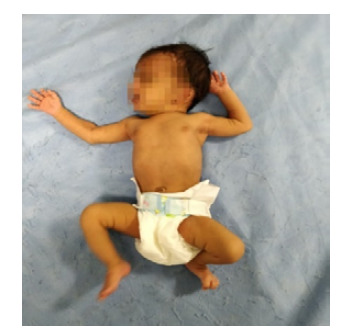
Paroxysmal supraventricular tachycardia (PSVT) is the second most common cause of arrhythmia in children after sinus tachycardia. In 40% of cases, PSVT arises in the first year of life [1]. Its incidence in the neonatal period has not been estimated adequately (approximately 1 out of 15,000-25,000 live births) [2]. A predisposing condition (congenital heart disease, medications, concomitant infection) is found in 15% of cases [3]. It is diagnosed by ECG when there is a sustained increased heart rate of more than 220 beats per minute with a QRS duration of <0.08 seconds. Adenosine is the drug of choice for terminating supraventricular tachycardia, if ineffective, DC cardioversion is the treatment modality of choice [4] but in most neonatal care setups in India, neonatal defibrillator is not available. So other treatment modalities like Propranolol, Amiodarone, Diltiazem can be used for terminating PSVT. We had treated an adenosine refractory PSVT with both Diltiazem and oral Propranolol (Figure 1).
Figure 1: Clinical Photograph of an Infant in the Supine Position Demonstrating Generalized Hypotonia and Abnormal Limb Posture
Case Report
A 20 days old 3kg female neonate presented in emergency with complaints of excessive crying since 1 day along with decrease acceptance of feed. There was no history of fever, no history of seizure, no history of fast breathing. She was on breastfeed and her birth history was uneventful. On examination she had heart rate of 290/minute, not tachypnoeic, afebrile, CRT<3 secs, peripheral pulses were well palpable and SPO2 was 100%. CVS examination revealed no murmer and CNS examination, par abdomen examination, chest examination was within normal limit. ECG done which revealed heart rate of 290 beats per minute, QRS duration <0.09 secs and absent p wave. She was diagnosed having PSVT and tried vagal manoeuvres but had no relief. Followed by that she was given i.v adenosine @0.1mg/kg twice but no symptomatic relief. No pediatric defibrillator for cardioversion was available which can provide a current of 3 to 6 joule. Then i.v Amiodarone @5mg/kg was given but tachycardia persisted. Then started on i.v diltiazem 1st dose @0.25mg/kg, as there were no symptomatic relief 2nd dose @0.35mg/kg was given and then started on diltiazem infusion @2mcg/kg/min but no symptomatic relief was seen, so along with that oral Propranolol @1mg/kg stat was given. Within 30-45 minutes his tachycardia got terminated. ECG done after the episode which was within normal limit. Patient was started on oral feed after 6 hours and she was accepting well, so shifted alongside mother to the ward.
Figure 2: ECG with PSVT
Figure 3: ECG After Termination of PSVT
DISCUSSION
The treatment of choice for symptomatic patients with a stable blood pressure is IV administration of adenosine [5]. Given its short half-life, it must be administered in a fast bolus (intravenous or intraosseous) followed by saline wash-out (2-2.5 mL). The initial recommended dose is 0.1 mg/kg; if ineffective it can subsequently be increased to 0.2 mg/kg and up to a maximum of 0.5 mg/kg [6]. Adenosine impairs conduction through the AV node and is thus effective in terminating tachycardia involving the AV node [7]. If the infant is in severe CHF or if tachycardia is refractory to adenosine, emergency treatment is directed at immediate cardioversion. The initial dose of 0.5 joule/kg is increased in steps up to 2 joules/kg [4] but due to nonavailability of neonatal defibrillator we had tried other measures to treat the tachycardia of the neonate. We had tried with Amiodarone, a class III antiarrhythmic drug which has an electrophysiological effect to increase the duration of action potential and the refractoriness of all cardiac cells [8]. Amiodarone is considered to be an agent that should be reserved for use in situations when the tachycardia is refractory to adenosine [9]. Then we had tried with Dilltiazem, a calcium channel blocker which has a significant electrophysiologic effect of depressing atrioventricular nodal function [10-13]. Verapamil can also be used to terminate supraventricular tachycardias, particularly those involving the AV node[14]. Intravenous verapamil is commonly used to terminate PSVT in adults, but are used with greater caution in the paediatric patient. It has caused cardiovascular collapse, profound bradycardia and death in infants [15] so verapamil could not be used. As diltiazem was ineffective, so along with that propranolol oral was given. The gastrointestinal absorption of propranolol has been shown to be nearly complete, but the high first-pass hepatic extraction, particularly following a single dose, has made it necessary to administer a large dose of the drug to achieve a therapeutic plasma level [16]. Since the serum concentration of both diltiazem and propranolol was achieved within 30min, our study could not conclude whether diltiazem alone or propranolol alone would be effective in terminating acute episodes of PSVT.
REFERENCES
Paul, T. et al. “Supraventricular tachycardia in infants, children and adolescents: Diagnosis and pharmacological and interventional therapy.” Pediatric Drugs, vol. 2, no. 3, 2000, pp. 171–181.
Ko, J.K. et al. “Supraventricular tachycardia mechanism and their age distribution in pediatric patients.” American Journal of Cardiology, vol. 69, 1992, pp. 1028–1032.
Kantoch, M.J. “Supraventricular tachycardia in children.” Indian Journal of Pediatrics, vol. 72, no. 7, 2005, pp. 609–619.
Kleinman, M.E. et al. Pediatric Advanced Life Support: 2010 American Heart Association Guidelines for Cardiopulmonary Resuscitation and Emergency Cardiovascular Care. American Heart Association, 2010.
Ralston, M.A. et al. “Use of adenosine for diagnosis and treatment of tachyarrhythmias in pediatric patients.” Journal of Pediatrics, vol. 124, no. 1, January 1994, pp. 139–143.
Paul, T. and J.P. Pfammatter. “Adenosine: An effective and safe antiarrhythmic drug in pediatrics.” Pediatric Cardiology, vol. 18, 1997, pp. 118–126.
Green, A.P. and K.H. Giattina. “Adenosine administration for neonatal SVT.” Neonatal Network, vol. 12, no. 5, 1993, pp. 15–18.
Weindling, S.N. et al. “Efficacy and risks of medical therapy for supraventricular tachycardia in neonates and infants.” American Heart Journal, vol. 131, 1996, pp. 66–72.
Pfammatter, J.P. and U. Bauersfeld. “Safety issues in the treatment of paediatric supraventricular tachycardias.” Drug Safety, vol. 18, no. 5, 1998, pp. 345–356.
Wakasa, Y. et al. “Beneficial effects of diltiazem on reentrant tachycardia involving A–V conduction.” Proceedings of the World Symposium on Cardiac Pacing, Montreal, 1979.
Rozanski, J.J. et al. “Electrophysiologic effects of diltiazem hydrochloride on supraventricular tachycardia.” American Journal of Cardiology, vol. 49, 1982, pp. 62.
Betriu, A. et al. “Beneficial effect of intravenous diltiazem in the acute management of paroxysmal supraventricular tachyarrhythmias.” Circulation, vol. 67, 1983, pp. 88.
Rowland, E. et al. “The comparative effects of diltiazem and verapamil on atrioventricular conduction and atrioventricular reentry tachycardia.” Circulation Research, vol. 52, suppl. 1, 1983, pp. 1–163.
Porter, C.J. et al. “Effects of verapamil on supraventricular tachycardia.” American Journal of Cardiology, vol. 48, 1981, pp. 487.
Radford et al. “Side effects of verapamil in infants.” Archives of Disease in Childhood, vol. 58, no. 6, June 1983, pp. 465–466.
Nies, A.S. and D.G.Shand. “Clinical pharmacology of propranolol.” Circulation, vol. 52, 1975, pp. 6.
Recommended Articles
Research Article
Oral Manifestations of Myasthenia Gravis, Rheumatoid Arthritis, Pernicious Anemia, Graft Vs Host Disease, Linear IgA Disease and Chronic Bullous Disease of Childhood
Download PDF
Research Article
Tlics Score & Denis Scale and Their Association with Various Variables among Patients Undergoing Operative Treatment for the Thoraco-Lumbar Fracture at Tertiary Care Hospital
Bahrat Bhushan,
...
Vineet Aggarwal
Published: 10/04/2022
Download PDF
Research Article
Socio-Demographic Characteristics, Classification, Management, Complication and Implant Status of Patients Undergoing Operative Treatment for the Thoraco-Lumbar Fracture at Tertiary Care Hospital.
Bahrat Bhushan,
...
Vineet Aggarwal
Published: 10/04/2022
Download PDF
Mini Review Article
The Significant and Profound Impacts of the Studies on the Rate of Diffusion-Controlled Reactions of Enzyme
Kuo- Chen Chou
Published: 10/10/2020
Download PDF
PO Box 101, Nakuru
Kenya.
Email: office@iarconsortium.org
Editorial Office:
J.L Bhavan, Near Radison Blu Hotel,
Jalukbari, Guwahati-India
Ghosh, S. & Srivastava, S. (2020). Combined use of Propranolol and Diltiazem in termination of Adenosine non responsive Paroxysomal supraventricular tachycardia in a neonate in a resource limited setting. IAR-Medical Series, 1(1), 1-3.
MLA
Ghosh, Saugat and Sushil Srivastava. "Combined use of Propranolol and Diltiazem in termination of Adenosine non responsive Paroxysomal supraventricular tachycardia in a neonate in a resource limited setting." IAR-Medical Series 1.1 (2020): 1-3.
Chicago
Ghosh, Saugat and Sushil Srivastava. "Combined use of Propranolol and Diltiazem in termination of Adenosine non responsive Paroxysomal supraventricular tachycardia in a neonate in a resource limited setting." IAR-Medical Series 1, no. 1 (2020): 1-3.
Harvard
Ghosh, S. and Srivastava, S. (2020) 'Combined use of Propranolol and Diltiazem in termination of Adenosine non responsive Paroxysomal supraventricular tachycardia in a neonate in a resource limited setting' IAR-Medical Series 1(1), pp. 1-3.
Vancouver
Ghosh S, Srivastava S. Combined use of Propranolol and Diltiazem in termination of Adenosine non responsive Paroxysomal supraventricular tachycardia in a neonate in a resource limited setting. IAR-Medical Series. 2020 Jul;1(1):1-3.


 Download PDF
 Download XML