Contents
Download PDF
pdf Download XML
110 Views
46 Downloads
Share this article
Research Article | Volume 1 Issue 1 (Jul-Dec, 2020) | Pages 1 - 4
Association of Maternal Age with Risk of Neonatal Sepsis: A Mono-Centric Retrospective Study in Lebanon
 ,
 ,
 ,
 ,
 ,
 ,
 ,
1
Lebanese University-Faculty of Medical Sciences, Department of Pediatrics, Lebanon
2
Rafic Hariri University Hospital, Division of Pediatrics and Neonatal Intensive Care Unit, Lebanon
Under a Creative Commons license
Open Access
Received
Sept. 3, 2020
Revised
Oct. 9, 2020
Accepted
Nov. 19, 2020
Published
Dec. 29, 2020
Abstract

Introduction: Neonatal sepsis is a challenging diagnosis due to the nonspecific signs and the lack of diagnostic tool. This leads to an empiric management with antibiotics that can be harmful. Objective: The aim of the study is to identify the correlation between maternal age and mortality rate from neonatal sepsis and to study maternal age, as a potential risk factor. Materials and Methods: A mono-centric, retrospective study, from 2005 through 2018 has included 475 infants admitted to NICU and treated for neonatal sepsis. Data collection concerned maternal age, infant hemodynamics, laboratory findings and cultures. Results: The median maternal age found is 26, mode is 27 and the mean is 27.22±6.492. E. Coli is the most common germ; confirmed sepsis with culture is equally distributed between blood and urine. Mortality rate is 2.9%. CRP was the most prevalent marker. Most of treated neonates had none of the inflammatory markers positive on NICU admission. Conclusion: No correlation between maternal age and mortality rate. A single diagnostic test is still needed, to diagnose and treat early and to emphasize antibiotic stewardship.

Keywords
INTRODUCTION

General Presentation 

Neonatal sepsis, defined as a bacterial bloodstream infection is the most leading cause of neonatal death in developing countries; divided practically into early onset within 72 hours of life or late onset beyond 72 hours of life. Physiological response of neonates makes them vulnerable to any strain and they differ from other groups by multiple factor especially their innocent immune system, futility of signs and symptoms, weakness of their body to adapt facing a stress. Advanced maternal age, is defined as pregnancy occurring at 35 years old or 33 in multiple pregnancies. It is established that maternal age is a risk factor for chromosomal aberrancy and congenital defect, with no direct correlation with neonatal sepsis prevalence. Is maternal age a possible risk factor that increases neonatal mortality from sepsis? Could maternal age be an encouraging reason to start empiric treatment when in doubt? What is the mean of age of pregnant women in Lebanon? Are the available laboratory techniques worth to count on or the clinical presentation is still leading the management? Do we lack evidence to prove our diagnosis? Several questions need to be addressed; however, the major concern of this study is to found a positive correlation between maternal age and neonatal mortality from sepsis. This will be an important clue in order to stratify the population at risk and to find an adequate scoring system that might help in the decision of treatment in the future.


Objectives

The objective of this study is to assess the correlation between maternal age and mortality rate of neonates treated for sepsis. The distribution of maternal age among deceased newborns, the choice of antibiotics and positivity of markers are also discussed in this study.


Review of Literature

Neonatal mortality represents 40% of all childhood mortality and neonatal sepsis is the third leading cause of death after prematurity and delivery related complications [1]. Neonatal sepsis presentation is very wide and varies from lack of symptoms to shock like state. It includes poor feeding, vomiting, diarrhea, jaundice and rash. Seizure with reduced sucking and hypotonia may become evident. Infants may have hypoglycemia, irregular respiration, temperature instability, bradycardia or tachycardia. These signs and symptoms are very subtle and non-specific, which makes the diagnosis challenging and leads to the initiation of empiric antibiotic therapy for other conditions which might present similarly. Early onset sepsis is caused by maternally transmitted organisms, primarily Group B Streptococcus (GBS) followed by E. Coli then Listeria monocytogenes; however late onset sepsis, which has higher incidence is due to primarily gram negative nosocomial infections [1]. GBS screening is routinely done during pregnancy at 35 weeks of gestation; it is obtained by vaginal or rectal swab culture. If results are positive the mother is treated with intrapartum antibiotic and in case of preterm with known GBS status, the mother will receive antibiotic intrapartum prophylactically. These measures have shown to be effective in decreasing the incidence of GBS in neonates born to mothers who have received antibiotic prophylaxis during labor and may be the reason behind the increasing rate of E. Coli [2]. Diagnostic Workup and Therapeutic Concerns: Once sepsis is suspected, a thorough work up must be initiated, including a wide panel of laboratory tests, with unfortunately, low sensitivity and specificity, which renders the diagnostic tool suboptimal. Regarding blood cultures, although it remains the gold standard for the diagnosis, but its positivity remains low. Results may be affected by many internal and external factors such as low bacteremia level and laboratory competences which are nonspecific with minimal informative importance [1]. For that, the therapeutic approach relies essentially on the clinical judgment more than on laboratory findings. However, other studies are trying to prove the importance of other cytokines in defining infection earlier which has high influence on the outcome [3]. In front of the challenging diagnosis, broad spectrum antibiotics are started without considering their adverse effect. The duration of therapy is found to be 15 and 8 days respectively in culture proven and culture negative sepsis [4]. It is well known that antibiotics can affect the neurological system and kidney function as well as other systems and studies have already established the association between prolonged antibiotic exposure and necrotizing enterocolitis and death, as well as the risk of resistance [5]. The use of antibiotic is higher than the rate of positive culture, which raises the concern about antibiotic stewardship [4]. 


Current Condition

Lebanon demographic criteria are dynamics because of the diversity of nationalities, education and socioeconomic level and religious communities. The presence of refugees has changed the incidence of some diseases, increased the number of living birth per year and has affected the age group of pregnant women. The education level is directly linked to the age of first pregnancy as well as the socioeconomic level. The difference in social groups and in marital cultures between religions renders the study of this particular population special. What are the maternal age groups of neonates treated for sepsis in Lebanon? What is the laboratory evaluation of markers and cultures as compared to known data? How much can we rely on inflammatory markers in the diagnosis? What is the rate of positive culture and what is the most implicated germ? What is the mortality rate and is it correlated to maternal age?
MATERIALS AND METHODS

Ethical Consideration

Our study is a retrospective study that does not include any trial; it is based on data collected from previous hospitalized patients. The study does not bring any harm or risk. The Institutional Review Board (IRB) of Rafic Hariri University Hospital (RHUH) has reviewed our study project and approved data collection on November 27th 2018.


Study Population

Rafic Hariri University Hospital is a public Hospital where most of the patients belong to the middle – low socioeconomic group as well as low educational level and employment status. A retrospective study conducted in RHUH, on 475 cases of newborns admitted to Neonatal Intensive Care Unit (NICU) and treated for neonatal sepsis, from 2005 through 2018. Infants were born from mothers of different nationalities: majority Lebanese but also Syrian, Palestinians and other minority groups.


Inclusion Criteria

Full term neonates diagnosed with sepsis, treated with antibiotics.


Exclusion Criteria

Preterm babies, congenital malformations, immunodeficiency, low birth weight and oligohydramnios.


Maternal Exclusion Criteria

Urinary tract infection, amnionitis, fever during or prior to delivery.


Study Design

A mono-centric, retrospective study was conducted, from 2005 through 2018. A total of 475 infants (n = 475) admitted to NICU and treated for neonatal sepsis were included.


Data Collection

concerned maternal age, as major factor and other defined inflammatory markers and signs. For 475 participants, detailed laboratory information was obtained including:


  • Leukocytosis (WBC >20 000)/Leukopenia (<1000) and/or left shift (Neutrophils N >80%)

  • The presence of one of these three criteria was considered positive

  • Positive CRP defined as >6

  • Hypoglycemia defined as <45 g/dL

  • Blood, urine and CSF cultures’ results were available

  • Hyperthermia (>38 C) or hypothermia (<36 C)


Data Analysis

Statistical analysis was performed using SPSS software version 22. Percentages, mean and median were used in this study to analyze epidemiological variables. T test, Chi-square and correlation test were used to study the correlation between neonatal mortality and maternal age. The value of p ≤0.05 was considered statistically significant.

RESULTS

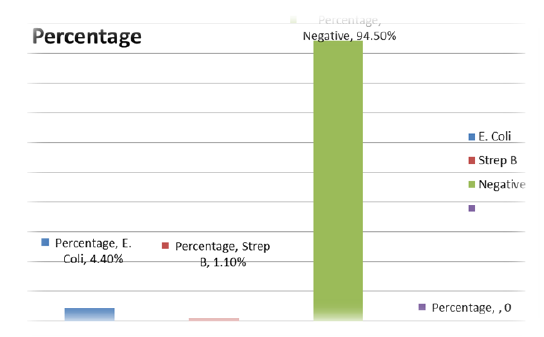
Among 475 women who were enrolled in the study, the median maternal age is 26 and the mean age is 27.22 ± 6.492. The highest age was 47 and the lowest 15. Mean, mode and median are almost equal with slight difference making the distribution symmetric with no skew. It is very similar to “bell-shaped curve” that often describes Gaussian distribution. Out of 475 cases, negative and positive cultures either in blood or in urine were 94.1% n’= 447 and 5.5% n’= 26 respectively and 0.4% were missing n = 2 (Figure 1). Among positive cultures, E. Coli was the most prevalent 80.77 % and GBS comes in second place 19.23 %. Listeria Monocytogenes was not found.


The combination of the three antibiotics, Ampicillin, Gentamicin and Cefotaxime accounts for 25.5% (121) of the total. Ampicillin and Gentamicin combined together has the highest frequency: 224 out of 475 accounting for 47.2%, as compared to the combination of Ampicillin and Cefotaxime 27.4%.


Figure 1: Negative Versus Positive Cultures


The antibiotic choice depends on laboratory and clinical findings. 461 out of 475 admitted newborns were cured 97.1%. Mortality rate was defined as 2.9%, presenting 14 newborns. 85.7% of deceased infants were born from mothers below age of 30 and the value increases to 92.9% if the cut off value of maternal age is below 35. The mortality rate was 7.1% in the age group of 40 >35. The Pearson correlation was applied to clarify the correlation between maternal age and mortality rate. It shows that there is no relation between maternal age and mortality rate: r = 0.015 and p = 0.737 (>0.05) which rejects our hypothesis and assumes the null hypothesis. The same results were found the Chi Square Test p = 0.761 (Table 1). 


Table 1: Correlation Between Maternal Age and Neonatal Death

Maternal Age - DeathPearson CorrelationChi square
r valuep-valuep-value
0.0150.7370.761


H1 is rejected and H0 is accepted. The absence of white count change is 72.6% (345 infants had normal white count) versus the presence of change, either increasing or decreasing to a significant level was 27.4% (130 infants with a significant change in their white count). Hypoglycemia was found in 21.5% of total cases. Body temperature abnormalities hyperthermia or hypothermia were found in 25.3% and culture positivity recorded 5.5% as discussed previously. CRP is the most prevalent inflammatory marker, present in 28.40% of cases, positive in 135 newborns out of 475 (Table 2).


Table 2: Most Positive Marker

InfectionNegativePositive
Leukocytosis/Leukopenia/Left Shift72.60%27.40%
Hypoglycemia78.50%21.50%
CRP71.60%28.40%
Fever Hypothermia74.70%25.30%
Culture94.50%5.50%
DISCUSSION

A total of 475 newborns admitted to NICU for neonatal sepsis treatment were included in our study. Data collection concerned maternal age, as a major risk factor contributing to their presentation, antibiotic usage is discerned and mortality rate is calculated. The mean of maternal age was 27.22±6.492; median and mode were very close to the median, making our population normally distributed. More than half of our population is below 35 years, the age that is considered advanced by the literature. Teen pregnancies 6.3% and advanced maternal age in pregnancy 13.5% were not prominent despite the presence of early marriage in our community. This may be due to the change in lifestyle of females who are more educated and engaged in work. E. Coli is the most causative agent of neonatal sepsis, which opposes the literature data where GBS is the most common [1] and correlates more with the recent findings where E. Coli incidence and resistance are increasing and GBS incidence is in decline [6,7]. It might be due to early GBS screening and treatment during the last trimester of pregnancy [2]. Cultures were negative in most cases 94.5% underlying the frequency of neonatal sepsis with negative cultures. Only 5.5% of cultures proved the presence of sepsis which is lower than the rate found in different [8], suggesting limitations in our laboratory techniques. Ampicillin is always administered in addition to either Gentamicin and or Cefotaxime. CRP is most common positive inflammatory marker among those chosen in advance, present in 28.40%. A very close value to one described in another study 33% [2]. The mortality rate is 2.9%. No correlation was found between advanced maternal age and increase in neonatal mortality rate, using T test, Pearson correlation and Chi Square test. This opposes the literature that states advanced maternal age as a risk factor for increase in neonatal mortality and morbidity and this may be due to many factors.


Study Limitations

A mono-centric study makes the population very similar in its characteristics, socioeconomic level and demographic criteria. Conducting a similar study on a larger group with different origin, education level, work status and residency may show different results. Many cases that required follow up were lost, because of possible transfer or refusal of medical care. A percentage of 2.90% was not enough to find a significant correlation between maternal age and mortality. By increasing the sample size, the power of the study will increase and the results could have shown significance.


Study Perspectives

The importance of this study resides in the importance of our statistical outcome that shows the mean age of pregnant woman in the Lebanese society, that is below of advanced age defined as above 35 by the literature; the emergence of E. Coli and its resistance to antibiotic should rise the concern of different empiric therapeutic approach facing this new clinical scenario as ESBL might be a future challenge. In addition, this study underlines the laboratory challenge we face in diagnosing neonatal sepsis, due to immature immune response in neonates, thermoregulation and the low negative predictive value of cultures. This raises the awareness regarding the importance of early intervention in decreasing the mortality as well as the importance of clinical judgment over the laboratory findings in making the diagnosis; or establishing a new diagnostic tool should to address infection properly and to shorten the therapy duration, thus cut down its toxicity. The increase in E. coli incidence in neonates raises awareness towards a proper antibiotic stewardship that cover the challenge that we might face in the future with the resistant generations. Our results correlate with recent studies that showed increasing in E coli incidence over the years which makes ESBL a possible challenge in the future and impose new strategies in the current management. The study looks forward for the presence of other markers that might have higher PPV and NPV in order to treat early and to avoid using antibiotics, therefore avoid their associated complications. IL-6 has showed high sensitivity and specificity in diagnosing early neonatal sepsis. Many studies including meta-analysis support the validity and accuracy of IL-6 but insist on combining it with our inflammatory markers [9]. IL-27 is also studied and showed promising results [10,11]. Procalcitonin, same as CRP can be affected by many factors and its sensitivity and specificity are similar to those of CRP but are higher when it comes to late onset neonatal sepsis [1,12]. CD64 neutrophil marker and PCR for pathogen identification are also studied [1,12].

CONCLUSION

Results found in our study, confirmed the challenge we encounter when dealing with an infant in whom we suspect sepsis. The non-specificity of signs and symptoms in addition to the absence of precise diagnostic tool, render the task tough and the management uncertain in some situations where we prefer to treat aggressively rather than to wait until death occurs. The diagnosis of neonatal sepsis needs a single test with high negative predictive value that allows a different approach and decreases the use of antibiotics, thus the resistance and a high positive predictive value that implies initiation of treatment and decides the end of treatment when cure is declared.

REFERENCES
  1. Zea-Vera, A. and T.J. Ochoa. “Challenges in the diagnosis and management of neonatal sepsis.” Journal of Tropical Pediatrics, vol. 61, no. 1, 2015, pp. 1–13.

  2. Toyofuku, M. et al. “Effects of intrapartum antibiotic prophylaxis on neonatal acquisition of group B streptococci.” The Journal of Pediatrics, vol. 190, 2017, pp. 169–173.

  3. Reis Machado, J. et al. “Neonatal sepsis and inflammatory mediators.” Mediators of Inflammation, vol. 2014, 2014, pp. 429–560.

  4. Kiatchoosakun, P. et al. “Early-onset neonatal sepsis and antibiotic use in northeast thailand.” American Journal of Perinatology, vol. 36, no. 12, 2019, pp. 1295–1303.

  5. Esaiassen, E. et al. “Antibiotic exposure in neonates and early adverse outcomes: A Systematic review and meta-analysis.” Journal of Antimicrobial Chemotherapy, vol. 72, no. 7, 2017, pp. 1858–1870.

  6. Mendoza-Palomar, N. et al. “Escherichia coli early-onset sepsis: Trends over two decades.” European Journal of Pediatrics, vol. 176, no. 9, 2017, pp. 1227–1234.

  7. Braye, K. et al. “Epidemiology of neonatal early-onset sepsis in a geographically diverse australian health district 2006–2016.” PLOS One, vol. 14, no. 4, 2019, e0214298.

  8. Sorsa, A. “Diagnostic significance of white blood cell count and c-reactive protein in neonatal sepsis; asella referral hospital, south east Ethiopia.” The Open Microbiology Journal, vol. 12, 2018, pp. 209.

  9. Sun, B. et al. “A meta-analysis of interleukin-6 as a valid and accurate index in diagnosing early neonatal sepsis.” International Wound Journal, vol. 16, no. 2, 2019, pp. 527–533.

  10. Abo El Magd, N.M. et al. “The role of serum interleukin-27 as a diagnostic biomarker for diagnosis of neonatal sepsis.” The Egyptian Journal of Immunology, vol. 25, no. 2, 2018, pp. 87–95.

  11. He, Y. et al. “Multiplex cytokine profiling identifies interleukin-27 as a novel biomarker for neonatal early-onset sepsis.” Shock, vol. 47, no. 2, 2017, pp. 140–147.

  12. Gilfillan, M. and V. Bhandari. “Biomarkers for the diagnosis of neonatal sepsis and necrotizing enterocolitis: Clinical practice guidelines.” Early Human Development, vol. 105, 2017, pp. 25–33.

Recommended Articles
Research Article
Association of Maternal Age with Risk of Neonatal Sepsis: A Mono-Centric Retrospective Study in Lebanon
...
Published: 21/10/2020
Download PDF
Chat on WhatsApp
Flowbite Logo
PO Box 101, Nakuru
Kenya.
Email: office@iarconsortium.org

Editorial Office:
J.L Bhavan, Near Radison Blu Hotel,
Jalukbari, Guwahati-India
Useful Links
Order Hard Copy
Privacy policy
Terms and Conditions
Refund Policy
Shipping Policy
Others
About Us
Team Members
Contact Us
Online Payments
Join as Editor
Join as Reviewer
Subscribe to our Newsletter
+91 60029-93949
Follow us
MOST SEARCHED KEYWORDS
Copyright © iARCON International LLP . All Rights Reserved.