Modern electronic payment methods, especially in developed countries, contribute to providing banking liquidity for banks due to individuals and companies not holding cash and the reduced currency in circulation, which has prompted most developing countries to follow the lead of developed countries, including Iraq. The study included three sections: the first part addressed electronic payment methods and the concept and importance of banking liquidity, while the second part discussed the development of electronic payment systems (gross settlement system, electronic clearing system, electronic clearing system). The third part included the most important conclusions and recommendations reached by the study.
Keywords
Electronic Payment Methods
Bank Liquidity
Electronic Clearing
Retail Payment
INTRODUCTION
Electronic payment methods are considered one of the key pillars for the development of the banking sector and therefore this transformation in banking operations in Iraq represents an important research area to examine the mechanisms of development in the liquidity position of this sector and the potential to maximise the benefits of electronic transactions to move towards automating this leading sector in economic development and achieving the desired level of electronic transactions to increase confidence in the performance of the banking sector. The use of electronic payment methods involves systems and tools used to carry out financial transactions online or via mobile devices. These methods provide a convenient and secure alternative to cash or traditional cheques, executing financial transactions instantly or almost instantly, thereby reducing the time required to process transactions. Thus, the Central Bank of Iraq has taken on the responsibility of developing banking activities electronically by utilizing the latest global banking systems and benefiting from international experiences through the services of reputable companies in this field.
Importance of the Research
The importance of the research comes from the significance of the banking sector and the roles it performs
The importance of developing electronic payment methods and their role in providing banking liquidity
Research Problem
Electronic payment methods in Iraq are still below expectations, lagging behind global developments and unable to play their role in providing banking liquidity.
Research Hypothesis
The study assumes that the development of electronic payment methods in Iraq could contribute to providing banking liquidity.
MATERIALS AND METHODS
To achieve the research objectives, the inductive and deductive approaches were used for the indicators of electronic payment tools and banking liquidity, relying on the publications and data issued by the Ministry of Finance, the Ministry of Planning and the Central Bank of Iraq, through data collection and analysis, leading to several conclusions and numerous recommendations.
Electronic Payment Methods
Theoretical Treatment: The payment system is considered a vital member of the overall economy. In recent decades, there have been significant changes in payment technology, particularly the shift from paper payments to electronic payment [1]. The electronic payment system, as an infrastructure, plays a pivotal role in the movement of money across all economic sectors, necessitating the use of modern systems, technologies and software. Otherwise, the flow of money would be restricted and activities in financial markets would be paralysed, causing all interbank transactions to halt. It can be noted that the electronic payment system, as an infrastructure, supports all economic activities, particularly commercial activities and financial transactions [2]. The importance of electronic payment methods stems from their role as tools for executing contracts and various legal transactions, which is a significant aspect of e-commerce. This is based on the premise that the former (payment methods) are merely a by-product of the latter concept. E-commerce derives its significance from its potential to become the cornerstone of international trade, relying on the global Internet network and its extensive reach, which has introduced a new form of commercial exchange between individuals from different countries. People have found in this new type of commerce (e-commerce) an easy and inexpensive means for global promotion and marketing, compared to traditional trade methods [3]. The significant development in communication means through the internet, modern technologies within the framework of the Fourth Industrial Revolution, artificial intelligence, big data and cloud computing has also helped financial institutions expand access to financial services for the financially excluded at the individual or institutional level, including micro, small and medium enterprises, which has contributed to reducing the cost of providing financial services and improving their efficiency [4]. To further deepen the concept of financial inclusion, the Board of Governors of central banks and Arab monetary institutions designated 27/4 of each year as Financial Inclusion Day to encourage banks and non-banking financial institutions to develop their services and offer more appropriate banking and financial products to improve the income of the majority of Arab communities, especially since electronic payment methods are one of the important tools for financial inclusion. Statistics from international financial organisations indicate that approximately 69% of the adult population, equivalent to 3.8 billion people, hold accounts in banks operating in various countries around the world. This percentage varies between countries and is linked to the economic classification of the states (advanced industrial, developing) and the level of development of the banking systems operating within them, in addition to the number of banking and financial services available, including electronic payment methods [5]. The speed of transactions between parties without the need for face-to-face interaction has given it great importance as it provides convenience in conducting transactions.
Therefore, its importance can be summarized as follows:
The payment system is a vital and essential element of the overall economy
The electronic payment system is a component of the infrastructure and plays a pivotal role in the flow of money across all economic sectors
The importance of electronic payment methods stems from their role in executing contracts and various legal transactions and they are also crucial for e-commerce
Electronic payment systems and methods are an important tool for achieving financial inclusion
The Concept of Bank Liquidity and its Importance
Concept of banking liquidity: Banking liquidity in its absolute sense means cash money, while in its technical sense it refers to the ability of an asset to be converted into cash quickly and without losses. The purpose of holding liquid assets is to meet obligations due currently or within a short period. It is a relative concept that expresses the relationship between liquidity and cash and easily convertible assets into cash quickly and without losses and the obligations that need to be fulfilled. Economically, liquidity refers to the liquidity of wealth elements (owned by individuals and institutions), which are expressed in a certain cash value, such as land, real estate, machinery, equipment, gemstones and others and the ease with which they can be converted into goods and services to satisfy the needs of their owner. Liquidity is widely understood as the availability of cash or equivalent resources and it is the lifeblood of any commercial or sovereign entity. Liquidity allows for the fulfilment of both expected and unexpected obligations when needed, ensuring that the daily business operations can continue without interruption. In the absence of sufficient cash resources, activities may be at risk [2]. Bank liquidity can be defined as the extent to which a bank can meet its obligations and finance increases in the asset side without resorting to liquidating assets at unfair prices or relying on high-cost sources. Bank liquidity is defined as the bank's ability to meet its short-term obligations on their due dates and to respond to credit requests, which requires the bank to keep part of its assets in liquid form as well as semi-liquid assets, meaning those that can be quickly and easily converted into cash without loss of value and also its ability to borrow to meet normal and unexpected withdrawals or to grant new loans [6]. Bank liquidity is defined as the necessity for a bank to maintain a reasonable proportion of liquid assets to meet its short-term obligations and to face unexpected withdrawals by customers. Generally, liquidity is defined as any asset that can be easily and quickly converted into cash and the closer the assets are to cash, the more liquid or semi-liquid they are, provided that their value does not suffer significant loss during the conversion process [7].
Liquidity has three dimensions:
Time: The speed at which an asset can be converted into cash
Risk: The possibility of the asset's value declining or the possibility of the source or producer failing to deliver or neglecting the asset in some way
Cost: The financial and other sacrifices that must be made in implementing the change
The Importance of Bank Liquidity
Commercial banks rely heavily on short-term funding sources obtained through public deposits and a large portion of these deposits can be withdrawn by depositors on demand or after a short period following notice to the bank of the depositor's desire to withdraw their deposits. This means that commercial banks may face large withdrawal requests at the same time, which requires them to maintain a liquidity ratio appropriate to the total short-term debt obligations. Maintaining a certain liquidity ratio does not mean that the bank holds its funds in the form of cash, as doing so would prevent it from making a profit. Rather, liquidity in this context refers to the ability to quickly convert investment items into cash without incurring losses [8]. Among the liquidity risks is the bank's inability to provide the necessary funding to meet its obligations on their due dates. Liquidity risks arise from difficulties in obtaining cash at a reasonable cost through borrowing or asset sales [9]. Liquidity management is considered one of the core competencies of all financial institutions. Banks typically transform maturity periods by funding themselves with deposits and other short-term liabilities and investing in assets with longer maturities while continuing to meet obligations as they come due. It is well known that commercial banks seek to generate profits through their banking activities by selling assets. Through these activities, commercial banks have opportunities to achieve profits; however, certain characteristics must be present in these assets in terms of liquidity, risk level and return. The higher the liquidity, the lower the return and risk and vice versa [10]. After the Asian financial crisis during 1997-1998, many economies in the region began to rebuild their savings, sometimes leading to a surplus. Capital inflows helped enhance liquidity and the combination of large savings and low borrowing costs stimulated credit creation and economic growth [11].
We will explain some liquidity ratios and how they are calculated. The cash to demand deposits ratio, also known as the cash liquidity to deposits ratio, is a measure used to determine a bank's ability to meet immediate cash withdrawals. This ratio reflects the portion of demand deposits held in cash (such as currency and balances at the central bank) compared to the total demand deposits.
The ratio of cash and near-cash to demand deposits:
This ratio measures a bank's immediate ability to meet depositors' withdrawals at any time and in any amount. Its importance lies in its linking of available cash to demand deposits that are subject to immediate withdrawal by depositors.
Cash and Near-Cash to Total Deposits
The importance of this ratio lies in its correlation between the cash available at the bank and the total deposits expected to be withdrawn by its depositors.
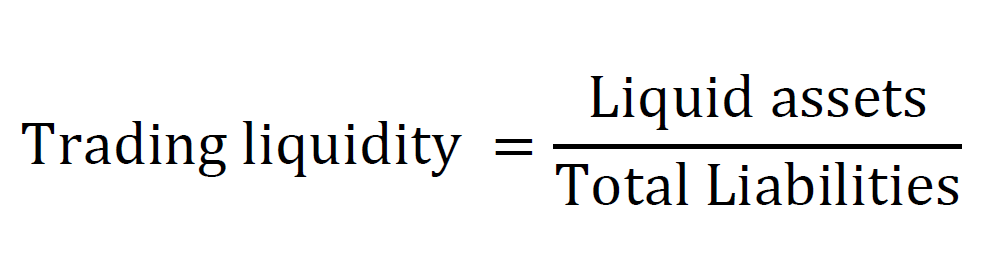
Trading Liquidity Ratio
We will explain that this ratio is calculated by dividing a bank's liquid assets, which include cash and near-cash assets, by total liabilities and this ratio shows the bank's ability to meet its obligations from its liquid assets.
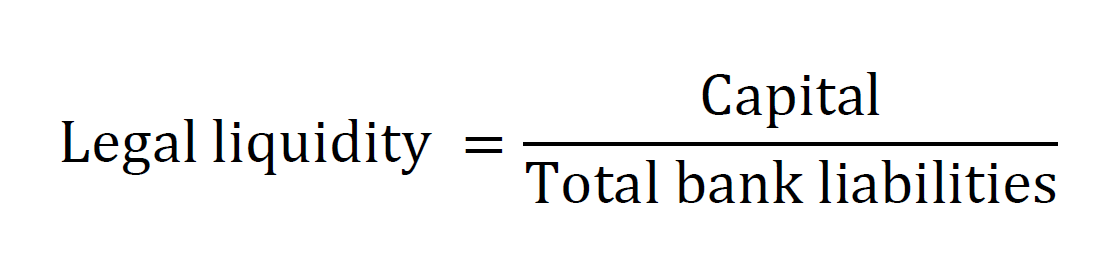
Legal liquidity Ratio
This ratio is used within banking supervision rules by the central bank and through determining the proportion and type of liquid assets that commercial banks must hold [12]. During the global financial crisis that began in the United States in late 2007, despite relatively high capital levels, many banks faced difficulties because they failed to manage liquidity properly. These events highlighted the importance of liquidity in banking sector performance and prompted regulators and policymakers to pay special attention to liquidity and its risk management in the banking industry. A liquidity shortage in one bank could affect the entire financial system and destabilise it [13].
The Evolution of Electronic Payment Systems
The Total Settlement System: The gross settlement system is a system used to settle financial transactions between banks or financial institutions completely and immediately, in this system transactions are settled between parties on a transaction-by-transaction basis and to the maximum:
It is evident from the data in Table 1 that the value of transfers in Iraqi dinars through the Real-Time Gross Settlement (RTGS) system followed an upward trend during the period 2017-2023.
Table 1: Bank Transfer Amounts Via the Real-Time Gross Settlement System in Billion Dinars and Dollars
Year
Value of transfer amounts: 1 billion dinars (1)
Number of transfers
(2)
Rate of change in the value of transfers
% (3)
Rate of change in the number of transfers
% (4)
Value of transfers:
$1billion (5(
Number of transfers (6)
Rate of change in the value of transfers
% (7)
Rate of change in the number of transfers
% (8)
2017
160,588,858
72,036
----
----
3,268,683
9,927
----
----
2018
161,812,789
56,342
0.7
-21.7
4,535,950
17,772
38.7 %
79 %
2019
185,628,749
56,640
14.7
0.5
5,874,599
21,528
29.5 %
21.1%
2020
198,002,415
51,337
6.6
-9.3
4,976,468
22,637
-15.2 %
5.1%
2021
200,807,161
72,997
1.5
42.1
5,377,739
26,119
8 %
15.3%
2022
231,379,333
72,561
15.22
-0.5
9,235,153
30,107
71.7 %
15.2%
2023
276,529,208
69,386
19.5
-4.3
11,250,690
27,256
21 %
-9.4%
Compound Growth Rate
9.3%
-0.6%
22%
18%
Source: Prepared by the researcher based on: Central Bank of Iraq / Department of Statistics and Research / Annual Statistical Bulletin for the period [16], Central Bank of Iraq, Directorate of Statistics and Research, Payment Systems, for the period (2017-2023). The annual percentage change was calculated by the researcher using the formula (Value of the second year - Value of the first year / Year 1 * 100), The compound annual growth rate (CAGR) was calculated by the researcher using the formula (Value of the last year / Value of the first year) ^(1/ Number of years - 1) - 1) * 100 (Ministry of Planning/Directorate of Foreign Trade/Imports Report).
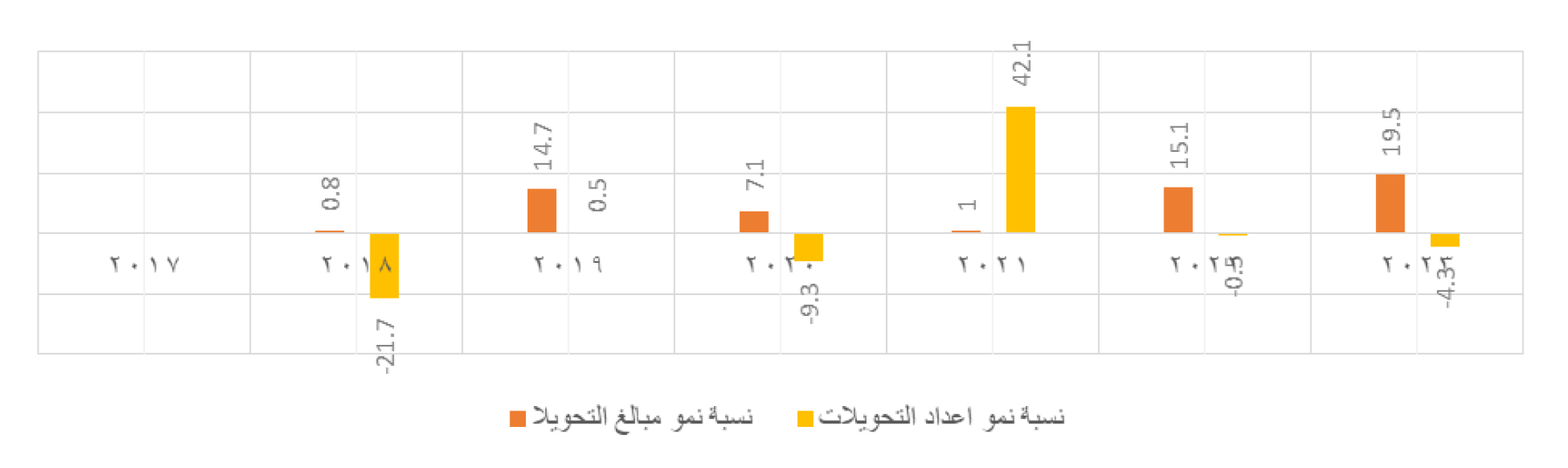
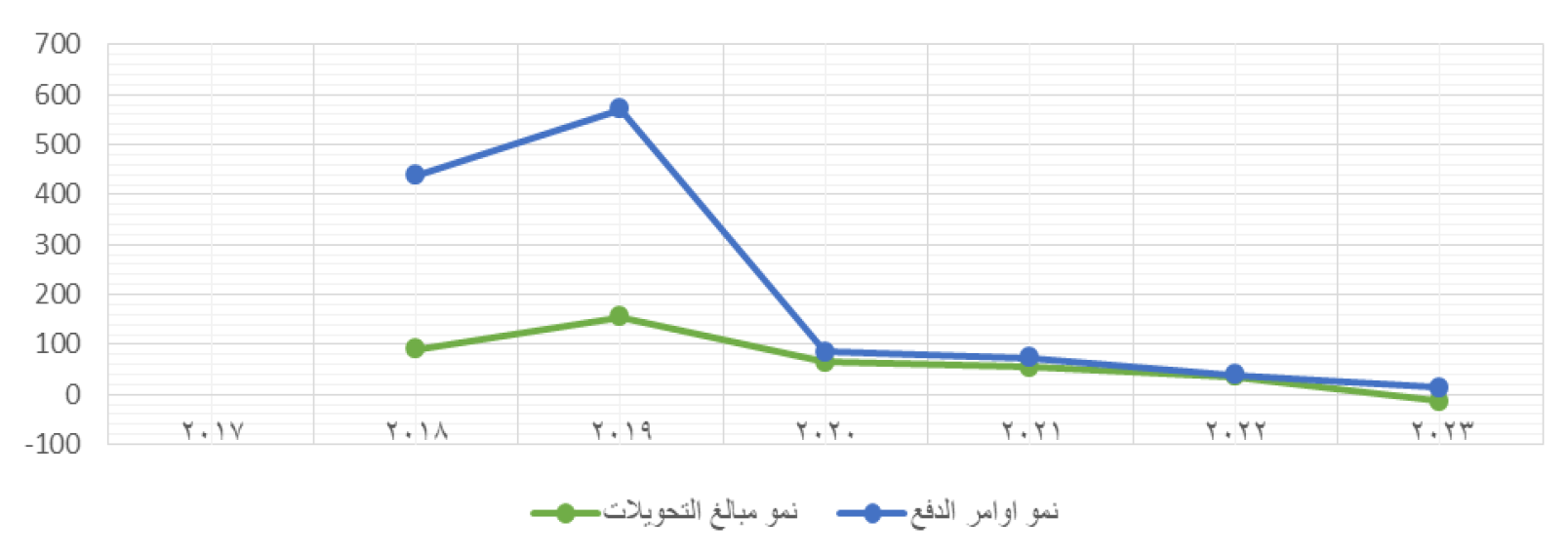
The value of transfers in Iraqi dinars in 2017 amounted to 160,588,858 dinars for 72,036 transfers, rising to 161,812,789 dinars in 2018, representing an annual change rate of 0.8%, for 56,342 transfers. This increase is attributed to the efforts of the Central Bank of Iraq in cooperation with the General Secretariat of the Council of Ministers on the project to localise all salaries, aimed at shifting from cash transactions to electronic payments. In 2018, the salaries of employees from 124 ministries or government institutions were localised [14]. The value of transfers in Iraqi dinars continued to rise gradually, reaching 198,002,415 dinars in 2020, with a change rate of 7.1%, for 51,337 transfers, showing a change rate of -9.3%. This is due to the repercussions of the COVID-19 pandemic and the global lockdown, with the value of transfers in Iraqi dinars continuing to rise to reach its highest level in 2023 at 276,529,208 dinars, with a change rate of 19.5%, compared to the number of transfers which reached 69,386 transactions, achieving a change rate of 19.5%, the highest rate experienced by transfer numbers in Iraqi dinars during the period 2017-2023. This is attributed to the fact that the Iraqi economy witnessed notable growth or recovery in some sectors, which could lead to an increase in large financial transactions through the RTGS system, as shown in Figure 1.
Figure 1: Shows the Growth Rate of Transfer Amounts in Iraqi Dinars Via the (RTGS) System
Source: Compiled by the researcher based on data from Table 1
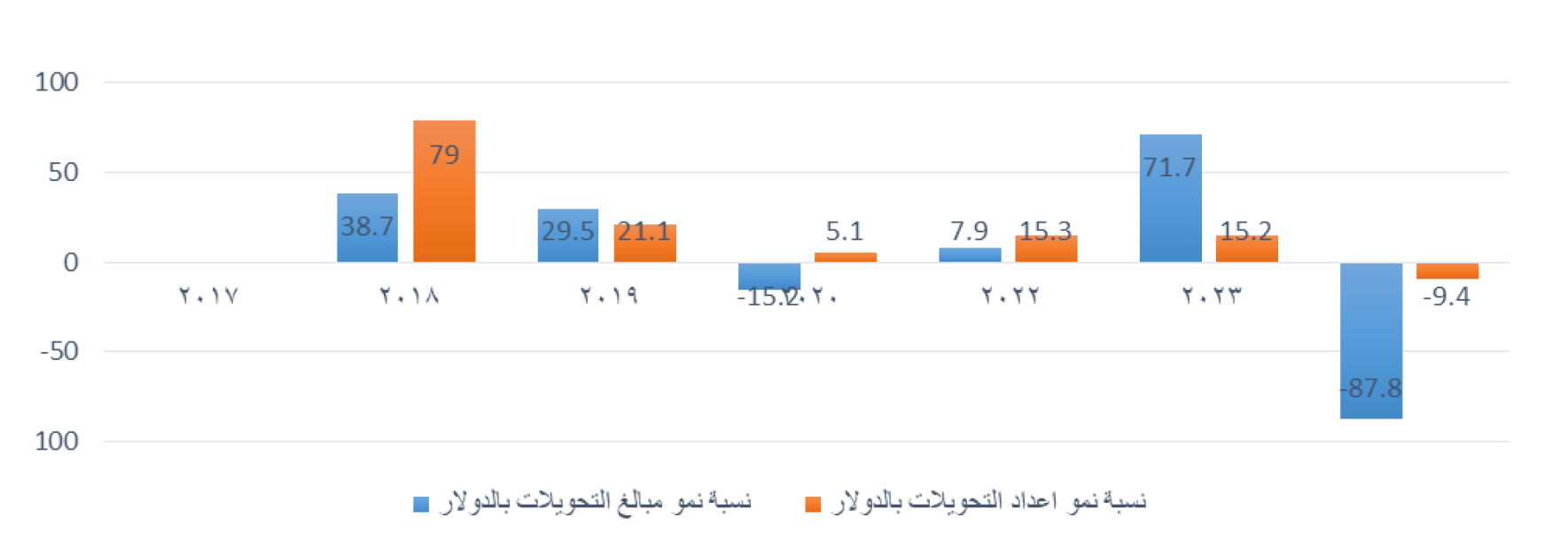
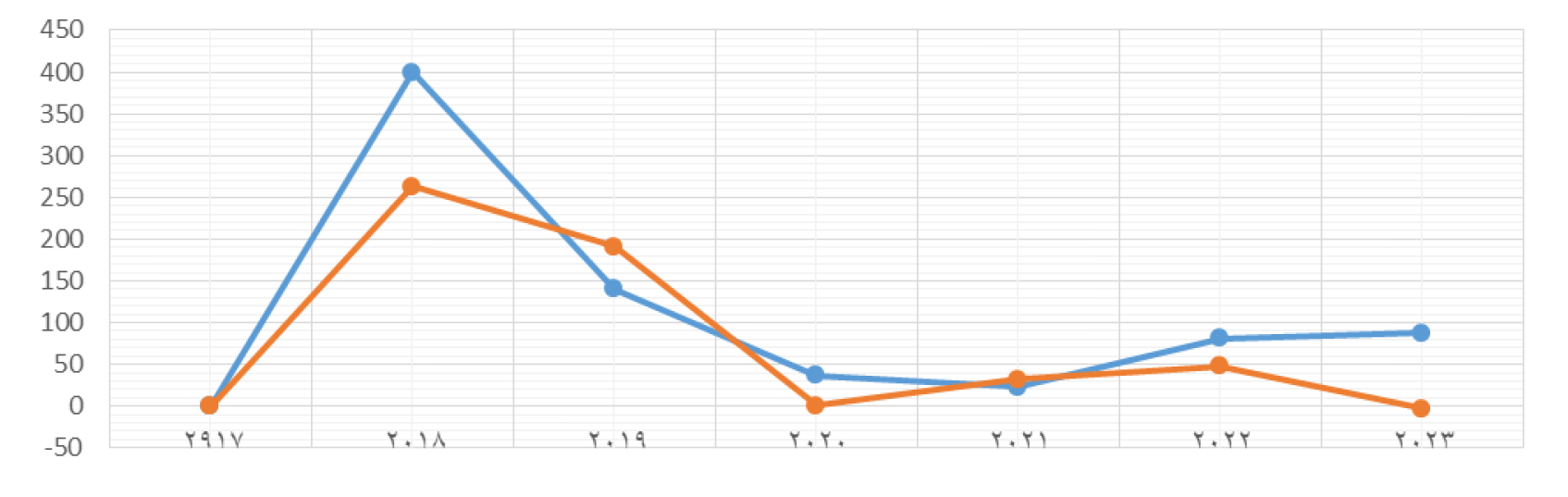
Meanwhile, the value of transfers in US dollars recorded a gradual increase in the early years of the period consecutively, recording 3,268,683 dollars in 2017 for 9,927 transfers and continued to rise until 2019 to reach 5,874,599 dollars, achieving an annual change rate of 29.5%, with the number of transfers reaching 21,528 transactions. This is due to the increase in import volumes resulting from the rise in oil prices during that period, on which the Iraqi economy is almost entirely dependent. However, this rise in the value of transfers in US dollars did not continue, recording a decrease in 2020 to an amount of $4,976,468, the lowest amount of transfers in US dollars during the period, with a rate of change of -15.2%. One of the factors affecting oil prices is supply and demand and the demand for crude oil decreased in 2020 due to the COVID-19 pandemic, leading to a decrease in the flow of US dollars. The value of such transfers rose again in the following years, reaching its highest level in 2023 at $11,250,690, achieving a rate of change of 21%. This is attributed to fluctuations in the exchange rate between the Iraqi dinar and the US dollar and there may be a tendency to increase transactions in dollars to avoid the risks of currency fluctuations, as shown in Figure 2.
Figure 2: Growth Rate of Amounts and Numbers of Transfers in US Dollars
The amount of transfers in Iraqi dinars through the gross settlement system achieved a compound annual growth rate of 9.3%, attributed to technological innovations that enhance banking efficiency, which in turn contributes to increasing the volume of transfers. Meanwhile, the number of transfers recorded a compound annual growth rate of -0.6%, due to local or global economic or political crises that may lead to a decline in the number of transfers. As for the value of transfers in US dollars, it achieved a compound annual growth rate of 22%, while the number of transfers achieved a compound annual growth rate of 18%, driven by the growth in international trade, which increases the demand for dollar transfers, thereby boosting both the total amounts transferred and the number of transfers.
Electronic Clearing System
The Automated Clearing House (ACH) system is used for electronically exchanging payments between financial institutions, facilitating fast and efficient financial transfers between bank accounts. The mechanism of the electronic clearing system inputs and updates financial information electronically instead of using paper checks.
Data from Table 2 shows that credit transfers in Iraqi Dinar through the electronic clearing system continued to rise during the period 2017-2023, with the value of credit transfers in Iraqi Dinar in 2017 amounting to 1,809,597,569 Dinar for a total of 94,186 transfers.
Table 2: Amounts of Bank Transfers Via the Electronic Clearing System: One Trillion Dinars and One Million Dollars
Year
Type of conversion
(1)
Value of transfer amounts: 1 trillion dinars
(2)
Number of transfers
(3)
Rate of change in transfer values
%(4)
Rate of change in the number of transfers
%(5)
The total value of the transfers is one million dollars.(6)
Number of transfers
(7)
Rate of change in transfer values
%(8)
Rate of change in the number of transfers
%(9)
2017
Creditor
1,809,597,569
94,186
----
----
8,885
1,443
----
----
Checks
23,506,415,937
477,886
----
----
410,383
1,883
----
----
2018
Creditor
3,452,160,461
507,057
90.7%
438.3%
44,477
5,234
400%
262.7%
Checks
31,361,203,736
608,503
33.4%
27.3%
549,578
2,039
33.9%
8.2%
2019
Creditor
8,822,634,362
3,401,830
155%
570.8%
107,401
15,212
141.4%
190.6%
Checks
38,356,902,543
798,193
22.3%
31.1%
240,452
2,537
56.2-%
24.4%
2020
Creditor
14,483,854,443
6,320,751
64%
85.8%
146,867
15,316
36.7%
0.68%
Checks
25,273,460,099
464,465
34.1-%
41.8-%
278,423
2,056
15.7%
18.9-%
2021
Creditor
22,326,522,805
10,970,578
54.1%
73.5%
181,048
20,194
23.2%
31.8%
Checks
22,793,710,963
582,205
9.8-%
25.3%
231,019
1,481
17-%
27.9-%
2022
Creditor
30,313,612,069
15,323,780
35.7%
39.6%
327,981
29,928
81.1%
48.2%
Checks
30,340,585,074
592,994
33.1%
1.8%
225,857
3,824
-2%
158.2%
2023
Creditor
25,796,671,166
17,350,642
-14%
13.2%
617,222
29,000
88%
3.1-%
Checks
37,412,396,838
369,210
23%
37.7-%
407,657
1,310
80%
65.7-%
Compound Growth Rate
Creditor
%55
106%
102%
64%
Checks
8%
4-%
-0.1%
-5%
Source: Prepared by the researcher based on: Central Bank of Iraq / Department of Statistics and Research/Annual Statistical Bulletin for the period [16]. Central Bank of Iraq, Directorate of Statistics and Research, Payment Systems, for the period 2017-2023
The value of credit transfers in Iraqi Dinar increased to 3,452,160,461 Dinar in 2018, achieving an annual growth rate of 90%, while the number of transfers reached 507,057, achieving an annual growth rate of 438.3%. This is attributed to the Central Bank of Iraq’s reliance on multiple systems to expedite the provision of electronic payment services and ensure their quality, It is evident that the value of remittances credited in Iraqi dinars continued to rise, reaching in 2020 the amount of 14,483,854,443 dinars, with a change rate of 64%, compared to the number of transfers, which amounted to 6,320,751 transactions, with a change rate of 85.8%. The value of remittances credited in Iraqi dinars continued to increase, reaching its highest level during the period in 2022, amounting to 30,313,612,069 dinars, with a change rate of 35.7%, compared to the number of transfers, which reached 15,323,780 transactions, with a change rate of 39.6%. This is attributed to the increase in GDP, which positively reflects on individual incomes and thus increases overall demand in both its consumer and investment components. The value of remittances credited in Iraqi dinars recorded a decrease in 2023, amounting to 25,796,671,166 dinars, with a change rate of -14%, due to the fluctuations in the exchange rate. If the Iraqi dinar appreciates in value against foreign currencies, the value of remittances processed in Iraqi dinars may decrease when converted from foreign currencies.
As for the value of remittances in US dollars, it can be observed that it followed an upward trajectory during the period 2017-2023, with the value of credit remittances in US dollars in 2017 recorded at $8,885 for a number of 1,443 transfers. The value of US dollar remittances via the electronic clearing system rose in 2018 to $44,477, achieving an annual change rate of 400%, which is the highest rate recorded during the period, against the number of transfers totaling 5,234. The value of credit remittances in US dollars continued to increase, reaching $146,867 in 2020 with a change rate of 36.7%, for the number of transfers that reached 15,316 transactions, with a change rate of 0.68%, as shown in Figure 3.
Figure 3: Shows the Growth Rate of Transfer Amounts in Iraqi Dinars Via the (ACH) System.
Source: The figure is from the researcher's work based on the data in Table 2
As for the electronic promissory note system, Table 2 data shows that the value of transfers through the electronic instruments system recorded an increase for the first three consecutive years. The value of electronic instrument transfers in Iraqi dinars in 2017 amounted to 23,506,415,937 dinars, for a total of 477,886 payment orders, continuing to rise until 2019 when the value reached 38,356,902,543 dinars, the highest amount recorded during the period, achieving a change rate of 22.2%, for a total of 798,193 payment orders, registering a change rate of 31.1%. This was due to an increase in general budget revenues by 37.6% in 2018 as a result of higher oil revenues [15]. However, this increase did not continue, as the value of electronic instrument transfers in Iraqi dinars dropped to its lowest level in 2021, amounting to 22,793,710,963 dinars with a change rate of -9.8%. This is attributed to the global pandemic (the Corona crisis) and after the end of the lockdown, it rose again during the years 2022 and 2023, with amounts of 37,412,396,838 and 30,340,585,074 respectively and a rate of change of 33.1% and 23%. Companies and institutions in Iraq may increasingly resort to sukuk as a means of raising finance. As for the amounts and numbers of electronic sukuk in dollars, they continued to fluctuate between rises and falls, reaching their lowest level in 2022 at 225,857 dollars with a rate of change of -2%, while the number of transfers reached 3,824, as shown in Table 3.
Table 3: Amounts of Bank Transfers Via the Internal Clearing System: One Trillion Dinars and One Million Dollars
Year
Type of conversion
(1)
The total value of the transfers is one trillion dinars.
(2)
Number of transfers
(3)
Rate of change in transfer values
% (4)
Rate of change in the number of transfers
% (5)
The total value of the transfers is one million dollars (6)
Number of transfers
(7)
Rate of change in transfer values
% (8)
Rate of change in the number of transfers
%
(9)
2017
Creditor
----
----
----
----
----
----
----
Checks
----
----
----
----
----
----
----
----
2018
Creditor
3,149,779,240
218735
----
----
66,528
582
----
----
Checks
25,003,210,714
673004
----
----
21,256
83
----
----
2019
Creditor
12,299,617,531
5690601
290%
%2500
55,040
377
-17%
-35%
Checks
,266,410,82128
628183
13.8%
%-6
207,940
45
878%
-45%
2020
Creditor
26,464,458,931
17646418
115.1%
%210
32,501
358
-40%
-5%
Checks
18,793,063,496
412114
-33%
-34%
12,519
37
-93%
-17%
2021
Creditor
45,954,382,083
32705691
74%
85%
31,747
306
-2%
-14%
Checks
19,242,450,058
472504
2%
14%
16,332
49
30%
32%
2022
Creditor
51,529,260,820
38887041
12%
18%
93,955
324
195%
5%
Checks
17,818,385,328
503703
-7%
6%
22,741
23
39%
-53%
2023
Creditor
59,051,150,748
39,859,679
14%
2%
42,249
235
-55%
-27%
Checks
18,221,225,191
360875
2%
-28%
37,028
23
62%
0%
Compound Growth Rate
Creditor
%79
183%
-8%
-16%
Checks
%-6
-11%
11%
-22%
Source: Prepared by the researcher based on: Central Bank of Iraq / Department of Statistics and Research/Annual Statistical Bulletin for the period (2017-2023) [16]. Central Bank of Iraq, Directorate of Statistics and Research, Payment Systems, for the period 2017-2023.
The amounts of credit transfers in Iraqi dinars achieved a growth rate of 55% and the number of payment orders achieved a compound growth rate of 106%. Thanks to automation and technology, this reduces human errors and risks associated with manual transactions, thereby enhancing the stability of the financial system. The amounts of transfers via cheques achieved a growth rate of 8%, attributed to the ease of access to the electronic clearing system. The increasing number of users boosts transaction volumes, resulting in higher growth rates. The number of payment orders achieved a growth rate of -4%, due to the suspension of some banks as a result of central bank supervision, the liquidation of some banks, or the merger of certain branches, which reduces the number of payment orders. The amounts of credit transfers in US dollars achieved a compound growth rate of 102%, while the number of payment orders achieved a growth rate of 64%, attributed to the increase in import volumes financed in US dollars. The amounts of transfers via cheques achieved a growth rate of -0.1% and the number of payment orders achieved a growth rate of -5%, due to fluctuations in economic activity levels during the period 2017–2023.
Centralized Document Storage (CSD) System
The central document management system is a system used to manage and store documents and papers centrally, facilitating access and retrieval. This system is usually designed to meet the needs of institutions, whether governmental or private and helps organise and protect information, converting traditional papers into a digital format to ease access. From the above, it is clear that the central document management system is used for storing documents and papers to preserve them and enable easy access when needed. It does not include data, which is why it is excluded from the analysis for the reasons mentioned above.
The Internal Clearing House System (ICBS)
A system used to settle financial transactions between parties, this system aims to organise and facilitate the exchange of funds, contributing to improved efficiency and reduced risks, allowing banks to conduct rapid transaction settlements, thereby reducing the time required to complete financial operations.
Table 3 shows that credit transfers in Iraqi dinars through the internal clearing system continued to rise during the period 2018-2023. The value of credit transfers in Iraqi dinars in 2018 amounted to 3,149,779,240 dinars, for a number of transfers totaling 218,735 transactions. The value of credit transfers in Iraqi dinars then increased in 2019 to 12,299,617,531 dinars, achieving an annual change rate of 290%, compared to a number of transfers totaling 5,690,601 transactions, achieving an annual change rate of 2500%. This is attributed to the increased pace of economic activity during that period. The value of credit transfers in Iraqi dinars continued to rise, reaching 26,464,458,931 dinars in 2020, with a change rate of 113%, compared to a number of Transfers totaled 17,646,418 transactions, representing a change of 210%. The value of credit transfers in Iraqi dinars continued to rise, reaching its highest level during the period in 2023 at 59,051,150,748 dinars, a change of 14%. This compares to 39,859,679 transactions, a change of 2%. This increase is attributed to the reopening of bank branches in liberated areas, as well as the opening of new branches. The value of credit transfers in US dollars, however, followed a fluctuating trend during the period 2018-2023. In 2018, the value of credit transfers in US dollars reached $66,528 across 582 transactions. The value of transfers in US dollars through the internal clearing system decreased in 2019. 55,040 dollars, achieving an annual change rate of -17%, compared to the number of transfers that amounted to 377. The value of credit transfer amounts in US dollars continued to decrease, recording in 2021 the amount of 31,747 dollars, with a change rate of -2%, compared to the number of transfers that amounted to 306 payments and with a change rate of -14%. This is attributed to economic fluctuations affected by a number of factors, including the Corona pandemic. The value of credit transfer amounts in US dollars rose to reach its highest level in 2022 with an amount of 93,955 dollars and with a change rate of 195%, compared to the number of transfers that amounted to 324 payments, recording an annual change rate of 5%. This is attributed to the rise in oil prices as a result of geopolitical changes, for example (the Russian-Ukrainian war).
As for the electronic check system, the data in Table 4 shows that the value of transfers via the electronic check system recorded an increase for the first two consecutive years of the period. The value of electronic check transfers in Iraqi dinars in 2018 amounted to 25,003,210,714 dinars, for a number of payment orders totaling 673,00. The value of electronic check transfers in Iraqi dinars increased in 2019, reaching 266,410,82128 dinars, the highest amount recorded during the period, representing a change rate of 13%, for a number of payment orders totaling 628,183, representing a change rate of -6%. However, the value decreased in 2020, reaching 18,793,063,496 dinars, representing a change rate of -33%, for a number of payments totaling -13%. 412,114 payments, with a change rate of -34%, attributed to the aforementioned quarantine measures. This figure rebounded in 2021, reaching 19,242,450,058 dinars, a change rate of 2%, with 472,504 payments, representing a change rate of 14%. This increase was due to the rise in local and global economic activity resulting from the easing of lockdown measures. The figure then decreased in 2022, reaching 17,818,385,328 dinars, a change rate of -7%, with 503,703 payments, a change rate of 6%. As for the amounts and numbers of electronic checks in US dollars, they continued to fluctuate, reaching their highest level in 2019 at 207,940 dollars, representing a change rate of 878%. 45 Payments, as shown in Table 4.
Table 4: Amounts of Bank Transfers via the Internal Clearing System: One Trillion Dinars and One Million Dollars
Year
Type of conversion(1)
The total value of the transfers is one trillion dinars.(2)
Number of transfers (3)
Rate of change in transfer values
%(4)
Rate of change in the number of transfers
%(5)
The total value of the transfers is one million dollars.(6)
Number of transfers
(7)
Rate of change in transfer values
%(8)
Rate of change in the number of transfers
%(9)
2017
Creditor
----
----
----
----
----
----
----
Checks
----
----
----
----
----
----
----
----
2018
Creditor
3,149,779,240
218735
----
----
66,528
582
----
----
Checks
25,003,210,714
673004
----
----
21,256
83
----
----
2019
Creditor
12,299,617,531
5690601
290%
%2500
55,040
377
-17%
-35%
Checks
,266,410,82128
628183
13.8%
%-6
207,940
45
878%
-45%
2020
Creditor
26,464,458,931
17646418
115.1%
%210
32,501
358
-40%
-5%
Checks
18,793,063,496
412114
-33%
-34%
12,519
37
-93%
-17%
2021
Creditor
45,954,382,083
32705691
74%
85%
31,747
306
-2%
-14%
Checks
19,242,450,058
472504
2%
14%
16,332
49
30%
32%
2022
Creditor
51,529,260,820
38887041
12%
18%
93,955
324
195%
5%
Checks
17,818,385,328
503703
-7%
6%
22,741
23
39%
-53%
2023
Creditor
59,051,150,748
39,859,679
14%
2%
42,249
235
-55%
-27%
Checks
18,221,225,191
360875
2%
-28%
37,028
23
62%
0%
Compound Growth Rate
Creditor
%79
183%
-8%
-16%
Checks
%-6
-11%
11%
-22%
Source: Prepared by the researcher based on: Central Bank of Iraq / Department of Statistics and Research/Annual Statistical Bulletin for the period 2017-2023. Central Bank of Iraq, Directorate of Statistics and Research, Payment Systems, for the period 2017-2023 [16]
Credit transfers in Iraqi dinars achieved a compound growth rate of 55%, while the number of payment orders achieved a compound growth rate of 183%. This is attributed to the fact that internal clearing systems help expedite transfer processes and reduce transaction processing time, thus enhancing trust between parties. However, transfers by check achieved a compound growth rate of -6%, while the number of payment orders achieved a compound growth rate of -11%. This is due to the proliferation of alternative methods, such as the increasing use of alternative solutions like credit cards and digital wallets, which can reduce the demand for electronic checks.
Credit transfers in US dollars achieved a Compound Annual Growth Rate (CAGR) of -8%, while the number of payment orders experienced a CAGR of -16%. This is attributed to the impact of fluctuating local and global economic conditions, such as recession or inflation, on dollar transactions. Transfers by check achieved a CAGR of 11%, due to the Iraqi government's move towards electronic payments instead of cash. The number of payment orders experienced a CAGR of -22%, attributed to the withdrawal of most branches of Lebanese banks operating in Iraq, which led to a decrease in the number of payment orders.
Figure 4: Growth Rate of Amounts and Numbers of Transfers of checks in Iraqi Dinars
The Integrated Retail Payment System Interface (IRPSI)
A retail payment system is a system that facilitates small, recurring financial transactions between individuals or between individuals and businesses through banks. These transactions typically include payments for goods or services, such as everyday purchases, bills and utility costs.
Table 5 shows that the value of transfers in Iraqi dinars via the Retail Payment System (IRPSI) recorded a continuous increase during the period 2017-2023.
Table 5: Amounts of Bank Transfers Via the Retail Payment System in Billions of Dinars and Dollars
Year
Value of transfers: 1 billion dinars (1)
Number of transfers (2)
Rate of change in transfer values
% (3)
Rate of change in the number of transfers
%(4)
Total value of transfers: Million dollars
(5)
Number of transfers (6)
Rate of change in transfer values %(7)
Rate of change in the number of transfers
%(8)
2017
2,124,225
8,099
----
----
1517
37
----
----
2018
34,189,267
10,1775
1500%
1,15%
659,82
3,327
42.4%
8,89%
2019
306,743,152
556,029
797%
446%
1,126
5,046
1,60%
52%
2020
1,449,226,871
1,974,186
372%
255%
6,170
9,935
447%
97%
2021
3,903,071,030
5,325,320
169%
170%
3,636
11,709
41-%
17%
2022
8,209,444,155
11,568,090
110%
117%
7,417
24,704
100.3%
110%
2023
9,622,262,090
18,824,624
17%
62%
9,124
24,625
23%
-0.3%
Compound Growth Rate
306%
263%
326%
195%
Source: Prepared by the researcher based on: Central Bank of Iraq / Department of Statistics and Research/Annual Statistical Bulletin for the period 2017-2023. Central Bank of Iraq, Directorate of Statistics and Research, Payment Systems, for the period 2017-2023 [16].
In 2017, the amount was 2,124,225 dinars, for a number of transfers amounting to 8,099 payments. The value of transfers in Iraqi dinars increased in 2018 to record the amount of 34,189,267 dinars, achieving an annual change rate of 1,500%, for a number of transfers of 10,1775 payments and a change rate of 1.15%. This is attributed to the start of work on the Iraqi Retail Payment System (IRPSI) in 2017, in which 8 banks participated. In 2018, there was an expansion in participation in this system, as 10 new banks participated, namely (Babel Bank, South Islamic Bank, Al-Rasheed Bank, Mosul Bank, Byblos Bank and Noor Iraq Islamic Bank). Jihan, Mediterranean Investment, Abu Dhabi Islamic Bank) where the linking process was completed after the completion of all administrative, technical and regulatory procedures. The value of transfers in Iraqi dinars through the retail payment system continued to rise during this period, reaching 1,449,226,871 dinars in 2020, achieving a change rate of 380%.
This is attributed to technological development and the increasing number of users of electronic services, which led to increased reliance on the retail payment system, as it is a system specifically for card transfers. The value of transfers in Iraqi dinars through the retail payment system continued to rise, reaching its peak in 2023 at 9,622,262,090 dinars, with a change rate of 17%. This is attributed to the fact that the high inflation rate contributes to an increase in the value of amounts transferred through electronic payment systems and methods, compared to the number of transfers, which reached 18,824,624 dinars, with a change rate of 62%, which is attributed to the fact that the retail payment system is a conduit for local card transactions between the issuer and the collector through the electronic payment service provider.
As for the value of transfers in US dollars, Table 5 shows that it recorded an increase for the first four consecutive years. In 2017, the amount was $1,517, with 37 transfers. This rose in 2018, registering the highest rate of change during the period at 43,390%, reaching $659.82, with 3,327 transfers and a change rate of 8.89%. This increase is attributed to the development of electronic payment technologies, such as retail payment systems, which make transfers easier and faster, thus contributing to their increased use. The rise continued until 2020, reaching $6,170, a change rate of 448%. This increase is due to the growth of international trade, where the dollar is preferred for global commerce, with 9,935 transfers and a change rate of 97%. However, this rise did not continue and the value subsequently declined. The total value of remittances in US dollars in 2021 amounted to $3,636, representing a change of -41%, the lowest rate of change recorded for the value of remittances in US dollars during that period. This occurred against a total of 11,709 remittances, representing a change of 17%. This decline is attributed to the drop in Arab oil prices from $64 per barrel in 2019 to $41.5 per barrel in 2020 as a result of the repercussions of the COVID-19 pandemic [4].
The value of transfers in Iraqi dinars through the retail payment system achieved a compound growth rate of 306%, while the number of transfers achieved a compound growth rate of 263%. As for the value of transfers in US dollars, it achieved a compound growth rate of 326%, while the number of transfers achieved a compound growth rate of 195%. This is attributed to the development of security technologies that contributed to enhancing public confidence, which increases the use of these systems. This is due to the availability of fast and easy experiences in retail payment systems, which attracts more users. In addition, the increase in initiatives to enhance access to financial services led to an increase in the number of users.
CONCLUSION
There is a common integration and a long-term relationship between electronic payment methods and banking liquidity for the banks (Al Ahli Iraqi, International Development for Investment, Ashour International for Investment, Al-Rasheed) in the research sample, which is attributed to the fact that electronic payment methods help attract the largest possible proportion of the public, leading to an increase in deposit levels in the banks of the research sample
Long-term estimates indicate a negative relationship between the number of Point of Sale (POS) terminals and the Liquidity Coverage Ratio (LCR), as the coefficient of this variable is statistically significant. Therefore, the short-term coefficients are significant, meaning that POS terminals negatively affect the liquidity coverage ratio in the short term and these results are consistent with the long-term results. This is attributed to the low availability of modern electronic banking products, as well as the fact that short-term liabilities are greater than short-term liquid assets, which negatively affects the liquidity coverage ratio
The topic of the relationship between the development of the banking sector and the use of modern financial technology presents a real challenge for a sector that has spent four decades relying on old classical methods in carrying out most of its operations, in addition to the international isolation of the Iraqi banking sector, which lasted for four decades and had a negative impact on the swift transition towards opening up to the global financial world
The decline in the contributions of the banking sector due to the lack of trust of depositors and foreign investors in the local banking sector had a negative effect on building high financial balances and most of these banks were unable to meet financial obligations quickly and accurately, which contributed to the decrease in available cash liquidity in local banks
Recommendations
Banks operating in Iraq should continuously work to develop electronic payment systems and methods, keeping pace with global advancements to achieve an efficient payment system that aligns with international developments and enables Iraqi banks to compete regionally and globally
Organize workshops and awareness campaigns to inform consumers about the benefits and advantages of electronic payments, such as security and convenience
Enhance internet connectivity and increase the availability of point-of-sale (POS) terminals and ATMs to facilitate the use of electronic payments everywhere
Provide incentives for users of electronic payment methods, such as fee reductions, to encourage their widespread use
Strengthen cybersecurity to secure transactions and build user trust in electronic payment methods
Banks operating in Iraq, particularly private banks, must invest the liquidity generated by electronic payment systems and methods to increase the volume of credit they extend. This aims to boost economic growth and support large-scale development projects
Collaborate with major international banks and financial institutions to develop new products and services that encourage the use of electronic payments
Streamline procedures and simplify steps for using electronic payment methods to make them easier and simpler
The spread of electronic payment methods should be moderate so that the monetary authority does not lose its ability to manage monetary policy
REFERENCES
Grace, B.L.I. et al. Two Sided Market R&D and Payments System Evolution. IMF Working Paper, 2019.
Banks, E. Liquidity Risk: Managing Funding and Asset Risk. Palgrave Macmillan, 2014.
Nakajima, M. Payment System. 2011.
Al-Hijazi, A.F.B. The Legal System of E-Government. 2nd ed., Dar Al-Kutub Al-Qanuniyya, 2007.
Arab Monetary Fund. Liquidity Risk Management in Accordance with Basel III Requirements in Arab Countries. 2019.
Abdul-Nabi, W.E. Financial Inclusion and Its Role in Achieving Banking Development and the Growth of the Iraqi Economy. Central Bank of Iraq, 2018.
Hussein, J.J.M. et al. “Evaluating the efficiency of bank liquidity management in the Iraqi banking system using data envelopment analysis (DEA), 2002–2019.” Iraqi Journal of Economic Sciences, 2022.
Hammoudi, M.A. et al. “The Importance of bank liquidity in commercial and Islamic banks in Iraq for the period 2017–2021.” Al-Kut Journal of Economic and Administrative Sciences, 2023.
Al-Sirafi, M. Banking Operations Management. 2016.
Urayqat, H.M. et al. Islamic Bank Management: A Modern Introduction. Amman, 2012.
Abdul-Hamid, M.T. The Interrelationship between the Money Supply and Electronic Banking. PhD diss., Damascus University, 2015.
Azis, J. et al. Managing Elevated Risk, Global Liquidity Capital Flows and Macroprudential Policy: An Asian Perspective.
Al-Shabib, D.K. Contemporary Bank Management. Amman, 2012.
Chiaramonte, L. Bank Liquidity and the Global Financial Crisis. 2018.
Central Bank of Iraq. Financial Stability Report. 2016–2023.
Ministry of Planning, Central Statistical Organization. Statistical Indicators on the Economic and Social Situation in Iraq for the Years 2015–2018. 2018.
Recommended Articles
Research Article
The impact of waste management strategies on achieving sustainability through waste treatment –Applied Study in a Sample of (Environmental Protection and Improvement Department in the Southern Region, Zubair Municipality Directorate, and Basra Municipality Directorate)
Zahraa Mohammad Khairallah,
Safaa Mohammad Hadi Hashem
Published: 19/09/2023
Download PDF
Research Article
Role of Total Quality Management Dimensions and Their Direct and Effective Impact on the Dimensions of Electronic Circuits: A Structural and Analytical Study of Organizational Structures to Address Difficulties
Sami Abdullah Kadhim
Published: 27/01/2025
Download PDF
Research Article
Organizational Creativity: The Information Security Paradigm
Nwinyokpugi ,
Brown Miller Ibiso
Published: 10/04/2022
Download PDF
Research Article
Designing and Examining a Digital Business Transformation Model and its Role in Developing Green Intellectual Capital: An Empirical Study in the Oil Sector
Mohammed Raoof Al-Musawi,
...
Reyath Thea Azeez Alsafo
Published: 12/04/2025
Download PDF
PO Box 101, Nakuru
Kenya.
Email: office@iarconsortium.org
Editorial Office:
J.L Bhavan, Near Radison Blu Hotel,
Jalukbari, Guwahati-India
Tomas, H. A. (2026). Analysis of the Development of Electronic Payment Methods and Their Impact on Banking Liquidity in Iraq for the Period 2017-2023. IAR Journal of Tourism and Business Management, 6(1), 1-10.
MLA
Tomas, Haqi A.. "Analysis of the Development of Electronic Payment Methods and Their Impact on Banking Liquidity in Iraq for the Period 2017-2023." IAR Journal of Tourism and Business Management 6.1 (2026): 1-10.
Chicago
Tomas, Haqi A.. "Analysis of the Development of Electronic Payment Methods and Their Impact on Banking Liquidity in Iraq for the Period 2017-2023." IAR Journal of Tourism and Business Management 6, no. 1 (2026): 1-10.
Harvard
Tomas, H. A. (2026) 'Analysis of the Development of Electronic Payment Methods and Their Impact on Banking Liquidity in Iraq for the Period 2017-2023' IAR Journal of Tourism and Business Management 6(1), pp. 1-10.
Vancouver
Tomas HA. Analysis of the Development of Electronic Payment Methods and Their Impact on Banking Liquidity in Iraq for the Period 2017-2023. IAR Journal of Tourism and Business Management. 2026 Jan;6(1):1-10.



 Download PDF
 Download XML