Endometriosis is a common gynecological disorder characterized by the presence of endometrial tissue outside the uterus, often causing chronic pelvic pain and infertility. While endometriosis typically affects the pelvic region, its involvement of the appendix is rare, and even more unusual is its association with acute appendicitis. This case report presents a 48-year-old obese woman with a BMI of 38 kg/m², systemic arterial hypertension, and diabetes mellitus, who presented with chronic abdominal pain exacerbated during menstruation. Physical examination revealed localized pain in the right iliac fossa, accompanied by an inflammatory mass. Imaging studies suggested an inflammatory process in the right pelvic region, and exploratory laparotomy confirmed acute phlegmonous appendicitis. The histopathological examination of the appendix revealed endometriosis involvement, characterized by glandular structures suggestive of endometrial epithelium. This case highlights the rarity of appendiceal endometriosis causing acute appendicitis and emphasizes the importance of considering this condition in the differential diagnosis of right iliac fossa pain, especially in women with a known history of endometriosis.
Endometriosis is a gynecological inflammatory disorder affecting up to 10–15% of women of reproductive age. The disease is defined by the proliferation of endometrial tissue outside the uterus and is characterized by recurrent “pain symptoms” including dysmenorrhea, dyspareunia, dyschezia, dysuria, and chronic pelvic pain as well as infertility [1], with typically manifests 12 months after menarche and progressively worsens, is a form of chronic regional pain syndrome involving the pelvic area. [2]
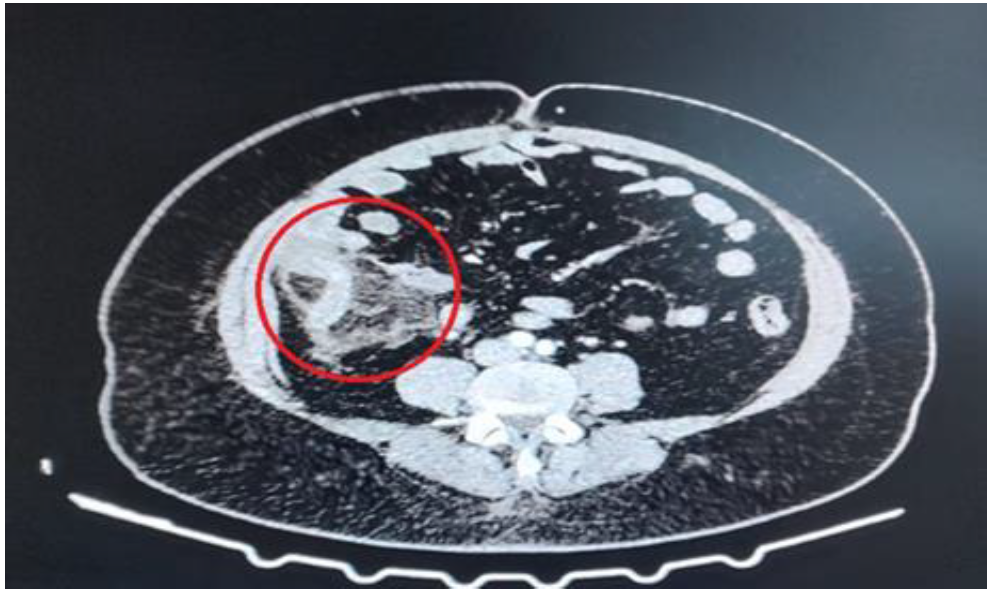
A 48-year-old obese patient with a BMI of 38 kg/m2, systemic arterial hypertension and diabetes mellitus, was seen in the Emergency Department with a report of chronic abdominal pain that worsened during menstruation. On physical examination, the pain was more pronounced in the right iliac fossa region, accompanied by a local inflammatory mass. Laboratory tests revealed leukocytosis (16,000/µL) without a left shift, associated with elevated C-reactive protein (4 mg/L) and hyperglycemia (234 mg/dL). Total abdominal computed tomography showed an inflammatory process in the right pelvic region with blockage of loops in the iliac fossa (figure 1).

Figure 1: Abdominal computed tomography with an inflammatory process in the region of the right iliac fossa.
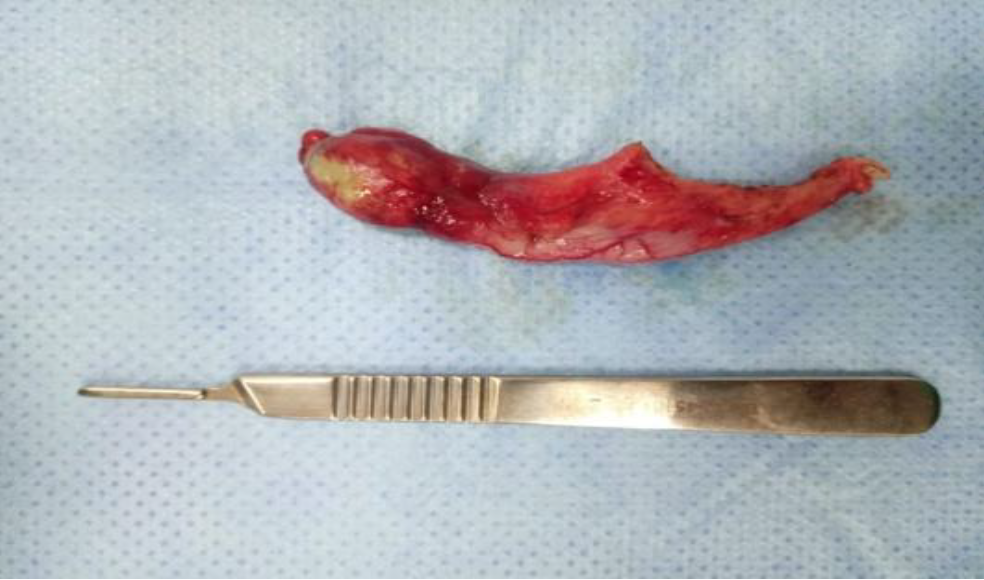
After undergoing exploratory laparotomy, acute phlegmonous appendicitis (Grade II) was diagnosed, with intervening serous secretion and local blockage of the epiploon (figure 2).

Figure 2: Surgical specimen of the cecal appendix.
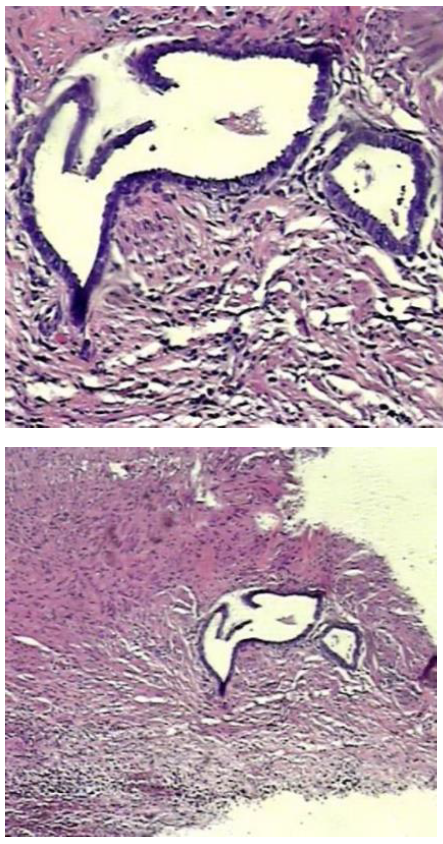
The anatomopathological examination revealed the presence of a cecal appendix with fibrinoleukocyte serositis, with points of ulceronecrotic mucosal lesion, associated with the histological pattern of endometriosis involvement (Figure 3).

Figure 3: Presence of glandular structures without atypia suggestive of endometrial epithelium.
Pain in the right iliac fossa is a frequent reason for consultation in the surgical emergency service, raising various differential diagnoses, particularly in women of childbearing age. Appendiceal endometriosis as a cause of abdominal pain is uncommon, but is even rarer when associated with an infectious condition of the appendix.
Endometriosis is a gynecological pathology caused by the presence of functional endometrial tissue, both glands and stroma, outside the uterine cavity. It affects women of reproductive age, being the most frequent cause of chronic pelvic pain or colorectal involvement, it is one of the most severe and debilitating forms of the disease and its incidence varies between 5 and 12%. [3] The most frequent locations are the rectum and rectosigmoid junction (70-93%), the appendix and the ileocecal region (3-18%). Small intestine involvement is rarer and can be observed in 2-5% of cases. [4]
Endometriosis of the appendix causing acute appendicitis is exceedingly rare and constitutes less than 1% of all appendiceal pathologies which can mimic acute appendicitis.[5] Appendiceal endometriosis is generally asymptomatic, rarely presenting clinical manifestations; but it can be expressed clinically as chronic pelvic pain, lower gastrointestinal bleeding, intussusception or acute appendicitis.6 There is a peak incidence between 25 and 35 years of age, with a smaller percentage of cases observed in girls before menarche and in postmenopausal women.[7] In women of reproductive age, appendiceal endometriosis is extremely rare, with a prevalence of around 2.8% when associated with pelvic endometriosis and 0.4% of women without a history of endometriosis.[8,9]
Abdominal pain in the right iliac fossa simulating acute appendicitis is the most common described symptom. Obstruction, hemorrhage or invagination are rare.[10] Considering endometriosis the conventional treatments consist of hormone suppression therapy and surgery, which includes both conservative surgery (to preserve fertility, such as excision of endometriosis) and hysterectomy (with or without unilateral or bilateral oophorectomy, and combined with excision of endometriosis).[11] Secondary acute appendicitis, or appendicitis associated with appendiceal endometriosis, should be considered in the differential diagnosis in patients with a known history of endometriosis.[12] In the differential diagnosis of ileocecal endometriosis, distinguishing it from entities such as Crohn's disease or malignancy is often difficult and surgical resection is frequently necessary. Cecal endometriosis may present as acute appendicitis, intussusception, volvulus, chronic abdominal/pelvic pain, ovarian tube abscess or malignancy, aiding the fact that abdominal pain is acute and occurs in 8% of cases.[13]
The authors declare that they have no conflict of interest
No funding sources
The study was approved by the University of Taubaté, São Paulo, Brazil.
Selntigia, A., et al. "Correlation between Endometriosis and Migraine Features: Results from a Prospective Case-Control Study." Cephalalgia, vol. 44, no. 3, Mar. 2024, pp. 3331024241235210. SAGE Journals, doi: https://doi.org/10.1177/03331024241235210.
Bulletti, C., et al. "Endometriosis and Infertility." Journal of Assisted Reproduction and Genetics, vol. 27, 2010, pp. 441-47.
Casas, María Agustina. "Manejo Quirúrgico de la Endometriosis Colorrectal." Revista Argentina de Coloproctología, vol. 31, no. 2, 2020, pp. 54-62. DOI: https://doi.org/10.46768/racp.v31i2.26.
Horton, J. D., et al. "Abdominal Wall Endometriosis: A Surgeon’s Perspective and Review of 445 Cases." American Journal of Surgery, vol. 196, 2008, p. 207.
Uwaezuoke, S., et al. "Endometriosis of the Appendix Presenting as Acute Appendicitis: A Case Report and Literature Review." Ethiopian Journal of Health Sciences, vol. 23, no. 1, Mar. 2013, pp. 69-72. PubMed, PMID: 23559841, PMCID: PMC3613818.
Suarez, F. A. A., and G. C. Sanchez. "Endometriosis Apendicular Como Hallazgo en Cuadros de Apendicitis Aguda: Reporte de 4 Casos del Hospital Nacional Dos de Mayo." Revista Gastroenterología del Perú, vol. 26, no. 3, 2006, pp. 324-27.
As-Sanie, S., et al. "Changes in Regional Gray Matter Volume in Women with Chronic Pelvic Pain: A Voxel-Based Morphometry Study." Pain, vol. 153, 2012, pp. 1006.
Lee, Caroline E., et al. "Outcomes After Surgery at an Interdisciplinary Centre of Expertise for Endometriosis and Pelvic Pain in Canada: A Prospective Cohort Study." Journal of Obstetrics and Gynaecology Canada, vol. 46, no. 2, 2024, doi: https://doi.org/10.1016/j.jogc.2023.102246.
St John, B. P., et al. "Endometriosis of the Appendix Presenting as Acute Appendicitis with Unusual Appearance." International Journal of Surgery Case Reports, vol. 53, 2018, pp. 211-13. Elsevier, doi: https://doi.org/10.1016/j.ijscr.2018.10.048.
Cobo, C., et al. "Endometriosis Apendicular: Nuestra Experiencia en los Últimos 11 Años." Ginecología y Obstetricia, vol. 45, 2018, p. 2. DOI: https://doi.org/10.1016/j.gine.2017.03.003.
Asas, M. "Manejo Quirúrgico de la Endometriosis Colorrectal." Revista Argentina de Coloproctología, vol. 31, 2020. DOI: https://doi.org/10.46768/racp.v31i2.26.
Hale, CPT Justin, et al. "Military Medicine." Military Medicine, vol. 188, no. 11/12, 2023, pp. e3730-33.
Parasar, P., et al. "Endometriosis: Epidemiology, Diagnosis and Clinical Management." Current Obstetrics and Gynecology Reports, vol. 6, 2017, pp. 34-41.