Introduction: Chronic lower back pain (CLBP), often accompanied by lower limb radiculopathy, is a prevalent condition causing significant disability and healthcare burden globally. The etiology of CLBP is multifactorial, with disc degeneration, herniation, and facet joint arthritis being common contributors. Bupivacaine and Ropivacaine, two long-acting local anesthetics, are frequently used, yet there is limited direct comparison of their efficacy and safety for CLBP with radiculopathy.Aims and Objectives: The study aimed to assess and compare the effectiveness and safety of 0.5% Bupivacaine versus 0.5% Ropivacaine caudal epidural injections in patients with CLBP and radiculopathy. Materials and Methods: This was a randomized, controlled, double-blinded comparative study conducted at the Department of Orthopaedics, Adesh Medical College. A total of 148 patients with CLBP and radiculopathy, who failed conservative management, were randomized into two groups to receive either 0.5% Bupivacaine or 0.5% Ropivacaine. The primary outcome measure was pain reduction as assessed by VAS scores, and secondary outcome was functional improvement measured by ODI scores. Data were collected at baseline, immediately post-injection, and at intervals up to 24 weeks. Results: The demographic and baseline clinical characteristics were comparable between the two groups. Both groups showed significant pain reduction post-injection; however, no statistically significant difference was observed between the Bupivacaine and Ropivacaine groups in terms of VAS scores at any time point. In contrast, significant differences were noted in ODI scores, with the Bupivacaine group showing greater improvement in functional outcomes over time compared to the Ropivacaine group. No severe adverse effects were reported in either group.Conclusion: Our study suggests that while both 0.5% Bupivacaine and 0.5% Ropivacaine are effective for caudal epidural injection in CLBP with radiculopathy, Bupivacaine may offer superior functional improvement. These findings support the selection of Bupivacaine for patients prioritizing functional recovery alongside pain relief. However, individual patient characteristics and clinical contexts should guide the final choice of anesthetic.
Lower back pain is defined as pain and discomfort in low back region (between the costal margin and inferior gluteal folds), with or without pain radiating to lower limb. Pain may be acute (less than 6 weeks duration), sub-acute, (6-12 weeks) and chronic (more than 12 weeks). It is usually not possible to distinguish source of pain between the disc, facet joints, muscles, ligaments, and the sacroiliac joints. As per literature, discogenic and facetogenic pain are the most common causes for chronic lower back pain and discogenic causes often lead to radicular pain distribution and sensory disturbances in lower limbs either unilateral or bilaterally. In most people, degenerative disc disease precedes facet osteoarthritis.
Degenerative disc disease is common in older age groups, its prevalence increases from 37% in 20 years old adult to 84% in 80 years old adult.[1].In today’s era, Low back pain is one of the leading cause of morbidity including disability-adjusted life years(DALYs) in elderly population and its prevalence has increased in younger population too in recent times, may be due to bad postural habits owing to hectic lifestyle patterns, affecting activities of their daily living. Low back pain poses a significant worldwide epidemiologic burden, especially in women, adults and high socio-demographic index countries, displaying an escalating trend that is not expected to reverse soon.[2]
The available literature suggests that Caudal Epidural Steroid Injection is a very good treatment modality in management of patients with chronic back pain with lower limb radiculopathy.[3] But the advantage of one drug over other is yet to be ascertained due to lack of availability of comparative studies. The present study aimed to assess and compare the effectiveness and safety of 0.5% Bupivacaine versus 0.5% Ropivacaine caudal epidural injections in patients with CLBP and radiculopathy. Objectives were to compare the analgesic effectiveness, functional outcomes, and any adverse effects associated with each medication, thereby identifying a superior agent for clinical application.
This was a randomized, controlled, double-blinded comparative study conducted at the Department of Orthopaedics, Adesh Medical College. A total of 148 patients with CLBP and radiculopathy, who failed conservative management, were randomized into two groups to receive either 0.5% Bupivacaine or 0.5% Ropivacaine. The primary outcome measure was pain reduction as assessed by VAS scores, and secondary outcome was functional improvement measured by ODI scores. Data were collected at baseline, immediately post-injection, and at intervals up to 24 weeks.
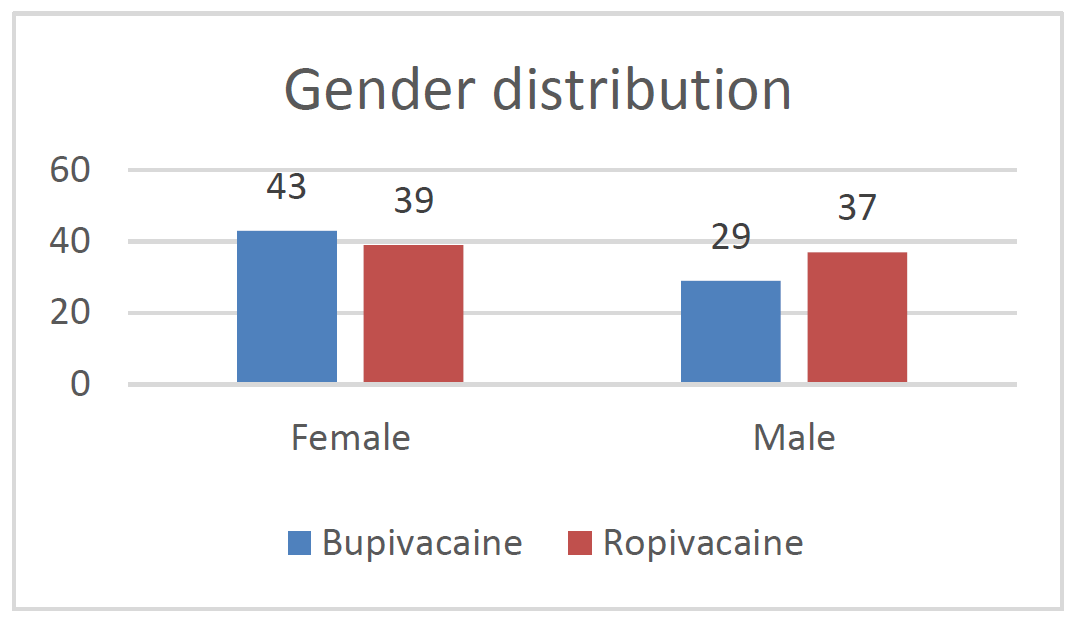
The study successfully enrolled 148 participants diagnosed with chronic lower back pain with lower limb radiculopathy, who were randomly assigned to two groups: 72 patients in the Bupivacaine group and 76 in the Ropivacaine group. There was no significant dropout, ensuring a complete dataset for final analysis.The demographic and baseline characteristics, including age, gender, and duration of lower back pain (LBP), were comparable between both groups, ensuring baseline equivalence for comparative analysis. (Table 1)
Table 1: Baseline Demographic Details of the Study Participants
Variable | Bupivacaine Group (N=72) | Ropivacaine Group (N=76) | P-value |
|---|---|---|---|
Age (years) | 49.06 ± 13.06 | 50.51 ± 14.51 | 0.100 |
Gender | |||
- Female | 43 (59.7%) | 39 (51.3%) | 0.511 |
- Male | 29 (40.3%) | 37 (48.7%) | |
Duration of LBP | 6.12 ± 3.45 months | 6.25 ± 3.60 months | 0.810 |
(Note: ± indicates standard deviation)

Figure 1: Gender distribution of the patient
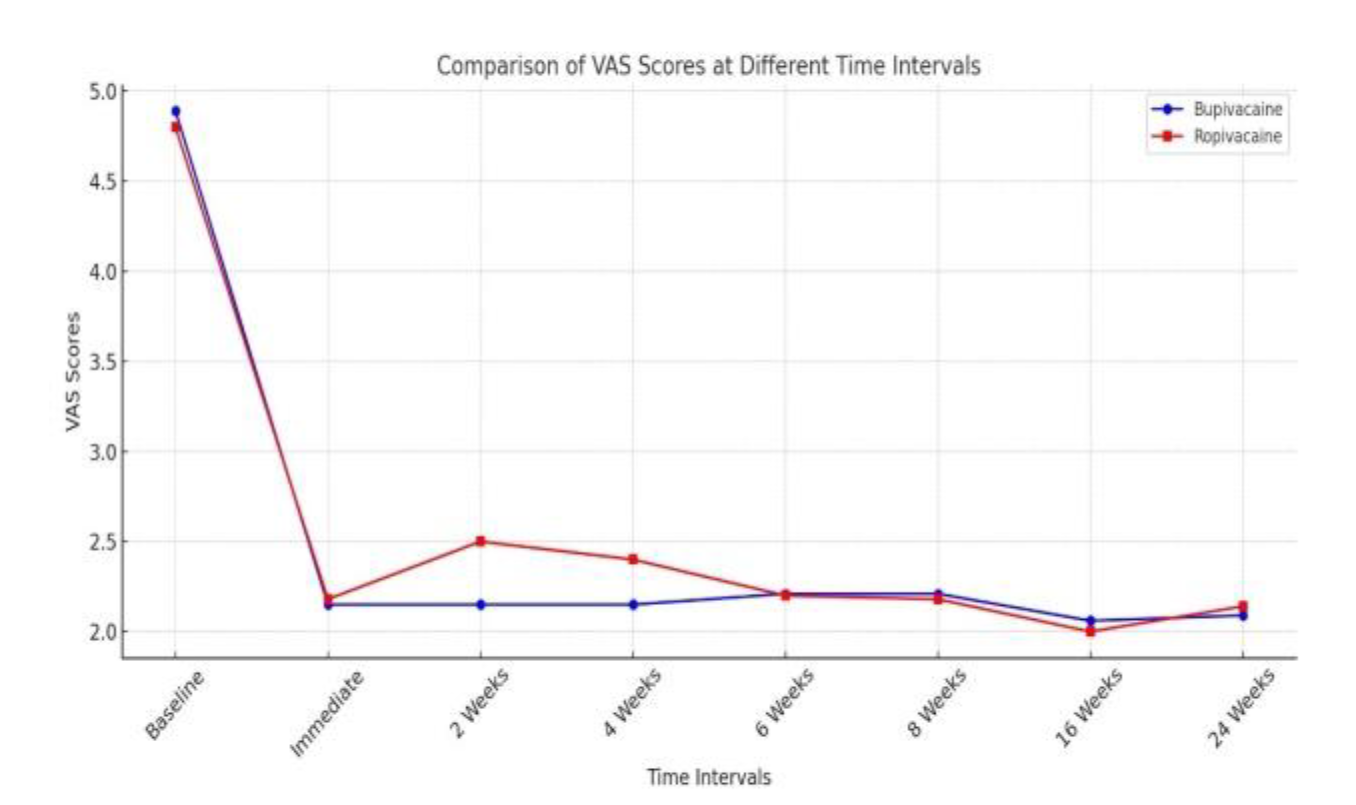
The VAS scores between both groups over time showed a significant reduction from baseline following the caudal injections, indicating effective pain management in both groups. However, there were no statistically significant differences between groups at any time point. (Table 2)
Table 2: Group-wise Comparison of Visual Analogue Scale (VAS) at Different Time Intervals
Time Interval | Bupivacaine Group (Mean ± SD) | Ropivacaine Group (Mean ± SD) | P-value |
|---|---|---|---|
Baseline | 4.89 ± 1.026 | 4.80 ± 1.107 | 0.667 |
Immediate | 2.15 ± 1.021 | 2.18 ± 1.063 | 0.884 |
2 Weeks | 2.15 ± 1.383 | 2.50 ± 1.182 | 0.181 |
4 Weeks | 2.15 ± 1.318 | 2.40 ± 1.212 | 0.331 |
6 Weeks | 2.21 ± 1.318 | 2.20 ± 1.278 | 0.961 |
8 Weeks | 2.21 ± 1.350 | 2.18 ± 1.257 | 0.902 |
16 Weeks | 2.06 ± 1.275 | 2.00 ± 1.325 | 0.810 |
24 Weeks | 2.09 ± 1.120 | 2.14 ± 1.178 | 0.815 |
(Note: SD = Standard Deviation)

Figure 2: Comparison of VAS scores between the two groups at different time intervals
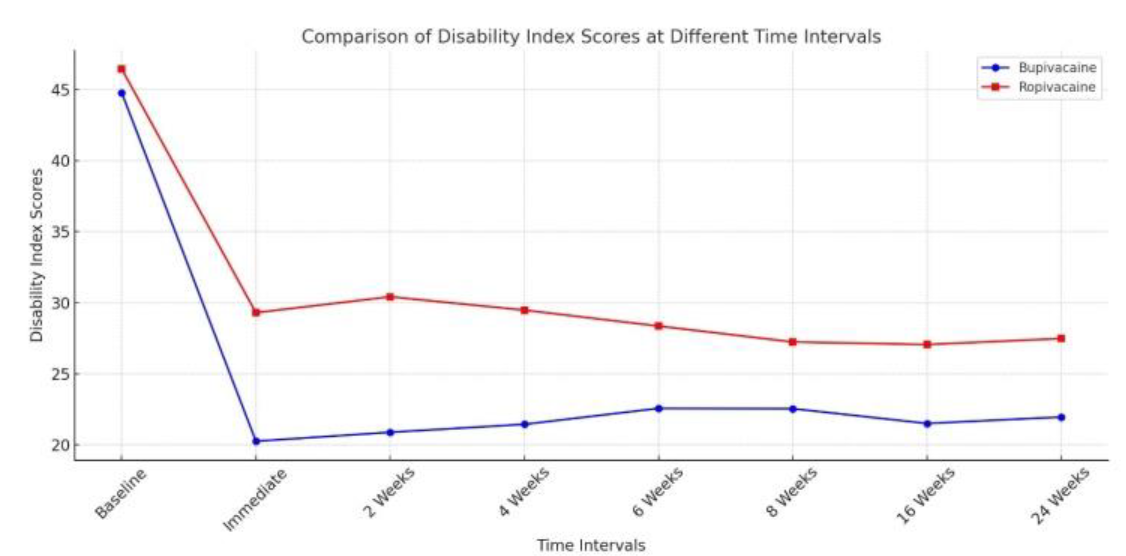
The Oswestry Disability Index (ODI) scores showed significant differences between the two groups from immediate post-injection assessments through to the 24-week follow-up. The Bupivacaine group demonstrated consistently lower disability scores compared to the Ropivacaine group, indicating better functional outcomes. (Table 3)
Table 3: Group-wise Comparison of Oswestry Disability Index (ODI) at Different Time Intervals
Time Interval | Bupivacaine Group (Mean ± SD) | Ropivacaine Group (Mean ± SD) | P-value |
|---|---|---|---|
Baseline | 44.77 ± 10.76 | 46.44 ± 10.64 | 0.443 |
Immediate | 20.26 ± 9.11 | 29.30 ± 11.55 | <0.001 |
2 Weeks | 20.89 ± 9.99 | 30.42 ± 12.23 | <0.001 |
4 Weeks | 21.45 ± 9.82 | 29.48 ± 12.54 | 0.001 |
6 Weeks | 22.57 ± 10.25 | 28.36 ± 11.35 | 0.010 |
8 Weeks | 22.55 ± 9.91 | 27.24 ± 11.96 | 0.039 |
16 Weeks | 21.51 ± 9.63 | 27.06 ± 11.74 | 0.013 |
24 Weeks | 21.96 ±9.29 | 27.48 ±10.73 | 0.008 |
(Note: SD = Standard Deviation)

Figure 3: Comparison of disability index between the two groups at different time intervals
Low back pain (LBP) encompasses the sensation of pain or discomfort within the region spanning from the lower back to the sacrum. It pain manifests as pain, stiffness, muscle spasms, and a decrease in mobility, all of which carry considerable implications for an individual's overall well-being and health. Additionally, LBP can cast a shadow over emotional and mental equilibrium, often leading to feelings of anxiety, depression, and other adverse emotions. With the global population continuously expanding and the challenge of aging becoming more widespread, the burden of chronic and persistent LBP is set to rise. This underscores the pressing necessity for more efficacious treatment approaches to manage LBP, which traditionally relies on medications such as nonsteroidal anti-inflammatory drugs, muscle relaxants, and opioids.[4]
Since the introduction of epidural catheter analgesia in North America in 1942, its utilization has seen a significant rise. Advances in equipment, techniques, and medications have expanded its scope of use, encompassing surgical anaesthesia, long-term pain management, and postoperative pain control, among other applications. Multiple methods for epidural puncture and catheter insertion have been documented. While complications have been linked to catheter placement, these are infrequent when performed by a skilled anaesthesiologist. Originally, epidural analgesia primarily involved the use of local anaesthetics, with bupivacaine being the preferred choice for epidural infusion.
Though administering epidural local anaesthetics in a bolus provides effective pain relief, its application is limited by its short duration and occasional severe hypotension. Continuous infusion of epidural local anaesthetics has been explored to mitigate side effects. Nonetheless, issues such as hypotension, motor impairment, numbness, nausea, and urinary retention have arisen. While epidural analgesia using local anaesthetics effectively alleviates postoperative pain, its safety and feasibility have been questioned due to the frequent occurrence of potentially severe side effects.[5] Top of Form
Bottom of Form
In the present study, a total of 148 patients were enrolled, with 72 receiving bupivacaine and 76 receiving ropivacaine injections. The two groups were comparable in terms of age, with mean ages of 49.06 years for the bupivacaine group and 50.51 years for the ropivacaine group.Baseline Visual Analogue Scale (VAS) scores were similar between the two groups, with scores of 4.89 (SD=1.026) for bupivacaine and 4.80 (SD=1.107) for ropivacaine. Immediately after injection, VAS scores remained statistically similar between the groups, measuring 2.15 (SD=1.021) for bupivacaine and 2.18 (SD=1.06) for ropivacaine. Subsequent assessments at 2, 4, 6, 8, 16, and 24 weeks after injection showed no statistically significant differences in VAS scores between the bupivacaine and ropivacaine groups. The VAS scores in both groups demonstrated consistent improvement over time, indicating that both bupivacaine and ropivacaine were effective in reducing pain.
Traditionally, bupivacaine has emerged as the most commonly used drug for spinal anesthesiabecause it offers the advantage of providing a long duration of action and a favourable ratio of sensory to motor neural block.[6] However, its side effects such as hypotension, bradycardia, prolonged duration of motor paralysis, cardiotoxicity and central nervous system toxicity, is a concerning issue especially when larger doses are used as with peripheral nerve blocks and/or prolonged infusions for postoperative analgesia.Hence, this led to the identification of long acting pure S-enantiomer of ropivacaine.[7] Ropivacaine is nearly identical to bupivacaine in onset, quality and duration of sensory block, but it produces lesser duration of motor blockade, has a better safety profile.[8-9] investigated the effects of ropivacaine in postoperative pain management in spinal tuberculosis patients. In this study, patients were divided into two groups, one receiving ropivacaine and the other receiving a placebo (physiological saline). The results showed that the VAS scores in the experimental group were significantly lower than those in the control group at 1, 3, 6, 12, and 24 hours post-surgery. These differences were statistically significant, indicating that ropivacaine was more effective in reducing postoperative pain compared to the placebo.
From the study of [10], the findings indicate that the concentration of ropivacaine used had an impact on the duration and quality of analgesia and motor block. Ropivacaine at 1.0% concentration provided a longer duration of analgesia and motor block, as well as more intense motor block and better patient satisfaction with analgesia compared to 0.5% bupivacaine.
While the present study investigated the effectiveness of bupivacaine and ropivacaine for pain management in the context of lower back pain over a 24-week period and found no significant difference in VAS scores between bupivacaine and ropivacaine,[11] focused on the use of ropivacaine specifically in postoperative pain management for patients undergoing orthopaedic surgery. They found that ropivacaine infiltration did not reduce postoperative pain or opioid requirements during the first 4 days.
The study conducted [12] aimed to compare the efficacy of different combinations of local anaesthetics and sufentanil in the context of postoperative pain relief and motor block in a patient-controlled epidural analgesia setting. The study involved three groups of patients who received different combinations of ropivacaine and levobupivacaine with sufentanil. There were no significant differences between the three groups in terms of numerical rating scores for pain, patient satisfaction, and motor block scores at any of the time intervals. Time to the first demand for patient-controlled epidural analgesia and average hourly sufentanil consumption were similar across the groups. Patients in group 1 (ropivacaine 0.2%, sufentanil) used significantly more local anaesthetic than patients in groups 2 (ropivacaine 0.125%, sufentanil) and 3 (levobupivacaine 0.125%, sufentanil).Immediately after injection and throughout the 24-week study period, patients who received bupivacaine consistently exhibited lower Disability Index scores compared to those who received ropivacaine. Statistically significant differences in Disability Index scores were observed between the two groups, with patients in the bupivacaine group experiencing less disability. The trend of reduced disability in the bupivacaine group persisted over the entire study duration, indicating a potential advantage of bupivacaine in improving functional outcomes in patients with lower back pain. These findings suggest that bupivacaine may be more effective in reducing disability when compared to ropivacaine, as indicated by the consistently lower Disability Index scores in the bupivacaine group over the 24-week period.
In a clinical trial conducted [13], patients undergoing total knee arthroplasty (TKA) initially received continuous femoral nerve block with ropivacaine 0.2% from the time of surgery until the following morning. They were then randomly assigned to either continue perineural ropivacaine or receive normal saline. Patients were followed up for disability over several months using the Western Ontario and McMaster Universities Osteoarthritis Index to assess pain, stiffness, and physical function. The study found that extending the continuous femoral nerve block from one night to four days did not significantly impact subsequent pain, stiffness, or physical function in patients undergoing TKA in various orthopaedic centres. There was no evidence of improvement or worsening in these outcomes with the extended infusion.
In a one year follow up study conducted [14], a total of 200 participants, aged 25 to 50 years and diagnosed with lumbar radiculopathic pain due to disc herniation, were divided into two equal groups. Group I received a combination of 80 mg of triamcinolone, 0.25% bupivacaine, and 30 mg of preservative-free ketamine. Group II received 80 mg of triamcinolone, 0.25% bupivacaine, and 3 mL of 0.9% saline. The Oswestry Low Back Pain Disability Questionnaire was used to assess the participants' quality of life, and it indicated superior outcomes for Group I in terms of pain relief and disability reduction. Additionally, pain scores were collected before the injection and at various time points up to one year after the injection. The results showed that immediately after the injection, there was no significant difference in pain scores between the two groups. However, after one week, Group I experienced significantly better pain relief and improved disability compared to Group II, and this improvement continued at all subsequent evaluation time points up to one year after the injection.
In a randomized, single-blind trial [15] involving 67 patients with chronic shoulder pain from degenerative joint or rotator cuff disease, the efficacy of suprascapular nerve block for pain relief was compared between two approaches: CT-guided and anatomical landmark. The study found that both approaches resulted in significant and prolonged improvements in pain scores and disability levels. No significant differences were observed in pain and disability improvements between the two methods at any time point during the 12-week follow-up. Moreover, patient satisfaction with pain relief using both approaches was high, and no significant adverse effects were reported. This study suggests that both CT-guided and anatomical landmark approaches to performing suprascapular nerve blocks are safe and equally effective in reducing pain and disability in patients with degenerative shoulder conditions

We conclude that although both the drugs under study were effective in reducing the chronic backache, but the results were not significantly different. Disability was significantly reduced in the patients who were administered with bupivacaine. On the basis of the present study, we recommend that despite of the side effects mentioned in the literature bupivacaine is a better choice over ropivacaine for the management of chronic back ache.
The authors declare that they have no conflict of interest
No funding sources
The study was approved by the Orthopaedics, Adesh Medical College.
Brinjikji W, Luetmer PH, Comstock B, Bresnahan BW, Chen LE, Deyo RA, et al. Systematic literature review of imaging features of spinal degeneration in asymptomatic populations. AJNR Am J Neuroradiol. 2015;36(4):811–6.
Mattiuzzi C, Lippi G, Bovo C. Current epidemiology of low back pain. J Hosp Manag Heal Policy. 2020;4(0):15–15.
Manchikanti L, Knezevic NN, Navani A, Christo PJ, Limerick G, Calodney AK, et al. Epidural Interventions in the Management of Chronic Spinal Pain: American Society of Interventional Pain Physicians (ASIPP) Comprehensive Evidence-Based Guidelines. Pain Physician. 2021;24(S1):S27–208.
Chen Q, Wang Z, Zhang S. Mechanism, application and effect evaluation of nerve mobilization in the treatment of low back pain: A narrative review. Medicine (Baltimore). 2023;102(34):e34961.
Fischer RL, Lubenow TR, Liceaga A, McCarthy RJ, Ivankovich AD. Comparison of continuous epidural infusion of fentanyl-bupivacaine and morphine-bupivacaine in management of postoperative pain. Anesth Analg. 1988;67(6):559–63.
Cox CR, Faccenda KA, Gilhooly C, Bannister J, Scott NB, Morrison LMM. Extradural S(-)-bupivacaine: comparison with racemic RS-bupivacaine. Br J Anaesth. 1998;80(3):289–93
Kaur A, Singh RB, Tripathi RK, Choubey S. Comparision Between Bupivacaine and Ropivacaine in Patients Undergoing Forearm Surgeries Under Axillary Brachial Plexus Block: A Prospective Randomized Study. J Clin Diagn Res. 2015;9(1):UC01.
Pathak A, Yadav N, Mohanty SN, Ratnani E, Sanjeev OP. Comparison of Three Different Concentrations 0.2%, 0.5%, and 0.75% Epidural Ropivacaine for Postoperative Analgesia in Lower Limb Orthopedic Surgery. Anesth Essays Res. 2017;11(4):1022.
Feng J, Xia P, Pu F. Safety and efficacy of topical ropivacaine injection for relieving postoperative pain of spinal tuberculosis: A randomized clinical trial. Asian J Surg. 2023;46(4):1645–6.
Wolff AP, Hasselstrom L, Kerkkamp HE, Gielen MJ. Extradural ropivacaine and bupivacaine in hip surgery. Br J Anaesth. 1995;74(4):458–60.
Bech RD, Ovesen O, Lindholm P, Overgaard S. Local anesthetic wound infiltration for pain management after periacetabular osteotomy. A randomized, placebo-controlled, double-blind clinical trial with 53 patients. Acta Orthop. 2014;85(2):141–6.
Sitsen E, van Poorten F, van Alphen W, Rose L, Dahan A, Stienstra R. Postoperative epidural analgesia after total knee arthroplasty with sufentanil 1 microg/ml combined with ropivacaine 0.2%, ropivacaine 0.125%, or levobupivacaine 0.125%: a randomized, double-blind comparison. Reg Anesth Pain Med. 2007;32(6):475–80.
Ilfeld BM, Shuster JJ, Theriaque DW, Mariano ER, Girard PJ, Loland VJ, et al. Long-term pain, stiffness, and functional disability after total knee arthroplasty with and without an extended ambulatory continuous femoral nerve block: a prospective, 1-year follow-up of a multicenter, randomized, triple-masked, placebo-controlled trial. Reg Anesth Pain Med. 2011;36(2):116–20.
Mohamed Amr Y. Effect of Addition of Epidural Ketamine to Steroid in Lumbar Radiculitis: One-Year Follow-Up. Pain Physician. 2011;14:475–81.
Shanahan EM, Smith MD, Wetherall M, Lott CW, Slavotinek J, FitzGerald O, et al. Suprascapular nerve block in chronic shoulder pain: are the radiologists better? Ann Rheum Dis. 2004;63(9):1035–40.