Background: Cardiovascular Diseases (CVDs) pose a significant global health challenge, with India being no exception. This study aimed to assess the awareness and knowledge levels regarding CVD risk factors and prevention strategies among the residents of District Shimla, Himachal Pradesh. Materials and Methods: A cross-sectional survey was conducted between April and June 2023 among 400 adults in Shimla District. A structured questionnaire assessed participants' awareness of CVD, risk factors, lifestyle choices and emergency preparedness. Data were analyzed using Epi Info V7 software. Results: While participants demonstrated substantial awareness of common CVDs and major risk factors, knowledge gaps existed in other areas. Approximately 27.5% had very good knowledge, 41% good knowledge, 17% fair knowledge and 14.5% poor knowledge regarding CVD. Notable findings included high awareness of smoking's impact on heart health (66%), regular physical activity (66.25%) and dietary importance (64.25%). However, awareness of family history's role (27.25%) and atherosclerosis (26%) was limited. Conclusion: Tailored education and awareness campaigns are essential to address knowledge gaps and promote heart-healthy behaviors in Shimla, Himachal Pradesh. Initiatives should emphasize lesser-known risk factors, emergency preparedness, family history awareness and cultural practices. Improving CVD knowledge can enhance cardiovascular health outcomes in the region.
Cardiovascular diseases (CVDs) stand as a significant global health challenge, responsible for a substantial burden of morbidity and mortality. These conditions, encompassing various heart and blood vessel disorders, include coronary artery disease, heart failure, stroke and hypertension, among others. In India, CVDs are a leading cause of death and disability and Himachal Pradesh, with its serene landscapes and unique geographical challenges, is not immune to this health crisis. Understanding the awareness and knowledge levels of CVD risk factors and prevention strategies among the residents of District Shimla in Himachal Pradesh is paramount for effective public health interventions [1-3].
CVDs often manifest silently, progressing stealthily until severe complications arise. Yet, a significant proportion of CVDs can be prevented through lifestyle modifications and early intervention. Lifestyle factors, such as tobacco use, unhealthy diets, physical inactivity and excessive alcohol consumption, along with medical risk factors like hypertension, diabetes and obesity, contribute to the development of CVD. Therefore, raising awareness about these risk factors and promoting preventive measures is crucial [4,5].
The objective of this study is to gauge the levels of awareness and knowledge regarding risk factors and prevention strategies related to cardiovascular disease among the general population of District Shimla, Himachal Pradesh. By assessing the current understanding of CVD risk factors, lifestyle choices and preventive measures, this research aims to identify gaps in knowledge that can inform targeted awareness campaigns, healthcare policies and community-based interventions.
The unique topography and demographics of Shimla District may present specific challenges and opportunities for addressing CVD. Factors like altitude, dietary habits and cultural practices can influence the prevalence and management of CVD risk factors. Therefore, tailoring interventions to the distinct needs of this region is essential for effective disease prevention.
In addition to individual-level awareness, community-level initiatives, such as promoting heart-healthy environments and encouraging regular health check-ups, play a vital role in reducing CVD burden.
Ultimately, the objective of this study is to equip the residents of District Shimla with the knowledge and tools necessary to make informed choices about their heart health, ultimately leading to a healthier and more vibrant community.
Objectives of the Study
The objective of this study is to gauge the levels of awareness and knowledge about Risk Factors and Prevention of Cardiovascular Disease among the general population of District Shimla Himachal Pradesh
Research Approach: Descriptive
Research Design: Cross-sectional survey design
Study Area: District Shimla, Himachal Pradesh
Study Duration: Between April 2023 to June 2023
Study Population: The study's target population encompassed all adults aged 18 and above who had been residents of District Shimla for a minimum of 12 months
Sample Size: A robust sample size of 400 adults was determined using a 95% confidence level, an estimated knowledge level of 50% regarding Risk Factors and Prevention of Cardiovascular Disease, a precise 5% absolute error margin and a conservative 5% non-response rate
Study Tool: A google form questionnaire consisting of questions regarding socio-demography and knowledge regarding Risk Factors and Prevention of Cardiovascular Disease was created. The questionnaire was initially pre-tested on a small number of participants to identify any difficulty in understanding by the respondents.
Description of Tool
Demographic Data Survey Instrument: The demographic form elicited information on participants’ background: age, marital status, religion, employment, education and many more
Questionnaire: The questionnaire contains 20 structured knowledge related questions regarding Risk Factors and Prevention of Cardiovascular Disease. One mark was given for each correct answer and zero for incorrect answer. The maximum score was 20 and minimum score was zero. Scoring was done on the basis of marks as >80% (16-20) = very good, 60-79% (12-15) =Good, 41-59% (8-11) = Fair, <40% (<8) = poor
Validity of Tool: By the experts in this field
Data Collection: Data was collected under the guidance of supervisors. The google form questionnaire was circulated among the residents of District Shimla, Himachal Pradesh for responses using online modes like e-mail and social media platforms like Whatsapp groups, Facebook, Instagram and Linkedin till the 400 responses were collected
Data Analysis: Data was collected and entered in Microsoft excel spread sheet, cleaned for errors and analyzed with Epi Info V7 Software with appropriate statistical test in terms of frequencies and percentage.
Ethical Considerations: Participants confidentiality and anonymity was maintained
The primary objective of this study was to gauge the understanding of Risk Factors and Prevention of Cardiovascular Disease among the general population of Shimla. A total of 400 participants took part in the study, with 253 (63.25%) residing in urban areas and 147 (36.75%) in rural areas (Table 1).
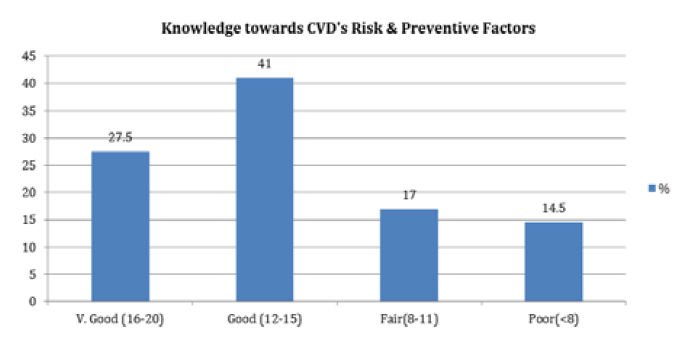
In the present study 27.5% (110) participants had very good knowledge (16-20 marks) towards Risk Factors and Prevention of Cardiovascular Diseases, 41% (164) had good knowledge (12-15 marks), 17% (68) had fair knowledge (8-11 marks) and 14.5% (58) having poor knowledge (<8 marks) (Figure 1).
Table 1: Knowledge Regarding Risk Factors and Prevention of Cardiovascular Diseases among Study Participants
| Statements | Frequency of Correct Responses | % |
Can you name some common cardiovascular diseases that affect the heart and blood vessels? | 278 | 69.5 |
What are the major risk factors associated with cardiovascular diseases? | 267 | 66.75 |
Are you aware of the link between smoking or tobacco use and heart health? | 264 | 66 |
Do you know the recommended levels for blood pressure that are considered healthy? | 282 | 70.5 |
How often do you engage in physical activity or exercise as a part of your routine? | 265 | 66.25 |
Are you familiar with the term "cholesterol" and its role in heart health? | 239 | 59.75 |
Have you ever undergone a cholesterol screening or lipid profile test? | 232 | 58 |
Are you aware of the importance of a balanced diet in preventing heart diseases? | 257 | 64.25 |
Can you name some foods that are considered heart-healthy or beneficial for cardiovascular health? | 228 | 57 |
Have you heard of conditions like diabetes and its connection to heart disease? | 265 | 66.25 |
Do you know the symptoms of a heart attack or stroke and what actions to take in such emergencies? | 274 | 68.5 |
Are you aware of the benefits of stress management techniques, such as meditation or yoga, for heart health? | 262 | 65.5 |
Have you or someone you know ever received information about CPR (Cardiopulmonary Resuscitation) and its significance? | 187 | 46.75 |
Do you think genetics or family history plays a role in cardiovascular disease risk? | 109 | 27.25 |
Have you been informed about the dangers of excessive alcohol consumption for heart health? | 242 | 60.5 |
Are you familiar with the concept of "atherosclerosis" and how it affects blood vessels? | 104 | 26 |
Have you ever attended a health workshop or seminar on cardiovascular disease prevention? | 98 | 24.5 |
Do you know the importance of regular health check-ups, including heart-related screenings? | 127 | 31.75 |
Are there any local or traditional practices in Himachal Pradesh that are believed to promote heart health? | 229 | 57.25 |
What lifestyle changes do you think are necessary to reduce the risk of cardiovascular diseases in Himachal Pradesh? | 272 | 68 |

Figure 1: Knowledge Scores towards Risk Factors and Prevention of Cardiovascular Disease among Study Participants
Cardiovascular Diseases (CVDs) remain a significant global health challenge and understanding the awareness and knowledge levels regarding CVD risk factors and prevention strategies is essential for effective public health interventions. This discussion section will delve into the findings of the study conducted in District Shimla, Himachal Pradesh and compare them with existing literature to identify knowledge gaps and opportunities for improving cardiovascular health awareness.
In this study, 69.5% of respondents could name some common cardiovascular diseases that affect the heart and blood vessels. This level of awareness is notable, as recognizing CVDs is the first step in understanding the associated risks and prevention strategies. However, further research could explore participants' knowledge of less common CVDs to assess the comprehensiveness of their awareness.
Approximately 66.75% of participants were aware of the major risk factors associated with cardiovascular diseases. These risk factors include tobacco use, high blood pressure, unhealthy diets, physical inactivity, excessive alcohol consumption and diabetes. This finding suggests a relatively good understanding of the fundamental risk factors contributing to CVD. Nevertheless, it is essential to examine whether individuals are aware of lesser-known risk factors and their impact on heart health.
Awareness of the link between smoking or tobacco use and heart health was relatively high, with 66% of respondents acknowledging this connection. This finding is encouraging, considering the severe impact of tobacco on cardiovascular health. Approximately 66.25% of participants reported engaging in physical activity or exercise as part of their routine. While this suggests a significant portion of the population prioritizes physical activity, further research could explore the intensity and frequency of these activities to determine whether they meet recommended guidelines for heart health.
Approximately 59.75% of respondents were familiar with the term "cholesterol" and its role in heart health. Understanding cholesterol and its impact on CVD risk is crucial, as it can influence dietary choices and lifestyle decisions. Approximately 64.25% of participants were aware of the importance of a balanced diet in preventing heart diseases. This awareness indicates the potential for dietary improvements to reduce CVD risk. However, future studies could delve deeper into participants' knowledge of specific dietary recommendations for heart health.
Knowledge regarding the connection between diabetes and heart disease was reported by 66.25% of participants. This finding is essential, as diabetes is a significant risk factor for CVD. It is crucial to continue educating individuals about the importance of diabetes management in preventing heart-related complications.
Approximately 68.5% of participants could identify the symptoms of a heart attack or stroke and knew what actions to take in such emergencies. Recognizing these symptoms and responding promptly is critical for minimizing the impact of CVD events. However, further research could explore whether participants are aware of the importance of calling emergency services in such situations.
While 46.75% of participants reported having received information about CPR (Cardiopulmonary Resuscitation) and its significance, this percentage could be higher. CPR knowledge is invaluable, as it can mean the difference between life and death in CVD emergencies. Thus, efforts should continue to increase CPR awareness and training.
Approximately 27.25% of participants believed that genetics or family history plays a role in cardiovascular disease risk. This perception is relatively low, considering the well-established link between family history and CVD risk. Educational initiatives could emphasize the importance of understanding one's family history in CVD prevention.
Approximately 60.5% of respondents were informed about the dangers of excessive alcohol consumption for heart health. This awareness is essential; as excessive alcohol intake is a modifiable risk factor for CVD. Education campaigns should continue to highlight the impact of alcohol on heart health.
Approximately 26% of participants were familiar with the concept of "atherosclerosis" and how it affects blood vessels. Increasing awareness of atherosclerosis and its role in CVD development can further empower individuals to make heart-healthy choices. Awareness of community health workshops or seminars on cardiovascular disease prevention was reported by 24.5% of participants. This finding suggests the potential for expanding community-based education and awareness initiatives. Additionally, 31.75% of respondents recognized the importance of regular health check-ups, including heart-related screenings. Encouraging regular health check-ups is critical for early detection and intervention.
A noteworthy 57.25% of participants were aware of local or traditional practices in Himachal Pradesh believed to promote heart health. These practices may include dietary choices, herbal remedies, or cultural traditions. Exploring and documenting these practices can provide valuable insights for developing culturally tailored CVD prevention programs. Approximately 68% of respondents recognized the need for lifestyle changes to reduce the risk of cardiovascular diseases in Himachal Pradesh. This acknowledgment indicates a readiness for behavior modification and presents an opportunity for targeted interventions.
Comparing these findings with studies conducted in other regions reveals variations in awareness levels and knowledge about cardiovascular diseases and their risk factors [6-10]. Factors such as educational background, access to healthcare and cultural practices can significantly influence individuals' understanding of CVD. Customizing awareness campaigns and interventions to address specific knowledge gaps in Shimla District is crucial for promoting heart-healthy behaviors.
In conclusion, this study sheds light on the awareness and knowledge levels of CVD risk factors and prevention strategies among the residents of District Shimla, Himachal Pradesh. While there is substantial awareness in some areas, such as recognizing common CVDs and major risk factors, there are notable knowledge gaps in other aspects of cardiovascular health. These findings emphasize the importance of tailored education and awareness campaigns to bridge these gaps, ultimately leading to improved cardiovascular health outcomes in the region.
World Health Organization. “Cardiovascular diseases (CVDs).” World Health Organization, 2017, www.who.int/news-room/fact-sheets/detail/cardiovascular-diseases-(cvds).
World Heart Federation. “Cardiovascular disease risk factors.” World Heart Federation, n.d., www.world-heart-federation.org/resources/risk-factors/.
Reddy, K.S. et al. “Educational status and cardiovascular risk profile in Indians.” Proceedings of the National Academy of Sciences of the United States of America, vol. 104, no. 41, 2007, pp. 16263–16268.
Gaziano, T.A. et al. “An assessment of community health workers’ ability to screen for cardiovascular disease risk with a simple, non-invasive risk assessment instrument in Bangladesh, Guatemala, Mexico and South Africa: An observational study.” The Lancet Global Health, vol. 6, no. 8, 2008, pp. e885–e893.
Gaziano, T.A. “Cardiovascular disease in the developing world and its cost-effective management.” Circulation, vol. 112, no. 23, 2005, pp. 3547–3553.
Gupta, R. et al. “Trends in coronary heart disease epidemiology in India.” Annals of Global Health, vol. 74, nos. 3–4, 2008, pp. 265–272.
Reddy, K.S. et al. “Responding to the threat of chronic diseases in India.” The Lancet, vol. 366, no. 9498, 2005, pp. 1746–1751.
Nabel, E.G. and E. Braunwald. “A tale of coronary artery disease and myocardial infarction.” New England Journal of Medicine, vol. 366, no. 1, 2012, pp. 54–63.
Gupta, R. et al. “Cardiovascular diseases in india: current epidemiology and future directions.” Circulation, vol. 133, no. 16, 2016, pp. 1605–1620.
Prabhakaran, D. et al. “Cardiovascular diseases in india: current epidemiology and future directions.” Circulation, vol. 133, no. 16, 2016, pp. 1605–1620.