Background: Stroke is a global public health concern associated with significant morbidity, mortality and healthcare costs. Enhancing awareness and knowledge about stroke risk factors and preventive measures is crucial to mitigate its impact. This study aims to assess the level of stroke awareness among the general public in District Shimla, a region with unique demographic and geographic characteristics. Materials and Methods: A cross-sectional survey design was employed to evaluate stroke awareness among adults (N=400) residing in District Shimla. A structured Google Form questionnaire was used to collect data on sociodemographic information, stroke-related knowledge and awareness of risk factors and preventive measures. Data analysis included descriptive statistics and knowledge categorization. Results: The study revealed that 73.25% of participants accurately defined stroke and 64.25% could identify common risk factors. While 67.75% understood the link between high blood pressure and stroke, knowledge varied for factors like smoking (52%), physical inactivity (60.25%) and diabetes (58%). Preventive measures like balanced diet (63.25%), exercise (64.25%) and managing cholesterol (53%) were acknowledged. However, awareness regarding stroke symptoms (42.75%) and recommended actions during stroke (30%) indicated gaps. Overall, 25.75% demonstrated very good knowledge, 36.75% good knowledge, 25.5% fair knowledge and 12% poor knowledge. Conclusion: The study highlights a positive foundation of stroke awareness among the general public in District Shimla. While many are informed about key risk factors and preventive measures, gaps exist in understanding symptoms and appropriate actions during stroke. Tailored educational interventions are needed to address specific knowledge deficits and promote holistic stroke awareness.
Stroke is a significant public health concern globally, accounting for substantial morbidity, mortality and healthcare expenditure. It is a cerebrovascular disorder characterized by the sudden disruption of blood supply to the brain, leading to brain cell damage and functional impairment. While advancements in medical science have improved stroke management, prevention remains the most effective approach to mitigate its devastating effects. To this end, enhancing public awareness and knowledge about the risk factors and preventive measures associated with stroke is of paramount importance [1-3].
The District Shimla, nestled in the picturesque Himalayan region of India, represents a unique demographic and geographic context. Despite its natural beauty and cultural significance, the district's remote location and limited access to specialized healthcare facilities can pose challenges for addressing medical emergencies such as stroke. Against this backdrop, understanding the level of stroke awareness and knowledge within the general public of District Shimla becomes crucial.
This present research aims to assess the current state of stroke awareness and knowledge in the region. The study will delve into the awareness levels of the general public regarding the risk factors associated with stroke, as well as their understanding of preventive measures that can be adopted to reduce the incidence of this condition. By identifying existing gaps in knowledge, this study intends to provide insights that can inform targeted educational interventions and public health campaigns.
Objectives of the Study
To evaluate the awareness and knowledge regarding Risk and Preventive factors for Stroke among general public of District Shimla.
Study Design and Setting
This research employed a cross-sectional survey design to evaluate the knowledge about Risk and Preventive factors for Stroke among the general population of District Shimla, known for its diverse population and urban lifestyle. Data collection and analysis took place over a duration of three months, from April 2023 to July 2023.
Study Population and Sample Size
The study's target population consisted of all adults above 18 years of age who had been residing in District Shimla for at least 12 months. A sample size of 400 adults was determined using a confidence level of 95%, an estimated knowledge level of 50% about Stroke risk and preventive factors, a 5% absolute error and a 5% non-response rate. This sample size ensured that the findings could be generalized to the larger population and provided sufficient representation.
Data Collection Tool
A well-structured and validated Google Form questionnaire was developed to collect data on the knowledge of Stroke risk and preventive factors. The questionnaire comprised two sections: the first section gathered socio-demographic data, including age, gender, marital status, religion, employment and education. The second section included 20 carefully crafted questions to assess participants' knowledge about Stroke risk and preventive factors. Each correct response was given one mark, while incorrect answers received zero marks. Participants' knowledge levels were categorized into four groups based on their scores: very good (>80%), good (60-79%), fair (41-59%) and poor (<40%).
Data Collection
Data collection was supervised by experienced personnel to ensure accuracy and reliability. The Google Form questionnaire was distributed through various online platforms, including email, WhatsApp groups, Facebook, Instagram and LinkedIn, to reach both rural and urban areas of District Shimla. Participants were provided with informed consent before their inclusion in the study and their personal information was treated confidentially. Ethical guidelines were strictly adhered to throughout the study, ensuring the privacy and anonymity of all respondents.
Data Analysis
Collected data was meticulously entered into a Microsoft Excel spreadsheet, where it was thoroughly checked for accuracy and completeness. Epi Info V7 software was utilized for data analysis. Descriptive statistics, such as frequencies and percentages, were employed to present the findings in a clear and concise manner. The data analysis aimed to identify the level of knowledge about Stroke risk and preventive factors among the general public of District Shimla and highlight any knowledge gaps that required attention.
Ethical Considerations
Ethical considerations were of utmost importance throughout the study. Informed consent was obtained from all participants before their participation, ensuring their voluntary involvement in the research. To protect the privacy and confidentiality of respondents, all data was anonymized and kept secure. Ethical guidelines for research involving human participants were strictly adhered to, fostering trust and respect between the researchers and the study population.
The goal of the current study was to assess the knowledge regarding Risk and Preventive factors for Stroke among general public of District Shimla through a non-experimental descriptive survey.
A total of 400 respondents took part in the study, with 282 (70.5%) coming from urban areas and 118 (29.5%) from rural areas (Table 1).
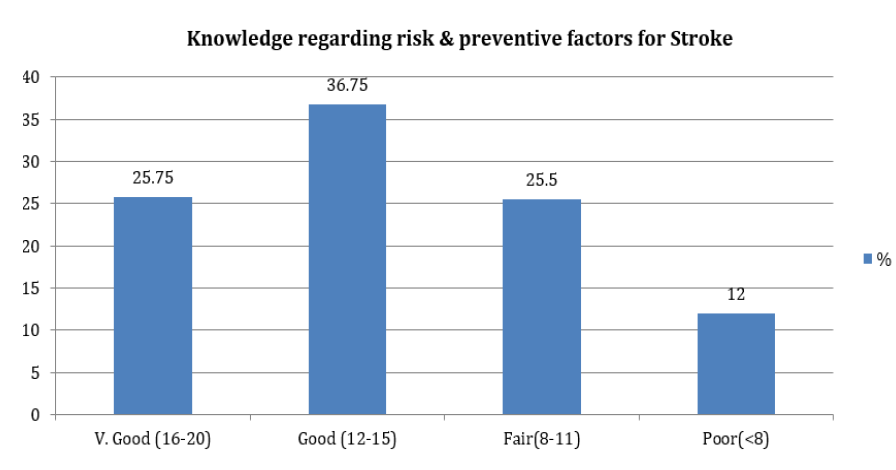
In the present study 25.75% (103) participants had very good knowledge (16-20 marks) towards Risk and Preventive factors for Stroke, 36.75% (147) had good knowledge (12-15 marks), 25.5% (102) had fair knowledge (8-11 marks) and 12% (48) having poor knowledge (<8 marks) (Figure 1).
Table 1: Knowledge Regarding Risk and Preventive Factors for Stroke among Study Participants
| Statements | Frequency of Correct Responses | % |
| What is a stroke and how would you define it in your own words? | 293 | 73.25 |
| Can you identify some common risk factors associated with stroke? | 257 | 64.25 |
| How does high blood pressure (hypertension) contribute to the risk of stroke? | 271 | 67.75 |
| Are you aware of the role of smoking in increasing the risk of stroke? | 208 | 52 |
| Can you name some lifestyle factors that can influence the likelihood of having a stroke? | 236 | 59 |
| How does physical inactivity impact the risk of stroke? | 241 | 60.25 |
| Are you familiar with the connection between diabetes and stroke risk? | 232 | 58 |
| Can you identify the role of family history in determining the risk of stroke? | 193 | 48.25 |
| Do you know if there are any specific age groups more vulnerable to stroke and why? | 162 | 40.5 |
| What role does obesity or being overweight play in stroke risk? | 218 | 54.5 |
| Do you know how excessive alcohol consumption can affect stroke risk? | 173 | 43.25 |
| Can you name some preventive measures that can be taken to reduce the risk of stroke? | 264 | 66 |
| How does a balanced diet contribute to preventing stroke? | 253 | 63.25 |
| Are you aware of the importance of managing cholesterol levels to prevent stroke? | 212 | 53 |
| Can you identify the warning signs or symptoms of a stroke? | 171 | 42.75 |
| What is the recommended action to take when someone is experiencing stroke symptoms? | 120 | 30 |
| Do you know the importance of seeking immediate medical attention in case of a suspected stroke? | 270 | 67.5 |
| How does regular exercise help in preventing stroke? | 257 | 64.25 |
| How can stress and anxiety impact the risk of stroke? | 261 | 65.25 |
Are you aware of any community resources or programs that provide information about stroke prevention? | 110 | 27.5 |

Figure 1: Knowledge Scores towards Risk and Preventive Factors for Stroke among Study Participants
The findings of this study provide valuable insights into the awareness and knowledge of the general public in District Shimla regarding the risk factors and preventive measures associated with stroke. Stroke continues to be a significant public health concern, warranting comprehensive efforts to enhance awareness and knowledge in order to reduce its burden on both individuals and healthcare systems.
The study revealed that a considerable percentage of participants had a relatively good understanding of stroke-related concepts. The majority of respondents could define stroke accurately and were aware of common risk factors such as high blood pressure, smoking, physical inactivity and diabetes. This level of awareness is promising, as it reflects that foundational knowledge about stroke exists within the surveyed population. Similar findings were reported by Pandian et al. [3], who noted improved knowledge about stroke risk factors in urban Indian populations.
Interestingly, the knowledge about lifestyle factors and their impact on stroke risk varied among participants. While many were aware of the link between obesity and stroke risk, a notable proportion lacked understanding about excessive alcohol consumption and its association with stroke. This highlights the need for targeted education campaigns that address specific lifestyle factors comprehensively. Comparable observations were made in a study conducted by O'Donnell et al. [2], in multiple countries, emphasizing the necessity for tailored awareness strategies.
In terms of preventive measures, a significant number of participants demonstrated knowledge of the role of a balanced diet, exercise and managing cholesterol levels in stroke prevention. This aligns with the recommendations of the World Health Organization [4,5] and corroborates the impact of health education initiatives in disseminating preventive information. However, there remains room for improvement in understanding warning signs and immediate actions when stroke symptoms occur. A considerable proportion of respondents lacked awareness of the recommended actions in such scenarios. This underscores the importance of emphasizing rapid response and seeking medical attention, as time-sensitive interventions are critical in stroke management [1,6].
The distribution of knowledge scores among participants indicated variations in understanding, with a substantial number falling into the "fair" category. This suggests that while foundational knowledge exists, there are knowledge gaps that need to be addressed through targeted educational interventions. The lack of awareness regarding community resources or programs for stroke prevention highlights an area where health authorities can facilitate greater access to information.
In conclusion, this study underscores the importance of stroke awareness and knowledge among the general public in District Shimla. While foundational knowledge about stroke risk factors and preventive measures is present, specific areas of deficiency require focused interventions. Public health campaigns should concentrate on enhancing knowledge about lesser-known risk factors, symptoms and immediate actions in case of a stroke. The findings from this study can serve as a valuable reference for designing and implementing context-specific educational programs to improve stroke awareness and prevention in District Shimla.
Feigin, V.L. et al. “Update on the global burden of ischemic and hemorrhagic stroke in 1990-2013: The GBD 2013 Study.” Neuroepidemiology, vol. 45, no. 3, 2015, pp. 161–176.
O'Donnell, M.J. et al. “Risk factors for ischaemic and intracerebral haemorrhagic stroke in 22 Countries (the interstroke Study): A Case-Control Study.” The Lancet, vol. 376, no. 9735, 2010, pp. 112–123.
Pandian, J.D. et al. “Prevention of stroke: a global perspective.” The Lancet, vol. 392, no. 10154, 2018, pp. 1269–1278.
World Health Organization. Stroke. 2021, https://www.who.int/news-room/fact-sheets/detail/stroke. Accessed 14 July 2023.
World Health Organization. Prevention and Control of Noncommunicable Diseases: Guidelines for Primary Health Care in Low Resource Settings. 2021, https://www.who.int/publications/i/item/9789241550233. Accessed 15 July 2023.
Asplund, K. and B. Stegmayr. “Stroke in Sweden: Recent progress.” Journal of Internal Medicine, vol. 281, no. 5, 2017, pp. 461–473.