Aim: The aim of this study is to evaluate the utilization of diabetic ulcer severity score as predictor of amputation. Objective: The objective of this study is to co-relate the diabetic ulcer severity score with the clinical outcome and evaluate the diabetic ulcer severity score as predictor of amputation. Materials and Methods: The study was conducted on 100 patients with foot ulcer and suffering from diabetes mellitus (as per WHO criteria) DUSS was calculated and patients received routine medical care for blood sugar control and wound care with debridement and wound dressing and final outcome co-related with the total DUSS. Results were analyzed and efficacy of DUSS to predict amputation in diabetic ulcers patients calculated. Results: Out of 100 patients, 29% of patients had major amputation, while 25% of them underwent minor amputations, 24% and 22% of ulcers healed by primary intention and split skin graft respectively. The probability of amputation with score of 0 was 5%, with score 1 was 12%, with score 2 was 27.28%, with score 3 was 47.06% and with score 4 was 68.75%. Discussion: Overall, 54 of 100 people had amputations in our study. Major amputation (below or above knee amputation) was done for 29% of patients in our study. Minor Amputation (toe or forefoot amputations) was done in 25% of patients in our study. 1 out of 20 with score 0, 3 out of 25 with score 1, 6 out of 22 with score 2, 8 out of 17 people with score 3 and 11 out of 16 people with score 4 had major amputations. Conclusion: Diabetic Ulcer Severity Score is easily applicable cost and time efficient scoring system to predict the clinical outcome in diabetic patients having foot ulcer without altering the routine line of management. Higher the total DUSS higher the risk of major amputation in diabetic patients with foot ulcer.
Keywords
Diabetic Ulcer Severity Score
Foot Ulcer
Clinical Score
Amputation
Diabetes Mellitus
INTRODUCTION
Foot ulcers are a common complication of diabetes and represent a major source of morbidity. Fifteen percent of diabetics develop foot ulcers during their life time with significant health related decrease in quality of life and consumption of a great deal of healthcare resources [1,2].
Numerous foot ulcer classification systems, such as the Meggit-Wagner system and the University of Texas systems, have been developed in an effort to classify ulcers more effectively and enable effective comparison of the results of routine management in various centers and treatment approaches. These systems have been utilized to compare the results and vary based on the location of the ulcer, its depth and the presence or absence of neuropathy, infection and peripheral arterial disease [3,4].
MATERIALS AND METHODS
Based on the inclusion and exclusion criteria listed below, 100 diabetic patients with diabetic foot ulcers (below ankle) of any duration who attended The Oxford Medical College Hospital, surgical outpatient clinics and getting hospitalized were included in the study.
Detailed clinical history elicited routine demographic data including age, sex, occupation, socio-economic and education status, details about habits and treatment history noted.
Thorough general physical examination and local examination of the affected foot with ulcer done, DUSS calculated and correlated with the outcome with follow up for 6 months.
Inclusion Criteria
All inpatients above 18 years with foot ulcers (below ankle) and suffering from Diabetes mellitus (as per WHO criteria).
Table 1: Diabetic Ulcer Severity Score
Parameters
Score 0
Score 1
Palpable pedal pulse
Present
Absent
Probing to bone
No
Yes
Ulcer site
Toes
Foot
Ulcer number
Single
Multiple
Exclusion Criteria
All non-diabetic ulcers over foot
Patients currently on immunosuppressive therapy
Ulcers situated above the ankle
Any existing active neoplastic disease
Patients with Necrotising fasciitis
Venous stasis ulcers with Diabetes mellitus
All patients with less than two follow up visits during observation period
Non diabetic neuropathic ulcers (Table 1)
Observations
About 100 patients with diabetic foot were included in our study. The following are our observations. The most commonly affected age group was 41-60 years, with mean age of 50+ = 2 years. Males were most commonly affected accounting to 68%.
DUSS Parameters (Ulcer Characteristics)
Ulcer Site: In our study most of the subjects had ulcers over the foot 72%
Ulcer Number: Majority of patients had single ulcers (66%) on presentation which showed positive results in terms of wound healing compared to those with multiple ulcers (34%)
Peripheral Pulses: 60.5% has palpable peripheral pulses. Those with absent peripheral pulses had higher amputation rates
Probing to Bone: Probing to the bone by a sterile blunt probe indicates depth of ulcer. In our study 61 patients (30.5%) had probing to the bone. These patients had higher scores with poorer outcomes
RESULTS
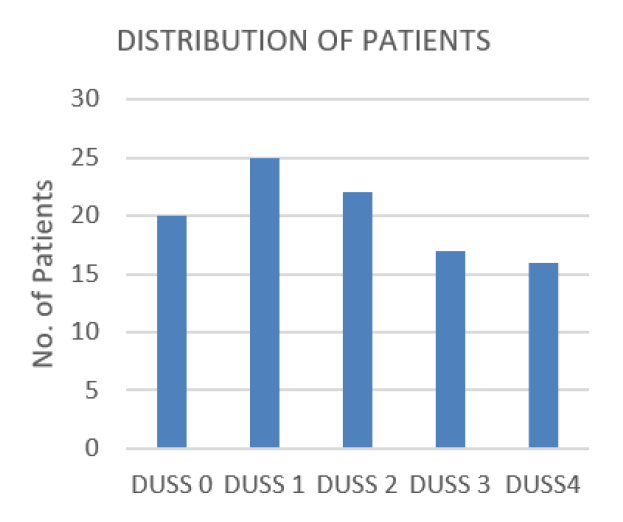
Out of 100 patients, 29% of patients had major amputation i.e. above knee and below knee amputations, while 25% of them underwent minor amputations i.e. toe disarticulation or fore foot amputation. 24% and 22% of ulcers healed by primary intention and split skin graft respectively (Figure 1).
Figure 1: Distribution of Patients According to DUSS Score Categories (DUSS 0–4)
Most of the ulcers were given DUSS score of 1(25% of patients), followed by DUSS score of 2 (22% of patients)
Among 45 patients with DUSS score 0 and 1
50% of ulcers healed by primary intention
37% of patients underwent split skin graft
4.2% underwent minor amputation
8.8% had major amputation
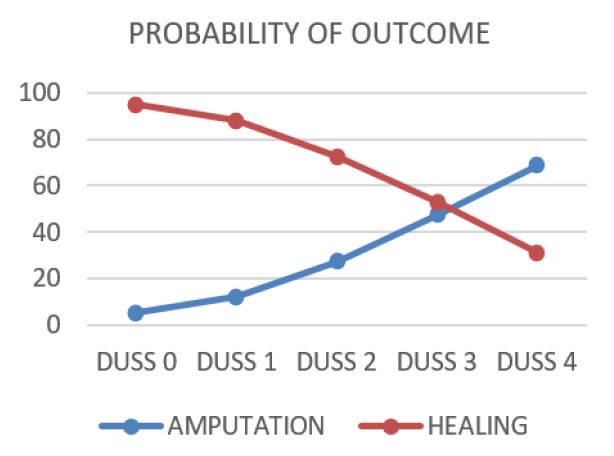
6 out of 22(27.27%) patients with DUSS score of 2 underwent major amputations (Figure 2)
while 8 out of 17 with DUSS score of 3 and 11 out of 16 with DUSS score of 4 had major amputations
Figure 2: Graph Illustrating the Inverse Relationship Between Healing and Amputation Probabilities Across Increasing DUSS Scores
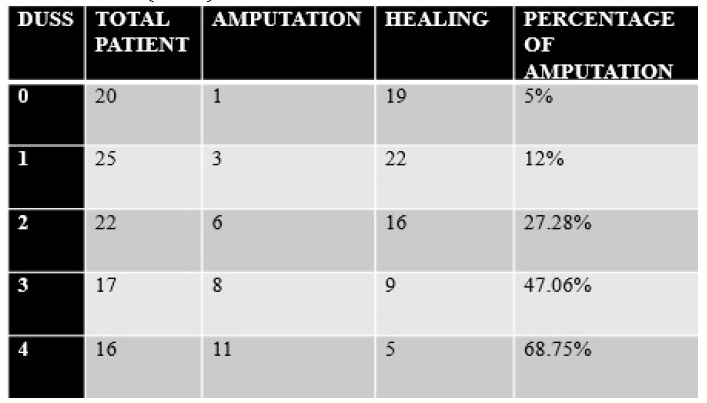
The probability of amputation with DUSS score was analyzed using Kaplan Meir statistics. The probability of amputation with score of 0 was 5%, with score 1 was 12%, with score 2 was 27.28%, with score 3 was 47.06% and with score 4 was 68.75% (Table 2)
Summary of the results of the study
Table 2: Distribution of Patient Outcomes (Healing and Amputation) and Percentage of Amputation According to Diabetic Ulcer Severity Score (DUSS)
DISCUSSION
Overall, 54 of 100 people had amputations in our study. Major amputation (below or above knee amputation) was done for 29% of patients in our study. Minor Amputation (toe or forefoot amputations) was done in 25% of patients in our study [5,6].
In the original study by Beckert et al. Patients with a score of 0 had no risk of major amputation, while patients with a score of 1 had a 2.4%, patients with a score of 2 had a 7.7%, patients with a score of 3 had an 11.2% and patients with a score of 4 had a 3.8% [1,7,8].
In comparison in our present study 1 out of 20 with score 0, 3 out of 25 with score 1, 6 out of 22 with score 2, 8 out of 17 people with score 3 and 11 out of 16 people with score 4 had major amputations [9,10].
CONCLUSION
The DUSS scoring system combines four clinically measurable wound-based characteristics to create a simple diagnostic tool for predicting the likelihood of healing or amputation.
It is very simple scoring system and easy to apply for diabetic patients with foot ulcers on routine basis.
In order to give a straightforward, streamlined method in a clinical context without the need for advanced investigative tool, the research groups can be stratified based on the severity of the ulcers. However, this does not change the process of wound management.
REFERENCES
Beckert, S. et al. “A new wound-based severity score for diabetic foot ulcers.” Diabetes Care, vol. 29, 2006, pp. 988–992.
Jeffcoate, W. et al. “The Charcot foot.” Diabetic Medicine, vol. 17, 2000, pp. 253–258.
Das, A.K. and A. Agarwal. “A precipitating factor in tropical diabetic foot ulcer in India.” Journal of the Association of Physicians of India, vol. 39, no. 5, May 1991, pp. 426.
Kalaivani, V. and H.M. Vijay Kumar. “Short communication: diabetic foot in India reviewing the epidemiology and the Amit Jain’s.” Scholars Academic Journal of Biosciences, vol. 1, no. 6, 2013, pp. 305–308.
Deribe, B.K. et al. “Prevalence and factors influencing diabetic foot ulcer among diabetic patients attending Arbaminch Hospital, South Ethiopia.” Journal of Diabetes and Metabolism, vol. 5, no. 1, 2014, pp. 2–7.
Karthikesalingam, A. et al. “A systematic review of scoring systems for diabetic foot ulcers.” Diabetic Medicine, vol. 57, no. 5, 2010, pp. 544–549.
Buckley, C.M. et al. “Timing of access to secondary healthcare services for diabetes management and lower extremity amputation in people with diabetes: a protocol of a case–control study.” BMJ Open, vol. 3, no. 10, 2013, article e003871.
Kumar, S.T. et al. “Diabetic ulcer severity score: clinical validation and outcome.” International Surgery Journal, vol. 3, 2016, pp. 1606–1610.
Shashikala, C.K. et al. “Validation of diabetic ulcer severity score (DUSS).” Annals of International Medical and Dental Research, vol. 3, no. 1, 2017, pp. SG27–SG30.
Menezes, J.V.F. et al. “Clinical utility of diabetic ulcer severity score in surgical practice.” International Surgery Journal, vol. 6, 2019, pp. 2469–2474.
Recommended Articles
Research Article
Advantages of Two Clips Laparoscopic Cholecystectomy (TCLC) and Conventional Laparoscopic Cholecystectomy (CLC): A Comparative Study
Anshu Attri,
...
Kartik Syal
Published: 10/01/2022
Download PDF
Research Article
Bladder Brilliance: Unveiling the Tapestry of Knowledge on Bladder Cancer in District Kangra, Himachal Pradesh
Vandana Thakur,
...
Ankita Pandey
Published: 08/12/2023
Download PDF
Research Article
Shouldering the Pain: Public Knowledge Assessment of Rotator Cuff Injuries in Himachal Pradesh
Sidhant Korla,
...
Praveen Kumar Thakur
Published: 30/07/2024
Download PDF
Research Article
Awareness regarding Symptoms and Treatment Options for Benign hypertrophy of prostate among the male patients attending outpatient department of Civil hospital , Nurpur, Himachal Pradesh
Aarti Chaudhary,
Brish Bhanu Bhardwaj
Published: 26/05/2023
Download PDF
PO Box 101, Nakuru
Kenya.
Email: office@iarconsortium.org
Editorial Office:
J.L Bhavan, Near Radison Blu Hotel,
Jalukbari, Guwahati-India
Achar, S. N. K., V., S. & Bhushan, S. N. (2023). Utilization of Diabetic Ulcer Severity Score as Predictor of Amputation. International Academic Research Journal of Surgery, 3(1), 1-3.
MLA
Achar, Shashank. N. K., Satish. V. and Suhas. N. Bhushan. "Utilization of Diabetic Ulcer Severity Score as Predictor of Amputation." International Academic Research Journal of Surgery 3.1 (2023): 1-3.
Chicago
Achar, Shashank. N. K., Satish. V. and Suhas. N. Bhushan. "Utilization of Diabetic Ulcer Severity Score as Predictor of Amputation." International Academic Research Journal of Surgery 3, no. 1 (2023): 1-3.
Harvard
Achar, S. N. K., V., S. and Bhushan, S. N. (2023) 'Utilization of Diabetic Ulcer Severity Score as Predictor of Amputation' International Academic Research Journal of Surgery 3(1), pp. 1-3.
Vancouver
Achar SNK, V. S, Bhushan SN. Utilization of Diabetic Ulcer Severity Score as Predictor of Amputation. International Academic Research Journal of Surgery. 2023 Jan;3(1):1-3.



 Download PDF
 Download XML