Background and Aim: Liver diseases are associated with low testosterone. However, little is known about risk factors of changes in testosterone. This study determined testosterone levels in liver cirrhosis and associated risk factors with the abnormal testosterone levels. Methods: In this descriptive hospital-based study, 50 patients with evidence of liver cirrhosis diagnosed on history, imaging and investigations were included for a period of 12 months. Testosterone levels were measured by enzyme chemiluminescence immunoassay (ECLIA)and value <249 ng/dl was taken as cut-off for decreased levels. Results: 84% of the patients had abnormal testosterone levels. Age, SGOT, SGPT, serum albumin, PT, and INR were not significantly associated with abnormal testosterone levels. Testosterone levels were decreased in majority of the patients but testosterone levels in CTP class B and C were higher, signifying that testosterone levels are related with severity of liver disease. Conclusion: There is a significantly higher prevalence of abnormal testosterone levels in liver cirrhotic patients in this region.
Keywords
Liver Cirrhosis
Testosterone
CTP
INTRODUCTION
Testosterone levels are generally low in men with advanced liver disease and progressively fall with increasing severity of liver disease [1]. Many clinical sequelae of advanced liver disease, such as anemia, sarcopenia, bone disease, and gynecomastia are also seen in hypogonadism. Therefore, low Testosterone levels may contribute to at least some of these manifestations. In addition,Testosterone deficiency has recently been identified as an independent prognostic marker in cirrhosis [2]. In this study, we determined testosterone levels in liver cirrhosis and associated risk factors with the abnormal testosterone levels.
MATERIALS AND METHODS
In this descriptive hospital-based study, 50 patients with evidence of liver cirrhosis diagnosed on history, imaging and investigations were included for a period of 12 months (Jan 2020-Dec 2020) at in Dr. Rajendra Prasad Government Medical College, Kangra at Tanda. Non-cirrhotic patients, and those who did not consent to participate in the study, were excluded.
Methodology
All consecutive patients of cirrhosis of liver willing to participate were subjected to focused history and examination. Demographic profile and detailed history were elicited. Detailed systemic examination was conducted. Patients were carefully examined to determine the etiology of the disease, complications at the time of presentation and disease prognosis. Data were recorded on a questionnaire specifically designed for this purpose. Variables were recorded, analyzed.
Each patient underwent the following laboratory analyses: full blood count; liver function tests, serum protein, serum albumin, SGPT, SGOT, direct, indirect and total bilirubin; renal function tests; blood sugar; serum electrolytes; and coagulation profile. Patients underwent laboratory test for testosterone levels. Testosterone levels were measured by enzyme chemiluminescence immunoassay (ECLIA)and value <249 ng/dl was taken as cut-off for decreased levels [3].
Statistical Analysis
Data were recorded into Microsoft® Excel workbook 2007 and exported into SPSS v21.0 (IBM, USA) for statistical statistical analysis. Categorical data were presented as frequency and percentages. Non-normative quantitative data were presented as median and interquartile range, compared using Mann-Whitney U test. Normative quantitative data were compare using one-way ANOVA between 3 groups. P<0.05 was considered significant.
RESULTS
General Characteristics
In our study, we observed that 7 patients (14%) were in the age group of less than 40 years, 18 patients (36%) were in the age group of 40-50 years, 18 patients (36%) were in the age group of 51-60 years and 7 patients (14%) were more than 60. The mean age was 50.4±10.1 years. The most common symptom was abdominal distension (50%) followed by upper GI bleed (30%), altered sensorium (20%), and jaundice (10%). Majority of the patients (58%) in our study were in CTP class C, followed by 16 patients (32%) in CTP class B, and 5 patients (10%) in CTP class A (Table 1).
Table 1: General Characteristics
Parameters
Frequency
Percentage
Age Group (Years)
<40
7
14.0
40-50
18
36.0
51-60
18
36.0
>60
7
14.0
Symptoms
Upper GI bleed
15
30.0
Abdominal distension
25
50.0
Altered sensorium
10
20.0
Jaundice
5
10.0
CTP class
A
5
10.0
B
16
32.0
C
29
58.0
Testosterone Levels
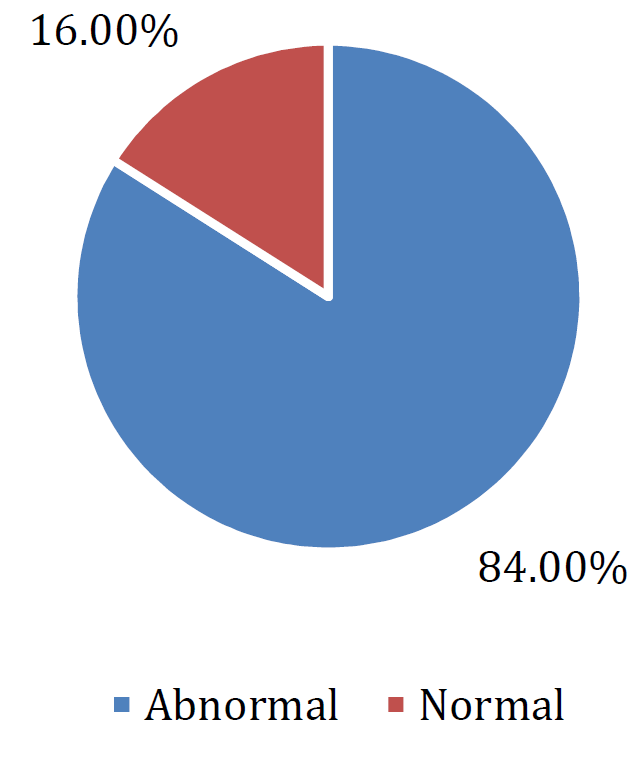
In this study, 84% of the patients had abnormal testosterone levels (Figure 1).
Figure 1: Testosterone Levels
Risk Factors of Abnormal Testosterone Levels
In our study, age, SGOT, SGPT, serum albumin, PT, and INR were not significantly associated with abnormal testosterone levels (Table 2).
Table 2: Risk Factors of Abnormal Testosterone Levels
Parameters
Normal (n = 8)
Abnormal (n = 42)
p value
Age (years)
42.5 (39.25, 50.25)
51.5 (44.75, 58.0)
0.064
SGOT
112.0 (73.5, 170.25)
85.5 (58.5, 176.5)
0.741
SGPT
44.5(31.25, 86.5)
45.5 (24.75, 90.75)
0.721
Serum albumin
2.5 (2.25, 3.2)
2.5 (2.3, 3.12)
0.979
PT
22.7 (16.7, 32.8)
17.3 (17.0, 24.4)
0.353
INR
1.9 (1.3, 2.3)
1.5 (1.3, 2.2)
0.443
Relation between CTP Score vs Testosterone
In our study, testosterone levels were decreased in majority of the patients but testosterone levels in CTP class B and C were higher, signifying that testosterone levels are related with severity of liver disease as shown in Table 3.
Table 3: Relation between CTP Class vs Testosterone
CTP class
Testosterone
p value
A
86.9±34.2
<0.0001
B
110.1±117.9
C
198.1±309.5
DISCUSSION
Testosterone, the most important androgen in males, plays a critical role in the metabolism of proteins, carbohydrates, and fat; and is believed to have suppressive effects on the immune system [4]. And its deficiency may contribute to increasing fat, decreasing muscle mass[5], intense immune response to HBV infection and severe liver inflammation [6].Testosterone deficiency is of high incidence among men with end-stage liver disease; furthermore, low testosterone is associated with an increased risk of mortality regardless of the etiology of disease.
Ray and Bhargava reported that overall testosterone levels were lower than normal in males (97% had low levels) but normal in females (46% had slightly high levels) and these changes were independent of the etiology or severity of CLD in both sexes [7]. However, in our study, all the patients were males, and the prevalence was 84%.
Kim et al. reported that men low serum testosterone levels were at a higher risk for NAFLD than men with a higher serum testosterone [8]. Moctezuma-Velázquez et al. reported that prevalence of hypotestosteronemia was 30% of male cirrhotic patients [9].
One of the limitations of our study is a smaller sample size, and we did not determine role of specific factors such as alcohol abuse, etiology of cirrhosis, BMI, etc.
CONCLUSION
Cirrhotic male patients have a higher prevalence of abnormal testosterone levels. Further studies with a large sample size are required to validate our findings.
REFERENCE
Handelsman, D.J. et al. “Hypothalamic-pituitary-testicular function in end-stage non-alcoholic liver disease before and after liver transplantation.” Clinical Endocrinology (Oxford), vol. 43, 1995, pp. 331–337.
Grossmann, M. et al. “Low testosterone levels as an independent predictor of mortality in men with chronic liver disease.” Clinical Endocrinology (Oxford), vol. 77, 2012, pp. 323–328.
Basukarno, A. et al. “Cut-off value of testosterone and FSH level in patient with azoospermia.” KME, vol. 1, no. 1, 2016, pp. 145–152.
Trigunaite, A. et al. “Suppressive effects of androgens on the immune system.” Cellular Immunology, vol. 294, no. 2, 2015, pp. 87–94.
Wang, C. et al. “Low testosterone associated with obesity and the metabolic syndrome contributes to sexual dysfunction and cardiovascular disease risk in men with type 2 diabetes.” Diabetes Care, vol. 34, no. 7, 2011, pp. 1669–1675.
Schwinge, D. et al. “Testosterone suppresses hepatic inflammation by the downregulation of IL-17, CXCL-9, and CXCL-10 in a mouse model of experimental acute cholangitis.” Journal of Immunology, vol. 194, no. 6, 2015, pp. 2522–2530.
Ray, G. and P.M. Bhargav. “A study of hormonal abnormalities in chronic liver disease.” Journal of the Association of Physicians of India, vol. 67, no. 4, 2019, pp. 47–52.
Kim, S. et al. “A low level of serum total testosterone is independently associated with nonalcoholic fatty liver disease.” BMC Gastroenterology, vol. 12, 2012, pp. 69.
Moctezuma-Velázquez, C. et al. “Association between low testosterone levels and sarcopenia in cirrhosis: A cross-sectional study.” Annals of Hepatology, vol. 17, no. 4, 2018, pp. 615–623.
Recommended Articles
Research Article
Advantages of Two Clips Laparoscopic Cholecystectomy (TCLC) and Conventional Laparoscopic Cholecystectomy (CLC): A Comparative Study
Anshu Attri,
...
Kartik Syal
Published: 10/01/2022
Download PDF
Research Article
Bladder Brilliance: Unveiling the Tapestry of Knowledge on Bladder Cancer in District Kangra, Himachal Pradesh
Vandana Thakur,
...
Ankita Pandey
Published: 08/12/2023
Download PDF
Research Article
Shouldering the Pain: Public Knowledge Assessment of Rotator Cuff Injuries in Himachal Pradesh
Sidhant Korla,
...
Praveen Kumar Thakur
Published: 30/07/2024
Download PDF
Research Article
Awareness regarding Symptoms and Treatment Options for Benign hypertrophy of prostate among the male patients attending outpatient department of Civil hospital , Nurpur, Himachal Pradesh
Aarti Chaudhary,
Brish Bhanu Bhardwaj
Published: 26/05/2023
Download PDF
PO Box 101, Nakuru
Kenya.
Email: office@iarconsortium.org
Editorial Office:
J.L Bhavan, Near Radison Blu Hotel,
Jalukbari, Guwahati-India
Sharma, S. & Shad, R. (2022). Risk Factors of Abnormal Testosterone Levels in Liver Cirrhosis. International Academic Research Journal of Surgery, 2(1), 1-3.
MLA
Sharma, Shubham and Roha Shad. "Risk Factors of Abnormal Testosterone Levels in Liver Cirrhosis." International Academic Research Journal of Surgery 2.1 (2022): 1-3.
Chicago
Sharma, Shubham and Roha Shad. "Risk Factors of Abnormal Testosterone Levels in Liver Cirrhosis." International Academic Research Journal of Surgery 2, no. 1 (2022): 1-3.
Harvard
Sharma, S. and Shad, R. (2022) 'Risk Factors of Abnormal Testosterone Levels in Liver Cirrhosis' International Academic Research Journal of Surgery 2(1), pp. 1-3.
Vancouver
Sharma S, Shad R. Risk Factors of Abnormal Testosterone Levels in Liver Cirrhosis. International Academic Research Journal of Surgery. 2022 Jan;2(1):1-3.


 Download PDF
 Download XML