Profile of Urology Patients at the Covid-19 Isolation Ward in Dr. Moewardi General Hospital Surakarta Periode June 2020 – May 2021 (A Retrospective Descriptive Study)
Meily Anggreini
1
,
Wibisono
2
1
General Surgery Resident, Faculty of Medicine, Universitas Sebelas Maret/Dr. Moewardi Hospital, Surakarta, Indonesia
2
Department of Urology, Faculty of Medicine, Universitas Sebelas Maret/Dr. Moewardi Hospital, Surakarta, Indonesia
Objective: Coronavirus disease firstly discovered in December 2019, has caused many changes in patient management in the hospital, including in urology department. Several studies have demonstrated an increased rate of delayed care, with urology surgery having a delay of more than 8 weeks [1]. The medical workers are trying to reduce the spread rate by reducing of transmission [1,2].The spread of this infectious disease is continuously increasing, hence the declaration of a pandemic [3].The COVID-19 status in the Solo city was updated to the red zone since the first year of the pandemic which makes the author interested in sharing information about COVID-19 in urology inpatients in the isolation ward [4]. Materials and Methods: This study is a retrospective descriptive study that used secondary medical records data to determine the profile of urology patients in the COVID-19 isolation ward in dr. Moewardi General Hospital Surakarta for 1 year from May 2020 – June 2021. Results: This study found the urology patients in the COVID-19 ward were 26 patients, which was 4% of the total urology inpatients in the dr. Moewardi General Hospital in the first year of pandemic. Male patients consisted 85% of the total patients, with a mean age of over 50 years. The most frequent diagnosis was urinary retention. The mean duration of hospitalization was 2 weeks. The management in ward were urinary catheter insertion, closed cystostomy, prostate biopsy with local anesthesia, and emergency debridement surgery in isolated operating room. Delayed diagnostic procedures consisted of USG and BNO, while the delayed elective surgery consisted of cystoscopy, nephrectomy, direct visual urethrotomy (DVIU), and DJ stent insertion. Conclusions: The urology inpatients in the COVID-19 ward treated by multiple departments, in which the treatment of COVID-19 was prioritized before the definitive management from the urology department.
Keywords
Urology Covid-19
Urological Surgeries
COVID-19 Pandemic
INTRODUCTION
The first coronavirus disease case was found at Wuhan, China, in December 2019. The spread of the disease was rapid and moved from Asia to the western [5]. The first COVID-19 case in Indonesia was reported on early March 2020 [6].Meanwhile the Covid-19 case was also reported at dr. Moewardi Hospital (RSDM) in the same month and year, hence it made Solo city became the first city with the first COVID-19 patient in Central Java [4]. The first urology patient with COVID-19 who was reported at RSDM was diagnosed with unspecific hematuria. COVID-19 has a huge impact on the medical world. In the urology department, the physicians have tightened the management of elective surgery with minimal risk to prevent the spread and transmission of the disease [5]. In this study, the author described that the timeline urology cases in COVID-19 at the RSUD dr. Moewardi was within the first year of the pandemic. As along of this study, COVID-19 is still increasing in the country. At the RSUD dr. Moewardi, the number of patients who are being treated in the isolation ward with the urology department are still increasing.
SARS-CoV-2 is a type of coronavirus that originated from bats. The virus is highly contagious, with three main routes of transmission: human contact, aerosol, and touch transmission [1]. In most countries, elective urological surgeries were canceled or postponed due to the high risk of COVID-19 infection, limited ventilator availability, limited medical personnel, or reduced hospital beds [1]. Surgical practice in the urology field was limited to only emergency cases, such as urinary tract obstruction, infection, acute renal failure, sepsis, trauma patients with unstable hemodynamics [5].Surgeries were delayed in cases of suspected or confirmed malignancy and stable oncology patients [7].In all confirmed or suspected cases of COVID-19, surgery must be conducted carefully.
We provided essential information regarding the patient profile in the COVID-19 ward with a urological evaluation in our hospital. A study reported that emergency urological surgery was constantly performed in a hospital at Singapore, but the elective surgery was decreased 70% within 2 months [4].Similarly, we also found such practice in the RSUD dr. Moewardi, including the management of urology patients in the COVID-19 ward. The diagnostic evaluations were postponed until the patient’s COVID-19 PCR swab result was negative. The elective surgeries were also postponed, with the exception of emergency conditions.
MATERIALS AND METHODS
This study is aimed to determine the profile of urology patients in the COVID-19 ward in RSUD dr. Moewardi Surakarta. We conducted a retrospective descriptive study from May 1st 2020 until June 30th 2021. The Data were obtained from the secondary medical records based on the COVID-19 diagnosis and urology diagnosis, which were hospitalized in the 3 COVID-19 isolation wards at RSUD dr. Moewardi. There were 26 subjects who were either treated because they were suspects with positive antigen swab results or from pneumonia on the chest x-ray or those who had been confirmed positive for COVID-19 from the PCR results. These patients could be urology patients who admitted from the emergency room (ER), or patients treated in the COVID-19 ward by the pulmonology or internal medicine department, which was later being consulted to the urology department with urology-associated or non-urology comorbidities. All hospitalized patients had symptoms or signs of COVID-19 infections and were tested with RT-PCR (reverse-transcriptase polymerase chain reaction) for viral identification.
RESULTS
The medical records data of urology inpatients in the COVID-19 ward showed that male subjects (85%) were more than female subjects (15%). The age range was 37 and 75 years. Out of 26 urology inpatients in the COVID-19 ward within the first 1 year of the pandemic, 21 of 26 (80%) were confirmed positive COVID-19 with a swab PCR test. The most frequent cases were urinary retention (19%), followed by hematuria (15%), bladder mass (15%), ureterolithiasis (11%), BPH (11%), renal tumor (7%), hydrocele (7%), Fournier gangrene (3%), urethral stricture (3%), and orchitis (3%). These patients were treated by the urology department with urinary catheter insertion and irrigation. For the emergency surgery, there was one case of emergency debridement in a patient with Fournier gangrene. The remaining patients were scheduled for elective surgery after a negative PCR swab test. Therefore, it can be concluded that urology inpatients in the COVID-19 ward were treated with the pulmonology and internal medicine department. The treatment for COVID-19 infection was conducted first prior the definitive management from the urology department while still addressing the emergency condition first.
DISCUSSION
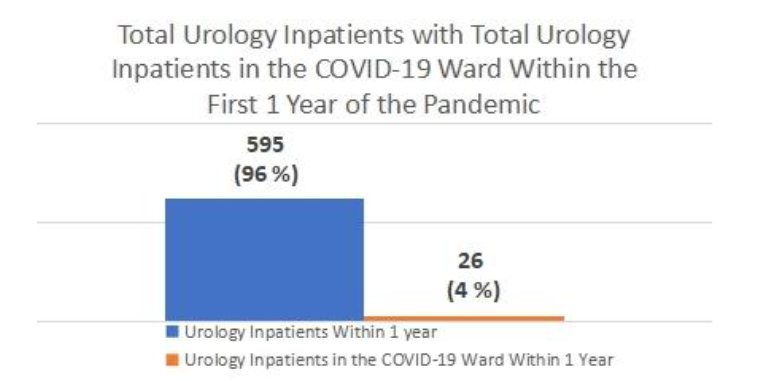
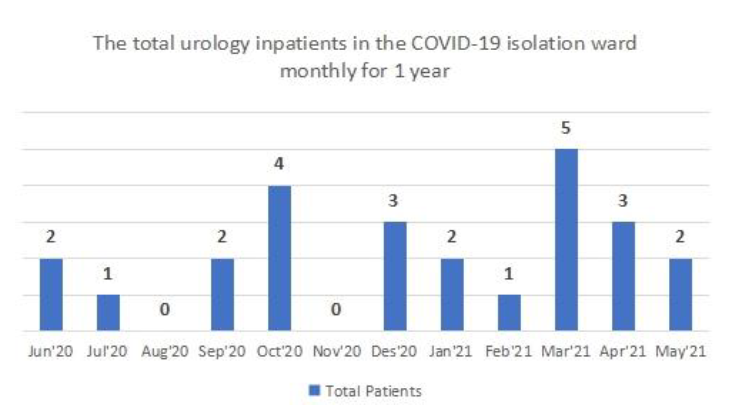
A study in Africa, Australia, and New Zealand has demonstrated an increased delayed rate of urological service with the rate of COVID-19 outbreak, with a mean of 28% in the outpatient clinic, 30% investigation and outpatient procedure, 31% of urological procedure was delayed for more than 8 weeks [1].Meanwhile, the number of COVID-19 patients in the country kept on rising [4].The graph below showed the total COVID-19 and urology patients in the RSUD dr. Moewardi. The monthly amount did not increase simultaneously, but the highest number was in March 2021. Out of 621 urology patients hospitalized within 1 year, there were 26 urology patients treated in the COVID-19 isolation ward, both suspects and confirmed cases. Therefore, only 4% of total urology inpatients were urology patients treated in the COVID-19 isolation ward (Figure 1,2).
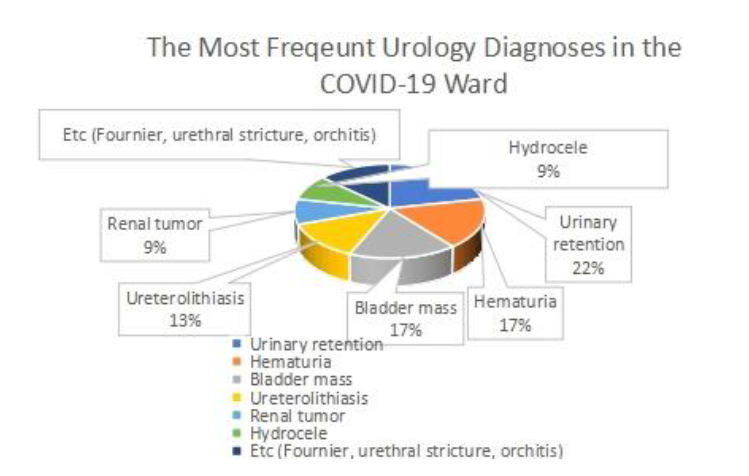
The 26 patients included patients with suspicious COVID-19, who had a reactive COVID-19 rapid test result or positive antigen swab or pneumonia features on the thorax x-ray, and patients with a confirmed positive result from PCR swab. A pulmonologist or internist treated these patients in the COVID-19 isolation ward with antiviral and symptomatic treatment. The incidence rate affects patients aged 37-80 years, with a ratio of 85%:155 for males: females. The most frequent cases in the urology field were urinary retention, with 5 patients (19%), hematuria with 4 patients (15%), bladder mass with 4 patients (15%), ureterolithiasis with 3 patients (11%), benign prostate hyperplasia (BPH) with 3 patients (11%), renal tumor with 2 patients (7%), hydrocele with 2 patients (7%), Fournier gangrene with 1 patient (3%), urethral stricture with 1 patient (3%), orchitis with 1 patient (3%) (Table 1) (Figure 3).
Figure 1: Total Urology Inpatients with Total Urology in the COVID-19 Ward within the First Year of the Pandemic
Figure 2: The Total Urology Inpatients in the COVID-19 Isolation Ward Monthly for 1 Year
Figure 3: Pie Chart the Most Urology Diagonoses
Table 1: Categorized the Emergency Urological Cases in the COVID-19 Ward
NO
Urological Emergency
Urological non-emergency
1
Urinary retention with urethral stenosis, urinary retention with obstructive uropathy with ovarium cancer and colon cancer, urinary retention with BPH
Urethrolithiasis with colic ureter and type 2 DM.
2
Hematuria with pancytopenia, gross hematuria with hematochezia, hematuria with prostate tumor dd/ bladder tumor, and pancytopenia
Orchitis
3
Fournier gangrene
Bladder cancer SCC post-TURB with cancer pain, TCC with AKI dd/ acute on CKD
4
Urethral stricture
Renal tumor with EDEM tumor with bone metastasis
5
-
BPH Post TURP on cystostomy
6
-
Hydrocele with pulmonary tumor, hydrocele with mediastinum tumor and pleural effusion.
Management in the COVID-19 Ward
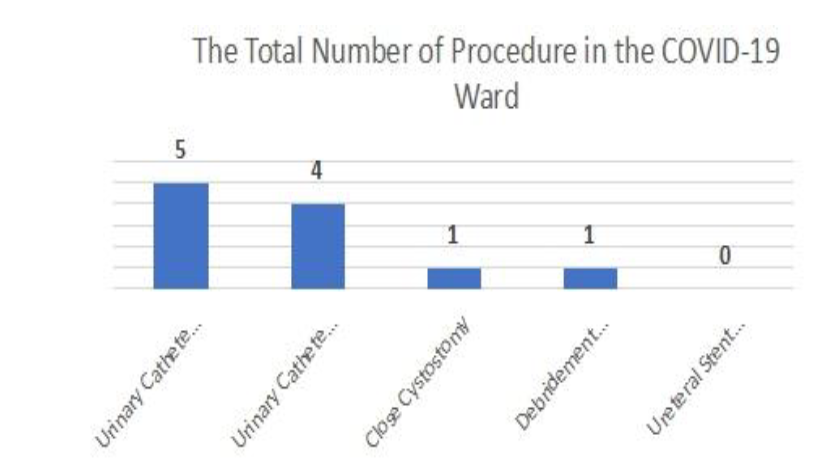
Several managements for urology inpatients in the COVID-19 ward included: urinary catheter insertion (DC), three-way DC insertion for irrigation, blasspunction (closed cystostomy), emergency debridement in the COVID-19 operating room, and scrotal support. Patients who required further radiologic workups such as USG or BNO were postponed until the PCR swab test result was negative. Similarly, the non-emergency urology patients who required definitive management with elective surgery were postponed until negative PCR swab test results. These patients consisted of urethral stricture patients who were planned for a direct visual internal urethrotomy (DVIU), patients with renal tumor planned for immediate nephrostomy reduction, and patients who were planned DJ stent insertion. The diagnostic workups that could be performed in the COVID-19 ward without delay consisted of laboratory workup, PSA, and prostate biopsy with local anesthesia. As the specialized COVID-19 management team, treatment from the pulmonology and internal medicine departments consisted of antiviral (Favipiravir), antibiotics (Azithromycin), anti-inflammatory, and symptomatic medicine as indicated.
Length Of Stay
From the 26 urology patients in the COVID-19 ward, 5 patients had thorax x-ray features of pneumonia and positive antigen swab test and were discharged after a confirmed negative PCR swab test on the 2nd day of admission. The other 21 patients treated in the COVID-19 ward had a confirmed positive PCR swab test, with a mean total length of stay of 14 days.
Figure 4: Total Number of Procedure in the COVID-19 Ward
Follow-Up
5 patients died during treatment in the COVID-19 ward, 3 patients died in the first 48 hours of admission. The patients were 1 COVID-19 patient with bladder carcinoma, and the other 2 patients died after 1 month of treatment. The other 2 patients were COVID-19 patients with multiple nephrolithiasis and bladder carcinoma. The remaining patients were discharged with a negative PCR swab test and good overall condition. Half of the patients still had positive PCR swab test results but had already done 14 days of treatment in the COVID-19 ward without clinical symptoms of COVID-19. These patients were discharged for further self-isolation in their homes (Figure 4).
CONCLUSION
The urology inpatients in the COVID-19 ward in the first year of pandemic in General Hospital dr. Moewardi Surakarta was only 4 % from the total of urology inpatients, consisted of patients treated by the internal medicine departments and pulmonary departments, the doctors had delayed the definitive management as for non-emergency surgery, in which the treatment of COVID-19 was prioritized before the definitive management from the urology department.
REFERENCE
Amota, O. et al. “Urological practice during the COVID-19 pandemic in Targu Mureș: A Clinical Study.” Romanian Journal of Medicine, vol. 19, 2020, pp. 19–21.
Sanyaolu, A. et al. “Comorbidity and its impact on patients with COVID-19.” SN Comprehensive Clinical Medicine, Springer Nature Switzerland AG, 2020, https://doi.org/10.1007/s42399-020-00363-4.
Cucinotta, D. and M. Vanelli. “WHO Declares COVID-19 a Pandemic.” Acta Biomedica, 2020, www.mattioli1885journals.com/index.php/actabiomedica/article/view/9397/8659.
Tanggap COVID-19 Jawa Tengah. “Berita detail.” Pemerintah Provinsi Jawa Tengah, 2020, corona.jatengprov.go.id/berita-detail/72.
Rasyid, N. et al. “Impact of the COVID-19 pandemic on urology practice in Indonesia: A Nationwide Survey.” Urology Journal, vol. 17, no. 6, 2020, pp. 677–679, https://doi.org/10.22037/uj.v16i7.6459.
Singhal, T. “A Review of Coronavirus Disease-2019 (COVID-19).” Indian Journal of Pediatrics, vol. 87, no. 4, April 2020, pp. 281–286, https://doi.org/10.1007/s12098-020-03263-6.
Heinze, A. et al. “Impact of COVID-19 on clinical and academic urological practice: A survey from the European Urology section of Uro-technology.” European Urology Open Science, vol. 21, 2020, pp. 22–28.
Recommended Articles
Research Article
Advantages of Two Clips Laparoscopic Cholecystectomy (TCLC) and Conventional Laparoscopic Cholecystectomy (CLC): A Comparative Study
Anshu Attri,
...
Kartik Syal
Published: 10/01/2022
Download PDF
Research Article
Bladder Brilliance: Unveiling the Tapestry of Knowledge on Bladder Cancer in District Kangra, Himachal Pradesh
Vandana Thakur,
...
Ankita Pandey
Published: 08/12/2023
Download PDF
Research Article
Shouldering the Pain: Public Knowledge Assessment of Rotator Cuff Injuries in Himachal Pradesh
Sidhant Korla,
...
Praveen Kumar Thakur
Published: 30/07/2024
Download PDF
Research Article
Awareness regarding Symptoms and Treatment Options for Benign hypertrophy of prostate among the male patients attending outpatient department of Civil hospital , Nurpur, Himachal Pradesh
Aarti Chaudhary,
Brish Bhanu Bhardwaj
Published: 26/05/2023
Download PDF
PO Box 101, Nakuru
Kenya.
Email: office@iarconsortium.org
Editorial Office:
J.L Bhavan, Near Radison Blu Hotel,
Jalukbari, Guwahati-India
Anggreini, M. & None, W. (2022). Profile of Urology Patients at the Covid-19 Isolation Ward in Dr. Moewardi General Hospital Surakarta Periode June 2020 – May 2021 (A Retrospective Descriptive Study). International Academic Research Journal of Surgery, 2(1), 1-4.
MLA
Anggreini, Meily and Wibisono . "Profile of Urology Patients at the Covid-19 Isolation Ward in Dr. Moewardi General Hospital Surakarta Periode June 2020 – May 2021 (A Retrospective Descriptive Study)." International Academic Research Journal of Surgery 2.1 (2022): 1-4.
Chicago
Anggreini, Meily and Wibisono . "Profile of Urology Patients at the Covid-19 Isolation Ward in Dr. Moewardi General Hospital Surakarta Periode June 2020 – May 2021 (A Retrospective Descriptive Study)." International Academic Research Journal of Surgery 2, no. 1 (2022): 1-4.
Harvard
Anggreini, M. and None, W. (2022) 'Profile of Urology Patients at the Covid-19 Isolation Ward in Dr. Moewardi General Hospital Surakarta Periode June 2020 – May 2021 (A Retrospective Descriptive Study)' International Academic Research Journal of Surgery 2(1), pp. 1-4.
Vancouver
Anggreini M, Wibisono W. Profile of Urology Patients at the Covid-19 Isolation Ward in Dr. Moewardi General Hospital Surakarta Periode June 2020 – May 2021 (A Retrospective Descriptive Study). International Academic Research Journal of Surgery. 2022 Jan;2(1):1-4.


 Download PDF
 Download XML