Contents
Download PDF
pdf Download XML
422 Views
196 Downloads
Share this article
Research Article | Volume 2 Issue 1 (Jan-June, 2022) | Pages 1 - 4
Ocular Surface Disorders and Their Association with Socio-Demographic Variables Among Patients Admitted in Adult Intensive Care Unit of a Tertiary Care Hospital
 ,
 ,
 ,
 ,
1
MS, Ophthalmology, Pt. Jawahar Lal Nehru GMC, Chamba, Himachal Pradesh, India
2
Professor and Head, Department of Ophthalmology,Dr RPGMC Kangra Tanda, Himachal Pradesh, India
3
Professor, Department of Ophthalmology, Dr RPGMC Kangra Tanda, Himachal Pradesh, India
4
Assistant Professor, Department of Anaesthesiology, Indira Gandhi Medical College, Shimla, Himachal Pradesh, India
5
MS, ENT,Civil Hospital, Chowari, Chamba, Himachal Pradesh, India
Under a Creative Commons license
Open Access
Received
Feb. 3, 2022
Revised
March 9, 2022
Accepted
April 19, 2022
Published
May 10, 2022
Abstract

Background: Present study was done to evaluate the ocular surface disorders and their association with Socio-demographic variables among patients admitted in Adult Intensive Care Unit. Material and Methods: It was a prospective observational study carried in AICU over period of one year by Department of Ophthalmology, Dr. RPGMC Kangra at Tanda. All the patients who were admitted in AICU greater than 48 hours between ages of 18-65 years were included and evaluated for socio-demographic information like age, gender etc. Thorough ophthalmic examination was also done for ocular surface disorders and analyzed using epi info v7 software. Results: A total of 126 patients were included in the study. Mean age of the study participants was 41.8 years. Maximum patients, 23.8% of the patients were in age group of 51 and 60 years followed by 23% between 21 and 30 years and 41 and 50 years each. 64.3% of the patients were males while 35.7% were females. 101(80.2%) patients belonged to rural areas while 25(19.8%) belonged to urban areas. 73.8% of the patients belonged to lower upper Socioeconomic class followed by 11.2% patients in lower middle class. For 78.6% of the patients, duration of stay in AICU was up to one week followed by 12.7% had the hospital stay was between 1 week and 2 weeks. 74 (58.7%) of the patients had ocular surface disorders. Longer duration of stay in AICU was associated with significantly increased number of patients having ocular surface disorders (p<0.0001). Presence of ocular surface disorders was not related with age (p = 0.153) and gender (p = 0.359). Conclusion: The present study concluded that there is a close association of ocular surface disorders with longer duration of stay of these critically ill AICU patients. Eye care should be an integral part of management of these patients. 


Keywords
INTRODUCTION

Intensive care unit (ICU) patients are susceptible to a number of ophthalmic conditions that may result in visual loss. Such ICU patients are often neglected for ocular complications, while management of life-threatening conditions becomes primary objective. However, visual impairment in those who survive their stay in the ICU can be devastating, largely irreversible, and often preventable and may occur in those who might have otherwise recovered from their primary illness without lasting sequelae [1,2]. Ocular surface disorders characterized by disorders of the conjunctiva or cornea have been described in the anaesthetized patients. Though, ocular surface disorders are usually self-limiting, they may lead to visual impairment or blindness if extensive. Post-recovery visual loss would be devastating to any patient who has recovered from the physical and psychological impact of intensive care therapy [3]. In the critically ill and unconscious patients, predisposing factors include position of the lid, use of mechanical ventilation, presence of respiratory tract infection or organ failure and prophylactic eye care instituted. Temperature and humidity also play an important role in patients with incomplete eye closure [4]. 


Several studies around the globe as well as in India have reported ocular surface disorders in ICU patients. However, no such study of its kind has been reported from this region. Hence, we planned to study the ocular surface disorders and their association with Socio-demographic variables among patients admitted in Adult Intensive Care Unit either on mechanical ventilation or on spontaneous respiration.


Aim and Objectives

To study the Ocular Surface Disorders and their association with Socio-demographic variables among patients admitted in Adult Intensive Care Unit of Dr RPGMC Kangra (Tanda), H.P.

MATERIALS AND METHODS

Study Design

It was a prospective observational study


Study Area

Department of Ophthalmology, Dr. RPGMC Kangra at Tanda


Study Period

After approval by institutional ethical committee (IEC), this study was carried in adult intensive care unit (AICU) at Dr. Rajendra Prasad Government Medical College, Kangra at Tanda (HP) over period of one year.


Study Population

This prospective study was carried out in 126 patients, 18-65 years of age in adult intensive care unit (AICU) at Dr. Rajendra Prasad Government Medical College, Kangra at Tanda (HP).


Inclusion Criteria


  • All patients aged 18-65 years admitted in AICU for a time period >48 hours were included. 

  • Prior informed consent was obtained from attendant authorized to do so.


Exclusion criteria


  • Patients who presented with ocular surface disorders prior to admission in AICU.

  • Patients or authorized attendant not willing to participate in the study.


Materials for Eye Examination

Following equipments were used for clinical examination:


  • For anterior segment examination

  • Hand held Slit lamp examination

  • Staining procedures

  • Fluorescein staining

  • Rose Bengal staining

  • For Microbiological examination (if and when required)

  • Conjunctival Swab

  • Gram stain

  • KOH mount

  • Culture in Blood Agar, Sabouraud dextrose Agar, Brain Heart Infusion

  • For tear film function 

  • Schirmer’s test

  • For intra ocular pressure measurement

  • Schiotz tonometer

  • For posterior segment examination

  • Direct ophthalmoscope (Heine beta 200S ophthalmoscope)

  • Indirect ophthalmoscopy with 20D aspheric lens (If required)


Methodology of Data Collection

All the patients who were admitted in ICU greater than 48 hours between age of 18-65 years were included in this observational study. All patients who were on mechanical ventilation or on spontaneous ventilation were taken for this study. Mechanically ventilated patients were those patients who are intubated either by Endotracheal tube (ETT) or Tracheostomy tube (TT) and were on mechanical ventilation. Spontaneous breathing patients were patients who were either on room air or on venti mask.


Patients were evaluated with special reference to Demographic information like name, age (in years), gender (male/female), occupation, address. Socioeconomic class was determined using Kuppuswamy’ scale, Past history of ocular infection, surgery, trauma.History of any drugs use like amiodarone, tetracycline etc. and Examination finding including general physical examination, pulse, blood pressure.


Thorough ophthalmic examination including Pupil size and reactionRelative afferent pupillary defect by swinging flash light examination, External eye examination for conditions like presence of lagophthalmos, exophthalmos, buphtalmos and deviation of eyeball, Hand held Slit lamp examination for complete anterior segment evaluation.


Conjunctival swab was obtained pulling down lower lid exposing the conjunctiva. Gently sweep the sterile swab stick along the lower fornix from inner to outer canthus taking care not to touch the eyelids.


Fundus evaluation using direct ophthalmoscope (Heine beta 200S LED) after pupillary dilatation with 1% Tropicamide eye drop twice, instilled 15 minutes apart.


Follow-up of the patients was done on every alternate day or depending upon the ocular surface involvement.


Ethical Consideration

The study was approved by IEC at Dr RPGMC Kangra at Tanda. Consent forms were signed and collected from attendants of all the patients, who were included in the study.


Financial Disclosure

There was no any additional financial burden on the subjects because of participation in the study. Investigator did not get any financial benefit from any source for this study. 


Statistical Analysis

Data were entered in to spreadsheet and analysed using SPSS v21. Data were presented as frequency, percentage, mean, and standard deviation (SD). Normality of data was determined by Shapiro Wilk test. Normally distributed quantitative variables were compared using Student t-test. Categorical variables were compared using Chi square test. P value <0.05 was considered statistically significant. 
RESULTS

Observations and Results

The present study was aimed to evaluate the ocular surface disorders Ocular Surface Disorders and their relation to Socio-demographic variables among patients admitted in Adult Intensive Care Unit of Dr RPGMC Kangra at Tanda during the period of one year. A total of 126 patients were included in the study. Out of 126 patients, 102 patients were later shifted to respective wards, 17 patients did not survive while 7 patients were referred to higher centre for further management. The study findings have been presented below:


In the present study, for 78.6% of the patients, duration of stay in AICU was up to one week. For 12.7% of the patients, the hospital stay was between 1 week and 2 weeks. Only 4.8% of the patients were admitted in AICU for more than 3 weeks.


Mean age of the study participants was 41.8 years with a range from 18 years to 65 years. 23.8% of the patients were in age group of 51 and 60 years. 23% of the patients were each aged between 21 and 30 years and 41 and 50 years. 13.5% patients belonged to age-group of 31 to 40 years. 8.8% of the patients were elderly (>60 years). Remaining, 7.9% of the patients aged up to 20 years. In the present study, male to female ratio was 1.8:1. 64.3% of the patients in our study were males while remaining 35.7% of the patients were females.


In the present study, 101(80.2%) patients belonged to rural areas while 25(19.8%) patients belonged to urban areas. Socioeconomic class was determined using Kuppuswamy scale. 73.8% of the patients belonged to lower upper class followed by 11.2% patients in lower middle class (Table 1).


Table 1: Age and Gender Distribution of the Study Participants 

Parameters

Number of patients

Percentage


Age (Years) (n = 126)

≤20

10

7.9

21-30

29

23.0

31-40

17

13.5

41-50

29

23.0

51-60

30

23.8

60-65

11

8.8

Gender (n = 126)

Male

81

64.3

Female

45

35.7

Total number of patients

126

100


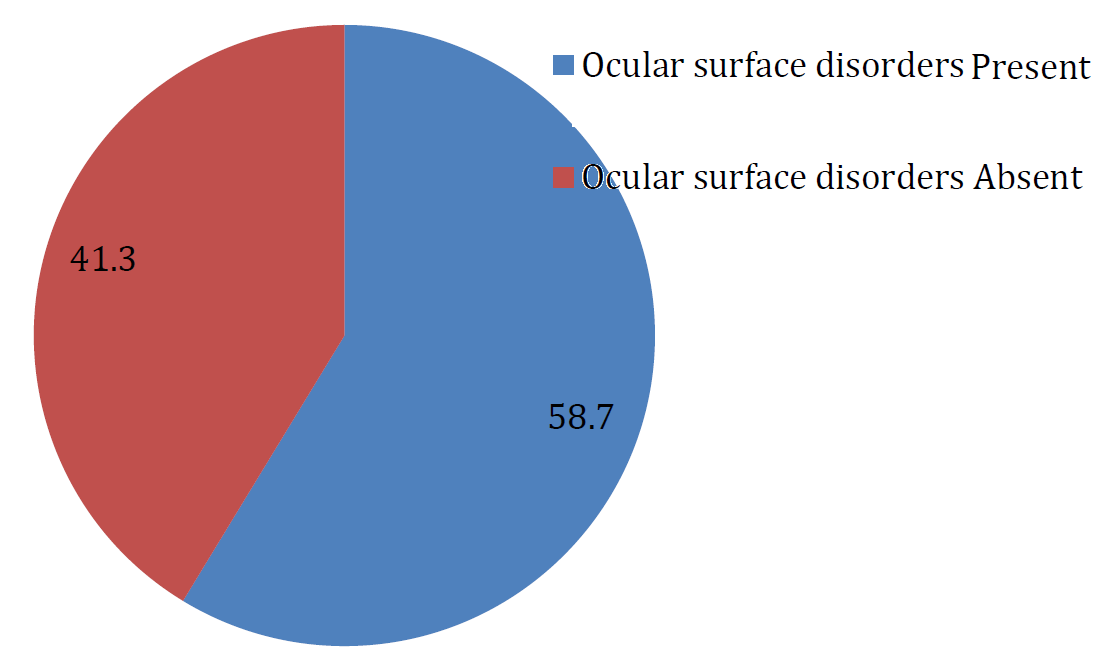
In the present study, 74 (58.7%) of the patients had ocular surface disorders while it was absent in 52 (41.3%) patients (Table 2).


Table 2: Distribution of Study Participants Based on Residence and Socioeconomic Class 

Parameters

Rural/Urban

Number of Patients

Percentage

Area of Residence (n = 126)

Rural

101

80.2

Urban

25

19.8


Socioeconomic class (n = 126)


Upper

3

2.4

Upper Middle

5

4.0

Lower Middle

14

11.2

Upper Lower

11

8.7

Lower

93

73.8

Total number of patients

126

100


In the present study, mean age of patients with ocular surface disorders was 43.40±14.37 years and mean age of the patients who did not have ocular surface disorders was 39.52±14.67 years. The difference between age of these patients was not statistically significant (p = 0.141). In the present study, presence of ocular surface disorders was not related with gender of the patients (p = 0.359) (Table 3). 


Table 3: Relation Between Presence of Ocular Surface Disorders and Socio-Demographic Variables

Socio-demographic variables No Ocular Surface Disorders (N = 52)Ocular Surface Disorders Present (N = 74)p value

Mean age of patients (years)

Mean ± SD

39.52±14.67

43.40±14.37

0.141

Gender 

Male

31

50

0.359

Female

21

24

Mean duration of stay in AICU (days)

Mean ± SD

3.40±1.24

8.34±7.37

<0.0001


In the present study, mean duration of stay of patients with ocular surface disorders was 8.34±7.37 days and mean duration of stay of the patients who did not have ocular surface disorders was 3.40±1.24 days. The difference between duration of stay of these patients was statistically significant (p<0.0001) (Figure 1).


Figure 1: Ocular Surface Disorders (n = 126)

DISCUSSION

In our study, mean age of the patients was 41.8 years. 55.4% of the patients were aged above 40 years. Our findings are in agreement with the previous studies. Ramamoorthy and Kothandaraman [5] reported that 70% of the ICU patients were aged >40 years. In our study, age was not associated with increased incidence of ocular surface disorders. This is in concordance with results of Merceica et al. [6] who also showed that age was not a predisposing factor for development of keratopathy in AICU patients.


In the present study, hospital-based incidence of ocular surface disorders was 58.7% in our patients. Our results are in concordance with Desalu et al. [7] who reported the incidence of ocular surface disorders in 55.4% of critically ill patients. In another study by Hernandez et al. [8], punctate epithelial keratopathy developedin 40% of patients in the AICU.


In the present study, 64.3% of the patients were males, and gender was not associated with the development of ocular surface disorders. Ramamoorthy and Kothandaraman [5] reported that 62.5% of the ICU patients were males. Merceica et al.[6] reported that gender of the patients was not associated with development of keratopathy in ICU patients.


In our study, higher duration of AICU stay was associated with significantly higher ocular surface disorders (p<0.0001). The patients with longer duration of stay were mechanically ventilated for longer time, sedated for longer time, and had higher chances of lagophthalmos, which results in the development of ocular surface disorders.Duration of stay has earlier been suggested as a risk factor for the development of ocular surface disorders in AICU patients. In a retrospective analysis, Imanaka et al. [9] reported that longer AICU stay was one of the predisposing factors for the development of ocular surface disorders. In a prospective study by Hernandez et al. [8], 82% of the patients developed corneal abnormalities who stayed in AICU for more than one week. Similarly, Merceica et al. [6] reported that 82% of keratopathy was detected at the end of first week of AICU stay.


ICU medical and nursing staffs are primarily concerned with life threatening conditions; therefore, the ocular signs and symptoms may be missed leading to serious ocular complications. If they are properly educated about eye care along with general care, they can markedly reduce eye related complications which may cause blindness. 

CONCLUSION

The present study concluded that critically ill patients admitted in Adult Intensive Care Unit were mostly males, in the age group between 51-60 years, belongs to rural area, from lower upper Socioeconomic class, had duration of stay up to one week and had high incidence of ocular surface disorders. There is a close association of ocular surface disorders with longer duration of stay of these critically ill AICU patients. Eye care should be an integral part of management of these patients.

REFERENCE
  1. Hearne, B.J. et al. “Eye care in the intensive care unit.” J Intensive Care Soc., vol. 19, no. 4, November 2018, pp. 345–350.

  2. Płaszewska-Żywko, L. et al. “Risk factors of eye complications in patients treated in the intensive care unit.” Int J Environ Res Public Health, vol. 18, no. 21, October 2021, 11178.

  3. White, E. and Crosse, M.M. “The aetiology and prevention of peri-operative corneal abrasions.” Anaesth, vol. 53, 1998, pp. 157–161.

  4. Desalu, I. et al. “Ocular surface disorders in intensive care unit patients in a sub-saharan teaching hospital.” J Emerg Intensive Care Med, vol. 11, 2008, pp. 35–39.

  5. Ramamoorthy, K. and Kothandaraman, K. “A study of incidence of dry eye in critically ill patients in intensive care unit.” Int J of Allied Med Sci Clin Res, vol. 5, 2017, pp. 247–252.

  6. Merceica, F. et al. “Ocular surface disease in intensive care unit patients.” Eye, vol. 13, 1999, pp. 231–236.

  7. Desalu, I. et al. “Ocular surface disorders in intensive care unit patients in a sub-saharan teaching hospital.” J Emerg Intensive Care Med, vol. 11, 2008, pp. 35–39.

  8. Hernandez, E.V. and Mannis, M.J. “Superficial keratopathy in intensive careunit patients.” Am J Ophthalmol, vol. 2, 1997, pp. 212–216.

  9. Imanaka, H. et al. “Ocular surface disorders inthe critically ill.” AnesthAnalg, vol. 85, 1997, pp. 343–346.

Recommended Articles
Research Article
Advantages of Two Clips Laparoscopic Cholecystectomy (TCLC) and Conventional Laparoscopic Cholecystectomy (CLC): A Comparative Study
...
Published: 10/01/2022
Download PDF
Research Article
Bladder Brilliance: Unveiling the Tapestry of Knowledge on Bladder Cancer in District Kangra, Himachal Pradesh
...
Published: 08/12/2023
Download PDF
Research Article
Shouldering the Pain: Public Knowledge Assessment of Rotator Cuff Injuries in Himachal Pradesh
...
Published: 30/07/2024
Download PDF
Research Article
Awareness regarding Symptoms and Treatment Options for Benign hypertrophy of prostate among the male patients attending outpatient department of Civil hospital , Nurpur, Himachal Pradesh
Published: 26/05/2023
Download PDF
Chat on WhatsApp
Flowbite Logo
PO Box 101, Nakuru
Kenya.
Email: office@iarconsortium.org

Editorial Office:
J.L Bhavan, Near Radison Blu Hotel,
Jalukbari, Guwahati-India
Useful Links
Order Hard Copy
Privacy policy
Terms and Conditions
Refund Policy
Shipping Policy
Others
About Us
Team Members
Contact Us
Online Payments
Join as Editor
Join as Reviewer
Subscribe to our Newsletter
+91 60029-93949
Follow us
MOST SEARCHED KEYWORDS
Copyright © iARCON International LLP . All Rights Reserved.