The rate of tuberculosis is expanding around the world, particularly in creating nations. The prevalence of abdominal tuberculosis has been found to be as high as 12% in individuals with extrapulmonary tuberculosis. Peritoneal thickening and intestinal attachments can happen in patients with stomach tuberculosis. Inguinal hernias are greatly uncommon in individuals with stomach tuberculosis; as it where 11 cases have been detailed within the English-language writing, half of which involved pediatric patients. No authoritative rule on the administration of such cases is accessible. In this report, we depict the abnormal finding of an imprisoned inguinal hernia in a grown-up with abdominal tuberculosis and propose a treatment to treat this complicated illness based on our successful encounter.
Keywords
Incarcerated Inguinal Hernia
Abdominal Tuberculosis
Treatment
Indonesia
INTRODUCTION
Tuberculosis (TB) may be an all-inclusive illness with a frequency that's expanding around the world since of the tall predominance of procured immunodeficiency disorder and destitution, particularly in creating countries.1 Stomach TB accounts for a expansive extent of cases of TB and is characterized by diverse introductions, such as intense abdomen, intestinal puncturing or obstacle, or persistent stomach pain [1].
Hernia inguinalis are amazingly uncommon in individuals with stomach TB. Also, no authoritative rule with respect to how to oversee abdominal TB in grown-ups is as of now accessible. In this report, we portray the unordinary finding of an imprisoned inguinal hernia in an adult with stomach TB and propose a treatment to treat this complicated illness based on our fruitful involvement. This case is being detailed to caution specialists to the reality that an inguinal hernia and abdominal TB may coexist and to supply therapy to bargain with this complicated circumstance in clinical hone [1].
Case Report
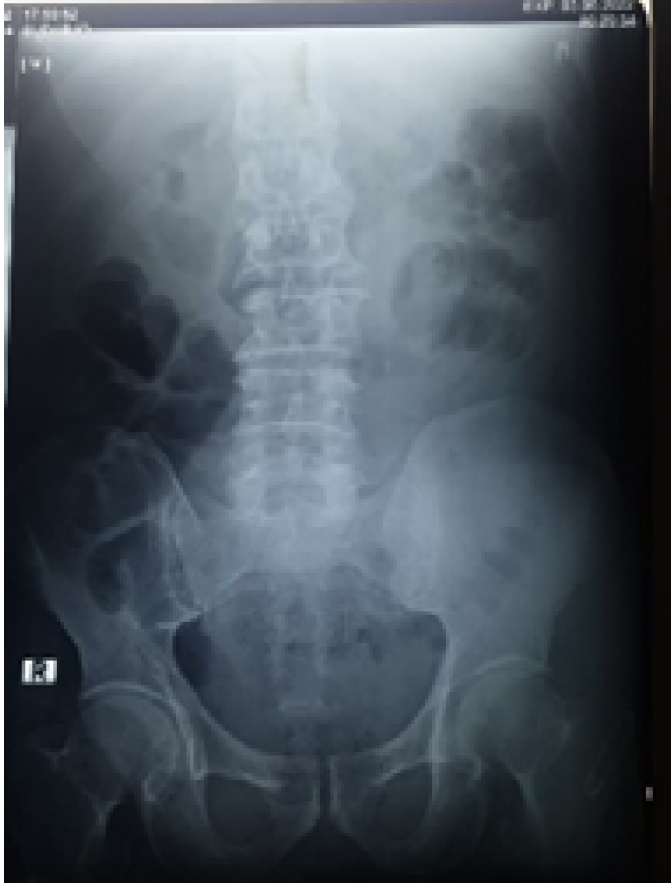
A 71-year-old man came to the hospital with complaints of abdominal pain for 1 week before admission, which is getting worse today. His stomach feels like it's getting bigger and bigger. Another complaint is a lump in the right groin for 1 month. The lump cannot go back in. There were no complaints of nausea and vomiting, while for micturition there were disturbances for 1 week. Defecation is still within normal limits. The patient has a history of left hernia surgery in 2021. He denied any history of lung TB, modification in bowel propensities, or blood in his stools. Clinical abdominal examination uncovered an irreducible right imprisoned inguinal herniawith slight abdomen distention but without delicacy or free fluid. From the abdominal X-Ray affirmed multiple dilated loops of small and large bowel consistent with obstruction. Locule of gas seen to overlie the left obturator foramen would suggest left inguinal hernia as the cause (Figure 1). For hematological and biochemical parameters were all inside ordinary limits. The result of a human immunodeficiency virus test was negative.
Figure 1: The abdominal X-Ray indicated Inguinal Hernia. Multiple Dilated Loops of Small and Large bowel Consistent with Obstruction
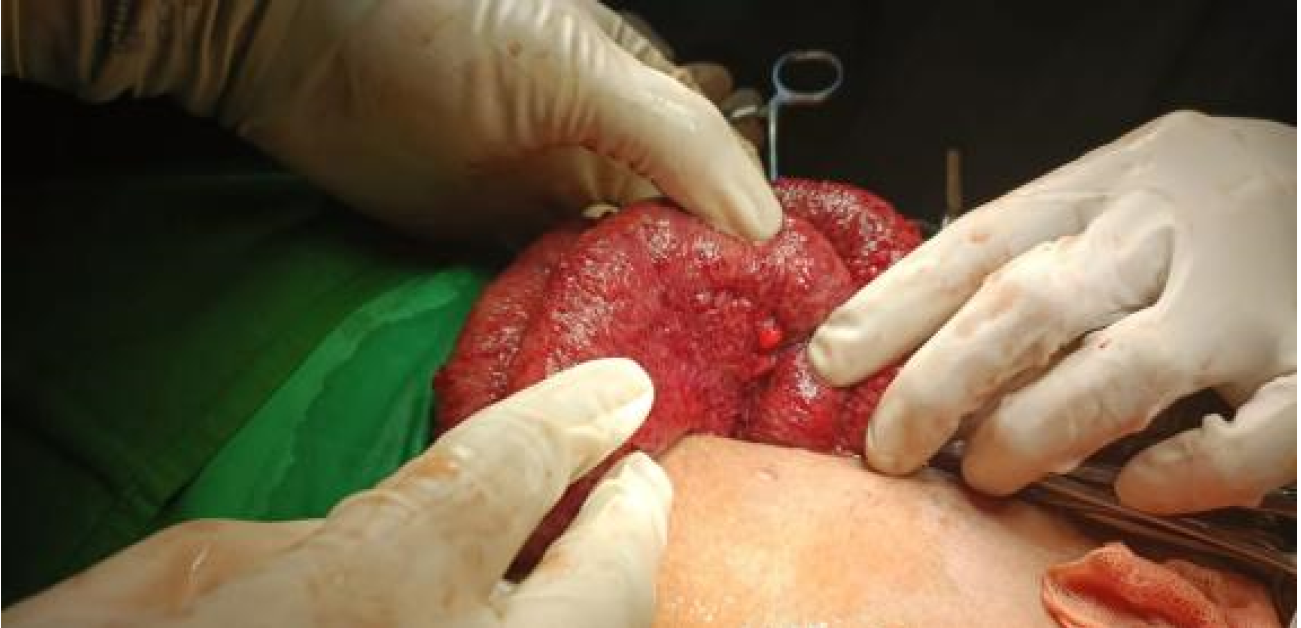
An exploratory laparotomy was performed, in which various white small miliary knobs were watched on the surface of the peritoneum, liver, stomach, little digestive tract, and colon (Figure 2).
A little sum of straw-colored ascitic liquid and over whelming intestinal attachments were found within the stomach depression. Amid surgery, we found a thickened hernial sac containing little digestive system and different miliary knobs that had come about in adherence of the hernia to the profound inguinal ring and obstructed its lessening. Intraoperative solidified area of the knobs uncovered granulomatous irritation that was suspicious for TB.
Figure 2: Intraoperative Photo Appearing Various White Little Miliary Knobs on the Surface of the Little Digestive System
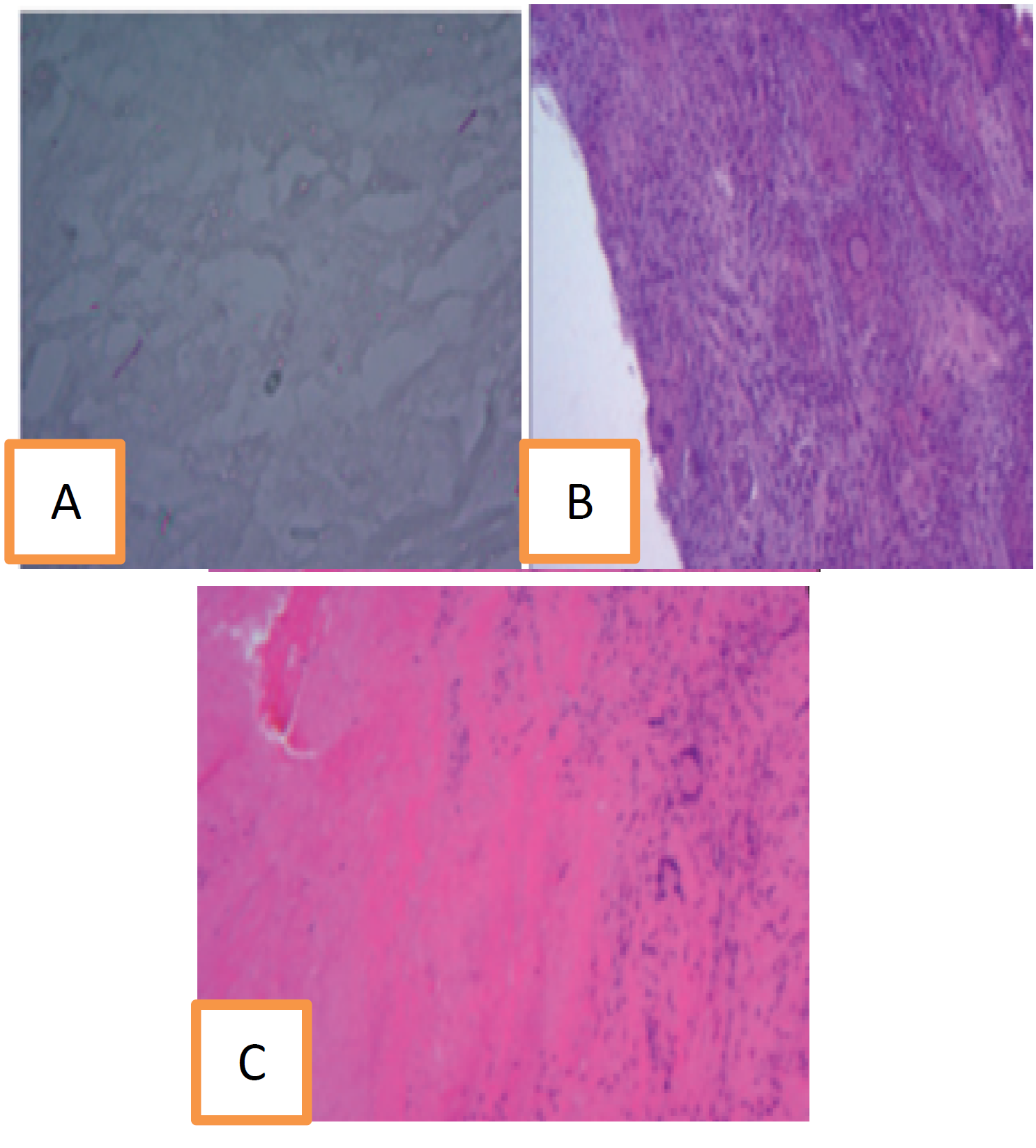
In see of these discoveries, the patient experienced surgery with reduction of the imprisoned hernia and closure of the right profound inguinal ring. No intestinal necrosis, puncturing, or stenosis was present. Histological examination appeared different granulomas together with Langhans giant cells, epithelioid cells, and caseous necrosis, all of which were suggestive of TB (Figure 3).
Figure 3:Histopathology Findings in Miliary Nodules (A) a Positive Result Utilizing an Anti-Acid Recoloring Strategy (1000x) (B) Granuloma and Multinucleated Mammoth Cells (Hematoxylin–Eosin,100x), and (C) Rot and Multinucleated Monster Cells (Hematoxylin–Eosin,100x)
His postoperative recovery was uneventful. The persistent was treated with antitubercular sedate treatment comprising rifampicin, isoniazid, and pyrazinamide for 6 months. He from there on experienced clinical and research facility determination of his symptoms.
Open prolene work repair of the hernia was performed 1 month after the orderly antitubercular chemotherapy. No mesh-related complications occurred. He was doing well 2 years following the work repair without hernia repeat.
The Ethics Committee of Muhammadiyah Babat Clinic endorsed this think about. The examination was performed in agreement with the ethics measures of the healing center. The patient reported in this consider given written informed assent. Moreover, consent for distribution of the person patient data was gotten by Muhammadiyah Babat Hospital.
DISCUSSION
The frequency of TB is expanding worldwide, particularly in creating countries [1]. The predominance of stomach TB has been found to be as tall as 12% in individuals with extrapulmonary TB [1]. Individuals with abdominal TB regularly display with intense abdomen, intestinal puncturing or obstacle, or chronic stomach torment that's troublesome to diagnose [1]. However, abdominal TB isn't a major preoperative concern in day-by-day practice. The preoperative conclusion of abdominal TB based on radiologic discoveries is challenging since stomach TB has no specific radiologic appearance [2-5].
Thickening of the peritoneum and intestinal attachments can to happen in abdominal TB. The rate of inguinal hernia is greatly uncommon in individuals with abdominal TB, as it where 11 cases have been reported within the English-language literature, half of which included pediatric patients [6-12].In this case report, we have depicted the unusual finding of an grown-up with an incar cerated inguinal hernia related with abdominal TB. Diverse from other case reports, the substance of the hernia sac in this persistent were portion of the little intestine. Hernias happen at destinations of shortcoming in the abdominal divider. The layers of the abdominal divider may be debilitated by the chronic abdominal TB, coming about in a potential inguinal hernia. The fiery adhesions caused by numerous miliary nodules between little digestive system and internal inguinal ring actuated the intestinal incarceration and hindrance within the show case. However, we ought to stay cautious and also consider the plausibility that the coexistence of the imprisoned inguinal hernia and stomach TB was coincidental, especially since such co-occurrence has been rarely reported [7].
Abdominal TB is amazingly uncommon in our hospital. After experiencing this persistent, we searched the writing for reports regarding the treatment of inguinal hernias in patients with intestinal TB. Faccin et al.7 detailed a 6-month regimen comprising rifampicin, isoniazid, and pyrazinamide, which provided a great result. Subsequently, we embraced this regimen within the display case. However, when we checked on the total treatment handle, we in this way considered that we may have accomplished an indeed way better result on the off chance that this regimen had been altered to a more common treatment such as isoniazid, rifampin, pyrazinamide, and ethambutol for 2 months taken after by isoniazid, rifampin, and ethambutol for 4 months. Inguinal hernias in children are repaired by tall ligation (disposal) of the sac without any other sort of repair, such as muscle repair.2–6 Lazarus and Pillay6 reported a case in which tall ligation of the sac was performed in an 8-year-old child with stomach TB showing with an inguinal hernia. Be that as it may, no definitive guideline with respect to how to oversee this condition in grown-ups is as of now accessible.
Faccin et al.[7] argued the hernia sac in a 41-year-old man with this condition. Datta et al.[8] performed an anatomical repair of the hernia imperfection in a 60-year-old man with abdominal TB. In any case, neither report given subtle elements on the particular surgical strategy. Vashist et al.[9] performed a prolene mesh-plasty on man with abdominal TB within the hernial sac and detailed no mesh-related complications. Be that as it may, considering the potential for mesh-related infection, Basrur et al.[10] performed an altered Bassini-type herniorrhaphy to strengthen the back stomach divider in a 32-year-old man who displayed with abdominal TB in an inguinal hernia.
The rate of hernial repeat is high on the off chance that as it were tall ligation of the sac or closure of the hernia neck is performed because patients with stomach TB are at risk of broadening of the profound inguinal ring, ascites, repeat of intestinal obstruction, and persistent hack. The infection seems spread to the work in case mesh-plasty is promptly performed. The nearness of infection after work hernia repair is known to jeopardize the quality of the repair and increase the rate of recurrence [10]. The placement of work in this zone might delay or hinder the impact of the antitubercular chemotherapy and become a source of chronic sepsis [10]. Within the present case, closure of the proper profound inguinal ring was performed upon doubt of TB. The histological examination affirmed abdominal TB. Open prolene work repair of the hernia was performed 1 month after systemic antitubercular chemotherapy. No mesh-related complications or hernia repeat happened.
With the expanded predominance of human immunodeficiency infection and the subsequent increase in TB, this issue is likely to be more as often as possible experienced in areas affected by TB scourges. On the premise of our effective involvement of treatment in this understanding, we recommend closure of the deep inguinal ring in a first-stage operation, followed by open prolene work hernia repair 1 month after systemic antitubercular chemotherapy.
Acknowledgment
The authors would like to thank to Muhammadiyah Babat Hospital, also to Maryam and Isa Clinic Journal for her language editing assistance.
Conflict of Interest
The authors declare that there is no conflict of interest.
REFERENCE
Pattanayak, S. and S. Behuria. “Is abdominal tuberculosis a surgical problem?” Annals of the Royal College of Surgeons of England, vol. 97, 2015, pp. 414–419.
Bhatia, S. et al. “Abdominal tuberculosis presenting as an inguinal hernia.” Tropical Gastroenterology, vol. 26, 2005, pp. 98.
Narasimharao, K.L. et al. “Abdominal tuberculosis presenting as inguinal hernia.” Indian Pediatrics, vol. 20, 1983, pp. 790–791.
Dewanda, N.K. et al. “Hernial sac tuberculosis—An unusual presentation of gastrointestinal tuberculosis: case report with review of literature.” International Journal of Scientific and Research Publications, vol. 4, 2014.
Dhandore, P. et al. “Unusual finding in the inguinal canal: Abdominal tuberculosis presenting as inguinal hernia.” Journal of Clinical and Diagnostic Research, vol. 10, 2016, pp. PD13–PD14.
Lazarus, J. and K. Pillay. “Abdominal tuberculosis presenting as an inguinal hernia in a child.” Urology, vol. 77, 2011, pp. 1470–1471.
Faccin, M. et al. “Inguinal hernia incarceration as a form of intestinal tuberculosis.” São Paulo Medical Journal, vol. 114, 1996, pp. 1097–1099.
Datta, S. et al. “Tuberculous peritonitis in a hernia sac.” Medical Journal of the Armed Forces India, vol. 56, 2000, pp. 163–164.
Vashist, M. et al. “Abdominal tuberculosis in a hernial sac: A rare presentation.” The Internet Journal of Surgery, vol. 28, 2012.
Basrur, G.B. et al. “Primary presentation of abdominal tuberculosis in an inguinal hernia.” Indian Journal of Surgery, vol. 68, 2006, pp. 174.
Rao, B.J. et al. “Richter’s hernia: A rare presentation of abdominal tuberculosis.” Indian Journal of Gastroenterology, vol. 18, 1999, pp. 33.
Taylor, B.A. “Tuberculous peritonitis presenting in a hernial sac.” Journal of the Royal College of Surgeons of Edinburgh, vol. 31, 1986, pp. 313–315.
Recommended Articles
Research Article
Video-Assisted Thoracoscopic Surgery (VATS) with Mini-Thoracotomy for Management of Giant Posterior Hepatic Hydatid Cysts in Segments VI and VII: A Case Report
Mustafa Ridha Al-Hadidi,
...
Mohammed Abduljabbar Mohammed
Published: 18/04/2026
Download PDF
Research Article
Advantages of Two Clips Laparoscopic Cholecystectomy (TCLC) and Conventional Laparoscopic Cholecystectomy (CLC): A Comparative Study
Anshu Attri,
...
Kartik Syal
Published: 10/01/2022
Download PDF
Research Article
Bladder Brilliance: Unveiling the Tapestry of Knowledge on Bladder Cancer in District Kangra, Himachal Pradesh
Vandana Thakur,
...
Ankita Pandey
Published: 08/12/2023
Download PDF
Research Article
Shouldering the Pain: Public Knowledge Assessment of Rotator Cuff Injuries in Himachal Pradesh
Sidhant Korla,
...
Praveen Kumar Thakur
Published: 30/07/2024
Download PDF
PO Box 101, Nakuru
Kenya.
Email: office@iarconsortium.org
Editorial Office:
J.L Bhavan, Near Radison Blu Hotel,
Jalukbari, Guwahati-India
Putra, M. D. P. & Putra, D. S. A. (2022). Management of Incarcerated Inguinal Hernia Associated with Abdominal Tuberculosis in Muhammadiyah Babat Hospital, Indonesia. International Academic Research Journal of Surgery, 2(1), 1-3.
MLA
Putra, Muhammad D. P. and Doddy S. A. Putra. "Management of Incarcerated Inguinal Hernia Associated with Abdominal Tuberculosis in Muhammadiyah Babat Hospital, Indonesia." International Academic Research Journal of Surgery 2.1 (2022): 1-3.
Chicago
Putra, Muhammad D. P. and Doddy S. A. Putra. "Management of Incarcerated Inguinal Hernia Associated with Abdominal Tuberculosis in Muhammadiyah Babat Hospital, Indonesia." International Academic Research Journal of Surgery 2, no. 1 (2022): 1-3.
Harvard
Putra, M. D. P. and Putra, D. S. A. (2022) 'Management of Incarcerated Inguinal Hernia Associated with Abdominal Tuberculosis in Muhammadiyah Babat Hospital, Indonesia' International Academic Research Journal of Surgery 2(1), pp. 1-3.
Vancouver
Putra MDP, Putra DSA. Management of Incarcerated Inguinal Hernia Associated with Abdominal Tuberculosis in Muhammadiyah Babat Hospital, Indonesia. International Academic Research Journal of Surgery. 2022 Jan;2(1):1-3.



 Download PDF
 Download XML