Bear attacks on humans are rare but can result in severe maxillofacial and systemic injuries. We report a case of a 45-year-old male with extensive facial and neck injuries following a bear attack in Sirmaur district, Himachal Pradesh, highlighting the clinical presentation and emergency management.
Keywords
Bear Attack
Maxillofacial Injuries
Wildlife–Human Conflict
INTRODUCTION
Bears are strong, agile, dangerous, and unpredictable mammals inhabiting jungles and sanctuaries. Bear attacks are rare events. Chances of human encountering a bear increases as the remote bear territory diminishes[1]. Attack on humans by bears is relatively rare event and intent is mostly defensive. Bear bite injuries to head and neck regions can result in facial disfigurement with distressing physical and psychological outcomes.In hilly regions of Sirmaur district of Himachal Pradesh, the bear attacks are most common in months of June-September. Shri Renuka ji wild life sanctuary known for bear population lies within Sirmaur. With humans encroaching the jungle for food, foliage, and wood, the bear sightings are becoming more common.
Case Report
A 45-year-old male was attacked by bear and two cubs while on his way to main road in the morning in Sangrah. He was rescued by other villagers by pelting stones on the bear. The patient was taken to Government Hospital Sangrah and was subsequently referred to Emergency Department of Govt. Medical College, Nahan. He was admitted in the Emergency Department in confused state and in mild hypovolemic shock. He was treated by a team of surgeons, dental experts and anaesthetist.
His Glasgow coma score was 13/15, blood pressure 90/60, pulse 112/min, with tachypnoea and cold clammy skin. The patient was immediately started on intravenous fluids and broad-spectrum antibiotics. Anti-rabies vaccine and immunoglobulin was administered. The wounds were thoroughly washed with normal saline and bleeding was controlled.
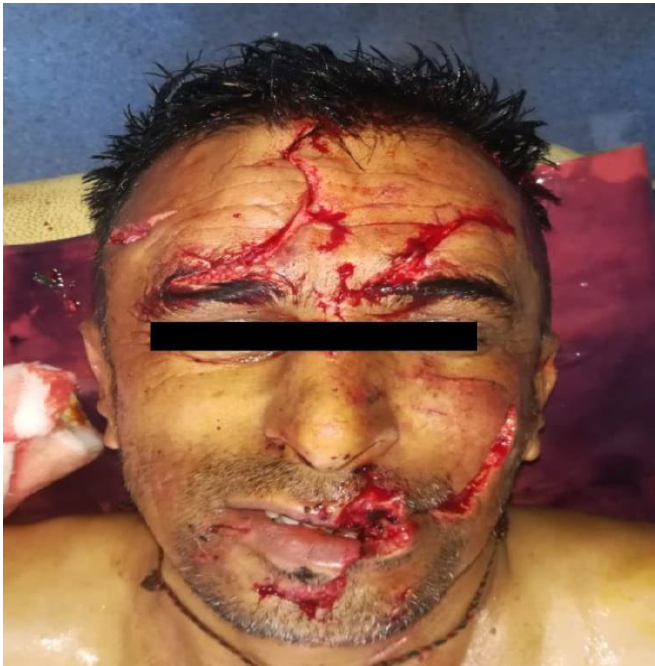
On careful examination we found that multiple lacerations of forehead left side extending up to glabella and another laceration on right extending up to right eyebrow. Degloving injury left cheek extending up to upper lip and left nostril. Laceration extending over lower lip and chin. Undisplaced dentoalveolar fracture between 1st mandibular incisors. Laceration on neck left side and another lacerated wound in left axilla (Figure1).
Figure1: Severe Facial and Neck Lacerations
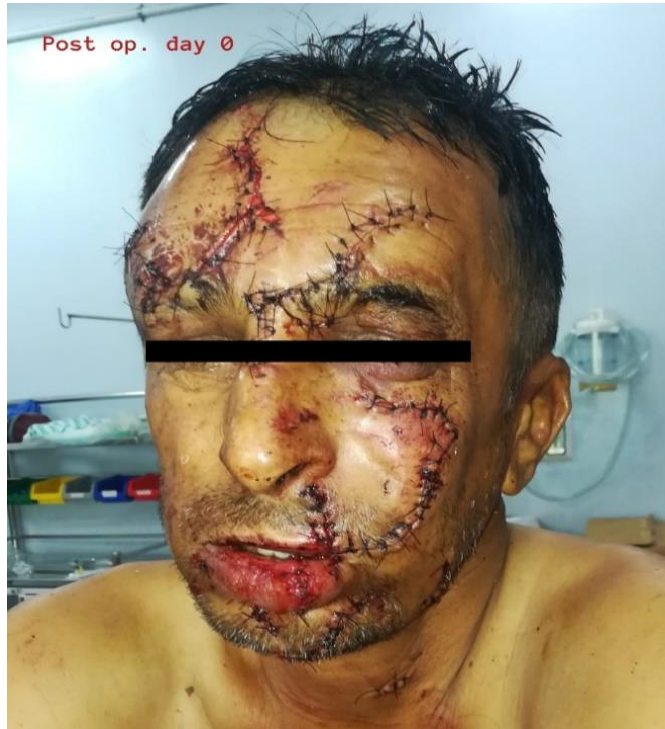
On further examination we found that there was almost no tissue loss. Lacerations were sutured in layers keeping in mind the anatomical landmarks of different layers.
The end result was satisfactory closure of the defect. The dental fracture was managed conservatively.
(Figure 2) Post operatively patient was started on 4.5 g of piperacillin tazobactam intravenously every 8 hours and was continued for 1 week followed by 625mg of amoxycillin clavulanate thrice orally for two weeks. There was a good clinical response.
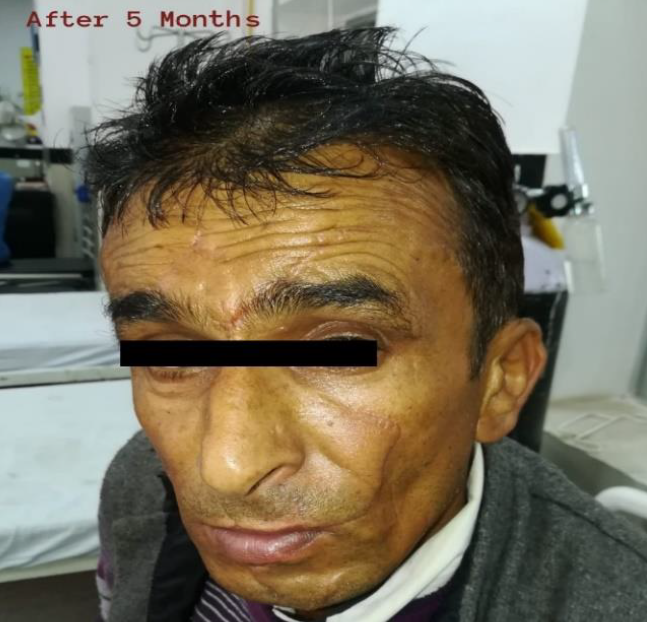
Bear bites are commonly complicated by postoperative infection. However, in our case there was no postoperative infection and the wound was healthy[2,3] (Figure 3).
Figure 3: Healthy Wound without Infection
DISCUSSION
Bear attacks are rare incidents but widely publicised. Our reported case was also widely publicised in print and social media. Fragmentation of forests has led to isolated nonviable bear population[4]. Degradation in form of overgrazing, tree felling, fire, conversion and reclamation for other uses, and over extraction of forest resources essential for bear survival is occ urring throughout the bear range [5].For those who frequent forest, bear presents a considerable danger worse than the tigers and leopards [5].
Bargali et al in a study in forest division observed that attack was predominantly by a single bear (93%) and rarely by 2 (4 %) or 3 bears (3%)[6]. In general, most of the victims are middle aged and young adult males (around 62%)[7,8]. Higher incidences of injuries of middle age group can be explained by the outdoor activities like cattle grazing, working in fields, etc.
Most common injury was laceration wound (62%) and puncture wound (48%) [9]. The injuries are around 16-19% with tissue loss in 9-10% cases[7]. Affected body parts were scalp (24%) and face (46%) [9]. Upper limb injury in (14%) cases and involvement of back and buttock in 10% cases. These injuries are due to substantial struggle on part of victim on the ground which forces mud, grass and other contaminating materials into the wounds. Thus, it is necessary to draw for treating surgeon, physician and dental surgeon to act in unison in cases of animal attack[10]. The treatment should be based on following considerations [10].
Resuscitation and Determination of Extent of Injury
As bear attacks usually occur in far off areas, the patients are most likely to report to small clinics, dispensaries or primary health centers (PHC). First and foremost is resuscitation as per ATLS guidelines. Identification of extent of injuries and referral to appropriate next higher level without wasting golden hours is also important.
Risk of Rabies
Wild animal bite poses a danger of rabies transmission. Post exposure prophylaxis (PEP) must be started immediately.
Bacteriology
Bears carry large number of bacteria in their mouth and can transmit number of zonotic diseases and viruses. Broad spectrum antibiotic coverage should be started at the entry point into the health care system.
Injury Management
At tertiary centre inspection, debridement, irrigation with normal saline and closure is indicated. Removal of grass, dirt and other foreign bodies is important to prevent infection. Many bite wound lead to disfigurement, scars which may require expertise of plastic surgeon.
CONCLUSION
The number of bear attacks is relatively rare. Bear bites causing rabies has not been reported, but as all animal bites have the potential to cause rabies so post exposure prophylaxis must be started immediately. Delay in referral to appropriate tertiary center should be minimised. Primary closure of wounds especially in head and neck region gives good results. Doctors need to be aware of treatment protocols in such cases. Awareness, education, knowledge and prevention, rather than the elimination of animal population, may be the best way to control wild-animal attacks on humans in the future.
Conflict of Interest
None
REFERENCE
Dieter, R.A. et al. “Bear mauling: A descriptive review.” International Journal of Circumpolar Health, vol. 60, 2001, pp. 696–704.
Lehtinen, V.A. et al. “Mycobacterium fortuitum Infection after a brown bear bite.” Journal of Clinical Microbiology, vol. 43, 2005, pp. 1009. Kunimoto, D. et al. “Bacteriology of a bear bite wound to a human: Case report.” Journal of Clinical Microbiology, vol. 42, 2004, pp. 3374–3376.
Garshelis, D.L. et al. “Sloth bear conservation action plan.” Bears: Status Survey and Conservation Action Plan, edited by C. Servheen and B. Peyton, IUCN/SSC Bear and Polar Bear Specialist Groups, IUCN, 1999, pp. 309.
Yoganand, K. and Rice, C.G. Evaluating Panna National Park with Special Reference to Ecology of Sloth Bear (Melursus ursinus). Wildlife Institute of India, 2005.
Bargali, H.S. et al. “Characteristics of sloth bear attacks and human casualties in North Bilaspur Forest division, Chhattisgarh, India.” Ursus, vol. 16, no. 2, 2005, pp. 263–267.
Shah, A.A. et al. “Pattern of bear maul maxillofacial injuries in Kashmir.” National Journal of Maxillofacial Surgery, vol. 1, no. 2, 2010, pp. 96–101.
Herrero, S. “Human injury inflicted by grizzly bears.” Science, vol. 170, no. 3958, 1970, pp. 593–598.
Siddharth, R.K. et al. “Study of bear bite injury and management in tribal belt of Chhattisgarh, India.” Journal of Evidence Based Medicine and Healthcare, vol. 7, no. 1, 2020, pp. 34–37. https://doi.org/10.18410/jebmh/2020/8.
Phalke, B. et al. “Bear bite: A case report.” Journal of Forensic Medicine, Science and Law, vol. 23, no. 2, 2014.
Recommended Articles
Research Article
Advantages of Two Clips Laparoscopic Cholecystectomy (TCLC) and Conventional Laparoscopic Cholecystectomy (CLC): A Comparative Study
Anshu Attri,
...
Kartik Syal
Published: 10/01/2022
Download PDF
Research Article
Bladder Brilliance: Unveiling the Tapestry of Knowledge on Bladder Cancer in District Kangra, Himachal Pradesh
Vandana Thakur,
...
Ankita Pandey
Published: 08/12/2023
Download PDF
Research Article
Shouldering the Pain: Public Knowledge Assessment of Rotator Cuff Injuries in Himachal Pradesh
Sidhant Korla,
...
Praveen Kumar Thakur
Published: 30/07/2024
Download PDF
Research Article
Awareness regarding Symptoms and Treatment Options for Benign hypertrophy of prostate among the male patients attending outpatient department of Civil hospital , Nurpur, Himachal Pradesh
Aarti Chaudhary,
Brish Bhanu Bhardwaj
Published: 26/05/2023
Download PDF
PO Box 101, Nakuru
Kenya.
Email: office@iarconsortium.org
Editorial Office:
J.L Bhavan, Near Radison Blu Hotel,
Jalukbari, Guwahati-India
Sharma, M. & Sharma, U. (2022). Bear Bite Injuries in the Hilly Areas of District Sirmaur, Himachal Pradesh. International Academic Research Journal of Surgery, 2(1), 1-3.
MLA
Sharma, Manish and Uma Sharma. "Bear Bite Injuries in the Hilly Areas of District Sirmaur, Himachal Pradesh." International Academic Research Journal of Surgery 2.1 (2022): 1-3.
Chicago
Sharma, Manish and Uma Sharma. "Bear Bite Injuries in the Hilly Areas of District Sirmaur, Himachal Pradesh." International Academic Research Journal of Surgery 2, no. 1 (2022): 1-3.
Harvard
Sharma, M. and Sharma, U. (2022) 'Bear Bite Injuries in the Hilly Areas of District Sirmaur, Himachal Pradesh' International Academic Research Journal of Surgery 2(1), pp. 1-3.
Vancouver
Sharma M, Sharma U. Bear Bite Injuries in the Hilly Areas of District Sirmaur, Himachal Pradesh. International Academic Research Journal of Surgery. 2022 Jan;2(1):1-3.


 Download PDF
 Download XML